
2027 Best Online RN to MSN-PMHNP Programs

Co-Founder and Chief Data Scientist
Registered nurses who want to move into psychiatric mental health care face a specific decision: whether an online RN to MSN-PMHNP program is the right bridge from bedside nursing to advanced practice. The path can be attractive because it combines graduate nursing education, psychiatric assessment, therapy-related coursework, psychopharmacology, and supervised clinical practice. It also requires careful planning because accreditation, clinical placements, state licensure rules, certification eligibility, cost, and time commitment can affect whether a program actually supports your career goal.
This guide is designed for RNs comparing online RN to MSN Psychiatric-Mental Health Nurse Practitioner programs. It explains what these programs include, how long they usually take, how online and campus formats differ, what they may cost, how to evaluate clinical training, and how to judge whether the investment fits your financial and professional plans.
Quick answer: Is an online RN to MSN-PMHNP program worth considering?
An online RN to MSN-PMHNP program can be a strong option for licensed registered nurses who want to become psychiatric mental health nurse practitioners without stepping away from work entirely. The pathway is most useful when the program is properly accredited, prepares graduates for PMHNP certification and state advanced practice licensure, offers reliable clinical placement support, and fits the student’s budget and schedule.
- An MSN-PMHNP can prepare registered nurses for advanced practice psychiatric mental health roles, including the psychiatric mental health nurse practitioner role.
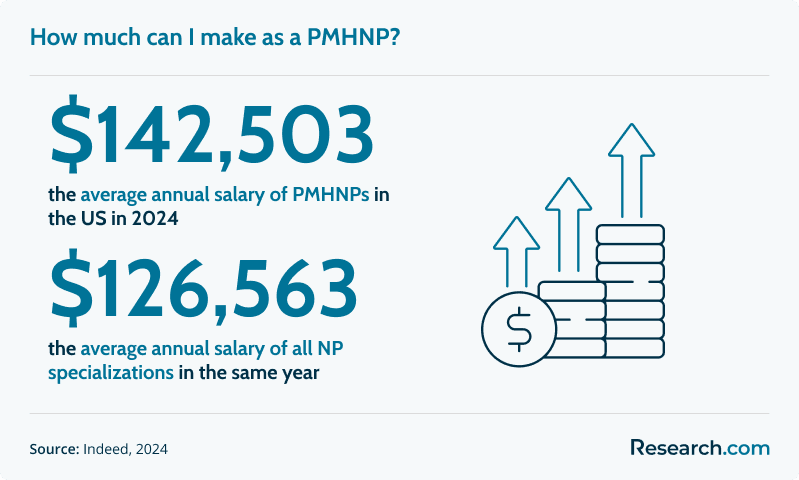
- The average annual salary for PMHNPs is $142,503, while registered nurses in the US made an average of $86,070.
- Online RN to MSN-PMHNP programs can offer working nurses more flexibility, but students still need to complete supervised clinical training and meet state licensure requirements.
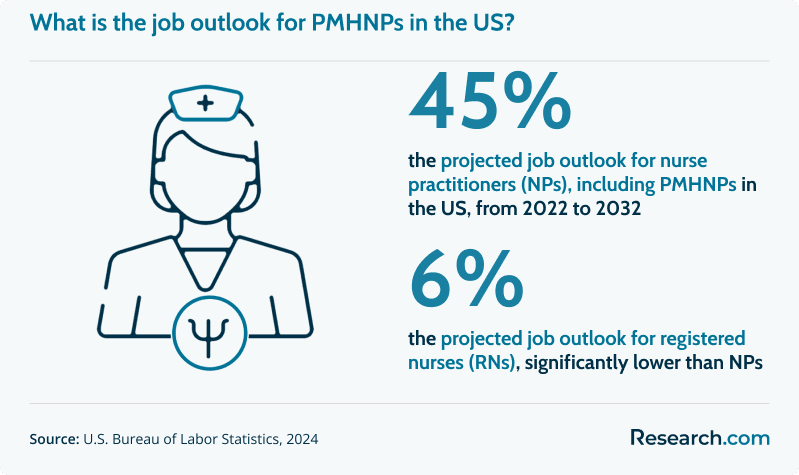
- The projected job outlook for nurse practitioners, including PMHNPs, is 45% from 2022 to 2032, compared with 6% projected growth for registered nurses.
What can I expect from the best online RN to MSN-PMHNP degree programs?
Online RN to MSN-PMHNP programs are graduate nursing pathways for registered nurses who want advanced psychiatric mental health preparation. Students typically study advanced health assessment, psychiatric diagnosis, treatment planning, psychopharmacology, psychotherapy approaches, advanced pathophysiology, ethics, and population-based mental health care. Programs also require supervised clinical practicum experiences so students can apply classroom learning with patients in approved care settings.
A PMHNP is not the same as a psychiatrist. PMHNPs are advanced practice nurses, while psychiatrists are physicians who complete medical school and specialized psychiatry training. If you are comparing the two professions, review the requirements in this guide to how to become a psychiatrist before choosing a path.
Where can I work with a degree from the best online RN to MSN-PMHNP degree programs?
Graduates may work in psychiatric hospitals, community mental health centers, behavioral health clinics, primary care practices, substance abuse treatment settings, private practices, correctional health systems, telehealth organizations, academic institutions, research settings, and healthcare administration. PMHNPs often provide psychiatric evaluation, medication management, psychotherapy-informed care, patient education, case coordination, and care planning for people across the lifespan.
In many care environments, PMHNPs collaborate with other advanced practice nurses, physicians, social workers, counselors, and specialists. For example, psychiatric mental health services may overlap with acute or complex care needs, making collaboration with clinicians from acute care nurse practitioner online programs common in hospitals and integrated health systems.
How much can I make with a degree from the best online RN to MSN-PMHNP degree programs?
The average annual salary for PMHNPs in the United States is $142,503. That is higher than the average of $86,070 reported for registered nurses in the US and higher than the average of all NPs at $126,563. Salary can vary by state, employer, experience level, scope of practice rules, telehealth opportunities, and whether the role includes leadership, on-call duties, private practice, or specialized patient populations.
Students should not treat salary averages as guaranteed outcomes. A better approach is to compare total program cost, expected borrowing, employer tuition benefits, regional job openings, clinical placement strength, certification preparation, and licensure eligibility before deciding whether the degree has a reasonable return for their situation.
- Best online RN to MSN-PMHNP programs for 2027
- Program length: how long does an online RN to MSN-PMHNP take?
- Online vs. campus RN to MSN-PMHNP programs
- Average cost of online RN to MSN-PMHNP programs
- Financial aid options for online RN to MSN-PMHNP students
- Financial resources for PMHNP students and aid options to review first
- PMHNP specialization options
- Career advancement pathways after an MSN-PMHNP and specialized practice areas
- How to compare online RN to MSN-PMHNP programs
- How to verify accreditation
- Certifications that may support PMHNP career growth
- Options for non-nurses interested in MSN-PMHNP pathways
- Clinical training and support services
- Using RN credentials to shorten the pathway
- Completion rates, licensure outcomes, and program quality
- Challenges in online RN to MSN-PMHNP programs, quality signals to check, and bridge-credit policies
- Networking and mentorship in online programs
- Certification exam preparation
- Legal and regulatory issues for PMHNPs
- Evidence-based practice and research training
- Women’s mental health specialization opportunities
- Streamlining prerequisite requirements
- Cultural competence and health disparities
- MSN-PMHNP preparation for leadership roles
- Career paths for MSN-PMHNP graduates
- Return on investment for an MSN-PMHNP
- Job market outlook for PMHNP graduates
- Dual degree options for PMHNPs
- Final checklist for choosing the right program and labor market considerations
Best Online RN to MSN-PMHNP Programs for 2027
How Research.com evaluates schools
Our rankings are built from structured research and data review by the Research.com team. The ranking process is explained in our methodology section. To support program comparisons, we use sources such as the IPEDS database, Peterson's database, the National Center for Education Statistics, and the College Scorecard. These sources help verify institutional information, costs, outcomes, and online program availability.
| School and program | Program length | Credits | Cost per credit | Accreditation listed |
| University of South Alabama RN to MSN Pathway - Psychiatric Mental Health NP | 2-3 years | 45 | $594 | Commission on Collegiate Nursing Education (CCNE) |
| University of Mississippi Medical Center RN to MSN - Family Psychiatric Mental Health Nurse Practitioner | 2-3 years | 62 | $562 | Commission on Collegiate Nursing Education (CCNE) |
| University of Rochester RN to BS to MS Program - Nurse Practitioner | 2-3 years | 54 | $1,740 | Middle States Commission on Higher Education (MSCHE) |
| Georgia State University Online RN to MSN Bridge Program | 2-4 years | 54 | $408 | Commission on Collegiate Nursing Education (CCNE) |
| East Tennessee State University RN-MSN Bridge Program | 2-4 years | 48 | $646 | Commission on Collegiate Nursing Education |
1. University of South Alabama RN to MSN Pathway - Psychiatric Mental Health NP
University of South Alabama offers an RN to MSN pathway with a Psychiatric Mental Health Nurse Practitioner focus. The program is designed to prepare nurses to assess, diagnose, and manage psychiatric and mental health conditions for patients across age groups and care environments, including ambulatory, acute, long-term, and community settings.
- Program Length: 2-3 years
- Required Credits to Graduate: 45
- Cost per Credit: $594
- Accreditation: Commission on Collegiate Nursing Education (CCNE)
2. University of Mississippi Medical Center - RN to MSN - Family Psychiatric Mental Health Nurse Practitioner
University of Mississippi Medical Center provides an RN to MSN Family Psychiatric Mental Health Nurse Practitioner track. The curriculum emphasizes psychiatric assessment, diagnosis, treatment, psychopharmacology, and psychotherapeutic interventions for individuals and families across the lifespan. Graduates can pursue the ANCC certification exam and state advanced practice licensure.
- Program Length: 2-3 years
- Required Credits to Graduate: 62
- Cost per Credit: $562
- Accreditation: Commission on Collegiate Nursing Education (CCNE)
3. University of Rochester - RN to BS to MS Program - Nurse Practitioner
University of Rochester offers an RN to BS to MS pathway with a Psychiatric Mental Health Nurse Practitioner specialization. Students build skills in psychiatric evaluation, diagnosis, psychotherapy, and psychopharmacology, with preparation for practice in acute care, community health, and primary care environments.
- Program Length: 2-3 years
- Required Credits to Graduate: 54
- Cost per Credit: $1,740
- Accreditation: Middle States Commission on Higher Education (MSCHE)
4. Georgia State University - Online RN to MSN Bridge Program
Georgia State University offers an online RN to MSN bridge program for registered nurses with associate degrees or diplomas and at least one year of work experience. Students complete required undergraduate preparation before moving into master’s-level nursing coursework.
- Program Length: 2-4 years
- Required Credits to Graduate: 54
- Cost per Credit: $408
- Accreditation: Commission on Collegiate Nursing Education (CCNE)
5. East Tennessee State University - RN-MSN Bridge Program
East Tennessee State University offers an RN-MSN bridge program with a Psychiatric/Mental Health Nurse Practitioner concentration. The program prepares registered nurses to deliver mental healthcare for individuals, families, and groups in a range of clinical and community settings.
- Program Length: 2-4 years
- Required Credits to Graduate: 48
- Cost per Credit: $646
- Accreditation: Commission on Collegiate Nursing Education
What students should look for beyond rankings
Rankings can help narrow a search, but they should not replace your own verification process. Before applying, ask each school how it supports clinical placements, whether the program meets your state’s APRN requirements, how students prepare for certification, whether faculty include practicing PMHNPs, and what happens if a student cannot secure a local preceptor on time.
Key findings for prospective PMHNP students
- Demand for nurse practitioners, including PMHNPs, is projected to grow 45% from 2022 to 2032, which is far above the 6% projected growth for registered nurses.
- PMHNPs are important providers in a healthcare system facing persistent mental health access needs.
- Online RN to MSN-PMHNP programs can help working nurses continue employment while completing graduate study, but clinical hours still require local or approved in-person training.
- The average annual salary for PMHNPs is $142,503, but earnings vary by location, employer, experience, and practice authority.
- PMHNP employment settings include psychiatric hospitals, community mental health centers, private practices, primary care clinics, telehealth providers, and academic or administrative roles.
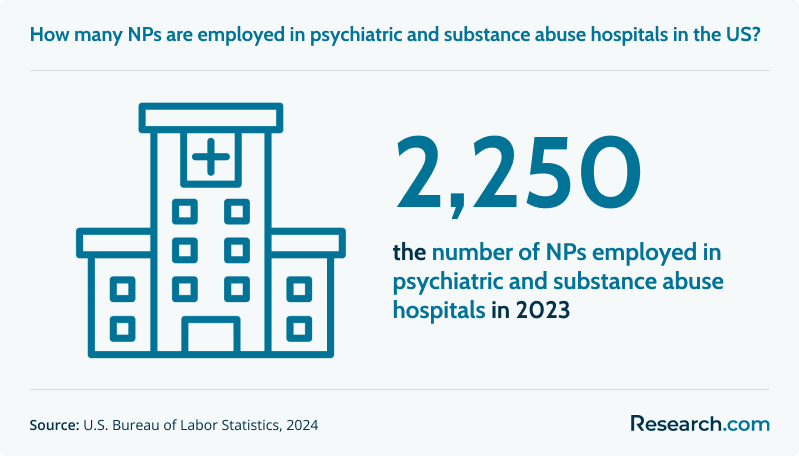
- Psychiatric and substance abuse hospitals employed 2,250 NPs in 2023, and about 0.96% of workers in that industry are NPs.
How long does it take to complete an online RN to MSN-PMHNP program?
Most online RN to MSN-PMHNP programs take about two to three years, although some programs may take 2-4 years depending on bridge requirements, course load, clinical scheduling, and whether the student enrolls full time or part time. Some accelerated nurse practitioner programs may allow completion in as little as one year, but accelerated pacing can be difficult for students who work full time or have limited clinical site options.
Timeline is affected by your prior education. An RN with an ADN may need bridge or BSN-level coursework before entering the graduate PMHNP sequence. Nurses who already have a BSN may be able to move more directly into MSN coursework. Students considering other advanced practice directions can also compare online BSN to FNP programs to understand how psychiatric mental health training differs from family primary care preparation.
| Student situation | What may affect the timeline | Decision point |
| RN with an associate degree or diploma | Bridge courses, BSN-equivalent requirements, prerequisites, and graduate nursing sequence | Confirm whether the school awards a BSN on the way to the MSN or uses a bridge model only. |
| RN with completed BSN coursework | Transfer credit review and remaining undergraduate requirements | Ask whether prior BSN credits can reduce time or cost. |
| Working full-time RN | Part-time enrollment, shift schedule, clinical placement availability, and practicum hours | Choose a format that realistically fits work and family responsibilities. |
| Student seeking the fastest route | Accelerated terms, heavy course loads, and limited breaks | Make sure speed does not compromise clinical readiness or licensure eligibility. |
How do the best online RN to MSN-PMHNP programs compare to an on-campus program?
Online and campus-based RN to MSN-PMHNP programs should prepare students for the same advanced psychiatric mental health competencies. Both formats typically include graduate nursing core courses, advanced practice content, psychiatric diagnosis, treatment planning, pharmacology, psychotherapy principles, and supervised clinical practicum hours.
The main difference is delivery. Online programs may use asynchronous lectures, live virtual sessions, discussion boards, remote advising, simulation tools, and locally arranged clinical placements. Campus programs usually offer more face-to-face interaction, easier access to physical simulation labs, and a more traditional classroom experience. Many online programs still require in-person clinical rotations, intensives, or skills experiences.
| Factor | Online RN to MSN-PMHNP | Campus RN to MSN-PMHNP |
| Best for | Working nurses who need schedule flexibility | Students who prefer in-person instruction and campus-based support |
| Clinical training | Often completed near the student’s location with approved preceptors | May rely more on school-connected clinical sites near campus |
| Interaction | Virtual faculty access, online discussions, live sessions, and remote advising | In-person lectures, office hours, labs, and peer interaction |
| Risk to check | Clinical placement responsibility may fall partly on the student | Less flexibility for students with full-time work or long commutes |
| Best question to ask | “Does the program guarantee, coordinate, or only approve clinical placements?” | “How often must I be on campus, and can I keep working while enrolled?” |
What is the average cost of the best online RN to MSN-PMHNP programs?
Tuition varies widely by school, residency status, credit requirements, fees, and whether undergraduate bridge courses are included. Among the top programs discussed in this article, the average cost-per-credit range is $689 for in-state students and $885 for out-of-state students. Cost per credit ranges from around $295 to more than $1,700. Some of the cheapest online MSN programs can cost less than $200 per credit.
Because PMHNPs earned an average of $142,503 in 2024 compared with $126,563 for all NPs, some students may see strong income potential after graduation. Still, ROI depends on total tuition, fees, books, travel for clinical or campus requirements, lost work hours, loan interest, and the job market in the student’s state. If you are comparing nursing pathways after RN licensure, this career direction may be considered alongside other options often discussed among the best degrees to get for career mobility.
| Cost factor | Why it matters | What to ask the school |
| Per-credit tuition | Small differences can become large across 45, 48, 54, or 62 credits. | “Is the listed tuition the same for online, in-state, and out-of-state students?” |
| Bridge coursework | RN to MSN students may need undergraduate courses before graduate study. | “How many credits will I personally need after transcript review?” |
| Clinical costs | Background checks, immunizations, travel, parking, and onboarding fees can add expenses. | “What clinical-related costs are not included in tuition?” |
| Technology and distance fees | Online programs may charge platform, proctoring, or course fees. | “Can you provide a full program cost estimate in writing?” |
| Loan interest | Borrowing can increase the true cost of the degree over time. | “What debt levels do graduates commonly report?” |
What are the financial aid options for students enrolling in the best online RN to MSN-PMHNP programs?
Financing an RN to MSN-PMHNP program usually requires combining several resources. Even students comparing the most affordable MSN programs online should look beyond tuition and calculate the full cost of attendance.
- Federal Student Aid. Completing the Free Application for Federal Student Aid is the usual first step for determining eligibility for federal loans, grants, and work-study options.
- Scholarships. Nursing schools, state organizations, foundations, employers, and professional associations may offer scholarships for graduate nursing students or students entering mental health practice.
- Employer Reimbursement. Hospitals, health systems, and community agencies may reimburse part of tuition for employees who continue working while earning an advanced degree.
- Private Loans. Private loans can help cover gaps, but students should compare interest rates, repayment terms, deferment options, and whether federal borrowing is safer before committing.
What financial resources are available for PMHNP students?
PMHNP students can reduce out-of-pocket costs by combining federal aid, scholarships, employer benefits, state workforce programs, payment plans, and careful school selection. The FAFSA can help determine access to federal loans and other aid. Employer tuition reimbursement can be especially useful for RNs who remain employed while studying.
Students should also search for nursing-specific scholarships, behavioral health workforce funding, and school-based awards. If cost is a major barrier and you already hold an MSN, compare certificate routes as well. Research.com’s guide to the cheapest online PMHNP certificate programs may help nurses who need a post-master’s option rather than a full RN to MSN pathway.
What types of specializations are available in online RN to MSN-PMHNP programs?
Most RN to MSN-PMHNP programs prepare students for broad psychiatric mental health practice across the lifespan. Some programs, clinical placements, electives, or post-graduate training options allow students to develop deeper experience with certain populations or care settings.
- Adult Mental Health. Focuses on psychiatric assessment, diagnosis, treatment planning, and long-term management for adult patients.
- Geriatric Mental Health. Emphasizes mental health conditions affecting older adults and the clinical issues associated with aging.
- Child and Adolescent Psychiatry. Prepares students to understand mental health needs among children and adolescents while collaborating with families and care teams.
- Forensic Psychiatry. Supports practice in settings connected to correctional systems, legal processes, or justice-involved populations.
- Substance Abuse. Integrates psychiatric care with assessment, treatment, and prevention of substance use disorders.
Some PMHNPs later pursue additional graduate study or research-oriented education in related fields. For example, students interested in psychology research may compare the most affordable PhD psychology programs, although a psychology doctorate serves a different purpose from PMHNP clinical preparation.
Regardless of specialization, psychiatric and substance abuse hospitals remain an important employment setting. This industry had 2,250 NPs in 2023 and is listed as the fifth industry with the highest concentration of NPs.
What are the flexible pathways for career advancement with an MSN-PMHNP?
An MSN-PMHNP most directly prepares graduates for psychiatric mental health nurse practitioner practice, but the degree can also support broader career directions. The best pathway depends on whether you want direct patient care, leadership, teaching, policy, research, telehealth, or entrepreneurship.
- Clinical PMHNP practice. Graduates may provide psychiatric evaluations, medication management, therapy-informed care, and patient education in hospitals, clinics, private practices, or telehealth settings.
- Behavioral health leadership. Experienced PMHNPs may move into roles such as Director of Behavioral Health Services or Mental Health Program Manager.
- Academic and teaching roles. PMHNPs with strong clinical experience may teach psychiatric mental health nursing or help develop nursing curricula.
- Policy and advocacy. Graduates may work with public agencies, nonprofit organizations, or healthcare systems to improve mental health access and care delivery.
- Entrepreneurship. Depending on state rules and business requirements, some PMHNPs pursue private practice or telehealth-based service models.
- Research and quality improvement. PMHNPs may contribute to studies, clinical outcome measurement, evidence-based protocols, or care model improvement.
If affordability is central to your decision, compare this pathway with the cheapest online nursing master's programs before applying.
How do you choose the best online RN to MSN-PMHNP program?
The best program is not simply the cheapest, fastest, or highest ranked. It is the program that is accredited, fits your state’s licensure requirements, provides appropriate clinical training, prepares you for certification, and makes financial sense for your expected career path.
| Selection factor | Why it matters | Red flag |
| Accreditation | Accreditation affects quality assurance, financial aid eligibility, certification preparation, and employer confidence. | The school cannot clearly identify nursing accreditation status. |
| State authorization and licensure alignment | Online programs may not meet requirements in every state. | The admissions team gives vague answers about your state. |
| Clinical placement support | PMHNP training depends on approved clinical hours with qualified preceptors. | Students are fully responsible for finding placements with little support. |
| Faculty expertise | Experienced PMHNP faculty can strengthen clinical reasoning and mentorship. | Few faculty have psychiatric mental health practice experience. |
| Certification preparation | Graduates need to be ready for PMHNP certification expectations. | No structured review, practice exams, or outcome data are available. |
| Total cost | Tuition is only part of the financial picture. | The school will not provide a complete cost estimate. |
| Student support | Online learners need advising, tech help, tutoring, library access, and career services. | Support is limited to email-only contact with slow response times. |
Is my online RN to MSN-PMHNP program accredited by recognized bodies?
Accreditation should be one of the first items you verify. For nursing programs, recognized nursing accreditation is commonly associated with bodies such as the Commission on Collegiate Nursing Education (CCNE) or the Accreditation Commission for Education in Nursing (ACEN). Accreditation can affect federal financial aid eligibility, certification readiness, graduate school options, employer acceptance, and state licensure review.
Do not rely only on a school’s marketing page. Check the accreditor’s database, confirm institutional accreditation, and ask the program directly whether graduates are eligible for PMHNP certification and APRN licensure in your state. Students comparing advanced practice pathways may also find it useful to review standards across accredited DNP online programs.
What additional certifications can further advance my PMHNP career?
The MSN-PMHNP degree provides advanced psychiatric mental health preparation, but additional credentials can help experienced clinicians build expertise in specific patient populations or treatment areas. Examples may include training connected to gerontology, substance use care, trauma-informed care, telehealth, or leadership. The value of any certification depends on employer demand, scope-of-practice rules, and whether the credential supports the role you want.
If you are considering older adult mental health as a focus, reviewing compensation context such as master's in gerontology salary can help you understand how specialty-related career paths may differ from general PMHNP practice.
Can non-nurses enroll in an online MSN-PMHNP program?
Most RN to MSN-PMHNP programs are built for licensed registered nurses, not applicants without nursing credentials. Non-nurses generally need a different entry route that first provides foundational nursing education, RN preparation, and clinical competency before advanced psychiatric mental health coursework.
Career changers should look for direct-entry or pre-licensure nursing pathways rather than standard RN to MSN options. Research.com’s guide to direct entry MSN programs can help non-nurses understand how accelerated nursing entry pathways are structured.
How do online RN to MSN-PMHNP programs enhance clinical training through support services?
Strong online PMHNP programs connect coursework to clinical practice through structured advising, preceptor guidance, simulation, case-based learning, telehealth training, faculty feedback, and clear practicum policies. The most important question is how clinical placements are handled. Some schools coordinate placements directly, some provide leads, and others expect students to identify sites that the school then approves.
Before enrolling, ask whether the program has clinical partners in your state, what happens if a placement falls through, whether preceptors must be PMHNPs or may include other psychiatric providers, and how the school monitors clinical quality. Students comparing bridge models may also review RN to MSN FNP programs to see how clinical support differs across advanced practice specialties.
Can I leverage my current RN credentials to fast-track my MSN-PMHNP degree?
Many RN to MSN programs give credit for previous nursing education or allow ADN-prepared nurses to complete bridge coursework instead of earning a separate BSN first. Policies vary by school, so students should request a transcript evaluation before assuming that prior credits will shorten the degree.
Ask whether the program accepts transfer credits, whether there is a maximum age for science prerequisites, how many undergraduate credits are required before graduate coursework, and whether an RN to BSN step would be more affordable. Nurses still comparing foundational options can review the most affordable RN to BSN programs as part of a longer-term PMHNP plan.
How do program completion and licensure success rates impact overall quality?
Program outcomes help show whether students finish, pass required exams, and transition into appropriate roles. When possible, review graduation rates, certification pass rates, attrition data, employment outcomes, student satisfaction, and time-to-completion information. These numbers are especially useful when comparing programs that appear similar on tuition and curriculum.
If a school does not publish outcomes, ask for them. Also ask whether the reported data applies specifically to the PMHNP track or to the nursing school overall. Students considering other advanced practice options can compare outcome transparency across programs such as cheapest AGNP programs online.
What challenges might I face in an online RN to MSN-PMHNP program?
Online RN to MSN-PMHNP programs can be demanding. Students often manage graduate coursework, employment, family responsibilities, clinical placements, and certification preparation at the same time. Remote learning also requires discipline, reliable technology, comfort with online communication, and the ability to ask for help early.
- Clinical placement pressure. Securing an appropriate psychiatric mental health site can take time, especially in competitive regions.
- Work-school balance. Full-time nursing schedules can conflict with synchronous sessions, exams, and clinical hours.
- Technology dependence. Online lectures, simulations, proctored exams, and telehealth practice require stable internet and digital fluency.
- State-specific rules. Licensure, prescriptive authority, and clinical requirements vary by state.
- Emotional intensity. Psychiatric mental health training involves complex patient situations that require strong boundaries and support.
Students who want broader comparisons of low-cost NP pathways can review cheap online FNP programs, while keeping in mind that family practice and psychiatric mental health are distinct specialties.
How do online RN to MSN-PMHNP programs enhance networking and mentorship opportunities?
Good online programs intentionally create professional connection points. These may include live case conferences, faculty mentorship, virtual office hours, peer discussion groups, alumni networks, professional webinars, clinical preceptor relationships, and career services. Networking matters because PMHNP roles often depend on local employer relationships, clinical reputation, and specialty interest.
Students should ask whether the program connects learners with practicing PMHNPs, offers alumni contacts, supports conference participation, and helps with job-search preparation. Nurses still completing earlier education can also compare online BSN accelerated programs when planning a long-term advanced practice pathway.
How do online RN to MSN-PMHNP programs support exam success?
Certification preparation should be built into the program rather than treated as an afterthought. Useful supports may include practice exams, board-style questions, review modules, faculty-led content reviews, case-based simulations, study plans, and advising for students who are struggling academically.
Ask each school for PMHNP certification pass-rate data, whether review resources are included in tuition, and how the curriculum maps to certification competencies. Students comparing foundational nursing options may also find context in Research.com’s article on the easiest BSN program to get into.
What are the legal and regulatory challenges for PMHNPs?
PMHNP practice is shaped by state licensure laws, scope-of-practice rules, prescriptive authority, supervision or collaboration requirements, telehealth regulations, controlled substance rules, documentation standards, privacy requirements, and payer policies. These rules can affect where and how a PMHNP works after graduation.
Before enrolling in an online program, confirm that the school accepts students from your state and that the curriculum supports your state’s APRN requirements. If your goal is to move quickly into advanced practice, compare timelines carefully with resources such as fastest path to NP careers.
How do online RN to MSN-PMHNP programs integrate evidence-based research into clinical training?
PMHNP students need to learn how to apply current evidence to psychiatric assessment, medication decisions, psychotherapy-informed interventions, population health, and quality improvement. Programs may integrate evidence-based practice through research appraisal assignments, clinical guidelines, outcome measurement, case studies, simulation, and quality improvement projects.
When comparing schools, look for courses that teach students how to evaluate research, measure outcomes, and update care plans based on evidence. Students comparing cost-conscious advanced practice programs can also review the cheapest FNP program options, while recognizing that FNP and PMHNP clinical competencies differ.
How can online RN to MSN-PMHNP programs support specialization in women's health?
Some PMHNP students are interested in women’s mental health, including perinatal mental health, trauma, mood disorders, anxiety, reproductive life transitions, and gender-specific care barriers. A general PMHNP program may support this interest through electives, clinical placements, research projects, or post-graduate continuing education.
Students who want a stronger women’s health focus should ask whether clinical placements include women’s behavioral health, perinatal psychiatry, community health, or integrated primary care. Related training options such as fast track women's health nurse practitioner programs online may also be useful for comparing specialization routes.
Can I accelerate my PMHNP career by streamlining prerequisite requirements?
Experienced RNs may be able to shorten the path by transferring credits, completing bridge coursework efficiently, or choosing programs that avoid unnecessary repetition. However, students should be cautious about any program that seems to reduce essential psychiatric mental health clinical preparation.
If you need to complete BSN-level requirements before MSN admission, compare programs that minimize redundant clinical components where appropriate. Research.com’s guide to RN to BSN without clinicals may help nurses evaluate one possible step before graduate PMHNP study.
How do online RN to MSN-PMHNP programs address cultural competence and health disparities?
Psychiatric mental health care requires cultural humility, awareness of social determinants of health, trauma-informed communication, and sensitivity to disparities in access, diagnosis, treatment, and follow-up care. Strong programs include case studies, simulation, population health assignments, ethics training, and clinical exposure to diverse patient groups.
Students should ask how the curriculum prepares them to serve rural communities, underserved populations, veterans, older adults, children and adolescents, LGBTQ+ patients, and patients affected by substance use or poverty. Nurses considering doctoral-level advancement after the MSN may also compare options such as a fast DNP program.
Can an MSN-PMHNP degree pave the way to nurse executive leadership roles?
An MSN-PMHNP can support leadership development because graduates understand clinical care, behavioral health systems, patient safety, quality improvement, and interdisciplinary teamwork. However, executive roles may require additional management experience, financial literacy, policy knowledge, and organizational leadership training.
PMHNPs interested in administration should seek mentorship, committee work, quality projects, leadership certificates, or additional graduate education. To compare leadership-focused nursing pathways, review what can you do with a nurse executive leadership MSN degree.
What career paths are available for graduates of the best online RN to MSN-PMHNP program?
An online RN to MSN-PMHNP can lead to several clinical and nonclinical roles, including some of the highest paying jobs for nurses. The right path depends on state practice authority, experience, employer needs, and whether the graduate wants direct care, leadership, education, research, or telehealth work.
- Psychiatric Mental Health Nurse Practitioner. Provides psychiatric assessment, diagnosis, treatment planning, medication management, and mental health care in hospitals, clinics, private practices, telehealth settings, and community organizations.
- College Professor or Instructor. Teaches psychiatric mental health nursing courses or supports clinical education for nursing students.
- Nurse Researcher. Studies mental health conditions, treatment models, care access, outcomes, or healthcare delivery systems.
- Mental Health Consultant. Advises healthcare organizations on behavioral health services, quality improvement, staff education, or program development.
- Telehealth Provider. Delivers psychiatric mental health services remotely, which may improve access for patients in underserved areas when state and payer rules allow.
- Military or Veterans Affairs Clinician. Provides mental healthcare for active-duty service members, veterans, and families within military or Veterans Affairs systems.
Many NPs work in physicians' offices, where around 4.82% of workers in the industry are NPs. Around 0.96% work in psychiatric and substance abuse hospitals. The chart below provides additional detail.
What is the return on investment for an MSN-PMHNP degree?
ROI for an MSN-PMHNP depends on more than salary. Students should compare total degree cost, borrowing, clinical placement expenses, time away from work, employer tuition support, regional hiring demand, certification success, and long-term advancement options. A higher salary average does not automatically make a program affordable if the student must take on excessive debt or cannot complete clinical requirements on time.
To estimate ROI, calculate total program cost, subtract grants or employer reimbursement, estimate loan payments, and compare likely entry-level and experienced PMHNP roles in your area. For a broader compensation baseline, review entry level masters in nursing salary.
What is the job market for graduates of the best online RN to MSN-PMHNP programs?
The job market for PMHNP graduates is supported by strong demand for mental health services and the broader growth outlook for nurse practitioners. Nurse practitioners, including PMHNPs, have projected job growth of 45% from 2022 to 2032, compared with 6% for registered nurses.
Still, job opportunity varies by state, scope-of-practice rules, payer environment, telehealth laws, employer type, and clinical experience. Students should research local openings before enrolling and ask programs where recent graduates work.
Is a dual degree beneficial for advancing my PMHNP career?
A dual degree may be useful for PMHNPs who want to combine psychiatric clinical expertise with business, administration, entrepreneurship, or executive leadership. It is less necessary for students who want to focus primarily on direct patient care. The added value depends on cost, time, career goals, and whether the second degree clearly supports the roles you want.
For PMHNPs interested in management or organizational strategy, MBA MSN dual degree programs online can provide a framework for comparing clinical-business graduate pathways.
How to choose the right online RN to MSN-PMHNP program?
Use a decision checklist before applying. The goal is to confirm that the program is legitimate, affordable, clinically strong, and aligned with your state and career plan.
- Verify accreditation. Confirm institutional and nursing program accreditation through official accreditor sources.
- Check state eligibility. Ask whether the program meets PMHNP certification and APRN licensure requirements where you plan to practice.
- Request a transcript review. Find out exactly how many credits you need, including bridge courses and prerequisites.
- Clarify clinical placement support. Ask whether the school finds placements, assists with placements, or expects students to find preceptors independently.
- Compare total cost. Include tuition, fees, books, travel, clinical onboarding, technology, and loan interest.
- Review outcomes. Ask for completion rates, certification pass rates, employment outcomes, and student support data.
- Evaluate flexibility honestly. Decide whether the course schedule works with your job, family responsibilities, and clinical availability.
- Ask about faculty access. Look for responsive faculty, PMHNP expertise, advising, and mentorship.
- Compare alternatives. If you still need BSN-level preparation, review options such as the fastest RN to BSN program pathways before committing to an RN to MSN route.
Common mistakes to avoid when choosing an online RN to MSN-PMHNP program
- Choosing only by tuition. A low per-credit price may not reflect fees, extra bridge credits, clinical costs, or delayed graduation.
- Ignoring accreditation. Accreditation problems can affect financial aid, certification, licensure, and employment options.
- Assuming online means fully remote. PMHNP students still need supervised clinical experiences and may need occasional campus or intensive requirements.
- Not checking state authorization. Some online programs cannot enroll students from every state or may not meet every state’s APRN requirements.
- Underestimating clinical placement difficulty. Waiting too long to plan clinical sites can delay graduation.
- Relying only on rankings. Rankings are a starting point, not a substitute for program-specific verification.
- Assuming salary outcomes are guaranteed. Average salaries are useful benchmarks, but actual earnings depend on region, experience, employer, and scope of practice.
Key Insights
- Online RN to MSN-PMHNP programs are best for licensed RNs who want advanced psychiatric mental health practice preparation with more scheduling flexibility than a traditional campus program.
- The strongest programs combine accreditation, state licensure alignment, structured clinical support, PMHNP-focused faculty, and certification exam preparation.
- Program length commonly falls around two to three years, but bridge coursework, transfer credits, clinical placement timing, and part-time enrollment can extend the timeline.
- Cost varies substantially. Among programs discussed here, cost per credit ranges from around $295 to more than $1,700, so students should compare total cost rather than tuition alone.
- PMHNP salary potential is strong, with an average annual salary of $142,503, but ROI depends on debt, local job opportunities, completion time, and licensure success.
- Before applying, confirm three things in writing: accreditation status, whether the program meets your state’s PMHNP licensure requirements, and how clinical placements are arranged.
References:
- Indeed. (2024). Psychiatric-mental health nurse practitioner salary in United States. Retrieved August 14, 2024, from Indeed.
- Indeed. (2024). Nurse practitioner salary in United States. Retrieved August 14, 2024, from Indeed.
- U.S. Bureau of Labor Statistics. (2024). Nurse anesthetists, nurse midwives, and nurse practitioners - Job outlook. Retrieved August 14, 2024, from BLS.
- U.S. Bureau of Labor Statistics. (2024). Registered nurses - Job outlook. Retrieved August 14, 2024, from BLS.
- U.S. Bureau of Labor Statistics. (2024). Occupational employment and wages, May 2023 - 29-1171 Nurse practitioners. Retrieved August 14, 2024, from BLS.
Other Things You Should Know About The Best Online RN to MSN-PMHNP Programs
Most RN to MSN-PMHNP programs require about 500 to 700 supervised clinical hours, with practicum sites arranged after approval by the school and preceptors who meet state and university requirements. These hours are separate from any RN work experience and must be completed before graduation.
In 2027, students in top online RN to MSN-PMHNP programs typically gain clinical experience through arranged local placements. Programs often work closely with students to secure suitable sites and preceptors, ensuring comprehensive training that meets state licensing requirements.
To succeed in the best online RN to MSN-PMHNP programs in 2027, students need a reliable computer, high-speed internet, a webcam, and updated software such as Microsoft Office. Some programs may require specific platforms for interactive learning and virtual simulations.


