
2027 Most Affordable Online MSN Nurse Administrator Programs

Co-Founder and Chief Data Scientist
Choosing an affordable online MSN in Nurse Administration is not just a tuition decision. It is a career decision for registered nurses who want more authority over staffing, budgets, quality improvement, policy implementation, and the systems that shape patient care. Between 2020 and 2021, over 100,000 U.S. registered nurses left the workforce, showing how urgently healthcare organizations need experienced nurse leaders who understand both bedside realities and operational constraints.
This guide is for working RNs comparing online MSN nurse administrator programs, especially those who want to move into roles such as nurse manager, director of nursing, patient safety leader, or nurse executive without stepping away from employment. You will learn what these programs teach, how long they take, what they cost, how online and campus formats compare, which schools offer affordable options, and how to judge whether a program is worth the investment.
Quick answer: Is an affordable online MSN in Nurse Administration worth it?
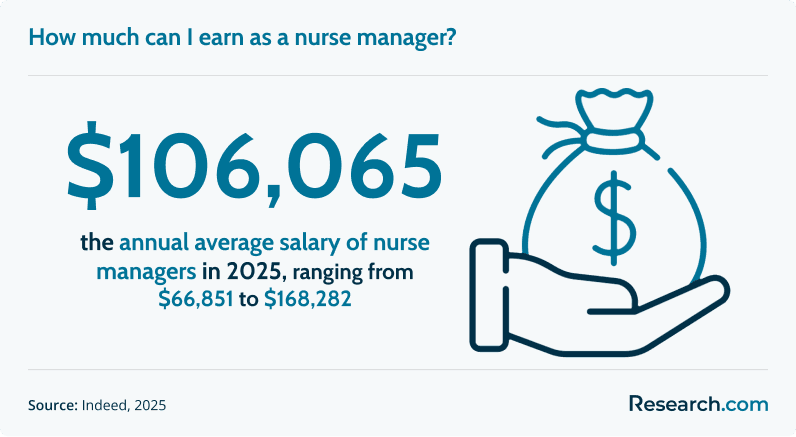
For experienced RNs who want formal leadership roles, an accredited online MSN in Nurse Administration can be worth it if the program fits your budget, offers practicum support, and is accredited by CCNE or ACEN. The degree prepares nurses for management and executive-track roles while allowing many students to continue working. Nurse managers earn an average annual salary of $106,065, and medical and health services managers are projected to grow 29% between 2023 and 2033.
What are the main benefits of affordable online MSN nurse administrator programs?
- Leadership mobility: The degree can help experienced nurses qualify for roles such as nurse manager, director of nursing, clinical operations leader, patient safety officer, and nurse executive.
- Potential salary growth: Nurse managers earn an average annual salary of $106,065, with a typical range extending up to $168,282 depending on location, employer size, experience, and responsibility level.
- Work-friendly format: Online coursework can make graduate study more realistic for nurses balancing shifts, family obligations, and professional responsibilities.
- Systems-level impact: Instead of focusing only on one patient assignment at a time, nurse administrators influence staffing models, quality initiatives, budgets, workflows, and care delivery standards.
What can I expect from an affordable online MSN nurse administrator program?
An online MSN in Nurse Administration builds on your RN experience and shifts your training from direct clinical care to leadership, finance, quality improvement, informatics, policy, and workforce management. You are not starting over clinically. You are learning how to lead the systems that support safe and effective care.
Most programs include graduate nursing core courses, administration-focused courses, and a required in-person practicum. The practicum matters because nurse administration cannot be learned only through readings and discussion boards. You will need supervised experience applying management concepts in a healthcare setting, often with an approved preceptor.
The strongest programs help students connect clinical judgment with business and operational decision-making. By graduation, you should be better prepared to evaluate staffing needs, interpret budgets, support evidence-based practice, manage teams, communicate with executives, and advocate for both patients and nursing staff.
| Program component | What it usually covers | Why it matters for nurse leaders |
| Leadership and management coursework | Organizational behavior, leadership theory, conflict resolution, team development, change management | Prepares you to supervise staff, lead change, and manage unit or department performance |
| Healthcare finance and operations | Budgeting, resource allocation, reimbursement, cost analysis, productivity metrics | Helps you make practical decisions about staffing, supplies, efficiency, and service delivery |
| Policy, ethics, and law | Healthcare regulation, advocacy, compliance, ethical decision-making, patient rights | Builds the judgment needed for administrative decisions that affect patients, employees, and organizations |
| Quality and safety | Evidence-based practice, safety initiatives, performance improvement, outcome measurement | Connects administrative work to measurable improvements in care quality and patient safety |
| Practicum or leadership experience | Supervised administrative work in a healthcare setting | Provides real-world leadership exposure and helps translate coursework into practice |
Where can I work with an MSN in Nurse Administration?
An MSN in Nurse Administration can prepare nurses for leadership roles in many healthcare environments. Hospitals are common employers, but they are not the only option. Any organization that employs nurses, manages patient care, or coordinates healthcare operations may need nurse administrators.
- Hospitals: Nurse leaders may manage units, service lines, quality initiatives, staffing operations, or system-wide nursing practice.
- Ambulatory care centers: Graduates may oversee outpatient clinics, procedural centers, urgent care settings, and surgery centers.
- Long-term care facilities: Nurse administrators may supervise nursing departments in skilled nursing facilities, rehabilitation centers, and continuing care environments.
- Home health agencies: Leadership roles may involve care coordination, compliance, staffing, patient outcomes, and field nurse support.
- Physician group practices: Larger practices often need clinical operations leaders to manage nursing teams, workflows, patient access, and quality processes.
How much can I make with an affordable online MSN nurse administrator degree?
Nurse managers earn an average annual salary of $106,065. Salaries can be higher, with a typical range extending up to $168,282 based on factors such as geographic market, years of experience, facility size, department complexity, and level of responsibility.
The degree can support a move from staff nursing into formal leadership, but salary outcomes are not guaranteed. Before enrolling, compare the program’s total cost with realistic roles in your local market, your employer’s promotion requirements, and the salary range for nurse leadership positions where you plan to work.
| Salary or career figure | What it indicates | How to use it when deciding |
| Nurse manager average annual salary: $106,065 | Shows the earning level associated with a common MSN nurse administration outcome | Compare this with your current RN compensation and the total cost of the program |
| Typical salary range extends up to $168,282 | Higher pay is possible in more complex, senior, or competitive roles | Do not assume the top of the range applies immediately after graduation |
| Registered nurse average annual salary: around $98,430 | Provides a comparison point between RN compensation and nurse manager compensation | Estimate the payback period using your actual tuition, aid, and expected promotion path |
- 10 affordable online MSN nurse administrator programs for 2027
- How long does an online MSN nurse administrator program take?
- Online vs. on-campus MSN nurse administrator programs
- Average cost of affordable online MSN nurse administrator programs
- Financial aid options for online MSN nurse administrator students
- Prerequisites for affordable online MSN nurse administrator programs
- Common courses in online MSN nurse administrator programs
- Specializations and focus areas in MSN nurse administration
- Direct entry MSN programs for non-nurses
- How to choose the best affordable online MSN nurse administrator program
- Questions to ask before enrolling
- Career paths for MSN nurse administration graduates
- Academic quality and career support factors
- Job market for MSN nurse administration graduates
- Emerging trends in MSN nurse administration programs
- How to succeed in an online MSN nurse administrator program
10 affordable online MSN nurse administrator programs for 2027
How do we rank schools?
Research.com evaluates programs using a structured, data-informed process described in our methodology. For this ranking, we reviewed information from sources that include the IPEDS database from the National Center for Education Statistics, the Peterson’s Distance Learning Licensed Data Set, the College Scorecard, and institutional data from NCES.
Use this list as a starting point, not as your only decision tool. Tuition, practicum support, state authorization, employer reputation, transfer policies, and scheduling format can all affect whether a program is the right fit for your situation.
1. University of North Carolina at Charlotte - MSN in Nurse Administration
The University of North Carolina at Charlotte offers an MSN in Nurse Administration for working nurses who want to strengthen their leadership capacity in healthcare delivery systems. The program emphasizes areas such as healthcare finance, informatics, and organizational behavior so students can learn to guide teams, allocate resources, and improve patient care processes in complex settings.
- Program Length: 27 months (part-time)
- Required Credits to Graduate: 36
- Cost per Credit: $288.82 (in-state); $536.98 (out-of-state)
- Accreditation: Commission on Collegiate Nursing Education (CCNE)
2. Texas A&M International University - MSN in Nursing Administration
Texas A&M International University combines leadership theory, strategic planning, and healthcare finance to prepare nurses for administrative decision-making. Students develop skills for supervising healthcare teams, improving organizational performance, and managing clinical operations across varied care environments.
- Program Length: 10 months
- Required Credits to Graduate: 36
- Cost per Credit: $367 (in-state); $1,030 (out-of-state)
- Accreditation: Accreditation Commission for Education in Nursing (ACEN)
3. Arkansas State University - MSN in Nursing Administration
Arkansas State University provides a nursing administration curriculum for nurses seeking stronger skills in leadership, financial management, and healthcare operations. The program connects theory with practical application for administrative work in settings such as hospitals, clinics, and public health organizations.
- Program Length: 14 months
- Required Credits to Graduate: 34
- Cost per Credit: $340
- Accreditation: Accreditation Commission for Education in Nursing (ACEN)
4. Lamar University - MSN in Nursing Administration
Lamar University focuses on preparing nurses to manage teams, budgets, policies, and care delivery systems. Coursework highlights organizational leadership, healthcare policy, and evidence-based decision-making for nurses planning to move into supervisory or executive-track roles.
- Program Length: 24 months
- Required Credits to Graduate: 37
- Cost per Credit: $417 at $1,252 per course
- Accreditation: Accreditation Commission for Education in Nursing (ACEN)
5. Radford University - MSN in Nursing Administration
Radford University helps nurses build administrative expertise in personnel management, healthcare operations, leadership, and organizational strategy. The program grounds leadership development in clinical experience while preparing graduates for management responsibilities across healthcare settings.
- Program Length: 24 months
- Required Credits to Graduate: 37
- Cost per Credit: $485 at $1,455 per course
- Accreditation: Commission on Collegiate Nursing Education (CCNE)
6. University of Texas at Arlington - MSN in Nursing Administration
The University of Texas at Arlington offers a program centered on leadership and business skills for managing healthcare teams and systems. Its curriculum connects nursing practice with finance, organizational theory, and strategic planning to support nurses moving into higher-level administrative positions.
- Program Length: 19-22 months
- Required Credits to Graduate: 36
- Cost per Credit: $494.44 at $1,483.33 per course
- Accreditation: Commission on Collegiate Nursing Education (CCNE)
7. William Paterson University - MSN in Nursing Administration
William Paterson University delivers an online nursing administration program that combines healthcare leadership, organizational strategy, financial management, healthcare systems, and leadership theory. The format is designed for nurses who want management preparation while maintaining flexibility.
- Program Length: 10 months
- Required Credits to Graduate: 31
- Cost per Credit: $602.75 at $1,808.25 per course
- Accreditation: Commission on Collegiate Nursing Education (CCNE)
8. Franklin University - MSN in Nurse Administrator
Franklin University prepares nurses to lead healthcare teams, manage resources, and contribute to system-wide outcomes. The curriculum emphasizes strategic leadership, healthcare policy, and quality improvement for students pursuing operational or executive responsibilities.
- Program Length: 16 months
- Required Credits to Graduate: 33
- Cost per Credit: $598
- Accreditation: Commission on Collegiate Nursing Education (CCNE)
9. University of Southern Maine - Nursing Administration and Leadership (Accelerated)
The University of Southern Maine offers an accelerated nursing administration and leadership pathway for experienced nurses seeking executive preparation. Coursework emphasizes systems thinking, fiscal responsibility, evidence-based leadership, and applied projects that develop administrative judgment.
- Program Length: 12 months
- Required Credits to Graduate: 36
- Cost per Credit: $625 ($526 e-tuition)
- Accreditation: Commission on Collegiate Nursing Education (CCNE)
10. Walden University - MSN-Nurse Executive
Walden University offers an MSN-Nurse Executive program that blends management theory, organizational leadership, policy, and applied leadership practice. Students work on decision-making, team leadership, and operational management skills relevant to hospitals, clinics, and other healthcare organizations.
- Program Length: 18 months (course-based)
- Required Credits to Graduate: 36
- Cost per Credit: $500 (quarter hour); $26,500 (estimated total)
- Accreditation: Commission on Collegiate Nursing Education (CCNE)
How long does it take to complete an affordable online MSN nurse administrator program?
Your completion time depends mainly on your current nursing education, enrollment pace, transfer credits, and whether the program uses traditional semesters or accelerated terms.
BSN-to-MSN pathway
If you already have a Bachelor of Science in Nursing, many MSN programs require 30 to 40 credit hours. Full-time students can often finish in 18 to 24 months, while part-time students may need about two to four years.
Nurses who want to strengthen analytics-driven leadership may also consider targeted credentials such as the fastest online graduate certificate in data analytics, especially if they plan to work with dashboards, quality metrics, staffing models, or operational performance data.
RN-to-MSN bridge pathway
RN-to-MSN programs are designed for registered nurses with an Associate Degree in Nursing. These programs usually take two to four years because they include bridge coursework before the graduate-level MSN classes begin. This route can be useful for experienced RNs who want to move directly toward graduate leadership preparation without completing a separate BSN first.
Bridge programs are structured in stages, much like other interdisciplinary degrees that build foundational knowledge before advanced specialization, such as an affordable space studies degree online.
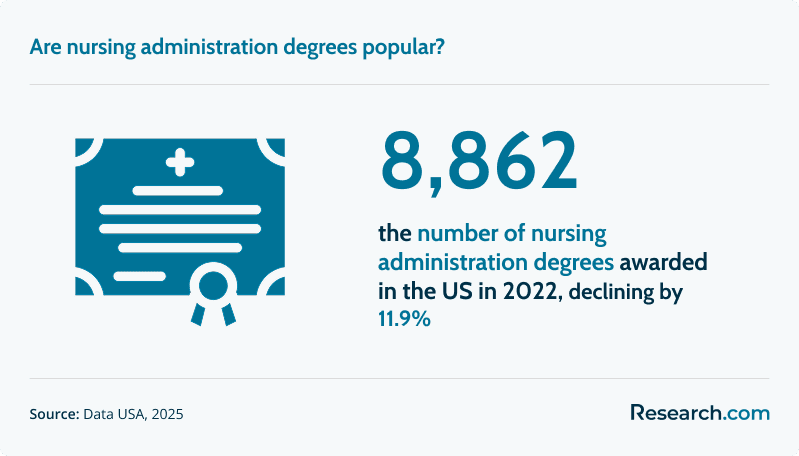
In 2022, while over 262,000 registered nursing degrees were awarded, a mere 8,662 were in nursing administration. That smaller pool of graduates can make the credential especially relevant for nurses pursuing administrative roles in a labor market that needs experienced clinical leaders.
| Pathway | Typical student | Estimated timeline | Best fit |
| BSN-to-MSN | RN with a BSN | 18 to 24 months full-time; about two to four years part-time | Nurses ready to begin graduate-level administration coursework immediately |
| RN-to-MSN bridge | RN with an ADN | Two to four years | Experienced nurses who want a direct bridge into graduate study |
| Accelerated MSN option | Student able to manage a faster course sequence | Varies by program, with some listed options as short as 10 months or 12 months | Nurses with strong time management, employer support, and fewer scheduling barriers |
How does an online MSN nurse administrator program compare to an on-campus program?
An accredited online MSN nurse administrator program can carry the same academic value as an on-campus program when the school, curriculum, faculty standards, and accreditation are comparable. Employers typically care more about accreditation, institutional reputation, nursing leadership preparation, and your experience than whether you completed lectures online or in a classroom.
Some nurses comparing leadership pathways also look at related administrative degrees, such as the cheapest online master's in emergency management, which may appeal to professionals interested in disaster response, public safety, or healthcare emergency preparedness rather than nursing administration specifically.
Online vs. on-campus comparison
| Factor | Online MSN nurse administrator program | On-campus MSN nurse administrator program |
| Flexibility | Often better for working RNs because coursework may be asynchronous or shift-friendly | May require scheduled travel, fixed class times, and more local availability |
| Academic rigor | Accredited programs should meet the same graduate-level standards | Accredited programs should meet the same graduate-level standards |
| Interaction | Discussion boards, video meetings, group projects, faculty office hours, and online advising | Face-to-face classes, campus events, in-person faculty access, and local peer networking |
| Practicum | Still requires in-person field experience with an approved preceptor | Also requires in-person field experience, often near the campus or affiliated sites |
| Best for | Nurses who need schedule flexibility or live far from campus | Nurses who prefer in-person learning and can commute consistently |
Academic rigor and curriculum
Accredited online programs should not be viewed as easier simply because they are online. Students complete graduate-level assignments, leadership projects, policy analysis, research work, and practicum requirements. The rigor comes from the outcomes and standards, not the building where instruction occurs.
If you need a shorter credential rather than a full MSN, the cheapest nurse administrator graduate certificate online may be worth comparing, particularly if you already hold a graduate nursing degree or want targeted administrative training.
Interaction and support
Modern online nursing programs are not limited to solitary reading. Strong programs use learning platforms, virtual meetings, online discussion, faculty feedback, peer collaboration, library access, writing support, advising, and career services. Before enrolling, ask whether online students receive the same level of support as campus students.
In-person practicum
Online does not mean entirely remote. Accredited MSN programs generally require in-person practicum experience. Ask each school whether you must find your own preceptor, whether the program helps identify sites, and whether your current workplace can be approved for practicum hours.
What is the average cost of affordable online MSN nurse administrator programs?
For the affordable online MSN in Nurse Administration programs in this guide, total tuition is around $17,000 for in-state students and just under $20,000 for out-of-state students. Per-credit tuition often ranges from about $290 to $625 for in-state students and from $340 to over $1,000 for out-of-state students.
Tuition is only one part of cost. You should also ask about technology fees, clinical placement fees, graduation fees, books, background checks, immunization documentation, travel for practicum requirements, and whether tuition differs by residency status.
Is the return on investment worth the cost?
The ROI can be strong for nurses who use the degree to move into leadership roles. A registered nurse earns an average annual salary of around $98,430, while a nurse manager earns an average of $106,065, with salaries often climbing as high as $168,000 depending on experience and location.
However, ROI depends on your actual tuition, debt, employer reimbursement, how quickly you graduate, and whether your organization requires or rewards graduate leadership preparation. A lower-cost program is not automatically the best option, but unnecessary debt can reduce the value of the degree.
| Cost factor | Why it affects affordability | Question to ask |
| Per-credit tuition | Determines the base cost of required coursework | Is the rate different for in-state and out-of-state online students? |
| Total credits | A lower per-credit rate may still cost more if the program requires more credits | How many credits are required to graduate? |
| Fees | Technology, online learning, practicum, and graduation fees can raise the final cost | Can the school provide a full cost-of-attendance estimate? |
| Practicum travel | Travel, time off, and site requirements can add indirect costs | Can practicum hours be completed near my home or workplace? |
| Employer support | Tuition reimbursement can substantially reduce out-of-pocket cost | Does my employer reimburse graduate nursing leadership programs? |
What are the financial aid options for students enrolling in affordable online MSN nurse administrator programs?
Graduate nursing students may be able to combine several funding sources. Start early because scholarships, employer reimbursement programs, and federal aid timelines may not match the application deadline for your MSN program.
- Complete the FAFSA: Submit the Free Application for Federal Student Aid (FAFSA) to determine eligibility for federal financial aid. Many schools also use FAFSA information when awarding institutional aid.
- Federal student loans: Graduate students may qualify for Direct Unsubsidized Loans. Some students also use Grad PLUS Loans, which can cover up to the full cost of attendance minus other aid received.
- Employer tuition assistance: Hospitals, health systems, and large healthcare employers may offer tuition reimbursement or education assistance for nurses pursuing leadership credentials. Ask HR about annual caps, grade requirements, work commitments, and repayment rules if you leave the employer.
- Scholarships and grants: Universities, nursing organizations, foundations, and professional associations may offer scholarships for graduate nursing students.
- Payment plans: Some schools allow students to divide tuition across a term, which may reduce the need for borrowing if you can pay while enrolled.
The school financial aid office should be one of your first contacts. Ask for the total estimated cost, aid deadlines, scholarship opportunities, and whether online MSN students are eligible for the same funding options as campus students.
What are the prerequisites for enrolling in affordable online MSN nurse administrator programs?
Admission requirements vary by school and pathway, but most programs want evidence that you are a licensed RN with the academic readiness and clinical experience needed for graduate-level leadership study.
BSN-to-MSN pathway
If you already hold a Bachelor of Science in Nursing, common requirements include:
- An active, unencumbered Registered Nurse license
- A BSN from a program accredited by CCNE or ACEN
- A minimum GPA of 3.0 on a 4.0 scale, though some schools may use different thresholds
- One to two years of direct patient care experience as an RN, depending on the program
- Official transcripts, professional resume, letters of recommendation, and a personal statement or essay
RN-to-MSN pathway
For nurses with an Associate Degree in Nursing, common requirements include:
- An active, unencumbered Registered Nurse license
- An ADN from an accredited institution
- A minimum GPA, often around 3.0
- Meaningful clinical experience and a strong professional record
- Transcripts, resume, recommendations, and other application materials required by the school
Admission factors that deserve extra attention
| Requirement | Why it matters | What to verify |
| RN license | Programs generally require current professional nursing licensure | Whether your license must be in the same state as the school or practicum site |
| Nursing accreditation | Prior nursing education may need to come from a recognized accredited program | Whether your ADN or BSN meets the school’s accreditation rules |
| GPA | Graduate schools use GPA to judge academic readiness | Whether conditional admission is possible if your GPA is below the preferred level |
| Work experience | Leadership coursework is more useful when connected to clinical practice | Whether charge nurse, preceptor, committee, or quality work strengthens your application |
What courses are typically in affordable online MSN nurse administrator programs?
An MSN in Nurse Administration teaches nurses how to manage people, budgets, policies, data, and quality systems. Compared with a clinical advanced practice route, this degree focuses less on diagnosing and treating patients and more on leading the workforce and operations that make care possible.
This distinction matters when comparing career goals. For example, a nurse educator job description centers on teaching, curriculum, and clinical education, while nurse administration focuses on management, operations, and organizational leadership.
Core curriculum for aspiring nurse leaders
- Leadership and management theories: Examines leadership styles, organizational behavior, change management, team development, and decision-making.
- Health policy and advocacy: Reviews how healthcare policy affects patients, staff, reimbursement, access, and organizational strategy.
- Ethical and legal issues in healthcare: Covers administrative responsibilities related to compliance, patient rights, staffing decisions, confidentiality, and risk.
- Research methods for evidence-based practice: Teaches students to evaluate research and apply evidence to improve clinical and operational outcomes.
Financial and operational management
- Healthcare finance and budgeting: Builds skills in budgeting, cost analysis, reimbursement awareness, and resource planning.
- Human resources management: Covers hiring, retention, performance management, staff development, scheduling, and workforce planning.
- Strategic planning in healthcare: Teaches students how to develop goals, evaluate organizational performance, and align nursing priorities with healthcare system needs.
These courses can help nurses prepare for responsibilities such as improving staffing processes, managing unit budgets, implementing quality initiatives, and leading safety protocols. With over 1.8 million RNs employed in general medical and surgical hospitals alone, administrative skills remain highly relevant in large, complex healthcare environments.
The chart below shows major employment sectors for registered nurses and helps explain why administrative preparation is useful across care settings.
What types of specializations are available in affordable online MSN nurse administrator programs?
Specializations in nurse administration are usually management focus areas rather than separate licensed clinical roles. This is different from advanced practice pathways such as FNP careers, which prepare nurses for a specific provider role. In nurse administration, a concentration helps you build deeper expertise in a leadership domain.
- Healthcare informatics: Focuses on health data, clinical information systems, workflow technology, and digital tools used to improve decision-making and outcomes.
- Healthcare finance: Develops deeper knowledge of budgeting, financial planning, cost control, reimbursement, and economic pressures in healthcare organizations.
- Executive nurse leadership: Emphasizes high-level strategy, governance, organizational leadership, and executive decision-making.
- Patient safety and quality improvement: Prepares nurses to lead initiatives that reduce errors, improve outcomes, and strengthen compliance with safety standards.
Choose a focus area based on the type of leadership work you want. Informatics may fit nurses drawn to data and technology. Finance may fit nurses who want operational or service-line leadership. Quality and safety may fit nurses who want to lead performance improvement. Executive leadership may be more relevant for nurses aiming toward senior administration.
Some specialized industries place a high value on advanced administrative and technical skills. For example, industries like computer systems design, which rely on informatics expertise, offer nurses significantly higher average salaries, often exceeding $111,000. The chart below highlights higher-paying industries for registered nurses where specialized administrative capabilities can be valuable.
Are there direct entry MSN programs available for non-nurses?
Yes, direct entry MSN programs exist for students who do not already hold a nursing degree, but they are different from MSN nurse administration programs for experienced RNs. Direct entry pathways usually begin with foundational nursing coursework and clinical preparation before moving into graduate-level study.
Non-nurses who want to enter nursing should be careful not to confuse direct entry MSN programs with nurse administration programs designed for licensed RNs. Nurse administration assumes a clinical nursing foundation, while direct entry programs are intended to help students first become nurses. To compare accelerated entry routes, review options such as direct MSN programs online.
How do I choose the best affordable online MSN nurse administrator program?
The best program is not simply the cheapest. It is the accredited program that fits your budget, schedule, state requirements, practicum needs, and career goals. A low tuition rate can be valuable, but only if the program has the academic quality and support you need to graduate and use the credential.
Step-by-step program selection process
- Confirm nursing accreditation first. Look for accreditation from the Commission on Collegiate Nursing Education or the Accreditation Commission for Education in Nursing.
- Check state authorization and practicum rules. Make sure the school can enroll students in your state and support practicum placement where you live or work.
- Calculate full cost, not just tuition. Include fees, books, travel, background checks, and lost income if the schedule reduces your work hours.
- Compare curriculum to your target role. A nurse manager track should cover leadership, staffing, budgeting, quality, policy, and operations.
- Ask about practicum support. Find out whether the school helps secure preceptors or expects you to locate your own site.
- Evaluate flexibility honestly. Synchronous courses may offer structure, while asynchronous courses may be easier for shift workers.
- Review student services. Online students should have access to advising, library resources, technology help, writing support, and career services.
Career goals should drive the final choice. If you are interested in broader community or systems work, resources on public health careers may help you compare how nurse administration overlaps with population health leadership.
| Program feature | Strong sign | Warning sign |
| Accreditation | CCNE or ACEN accreditation is clearly stated | Accreditation is vague, missing, or unrelated to nursing |
| Practicum support | School explains site approval, preceptor requirements, and student support | Students are left to figure out placement with little guidance |
| Cost transparency | Program provides tuition, fees, and total estimated cost | Only a per-credit rate is shown, with fees unclear |
| Online student support | Advising, technology support, library access, and career services are available online | Services appear designed mainly for campus students |
| Career alignment | Courses match nurse manager, director, quality, finance, and executive leadership skills | Curriculum is too general for your intended leadership path |
What questions should you ask when evaluating affordable online MSN nurse administrator programs?
Before applying, ask direct questions that reveal cost, quality, support, and career fit. Admissions pages rarely answer everything a working nurse needs to know.
- Accreditation: Is the MSN program accredited by CCNE or ACEN?
- State authorization: Can the program enroll students from my state?
- Practicum: How many practicum hours are required, and who helps secure the preceptor?
- Workplace placement: Can I complete practicum hours with my current employer if the site and preceptor meet program requirements?
- Schedule: Are courses asynchronous, synchronous, or a mix of both?
- Total cost: What is the full estimated cost, including tuition, fees, books, technology, and practicum-related expenses?
- Transfer credits: Can graduate credits transfer in, and what is the maximum allowed?
- Faculty experience: Do faculty have nurse leadership, executive, quality, finance, or healthcare operations experience?
- Career support: Are online students eligible for leadership coaching, resume help, interview preparation, and employer networking?
- Alternatives: If my long-term goal is advanced practice rather than administration, should I compare options such as nurse practitioner programs non-nursing bachelor's degree pathways?
What career paths are available for graduates of affordable online MSN nurse administrator programs?
An MSN in Nurse Administration can move experienced nurses into formal leadership roles where they manage people, budgets, policies, quality initiatives, and operational performance. The role you qualify for will depend on your prior experience, employer structure, local job market, and how much leadership responsibility you already have.
Common nurse administration roles
| Role | Main responsibilities | Typical fit |
| Nurse Manager | Manages daily operations, staffing, budget oversight, scheduling, performance, and quality on a unit | Experienced RNs, charge nurses, or clinical leaders moving into first-level management |
| Director of Nursing | Oversees multiple units, nursing departments, policies, compliance, strategic planning, and interdepartmental coordination | Nurse managers or experienced leaders ready for broader responsibility |
| Clinical Nurse Leader | Focuses on improving quality and safety outcomes at the point of care through evidence-based initiatives and staff mentoring | Nurses interested in quality, care coordination, and practice improvement |
| Patient Safety Officer | Leads safety initiatives, error reduction strategies, reporting processes, and compliance efforts | Nurses drawn to risk reduction, quality systems, and patient safety work |
| Chief Nursing Officer | Sets nursing strategy, represents nursing in executive decisions, oversees standards of nursing practice, and leads organization-wide nursing priorities | Senior nurse leaders with extensive management and executive experience |
MSN vs. MHA vs. MBA for nurse leaders
Nurses considering administration may also compare the MSN with the Master of Health Administration and Master of Business Administration. The broader path for how to become a health administrator can include multiple graduate degree options, but each has a different emphasis.
| Degree | Primary focus | Best fit |
| MSN in Nurse Administration | Nursing leadership, clinical operations, staffing, quality, policy, finance, and nursing practice systems | RNs who want to lead nursing teams or nursing operations |
| MHA | Healthcare systems, policy, operations, administration, and organizational management | Professionals seeking broader healthcare administration roles across departments |
| MBA | General business, finance, strategy, operations, and management | Professionals seeking business leadership roles inside or outside healthcare |
The MSN is often the most directly relevant option for nurses who want to lead nursing practice because it keeps clinical credibility at the center of leadership preparation.
What academic quality and career support factors should I consider?
Affordability should not come at the expense of support. A low-cost online MSN can be a smart choice when it has clear accreditation, qualified faculty, strong advising, practicum guidance, and career services for online students.
- Faculty background: Look for instructors with experience in nurse leadership, healthcare finance, quality improvement, informatics, policy, or executive practice.
- Practicum coordination: Strong programs explain how placements work and how students receive approval for preceptors and sites.
- Career services: Ask whether the school helps with leadership resumes, promotion strategy, interview preparation, and networking.
- Alumni outcomes: Request examples of roles graduates commonly pursue, while remembering that individual outcomes vary.
- Student support: Online learners should have reliable access to advising, library databases, writing help, disability services, and technology support.
If you are still building toward graduate study, comparing earlier advancement pathways such as RN to BSN online no clinicals accredited programs can help you understand how schools support working nurses at different stages.
What is the job market for graduates with an MSN in Nurse Administration?
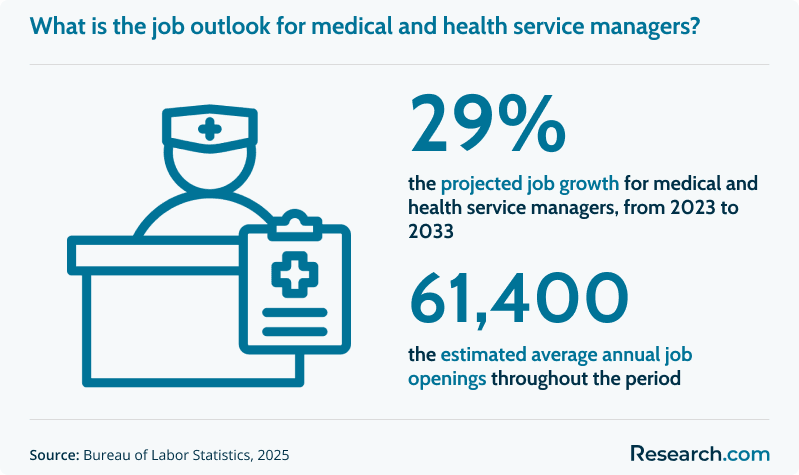
The labor market for nurse administrators is supported by strong demand for medical and health services managers, the occupational category often used to understand what does a health services manager do. Employment for medical and health services managers is projected to grow 29% between 2023 and 2033.
That projected growth is much higher than the 6% growth projected for registered nurses. Healthcare organizations need leaders who can address staffing pressure, quality requirements, regulatory complexity, technology adoption, financial constraints, and care coordination challenges.
Graduates should still research their local market. Job titles, salary ranges, promotion norms, and degree requirements vary by employer. Some organizations may promote experienced nurses into leadership with a BSN and strong experience, while others may prefer or require an MSN for director-level or executive-track positions.
What emerging trends are MSN nurse administration programs incorporating?
MSN nurse administration programs are increasingly expected to prepare nurses for technology-enabled, data-informed, and team-based healthcare environments. The strongest programs do more than teach traditional supervision; they help nurses understand how modern systems measure performance, manage risk, and coordinate care across disciplines.
- Digital health and telehealth: Nurse leaders need to understand how virtual care affects staffing, access, workflows, patient monitoring, and quality oversight.
- Data analytics and informatics: Administrative decisions increasingly rely on dashboards, quality metrics, staffing data, patient outcomes, and financial indicators.
- Interprofessional collaboration: Nurse administrators must coordinate with physicians, pharmacists, behavioral health specialists, social workers, informatics teams, and advanced practice nurses, including professionals trained through the most affordable PMHNP programs.
- Quality, safety, and regulatory readiness: Programs are placing more emphasis on compliance, risk reduction, evidence-based improvement, and patient safety systems.
- Sustainable operations: Nurse leaders are expected to balance workforce well-being, financial responsibility, patient needs, and organizational performance.
How can I excel in an online MSN nurse administrator program?
Succeeding in an online MSN nurse administrator program requires more than logging in on time. You need a realistic study system, early practicum planning, active communication, and a way to connect assignments to your current healthcare environment.
- Build a weekly schedule before classes start. Block study time around shifts, family responsibilities, sleep, and assignment deadlines.
- Use your workplace as a learning laboratory. When appropriate, connect class concepts to staffing, quality, patient flow, budgeting, or policy challenges you observe at work.
- Communicate early with faculty. Ask questions before problems become urgent, especially if shift work affects deadlines or synchronous sessions.
- Start practicum planning early. Preceptor approval, site paperwork, background checks, and compliance documents can take time.
- Participate actively online. Discussion boards and group projects can become valuable networking opportunities with other experienced nurses.
- Use support services. Take advantage of writing centers, library databases, tutoring, technology help, and career advising.
- Broaden your leadership perspective. Comparing related nursing pathways, such as affordable womens health nurse practitioner programs, can help you understand how administrative decisions affect different clinical specialties.
Common mistakes to avoid when choosing an online MSN nurse administrator program
| Mistake | Why it can hurt you | Better approach |
| Choosing only by lowest tuition | The cheapest option may lack the practicum support, flexibility, or services you need | Compare total cost, accreditation, support, curriculum, and graduation fit |
| Ignoring accreditation | Employers may question degrees from programs without recognized nursing accreditation | Verify CCNE or ACEN accreditation before applying |
| Assuming online means no in-person requirements | Practicum hours are usually completed in person | Ask how placements work and whether your location is supported |
| Overlooking state authorization | Some schools may not be authorized to enroll students in every state | Confirm eligibility based on your state of residence and practicum location |
| Focusing only on speed | A fast program may be difficult to manage with full-time nursing work | Choose a pace that allows you to learn, complete practicum requirements, and avoid burnout |
| Assuming salary outcomes are automatic | A degree can strengthen qualifications, but promotions depend on market, employer, and experience | Research local roles and talk with nurse leaders at your organization |
Key Insights
- An affordable online MSN in Nurse Administration is best for licensed RNs who want to lead nursing teams, operations, budgets, quality initiatives, and healthcare systems.
- Accreditation is non-negotiable. Prioritize programs accredited by CCNE or ACEN before comparing tuition, speed, or convenience.
- Online programs can be academically comparable to campus programs, but they still require in-person practicum experience.
- Total tuition for programs in this guide is around $17,000 for in-state students and just under $20,000 for out-of-state students, but fees and practicum-related expenses can change the real cost.
- Nurse managers earn an average annual salary of $106,065, and the typical range can extend up to $168,282, but outcomes vary by employer, location, experience, and role level.
- Employment for medical and health services managers is projected to grow 29% between 2023 and 2033, compared with 6% growth projected for registered nurses.
- With an estimated 61,400 job openings for health service managers expected annually, graduates may find opportunities in hospitals, ambulatory care, long-term care, home health, physician practices, and healthcare systems.
- In 2022, only 8,663 nursing administration degrees were awarded nationwide, making the credential a specialized leadership pathway within nursing education.
- The master's degree is the established standard for this career path, comprising 81.1% of all nursing administration credentials awarded.
- The best program is the one that balances recognized accreditation, realistic cost, practicum support, scheduling flexibility, and alignment with your target leadership role.
References:
- American Association of Colleges of Nursing. (2025). Nursing shortage fact sheet. Retrieved June 9, 2025, from AACN.
- Bureau of Labor Statistics. (2025). Medical and health services managers. Retrieved June 9, 2025, from BLS.
- Data USA. (2025). Registered nursing. Retrieved June 9, 2025, from Data USA.
- Indeed. (2025). Nurse manager salary in United States. Retrieved June 9, 2025, from Indeed.
- Projections Central. (2025). Long-Term occupational projections (2022-2032). Retrieved June 9, 2025, from Projections Central.
Other Things You Should Know About The Most Affordable Online MSN Nurse Administrator Programs
Some of the most affordable online MSN Nurse Administrator programs in 2027 include those offered by Ohio University, University of Texas at Arlington, and Lamar University. These programs provide a blend of online flexibility and competitive tuition rates for aspiring nurse administrators.
Most online MSN Nurse Administrator programs in 2027 require a Bachelor of Science in Nursing (BSN) for enrollment. Some schools offer bridge programs for RNs with an associate's degree or bachelor’s degree in another field, which incorporate necessary BSN coursework.
The affordability of online MSN Nurse Administrator programs in 2027 can be influenced by factors such as residency status, as in-state tuition is often less expensive than out-of-state; availability of financial aid and scholarships; program length and the number of credit hours required; and whether the institution is private or public. Exploring various financial aid options and comparing program requirements can help prospective students make cost-effective decisions.


