2027 Most Affordable Online Master's in Emergency Management Programs

Co-Founder and Chief Data Scientist
Choosing an online master’s in emergency management is usually a practical decision, not just an academic one. Many prospective students already work in public safety, healthcare, military service, local government, logistics, law enforcement, or nonprofit response work, and they need a graduate program that can strengthen their crisis leadership skills without forcing them to leave their jobs or take on excessive debt.
This guide focuses on affordable online master’s in emergency management programs and explains how to compare them beyond tuition alone. You will learn what these programs cover, how long they take, what they may cost, which career paths they support, how employers view online degrees, and what questions to ask before enrolling.
The goal is simple: help you identify a credible, career-relevant, and financially realistic emergency management master’s program.
Quick Answer: What Is the Most Affordable Online Master’s in Emergency Management?
The most affordable online master’s in emergency management is typically a regionally accredited or field-accredited graduate program with a per-credit tuition rate that fits your budget, a total credit requirement you can complete without unnecessary coursework, and a curriculum aligned with your target role in disaster response, homeland security, public health preparedness, business continuity, or emergency services leadership.
Based on the programs listed in this guide, affordable options commonly require 30 to 36 credits and can often be completed in 18 months to 2 years, depending on whether you study full-time, part-time, or in an accelerated format. Tuition varies widely, so students should compare total program cost, not just the advertised per-credit rate.
Who Should Consider an Online Master’s in Emergency Management?
An online master’s in emergency management is best suited for professionals who want to move into planning, coordination, policy, or leadership roles related to disasters, public safety, homeland security, crisis communication, and organizational resilience.
This degree may be a strong fit if you:
- Work in emergency services, public safety, healthcare, the military, law enforcement, government, or nonprofit disaster relief.
- Want to qualify for management or director-level roles in preparedness, response, recovery, mitigation, or business continuity.
- Need an online format because you cannot relocate or attend daytime campus classes.
- Want graduate-level training in risk analysis, emergency operations, interagency coordination, crisis leadership, and disaster policy.
- Prefer an applied program with simulations, case studies, capstone projects, or field-based assignments.
You may want to consider a different graduate path if your main goal is clinical healthcare leadership, cybersecurity engineering, public administration broadly, or corporate operations management without a specific emergency preparedness focus. In those cases, related options such as public administration, homeland security, cybersecurity, healthcare administration, or an online MBA program may fit better.
What are the benefits of obtaining an online master's in emergency management?
- Career-friendly scheduling: Online programs are often designed for working adults. Many use asynchronous courses, which lets students complete lectures, assignments, and discussions around shift work, deployments, family responsibilities, or full-time employment.
- Leadership preparation: A master’s program can help students build advanced skills in emergency planning, risk assessment, disaster response coordination, public policy, public information, recovery planning, and multi-agency collaboration.
- Applied crisis training: Many programs use simulations, case studies, capstone projects, or scenario-based assignments so students can practice decision-making in complex emergency situations.
- Broader employment options: Graduates may pursue roles in government, healthcare, higher education, nonprofit disaster relief, critical infrastructure, corporate risk management, logistics, and public safety agencies.
- Lower relocation costs: Because online students can often remain in their current communities, they may avoid expenses tied to commuting, moving, housing, or leaving the workforce.
What can I expect from online master's in emergency management?
An online master’s in emergency management usually combines graduate-level theory with practical training in disaster preparedness, response, mitigation, recovery, and resilience. The strongest programs help students understand not only how emergencies unfold, but also how agencies, communities, hospitals, schools, corporations, and governments coordinate before, during, and after a crisis.
| Program Feature | What It Usually Means for Students | Why It Matters |
| Online delivery | Courses may be asynchronous, synchronous, or a mix of both. | Working professionals should check whether live sessions are required and whether the schedule fits their work shifts. |
| Core curriculum | Topics often include preparedness, mitigation, response, recovery, crisis communication, risk assessment, and emergency operations. | The curriculum should match the type of emergency management work you want to do after graduation. |
| Applied assignments | Programs may include simulations, real-world case analyses, planning documents, or agency-based projects. | Applied work can help students demonstrate job-ready skills to employers. |
| Capstone or practicum | Many programs end with a capstone, thesis, practicum, or field-based project. | This can become a portfolio piece for promotion, career transition, or leadership applications. |
| Peer network | Online cohorts may include students from public safety, military, healthcare, nonprofit, and corporate backgrounds. | Discussions can expose students to how different sectors handle similar crisis problems. |
| Completion timeline | Many programs take 18 to 24 months, though part-time study can extend the timeline. | Timeline affects total cost, workload, financial aid planning, and career timing. |
Before applying, review whether the program emphasizes public-sector disaster management, homeland security, healthcare preparedness, organizational continuity, emergency services leadership, or a broader interdisciplinary approach. Two programs with similar names can prepare students for different career outcomes.
Where can I work with an online master's in emergency management?
Graduates can work in any setting where leaders must anticipate threats, coordinate resources, communicate under pressure, and restore operations after disruption. Emergency management is not limited to hurricanes, floods, wildfires, or tornadoes; it also includes public health emergencies, cyber incidents, infrastructure failures, terrorist threats, mass casualty events, school safety planning, and corporate continuity.
| Employment Setting | Typical Responsibilities | Good Fit For |
| Local, state, and federal government | Develop response plans, coordinate agencies, manage preparedness programs, and support disaster recovery. | Students interested in public service, FEMA-related work, homeland security, or community resilience. |
| Healthcare and public health | Prepare hospitals and health systems for pandemics, mass casualty incidents, supply disruptions, and evacuation needs. | Healthcare workers, public health professionals, and emergency planners. |
| Nonprofit and humanitarian organizations | Support disaster relief, community preparedness, shelter operations, volunteer coordination, and recovery services. | Students drawn to mission-driven relief work and community response. |
| Private sector and critical infrastructure | Create business continuity plans, assess operational risk, protect supply chains, and reduce downtime during crises. | Professionals in logistics, utilities, transportation, finance, technology, or corporate security. |
| Schools and universities | Manage emergency drills, threat assessments, campus safety plans, and coordination with first responders. | Education professionals and safety specialists. |
| Law enforcement, fire, EMS, and first responder agencies | Improve interagency coordination, incident command processes, emergency planning, and preparedness training. | First responders seeking promotion or administrative leadership roles. |
The right program depends on the setting you want to enter. For example, a student aiming for public health emergency planning should look for coursework in health systems and mass casualty response, while someone targeting corporate continuity should prioritize risk management, continuity planning, and organizational resilience.
How much can I make with an online master's in emergency management?
Salary outcomes vary by job title, employer, location, experience, clearance requirements, industry, and management responsibility. A master’s degree can support advancement, but it does not guarantee a specific salary. Students should review labor market data for their region and compare it with total program cost before enrolling.
- Emergency Management Directors: According to the U.S. Bureau of Labor Statistics, the median annual salary for emergency management directors is around $86,130 in May 2024, with the top 10% earning over $160,420.
- Disaster Recovery Managers and Specialists: These positions commonly pay between $70,000 and $110,000 per year, depending on role scope, employer type, and level of responsibility.
- Homeland Security and Public Safety Roles: Professionals in homeland security, emergency planning, or law enforcement coordination can earn $80,000 to $120,000+, especially in federal settings or high-risk environments.
- Business Continuity and Risk Managers: Corporate roles can range from $85,000 to $130,000, particularly when the position involves enterprise-wide continuity, risk, or resilience planning.
When evaluating salary potential, compare the degree to your current role and your likely next step. A current emergency services professional seeking promotion may calculate ROI differently from a career changer trying to enter the field.
- Most Affordable Online Master’s in Emergency Management Programs for 2027
- How long does it take to earn a master's in emergency management degree?
- What is the average cost of an online master's in emergency management degree program?
- What are the financial aid options for students enrolling in an online master's in emergency management?
- What are the prerequisites for enrolling in an online master's in emergency management degree program?
- What courses are typically included in an online master's in emergency management degree program?
- What types of specializations are available in a master's in emergency management degree program?
- How can interdisciplinary programs complement an online master's in emergency management?
- How does the return on investment compare for an online master's in emergency management degree program?
- Is accreditation essential for ensuring educational quality and career readiness?
- Do employers value an online master's in emergency management degree?
- How can I choose the best among the most affordable online master's in emergency management degree programs?
- What are the differences between a traditional and an online master's in emergency management degree program?
- What career paths are available for graduates of an online master's in emergency management degree program?
List of the Most Affordable Online Master’s in Emergency Management Programs for 2027
The programs below are presented to help cost-conscious students compare online graduate options in emergency management, disaster management, homeland security, and emergency services leadership. Use this list as a starting point, then verify tuition, fees, accreditation, course availability, and admissions requirements directly with each school before applying.
Our rankings are built from research and data analysis using sources such as the IPEDS database, Peterson's database, including its Distance Learning Licensed Data Set, the College Scorecard database, and the National Center for Education Statistics. Students who want more detail about how Research.com evaluates programs can review our methodology.
| School | Program | Credits | Tuition per Credit | Typical Length |
| Columbia Southern University | Master of Science in Emergency Services Management | 36 | $359 | 2 years |
| Arkansas Tech University | Master of Science in Emergency Management & Homeland Security | 36 | $315 | 2 years |
| University of Alaska Fairbanks | Master of Security and Disaster Management | 30 | $539 | 2 years |
| Waldorf University | Master of Arts Organizational Leadership with a concentration on Emergency Management Leadership | 36 | $445 | 30 months |
| American Public University System | Master of Arts in Emergency and Disaster Management | 36 | $455 | 2 years |
| Arizona State University Online | Master of Arts in Emergency Management and Homeland Security - Emergency Management | 33 | $605 | 2 years |
| CUNY John Jay College of Criminal Justice | Master of Science in Emergency Management | 36 | $565 | 2 years |
| Arkansas State University | Master of Science in Disaster Preparedness and Emergency Management | 36 | $340 | 12 months |
| Liberty University | Master of Public Administration - Disaster Management | 36 | $580 | 2 years |
| Adelphi University | Master of Science in Emergency Management | 33 | $865 | 30 months |
1. Columbia Southern University
Columbia Southern University offers an online Master of Science in Emergency Services Management that emphasizes management, communication, and applied decision-making across the disaster cycle. The program is designed for students who want to understand how emergency services organizations prepare for, respond to, and recover from natural and human-caused incidents.
Its curriculum introduces the systems, stakeholders, operational demands, and planning concepts involved in managing disasters and other emergencies. Students looking for a program centered on emergency services administration may find this option especially relevant.
- Location: Orange Beach, AL
- Program: Master of Science in Emergency Services Management
- Length: 2 years
- Number of credits required: 36Tuition per credit: $359
- Accreditation: Institute of Hazardous Materials Management (IHMM)
2. Arkansas Tech University
Arkansas Tech University is a public nonprofit institution offering an online Master of Science in Emergency Management & Homeland Security. The program blends research, professional application, technology, policy, ethics, law, leadership, and the social dimensions of emergency management and homeland security.
This degree is built for students who want to connect academic theory with the real demands of emergency management practice. It may appeal to learners seeking a public university option with a clear focus on critical thinking and practitioner preparation.
- Location: Russellville, AR
- Program: Master of Science in Emergency Management & Homeland Security
- Length: 2 years
- Number of credits required: 36
- Tuition per credit: $315
- Accreditation: Higher Learning Commission
3. University of Alaska Fairbanks
University of Alaska Fairbanks offers an online Master of Security and Disaster Management designed for current and aspiring homeland security and emergency management professionals. The program uses real-world situations and is taught by faculty with military, law enforcement, and field experience.
The university participates in the Federal Emergency Management Agency Emergency Management Higher Education Program and the Department of Homeland Security University and Agency Partnership Initiative, giving students access to national resources connected to the field.
- Location: Fairbanks, AK
- Program: Master of Security and Disaster Management
- Length: 2 years
- Number of credits required: 30
- Tuition per credit: $539
- Accreditation: Northwest Commission on Colleges and Universities
4. Waldorf University
Waldorf University is a for-profit institution offering a fully online Master of Arts in Organizational Leadership with a concentration in Emergency Management Leadership. The program focuses on building leadership skills that can be applied to preparedness, response, prevention, and community safety.
This option may work well for students who want emergency management training within a broader organizational leadership framework rather than a standalone emergency management degree.
- Location: Forest City, IA
- Program: Master of Arts Organizational Leadership with a concentration on Emergency Management Leadership
- Length: 30 months
- Number of credits required: 36
- Tuition per credit: $445
- Accreditation: Higher Learning Commission
5. American Public University System
American Public University System is a for-profit university with an online Master of Arts in Emergency and Disaster Management. Students can pursue specializations in Cybersecurity in Emergency Management, Climate Change Adaptation, and Mass Casualty Incident Management.
The program uses case studies to examine natural, technical, and human-induced emergencies, disasters, and catastrophes. Faculty include board-certified emergency managers and professionals working in government, safety, or security roles.
- Location: Charles Town, WV
- Program: Master of Arts in Emergency and Disaster Management
- Length: 2 years
- Number of credits required: 36
- Tuition per credit: $455
- Accreditation: International Fire Service Accreditation Congress
6. Arizona State University, Online
Arizona State University Online is a public nonprofit university offering a Master of Arts in Emergency Management and Homeland Security - Emergency Management. The program includes five concentration areas: Biosecurity and threat management, Community resilience, Cybersecurity policy and management, Emergency management, and Homeland security.
Students study strategies for reducing hazard risk, improving resilience, and leading response efforts related to natural disasters, cyber attacks, terrorism, and large-scale emergencies.
- Location: Tempe, AZ
- Program: Master of Arts in Emergency Management and Homeland Security - Emergency Management
- Length: 2 years
- Number of credits required: 33
- Tuition per credit: $605
- Accreditation: Higher Learning Commission
7. CUNY John Jay College of Criminal Justice
CUNY John Jay College of Criminal Justice is a public nonprofit college offering a Master of Science in Emergency Management. The curriculum includes Geographic Information Systems, terrorism and critical infrastructure coursework, legal frameworks, organizational issues, and technology in emergency management.
The program prepares students for leadership and professional responsibility in public, nonprofit, and private organizations involved in preparedness, response, recovery, and mitigation.
- Location: New York, NY
- Program: Master of Science in Emergency Management
- Length: 2 years
- Number of credits required: 36
- Tuition per credit: $565
- Accreditation: Middle States Commission on Higher Education
8. Arkansas State University
Arkansas State University offers a Master of Science in Disaster Preparedness and Emergency Management accredited by the Council for the Accreditation of Emergency Management and Homeland Security Education (CAEMHSE). This specialized accreditation can be especially useful for students who want a program aligned with recognized emergency management education standards.
The curriculum covers hazards, risk, disaster theory, historical and social context, and the political, legal, cultural, fiscal, and economic dimensions of emergency management. The program sequence also integrates FEMA Emergency Management Institute prerequisites and both Core and Basic Disaster Life Support certifications.
- Location: Jonesboro, AR
- Program: Master of Science in Disaster Preparedness and Emergency Management
- Length: 12 months
- Number of credits required: 36
- Tuition per credit: $340
- Accreditation: Council for the Accreditation of Emergency Management and Homeland Security Education (CAEMHSE)
9. Liberty University
Liberty University is a private nonprofit Christian university offering a 100% online Master of Public Administration - Disaster Management. Students study risk assessment, hazard mitigation, community preparedness, and response to natural and human-caused disasters.
The program also includes coursework on the political, legal, and financial systems that shape disaster management and prevention, along with terrorism topics connected to homeland security goals.
- Location: Lynchburg, VA
- Program: Master of Public Administration - Disaster Management
- Length: 2 years
- Number of credits required: 36
- Tuition per credit: $580
- Accreditation: Southern Association of Colleges and Schools Commission on Colleges (SACSCOC)
10. Adelphi University
Adelphi University offers a 100% online, instructor-led Master of Science in Emergency Management. The program is designed to provide broad applied training for students preparing to lead in complex, interdisciplinary emergency management settings.
Students study disaster preparedness, mitigation, response, and recovery, and the curriculum can be tailored to match career goals. Coursework also introduces current tools and technologies, including the use of drones in disaster response.
- Location: Garden City, NY
- Program: Master of Science in Emergency Management
- Length: 30 months
- Number of credits required: 33
- Tuition per credit: $865
How long does it take to earn a master's in emergency management degree?
A master’s in emergency management commonly takes 18 months to 2 years to complete. Some accelerated online programs may allow full-time students to finish in 12 to 18 months, while part-time students often need 2 to 3 years because they are balancing graduate coursework with work, family, military service, or emergency response schedules.
Program length depends on credit requirements, course pacing, capstone expectations, internship or practicum components, and whether the school offers summer or intersession courses. Many programs require 30 to 36 credits, so even small differences in course load can affect the graduation timeline.
| Study Format | Typical Timeline | Best For |
| Accelerated full-time | 12 to 18 months | Students who can manage a heavy workload and want to finish quickly. |
| Standard full-time | 18 months to 2 years | Students who want a structured pace without extending the degree too long. |
| Part-time | 2 to 3 years | Working professionals, parents, shift workers, and military students who need flexibility. |
This flexibility is similar to what students may find in an affordable online nurse administrator graduate certificate, where targeted online coursework can fit around professional responsibilities.
What is the average cost of an online master's in emergency management degree program?
The cost of an online master’s in emergency management depends on tuition structure, number of credits, student residency, institutional fees, transfer credit policies, and financial aid. Do not compare programs only by per-credit tuition. A lower per-credit rate can still lead to a higher total cost if the program requires more credits or charges significant fees.
- Per-credit tuition ranges between $270 and $630, with most programs comprising 30–36 credits—resulting in total tuition costs between $8,000 and $23,000.
- For top-rated online programs, average tuition is approximately $819 per credit, leading to total costs of $24,570 to $29,484 for a full 30–36 credit program.
- Public institutions online typically charge around $11,554 in tuition and fees per academic year, while private nonprofit schools average about $20,400, leading to a two-year total between $23,100 and $41,000.
- Some highly affordable options exist. For example, Arkansas Tech University offers a fully online master’s at just $5,661 per year, and University of Alaska Fairbanks charges approximately $8,085 annually .
- Mid-range public universities such as Millersville University at approximately $605/credit, or about $18,150 total, and University of New England at $860/credit, or about $25,920 for a 30-credit program, illustrate typical costs within in-state price brackets.
If keeping costs low is your main priority, expect to compare total tuition in the $8,000 to $15,000 range among the most affordable options. Programs with higher tuition, extensive institutional resources, or research-oriented structures can exceed $30,000. Always calculate the full price, including fees, books, technology charges, graduation costs, travel for any required residencies, and possible lost income if you reduce work hours.
| Cost Item | Why It Matters | Question to Ask |
| Per-credit tuition | This is the most visible price, but not always the full cost. | Is the rate the same for online, out-of-state, military, and part-time students? |
| Total credits | A 30-credit program and a 36-credit program can differ substantially in total tuition. | How many credits are required to graduate? |
| Fees | Technology, application, student service, and graduation fees can add up. | What mandatory fees will I pay each term? |
| Transfer credits | Accepted graduate transfer credits can reduce cost and time. | Can prior graduate coursework or certificates apply to this degree? |
| Employer or military benefits | Tuition assistance can meaningfully reduce out-of-pocket cost. | Does the school accept employer reimbursement, GI Bill benefits, or military tuition discounts? |
Students still completing undergraduate study can also compare the most affordable online bachelor's in emergency management options before moving on to graduate-level training.
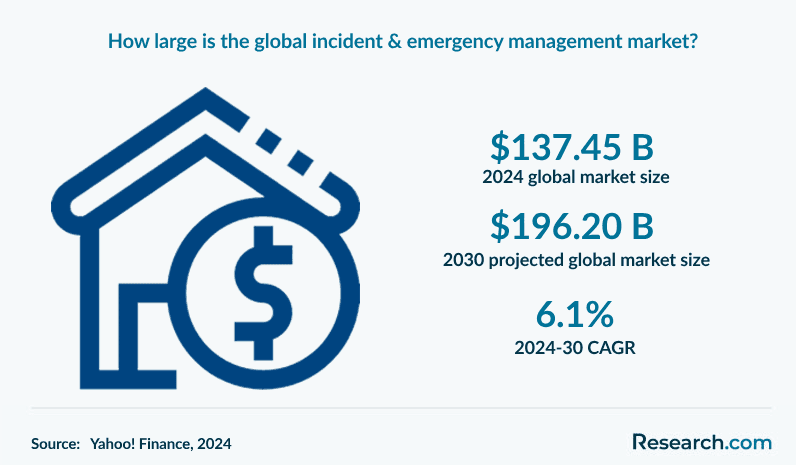
The image below illustrates the size of the global incident and emergency management market, which provides context for why emergency preparedness, resilience planning, and disaster response remain important areas of workforce development.
What are the financial aid options for students enrolling in an online master's in emergency management?
Online graduate students may qualify for many of the same financial aid options as campus-based students, provided the institution and program meet eligibility requirements. Because emergency management students often work in public service, healthcare, military, or government settings, employer and service-related benefits can be especially important.
- Federal financial aid: U.S. citizens and eligible non-citizens can submit the Free Application for Federal Student Aid. Graduate students may qualify for federal Direct Unsubsidized Loans and Graduate PLUS Loans.
- Scholarships and grants: Universities may offer merit scholarships, need-based grants, public service awards, or emergency management-related scholarships. Professional organizations such as the International Association of Emergency Managers may also offer scholarship opportunities.
- Employer tuition assistance: Government agencies, hospitals, emergency services departments, and private employers may provide tuition reimbursement or tuition assistance for employees pursuing job-relevant graduate education.
- Military and veteran education benefits: Active-duty service members, veterans, and eligible dependents may be able to use GI Bill benefits, Yellow Ribbon Program support, or school-based military tuition discounts. These benefits are not limited to students pursuing military science careers.
- Payment plans and institutional aid: Many universities offer monthly payment plans or institutional aid packages for online, adult, or part-time learners.
Before borrowing, ask the school for a full cost breakdown and compare expected monthly loan payments with realistic salary outcomes in your target role. A lower-cost accredited program may produce better ROI than a more expensive program with similar career outcomes.
What are the prerequisites for enrolling in an online master's in emergency management degree program?
Admission requirements vary by school, but most online master’s in emergency management programs expect applicants to show readiness for graduate-level coursework and a clear reason for entering the field.
- Bachelor’s degree: Applicants usually need a bachelor’s degree from an accredited institution. Emergency management, public administration, criminal justice, public health, homeland security, political science, business, or related majors may be helpful, but many programs accept students from other academic backgrounds. Students comparing related fields should understand the difference between criminal justice vs forensic science.
- Minimum GPA: Many schools require an undergraduate GPA between 2.5 and 3.0. Some may offer conditional admission if an applicant has strong professional experience or other evidence of readiness.
- Professional experience: Experience in emergency services, military service, healthcare, public safety, disaster response, government, or nonprofit work is often preferred, though not always required.
- Letters of recommendation: Programs may request 1–3 recommendations from supervisors, professors, or professional colleagues.
- Statement of purpose: Applicants are often asked to explain their career goals, interest in emergency management, and reasons for pursuing graduate study.
- Resume or CV: Schools commonly request a current resume showing education, employment, certifications, volunteer experience, leadership, and relevant technical skills.
- GRE scores: Most online programs do not require the GRE, although some schools may make it optional or request it from applicants with lower GPAs.
The chart below shows that Texas employs the most number of emergency management directors.
What courses are typically included in an online master's in emergency management degree program?
Emergency management master’s programs usually combine policy, planning, leadership, communication, operations, and analytical coursework. The best curriculum for you depends on whether your goal is government emergency management, public health preparedness, homeland security, nonprofit relief, corporate continuity, or emergency services administration.
| Course Area | What Students Learn | Career Relevance |
| Principles of emergency management | Preparedness, mitigation, response, recovery, and the disaster cycle. | Foundational knowledge for nearly all emergency management roles. |
| Disaster response and recovery | Agency coordination, resource deployment, recovery planning, and community restoration. | Useful for government, nonprofit, and field response roles. |
| Risk assessment and hazard mitigation | Threat identification, vulnerability analysis, and strategies to reduce future losses. | Important for planning, resilience, and mitigation-focused positions. |
| Crisis communication | Public messaging, media relations, stakeholder communication, and information management. | Critical for leadership roles where timely, accurate communication affects public safety. |
| Incident command and emergency operations | Operational frameworks such as the Incident Command System and multi-agency coordination. | Relevant for first responders, emergency operations centers, and public-sector planners. |
| Public health emergency management | Pandemics, bioterrorism, mass casualty incidents, and healthcare system readiness. | Useful for hospital, health department, and public health preparedness roles. |
| Homeland security and terrorism | National security policy, threat assessment, terrorism, and infrastructure protection. | Helpful for students considering homeland security or public safety careers. |
| Legal and ethical issues | Laws, regulations, authority, liability, ethics, and decision-making under pressure. | Essential for leaders responsible for policy and public accountability. |
| Capstone or practicum | Applied research, crisis scenario analysis, or a field-based project. | Can demonstrate practical competence to employers. |
Students specifically interested in national security may also compare the most affordable online master's programs in homeland security as an alternative or complementary path.
The chart below shows what emergency management specialists in the U.S. typically major in for their undergraduate degrees.
What types of specializations are available in a master's in emergency management degree program?
Specializations help students align graduate study with specific career goals. A concentration is most useful when it connects directly to the type of employer, hazard environment, or leadership role you want after graduation.
| Specialization | Focus | Best For |
| Homeland Security | Terrorism prevention, national security threats, border issues, infrastructure protection, and counterterrorism policy. | Students seeking roles in federal agencies, law enforcement, or security-focused public safety organizations. |
| Public Health Emergency Management | Pandemics, bioterrorism, health system surge capacity, mass casualty planning, and medical crisis response. | Healthcare workers, public health professionals, and hospital emergency planners. Some may also consider an affordable MSN nurse executive leadership degree online. |
| Disaster Recovery and Resilience | Long-term recovery, rebuilding, community resilience, mitigation, and post-disaster support systems. | Students interested in community planning, government recovery work, or nonprofit disaster relief. |
| Cybersecurity and Emergency Management | Cyber incident response, digital infrastructure protection, cyber policy, and crisis coordination during technology disruptions. | Professionals working with emergency operations, IT risk, public safety technology, or critical infrastructure. |
| Environmental Hazards and Climate Adaptation | Environmental disasters, climate-related hazards, mitigation, sustainability, and adaptation planning. | Students interested in resilience work involving floods, storms, wildfires, environmental risk, or local planning. |
| Criminal Justice and Emergency Services | Law enforcement coordination, emergency services administration, public safety systems, and incident response. | Police, fire, EMS, corrections, and public safety professionals moving into leadership. |
| Business Continuity and Risk Management | Operational continuity, enterprise risk, crisis planning, supply chain disruption, and organizational resilience. | Corporate, healthcare, logistics, and infrastructure professionals. Healthcare leaders may also compare the cheapest online MSN nurse administrator program. |
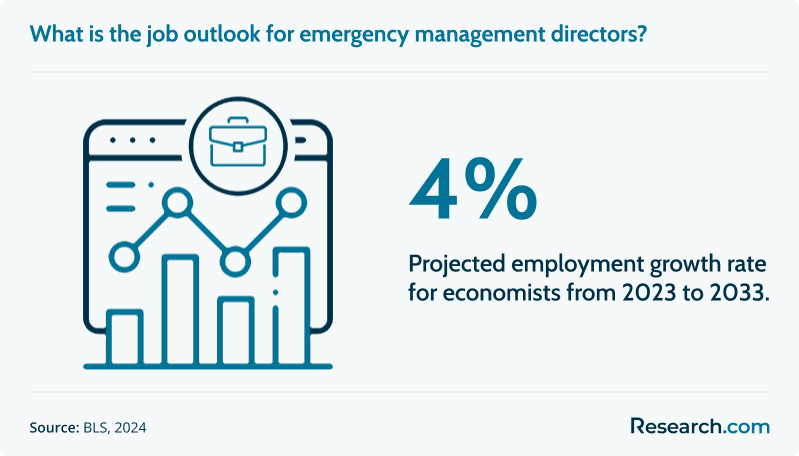
The image below shows the job outlook for emergency management directors in the United States from 2023 to 2033. This translates to an estimated 1,000 job openings for emergency management director each year over this 10-year period.
How can interdisciplinary programs complement an online master's in emergency management?
Emergency management is inherently interdisciplinary. Effective leaders must understand operations, communication, public policy, budgeting, logistics, technology, law, public health, and human behavior under stress. For that reason, some students strengthen their emergency management degree with targeted coursework or certificates in adjacent fields.
- Business and management: Useful for budgeting, resource allocation, continuity planning, and executive communication.
- Data analytics: Helpful for interpreting risk models, incident data, community vulnerability metrics, and operational dashboards.
- Cybersecurity: Increasingly relevant as cyber incidents can disrupt hospitals, utilities, government agencies, and emergency communications.
- Public health: Valuable for students focused on pandemics, mass casualty events, hospital readiness, or community health emergencies.
- Public administration: Strong fit for students who want policy, budgeting, and public-sector leadership roles.
Students who want stronger budgeting, operations, and organizational strategy skills may compare emergency management coursework with best value executive MBA programs online, especially if their long-term goal is senior leadership rather than field operations.
How does the return on investment compare for an online master's in emergency management degree program?
ROI for an online master’s in emergency management depends on your starting point. A professional already working in public safety, healthcare emergency preparedness, corporate risk, or government may use the degree to qualify for promotion. A career changer may need the degree plus internships, certifications, volunteer experience, or entry-level emergency planning work to become competitive.
| ROI Factor | Why It Matters | How to Evaluate It |
| Total program cost | Lower tuition can reduce debt and improve ROI. | Calculate tuition, fees, books, travel, and lost income if you reduce work hours. |
| Current career level | Professionals already in the field may benefit faster than career changers. | Ask whether graduates commonly receive promotions, new responsibilities, or role changes. |
| Accreditation and reputation | Employers may prefer degrees from recognized institutions with credible academic standards. | Verify institutional accreditation and, where relevant, field-specific accreditation. |
| Applied experience | Projects and simulations can help demonstrate skills to employers. | Look for capstones, practicum options, case-based courses, and portfolio-ready assignments. |
| Career alignment | A low-cost degree is less valuable if the curriculum does not support your target role. | Match courses and concentrations to specific job descriptions you want after graduation. |
Students should be cautious about assuming that a master’s degree alone will produce a salary jump. Compare program outcomes, local job postings, employer preferences, and your own experience before deciding whether the investment is worthwhile.
Is accreditation essential for ensuring educational quality and career readiness?
Yes. Accreditation is one of the most important quality checks when comparing online master’s programs. At minimum, students should look for institutional accreditation from a recognized accrediting body. Field-specific accreditation can provide an additional signal that the curriculum aligns with emergency management and homeland security education standards.
Accreditation matters because it can affect financial aid eligibility, transfer credit, employer perception, and confidence that the program meets established academic standards. In emergency management, where graduates may make decisions affecting public safety, curriculum quality and faculty expertise are especially important.
Students should also distinguish accreditation from rankings, marketing claims, and salary anecdotes. For example, salary discussions in other fields, such as entrepreneurship major salary, are not the same as verifying whether an emergency management program has the academic recognition and applied training needed for public safety careers.
Do employers value an online master's in emergency management degree?
Employers can value an online master’s in emergency management when the program is accredited, academically rigorous, and relevant to the role. In many hiring contexts, the delivery format matters less than whether the degree came from a credible institution and whether the candidate can show practical competence.
Employers often look for:
- Accreditation and institutional credibility.
- Coursework aligned with emergency planning, response coordination, risk analysis, resilience, and leadership.
- Applied projects, simulations, capstones, or practicum experience.
- Relevant work history in public safety, healthcare, government, nonprofit, military, logistics, or risk management.
- Communication, leadership, and decision-making skills under pressure.
- Evidence that the candidate can work across agencies, disciplines, and stakeholder groups.
Online learning can also signal self-discipline and digital collaboration skills. This is similar to how employers in other fields may consider efficient online formats, such as accelerated finance degrees online, when the institution and curriculum are credible.
How can I choose the best among the most affordable online master's in emergency management degree programs?
The best affordable program is not always the cheapest one. It is the program that provides the strongest combination of accredited quality, manageable cost, flexible scheduling, relevant coursework, useful faculty expertise, and clear alignment with your career goals.
| Selection Factor | What to Check | Why It Matters |
| Accreditation | Confirm institutional accreditation and any emergency management-specific accreditation. | Accreditation can affect financial aid, transferability, and employer confidence. |
| Total price | Compare tuition, credits, fees, books, technology charges, and graduation costs. | A program with a low per-credit rate may not be the lowest total cost. |
| Curriculum fit | Review required courses, electives, and concentrations. | The degree should support your target role, such as homeland security, public health preparedness, or business continuity. |
| Online format | Ask whether courses are asynchronous, live, cohort-based, accelerated, or self-paced. | Format determines whether you can realistically finish while working. |
| Applied learning | Look for capstones, simulations, planning projects, internships, or practicum options. | Applied assignments can help you show employers what you can do. |
| Faculty background | Review faculty experience in emergency management, public safety, homeland security, healthcare, or disaster response. | Faculty with field experience can connect theory to operational reality. |
| Student support | Ask about advising, library access, technical support, career services, and online student resources. | Online learners need support systems that do not depend on campus access. |
| Transfer and credit policies | Ask whether prior graduate credits or certificates can apply. | Transfer credit can reduce both cost and time to completion. |
Professionals who want to strengthen risk modeling, mapping, reporting, or incident analysis skills may also consider pairing emergency management study with an accelerated data analytics graduate certificate online.
Questions to Ask Before Enrolling
- Is the institution regionally accredited or otherwise properly accredited?
- Does the program have field-specific accreditation or recognition in emergency management?
- What is the total cost after tuition, fees, books, and technology charges?
- Are online students charged the same tuition regardless of state residency?
- Can I complete the program fully online, or are campus visits required?
- Are classes asynchronous, live, or a mix of both?
- Does the curriculum match the jobs I want after graduation?
- Are there capstone, practicum, simulation, or portfolio-building opportunities?
- What support is available for online graduate students?
- Can I use employer reimbursement, military benefits, scholarships, or federal aid?
The chart below shows that local governments employ the most number of emergency management directors in the U.S.
What are the differences between a traditional and an online master's in emergency management degree program?
Online and campus-based emergency management master’s programs can lead to the same credential, but the student experience is different. The better choice depends on your schedule, learning style, location, need for in-person networking, and work responsibilities.
| Factor | Online Master’s | Traditional Campus Master’s |
| Schedule | Often more flexible, especially when courses are asynchronous. | Usually follows fixed class times and campus schedules. |
| Location | Can often be completed from anywhere without relocating. | Requires living near campus or commuting regularly. |
| Networking | Uses discussion boards, video meetings, group projects, and virtual events. | Offers face-to-face interaction, campus events, and local professional connections. |
| Learning style | Best for self-directed students who can manage deadlines independently. | Best for students who prefer in-person structure and immediate classroom interaction. |
| Work compatibility | Often better for full-time workers, shift workers, parents, and military students. | May be harder to manage with irregular work schedules. |
| Cost considerations | May reduce relocation and commuting costs, though fees vary. | May include campus-related costs, housing, transportation, or relocation expenses. |
Online programs are often the better option for working professionals who need flexibility. Campus programs may be better for students who want in-person networking, local internships, or a more structured academic environment.
What career paths are available for graduates of an online master's in emergency management degree program?
An online master’s in emergency management can prepare graduates for leadership and planning roles across public, private, and nonprofit sectors. The degree is most powerful when paired with relevant experience, certifications, applied projects, and a clear specialization.
| Career Path | Core Responsibilities | Common Employers |
| Emergency Management Director | Lead preparedness programs, coordinate disaster response, manage teams, and oversee recovery planning. | Local, state, and federal agencies; universities; hospitals; large organizations. |
| Homeland Security Officer or Analyst | Assess threats, support security planning, reduce infrastructure vulnerabilities, and coordinate prevention strategies. | Government agencies, law enforcement, transportation, infrastructure, and security organizations. |
| Disaster Recovery Specialist | Coordinate post-disaster recovery, rebuilding, community assistance, and infrastructure restoration. | Government agencies, nonprofits, consulting firms, and relief organizations. |
| Business Continuity and Risk Manager | Develop continuity plans, reduce operational disruption, test response plans, and support organizational resilience. | Corporations, hospitals, utilities, logistics companies, financial institutions, and critical infrastructure organizations. |
| Public Health Emergency Planner | Prepare for pandemics, bioterrorism, mass casualty events, medical surge needs, and health system disruptions. | Hospitals, health systems, public health departments, and emergency preparedness offices. |
| Environmental or Climate Resilience Specialist | Plan for environmental hazards, climate adaptation, mitigation, and sustainable recovery. | Government agencies, planning offices, nonprofits, consulting firms, and community resilience programs. |
| Crisis Communications Manager | Manage public messaging, media coordination, stakeholder communication, and emergency information flow. | Government agencies, universities, hospitals, corporations, and public safety organizations. |
Students interested in homeland security roles can compare related affordable online homeland security degree programs. Those exploring public health emergency planning can also review What does a public health administrator do? to understand how emergency planning differs from broader public health administration.
Common Mistakes to Avoid When Choosing an Online Emergency Management Master’s
- Choosing only by sticker price: Always calculate total cost, including credits, fees, books, technology charges, and any required travel.
- Ignoring accreditation: Accreditation can affect financial aid, transfer credits, employer perception, and educational quality.
- Assuming every emergency management degree has the same focus: Some programs emphasize homeland security, while others focus on public health, emergency services leadership, public administration, or business continuity.
- Overlooking schedule requirements: A program advertised as online may still require live sessions, fixed deadlines, group meetings, or occasional campus components.
- Skipping the curriculum review: Course titles, electives, and capstone expectations reveal whether the program supports your intended career path.
- Relying too heavily on rankings: Rankings can help you build a shortlist, but the best program is the one that fits your budget, schedule, goals, and employer expectations.
- Assuming a master’s degree guarantees a promotion: Graduate education can strengthen your qualifications, but experience, certifications, networking, and job market conditions still matter.
Here's What Graduates Have to Say About the Most Affordable Online Master's in Emergency Management
-
: "
The online format made it possible for me to keep my full-time public safety job while developing stronger skills in disaster planning and risk management. The coursework was flexible, but the discussions and group assignments still felt active and practical. I finished the program feeling ready to take on more leadership responsibility. Janelle
"
-
: "
I was not sure I could balance graduate school with parenting, but the structure of the online program made it manageable. The case studies and simulations connected directly to the work I do now in regional emergency response. The flexibility and support made the degree achievable. Ethan
"
-
: "
I began my online master’s while stationed overseas, and studying from anywhere was essential. The curriculum pushed me to think more strategically, and the classmates brought experience from many different sectors. The degree helped me move toward a federal emergency planning role. Olly
"
Key Insights
- Affordable does not mean low quality: The strongest low-cost programs combine reasonable tuition with proper accreditation, relevant coursework, applied projects, and support for online students.
- Total cost matters more than per-credit tuition: Compare credits, fees, residency rules, books, technology charges, and transfer policies before deciding which program is truly the most affordable.
- Most programs require 30 to 36 credits: Many students complete the degree in 18 months to 2 years, while accelerated options may take less time and part-time study may take 2 to 3 years.
- Career outcomes depend on experience and specialization: A master’s degree can support leadership roles, but students should align electives and capstones with target jobs in government, healthcare, homeland security, business continuity, or nonprofit response.
- Salary potential varies by role: Emergency Management Directors had a median annual wage of $83,960 as of May 2023. Top earners make over $151,560, while the bottom 10% earn under $50,340.
- Job growth is steady rather than explosive: Employment for Emergency Management Directors is projected to grow by 4% from 2023 to 2033, with about 1,000 job openings each year due to retirements or career changes.
- Online flexibility is valuable for working professionals: Students in emergency services, dispatch, law enforcement, healthcare, and military roles often need programs that can adapt around rotating schedules and full-time work.
- Accreditation should be non-negotiable: Before enrolling, verify institutional accreditation and review whether the program has specialized recognition, such as through the CAEMHSE.
References:
- Council for the Accreditation of Emergency Management and Homeland Security Education. (n.d.). No-Cost Assessment & Accreditation. CAEMHSE.
- United States Bureau of Labor Statistics. (2024, April 3). Occupational Employment and Wage Statistics: 11-9161 Emergency Management Directors. BLS.
- United States Bureau of Labor Statistics. (2025, April 18). Occupational Outlook Handbook: Emergency Management Directors. BLS.
- Zippia. (2025, Janaury 8). What is an Emergency Management Specialist and How to Become One. zippia.com.
Other Things You Should Know About the Most Affordable Online Master’s in Emergency Management Programs
Yes, many affordable online emergency management master’s programs require a capstone, thesis, or applied practicum. These final projects are often worth 3 to 6 credits and are completed near the end of the degree, usually after the core coursework is finished.
Online master's programs in emergency management in 2027 typically require students to have a reliable computer, high-speed internet, and updated software for accessing course materials and virtual classrooms. Some may also require specific software for assignments or simulations.
Online master's students in emergency management are often provided access to digital libraries, academic advising, career services, and virtual collaboration tools. These resources ensure that distance learners receive support similar to on-campus students during their studies.