2027 Most Affordable Online MSN to EdD Bridge Programs

Co-Founder and Chief Data Scientist
MSN-prepared nurses who want to teach, lead nursing programs, or move into academic administration often face the same barrier: a doctorate can improve career options, but the cost, time commitment, and program fit are not always clear. Online MSN to EdD bridge programs are designed to make that next step more practical by allowing nurses with graduate nursing preparation to pursue doctoral-level education leadership training without leaving the workforce.
This guide explains how affordable online MSN to EdD bridge programs work, what they cost, how long they take, which schools offer lower-cost options, and how to compare programs without focusing on tuition alone. It is written for MSN graduates, nurse educators, clinical instructors, nursing program leaders, and healthcare professionals who want a doctoral pathway focused on teaching, curriculum, leadership, and organizational change rather than advanced clinical practice.
You will learn what to expect from the curriculum, how online and campus-based options differ, what funding sources may reduce the cost, which admissions requirements to prepare for, and how to judge whether an EdD is the right doctorate for your career goals.
Quick answer: Is an affordable online MSN to EdD bridge program worth it?
An affordable online MSN to EdD bridge program can be worth it for nurses who want to move into nursing education, academic leadership, curriculum design, healthcare training, or administrative roles. The degree is especially useful for MSN-prepared nurses who want a practice-focused doctorate in education and leadership rather than a research-intensive PhD or a clinically focused DNP.
The strongest return usually comes when the program is regionally accredited, accepts prior MSN credits, aligns with your intended role, offers strong dissertation or capstone support, and keeps total costs manageable. It is less suitable for nurses whose main goal is to become an advanced clinical provider, since an EdD does not replace role-specific APRN preparation or licensure requirements.
What are the benefits of getting an affordable online MSN to EdD bridge program?
- Access to senior education and leadership roles: An EdD can prepare MSN-trained nurses for positions beyond bedside or direct clinical care, including nurse educator, nursing professor, academic leader, director of nursing education, director of nursing, program administrator, and leadership roles in colleges, universities, hospitals, and healthcare systems.
- Potential for higher earnings: Doctoral preparation may support advancement into better-compensated academic and administrative roles. In 2023, postsecondary nurse educators earned a median of about $80,780 to $86,900 annually, while those in general medical and surgical hospitals averaged around $106,620. Postsecondary education administrators had a median salary of $102,610 in 2023, and medical and health services managers had a median pay of $110,680.
- Flexibility for working nurses: Online programs can help nurses continue working while completing doctoral coursework. Many use asynchronous courses, allowing students to study around shifts, family obligations, and professional responsibilities. Online study may also reduce relocation, commuting, and campus housing costs.
What can I expect from an affordable online MSN to EdD bridge program?
An affordable online MSN to EdD bridge program is usually built for nurses who already hold a Master of Science in Nursing and want doctoral preparation in education, leadership, curriculum, assessment, and applied research. The “bridge” structure may allow students to apply previous MSN coursework toward doctoral requirements, which can shorten the path and reduce the number of credits needed compared with entering a doctorate without relevant graduate preparation.
Most programs emphasize applied leadership rather than laboratory-based or theory-heavy research. Students commonly study curriculum design, adult learning, instructional technology, assessment, policy, organizational improvement, and evidence-based approaches to nursing education. The final requirement is often a dissertation in practice or doctoral capstone that addresses a real problem in a nursing school, healthcare education department, clinical training program, or academic setting.
The online format is a major advantage for nurses who cannot relocate or pause employment. However, “online” does not always mean fully asynchronous. Some programs require live virtual meetings, summer intensives, orientation visits, campus residencies, or an in-person dissertation defense. Before enrolling, verify the exact delivery format and any travel requirements.
| Program feature | What it usually means for MSN-prepared nurses | What to verify before applying |
| Bridge structure | Prior MSN coursework may reduce required doctoral credits. | How many MSN credits transfer and whether transfer credit lowers tuition. |
| Education leadership focus | Coursework often centers on teaching, curriculum, assessment, and organizational change. | Whether the curriculum fits nursing education rather than general K-12 leadership only. |
| Online delivery | Students can often remain employed while completing coursework. | Whether courses are asynchronous, synchronous, hybrid, or residency-based. |
| Dissertation or capstone | Students complete an applied project tied to a professional education problem. | How dissertation advising works and average time to completion. |
Where can I work with an affordable online MSN to EdD bridge program?
Graduates usually pursue roles that combine nursing expertise with education, leadership, and program development. Many work in colleges, universities, nursing schools, healthcare systems, professional development departments, simulation centers, and academic medical settings.
- Nurse educator or nursing professor: Teach undergraduate or graduate nursing students, design learning activities, assess student performance, and help prepare future nurses for clinical practice.
- Program director or department chair: Manage nursing programs, coordinate faculty, support accreditation work, review outcomes, and guide curriculum quality.
- Academic dean or associate dean: Lead larger academic units, shape policy, manage budgets, oversee faculty development, and support institutional strategy.
- Healthcare education leader: Build staff education programs, continuing education initiatives, onboarding systems, clinical training modules, or simulation-based learning experiences.
How much can I make with an affordable online MSN to EdD bridge program?
Earnings depend on role, employer, region, experience, rank, and whether the position is in higher education, healthcare administration, or a hospital-based education department. An EdD does not guarantee a specific salary, but it can support eligibility for senior teaching and leadership positions that may pay more than roles requiring only an MSN.
For nurse educators and professors, the median annual salary was around $86,900 in 2023 for those working at colleges, universities, and professional schools. Nursing instructors in general medical and surgical hospitals earned a median of approximately $106,620. For broader administrative roles, postsecondary education administrators had a median annual wage of $102,610 in 2023, and medical and health services managers earned a median of $110,680 in May 2023.
| Career direction | Relevant salary figure stated in available data | How an EdD may help |
| Postsecondary nursing education | About $80,780 to $86,900 annually in 2023 | Supports eligibility for faculty, curriculum, and academic leadership roles. |
| Hospital-based nursing instruction | Around $106,620 in general medical and surgical hospitals | May strengthen qualifications for clinical education and staff development leadership. |
| Postsecondary education administration | $102,610 in 2023 | Can support movement into program administration, dean-level tracks, and academic operations. |
| Medical and health services management | $110,680 in May 2023 | Can complement nursing leadership experience in healthcare education or administration. |
- Most Affordable Online MSN to EdD Bridge Programs for 2027
- How long does it take to complete an affordable online MSN to EdD bridge program?
- How does an affordable online MSN to EdD bridge program compare to an on-campus program?
- What is the average cost of an affordable online MSN to EdD bridge program?
- What are the financial aid options for students enrolling in an affordable online MSN to EdD bridge program?
- What are the prerequisites for enrolling in an affordable online MSN to EdD bridge program?
- What courses are typically in an affordable online MSN to EdD bridge program?
- What types of specializations are available in affordable online MSN to EdD bridge programs?
- What challenges should I anticipate in an affordable online MSN to EdD bridge program?
- How do these programs leverage digital innovation to enhance nursing education?
- What student support services should I seek in an affordable online MSN to EdD bridge program?
- How does one choose the best among the most affordable online MSN to EdD bridge program?
- Are affordable online MSN to EdD bridge programs accredited, and why does accreditation matter?
- What career paths are available for graduates of affordable online MSN to EdD bridge programs?
- What is the job market like for graduates with an affordable online MSN to EdD bridge program?
- How can clinical specialization enhance the value of an online MSN to EdD bridge program?
Most Affordable Online MSN to EdD Bridge Programs for 2027
How do we rank schools?
Choosing an affordable online MSN to EdD bridge program is both an academic and financial decision. Research.com evaluates programs to help readers compare lower-cost doctoral pathways using available data rather than marketing claims alone.
This ranking is based on a transparent methodology using information from sources such as the Integrated Postsecondary Education Data System (IPEDS), Peterson's databases including the Distance Learning Licensed Data Set, and the College Scorecard database from the National Center for Education Statistics. These sources help compare institutional affordability, distance learning availability, and program-level characteristics that matter to working nurses.
1. Georgia Southwestern State University
Georgia Southwestern State University offers an online Doctor of Education in Educational Leadership that can fit MSN-prepared nurses seeking leadership roles in nursing education, higher education, or healthcare administration. The program is designed for education leaders across fields and uses a flexible online format that can work for employed professionals. Concentration options such as Educational Leadership and Higher Education Leadership may be relevant for nurses planning to teach or lead within academic settings.
- Program length: 3-4 years
- Tracks/concentrations: Educational Leadership and Higher Education Leadership
- Cost per credit: $257
- Required credits to graduate: 60 credits
- Accreditation: Southern Association of Colleges and Schools Commission on Colleges (SACSCOC), Council for the Accreditation of Educator Preparation (CAEP).
2. University of Texas at Arlington
The University of Texas at Arlington offers an online Doctor of Philosophy in Educational Leadership and Policy Studies. Although this is a Ph.D. rather than an EdD, MSN graduates interested in leadership, policy, institutional assessment, or higher education administration may find the program aligned with academic leadership goals. The program uses a cohort model delivered through a web-based system and is commonly structured for students entering in the fall.
- Program length: 5 years
- Tracks/concentrations: Institutional Assessment, Policy Analysis, Institutional Leadership, and Higher Education Administration.
- Cost per credit: $273.33
- Required credits to graduate: 66 credits
- Accreditation: Southern Association of Colleges and Schools Commission on Colleges (SACSCOC).
3. Texas Tech University
Texas Tech University offers an online Doctor of Education in Higher Education Administration for professionals who want to advance in colleges, universities, and related academic organizations. MSN graduates who want leadership roles in nursing schools or academic medical centers may find the higher education focus especially useful. The program follows a cohort model that begins in Fall semesters and uses a blended format with a required on-campus orientation, two summer immersion sessions, and a final on-campus dissertation defense.
- Program length: 3 years
- Tracks/concentrations: Higher Education Administration
- Cost per credit: $444.37
- Required credits to graduate: 55 credits
- Accreditation: Southern Association of Colleges and Schools Commission on Colleges (SACSCOC).
4. Valdosta State University
Valdosta State University offers an online Doctor of Education in Leadership for professionals who want to become ethical, effective leaders in schools, organizations, and healthcare-adjacent education settings. The program is delivered fully online and allows students to work with advisors to identify a cognate area. Options such as Executive Leadership, Curriculum Leadership, Technology Leadership, and Higher Education Leadership can be useful for MSN graduates focused on nursing education or organizational learning.
- Program length: 3 years
- Tracks/concentrations: Executive Leadership, Teacher Leadership, Curriculum Leadership, Technology Leadership, or Higher Education Leadership.
- Cost per credit: $293
- Required credits to graduate: 64 semester credits
- Accreditation: Southern Association of Colleges and Schools Commission on Colleges (SACSCOC), Council for the Accreditation of Educator Preparation (CAEP)
5. University of Wyoming
The University of Wyoming offers an online Doctor of Education in Educational Leadership with an applied practitioner focus. MSN-prepared nurses may use the program to build leadership capacity in formal education, community education, healthcare training, or nursing education contexts. The program is offered entirely online, typically begins new cohorts in the Fall, and emphasizes a Dissertation in Practice model that lets students address an applied problem from their professional environment.
- Program length: 3 years
- Tracks/concentrations: Curriculum and Instruction, Educational Leadership
- Cost per credit: $337
- Required credits to graduate: 80 credits
- Accreditation: Council for the Accreditation of Educator Preparation (CAEP)
6. South College
South College offers an online Doctor of Education through a competency-based education model. This structure can appeal to working nurses who want a more self-paced doctoral option and can demonstrate mastery efficiently. MSN graduates may find the Higher Education Leadership, Organizational Leadership, Adult Learning and Development, or Instructional Design and Technology options relevant to nursing education, healthcare training, and academic leadership goals.
- Program length: 2 years
- Tracks/concentrations: Higher Education Leadership, Organizational Leadership
- Cost per credit: $310
- Required credits to graduate: 60 credits
- Accreditation: Southern Association of Colleges and Schools Commission on Colleges (SACSCOC)
7. Fort Hays State University
Fort Hays State University offers an online Doctor of Education in Educational Leadership for professionals seeking leadership and administrative roles. MSN graduates may use the program to prepare for roles in higher education and other learning environments. The school also has partnerships, including with American College of Education (ACE), that may create additional doctoral pathways, including a D. in Nursing Education at ACE that FHSU graduates can access.
- Program length: 2 years
- Tracks/concentrations: General Educational Leadership, Global Leadership and Educational Technology Innovation
- Cost per credit: $319
- Required credits to graduate: 60 credits
- Accreditation: Higher Learning Commission (HLC)
8. Lamar University
Lamar University offers an online Doctor of Education in Educational Leadership for students preparing to lead across educational settings. MSN graduates who want to work in nursing education, healthcare learning departments, or educational technology may benefit from the program’s leadership and innovation emphasis. The program is delivered entirely online and includes concentration areas that can support work in curriculum development, organizational change, and technology-supported teaching.
- Program length: 2 years
- Tracks/concentrations: Global Educational Leadership and Educational Technology Innovation
- Cost per credit: $359
- Required credits to graduate: 60 credit hours
- Accreditation: Southern Association of Colleges and Schools Commission on Colleges (SACSCOC)
9. Appalachian State University
Appalachian State University offers an online Doctor of Education in Educational Leadership for experienced professionals who want to influence educational systems. MSN graduates interested in higher education may find the Higher Education concentration relevant. Unlike some self-paced online programs, this option commonly includes synchronous class meetings two nights per week, so applicants should be comfortable with scheduled live participation.
- Program length: 4.5 years
- Tracks/concentrations: Higher Education Administration and Educational Administration
- Cost per credit: $477
- Required credits to graduate: 60 hours
- Accreditation: Southern Association of Colleges and Schools Commission on Colleges (SACSCOC).
10. University of the Cumberlands
The University of the Cumberlands offers an online Doctor of Educational Leadership for professionals who want to guide change in education, healthcare, and organizational environments. Courses typically run in eight-week bi-terms, and many are asynchronous. The Specialty Emphasis Area of at least eighteen hours can include health professions or nursing, which may be especially valuable for MSN-prepared nurses who want a doctoral program connected to healthcare education.
- Program length: 2.5 to 3 years
- Tracks/concentrations: Health Professions and Nursing, along with other areas like Business, Counseling, Higher Education, and Technology
- Cost per credit: $415 per credit hour
- Required credits to graduate: 60 credit hours.
- Accreditation: Southern Association of Colleges and Schools Commission on Colleges (SACSCOC).
How long does it take to complete an affordable online MSN to EdD bridge program?
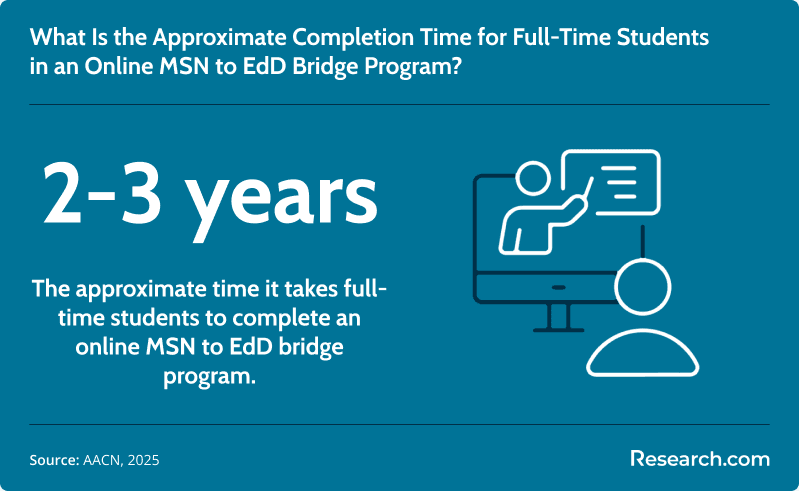
Most affordable online MSN to EdD bridge programs take about two to three years, though timelines vary by enrollment pace, dissertation progress, transfer credit, and program design. Some accelerated formats may be completed in three years or less, while part-time students may need more time. The value of the bridge format is that it can recognize prior MSN-level learning and reduce duplication.
The final project often determines whether students finish on schedule. Coursework may be predictable, but dissertation or capstone work requires topic approval, research design, data collection or analysis, faculty review, and revisions. Before enrolling, ask whether the program embeds dissertation work into early courses or leaves most of it until the end.
| Timeline factor | How it affects completion | Question to ask the program |
| Transfer credits | More accepted MSN credits may reduce required coursework. | How many graduate credits can be applied toward the EdD? |
| Enrollment pace | Full-time study is faster but harder to balance with nursing work. | Can I switch between full-time and part-time enrollment? |
| Residency requirements | Campus visits can add travel time and scheduling constraints. | Are any orientations, immersions, or defenses required in person? |
| Dissertation support | Strong advising can reduce delays during the final stage. | When do students begin planning the dissertation or capstone? |
How does an affordable online MSN to EdD bridge program compare to an on-campus program?
Online MSN to EdD bridge programs are usually the better fit for working nurses who need flexibility, want to avoid relocation, and plan to keep earning an income while studying. On-campus programs may work better for students who want face-to-face faculty access, structured weekly routines, and a stronger in-person academic network.
Many nurses comparing doctoral options also review cheapest MSN to PhD programs online, especially if they are deciding between an applied education doctorate and a research-focused doctorate.
The key difference is not simply location. Online programs can vary widely in delivery. Some are fully asynchronous, some include live evening classes, and some require short campus intensives. Campus-based EdD programs may also be designed for working professionals, with evening or weekend classes, but they usually require regular travel and proximity to the institution.
| Comparison point | Online MSN to EdD bridge program | On-campus EdD program |
| Flexibility | Best for nurses balancing shifts, family responsibilities, and geographic limitations. | Best for students who can attend scheduled in-person classes consistently. |
| Cost considerations | May reduce commuting, relocation, and housing expenses. | May involve transportation, parking, relocation, or time away from work. |
| Interaction | Depends on virtual advising, discussion boards, live sessions, and cohort design. | Offers more immediate face-to-face contact with faculty and peers. |
| Learning style | Requires independence, organization, and comfort with digital platforms. | Provides more structure for students who prefer classroom routines. |
What is the average cost of an affordable online MSN to EdD bridge program?
In 2024, approximately 20.6% of registered nurses have a master's degree, making doctoral bridge pathways relevant for a growing group of advanced-prepared nurses. Affordable online MSN to EdD bridge programs vary widely in cost. Per-credit tuition rates typically range from $275 to over $950 per credit hour. For a full-time program, costs might begin at approximately $595 per credit. Because most bridge programs require 45-60 credit hours, total program cost can range from $23,000 to $57,000, although some of the cheapest online EdD programs can be found for under $30,000 total.
Tuition is only one part of the actual price. Students should also calculate technology fees, graduation fees, books, dissertation fees, travel for residencies, exam or proctoring costs, and lost income if coursework reduces work hours. Online delivery may lower commuting and housing costs, while bridge credit can reduce the number of courses required.
Some nurses also explore cheapest online natural science programs when comparing affordable ways to add academic credentials or strengthen science-related preparation alongside nursing education goals.
Public universities are often among the lower-cost options, particularly for in-state students. Private universities may charge more but sometimes offer accelerated calendars, competency-based formats, or flexible start dates that can shorten time to completion for motivated students.
| Cost factor | Why it matters | How to reduce risk |
| Per-credit tuition | Small differences add up across 45-60 credit hours. | Compare total degree cost, not only the advertised per-credit rate. |
| Transfer credit | Accepted MSN credits may lower total tuition. | Request a written transfer evaluation before enrolling. |
| Residencies | Travel can increase the real cost of an “online” program. | Ask for all required campus visits and estimated timing. |
| Dissertation fees | Extended dissertation enrollment can increase cost. | Ask how tuition is charged after coursework is complete. |
Understanding the educational landscape of registered nurses (RNs) is useful when weighing the cost of doctoral study. The following chart shows the highest level of education attained by RNs in 2024 and reflects the profession’s movement toward advanced education.
What are the financial aid options for students enrolling in an affordable online MSN to EdD bridge program?
Students in affordable online MSN to EdD bridge programs may be able to combine federal aid, employer benefits, nursing scholarships, institutional aid, military education benefits, and loan forgiveness opportunities. The best approach is to apply early and compare funding sources before accepting loans.
Federal financial aid
- Submit the FAFSA to be considered for federal aid and to help states and schools determine eligibility for their own aid packages.
- At the doctoral level, loan options commonly include direct unsubsidized loans and grad PLUS loans.
- Federal aid eligibility usually depends on enrollment status, institutional eligibility, citizenship or eligible noncitizen status, and satisfactory academic progress.
Nursing-specific scholarships and grants
- The HRSA Nurse Corps Scholarship Program may support nursing education in exchange for service in critical shortage facilities.
- Nursing-specific scholarships can help reduce out-of-pocket costs for graduate and doctoral nursing students.
- Nurses Educational Funds, Inc. has awarded more than 1,460 scholarships for advanced degrees in nursing.
- The AfterCollege-AACN Scholarship Fund supports students working toward a BSN, MSN, or doctoral degree in nursing. One scholarship in the amount of $2,500 will be awarded to each quarter.
- Accelerated BSN to Doctoral (PhD, DNP, DNAP, EdD) applicant programs may have scholarship opportunities tied to doctoral preparation.
Additional financial support
- Employer tuition assistance from hospitals, health systems, colleges, or public agencies.
- Military education benefits and tuition discounts for eligible service members.
- State nursing workforce grants and local scholarship programs.
- Professional nursing association scholarships and foundation awards.
- Graduate assistantships or work-study options where available.
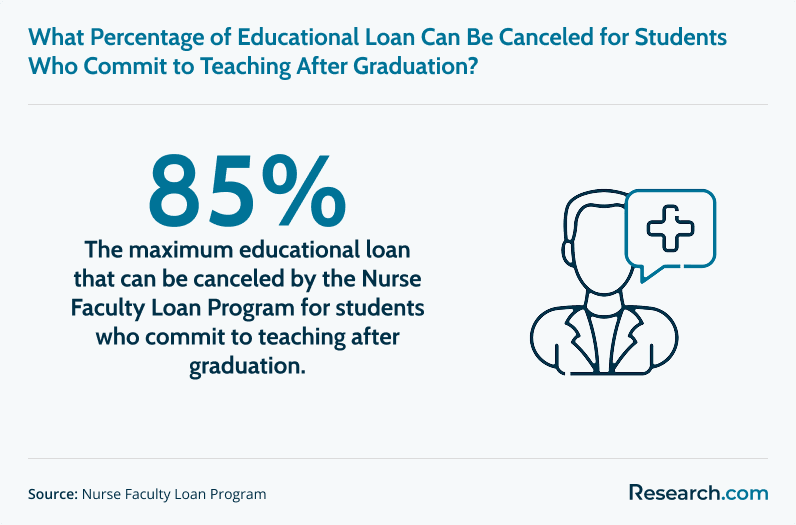
The Nurse Faculty Loan Program (NFLP), managed by the Health Resources and Services Administration (HRSA), is especially relevant for nurses pursuing faculty careers. Students who commit to teaching at a school of nursing after graduation can receive cancellation of up to 85% of their educational loans, plus interest, over a four-year period. This can be particularly valuable for nurses moving from affordable online MSN nursing education programs into doctoral-level faculty preparation.
What are the prerequisites for enrolling in an affordable online MSN to EdD bridge program?
Admissions requirements vary, but most affordable online MSN to EdD bridge programs expect applicants to show graduate-level academic readiness, active nursing credentials, relevant professional experience, and clear career goals in education or leadership.
Educational requirements
- A master's degree in nursing, with an overall GPA of at least 3.0, from a regionally-accredited institution.
- An undergraduate GPA of 3.0 on a 4.0 scale, a 3.0 average for the last 60 semester hours in a degree program, or a 3.0 or higher in a completed graduate degree program.
- The standard minimum GPA for an Ed.D. in nursing education is 3.0, though schools of nursing with stronger academic selectivity may require a higher GPA.
- Official transcripts for all undergraduate and graduate coursework.
Professional credentials
- A valid and active RN license from the United States.
- Relevant nursing experience; some Ed.D. programs may expect at least three years of relevant nursing experience.
- A current, unencumbered nursing license without disciplinary actions.
Application materials
- Three current references or letters of recommendation.
- A professional resume or curriculum vitae describing experience in teaching, administration, education policy, research, clinical leadership, or related work.
- An academic writing sample, personal statement, or statement of purpose when required.
- A graduate application and application fee.
Some programs may also require prerequisite coursework in statistics, research methods, or education theory. Others include interviews, writing assessments, or English proficiency requirements for international applicants. Nurses considering academic administration may also compare related doctoral routes, including affordable higher education PhD programs online.
What courses are typically in an affordable online MSN to EdD bridge program?
In 2024, 17% of registered nurses with MSN have non-nursing degrees. For MSN to EdD bridge students, the curriculum typically combines advanced education coursework with applied research and leadership content relevant to nursing and healthcare learning environments.
Core educational foundation courses
- Educational leadership and administration: Covers leadership models, organizational behavior, decision-making, and administrative practice in academic or healthcare education settings.
- Curriculum design and development: Teaches students how to create, review, and improve curricula using learning theory, instructional strategy, and outcomes assessment.
- Research methods and statistics: Builds skills in qualitative, quantitative, and mixed-methods research for applied education problems.
- Educational psychology and learning theory: Examines adult learning, motivation, cognitive development, and teaching methods relevant to nursing students and practicing clinicians.
- Assessment and evaluation in education: Focuses on measuring student learning, evaluating courses, reviewing program outcomes, and improving instruction.
Advanced specialization courses
- Technology in nursing education: Explores learning management systems, simulation, digital tools, and virtual teaching strategies.
- Quality improvement and program evaluation: Prepares students to analyze outcomes and improve nursing education programs systematically.
- Ethics and legal issues in nursing education: Addresses academic integrity, student rights, professional standards, regulatory expectations, and ethical leadership.
Culminating experience
- Dissertation in practice or doctoral capstone project: Most Ed.D. programs require students to complete an original applied project, dissertation in practice, or doctoral capstone focused on a problem in nursing education or educational leadership.
Most programs require 45-60 credit hours total. The bridge format may reduce the overall course load by allowing MSN graduates to apply previous graduate coursework toward degree requirements.
What types of specializations are available in affordable online MSN to EdD bridge programs?
Specializations help students align doctoral coursework with the setting where they plan to work. Some programs offer nursing-specific concentrations, while others provide broader education leadership tracks that MSN graduates can tailor through electives, applied projects, or dissertation topics.
In entry-level master's accelerated nursing programs of 2023, 9,318 students were enrolled, and 4,570 students graduated. For nurses seeking advancement, choosing the right EdD concentration can support movement toward leadership roles, including some paths associated with the highest paid nurses.
Primary nursing education specializations
- Nurse educator: Focuses on teaching, curriculum, clinical instruction, assessment, and preparation of future nurses. In 2024, among the nursing workforce 4.5% are nurse educators.
- Nursing and health professions education: Prepares graduates to teach and lead across nursing and other healthcare disciplines.
- Instructional leadership with nurse education concentration: Combines broad leadership preparation with focused coursework in nurse education.
Healthcare leadership and administration specializations
- Educational leadership and administration: Prepares students to manage, evaluate, and improve educational systems in nursing, healthcare, and academic environments.
- Healthcare leadership: Supports roles such as healthcare administrator, professor of nursing, and behavioral health program administrator.
Specialized focus areas
- Athletic training education: May be offered in broader education doctorates alongside Nurse Educator, Teaching and Learning, and Executive Leadership specializations.
- Teaching and learning: Emphasizes pedagogy, instructional design, and effective learning strategies for healthcare education.
- Executive leadership: Fits students targeting senior administrative roles in healthcare education organizations or academic units.
- Behavioral health program administration: Prepares leaders to oversee behavioral health programs that serve patients with mental, emotional, and behavioral health needs.
When comparing specializations, prioritize the one that connects directly to your intended workplace. A nurse who wants to become a faculty member may need different preparation from a nurse who wants to run professional development programs for a hospital system.
This chart shows enrollment trends for MSN programs between 2014 and 2023 and offers context for how participation in graduate nursing education has changed over the past decade.
What challenges should I anticipate in an affordable online MSN to EdD bridge program?
The biggest challenge is not usually a single course; it is sustaining doctoral-level work while managing a nursing career. Online EdD students need disciplined scheduling, comfort with self-directed research, and the ability to participate actively even without regular in-person contact.
Common pressure points include navigating virtual library systems, using learning management platforms, securing faculty feedback, staying on pace with dissertation milestones, and managing group work across time zones. Students who have been away from academic writing or statistics may also need extra preparation before research courses begin.
Prospective students should verify accreditation, dissertation support, faculty access, and student outcomes before enrolling. Nurses filling earlier education gaps may also compare alternative pathways such as RN to BSN without clinicals, but MSN-prepared applicants should focus primarily on doctoral fit, credit transfer, and career alignment.
Common mistakes to avoid
- Choosing the lowest tuition without calculating total program cost.
- Assuming “online” means no campus visits or live class meetings.
- Ignoring dissertation support until the final year.
- Enrolling in a general education doctorate without checking whether nursing education goals can be supported.
- Assuming an EdD will meet clinical licensure or APRN requirements.
- Failing to confirm accreditation before applying for federal aid or employer reimbursement.
How do these programs leverage digital innovation to enhance nursing education?
Online MSN to EdD bridge programs increasingly rely on digital tools that mirror the way modern nursing education is delivered. Students may use cloud-based learning management systems, virtual discussion spaces, digital research databases, online collaboration tools, and simulation-supported teaching methods.
For future nurse educators, this matters because digital competence is now part of effective teaching. Graduates may be expected to design online modules, support hybrid clinical learning, evaluate simulation activities, and use technology to improve student engagement and learning outcomes. Programs that integrate these tools well can help nurses become stronger educators in both academic and healthcare training environments.
Digital pathways are also reshaping earlier nursing education routes, including accelerated BSN online programs, which shows how nursing education continues to blend clinical preparation with flexible learning technology.
What student support services should I seek in an affordable online MSN to EdD bridge program?
Strong support services can determine whether an online doctoral program feels manageable or isolating. Look for programs that provide clear academic advising, accessible faculty, technical support, research guidance, writing assistance, and career services designed for doctoral students.
- Doctoral advising: Advisors should help with course sequencing, transfer credit, degree planning, and dissertation milestones.
- Research and library support: Students need access to databases, librarians, citation support, and research methodology resources.
- Writing support: Doctoral writing is demanding, so writing centers and dissertation workshops are valuable.
- Technology help: Online students should have reliable support for learning platforms, video tools, and digital submission systems.
- Faculty mentorship: Mentors can help connect coursework to career goals in nursing education, leadership, or administration.
- Peer networking: Cohorts, online communities, and virtual residencies can reduce isolation and build professional connections.
Support quality is relevant at every stage of nursing education, from entry pathways such as cheap LPN to RN online programs to doctoral-level leadership preparation.
How does one choose the best among the most affordable online MSN to EdD bridge programs?
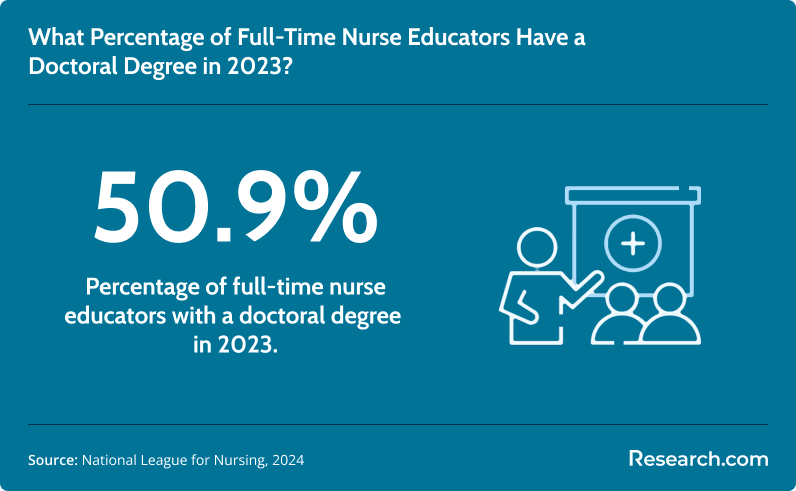
In 2023, 50.9% of full-time nurse educators have a doctoral degree. For MSN-prepared nurses, the best affordable online MSN to EdD bridge program is not simply the cheapest program. It is the program that meets accreditation standards, supports your career goal, accepts relevant transfer credit, fits your schedule, and offers enough faculty guidance to help you finish.
If you are comparing broader online nursing programs, use a decision process that separates price from value.
Essential accreditation and quality factors
- Institutional accreditation: Confirm that the university is accredited by a recognized accreditor before applying.
- Nursing-specific relevance: If your goal is nursing education, check whether the curriculum includes nursing education, health professions education, or an applied project option in nursing.
- Program reputation: Employers may consider institutional credibility, faculty expertise, and graduate outcomes when evaluating candidates.
Program structure and flexibility
- Curriculum fit: Review required courses, electives, research sequence, and capstone expectations to ensure they match your professional goals.
- Start dates and scheduling: Some programs offer multiple start dates, while cohort programs may admit only once per year.
- Credit transfer policies: Ask how many MSN credits can transfer and whether they reduce both time and cost.
Financial considerations
- Total program cost: Compare tuition, fees, travel, books, technology costs, and dissertation enrollment charges.
- Financial aid options: Look for institutional scholarships, employer assistance, graduate assistantships, and nursing-specific awards.
- Fee transparency: Some programs advertise low tuition but charge additional mandatory fees.
Faculty and support quality
- Faculty credentials: Look for faculty with doctoral preparation, nursing education experience, applied research expertise, and leadership backgrounds.
- Student services: Prioritize programs with advising, research support, technical help, writing support, and career guidance.
- Student success metrics: Ask about graduation rates, dissertation completion timelines, and job placement information where available.
Questions to ask before enrolling
| Question | Why it matters |
| How many MSN credits will transfer into the doctorate? | Transfer credit can reduce time and total tuition. |
| Is the program fully online, or are campus visits required? | Residencies can affect cost, travel, and scheduling. |
| Can my dissertation or capstone focus on nursing education? | The final project should strengthen your intended career path. |
| What support is available during the dissertation stage? | Weak support can delay graduation and increase costs. |
| Does the program meet requirements for employer reimbursement or federal aid? | Accreditation and enrollment status may affect funding eligibility. |
Are affordable online MSN to EdD bridge programs accredited, and why does accreditation matter?
Accreditation is one of the first things to verify because it affects academic quality, federal financial aid eligibility, transfer credit, employer reimbursement, and professional credibility. For an online MSN to EdD bridge program, students should confirm institutional accreditation and review whether the program’s content is appropriate for nursing education or healthcare education leadership.
Some nursing-related programs may reference professional standards from organizations such as the Commission on Collegiate Nursing Education, while the university itself should hold recognized institutional accreditation. Accreditation does not guarantee a job or salary outcome, but it helps indicate that the institution meets external quality standards.
Students comparing admissions standards and institutional quality across nursing education options may also review resources such as easy nursing school to get into, while remembering that doctoral program selection should prioritize fit, rigor, accreditation, and outcomes rather than ease of admission alone.
What career paths are available for graduates of affordable online MSN to EdD bridge programs?
Graduates of affordable online MSN to EdD bridge programs commonly pursue roles in academic nursing education, higher education administration, healthcare training, curriculum design, and organizational leadership. The EdD can support advancement into roles with greater responsibility and may influence long-term doctorate in nursing salary potential, although outcomes depend on role, employer, experience, and location.
Academic leadership and administration
- Dean of nursing: The average dean of nursing salary in the United States is $200,385 as of May 2024, but the range typically falls between $141,223 and $263,602.
- Associate dean or assistant dean: The BLS reports that the median salary for postsecondary education administrators in roles like academic dean and provost was $102,610 in 2023.
- Director of nursing education: Graduates may qualify for academic faculty and educational leadership roles, including Nursing Professor, Clinical Nursing Instructor, Director of Nursing, and related positions.
Faculty and teaching positions
- Nursing professor: EdD graduates may teach at public and private colleges and universities, professional schools, junior colleges, or community colleges. The BLS reports that median nurse educator salary figures for postsecondary health specialties teachers were $105,650.
- Clinical nursing instructor: Teaches clinical skills, supervises students, evaluates performance, and supports practice readiness in academic or clinical learning environments.
- Nursing simulation coordinator: Leads simulation labs, scenario design, debriefing, and educational technology initiatives.
Educational and program development
- Curriculum development specialist: Designs and improves nursing curricula using evidence-based teaching and assessment methods.
- Continuing education director: Oversees professional development, compliance training, and lifelong learning programs for nurses and healthcare staff.
- Academic research coordinator: Supports applied research and evaluation projects that advance nursing education practice.
Healthcare administration and consulting
- Healthcare education consultant: Advises healthcare organizations, schools, or training departments on instructional design, leadership development, and education strategy.
- Chief nursing officer with educational focus: Uses doctoral education preparation to support mentoring, workforce development, academic partnerships, and leadership training.
- Organizational development specialist: Leads learning initiatives, change management, leadership training, and program improvement in healthcare or academic settings.
Compared with roles tied only to MSN salary, EdD-prepared nurses may be more competitive for senior academic and administrative tracks. The degree is strongest when paired with teaching experience, clinical credibility, leadership accomplishments, and a focused dissertation or capstone topic.
What is the job market like for graduates with an affordable online MSN to EdD bridge program?
The job market for EdD-prepared nurses is supported by the ongoing need for nursing faculty, healthcare educators, and academic leaders. Similar to FNP careers, demand is shaped by healthcare workforce needs, education capacity, and retirements, but the EdD pathway is focused on education and leadership rather than advanced clinical practice.
Growth projections for education roles
The job growth rate from now until 2033 for postsecondary nursing instructors and teachers is projected to be 18%, more than a fourfold increase over the national average for all occupations. Jobs for postsecondary health specialties teachers are expected to increase 19% between now and 2033. These projections reflect continued demand for qualified educators in nursing and health professions programs.
Nursing faculty shortage and hiring demand
Faculty shortages at nursing schools across the country are limiting student capacity while the need for professional registered nurses continues to grow. Budget constraints, an aging faculty, and competition from clinical employers have contributed to this challenge. MSN to EdD graduates who can teach, lead curriculum work, support accreditation, and mentor students may find meaningful opportunities in this environment.
Broader higher education and healthcare demand
Overall employment of postsecondary teachers is projected to grow 8% from 2023 to 2033, faster than the average for all occupations. About 118,900 openings for postsecondary teachers are projected each year, on average, over the decade. Employment of postsecondary education administrators is projected to grow 3% from 2023 to 2033, about as fast as the average for all occupations, with about 15,200 openings for postsecondary education administrators projected each year, on average, over the decade.
Healthcare workforce demand also supports the need for educators. Overall employment in healthcare occupations is projected to grow much faster than the average for all occupations from 2023 to 2033, with about 1.9 million openings projected each year, on average, in these occupations. Registered nurse employment is projected to grow 6% from 2023 to 2033, faster than the average for all occupations, with about 194,500 openings for registered nurses projected each year, on average, over the decade.
How can clinical specialization enhance the value of an online MSN to EdD bridge program?
Clinical specialization can make an MSN to EdD bridge program more valuable when it gives the nurse educator deeper subject-matter expertise. A nurse who understands a specialty area well can design stronger courses, improve clinical teaching, mentor students more effectively, and connect academic instruction to real healthcare practice.
For example, nurses who combine doctoral education leadership with a focused clinical background, such as preparation from accelerated women's health nurse practitioner MSN programs, may be well positioned to teach specialty content, develop targeted curricula, or build academic-practice partnerships. The best combination depends on whether the nurse plans to teach, administer programs, conduct applied education research, or lead workforce development.
What professionals say about affordable online MSN to EdD bridge programs
- The online MSN to EdD pathway gave me the flexibility to keep working while preparing for a faculty role. The coursework helped me connect nursing practice with curriculum design, and I now get to help prepare future nurses in a full-time teaching position. Selene
- Before earning the EdD, I felt limited in how far I could advance in academic nursing. The online format let me study around my schedule, and the faculty support helped me move into curriculum development for a university nursing program. David
- I wanted a doctorate that connected my clinical background with my interest in teaching. The applied focus helped me improve as a clinical instructor and gave me practical strategies I could use with students immediately. Chloe
Key Insights
- An affordable online MSN to EdD bridge program is best suited for nurses who want careers in nursing education, academic leadership, curriculum design, healthcare training, or education administration.
- Cost varies widely. Per-credit tuition rates typically range from $275 to over $950 per credit hour, and most programs require 45-60 credit hours total. Always compare total program cost, not tuition alone.
- Program length commonly falls around two to three years, but dissertation or capstone progress, transfer credit, and enrollment pace can extend or shorten the timeline.
- Accreditation should be non-negotiable. It affects financial aid eligibility, transferability, employer confidence, and the overall credibility of the degree.
- The Nurse Faculty Loan Program can be especially valuable for students pursuing faculty careers because eligible students may receive cancellation of up to 85% of their educational loans, plus interest, over a four-year period.
- Online delivery can make doctoral study more accessible, but applicants should verify whether the program requires live sessions, residencies, campus visits, or an in-person dissertation defense.
- The strongest programs connect EdD coursework to nursing education practice through faculty mentorship, applied research, dissertation support, and relevant specialization options.
- Job prospects are supported by demand for nursing educators and healthcare leaders. Postsecondary nursing instructors and teachers are projected to grow 18% from now until 2033, while postsecondary health specialties teachers are expected to increase 19% between now and 2033.
References:
- American Association of Colleges of Nursing. (n.d.). Accelerated baccalaureate and master’s degrees in nursing.
- American Association of Colleges of Nursing. (n.d.). Nursing faculty shortage.
- Encoura. (n.d.). The pandemic's effect on the Master of Science in Nursing (MSN) market.
- National Council of State Boards of Nursing. (n.d.). 2024 workforce RN.
- National Council of State Boards of Nursing. (n.d.). Workforce.
- National League for Nursing. (2023). NLN annual survey 2022-2023.
- Sohn, L. (2025). The 2024 National Nursing Workforce Survey. Journal of Nursing Regulation, 15(5), 297–304.
- U.S. Bureau of Labor Statistics. (2024). Registered nurses. Occupational Outlook Handbook.
Other Things You Should Know About the Most Affordable Online MSN to EdD Bridge Programs
Most online MSN to EdD bridge programs require a dissertation or final scholarly project, usually completed after core coursework and a residency or capstone sequence. Students often must defend the project before faculty approval. Some programs set a minimum GPA of 3.0 and require IRB review for research involving human participants.
Financial aid options for 2027 online MSN to EdD bridge students may include federal loans, grants, and scholarships specific to nursing and education. Additionally, some institutions offer payment plans or school-specific awards to help reduce tuition costs.