2027 Most Affordable Online PhD and Doctorate Degrees in Higher Education

Co-Founder and Chief Data Scientist
Choosing an affordable online PhD or doctorate in higher education is not just a tuition decision. It affects your research agenda, leadership options, debt load, schedule, and long-term career mobility in colleges, universities, nonprofits, policy organizations, and education agencies. For working professionals, the appeal is clear: online doctoral programs can make advanced study possible without requiring a move, career break, or daily commute.
More than 8.5 million adults in the United States hold a doctorate or professional degree, and demand for advanced credentials remains strong in education leadership roles. This guide explains what online PhD and EdD programs in higher education include, how affordable programs compare, what they cost, how long they take, what careers they may support, and how to judge whether the investment makes sense for your goals.
Quick answer: Are affordable online PhD and doctorate programs in higher education worth considering?
Yes, an affordable online doctorate in higher education can be worth considering if you want to move into senior academic administration, student affairs leadership, institutional research, policy analysis, college teaching, or education consulting while continuing to work. The best programs are accredited, transparent about total costs, offer strong dissertation or capstone support, and align with the specific higher education role you want after graduation.
However, a doctorate is not automatically the best path for everyone. It requires years of independent research, disciplined time management, and careful financial planning. Students should compare PhD and EdD formats, total tuition and fees, dissertation expectations, faculty expertise, career outcomes, and employer recognition before enrolling.
What are the main benefits of earning an online PhD or doctorate in higher education?
- Greater schedule control: Online formats often make doctoral study more realistic for professionals balancing work, family, and leadership responsibilities.
- Lower indirect costs: Students may reduce or avoid relocation, commuting, housing, and some campus-based expenses, although fees and residency travel can still apply.
- Career flexibility: A recognized online doctorate can support advancement into administration, research, teaching, policy, and consulting roles when paired with relevant experience.
- Applied leadership development: Many programs allow students to connect coursework and research directly to problems in their current institution or professional setting.
What can I expect from an online PhD degree in higher education?
An online PhD or EdD in higher education is an advanced graduate program focused on how colleges, universities, and postsecondary systems operate, change, serve students, and respond to policy, funding, technology, equity, and accountability pressures. Students typically study leadership theory, governance, educational policy, finance, organizational change, student success, curriculum, assessment, and research methods.
Most online programs combine structured coursework with independent research. Courses may be asynchronous, with weekly deadlines and discussion boards, or synchronous, with scheduled live sessions. Some programs also include short residencies, virtual research seminars, cohort meetings, dissertation intensives, or capstone workshops.
The final doctoral requirement is usually a dissertation, applied dissertation, or capstone project. A traditional PhD generally emphasizes original research and scholarly contribution, while many EdD programs focus more directly on solving a real-world problem of practice. Both can be rigorous, but they often serve different career goals.
| Degree path | Best fit | Common final project | Typical career direction |
| PhD in Higher Education | Students interested in research, scholarship, policy analysis, or faculty-oriented roles | Research dissertation | Faculty roles, institutional research, policy research, senior academic leadership |
| EdD in Higher Education or Educational Leadership | Experienced practitioners who want to lead change in colleges, universities, agencies, or education organizations | Applied dissertation or capstone project | Administration, student affairs, enrollment management, organizational leadership, consulting |
Where can I work with an online PhD degree in higher education?
Graduates of online doctoral programs in higher education commonly work in colleges, universities, community colleges, education agencies, nonprofit organizations, workforce development groups, research offices, and consulting firms. The degree is especially relevant for professionals who already have experience in academic affairs, student affairs, advising, enrollment, assessment, institutional research, faculty development, or education policy.
Possible workplaces include public universities, private colleges, community colleges, online education providers, state higher education boards, accreditation-related offices, foundations, think tanks, and professional associations. The best fit depends on whether your program emphasizes research, applied leadership, student services, policy, adult learning, online education, or organizational change.
How much can I make with an online PhD degree in higher education?
Earnings vary widely by role, institution type, location, prior experience, and leadership responsibility. According to PayScale, the average base salary for PhD holders in Higher Education Administration is about $85,000 per year in 2023. Administrative and executive positions may pay more or less depending on the institution and scope of authority.
For example, in the same year, vice presidents average approximately $67,941 annually, while executive directors range from about $51,000 to $93,000, depending on experience and employer. These figures suggest that a doctorate can support financially viable advancement in higher education, but salary outcomes are never guaranteed by the degree alone.
- Most affordable online PhD and doctorate degrees in higher education for 2027
- How long online higher education doctorates usually take
- Online vs. on-campus doctoral programs in higher education
- Average cost of an online doctorate in higher education
- Financial aid options for online doctoral students
- Admissions requirements for online PhD and EdD programs
- Common courses in higher education doctoral programs
- Popular specializations in online higher education doctorates
- How to check accreditation and quality
- How to evaluate return on investment
- Challenges students should expect
- Current trends shaping online doctorates
- Academic resources that can support doctoral success
- How to choose the right online program
- Career paths after an online doctorate in higher education
- Job market outlook for graduates
10 Most Affordable Online PhD and Doctorate Degrees in Higher Education for 2027
How do we rank schools?
Affordability matters, but it should never be reviewed in isolation. A low-cost doctorate is only useful if the institution is credible, the program matches your goals, and the structure supports completion. For this ranking, Research.com evaluates available program information to help prospective doctoral students compare options more clearly and avoid relying only on advertised tuition.
Our full ranking methodology is explained here. Data sources used in the analysis include IPEDS, Peterson’s and its Distance Learning Licensed Data Set, College Scorecard, and the National Center for Education Statistics.
| School | Degree focus | Credits | Cost per credit | Program length |
| Liberty University | Higher Education Administration | 60 | $595 full-time; $650 part-time | 3 years |
| University of West Alabama | Rural Education | 60 | $630 | 3 years |
| Northwestern State University of Louisiana | Adult Learning and Development | 63 | $475 | 3 years |
| University of Louisiana at Monroe | Curriculum and Instruction | 60 | $500 | 2 years |
| American College of Education | Leadership | 64 | $306 | 3 years |
| Trevecca Nazarene University | Leadership | 60 | $725 | 3 years |
| Rockhurst University | Education and Leadership | 45 | $816 | 2 years |
| Hampton University | Education Management | 60 | $695 | 2 years |
| Capella University | Education | 77 | $765 | 5 years |
| Bay Path University | Higher Education Leadership and Organizational Studies | 60 | $995 | 3 years |
1. Liberty University
Liberty University provides a fully online PhD in Higher Education Administration for students preparing for leadership, teaching, assessment, and student affairs roles in postsecondary settings. The curriculum includes areas such as education law, higher education administration, and collegiate teaching, with multiple concentration options.
- Program Length: 3 years
- Tracks/concentrations: Assessment and Evaluation, Educational Leadership, Student Affairs
- Cost per Credit: $595 (full-time); $650 (part-time)
- Required Credits to Graduate: 60
- Accreditation: Southern Association of Colleges and Schools Commission on Colleges (SACSCOC)
2. University of West Alabama
The University of West Alabama offers an online Doctor of Education in Rural Education for educators and leaders focused on rural schools, colleges, organizations, and communities. Students can pursue either Teaching and Learning or Organizational Change and Leadership, making the program especially relevant for professionals addressing access, staffing, leadership, and community-based education challenges.
- Program Length: 3 years
- Tracks/concentrations: Teaching and Learning, Organizational Change and Leadership
- Cost per Credit: $630
- Required Credits to Graduate: 60
- Accreditation: SACSCOC
3. Northwestern State University of Louisiana
Northwestern State University of Louisiana offers an online EdD in Adult Learning and Development with pathways in Community College Leadership and Adult Learning & Workforce Development. The program is built for professionals who want to lead adult education, workforce training, and community college initiatives.
- Program Length: 3 years
- Tracks/concentrations: Community College Leadership, Adult Learning & Workforce Development
- Cost per Credit: $475
- Required Credits to Graduate: 63
- Accreditation: SACSCOC
4. University of Louisiana at Monroe
The University of Louisiana at Monroe delivers a fully online Doctor of Education in Curriculum and Instruction for K-20 professionals. Students may complete either a traditional dissertation or a capstone project, giving candidates a choice between a research-centered and practice-focused culminating experience.
- Program Length: 2 years
- Tracks/concentrations: Curriculum and Instruction
- Cost per Credit: $500
- Required Credits to Graduate: 60
- Accreditation: Council for the Accreditation of Educator Preparation (CAEP)
5. American College of Education
The American College of Education offers a fully online Doctor of Education in Leadership designed for working professionals seeking an affordable applied doctorate. The program emphasizes practical leadership, organizational improvement, strategic planning, and evidence-based decision-making across education and related professional environments.
- Program Length: 3 years
- Tracks/concentrations: Leadership
- Cost per Credit: $306
- Required Credits to Graduate: 64
- Accreditation: HLC
6. Trevecca Nazarene University
Trevecca Nazarene University offers an online Doctor of Education in Leadership with tracks that include Interdisciplinary Studies and Leadership in the Age of Artificial Intelligence. The program is intended for professionals who want to lead through organizational complexity, technology disruption, and change.
- Program Length: 3 years
- Tracks/concentrations: Interdisciplinary Studies, Leadership in the Age of Artificial Intelligence
- Cost per Credit: $725
- Required Credits to Graduate: 60
- Accreditation: SACSCOC
7. Rockhurst University
Rockhurst University provides a fully online Doctor in Education and Leadership with concentration options in Higher Education, Health Care Education, K-12 Leadership, and Organizational Leadership. Its cohort structure may appeal to students who want peer connection and a more guided doctoral experience.
- Program Length: 2 years
- Tracks/concentrations: Higher Education, Health Care Education, K-12 Leadership, Organizational Leadership
- Cost per Credit: $816
- Required Credits to Graduate: 45
- Accreditation: Higher Learning Commission (HLC)
8. Hampton University
Hampton University offers an online PhD in Education Management for professionals pursuing senior administrative and management roles in educational institutions. The program covers organizational behavior, policy analysis, planning, and leadership within education systems.
- Program Length: 2 years
- Tracks/concentrations: Education Management
- Cost per Credit: $695
- Required Credits to Graduate: 60
- Accreditation: SACSCOC
9. Capella University
Capella University offers an online PhD in Education with specializations in Leadership for Higher Education and Educational Administration. Students build advanced research, critical thinking, and data analysis skills for leadership and scholarly work in educational organizations.
- Program Length: 5 years
- Tracks/concentrations: Leadership for Higher Education, Educational Administration
- Cost per Credit: $765
- Required Credits to Graduate: 77
- Accreditation: HLC; CAEP
10. Bay Path University
Bay Path University offers a fully online doctorate centered on Higher Education Leadership and Organizational Studies. The program includes annual campus-based immersion weekends and emphasizes leadership identity, organizational analysis, and applied strategy for professionals seeking advancement in higher education administration.
- Program Length: 3 years
- Tracks/concentrations: Higher Education Leadership and Organization Studies; Transformative School Leadership
- Cost per Credit: $995
- Required Credits to Graduate: 60
- Accreditation: New England Commission of Higher Education (NECHE)
How long does it take to complete an online PhD degree in higher education?
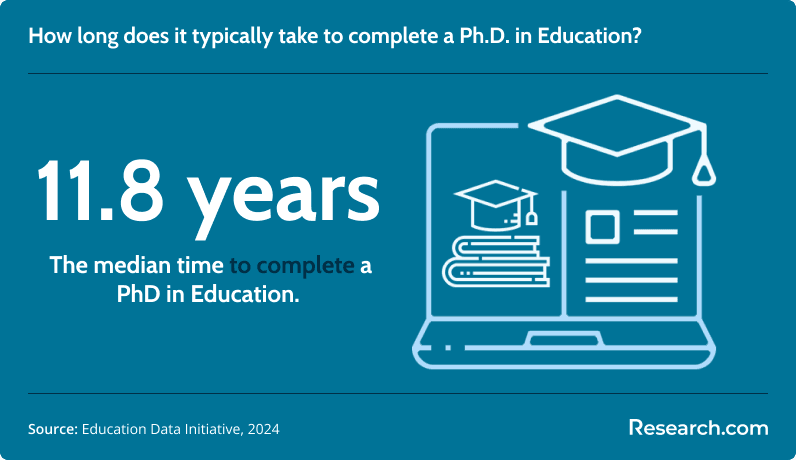
An online doctorate or online PhD Higher Education can take 3 to more than 11 years, depending on enrollment pace, transfer credit, program structure, dissertation progress, and whether the student studies full time or part time. Many programs are designed for working professionals, so flexibility is common, but flexibility can also extend the timeline if students reduce course loads or pause during the dissertation phase.
Full-time students may finish in 3 to 4 years when coursework is sequenced tightly and dissertation progress stays on schedule. Part-time students commonly need 5 to 6 years because they are often balancing professional, family, and research obligations. Some accelerated formats allow focused students to complete the degree in as little as 2.5 to 3 years, especially when year-round enrollment is available.
The dissertation is often the biggest timeline variable. A student may need 1 to 2 years for proposal development, institutional approval, data collection, analysis, writing, committee feedback, and revisions. Even in online programs, required residencies or dissertation defenses can affect scheduling and travel planning.
If you want to compare this doctoral timeline with a different type of graduate pathway, reviewing the cheapest master’s in industrial engineering online can help you see how master’s-level programs differ in length, structure, and flexibility.
| Enrollment approach | Estimated completion pattern | Best for | Main risk |
| Full-time | Often 3 to 4 years | Students with strong time availability and clear research direction | Heavy workload while employed |
| Part-time | Often 5 to 6 years | Working professionals who need a manageable course load | Longer time to graduation and greater persistence demands |
| Accelerated | As little as 2.5 to 3 years in some formats | Highly organized students who can study continuously | Less room for delays in research or life events |
| Extended dissertation timeline | Can contribute to timelines beyond 11 years | Students with complex research, interruptions, or delayed approvals | Higher total cost and loss of momentum |
How does an online PhD degree in higher education compare to an on-campus program?
An accredited online PhD or EdD in higher education can be academically comparable to an on-campus program when it uses the same faculty standards, research expectations, curriculum quality, and institutional accreditation. The main difference is not necessarily rigor; it is the learning experience. Online programs emphasize flexibility and self-direction, while campus programs usually provide more frequent in-person interaction.
Students exploring online education in other fields may also want to review cheapest online religious studies degree programs, especially if they are comparing online study formats that support education, ministry, nonprofit, or community leadership careers.
| Factor | Online doctorate | On-campus doctorate |
| Schedule | Often asynchronous, hybrid, or designed for working professionals | Usually follows campus-based class schedules and in-person requirements |
| Networking | Built through virtual cohorts, residencies, faculty meetings, and online conferences | More organic through campus events, assistantships, and daily faculty contact |
| Cost considerations | May reduce relocation, commuting, and housing expenses | May include more campus-based costs but can offer more traditional assistantship options |
| Research support | Depends heavily on online advising quality and committee access | May provide easier access to campus research centers and face-to-face mentoring |
| Employer perception | Generally stronger when the institution is accredited and reputable | Often familiar to employers, especially for traditional academic pathways |
The better option depends on your learning style, location, career goals, and need for flexibility. A busy student affairs director may benefit from an online EdD, while a student aiming for a research-intensive faculty role may place more weight on faculty mentorship, research fit, and institutional reputation.
What is the average cost of an online PhD degree in higher education?
The cost of an online PhD or EdD in higher education includes more than tuition. Some programs list total costs between $18,000 and $45,000, but students should also account for fees, books, technology requirements, dissertation expenses, residency travel, loan interest, and time away from additional paid work. Recent data shows that EdD graduates accumulate an average of $79,790 in student loans, while PhD holders owe around $81,900.
Students comparing education doctorates with other professional doctoral options may find it helpful to review the differences between a Doctor of Business Administration vs Doctor of Education. The better financial choice depends on whether your target roles are in higher education leadership, business leadership, consulting, policy, or organizational strategy.
Public universities often provide some of the more affordable online doctoral routes, particularly for students who qualify for in-state tuition. Still, a low tuition rate does not always mean the lowest total cost. A longer program with more required credits, repeated dissertation enrollment, or required travel may end up costing more than a higher-credit-price program that students complete quickly.
| Cost item | Why it matters | Question to ask before applying |
| Tuition per credit | Usually the largest advertised cost | Is tuition different for full-time, part-time, in-state, out-of-state, or online students? |
| Total required credits | Determines the real tuition baseline | How many credits are required after transfer evaluation? |
| Fees | Online, technology, graduation, dissertation, or registration fees can add up | Are fees included in the published program cost? |
| Residencies | Short campus visits can require travel, lodging, and time off work | How many in-person sessions are required? |
| Dissertation extension costs | Delayed completion can create additional enrollment charges | What happens financially if the dissertation takes longer than planned? |
What are the financial aid options for students enrolling in an online PhD degree in higher education program?
Doctoral funding requires careful planning because even affordable programs can create substantial debt. Up to 85% of doctoral students receive some form of financial aid, yet average debt remains high at around $80,210 for PhD holders and $79,790 for EdD recipients. For Doctorate in Education graduates, that figure increased by 2.8% from 2004 to 2020.
Students do not rely on one funding source. About 46.3% of EdD students report using personal or family resources, while 35.0% of all doctoral recipients receive primary support from research assistantships or traineeships. If your goal is a faster and less debt-heavy route into healthcare, affordable online associate's respiratory care therapy programs offer a useful comparison point because they can lead to employment without the financial scale of a doctorate.
Common funding options include the following:
- Federal Student Aid: Graduate students can complete the FAFSA to determine eligibility for federal loan options such as Direct Unsubsidized Loans.
- University scholarships and fellowships: Some institutions award merit-based, need-based, service-oriented, or diversity-focused funding to doctoral students.
- Teaching, research, or administrative assistantships: These are more common in traditional campus programs, but some online programs offer remote or limited assistantship opportunities.
- Employer tuition assistance: Colleges, universities, school systems, nonprofits, and public agencies may help fund advanced education when the degree supports the employee’s role.
- Military and veterans benefits: Eligible service members, veterans, and dependents may use benefits such as the GI Bill® or Yellow Ribbon support.
- Private loans, grants, and professional association awards: These can fill funding gaps, but borrowers should compare interest rates, repayment terms, and long-term risk.
Before borrowing, ask each program for a full cost of attendance estimate and a realistic completion timeline. Small differences in tuition matter less than total debt, expected career mobility, and whether the program helps you finish.
What are the prerequisites for enrolling in an online PhD degree in higher education program?
Admissions requirements vary, but most accredited online PhD and EdD programs in higher education expect applicants to show graduate-level academic readiness, relevant professional experience, research potential, and a clear reason for pursuing doctoral study.
- Master’s degree from an accredited institution: Applicants usually need a master’s degree in education, leadership, administration, student affairs, policy, or a related field. A low cost Master's in Adult Education online can be one possible preparation route for students focused on adult learning or postsecondary education.
- Minimum graduate GPA: Many programs set 3.0 GPA as a baseline, while some expect up to 3.5.
- Relevant professional experience: Many applicants come from higher education administration, teaching, advising, student affairs, enrollment, institutional research, or education agency roles. Texas Tech, for instance, requires full-time professional experience in a higher education or federal/state educational agency.
- Prerequisite coursework: Students without prior higher education coursework may need 18–21 credits in areas such as research methods or educational administration.
- Official transcripts: Schools generally require transcripts from all postsecondary institutions, and international applicants may need credential evaluations.
- Letters of recommendation: Programs often request 2–3 letters from faculty, supervisors, or leaders who can comment on academic ability, leadership potential, and research readiness.
- Statement of purpose: Applicants usually submit a 2–3 page essay explaining career goals, research interests, professional background, and program fit.
- Academic writing sample: A 5–8 page scholarly sample may be required to assess writing and research ability; in some cases, it may support a GRE waiver.
- Resume or curriculum vitae: A current CV should document professional roles, leadership experience, publications, presentations, service, awards, and research activity.
- Interview: Some programs use virtual or campus interviews to assess fit, communication skills, and dissertation readiness.
- English proficiency: Non-native English speakers may need TOEFL, IELTS, or equivalent scores unless they qualify for a waiver.
Admissions teams are usually looking for more than credentials. Strong applicants can explain the problem they want to study, why the program’s faculty and structure fit that goal, and how the degree connects to their professional trajectory.
What courses are typically in an online PhD degree in higher education?
Coursework in online higher education doctoral programs blends leadership, research, policy, finance, equity, organizational theory, and applied practice. Students are expected to read scholarly literature, analyze institutional problems, produce graduate-level research papers, and gradually shape a dissertation or capstone topic.
If you are comparing other graduate education specializations, affordable school psychology degree programs online provide a useful contrast because they focus more directly on student support and psychological services in K–12 environments.
- Leadership in Higher Education: Covers leadership models, ethical decision-making, governance, and strategic action in colleges and universities.
- Policy and Governance in Postsecondary Education: Examines how institutional, state, and federal policies shape access, funding, accountability, and campus operations.
- Quantitative and Qualitative Research Methods: Builds the methodological foundation needed to design, conduct, and evaluate education research.
- Organizational Change and Innovation: Explores how institutions respond to reform, technology, demographic shifts, financial pressure, and cultural change.
- Diversity and Social Justice in Education: Focuses on equity, inclusion, access, student belonging, and systemic barriers in postsecondary education.
- Higher Education Finance and Budgeting: Reviews funding sources, budget models, tuition policy, financial planning, and resource allocation.
- Strategic Planning and Accreditation: Connects institutional effectiveness, assessment, planning, accreditation expectations, and continuous improvement.
- Curriculum Development in Adult Learning: Addresses curriculum design, adult learning theory, assessment, and flexible instruction for nontraditional learners.
- Dissertation Design and Proposal Development: Helps students define a research problem, conduct a literature review, select methods, and prepare a proposal.
Electives often allow students to specialize in student affairs, assessment, online learning, institutional research, global higher education, community colleges, or educational technology.
What types of specializations are available in online PhD degree in higher education programs?
Specialization choice matters because it influences coursework, dissertation direction, faculty fit, internships or applied projects, and post-graduation job options. Students who already completed a low cost master's in instructional design online, for example, may find a doctoral concentration in online learning, curriculum, or instructional innovation to be a logical next step.
- Higher Education Leadership: Designed for students pursuing senior roles in academic affairs, institutional leadership, governance, and strategic planning. In 2023, demand for higher education administrators was projected to grow by 4% through 2032.
- Community College Administration: Focuses on two-year institutions, academic planning, fiscal management, facilities planning, transfer pathways, and workforce alignment. As of 2024, community colleges serve over 5.4 million students in the U.S.
- Student Affairs and Services: Prepares leaders in advising, retention, counseling, housing, activities, diversity services, financial aid, and student development. The field includes over 39 functional areas.
- Educational Policy and Reform: Emphasizes policy analysis, funding, accountability, regulation, and reform initiatives at institutional, state, and federal levels.
- Equity and Inclusion in Education: Examines inclusive practices, access barriers, legal frameworks, disability support, and policies affecting underrepresented students.
- Curriculum and Instruction for Adult Learners: Focuses on adult learning theory, assessment, instructional design, and curriculum development for nontraditional learners, who now comprise over 40% of higher education enrollments in some regions.
- Institutional Research and Assessment: Trains students to use data for accreditation, strategic planning, program evaluation, student outcomes, and institutional improvement.
- Online and Distance Education: Prepares professionals to design, evaluate, and lead digital learning environments using instructional technology, online pedagogy, and inclusive course design.
Education remains a major doctoral field. In the 2020–21 academic year, education ranked third among all research fields in the number of doctoral degrees awarded in the United States, according to Statista. This reflects the continuing need for leaders who can address complex institutional, technological, financial, and equity challenges.
How do I assess the accreditation and quality standards of an online PhD degree in higher education program?
Accreditation should be the first quality check. A program may be affordable and convenient, but if the institution lacks recognized accreditation, students may face problems with federal financial aid, employer reimbursement, transfer credit, academic hiring, and professional credibility. Start by verifying institutional accreditation through official accreditor and school sources, not only marketing pages.
Program-level quality also matters. Review faculty credentials, dissertation advising processes, student support services, research expectations, completion policies, residency requirements, and whether the curriculum matches the roles you want. Students comparing broader education options can also explore Research.com’s guide to online education degree programs.
| Quality signal | What to verify | Why it matters |
| Institutional accreditation | Recognized accreditor and current accreditation status | Supports credibility, aid eligibility, and employer acceptance |
| Faculty fit | Faculty research areas, publications, and availability | Strong fit improves dissertation guidance and topic development |
| Dissertation support | Proposal timeline, committee process, writing support, and defense format | The dissertation is often the main cause of delay |
| Online student services | Library access, tech support, advising, career services, and research tools | Online learners need support that is available remotely |
| Transparency | Tuition, fees, completion expectations, and residency details | Hidden costs can change affordability quickly |
How do you evaluate the return on investment of an online PhD degree in higher education?
ROI for a doctorate should be measured in both financial and career terms. The financial side includes tuition, fees, debt, interest, employer support, lost income opportunities, and the time required to finish. The career side includes promotion potential, eligibility for leadership roles, access to faculty or research positions, professional credibility, and expanded networks.
Compare the doctorate with shorter or less expensive credentials when appropriate. For example, a cheap online masters degree in early childhood education may be a better fit for some educators whose goals are classroom leadership, curriculum roles, or early childhood administration rather than doctoral-level research or senior higher education leadership.
- Estimate total cost: Include tuition, fees, books, technology, residencies, dissertation enrollment, and loan interest.
- Map the degree to specific roles: Do not enroll only because a doctorate sounds prestigious; identify the jobs or promotions it may unlock.
- Compare current and target earnings: Use salary data cautiously and focus on roles in your region and institution type.
- Ask about outcomes: Request information on completion rates, alumni roles, dissertation timelines, and career services for doctoral students.
- Value nonfinancial gains realistically: Leadership confidence, research ability, and professional networks matter, but they do not erase excessive debt.
What challenges might one face in online PhD degree programs in higher education?
Online doctoral study can be flexible, but it is not easy. Students must manage intensive reading, research design, writing, statistics or qualitative analysis, faculty feedback, and long-term motivation without the structure of daily campus life. The hardest part for many students is maintaining momentum after coursework ends and dissertation work becomes more independent.
Students who want a faster or more structured pathway may want to compare accelerated EdD programs, especially if they prefer applied leadership work over a longer traditional research doctorate.
| Common challenge | Why it happens | Better strategy |
| Isolation | Online students may miss informal campus interaction | Choose programs with cohorts, writing groups, residencies, and active faculty engagement |
| Dissertation delays | Research approval, data access, writing, and committee feedback take time | Start narrowing your topic early and confirm advisor expertise before enrolling |
| Time pressure | Many students work full time while studying | Block weekly writing and reading time before the term begins |
| Technology barriers | Platforms, databases, software, and virtual meetings are essential | Confirm library, software, and technical support availability for online learners |
| Unclear career payoff | Some students enroll without a target role | Connect the program to specific jobs, promotions, or research goals before applying |
What emerging trends are shaping online PhD degrees in higher education?
Online doctoral programs are adapting to changes in higher education itself. Colleges and universities are dealing with enrollment pressure, student success demands, online learning growth, public accountability, budget constraints, AI tools, and the need for stronger data-informed decision-making. As a result, doctoral curricula increasingly emphasize applied research, institutional effectiveness, technology leadership, assessment, equity, and change management.
Artificial intelligence is also becoming more visible in leadership and learning discussions. Some programs now address AI ethics, analytics, personalized learning, academic integrity, and technology strategy. Students with quantitative or analytical interests may find it useful to compare how data-focused fields are delivered online, such as through an accelerated online mathematics bachelor's degree, although doctoral work in higher education remains focused on leadership, research, and institutional systems.
- AI and analytics: Institutions need leaders who understand data use, privacy, ethics, and decision-making limits.
- Online learning quality: Doctoral programs increasingly examine digital pedagogy, accessibility, and student engagement.
- Equity and student success: Access, retention, belonging, and completion remain central concerns across postsecondary education.
- Accountability and accreditation: Institutions continue to face pressure to show measurable outcomes and continuous improvement.
- Applied research: Many EdD programs emphasize research that solves institutional problems rather than research for publication alone.
What additional academic resources can support my online PhD journey?
Strong doctoral students use more than the learning management system. They rely on virtual libraries, citation managers, research databases, writing centers, statistical or qualitative analysis tools, faculty office hours, peer writing groups, conference opportunities, and professional associations. These resources can improve both dissertation quality and student persistence.
Students who want to strengthen research, information literacy, and academic resource skills may also explore cheap MLIS online degree programs, particularly if their interests overlap with information management, academic libraries, research support, or scholarly communication.
- Library databases: Confirm remote access to education journals, dissertations, policy reports, and citation tools.
- Writing support: Use doctoral writing centers early, not only after major revisions are required.
- Research methods help: Look for workshops on statistics, qualitative coding, survey design, and IRB preparation.
- Faculty mentoring: Schedule regular meetings and clarify expectations for feedback and milestones.
- Professional communities: Join associations or conferences related to student affairs, higher education research, institutional research, or policy.
How does one choose the best among online PhD degree in higher education programs?
The best online doctorate is the one that fits your career goal, research interest, budget, schedule, and preferred level of support. Rankings can help you build a shortlist, but they should not replace a program-by-program review. A low tuition rate is not enough if the dissertation support is weak or the specialization does not match your target role.
- Degree focus and specialization: Choose a program aligned with your intended path, such as higher education leadership, policy, institutional research, online learning, or student affairs. Doctoral study can last between three and seven years, so fit matters.
- Accreditation: Confirm recognized accreditation before applying. Accreditation affects federal financial aid, employer reimbursement, and credibility for many academic roles. As of 2023, reputable online programs generally maintain recognized accreditation.
- Admission requirements: Compare GPA expectations, professional experience requirements, essays, interviews, writing samples, and test policies. If a program accepts standardized tests, applicants may need to compare the GMAT vs GRE to determine which exam is relevant.
- Residency and internship expectations: Some online programs require campus visits, intensives, internships, or in-person defenses. These can improve connection but add time and cost.
- Program length and schedule: Review credit requirements, course load, term structure, dissertation milestones, and whether accelerated or part-time options are available.
- Cost and financial aid: Calculate total cost, not just tuition. Doctorate holders earn a median of $575 more per week than those with only a bachelor’s degree, and they experience some of the lowest unemployment rates in the workforce, but debt still matters.
- Support services and community: Ask about advising, mentorship, online library access, dissertation coaching, career support, and peer interaction.
- Career outcomes: Look for evidence that graduates move into leadership, research, policy, faculty, or consulting roles aligned with your goals.
- Program format and flexibility: Determine whether courses are fully online, hybrid, asynchronous, or synchronous. In 2021, 60% of college students took at least one online class according to the National Center for Education Statistics, showing how central flexible delivery has become.
Common mistakes to avoid when choosing a program
| Mistake | Why it can hurt you | Better approach |
| Choosing only by lowest tuition | Fees, credits, and dissertation delays can raise total cost | Compare full cost of attendance and expected time to finish |
| Ignoring accreditation | Unrecognized credentials can limit aid, employment, and academic options | Verify accreditation through official sources before applying |
| Assuming online means easier | Doctoral work requires sustained research and writing discipline | Assess your weekly time capacity honestly |
| Choosing a weak faculty fit | A poor advisor match can slow dissertation progress | Review faculty research areas and contact programs with topic questions |
| Relying only on rankings | A highly ranked program may not match your career goal or schedule | Use rankings as a starting point, then evaluate fit and support |
What career paths are available for graduates of online PhD degree in higher education programs?
Graduates of affordable online EdD programs and online PhD programs in higher education can pursue leadership, research, policy, teaching, student services, and consulting roles. The strongest candidates usually combine the doctorate with relevant experience, clear specialization, and a record of applied or scholarly work.
| Career path | What the role does | Relevant salary or outlook detail |
| Postsecondary Teacher / Professor | Teaches college courses, conducts research, advises students, and contributes to academic programs | The BLS reports a median annual salary of $83,980 in 2024 and 8% projected job growth through 2033; in education, over 60,000 faculty members earn an average of $80,750 annually |
| Academic Dean or Department Chair | Leads academic units, supervises faculty, oversees curriculum, and manages departmental priorities | Pay often aligns with senior academic administration, with a median annual pay of around $102,610 |
| Educational Policy Analyst or Institutional Researcher | Analyzes data, policy, funding, accreditation, student outcomes, and institutional effectiveness | Strong fit for graduates with advanced research and assessment training |
| Director of Student Affairs or Enrollment Management | Leads advising, admissions, financial aid, retention, student engagement, or campus life functions | Best suited to professionals with prior student services or enrollment experience |
| Online Learning and Instructional Design Specialist | Designs, evaluates, and improves digital learning programs and instructional systems | Relevant for graduates specializing in online education, curriculum, or learning technology |
| Consultant or Training and Development Manager | Advises institutions, nonprofits, or organizations on leadership, compliance, training, and strategy | According to the BLS, training and development managers earn a median annual salary of $120,000, with 6% projected growth from 2023 to 2033 |
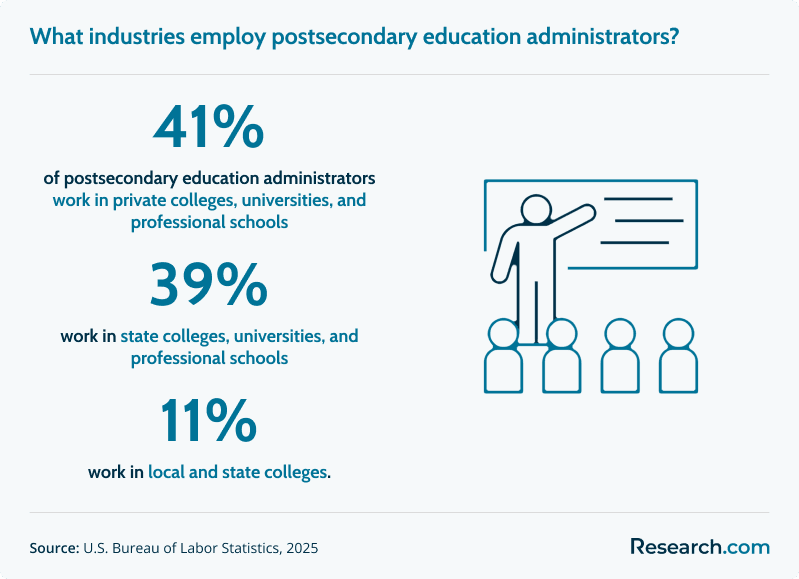
| Postsecondary Education Administrator | Oversees academic services, admissions, student affairs, planning, or institutional operations | According to BLS data from May 2024, approximately 216,400 individuals work in this field, with a median salary of $103,960 per year |
What is the job market outlook for graduates with an online PhD degree in higher education?
The job market for online PhD and EdD graduates in higher education is competitive but offers meaningful opportunities for candidates with the right mix of doctoral training, institutional experience, leadership ability, and research skills. Colleges and universities need professionals who can address enrollment shifts, student success, budget pressure, data reporting, accreditation, online learning, and organizational change.
Many doctoral students build on earlier education careers, including roles connected to Master of Education job opportunities. A doctorate can support advancement, but employers still examine the candidate’s leadership record, specialization, publications or applied projects, and ability to solve institutional problems.
Projections show a 3% growth rate from 2023 to 2033 for postsecondary administrators, with about 6,200 openings projected each year in the U.S. Online PhD graduates may be competitive for roles in student affairs, academic leadership, institutional research, policy, and online education leadership when their doctoral work aligns with employer needs.
With over 15 accredited universities offering online doctoral programs in educational leadership alone, working professionals now have more flexible ways to pursue advanced qualifications without leaving the workforce. Still, competition remains. A recent report from the National Association of Colleges and Employers indicates a more cautious hiring climate, with more employers rating the job market as fair or poor. The chart below illustrates this shift.
What do graduates commonly report about online PhD programs in higher education?
Graduates of online doctoral programs often describe the experience as demanding, flexible, and career-shaping. The most positive feedback usually centers on the ability to keep working while studying, connect with peers from different institutions, and apply research directly to professional challenges. The most common concerns involve isolation, dissertation delays, and the need for stronger faculty communication.
- Flexibility is the major advantage: Students often value the ability to complete coursework while maintaining full-time employment and family responsibilities.
- Peer networks can be meaningful: Cohorts, discussion groups, residencies, and virtual collaboration can create strong professional connections when programs intentionally support interaction.
- Dissertation support is critical: Students tend to report better experiences when faculty feedback, research expectations, and milestone timelines are clear.
- Self-discipline matters: Online doctoral learners need consistent weekly routines for reading, writing, research, and communication with advisors.
Key Insights
- An affordable online PhD or EdD in higher education can be a strong option for professionals pursuing leadership, research, policy, student affairs, teaching, or consulting roles without leaving the workforce.
- Do not judge affordability by tuition alone. Compare total credits, fees, residency costs, dissertation enrollment, aid options, and realistic completion time.
- PhD programs usually emphasize original research and scholarly contribution, while EdD programs often focus on applied leadership and solving problems of practice.
- Accreditation, faculty fit, and dissertation support are nonnegotiable. A low-cost program with weak advising can become expensive if completion is delayed.
- People with a Ph.D. in Education earn about $89,000 a year on average, while those with an EdD earn around $87,000, but salary depends heavily on role, experience, institution, and location.
- According to the NCES, 60% of college students, including those in higher education programs, took at least one online class, reflecting the continuing importance of flexible learning formats.
- Debt planning is essential. On average, people with a Doctorate in Education owe about $79,790 in student loans, and about 46.3% of Education doctorate students pay for their degree using their own money.
- The median time to finish a Ph.D. in Education is 11.8 years, so students should carefully evaluate dissertation expectations, pacing, and support before enrolling.
References:
- Glassdoor. (2025, April 10). How much does a Phd make? Glassdoor.com. Retrieved June 1, 2025.
- Hanson, M. (2024, November 25). Average cost of a doctorate degree. Education Data Initiative. Retrieved June 1, 2025.
- Hanson, M. (2025, January 14). Educational attainment statistics. Education Data Initiative. Retrieved June 1, 2025.
- NACE. (2024, November). Job outlook 2025. National Association of Colleges and Employers. Retrieved June 1, 2025.
- Payscale. (2023, May 31). Doctor of philosophy (PhD), higher education administration salary. PayScale.com. Retrieved June 1, 2025.
- Payscale. (n.d.). Doctor of education (EDD), educational leadership salary. Payscale.com. Retrieved June 1, 2025.
- U.S. BLS. (2025, April 18). Occupational outlook handbook: Postsecondary education administrators. U.S. Bureau of Labor Statistics. Retrieved June 1, 2025.
Other Things You Should Know About the Most Affordable Online PhD and Doctorate Degrees in Higher Education
Most affordable online PhD programs in Higher Education usually require a minimum 3.0 GPA on a 4.0 scale. Many also ask for official transcripts, a master’s degree from a regionally accredited institution, a resume, letters of recommendation, and a statement of purpose.
Admission requirements typically include a master's degree, a minimum GPA (often around 3.0), relevant work experience, and GRE scores. Specific criteria may vary by institution, so it is important to check the detailed requirements of each program for 2027.