
2027 Fastest Online TESOL Master's Degree Programs

Co-Founder and Chief Data Scientist
Choosing one of the fastest online master’s in TESOL programs is not just about finding the shortest completion time. The real decision is whether a program can help you move into ESL, ELL, curriculum, language-program, or international teaching roles without sacrificing accreditation, field experience, licensure alignment, or academic depth.
This guide is for licensed teachers, adult educators, international English instructors, career changers, and education professionals who want a graduate TESOL credential on an accelerated timeline. You will learn how fast online TESOL master’s programs work, what they usually cost, which programs stand out, how to compare licensure and practicum requirements, what salaries and job-market conditions look like, and how to decide whether the degree is a smart investment for your goals.
Quick answer: What is the fastest online master’s in TESOL?
The fastest online master’s in TESOL programs can often be completed in about 1 to 2 years, with some programs advertising completion in as little as 1 year or as little as 18 months. The best accelerated option depends on your background: licensed K-12 teachers should prioritize ESL endorsement alignment and practicum requirements, while adult education, international, or curriculum-focused professionals may be better served by non-licensure TESOL, TESL, applied linguistics, or English language learning tracks.
Speed matters, but it should not be the only filter. A credible fast TESOL master’s program should be institutionally accredited, transparent about total cost, clear about whether it leads to licensure or endorsement, and realistic about required fieldwork, synchronous sessions, and weekly workload.
What are the benefits of getting a qualification from the fastest online Master's in TESOL programs?
- Faster access to advanced education roles: A graduate TESOL credential can help qualified educators pursue positions such as lead ESL teacher, curriculum developer, instructional coach, program coordinator, or language-program specialist.
- Stronger eligibility for higher-responsibility positions: A master’s degree may support advancement into roles with broader instructional or administrative duties. Instructional coordinators have a median salary of approximately $74,720, with top earners making over $115,000 annually.
- Flexible study for working professionals: Online accelerated formats are designed for students who need to continue teaching, working, parenting, or living abroad while completing graduate coursework on a shorter schedule.
- Practical preparation for multilingual classrooms: TESOL master’s programs typically strengthen your ability to assess language development, design lessons for English learners, support academic language growth, and teach across cultural and linguistic differences.
What can I expect from the fastest online Master's in TESOL programs?
Fast online TESOL master’s programs compress graduate-level language teaching preparation into a shorter schedule. That usually means fewer breaks, intensive 7- or 8-week courses, year-round enrollment, or competency-based pacing. The content is still graduate-level, so students should expect substantial reading, lesson design, research assignments, discussion participation, and, in many cases, field experience.
| Program feature | What it usually means for students | Why it matters |
| Accelerated timeline | Many programs are designed for completion in 18-24 months, and some advertise faster pathways. | A shorter timeline can reduce time away from advancement opportunities, but it may increase weekly workload. |
| Core TESOL coursework | Students study second language acquisition, pedagogical grammar, assessment, curriculum design, cross-cultural communication, and language teaching methods. | These subjects form the academic foundation for working with English learners in K-12, adult, higher education, online, and international settings. |
| Online delivery | Courses may be asynchronous, synchronous, or a blend of both. | Asynchronous courses offer more scheduling freedom, while live sessions can provide more direct interaction. |
| Practicum or fieldwork | Some programs require supervised teaching, classroom access, observations, or internship hours. | Field experience can be essential for licensure, endorsement, and practical teaching readiness. |
| Licensure or non-licensure track | Some programs are designed for licensed teachers seeking ESL/ELL endorsement; others prepare students for adult education, global teaching, or curriculum roles. | Choosing the wrong track can delay or prevent eligibility for the job you want. |
Where can I work with a qualification from the fastest online Master's in TESOL programs?
A master’s in TESOL can support multiple career directions, but your options depend heavily on whether the program includes licensure preparation, field experience, and the right specialization for your target setting.
- K-12 public and private schools: Graduates may work as ESL teachers, ELL specialists, instructional coaches, or curriculum developers, depending on state licensure rules and school requirements.
- Colleges and universities: TESOL graduates may teach in intensive English programs, support international students, advise language learners, or help manage language centers.
- Adult education and community programs: Community colleges, nonprofit organizations, private language schools, refugee-support organizations, and immigrant-serving programs employ English language instructors and program staff.
- Education technology companies: TESOL expertise can apply to digital language-learning platforms, learning apps, adaptive instruction tools, content design, assessment development, and product consulting.
- Publishing and assessment organizations: Graduates may help write, edit, review, or evaluate ESL textbooks, digital materials, placement tests, and language proficiency resources.
- International schools and universities: A graduate TESOL degree may strengthen eligibility for advanced English teaching, teacher-training, and administrative roles outside the United States.
How much can I earn with a qualification from the fastest online Master's in TESOL programs?
Earnings vary by role, employer, location, licensure, experience, and whether you work in K-12, adult education, higher education, administration, consulting, or international education. A fast TESOL master’s degree can improve your qualifications, but it does not guarantee a specific salary.
- Teaching-level roles: K-12 ESL teachers or Adult ESL instructors typically earn between $55,000 and $70,000 annually, depending on the school district and location.
- Coordinator-level roles: Instructional coordinators, curriculum specialists, and related professionals can expect salaries ranging from $65,000 to over $85,000.
- Administrative-level roles: Senior positions such as intensive English program director or district-level ELL program administrator can command salaries of $80,000, potentially reaching over $100,000.
- Fastest online TESOL master's degree programs for 2027
- Average cost of an online TESOL master's degree
- Financial aid options for online TESOL master's students
- Prerequisites for online TESOL master's programs
- Common courses in an online TESOL master's degree
- TESOL master's specializations and when to choose each one
- How to choose the best fast online TESOL master's program
- Career paths for TESOL master's graduates
- Accreditation and quality standards for online TESOL programs
- TESOL master's preparation for educational leadership
- Whether an online TESOL master's degree is worth the investment
- Student support in online TESOL master's programs
- Salary expectations with an online TESOL master's degree
- Job market for online TESOL master's graduates
- Current and future trends in TESOL
Fastest Online TESOL Master's Degree Programs for 2027
How do we rank schools?
Because graduate school requires a meaningful investment of time and money, our ranking process is built around transparent, decision-useful information. Research.com’s methodology draws on established education data sources, including the IPEDS database, Peterson's database and its Distance Learning Licensed Data Set, the College Scorecard database, and the National Center for Education Statistics.
The programs below are useful starting points for students comparing accelerated online TESOL master’s options. Before enrolling, confirm current tuition, licensure alignment, practicum rules, transfer policies, and state authorization directly with the school.
| School | Program length | Credits or courses | Tuition cost | Best fit |
| Arizona State University | As little as 18 months | 30 | $10,290/academic year | Students seeking a 30-credit TESOL program with electives, a foreign language requirement, and supervised practicum experience. |
| Campbellsville University | Typically 1.5 to 2 years (accelerated options available) | 36 (non-thesis), 39 (thesis) | $445/credit | Students who want thesis and non-thesis options with online or hybrid flexibility. |
| Grand Canyon University | Accelerated, typically 1 to 2 years | 32 | $615/credit | Active licensed teaching professionals with access to a pre-K-12 classroom. |
| Hamline University | As few as 20 months | 36 (varies by track) | $592/credit | Students considering K-12 ESL License, Adult ESL, or General TESOL pathways. |
| University of Kansas | As few as 2 years | 30 | 365.60/credit | Licensed teachers and non-teachers who want separate track options and no GRE requirement. |
| Liberty University | As little as 1 year | 30 | $580/credit | Students seeking an 8-week course format and a Christian worldview approach. |
| University of Missouri | About 2 years (part-time) | 30 | 589.90/credit | Current or aspiring ESL/EFL educators who prefer a part-time MEd structure. |
| East Texas A&M University | Typically 1 to 2 years | 30-36 | $2,390/semester | Students interested in TESOL, applied linguistics, thesis or non-thesis study, and research resources. |
| Western Governors University | Median 1.5 years | 11 courses | $12,975 total cost | Licensed educators seeking English Language Learning (PK-12) preparation through a competency-based model. |
| Wilson College | Typically 1 to 2 years | 30 | $525/credit | Students who want asynchronous coursework, practical TESOL preparation, and individualized attention. |
1. Arizona State University
Arizona State University offers an online Master of TESOL that builds graduate-level preparation in language learning, classroom pedagogy, computer-assisted language learning, grammar, and curriculum design. The program includes a foreign language requirement and a supervised practicum internship, giving students both academic and applied preparation.
Graduates may pursue TESOL-related work locally, nationally, or internationally, including adult education teacher, ESL teacher, and translator roles. The program is housed in the College of Liberal Arts and Sciences, which includes faculty members such as Nobel laureates and Fulbright Scholars.
- Program Length: As little as 18 months
- Tracks/Concentrations: Customizable electives within linguistics and English
- Tuition Cost: $10,290/academic year
- Required Credits to Graduate: 30
- Accreditation: Higher Learning Commission (HLC)
2. Campbellsville University
Campbellsville University offers a Master of Arts in TESOL in fully online or hybrid formats. The curriculum emphasizes linguistics, second language acquisition, culture, and methods for teaching speaking and listening. A required practicum gives students a structured opportunity to connect theory with real teaching contexts.
The program can support careers such as ESL instructor, English materials developer, or ESL program director. Students can choose between thesis and non-thesis routes depending on whether they want a more research-oriented or practice-focused path.
- Program Length: Typically 1.5 to 2 years (accelerated options available)
- Tracks/Concentrations: Thesis and Non-Thesis
- Tuition Cost: $445/credit
- Required Credits to Graduate: 36 (non-thesis), 39 (thesis)
- Accreditation: Southern Association of Colleges and Schools Commission on Colleges (SACSCOC)
3. Grand Canyon University
Grand Canyon University offers a Master of Arts in TESOL for licensed educators who want to serve culturally and linguistically diverse classrooms. Coursework covers linguistics, language acquisition theories, language models, and professional and ethical practice from a Christian worldview.
The program requires 110 hours of practicum experience in the United States. Applicants must be active licensed teaching professionals and must have access to a pre-K-12 classroom for assignments and practicum completion.
- Program Length: Accelerated, typically 1 to 2 years
- Tracks/Concentrations: General TESOL
- Tuition Cost: $615/credit
- Required Credits to Graduate: 32
- Accreditation: Higher Learning Commission (HLC)
4. Hamline University
Hamline University offers a MATESOL program with online or hybrid flexibility and rolling admission for three annual start terms. The program emphasizes English as a global language, cultural and linguistic diversity, assessment, language systems, and effective instruction.
Students may select routes such as K-12 ESL License, Adult ESL, or General TESOL. Alumni have received Fulbright grants and U.S. Department of State English Language Fellow positions, which may appeal to students interested in global teaching networks.
- Program Length: As few as 20 months
- Tracks/Concentrations: K-12 ESL License, Adult ESL, General TESOL
- Tuition Cost: $592/credit
- Required Credits to Graduate: 36 (varies by track)
- Accreditation: Higher Learning Commission (HLC)
5. University of Kansas
The University of Kansas offers an online master’s in TESOL with teacher, non-teacher, and licensure endorsement pathways. This distinction is important for students because over 5.3 million students in U.S. public schools are English Learners, but not every TESOL master’s program is designed for the same professional audience.
Students study second language acquisition, linguistic analysis, and multicultural education while completing field experiences and practicums. The program can be completed in as few as two years, and no GRE is required for admission.
- Program Length: As few as 2 years
- Tracks/Concentrations: Teacher Track, Non-Teacher Track, Licensure Endorsement
- Tuition Cost: 365.60/credit
- Required Credits to Graduate: 30
- Accreditation: Higher Learning Commission (HLC)
6. Liberty University
Liberty University offers an online MA in TESL designed for students who want preparation for English language instruction in the United States or abroad. Its 8-week course format supports accelerated study, and the program can be completed from home or while living overseas.
The curriculum is taught from a Christian worldview and includes applied grammar, linguistics, second language acquisition, syntax, and phonology of major world languages. This may fit students seeking faith-integrated TESOL preparation and a short completion timeline.
- Program Length: As little as 1 year
- Tracks/Concentrations: General TESOL
- Tuition Cost: $580/credit
- Required Credits to Graduate: 30
- Accreditation: Southern Association of Colleges and Schools Commission on Colleges (SACSCOC)
7. University of Missouri
The University of Missouri offers a Master of Education with an emphasis in Teaching English to Speakers of Other Languages through the Department of Learning, Teaching and Curriculum. The program is intended for current teachers and students interested in ESL/EFL roles.
Students complete TESOL-focused coursework, core master’s courses, and electives. The College of Education & Human Development also supports outreach through centers and institutes, giving the program a broader education-development context.
- Program Length: About 2 years (part-time)
- Tracks/Concentrations: General TESOL
- Tuition Cost: 589.90/credit
- Required Credits to Graduate: 30
- Accreditation: Higher Learning Commission (HLC)
8. East Texas A&M University
East Texas A&M offers an online master’s in TESOL in online or hybrid formats. Students study language, pedagogy, applied linguistics, and teaching approaches for multilingual learners.
The Department of Literature and Languages offers thesis and non-thesis tracks, and students may also pursue a graduate certificate. Graduate students can access an Applied Linguistics Laboratory with tools such as a speech lab and eye-tracking equipment.
- Program Length: Typically 1 to 2 years
- Tracks/Concentrations: General TESOL, Applied Linguistics
- Tuition Cost: $2,390/semester
- Required Credits to Graduate: 30-36
- Accreditation: Southern Association of Colleges and Schools Commission on Colleges (SACSCOC)
9. Western Governors University
Western Governors University offers an online Master of Arts in English Language Learning (PK-12) for licensed educators seeking ESL or ELL endorsement. The program is nationally recognized by the TESOL International Association and uses a competency-based model that allows students to move more quickly through material they already know.
Students may begin on the first day of any month. Requirements include coursework in language acquisition theory, assessment, research, and lesson planning, along with a minimum of 15 hours of video observations and a supervised, face-to-face teaching experience with English language learners.
- Program Length: Median 1.5 years
- Tracks/Concentrations: English Language Learning (PK-12)
- Tuition Cost: $12,975 total cost
- Required Credits to Graduate: 11 courses
- Accreditation: Northwest Commission on Colleges and Universities (NWCCU)
10. Wilson College
Wilson College offers a fully online Master of Education in TESOL for educators and professionals preparing to work with English language learners. The program focuses on intercultural communication, linguistics, instructional strategies, field experience, and practical application.
Most TESOL faculty are ESL certified and have worked as ESL teachers. The program uses asynchronous coursework with no set class times, and the 13-to-1 student-to-faculty ratio is designed to support individualized attention.
- Program Length: Typically 1 to 2 years
- Tracks/Concentrations: General TESOL
- Tuition Cost: $525/credit
- Required Credits to Graduate: 30
- Accreditation: Middle States Commission on Higher Education (MSCHE)
If cost is your main filter, compare the accelerated options above with Research.com’s guide to the most affordable online TESOL master's degree programs.
What is the average cost of an online TESOL master's degree?
The total price of an online TESOL master’s degree depends on tuition rate, credit load, fees, residency rules, transfer credit, and whether the program is public or private. The fastest program is not always the cheapest, especially if accelerated courses carry higher per-credit tuition or limited aid flexibility.
- Program Credits: Many online TESOL master’s programs require 30 to 39 credit hours.
- Out-of-State Tuition: Public universities may charge higher rates to students who live outside the state, although some online programs use a flat online tuition structure.
- Private Universities: Private-school tuition is often less tied to residency, and total program costs often range from $30,000 to over $60,000.
- Additional Fees: Students should account for technology fees, application fees, digital textbooks, and other required course materials.
| Cost factor | Question to ask before enrolling |
| Per-credit tuition | Is the advertised tuition the same for online, out-of-state, and accelerated students? |
| Total credits | Does the program require 30, 32, 36, or 39 credits, and how does that affect the final cost? |
| Fees and materials | Are technology fees, textbooks, assessment fees, background checks, or practicum-related expenses included? |
| Transfer credit | Can prior graduate coursework reduce the total number of credits you must pay for? |
| Licensure costs | Will you need separate state exams, endorsement fees, fingerprinting, or additional coursework? |
Students comparing fast education-related credentials may also review the shortest master's in education technology online programs to understand how accelerated graduate programs in adjacent education fields structure tuition, timelines, and online learning requirements.
Job geography should also influence your cost decision. Zippia’s 2025 ESL job data shows wide variation by state. Some states report fewer than 200 available ESL teacher positions, including South Dakota with only 32 available jobs, West Virginia with 37, Idaho with 98, Mississippi with 109, and Arkansas with 158.
Other states show much larger ESL job counts. New Jersey has 1,068 jobs, New York has 983, Pennsylvania has 911, Maryland has 781 positions, and Georgia has 673. This means the value of a TESOL master’s may look different depending on whether you plan to work in a high-opportunity state, relocate, teach online, or pursue international employment.
The state-level data shows that ESL teaching opportunities are not evenly distributed. A student in a low-opening state should think carefully about relocation, remote work, endorsement portability, and whether the degree supports broader roles beyond classroom ESL teaching.
What are the financial aid options for an online TESOL master's degree?
Financial aid can make a fast TESOL master’s more manageable, but students should compare net cost rather than relying only on advertised tuition. The best strategy is to combine federal aid eligibility, school-based scholarships, employer support, and program-specific discounts where available.
- Federal Student Aid: Complete the Free Application for Federal Student Aid (FAFSA) to determine eligibility for federal student loans and other aid options.
- Employer Tuition Assistance: School districts, colleges, nonprofits, and education employers may reimburse part of the cost if the degree supports your current role or a staffing need.
- Scholarships and Grants: Universities and professional organizations such as the TESOL International Association may offer scholarships or grants for TESOL students. Students exploring short-format credentials in other fields can also compare aid structures with options such as the shortest user interface design online course.
- State-Specific Aid: Some states provide grants, incentives, or loan forgiveness programs for residents preparing for high-need education fields such as TESOL.
What are the prerequisites for enrolling in an online TESOL master's degree?
Admission requirements vary by institution and track. Programs designed for K-12 ESL endorsement often have stricter teaching-license and classroom-access requirements than non-licensure programs for adult education or international teaching.
- Bachelor's Degree: Applicants typically need a bachelor's degree from a regionally accredited institution.
- Minimum GPA: Many programs expect an undergraduate GPA of around 3.0 on a 4.0 scale, though some schools may consider conditional admission.
- Teaching License or Experience: Licensure-oriented programs may require a valid teaching license, teaching experience, or access to a classroom. Students comparing other accelerated educator-preparation pathways, including the shortest physical education degrees online, often see similar field-experience expectations.
- Application Materials: Common requirements include official transcripts, a resume, letters of recommendation, and a statement of purpose explaining your TESOL goals.
- Standardized Test Scores: Many programs are test-optional or do not require the GRE, but requirements should be verified with each school.
| If your goal is... | Look for this admission or program feature | Avoid this mistake |
| K-12 ESL endorsement | Programs requiring or supporting teacher licensure, classroom access, practicum hours, and state-aligned coursework. | Assuming any TESOL master’s automatically qualifies you for state ESL endorsement. |
| Adult ESL teaching | Programs with adult education, community education, assessment, and practical language teaching courses. | Choosing a K-12-only program if you do not plan to work with children or adolescents. |
| International teaching | TESOL, TESL, applied linguistics, intercultural communication, and global English preparation. | Ignoring visa, employer, country-specific, or school-specific hiring rules. |
| Curriculum or edtech work | Coursework in materials development, assessment, instructional design, and technology in language teaching. | Selecting a program with no curriculum-development or digital-learning components. |
What courses are typically in an online TESOL master's degree?
Online TESOL master’s curricula combine language theory, teaching methods, assessment, cultural responsiveness, and applied classroom practice. Although course titles differ, most credible programs cover the following areas.
- Foundations of Second Language Acquisition: Explores how people learn additional languages through linguistic, cognitive, social, and cultural processes.
- Pedagogical Grammar: Focuses on English grammar as it is taught to English language learners, not just as an abstract language system.
- Curriculum Design and Assessment in TESOL: Teaches students to build lessons, units, assessments, and program materials for multilingual learners.
- Cross-Cultural Communication: Examines how culture shapes classroom interaction, identity, participation, and interpretation.
- Methods of Teaching English as a Second Language: Covers strategies for teaching listening, speaking, reading, and writing. Students comparing TESOL with the shortest alternative teacher certification program online will notice that both pathways emphasize practical teaching readiness, although their licensure outcomes may differ.
- Technology in Language Teaching: Prepares educators to use digital tools, online platforms, multimedia, and language-learning technologies effectively.
These courses connect to a broad global learning need. Approximately 1.5 billion people worldwide are learning English, which helps explain continued interest in TESOL preparation across schools, universities, online learning companies, and international education organizations.
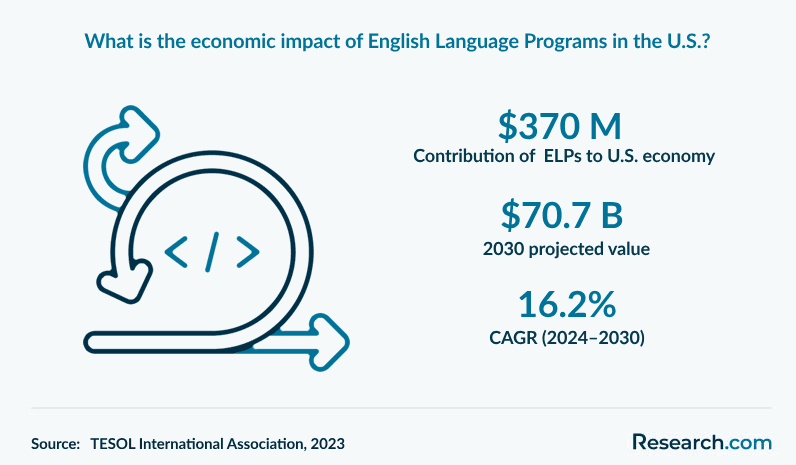
English language programs also have measurable economic effects in the United States. During the 2022–2023 academic year, English language programs at U.S. colleges and universities contributed $370 million to the U.S. economy. These programs directly supported 3,164 U.S. jobs, and every three international students enrolled in an ELP supported one domestic job.
For comparison, all international students during the same period contributed $40.1 billion and supported 368,333 jobs nationwide. English language programs are therefore a smaller but meaningful part of the larger international education economy.
What types of specializations are available for TESOL master's degree graduates?
Specialization choice should follow your target learner population and career setting. A K-12 ESL track is not the same as an adult education or applied linguistics track, and a non-licensure TESOL degree may not meet public-school endorsement requirements.
| Specialization | Best for | What to verify |
| K-12 ESL Education | Licensed or aspiring school teachers who want to work with English learners in elementary, middle, or high school settings. | Whether coursework and fieldwork meet your state’s licensure or endorsement rules. |
| Adult and Higher Education | Students planning to teach in community colleges, universities, intensive English programs, or adult learning centers. | Whether the program includes adult learning theory, placement assessment, and academic English preparation. |
| Curriculum and Materials Development | Educators who want to design textbooks, digital resources, assessments, or language-learning content. | Whether you will build a portfolio of instructional materials. |
| Language Program Administration | Professionals aiming for coordinator, director, or program-management roles. | Whether coursework includes evaluation, budgeting, staffing, supervision, and program improvement. |
| Technology in Language Teaching | Teachers and designers interested in online instruction, apps, adaptive learning, and computer-assisted language learning. | Whether the curriculum includes hands-on work with current digital teaching tools. |
| Applied Linguistics | Students interested in language research, second language acquisition, sociolinguistics, or doctoral study. | Whether the program offers research methods, thesis options, or preparation for a Ph.D. pathway. |
How do you choose the best among the fastest online TESOL master's degree programs?
The best fast online TESOL master’s program is the one that matches your career goal, state requirements, budget, schedule, and preferred learning format. Even low cost TESOL master's programs online should be evaluated for quality, not price alone.
- Check institutional accreditation first: Confirm that the university is accredited by a recognized accreditor such as CAEP, HLC, or SACSCOC. Accreditation can affect transfer credit, financial aid, licensure, and employer acceptance.
- Confirm licensure or endorsement alignment: If you want to work in K-12 public schools, ask whether the program meets requirements in your state and whether additional exams or applications are required.
- Compare curriculum depth: Look for full coverage of second language acquisition, grammar, methods, assessment, cultural responsiveness, and technology rather than a narrow credential built only around speed.
- Review faculty expertise: Programs led by faculty with TESOL research, ESL classroom experience, international teaching, or applied linguistics backgrounds may provide more relevant mentorship.
- Clarify the online format: Ask whether courses are asynchronous, synchronous, hybrid, cohort-based, or self-paced, and whether practicums require local school partnerships.
- Assess student support: Online students should have access to advising, technical support, library resources, writing help, career guidance, and practicum placement support where relevant.
Questions to ask before choosing a fast online TESOL master's program
- Does this program lead to licensure, endorsement, or only a graduate degree?
- Is the university regionally or institutionally accredited?
- Are there any in-person, classroom-access, observation, or practicum requirements?
- Can I complete the program while working full time?
- What is the total cost after tuition, fees, textbooks, and practicum expenses?
- How many students complete the program on the advertised accelerated timeline?
- Will this degree support the specific job title I want?
- Does the school help students find field placements or must students arrange them independently?
What career paths are available for graduates of online TESOL master's degree programs?
TESOL master’s graduates can work in direct teaching, program coordination, curriculum, training, consulting, and higher education. Some roles require additional licensure, teaching experience, or doctoral study.
- ESL Teacher: Teaches English to multilingual learners in K-12, adult education, or community settings.
- ESL Program Coordinator: Supports teachers, curriculum, assessment, scheduling, and program operations.
- Curriculum Developer: Creates lessons, assessments, textbooks, digital materials, and language-learning resources.
- Online ESL Instructor: Teaches English through virtual platforms to domestic or international students.
- Corporate Language Trainer: Provides workplace English, business communication, or professional language coaching.
- Community Education Specialist: Supports English learning programs for nonprofits, immigrant communities, or adult learners.
- International School Teacher: Teaches ESL or EFL in private, international, or overseas school settings.
- Higher Education Lecturer: Teaches English language courses at colleges or universities, often in programs serving international students. Students considering broader advancement can compare related Master of Education careers.
- Test Prep Instructor: Helps students prepare for English proficiency exams such as TOEFL or IELTS.
- TESOL Consultant or Trainer: Advises schools, trains teachers, reviews curricula, or supports language-program improvement.
What accreditation and quality standards should I consider for an online TESOL master's degree?
Accreditation is one of the clearest indicators that a school meets recognized academic standards. For TESOL students, it is especially important because employers, school districts, licensing boards, and doctoral programs may review whether your degree came from an accredited institution.
For licensure-oriented programs, institutional accreditation is not enough by itself. Ask whether the program’s coursework, fieldwork, and assessments meet the ESL or ELL endorsement requirements in the state where you plan to work. Also verify faculty qualifications, practicum supervision, student outcomes, and whether the program publishes clear academic policies.
Students comparing accelerated graduate education more broadly may also review how programs such as the shortest EdD online program handle quality control, timelines, and academic expectations.
Will an online TESOL master's degree prepare me for educational leadership roles?
An online TESOL master’s can prepare students for certain leadership-adjacent roles, especially in curriculum planning, teacher support, language-program coordination, instructional coaching, and assessment development. However, it may not be sufficient for formal administrative licensure, principal roles, or district leadership positions that require separate credentials.
If your goal is language-program leadership, choose a program with coursework in program evaluation, curriculum development, staff support, assessment systems, and educational decision-making. If your goal is broader school or district administration, you may eventually need a leadership-focused graduate credential such as one of the most affordable educational leadership doctoral programs online.
Is an Online TESOL Master’s Degree Worth the Investment?
An online TESOL master’s degree is most likely to be worth it when it clearly connects to a defined career goal: ESL endorsement, higher pay on a district salary schedule, adult education advancement, curriculum development, international teaching, or language-program leadership. It is less likely to pay off if you choose a program without confirming licensure requirements, job-market conditions, or total cost.
| A TESOL master’s may be worth it if... | You may want another path if... |
| Your district rewards graduate credits or master’s degrees on the salary schedule. | You only need a short certificate for a limited online tutoring role. |
| You need ESL/ELL endorsement preparation and the program is aligned with your state. | The program does not meet licensure requirements where you plan to teach. |
| You want to move into curriculum, coaching, program coordination, or adult education. | You are primarily interested in unrelated fields and are comparing credentials only by speed. |
| You can manage the accelerated workload without harming your current employment. | You need a slower, lower-cost, part-time pathway to avoid excessive debt or burnout. |
If you are weighing accelerated degrees outside education, compare the purpose and outcomes carefully. A fast TESOL master’s serves a very different career path than the fastest online philosophy degree programs.
How Do Online TESOL Master's Programs Support Student Success?
Strong online TESOL programs support students with academic advising, accessible faculty, virtual library access, writing help, technology support, practicum guidance, and career resources. In accelerated formats, these services matter because students have less time to recover from scheduling problems, placement delays, or unclear expectations.
Before enrolling, ask how quickly faculty respond, whether online students receive the same advising as campus students, and whether the school helps with field placements. If affordability is a major concern across graduate fields, you can also compare support and cost structures in programs such as the cheapest online MLIS programs.
How much can I earn with an online TESOL master's degree?
TESOL-related salary outcomes differ by job title. Classroom and support positions often pay less than roles involving specialization, consulting, administration, or postsecondary academic rank. A master’s degree can strengthen eligibility, but salary depends on employer type, region, experience, licensure, and responsibilities.
- ESL teachers earn a median of approximately $59,950 annually.
- Instructional coordinators earn a median of $74,720, with top earners exceeding $115,490.
- Salary growth is expected with experience and advanced qualifications.
According to 2025 PayScale data, TESOL-related and education-adjacent earnings vary widely. A tutor averages $20,000, a customer support representative earns $37,971, an elementary school teacher earns $41,447, and an administrative assistant earns $42,000. Middle school teachers average $46,500, while production editors average $48,600.
Several classroom roles cluster near the middle of the salary range. An English for Speakers of Other Languages instructor earns $49,992, an ESOL teacher earns $51,495, and an English as a Second Language teacher averages $54,316. These figures are near adult education teacher earnings of $52,813 and high school teacher earnings of $57,000. A special education teacher averages $70,595.
Higher compensation appears in more specialized or senior positions. An educational consultant averages $93,413, while an associate professor in a postsecondary institution averages $115,638. Students comparing long-term options can review broader careers in education to understand how TESOL fits into the larger education labor market.
What is the job market like for graduates with an online TESOL master's degree?
The TESOL job market is mixed. Demand for English language instruction remains significant globally and in many school systems, but some traditional adult education and ESL teacher roles face projected decline. Graduates should therefore think beyond one job title and choose programs that support adaptable skills.
- Domestic school demand: More than 10% of U.S. students are identified as ELLs, which sustains the need for teachers and specialists who can support multilingual learners.
- Leadership pathway: Roles such as instructional coordinator are projected to grow by 2% between 2022 and 2032.
- Global English learning: About 1.5 billion learners globally create opportunities in international schools, universities, private language institutions, and digital learning. A degree in English can also support language-focused work in non-English-speaking countries.
- Competition and sector differences: Adult basic ESL roles may be more limited, so students should consider curriculum, assessment, online teaching, and program coordination as possible alternatives.
According to the U.S. Bureau of Labor Statistics (2025), adult basic and secondary education and ESL teachers earned a median annual salary of $59,950 in 2024, or $28.82 per hour. These roles typically require a bachelor's degree, with no prior related work experience or on-the-job training needed. In 2023, there were approximately 41,700 jobs in this field.
The same BLS data projects employment to decline by 13% from 2023 to 2033, representing a loss of about 5,300 jobs over the decade.
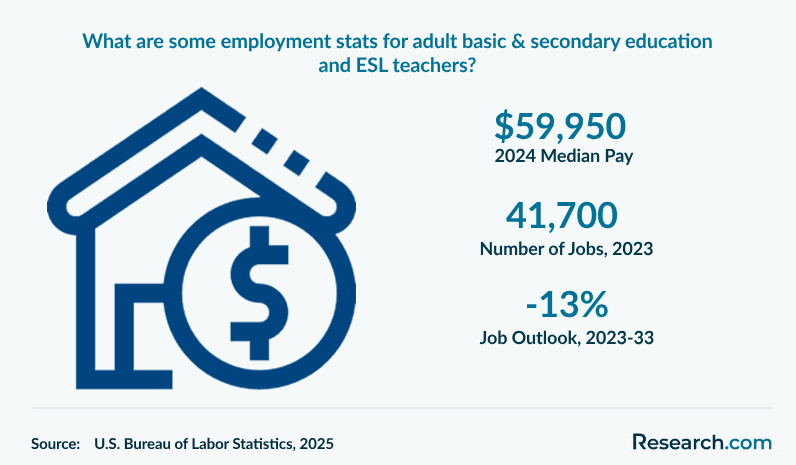
This projected decline makes program choice more important. Students should avoid assuming that every TESOL role is growing and should instead build skills that transfer across K-12, adult education, curriculum development, online instruction, assessment, and international education.
What are some current and future trends in TESOL?
TESOL is being shaped by reading science, multilingual education, digital instruction, AI-supported tutoring, and global demand for English proficiency. These trends do not eliminate the need for trained teachers, but they do change what employers may expect graduates to know.
- Science of Reading focus: Programs and schools are placing more emphasis on evidence-based phonics, decoding, fluency, vocabulary, and comprehension strategies.
- Early Literacy Intervention: More attention is going to early support for struggling readers before gaps widen.
- Digital Literacy Integration: English learners increasingly need support evaluating online texts, multimedia, and digital communication.
- Culturally Responsive Reading Materials: Schools and publishers are looking for texts that reflect students’ identities, languages, and lived experiences.
- AI-powered Reading Tools: Adaptive platforms and Artificial Intelligence tutors are being used to personalize literacy instruction.
- Family Literacy Engagement: Programs are involving parents and caregivers more directly in language and reading development.
- Bilingual and Multilingual Literacy: Dual-language and ESL supports are expanding in many settings.
- Screen Time and Reading Habits: Educators continue to examine how digital media affects sustained reading and comprehension.
- Literacy and Workforce Readiness: Adult literacy is increasingly connected to job skills, economic mobility, and career training.
- Universal Literacy Screeners: Schools are adopting more regular, data-driven reading assessments.
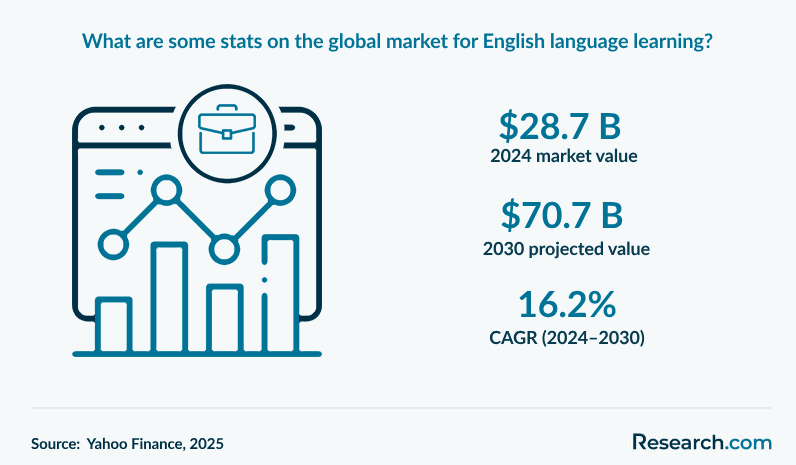
The global English language learning market was valued at USD 28.7 billion in 2024 and is projected to reach USD 70.7 billion by 2030. This represents a compound annual growth rate (CAGR) of 16.2%. Students considering an English teacher career should note that international and digital learning demand may differ from U.S. adult ESL employment projections.
Globalization, international trade, study-abroad mobility, and cross-border communication continue to support demand for English proficiency. At the same time, online courses, mobile apps, and digital platforms are changing how language instruction is delivered. For TESOL graduates, the strongest preparation combines language pedagogy, cultural responsiveness, assessment literacy, and comfort with technology.
Common mistakes to avoid when choosing a fast online TESOL master's program
| Mistake | Why it can hurt you | Better approach |
| Choosing only by shortest completion time | The fastest program may not meet licensure, practicum, or employer expectations. | Compare speed only after confirming accreditation, outcomes, and requirements. |
| Ignoring state licensure rules | A non-licensure TESOL degree may not qualify you for K-12 ESL endorsement. | Contact your state education agency and the program advisor before applying. |
| Looking only at tuition per credit | Fees, credit load, materials, and practicum expenses can change total cost. | Ask for a full program cost estimate in writing. |
| Assuming online means no fieldwork | Many TESOL programs require observations, supervised teaching, or classroom access. | Confirm local placement rules and whether the school helps arrange them. |
| Overlooking job geography | ESL opportunities vary widely by state and sector. | Compare local openings, relocation options, online teaching, and international roles. |
| Relying only on rankings | A highly ranked program may not match your schedule, budget, licensure needs, or teaching population. | Use rankings as a shortlist, then evaluate fit with your goals. |
Practical steps before you apply
- Define your end goal: Decide whether you want K-12 endorsement, adult ESL teaching, international teaching, curriculum work, online instruction, or program leadership.
- Check accreditation: Verify institutional accreditation and, for licensure tracks, state alignment.
- Request the full curriculum: Look for second language acquisition, methods, assessment, grammar, cultural responsiveness, and technology coursework.
- Confirm fieldwork requirements: Ask how many practicum, observation, or teaching hours are required and where they can be completed.
- Calculate total cost: Include tuition, fees, books, background checks, exams, travel, and lost work time if applicable.
- Ask about completion reality: Find out how many students actually finish within the advertised accelerated timeframe.
- Compare career support: Look for advising, placement guidance, resume help, alumni networks, and employer connections.
- Speak with your employer or licensing board: Confirm whether the degree will count toward salary advancement, endorsement, or promotion.
Key Insights
- Fast does not always mean best: The strongest accelerated TESOL master’s programs balance speed with accreditation, practicum quality, licensure alignment, and graduate-level rigor.
- Program fit depends on your career target: K-12 teachers should prioritize endorsement requirements, while adult educators, international instructors, and curriculum professionals may need different TESOL tracks.
- Costs vary widely: Many programs require 30 to 39 credit hours, and private university total program costs often range from $30,000 to over $60,000.
- Job location matters: Zippia’s 2025 data shows major state differences, from South Dakota with 32 ESL teacher jobs and West Virginia with 37 to New Jersey with 1,068, New York with 983, and Pennsylvania with 911.
- The labor market is uneven: BLS projects adult basic and secondary education and ESL teacher employment to decline by 13% from 2023 to 2033, even though global English learning demand remains substantial.
- Specialization can improve flexibility: Curriculum design, assessment, edtech, applied linguistics, and program administration can broaden opportunities beyond traditional classroom ESL roles.
- Salary depends on role and responsibility: PayScale data shows an ESL teacher averaging $54,316, a special education teacher averaging $70,595, an educational consultant averaging $93,413, and an associate professor averaging $115,638.
- Technology is reshaping TESOL: AI-supported tutoring, online language platforms, digital literacy, and multilingual literacy tools are becoming more important in language education.
- Verify before enrolling: Ask schools directly about accreditation, licensure, practicum placement, total cost, course format, transfer credit, and realistic completion timelines.
References:
- PayScale. (2025, March 1). Teaching English to speakers of other languages (TESOL) certification salary. PayScale.
- TESOL International Association. (2023). English language program data, 2023 [Data set]. TESOL International Association.
- U.S. Bureau of Labor Statistics. (2025). Adult basic and secondary education and ESL teachers. In Occupational Outlook Handbook. U.S. Bureau of Labor Statistics.
- Yahoo Finance. (2025, February). English Language Learning Market Boom: Forecast to Exceed Revenues of $70 Billion by 2030 with Globalization and Increasing Cross-border Communication Fueling Demand. Yahoo Finance.
- Zippia. (2025). 10 best states for English as a second language teachers in 2025. Zippia.
Other Things You Should Know About Online TESOL Master's Degree Programs
A fast online TESOL master’s program should come from an institutionally accredited university, and the education unit should hold TEAC or CAEP recognition when teacher licensure is the goal. In the United States, regional institutional accreditation is the standard employers and state agencies look for.
To enroll in the fastest online TESOL master's programs in 2027, students typically need a reliable internet connection, a computer with specific software like video conferencing tools, and possibly a headset. Requirements can vary, so check individual program specifications for details.


