2027 Can You Get a Teaching Degree Online?

Co-Founder and Chief Data Scientist
Choosing an online teaching degree is not just a question of convenience. The bigger decision is whether the program will qualify you for the classroom, meet your state’s licensure rules, fit your budget, and prepare you for the kind of education role you actually want. Online teacher preparation has become a practical option for working adults, career changers, paraprofessionals, military-affiliated students, and current educators seeking advancement, but the quality and licensing value of programs can vary widely.
This guide explains what an online teaching degree can and cannot do, how accreditation and state approval affect your eligibility to teach, what you may study, what costs to expect, and how to compare programs before enrolling. It is designed to help you avoid common mistakes, such as choosing a program that is accredited but not approved for licensure in your state, assuming online degrees are automatically cheaper, or overlooking student teaching requirements.
Quick answer: What are the benefits of getting a teaching degree online?
- Career flexibility: An online teaching degree can support several education paths, including K-12 teaching, online instruction, curriculum development, instructional design, and tutoring, depending on the program level, specialization, and state licensure outcome.
- Practical scheduling advantages: Online coursework can make it easier to keep working, care for family, or study from a location far from campus, although student teaching and fieldwork usually still require in-person placements.
- Potential earnings: The median salary for professionals with an online teaching degree can range from approximately $46,000 to $55,000 annually, but compensation depends heavily on job title, state, district, institution type, experience, and whether the role is full-time, adjunct, or contract-based.
What can I expect from a teaching degree online?
An online teaching degree usually combines education theory, subject-area preparation, instructional methods, classroom management, assessment, and supervised field experience. The online format changes how you attend class, submit assignments, collaborate with peers, and interact with faculty, but it should not reduce the academic or clinical expectations required for teacher preparation.
Students should expect regular use of a learning management system, video discussions, online exams or projects, virtual lesson-planning activities, and digital collaboration tools. Programs that lead to licensure also typically require classroom observations, practicum hours, and student teaching in an approved school setting. In other words, the lectures and assignments may be online, but the hands-on teaching requirement is usually local and in person.
| What online teaching programs usually include | Why it matters |
| Education foundations and child development | Builds understanding of how students learn and how instruction should change by age, ability, and context. |
| Teaching methods and lesson planning | Prepares candidates to design standards-aligned lessons and adapt instruction for different learners. |
| Technology integration | Helps future teachers use digital tools responsibly for instruction, feedback, accessibility, and collaboration. |
| Assessment and evaluation | Shows how to measure learning, interpret results, and adjust teaching based on student progress. |
| Fieldwork and student teaching | Provides supervised classroom experience, which is essential for licensure in most teacher preparation pathways. |
Where can I work with a teaching degree online?
Your employment options depend less on whether the degree was online and more on whether it is accredited, state-approved, aligned with your grade level or subject area, and paired with the license or credential required for the role. Graduates of online teaching programs may work in public schools, private schools, charter schools, virtual schools, colleges, tutoring organizations, education technology companies, nonprofit training programs, or corporate learning departments.
- K-12 classroom teacher: Requires state licensure for public school positions and may require specific endorsements by grade level or subject.
- Online teacher or virtual school instructor: Often requires the same teaching license as in-person K-12 roles, plus comfort with digital instruction tools.
- Curriculum developer: Focuses on lesson materials, standards alignment, assessments, and instructional resources.
- Instructional designer: Designs online courses, training modules, and learning experiences for schools, colleges, businesses, or edtech organizations.
- Online tutor or academic coach: May require subject expertise, teaching experience, or certification depending on the employer and student population.
- Instructional technology specialist: Helps educators select, implement, and evaluate classroom technology.
How much can I make with a teaching degree online?
Pay varies by role, school level, contract type, geographic area, union or district salary schedules, education level, and years of service. Online K-12 teachers may earn similarly to in-person teachers, with median salaries around $46,000 to $65,000 annually. Online adjunct college instructors are often paid per course rather than by annual salary. Full-time online professors can earn $70,000 to $100,000+, similar to on-campus faculty, though those roles often require advanced graduate credentials and relevant teaching or research experience.
The most useful way to evaluate salary is to compare the exact role you want in the state or district where you plan to work. A bachelor’s-level elementary teacher, a master’s-prepared special education teacher, an adjunct instructor, and an instructional designer may all have different pay structures even if they studied education online.
- Can you get a teaching degree online for 2027?
- Are online teaching degrees accredited and recognized?
- Do employers view online teaching degrees as legitimate as traditional ones?
- What types of teaching degrees can you earn online?
- What are some popular online teaching degree specializations?
- What is the curriculum like in an online teaching degree program?
- How much does an online teaching degree typically cost?
- Are there accelerated online teaching degree options available?
- How do I choose the right online teaching degree program?
- Can an online teaching degree boost my long-term career growth?
- How can I assess the return on investment of my online teaching degree?
- Are there different licensure requirements for online vs. traditional teaching degrees?
- What types of financial aid are available for online teaching students?
- What kind of technical skills do I need for online learning in education?
Can you get a teaching degree online for 2027?
Yes. You can earn a teaching degree online from many accredited colleges and universities, including programs designed for first-time teacher licensure, career changers, current teachers, and education professionals who want graduate-level advancement. The key is to confirm that the program’s accreditation, state approval, field placement model, and endorsement area match your goals.
- Fully or mostly online coursework is common: Many institutions deliver education courses online, but licensure programs usually include required fieldwork in schools.
- Accreditation must be verified: Before applying, review the school’s accreditation status and compare options using resources such as nationally accredited online colleges.
- Degree levels differ: Online options may include associate, bachelor’s, master’s, certificate, endorsement, and doctoral programs.
- State licensure is not automatic: A degree may be valid academically but still fail to meet teacher licensing rules in the state where you want to teach.
- Student teaching remains a major requirement: Most licensure routes require supervised classroom practice, even when the academic courses are online.
Online teaching degrees are most useful when they are chosen backward from the job you want: first identify the state, grade level, subject area, and license you need, then choose a program that clearly prepares students for that outcome.
Are online teaching degrees accredited and recognized?
Online teaching degrees can be accredited and widely recognized, but students need to distinguish among institutional accreditation, program approval, and specialized education accreditation. These are related, but they are not the same thing. A school may be institutionally accredited while a specific teacher preparation program may still need approval from a state education agency for licensure purposes.
- Institutional accreditation: Confirms that the college or university has met broad academic and operational standards.
- Regional accreditation: Often carries strong recognition among employers, graduate schools, and licensing bodies.
- National accreditation: May be legitimate, but credits and degrees from nationally accredited schools can face transfer or recognition limits in some cases.
- Programmatic or educator preparation approval: Matters for teacher licensure because state boards often require completion of an approved teacher preparation program.
- Independent verification: Students should confirm accreditation and state approval through official databases or state education agencies, not only through marketing pages.
Advanced education credentials can also shape leadership opportunities. If you are comparing doctoral routes beyond classroom teaching, this explanation of DBA vs EdD can help clarify whether a business-oriented doctorate or an education leadership doctorate better fits your long-term plans.
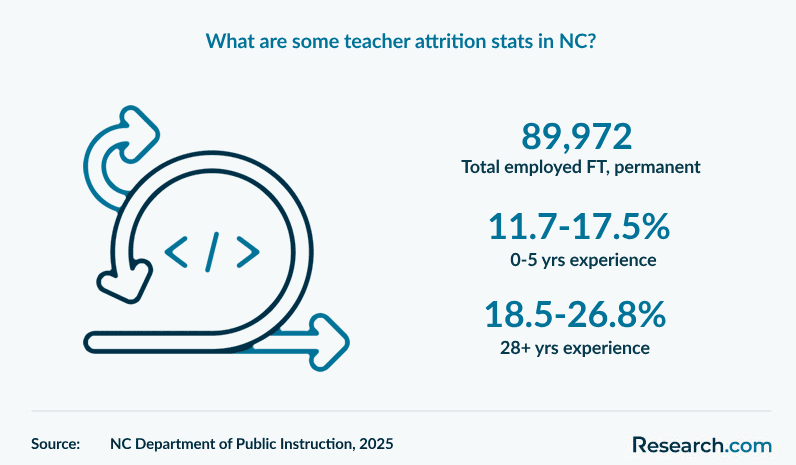
Workforce conditions also affect how students evaluate teacher preparation. The 2023-24 State of the Teaching Profession report surveyed all 115 public school districts in North Carolina, revealing a teacher attrition rate of 9.88% among the 89,972 full-time permanent teachers, which is higher than the average attrition rate of 8.64% over the past seven years. Despite this, over 90% of principals remained in their roles between March 2023 and March 2024, indicating leadership stability. Teacher attrition was notably higher for those with 0-5 years of experience (11.7% to 17.5%) and those with 28 or more years of experience (18.5% to 26.8%). These patterns appear in the graphic below.
Alternative routes into teaching are also part of the current licensure conversation. The alternative licensure pathway has seen a 19.6% increase since 2017-18, while the conversion rates to residency licenses for teachers with permits and emergency licenses from the 2018-19 cohort were approximately 61.2% and 55%, respectively. The overall vacancy rate in 2023-24, broadly defined, stood at 8.2%. For prospective students, these figures show why it is important to understand whether an online program leads to full licensure, provisional eligibility, residency licensure, or only a non-licensure education credential.
Employer acceptance of online education has improved as more established institutions have built rigorous distance learning programs. Still, hiring decisions in education are usually based on licensure, subject qualifications, supervised experience, references, and interview performance. The online format by itself is rarely the deciding factor when the degree comes from an accredited institution and satisfies state requirements.
Do employers view online teaching degrees as legitimate as traditional ones?
Many school districts, virtual schools, higher education institutions, and education employers consider online teaching degrees legitimate when they come from accredited institutions and meet licensure or job requirements. However, legitimacy is not based on the delivery format alone. Employers look at the institution, program reputation, field experience, certification status, and evidence that the candidate can teach effectively.
| Employer concern | What strengthens your application |
| Was the degree from a recognized institution? | Institutional accreditation and a reputable teacher preparation provider. |
| Does the candidate qualify for licensure? | Completion of a state-approved program, required exams, background checks, and student teaching. |
| Can the candidate manage a real classroom? | Strong practicum evaluations, student teaching experience, lesson samples, and references. |
| Does the candidate understand online and in-person instruction? | Experience with learning management systems, digital assessment, classroom technology, and differentiated instruction. |
| Is the specialization aligned with the job? | Correct grade band, subject endorsement, special education preparation, ESL training, or other relevant credential. |
- Accreditation matters more than modality: Employers are more likely to trust an online degree from a properly accredited institution than a campus-based degree from a weak or unrecognized provider.
- Licensure is essential for public K-12 roles: If a position requires certification, the employer will focus on whether you meet state rules.
- Reputation still influences confidence: Programs with established education departments, strong clinical partnerships, and transparent outcomes may carry more weight.
- Practical experience is difficult to replace: Fieldwork, student teaching, and classroom performance help employers judge readiness.
The bottom line: an online teaching degree can be as useful as a campus-based degree when it is accredited, licensure-aligned, and supported by meaningful field experience.
What types of teaching degrees can you earn online?
Online teaching degrees are available at several academic levels. The right choice depends on your current education, whether you already hold a teaching license, and whether you want initial certification, a new endorsement, career advancement, or a non-classroom education role.
| Degree or credential | Best for | Important caution |
| Associate degree in education | Students beginning college, paraprofessionals, or those planning to transfer into a bachelor’s program. | Usually does not qualify graduates to become licensed public school teachers on its own. |
| Bachelor’s degree in education | First-time college students or career changers seeking initial teacher licensure. | Must match the state, grade level, and subject area where you plan to teach. |
| Master of Education or teaching master’s degree | Licensed teachers pursuing advancement or career changers entering alternative licensure routes. | Some master’s programs are non-licensure; confirm the outcome before enrolling. |
| Certificate or endorsement program | Teachers adding areas such as ESL, special education, reading, or educational technology. | Requirements vary by state and may require exams or prior licensure. |
| Doctoral education degree | Educators pursuing leadership, administration, policy, research, or higher education roles. | Doctoral study is usually not needed for entry-level classroom teaching. |
- Online bachelor’s programs: These may prepare students for elementary, secondary, special education, or other licensure areas.
- Online master’s programs: These are common for current educators, and many cheap masters programs for teachers are designed around working professionals’ schedules.
- Online associate programs: These can be a lower-cost starting point before transferring into a four-year teacher preparation program.
- Online certification programs: These may help licensed teachers add endorsements or help career changers meet specific credential requirements.
- Specialized online degrees: Options may focus on early childhood education, special education, literacy, curriculum, technology, or administration.
Some students use online degrees as bridge programs. If you are wondering can I get a teaching certificate with an associate's degree, the usual next step is to find a bachelor’s completion or transfer pathway that accepts prior credits and leads to the license you need.
What are some popular online teaching degree specializations?
Specializations help align your degree with the students you want to teach and the jobs available in your region. Some tracks are designed for initial licensure, while others are intended for already licensed teachers who want to add expertise or move into instructional leadership.
- Special education: Focuses on supporting students with disabilities, individualized education plans, accommodations, and inclusive instruction.
- Early childhood education: Prepares educators to work with young children and understand early development, family engagement, and age-appropriate instruction.
- English as a Second Language: Builds skills for teaching multilingual learners and supporting language acquisition.
- Mathematics education: Emphasizes math pedagogy, problem-solving, assessment, and standards-based instruction.
- Science education: Prepares teachers to deliver science content through inquiry, labs, demonstrations, and evidence-based reasoning.
- Reading and literacy: Covers reading development, writing instruction, intervention strategies, and literacy assessment.
- Educational technology: Focuses on digital tools, online learning design, assistive technology, and technology-supported instruction.
- Curriculum and instruction: Often aimed at experienced teachers who want to improve programs, design curricula, or lead instructional improvement.
- Subject-specific education: May include history, English, foreign language, social studies, or other content areas.
- Gifted education: Prepares teachers to support advanced learners through differentiated and accelerated instruction.
For licensed teachers seeking graduate credentials, focused tracks may be available through cheap online master's programs for teachers. Cost should not be the only criterion, but an affordable program that is accredited, licensure-aligned, and well supported can be a practical choice.
Some students also explore education-adjacent degrees. For example, an online military studies degree may be relevant for people interested in civic education, history-related instruction, ROTC-connected environments, military academies, or curriculum work involving military history and public service.
Enrollment trends can also influence local hiring needs. Projections indicate varying percentage changes in public school enrollment for grades kindergarten through 12 across the United States from 2022 to 2031. Idaho is expected to see the largest increase at 10.0%, followed by North Dakota with a 4.4% rise and Florida with a 3.5% increase. Conversely, several states are projected to experience enrollment declines, with Oklahoma anticipating the most significant decrease at -1.5%, followed by Arizona at -1.1% and Nebraska at -0.6%. The graph below illustrates how demand for teachers may differ across states rather than move uniformly nationwide.
What is the curriculum like in an online teaching degree program?
A strong online teaching degree should look academically comparable to a campus-based teacher preparation program. Even the cheapest online teaching degree options should still include rigorous coursework, faculty interaction, assessment of teaching skills, and field experiences where required for licensure.
- Learning theory and development: Courses explain how children and adolescents learn, how motivation works, and how development affects instruction.
- Instructional methods: Students learn how to plan lessons, select teaching strategies, differentiate instruction, and use evidence-based practices.
- Subject-area preparation: Secondary and middle-grade candidates often complete deeper coursework in the subjects they plan to teach.
- Technology-supported instruction: Programs increasingly expect teachers to use digital tools for communication, accessibility, formative assessment, and online learning.
- Classroom management: Coursework addresses routines, behavior support, student engagement, conflict prevention, and positive learning environments.
- Assessment and feedback: Candidates learn how to evaluate student learning, use data, and provide constructive feedback.
- Diversity and inclusion: Programs with diversity, equity, and inclusion (DEI) content may address culturally responsive teaching, access, representation, and inclusive classroom practice.
- Instructional design: Some programs teach how to structure learning experiences for online, hybrid, or competency-based formats.
- Educational psychology: Students study cognition, motivation, learning differences, and social-emotional factors that affect achievement.
- Special education law and practice: Special education tracks cover legal obligations, accommodations, individualized supports, and collaboration with families and specialists.
- Literacy development: Many programs include reading and writing instruction, especially for elementary and early childhood candidates.
- Student teaching or practicum: Licensure-focused programs require supervised practice in real classrooms.
Pay and working conditions are also important context for anyone entering education. Between October 17th and November 14th, 2023, a survey regarding satisfaction with pay revealed that only 2% of respondents were extremely satisfied, while 13% were very satisfied with their compensation (Pew Research, 2024). A significant portion, 34%, reported being somewhat satisfied, while a combined 51% expressed dissatisfaction, with 29% not too satisfied and 22% not at all satisfied. Overall, the data indicates that a majority of respondents were less than very satisfied with their pay during this period.
Because 51% of respondents expressed some level of dissatisfaction with pay, students should evaluate teaching as both a mission-driven career and a financial decision. Salary schedules, benefits, pension rules, loan repayment options, union protections, and local cost of living can all affect the long-term value of the degree.
Timelines vary by starting point and program structure. Students comparing time-to-degree questions in other fields, such as how long does it take to get a degree in criminal justice, should use the same logic here: check transfer credits, practicum requirements, course load, and whether the program uses accelerated, semester-based, or part-time formats. Some accelerated formats finish in as little as 18 months, while others align with the traditional four-year model.
How much does an online teaching degree typically cost?
The cost of an online teaching degree depends on the school, degree level, residency status, number of transfer credits accepted, technology fees, student teaching expenses, exam fees, and whether the institution is public or private. Online study may reduce housing and commuting costs, but it is not automatically cheaper than campus study.
- Degree level: Undergraduate and graduate tuition structures differ, and even the cheapest online elementary education degree programs may still include fees beyond tuition.
- Institution type: Public universities may cost less than private institutions, especially for in-state students.
- Credit requirements: Transfer credits can substantially change the total price of a bachelor’s degree completion pathway.
- Licensure costs: Budget for background checks, testing, fingerprinting, placement requirements, and application fees where applicable.
- Online fees: Some schools charge technology, platform, or per-credit fees for distance learners.
The cost of an online teaching degree in 2024–25 ranges from approximately $2,850 to $5,100 per year at public institutions and from $4,100 to $60,000 total at private institutions, with per-credit costs typically between $95 and over $2,000, plus additional fees of about $5 to $7 per credit.
| Cost factor | Question to ask before enrolling |
| Tuition | Is tuition charged per credit, per term, or as a flat program rate? |
| Fees | Are there technology, online learning, clinical placement, graduation, or testing fees? |
| Transfer credits | How many credits will the school accept, and will they apply to major requirements or only electives? |
| Student teaching | Will I need to reduce work hours, travel to a placement, or pay for background checks and exams? |
| Financial aid | Is the program eligible for federal aid, state grants, scholarships, employer assistance, or military benefits? |
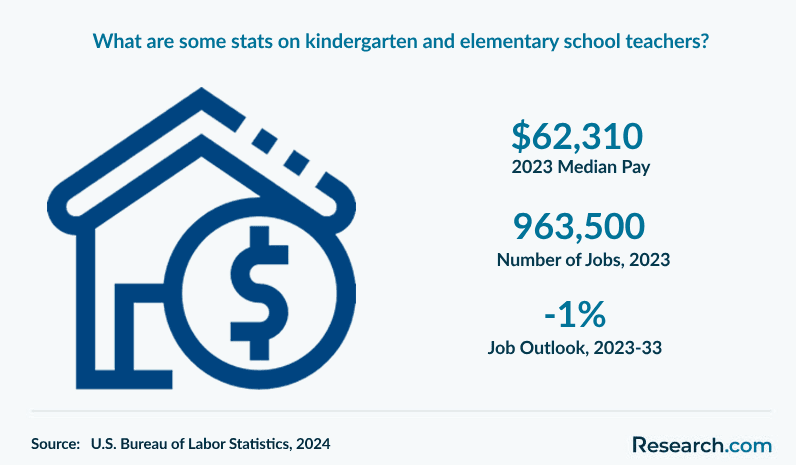
Career earnings should be weighed carefully against cost. In 2024, the median pay for kindergarten and elementary school teachers in the U.S. was $62,310 per year. A bachelor's degree typically serves as the entry-level education for this occupation, with no requirement for related work experience or on-the-job training. The number of jobs in this sector was 1,563,700 in 2023. Projections indicate a slight decline in the job outlook of -1% between 2023 and 2033, equating to an estimated loss of 11,500 positions (U.S. Bureau of Labor Statistics, 2024). The figure below summarizes these labor market data.
Even with a projected slight decline, kindergarten and elementary school teachers remain central to the education system. For prospective students, the practical question is not simply whether teaching is valuable, but whether the degree cost, expected salary schedule, work environment, and local hiring outlook make sense for their situation.
Are there accelerated online teaching degree options available?
Yes. Accelerated online teaching degrees exist, but they are not always the best fit for every student. These programs may use shorter terms, year-round calendars, heavier course loads, transfer-friendly policies, or credit for prior learning. They can be useful for students who already have college credits, hold a bachelor’s degree in another field, or need a faster route to graduate education.
Acceleration should not come at the expense of licensure requirements. If the program leads to teacher certification, you still need the required clinical hours, assessments, and state-approved student teaching experience. Students considering advanced leadership pathways may also compare faster doctoral options, such as the fastest EdD online program, but should confirm whether the schedule is realistic alongside work and school responsibilities.
| Accelerated format | When it may make sense | Potential drawback |
| Short courses | You can manage intensive weekly deadlines and frequent assignments. | Less time to absorb material or recover if you fall behind. |
| Transfer-heavy bachelor’s completion | You already have substantial college credit from an accredited institution. | Not all credits may apply to teacher education or licensure requirements. |
| Alternative licensure pathway | You already hold a bachelor’s degree and want to move into teaching. | Requirements vary by state and may involve provisional or residency licensure steps. |
| Year-round study | You want to finish faster and can study during summers or breaks. | May limit time for work, family responsibilities, or field placement scheduling. |
How do I choose the right online teaching degree program?
Start with the outcome, not the brochure. The right program is the one that leads to the credential, license, grade level, subject area, and career path you need at a price you can justify. If you are comparing specialized graduate programs, such as affordable early childhood education master's degrees online, confirm whether the program is designed for initial licensure, professional development, leadership, or salary advancement for current teachers.
- Identify the state where you plan to teach. Teacher licensure is state-specific, so the program must align with that state’s requirements.
- Confirm institutional accreditation. Use official accreditation sources and do not rely only on admissions materials.
- Check state approval for teacher preparation. Ask whether the program is approved for the specific license or endorsement you want.
- Review field placement support. Find out who arranges student teaching, where placements can occur, and what happens if you live out of state.
- Compare total cost, not just tuition. Include fees, books, exams, background checks, travel, and lost work time during student teaching.
- Evaluate faculty and support services. Look for advising, licensure guidance, tutoring, technology help, and career services.
- Ask about outcomes. Request completion rates, licensure exam pass rates, placement data, and graduate feedback when available.
Questions to ask admissions before applying
- Does this program lead to initial teacher licensure in my state?
- Is the program approved by my state education agency for the grade level and subject I want?
- How are student teaching placements arranged for online students?
- What exams, background checks, or field hours are required?
- What is the total estimated cost, including fees and licensure expenses?
- How many transfer credits will count toward my degree plan?
- Can I complete the program while working full time?
- What happens if I move to another state before finishing?
Can an online teaching degree boost my long-term career growth?
An online teaching degree can support career growth when it adds a credential, specialization, or advanced preparation that employers value. For new educators, the most important growth factor is usually obtaining the correct license and building strong classroom experience. For current teachers, graduate study may support advancement into instructional coaching, curriculum leadership, educational technology, special education, administration, or policy-related roles.
Long-term growth may also require credentials beyond a bachelor’s or master’s degree. Educators interested in senior leadership, district administration, higher education, or applied research may compare doctoral pathways, including the cheapest online EdD. Affordability matters, but so do accreditation, dissertation or capstone expectations, faculty expertise, and whether the program fits your leadership goals.
- For aspiring teachers: Prioritize licensure alignment, student teaching quality, and preparation for state exams.
- For current teachers: Look for endorsements or graduate programs that connect to district pay schedules and advancement rules.
- For non-classroom roles: Consider curriculum, instructional design, educational technology, or leadership-focused programs.
- For administrators: Confirm whether the degree meets principal, superintendent, or administrative licensure requirements in your state.
How can I assess the return on investment of my online teaching degree?
Return on investment for a teaching degree should be measured through more than first-year salary. Teaching careers often involve step-based salary schedules, benefits, pension or retirement systems, loan repayment possibilities, summers or extended-year contracts, and opportunities for additional stipends. A lower-cost program may produce a better ROI if it leads to licensure efficiently and does not require excessive borrowing.
When comparing education programs with affordability resources in other fields, such as the cheapest political science degrees online, use the same financial logic: compare total cost, completion time, job eligibility, credential value, and realistic earnings rather than focusing on tuition alone.
| ROI factor | How to evaluate it |
| Total program cost | Add tuition, fees, books, testing, background checks, travel, and lost wages during fieldwork. |
| Licensure outcome | Confirm the program qualifies you for the license or endorsement required for your target job. |
| Local salary schedules | Review district pay scales for bachelor’s, master’s, and additional-credit lanes. |
| Completion time | Longer timelines can increase costs and delay full-time earnings. |
| Borrowing level | Estimate monthly loan payments and compare them with expected entry-level pay. |
| Career mobility | Consider whether the degree supports future roles in leadership, special education, curriculum, or instructional design. |
Are there different licensure requirements for online vs. traditional teaching degrees?
Licensure requirements are set by states, not by whether a program is online or campus-based. In most cases, online and traditional candidates must meet the same rules: approved coursework, field experience, student teaching, required exams, background checks, and application procedures. The main risk for online students is enrolling in an out-of-state program without confirming whether it meets their state’s teacher certification requirements.
State-specific requirements to verify
- Praxis exams: Most states require teacher candidates to pass specific Praxis exams, but the required exams and passing scores vary significantly. Some states may require additional or different exams for certain subject areas or grade levels, and this applies to both online and traditional programs.
- Student teaching hours: The number of required student teaching hours varies by state. Some states may have specific requirements for the types of classroom settings or student populations in which those hours must be completed. These requirements are the same regardless of whether the program is online or traditional.
- Specific coursework: Some states mandate that teacher preparation programs, whether online or traditional, include coursework in specific areas, such as teaching students with disabilities, reading instruction, or state-specific curriculum standards.
- Background checks: All states require teacher candidates to undergo background checks, but the specific requirements and processes can vary.
- Residency requirements: Some states may have specific residency requirements for teacher licensure, which could indirectly affect online programs if a student completes a program out of state. However, this is not a difference between online and traditional programs, but a state-specific requirement.
Additional licensure checks for online students
- Program approval: Confirm that the online teacher preparation program is approved by the state education agency relevant to your intended license.
- Supervised student teaching: Ask whether the school will help place you in an approved classroom near your location.
- Out-of-state recognition: If the institution is in another state, ask your state licensing board whether additional coursework, exams, or applications will be required.
- Non-licensure programs: Some online education degrees are designed for professional development and do not lead to initial certification.
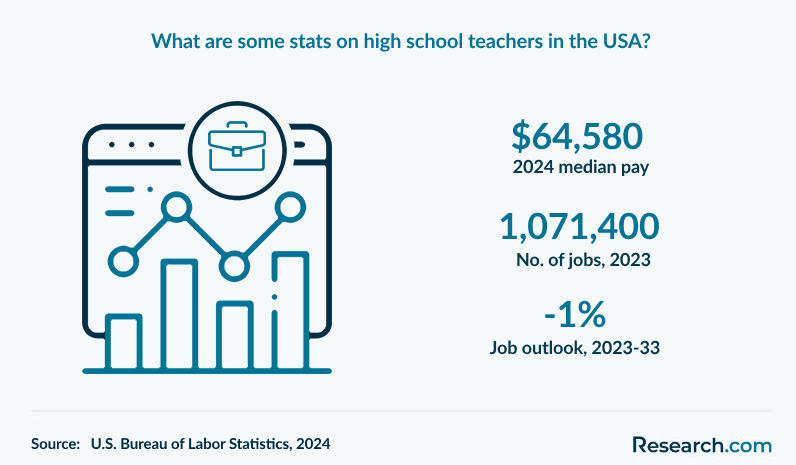
High school teaching illustrates why licensure alignment matters. In 2024, high school teachers in the U.S. earned a median pay of $64,580 per year, typically requiring a bachelor's degree for entry, with no specified need for related work experience or on-the-job training (U.S. Bureau of Labor Statistics, 2024). The number of high school teaching jobs in 2023 was 1,071,400 (U.S. Bureau of Labor Statistics, 2024). The job outlook for high school teachers projects a slight decline of -1% between 2023 and 2033, representing an anticipated loss of 6,900 positions (U.S. Bureau of Labor Statistics, 2024). The graphic below summarizes a relatively stable but slightly shrinking labor market.
What types of financial aid are available for online teaching students?
Online teaching students may qualify for many of the same financial aid options as campus-based students, provided the school and program meet eligibility requirements. Combining aid with inexpensive graduate degrees for teachers, can make an education degree more manageable, but students should still compare total cost and borrowing carefully.
- Federal student aid: Eligible online students may use federal grants, loans, and work-study programs when the institution and program qualify.
- Federal Pell Grants: Federal Pell Grants are typically awarded to undergraduate students with exceptional financial need.
- Direct Subsidized Loans: These are loans for undergraduate students with financial need, where the government pays the interest during certain periods.
- Direct Unsubsidized Loans: These are available to undergraduate and graduate students; interest accrues while in school.
- Direct PLUS Loans: These loans are available to graduate or professional students and parents of dependent undergraduate students to help pay education expenses.
- Federal Work-Study: This program provides part-time jobs for undergraduate and graduate students with financial need, allowing them to earn money for education expenses.
- State-based aid: Many states offer grants or scholarships for residents, including aspiring teachers.
- Institutional aid: Colleges may provide scholarships, grants, or tuition discounts for online students.
- Private scholarships: Education majors and online learners may qualify for awards from professional associations, nonprofits, community groups, and foundations.
- Employer tuition assistance: School districts, childcare centers, nonprofits, or other employers may help pay for job-related education.
- State-specific scholarships and grants: Some states provide aid for teacher shortage areas or candidates who commit to teaching in certain schools.
- Military scholarships and benefits: Service members, veterans, and eligible family members may qualify for education benefits.
- Teaching assistantships: Some graduate programs offer assistantships that may include tuition support or stipends.
- Foundation grants: Certain foundations fund students preparing for education careers or specialized teaching fields.
Students should complete financial aid steps early, compare award letters carefully, and ask whether aid will apply during student teaching terms. A program that appears affordable can become difficult to manage if unpaid fieldwork limits your ability to work.
The total amount of federal Pell Grants distributed in the United States saw a general downward trend from $34,473 million in 2018/19 to $28,330 million in 2022/23. However, preliminary data for 2023/24 indicates an increase to $31,415 million. Overall, while there was a decrease in Pell Grant distribution over the initial five-year period, the latest figures suggest a potential shift towards increased federal support through this grant program. These figures are shown in the graph below.
What kind of technical skills do I need for online learning in education?
You do not need to be a technology expert to succeed in an online teaching degree, but you do need reliable internet access, basic computer confidence, and willingness to troubleshoot common digital tasks. Because teaching increasingly involves digital tools, these skills also become part of your professional preparation.
- Computer basics: Manage files, install or update software, use a webcam and microphone, and organize documents.
- Internet navigation: Use browsers, academic databases, search tools, email, and online portals effectively.
- Word processing: Prepare lesson plans, papers, reflections, and professional documents.
- Presentation tools: Create slides, visuals, or recorded presentations for coursework and teaching demonstrations.
- Learning management systems: Navigate platforms such as Blackboard or Canvas to access materials, submit work, and participate in discussions.
- Video conferencing: Attend live classes, office hours, group meetings, or virtual observations using tools such as Zoom or Google Meet.
- Multimedia creation: Record short lessons, audio reflections, screen captures, or instructional videos when required.
- Digital collaboration: Work with peers through shared documents, discussion boards, cloud storage, and project management tools.
Common mistakes to avoid when choosing an online teaching degree
| Mistake | Better approach |
| Assuming accreditation automatically means licensure eligibility | Verify both institutional accreditation and state teacher preparation approval. |
| Choosing the cheapest program without checking outcomes | Compare cost alongside completion support, licensure pass rates, field placement help, and graduate results. |
| Ignoring state rules because the program is online | Contact your state education agency before enrolling in an out-of-state online program. |
| Overlooking student teaching logistics | Ask who arranges placements, where they can occur, and whether you can complete them while working. |
| Assuming all master’s degrees lead to certification | Check whether the program is licensure, endorsement, advancement, or non-licensure. |
| Comparing tuition only | Add fees, books, testing, background checks, travel, technology, and potential lost income. |
| Relying only on rankings or marketing pages | Use official accreditation, state approval, financial aid, and licensure sources to confirm claims. |
Key Insights
- Online teaching degrees can be legitimate: Employers generally focus on accreditation, state licensure eligibility, field experience, and candidate readiness rather than whether coursework was completed online.
- Licensure is the central issue: Before applying, confirm that the program meets the teacher certification rules for the state, grade level, and subject area where you plan to work.
- Student teaching usually remains in person: Even if classes are online, most licensure programs require supervised field placements in approved schools.
- Cost varies widely: The cost of an online teaching degree in 2024–25 ranges from approximately $2,850 to $5,100 per year at public institutions and from $4,100 to $60,000 total at private institutions, with per-credit costs typically between $95 and over $2,000, plus additional fees.
- Teacher labor markets differ by role and location: In 2024, kindergarten and elementary school teachers had median annual pay of $62,310, while high school teachers had median annual pay of $64,580; both occupations show a projected job outlook decline of -1% between 2023 and 2033.
- Workforce conditions matter: North Carolina’s 2023-24 teacher attrition rate was 9.88% among 89,972 full-time permanent teachers, above the 8.64% average over the past seven years, with higher attrition among teachers with 0-5 years of experience and those with 28 or more years of experience.
- Enrollment trends are uneven: From 2022 to 2031, Idaho is projected to see the largest public school enrollment increase at 10.0%, while Oklahoma is projected to have the largest decrease at -1.5%.
- Pay satisfaction is a real concern: A 2023 survey found that only 2% of respondents were extremely satisfied and 13% were very satisfied with compensation, while 51% were not too satisfied or not at all satisfied.
- Financial aid can reduce borrowing: Federal Pell Grant distribution decreased from $34,473 million in 2018/19 to $28,330 million in 2022/23, with preliminary data showing an increase to $31,415 million in 2023/24.
- The best program is the one that fits your goal: Choose based on licensure alignment, accreditation, field placement support, total cost, specialization, schedule, and realistic career outcomes.
References:
- Bureau of Labor Statistics, U.S. Department of Labor. (2024). Kindergarten and elementary school teachers. Occupational Outlook Handbook. Bureau of Labor Statistics.
- North Carolina Department of Public Instruction. (2025, April 2). Teacher attrition declined in 2023–24 school year; still higher than average of past several years. North Carolina Department of Public Instruction.
- Pew Research Center. (2024, April 4). 2023 Survey of Teachers: Final Topline. Pew Research Center.
- Statista. (2024). Amount of student aid paid, by federal grant program U.S. 2023. Statista.
- Statista. (2024). Change in U.S. public school enrollment from 1990 to 2023. Statista.
Other Things You Should Know About Getting a Teaching Degree Online
In 2027, online programs for teaching degrees are widely accessible, offered by many accredited universities. These programs provide flexibility and cater to various educational needs, allowing students to complete coursework remotely while still meeting required teaching competencies.
In 2027, online teaching degrees typically require students to complete supervised fieldwork or student teaching. This involves working in a school setting to gain practical experience under the guidance of a licensed teacher. Specific requirements vary by the program, so prospective students should verify fieldwork obligations before enrolling.