
2027 How Long Does It Take to Get a Criminal Justice Degree?

Co-Founder and Chief Data Scientist
A criminal justice degree can take anywhere from about 2 years to 4 years at the undergraduate level, and longer if you continue into graduate study or pursue a law enforcement promotion path. The best timeline depends on the credential you choose, whether you study full time or part time, how many credits you transfer, and whether your target job requires academy training, licensure, field experience, or graduate education.
This guide is for students comparing associate, bachelor’s, master’s, online, and accelerated criminal justice programs. It explains typical completion times, what can speed up or delay graduation, how online and campus programs differ, which career paths may require additional training, and how to evaluate cost, accreditation, salary expectations, and return on time invested before enrolling.
Quick Answer: How Long Does It Take to Get a Criminal Justice Degree?
A criminal justice associate degree usually takes about 2 years of full-time study, while a bachelor’s degree typically takes about 4 years. A master’s degree generally adds another 2 years after the bachelor’s. Online bachelor’s programs often follow the same 4-year timeline, but accelerated programs may shorten completion to about 3 years, and some accelerated online options may take 18 to 36 months depending on transfer credits, course load, and program structure.
Key things to know before choosing a criminal justice degree:
- A full-time bachelor’s degree in criminal justice typically takes about 4 years, but transfer credits, summer courses, and accelerated formats can shorten that timeline.
- Online programs can be just as academically valid as campus programs when they are properly accredited, but they require stronger self-management and may offer fewer in-person networking opportunities.
- A criminal justice degree can support careers in policing, investigations, corrections, courts, legal support, forensic science, security, and public administration, but some roles require additional academy training, certification, licensure, or work experience.
- Online vs. traditional criminal justice degrees
- Criminal justice degree timelines by credential level
- Pros and cons of accelerated online criminal justice programs
- Criminal justice certifications that can strengthen your resume
- What can shorten or extend your degree timeline?
- Average salary for criminal justice degree graduates
- How transfer credits affect graduation time
- Job market demand for criminal justice graduates
- Accreditation to look for in a criminal justice program
- Common jobs for criminal justice degree holders
- Using paralegal certification with a criminal justice degree
- How to reduce the cost and time of your degree
- Timeline to become a detective or investigator after graduation
- How to prepare for a federal law enforcement career
What is the difference between an online and a traditional criminal justice degree?
The main difference is delivery format. Online and traditional criminal justice programs may award the same degree and cover similar subjects, but the student experience can be very different. Your best option depends on your schedule, learning style, need for structure, and career goals.
| Factor | Online criminal justice degree | Traditional campus criminal justice degree |
| Schedule | Usually better for students balancing work, family, military service, or irregular shifts because coursework can often be completed remotely. | Usually follows fixed class times, which can help students who prefer routine but may be harder for working adults. |
| Learning style | Requires discipline, independent reading, comfort with digital platforms, and consistent weekly planning. | Provides more face-to-face discussion, immediate classroom interaction, and a more structured academic environment. |
| Networking | Networking depends heavily on virtual events, faculty access, discussion boards, internships, and student initiative. | May provide easier access to campus events, local agencies, classmates, guest speakers, and in-person faculty mentorship. |
| Hands-on learning | Some programs include remote simulations, local internships, or optional field experiences, but availability varies by school. | Campus programs may offer easier access to labs, mock courtrooms, forensic facilities, local agency partnerships, and student organizations. |
| Best fit | Students who need flexibility and can stay organized without daily in-person accountability. | Students who learn best through live discussion, structure, campus resources, and in-person relationship building. |
Both formats can work well if the program is accredited and aligned with your intended career. For example, a student planning for law enforcement may value internship connections with local agencies, while a working correctional officer may prioritize an online program that allows shift-friendly coursework. Students considering public-service careers that blend psychology, security, and behavioral analysis may also find it useful to compare related fields, such as those discussed in this military psychology career guide.
When comparing programs, look beyond the delivery format. Ask whether the curriculum emphasizes policing, courts, corrections, criminology, homeland security, cybercrime, juvenile justice, or administration. The same decision logic applies to other graduate and professional pathways: understanding the difference between a master’s in accounting and an MBA, for instance, shows why students should distinguish between specialized and broader credentials before committing time and money.
How long does it take to obtain different types of criminal justice degrees?
The length of a criminal justice degree depends mostly on degree level and enrollment pace. Full-time students finish faster, while part-time students often take longer because they complete fewer credits each term. Transfer students and accelerated learners may reduce the timeline substantially.
| Credential | Typical full-time timeline | Best for | Important planning note |
| Associate degree | 2 years | Students seeking a lower-cost starting point, entry-level roles, or transfer into a bachelor’s program. | Confirm that credits will transfer cleanly if your long-term goal is a bachelor’s degree. |
| Bachelor’s degree | 4 years | Students who want broader career options in law enforcement, courts, corrections, investigation, policy, or administration. | Many agencies and employers prefer or require bachelor’s-level preparation for advancement. |
| Master’s degree | 2 years beyond the bachelor’s | Professionals pursuing leadership, policy, homeland security, corrections administration, research, or teaching-related roles. | Work experience may matter as much as graduate education for many supervisory positions. |
| Online bachelor’s degree | About 4 years | Working adults, transfer students, military learners, parents, and students who need location flexibility. | Online does not automatically mean faster; the timeline depends on course load and accepted credits. |
| Accelerated degree | About 3 years | Motivated students who can handle compressed terms, year-round study, and heavier weekly workloads. | Check whether the faster format limits electives, internships, or field experiences. |
An associate degree can provide a practical starting point, especially if you plan to reduce costs before transferring. A bachelor’s degree gives more depth in criminal law, criminology, policing, corrections, ethics, research methods, and justice administration. A master’s degree is usually most useful for students who already know they want management, policy, analysis, or specialized agency roles.
Some students also consider doctoral or terminal professional degrees later in their careers. If you are comparing practice-focused and research-focused doctoral options, the distinction explained in what is the difference between DBA and EdD can help frame how advanced criminal justice study may differ depending on whether your goal is applied leadership, research, or teaching.
What are the pros and cons of accelerated online criminal justice degrees?
Accelerated online criminal justice programs can be a smart choice for students who want to finish quickly, already have transfer credits, or can dedicate consistent weekly time to school. They are not the right fit for everyone. Faster programs compress the same academic expectations into shorter terms, which can make mistakes, missed deadlines, and weak time management more costly.
| Advantage | Why it matters | Who benefits most |
| Faster completion | Some accelerated programs can be completed in as little as 18 to 36 months, which may help students qualify for jobs or promotions sooner. | Transfer students, working adults with clear goals, and students able to study year-round. |
| Flexible access | Online coursework can reduce commuting time and make school more manageable for students with work or family responsibilities. | Students with unpredictable schedules, rural learners, parents, and military-affiliated students. |
| Potential cost savings | A shorter timeline may reduce some costs and allow students to enter or advance in the workforce faster. | Students who avoid repeated courses, maximize transfer credits, and maintain steady progress. |
| Drawback | Why it can be a problem | How to reduce the risk |
| Heavy workload | Compressed courses often require frequent reading, writing, exams, and discussion posts with little room to fall behind. | Review sample syllabi and estimate weekly study hours before enrolling. |
| Less time to build relationships | A fast online format may reduce informal networking with faculty, classmates, and local criminal justice professionals. | Choose programs with career services, internships, faculty office hours, and agency partnerships. |
| Possible limits on field experience | Some programs may not emphasize in-person practice, labs, or placements as strongly as campus programs. | Ask whether internships, capstones, ride-alongs, simulations, or local field options are available. |
Accelerated programs are best for students who are organized, self-directed, and realistic about weekly workload. If you need a slower pace because of work, caregiving, health, or military obligations, a part-time online program may be a better long-term choice than repeatedly withdrawing from accelerated classes.
Students interested in teaching, training, or instructional roles within corrections, public safety, or vocational education should also check credential requirements carefully. Rules vary by state and institution, and this guide on whether you can teach with an associate degree illustrates why degree level alone may not answer every career-eligibility question.
What are some certifications you can get for criminal justice careers?
Certifications are not a substitute for a degree, academy training, or state licensure when those are required. However, they can help demonstrate specialized knowledge in investigations, fraud, legal support, corrections, or crime analysis. The right certification depends on the job you want, not just the credential name.
| Certification | Career relevance | Good fit for |
| Certified Criminal Investigator (CCI) | The Certified Criminal Investigator certification can support professionals who want to demonstrate investigative knowledge related to evidence, interviews, case organization, and legal processes. | Detectives, private investigators, law enforcement officers, and investigative support personnel. |
| Certified Fraud Examiner (CFE) | Focuses on fraud detection, prevention, investigation, ethics, financial records, and legal issues involving fraud. | Financial crime investigators, compliance staff, corporate security professionals, and auditors working with investigations. |
| Certified Law Enforcement Analyst (CLEA) | Highlights skills in crime data, trends, mapping, reporting, and intelligence support for law enforcement decisions. | Crime analysts, intelligence analysts, police department analysts, and public safety data professionals. |
| Certified Corrections Officer (CCO) | Supports knowledge of facility safety, inmate supervision, emergency procedures, use-of-force policies, and correctional operations. | Corrections officers, detention staff, and professionals seeking advancement in correctional facilities. |
| Certified Paralegal (CP) | Demonstrates legal support skills, including legal research, document preparation, ethics, and procedural knowledge. | Paralegals, legal assistants, court support staff, and criminal justice graduates interested in law offices or legal agencies. |
Before paying for any credential, verify whether employers in your target area actually request or value it. Some roles prioritize academy completion, state licensing, security clearance eligibility, language skills, report writing, physical fitness, or prior military/law enforcement experience more than optional certifications.
What factors can speed up or delay a criminal justice degree?
Your degree timeline is not fixed. Two students in the same program can graduate at different times because of transfer credit decisions, course availability, work obligations, academic performance, internships, and whether they attend full time or part time.
| Factor | Can speed up your degree when... | Can delay your degree when... |
| Transfer credits | Your previous courses are accepted and apply directly to general education, electives, or major requirements. | Credits are rejected, count only as electives, or come from coursework that does not match the new program. |
| Enrollment status | You study full time, take summer or winter courses, and maintain steady progress. | You study part time, stop out for a term, or reduce your course load because of work or family obligations. |
| Program format | You choose an accelerated or flexible online format that offers frequent start dates and year-round classes. | Required courses are offered only once per year or in a sequence that limits when you can take them. |
| Academic performance | You pass courses on the first attempt and meet prerequisites on schedule. | You withdraw, fail, repeat classes, or miss GPA requirements for major admission or internships. |
| Internships and fieldwork | Field experience is built into the schedule and can be completed locally or through your employer. | Placements are limited, require background checks, or conflict with work hours. |
Fieldwork can be especially important if your interests overlap with counseling, rehabilitation, or community supervision. For example, programs connected to a substance abuse counselor degree often include supervised experience because practical training is central to career preparation. Criminal justice students should ask early whether internships are optional, required, competitive, or tied to background-screening rules.
How much is the average salary for criminal justice degree graduates?
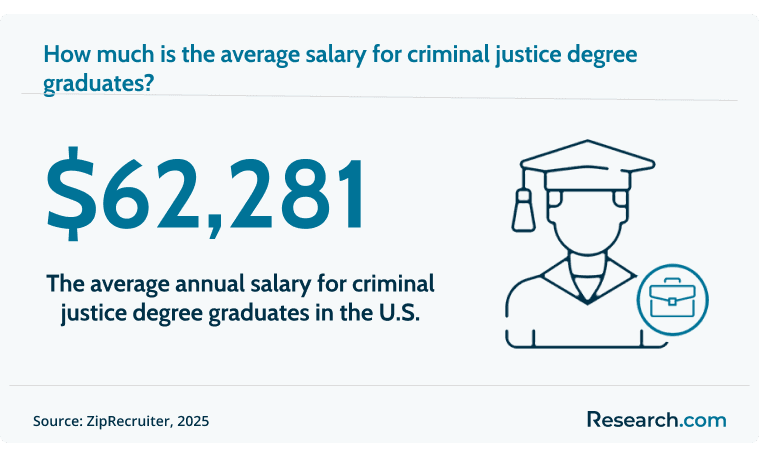
Criminal justice degree graduates earn an average salary of around $62,281 per year, but that figure should be treated as a broad reference point rather than a guarantee. Actual earnings depend on job title, agency type, location, overtime rules, seniority, education level, union agreements, specialized training, and whether the role is local, state, federal, nonprofit, or private sector.
Entry-level roles in corrections, legal support, security, or local law enforcement may pay differently than federal, investigative, forensic, or legal careers. Some roles also involve overtime, shift differentials, hazard pay, or promotion-based increases. If you are specifically interested in management or agency leadership, reviewing a criminal justice administration salary guide can help you compare how administrative responsibilities may affect compensation.
Salary factors to evaluate before choosing a specialization
- Role: Police work, corrections, legal support, forensic science, probation, private investigation, and federal enforcement have different pay structures.
- Employer: Federal, state, local, private, and nonprofit employers may offer different salaries, benefits, retirement plans, and advancement systems.
- Location: Pay often reflects regional budgets, local cost of living, agency size, and competition for qualified applicants.
- Education and credentials: A bachelor’s degree, graduate degree, academy training, or job-specific certification may support advancement, but requirements vary.
- Experience: Many higher-paying investigative and supervisory roles require years of field experience after graduation.
How does transferring credits affect how long it takes to get a criminal justice degree?
Transfer credits can shorten a criminal justice degree by allowing you to apply previous college coursework toward your new program. Students who enter with an associate degree, general education credits, military training credits, or prior criminal justice courses may avoid repeating classes and move more quickly into upper-level coursework.
In some cases, transfer credit can reduce a 4-year bachelor’s program to two or three years. The exact result depends on how many credits the new school accepts, whether those credits satisfy specific degree requirements, and whether there is a maximum transfer-credit limit. A course may transfer to the university but still not count toward the criminal justice major, so students should request a written degree audit before enrolling.
| Transfer question | Why it matters |
| Is the previous school accredited? | Credits from non-accredited institutions may not be accepted or may receive limited evaluation. |
| Will credits apply to the major or only as electives? | Elective credit helps, but major and general education credit usually has a bigger impact on graduation time. |
| Is there a transfer-credit cap? | Some schools limit how many outside credits can count toward the degree. |
| Are older credits accepted? | Some programs review older coursework differently, especially in technical or policy-heavy subjects. |
| Will a prior associate degree satisfy general education requirements? | Articulation agreements can make transfer smoother and reduce duplicate coursework. |
Students interested in technology-heavy justice careers should also consider how transfer credits align with analytics, cybercrime, digital evidence, or artificial intelligence coursework. If your interests extend beyond traditional criminal justice into technology, comparing options such as the cheapest online artificial intelligence degree programs can help you decide whether a justice-focused degree, tech-focused degree, or combined pathway is more practical.
Is there a strong job market demand for criminal justice graduates?
Demand for criminal justice graduates depends on the role. Public safety, courts, corrections, legal services, private security, fraud investigation, forensic science, and compliance all need trained workers, but hiring conditions vary by region, government budgets, agency staffing needs, and specialization. A degree can improve competitiveness, but it does not guarantee employment or immediate advancement.
The strongest candidates often combine formal education with practical experience, strong writing, ethical judgment, digital literacy, data awareness, and a clean background suitable for agency hiring. Employers are also paying more attention to technology-related skills because investigations increasingly involve digital evidence, surveillance systems, databases, cybercrime, financial records, and analytical tools.
For students who want flexibility and affordability while preparing for this evolving field, comparing options such as the cheapest online criminal justice degree can be a practical starting point. Cost matters, but it should be weighed alongside accreditation, internship access, employer reputation, faculty expertise, transfer policies, and career support.
What accreditation should I look for in a criminal justice program?
Accreditation is one of the most important checks before enrolling. It affects academic credibility, transfer credit, employer recognition, graduate school eligibility, and access to federal financial aid. At minimum, students should look for institutional accreditation from a recognized accrediting body. Program-specific quality indicators, such as experienced faculty, updated curriculum, internship partnerships, career advising, and strong student support, also matter.
| Accreditation or quality factor | What to check | Why it matters |
| Institutional accreditation | Confirm that the college or university is accredited by a recognized accrediting agency. | It supports credit transfer, financial aid eligibility, and degree recognition. |
| Curriculum fit | Review whether the program emphasizes law enforcement, corrections, courts, criminology, forensic science, cybercrime, or administration. | A general criminal justice degree may not prepare you equally well for every specialization. |
| Faculty background | Look for faculty with academic expertise, agency experience, research credentials, or professional specialization. | Faculty experience can shape course quality, mentorship, and career relevance. |
| Internships and partnerships | Ask whether the school has relationships with agencies, courts, labs, nonprofit organizations, or legal employers. | Practical experience can help students understand real work environments and build references. |
| Career services | Check whether the program supports resume writing, interview preparation, background-check readiness, and job-search planning. | Criminal justice hiring often includes structured processes, fitness standards, exams, and background investigations. |
Students interested in forensic science should be especially careful because lab-based careers may require specific science coursework, laboratory experience, or a more specialized degree plan than a general criminal justice major provides. Reviewing the best college forensic science programs can help clarify what stronger forensic preparation may look like.
What are the different job roles available for criminal justice degree holders?
A criminal justice degree can lead to several career directions, but each role has different entry requirements. Some positions require a police academy, state certification, background investigation, physical fitness standards, law school, scientific training, or prior work experience. Use salary figures as comparison points, not promises.
| Role | Average salary listed | What the role typically involves | Additional requirements to check |
| Police and Detectives | $77,270 | Responding to incidents, enforcing laws, writing reports, investigating crimes, interviewing witnesses, and supporting public safety. | Academy training, physical standards, background check, agency exams, and years of patrol experience for detective roles. |
| Probation Officers | $64,520 | Supervising people on probation, monitoring compliance, preparing reports, coordinating services, and supporting rehabilitation goals. | State or agency requirements, case-management skills, field safety training, and strong documentation ability. |
| Lawyers | $151,160 | Representing clients, interpreting law, preparing legal arguments, negotiating, and appearing in court or legal proceedings. | Law school, bar admission, and substantial legal training beyond a criminal justice undergraduate degree. |
| Private Detectives and Investigators | $52,370 | Conducting research, surveillance, interviews, background checks, and fact-finding for clients or organizations. | State licensing rules, experience requirements, insurance, and specialized investigative training. |
| Paralegals and Legal Assistants | $61,010 | Supporting attorneys through legal research, document drafting, case organization, filing, and trial preparation. | Legal writing skills, paralegal training, and employer preference for certification or specialized coursework. |
| Forensic Science Technicians | $67,440 | Collecting, documenting, preserving, testing, and explaining physical evidence from investigations. | Science coursework, lab skills, evidence-handling training, and sometimes a forensic science or natural science background. |
These roles show why criminal justice is not a single career track. A student who wants to become a police detective should plan differently from someone who wants to work in legal support, forensic labs, probation, or private investigations. If legal support interests you, this guide on how to become a criminal paralegal can help you understand the skills and steps involved.
Can a paralegal certification complement my criminal justice degree?
Yes. A paralegal certification can complement a criminal justice degree if your goal is to work in law offices, courts, prosecutors’ offices, public defender offices, compliance departments, or legal support roles connected to criminal law. Criminal justice coursework helps you understand systems, agencies, ethics, crime, and procedure, while paralegal training builds practical skills in legal research, document preparation, citation, case organization, and attorney support.
This combination is especially useful for students who are not ready for law school but want to work close to legal processes. It can also help future law school applicants gain exposure to legal work before committing to a longer and more expensive degree path. If cost is a major concern, reviewing affordable ABA accredited paralegal programs online can help you compare options more strategically.
How can I reduce the cost and time of a criminal justice degree?
The fastest way to reduce both cost and completion time is to avoid paying for credits you do not need. That means choosing an accredited school, transferring eligible credits, using exams or dual enrollment when appropriate, comparing total program cost, and building a graduation plan before your first term.
| Strategy | How it can save time | How it can save money |
| Use AP, CLEP, or dual enrollment credit | Exams and early college coursework may let you bypass introductory classes. | You may pay less than the cost of taking the same credits later through a college program. |
| Start at a community college | An associate degree or transfer pathway can cover general education before upper-level study. | Community college tuition is often lower than 4-year college tuition. |
| Transfer prior credits | Accepted credits reduce the number of courses left to complete. | You avoid retaking classes you have already finished. |
| Take summer or winter courses | Extra terms can help you graduate earlier. | Finishing sooner may reduce living expenses or opportunity costs, depending on your situation. |
| Choose the right pace | A realistic course load helps prevent withdrawals and repeated classes. | Avoiding failed or dropped courses protects tuition dollars and financial aid progress. |
| Apply for aid early | Financial planning can prevent stop-outs caused by unpaid balances. | Scholarships, grants, and aid may reduce out-of-pocket costs. |
Students can also use Advanced Placement (AP) or CLEP exams to seek credit for certain introductory subjects, depending on school policy. If you are pursuing evidence-related work, starting with lower-cost general education and relevant foundational coursework may also help you meet some evidence technician education requirements while controlling expenses.
Common mistakes that can add time or cost
| Mistake | Why it hurts | Better approach |
| Choosing a program without checking accreditation | Credits may not transfer, employers may question the degree, and financial aid eligibility may be affected. | Verify accreditation before applying or paying deposits. |
| Looking only at tuition per credit | Fees, books, technology costs, travel, internships, and repeated courses can change the real cost. | Compare total estimated cost to graduation. |
| Assuming online means faster | Many online programs follow the same credit requirements as campus programs. | Ask about term length, course availability, transfer credits, and accelerated options. |
| Ignoring transfer policy details | Credits may transfer as electives rather than required courses. | Request a written transfer evaluation and degree plan. |
| Skipping career requirements research | Your desired role may require academy training, licensure, law school, science courses, or prior experience beyond the degree. | Review job postings and agency requirements before selecting a program. |
| Relying only on rankings | A highly ranked program may still be too expensive, too broad, or poorly aligned with your target job. | Use rankings as one input, along with accreditation, cost, outcomes, and curriculum fit. |
How long does it take to become a detective or investigator after graduating?
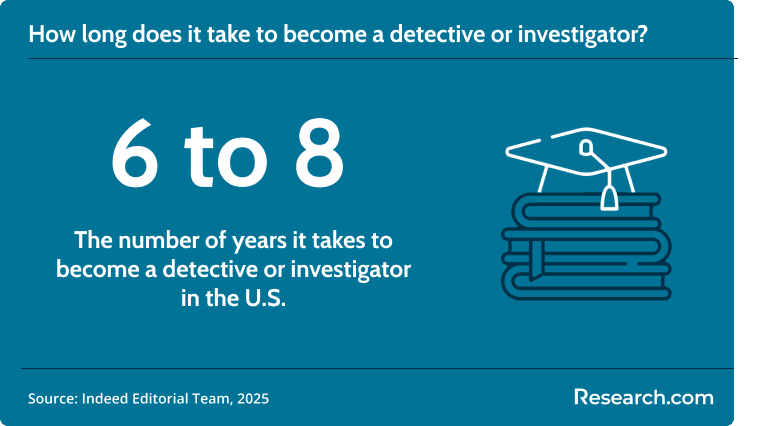
On average, it takes about 6 to 8 years to become a detective or investigator. That timeline commonly includes 4 years to complete a bachelor’s degree in criminal justice, or about 2 years with an associate degree, followed by 2 to 4 years of work experience as a police officer or in a related role before qualifying for promotion or specialized investigative positions.
Most police detectives do not start as detectives immediately after graduation. They typically begin as patrol officers, complete academy and field training, build investigative judgment, learn local procedures, write reports, testify in court, and gain experience handling calls and cases. Many departments require two to five years of on-the-job experience before officers can apply for or be promoted into detective positions.
Private investigator timelines vary more because state licensing rules and employer expectations differ. Some graduates may find entry-level investigative support work sooner, while others first gain experience in law enforcement, military service, insurance investigations, corporate security, fraud analysis, or legal support. Students interested in evidence analysis and crime-scene-related work should also review criminalist job requirements, since those roles may require different science and laboratory preparation than a general detective path.
| Path | Typical sequence | Planning advice |
| Police detective | Degree or required education, academy, patrol work, agency experience, promotion or assignment to investigations. | Research department-specific promotion rules before choosing electives or internships. |
| Private investigator | Degree or related background, state licensing if required, investigative work experience, specialized cases. | Check licensing requirements in the state where you plan to work. |
| Federal investigator | Bachelor’s degree, competitive application, background investigation, agency training, field assignment. | Prepare early for fitness, writing, interviews, security clearance, and specialized agency requirements. |
| Forensic or criminalist role | Science-heavy education, lab skills, evidence procedures, agency hiring process, specialized training. | Do not assume a general criminal justice degree alone will meet forensic lab requirements. |
How can I prepare for a federal law enforcement career?
Federal law enforcement hiring is competitive and usually requires more than a degree. Applicants may need to meet age, citizenship, education, experience, physical fitness, background investigation, and security clearance standards, depending on the agency and role. Planning early is important because past conduct, finances, work history, drug use, driving record, and online behavior can affect suitability reviews.
Practical steps to build a stronger federal law enforcement profile
- Choose relevant coursework. Consider classes in criminal law, constitutional law, investigations, intelligence, homeland security, cybercrime, foreign language, statistics, writing, and ethics.
- Gain experience before graduation. Look for internships, campus safety roles, emergency management volunteering, military experience, legal support work, or local agency opportunities.
- Maintain physical readiness. Many roles include fitness testing or physically demanding training academies.
- Protect your background. Avoid choices that can create problems during background checks, including dishonesty, unresolved financial issues, or conduct inconsistent with public trust roles.
- Improve writing and interviewing skills. Federal hiring often rewards clear documentation, sound judgment, and strong communication.
- Research agency-specific requirements. Different agencies have different missions, training pipelines, and hiring standards.
If immigration enforcement or homeland security work interests you, reviewing the pathway for becoming an ICE agent can help you understand how agency-specific expectations may differ from local or state law enforcement routes.
Questions to ask before enrolling in a criminal justice program
- Is the college institutionally accredited by a recognized accrediting body?
- How many of my prior credits will count toward the degree, and will they apply to major requirements or only electives?
- Does the program offer concentrations in policing, corrections, courts, homeland security, cybercrime, forensic science, or administration?
- Are internships required, optional, guaranteed, or competitive?
- Does the program help students prepare for academy applications, background checks, report writing, interviews, and fitness standards?
- What is the total estimated cost to graduate, including fees, books, technology, travel, and repeated-course risk?
- Can I attend part time, full time, online, or in an accelerated format without losing access to required courses?
- What career services are available specifically for criminal justice students?
- Do graduates work in the roles I am targeting, or is the program more general than my career goal requires?
- If I plan to move states, will the degree, internships, or certifications still support my career goals there?
Key Insights
- A criminal justice bachelor’s degree typically takes about 4 years full time, while an associate degree usually takes 2 years and a master’s degree generally adds 2 more years after the bachelor’s.
- Accelerated programs can shorten the path to about 3 years, and some accelerated online options may take 18 to 36 months, but the workload is heavier and may leave less room for internships or networking.
- Transfer credits can reduce both cost and time, but only if they are accepted and applied to actual degree requirements. Always request a written transfer evaluation.
- The average salary for criminal justice degree graduates is around $62,281 per year, but pay varies widely by role, employer, location, experience, and additional training.
- Common roles include police and detectives at $77,270, probation officers at $64,520, lawyers at $151,160, private detectives and investigators at $52,370, paralegals and legal assistants at $61,010, and forensic science technicians at $67,440.
- Becoming a detective or investigator often takes about 6 to 8 years because graduates usually need education plus several years of field experience before moving into investigative roles.
- Accreditation, transfer policy, curriculum focus, internship access, and career support are more important than choosing a program based only on speed, cost, or rankings.
- The best criminal justice degree is the one that matches your target role. Law enforcement, legal support, forensic science, corrections, and federal careers can require very different preparation.
References:
- Franklin University. (n.d.). How To Get a Master's In Criminal Justice. Franklin University
- Indeed Editorial Team. (2025). How To Become a Police Detective in 8 Steps. Indeed.com
- Maryville University. (n.d.) How Long Does It Take to Get a Bachelor’s Degree in Criminal Justice? Maryville University
- Monroe University. (n.d.). Associate Degree in Criminal Justice (Online). Monroe University
- U.S. Bureau of Labor Statistics. (2024). OOH: Police Detectives. U.S. BLS
- ZipRecruiter. (2025). Criminal Justice Degree Salary. ZipRecruiter
Other things you should know about how long it takes to get a criminal justice degree
In 2027, obtaining a criminal justice degree typically takes around four years for a bachelor's degree. However, factors like course load, program type (online or in-person), transfer credits, and personal commitments can alter the timeline, potentially speeding up or delaying graduation.
Yes. Many colleges accept up to 60 transfer credits toward a 120-credit bachelor’s degree, which can cut completion time by about two years. Final approval depends on course equivalency, regional accreditation, and the school’s transfer policy.
Prerequisites for enrolling in a criminal justice degree program in 2027 typically include a high school diploma or equivalent, meeting minimum GPA requirements, and sometimes standardized test scores like the SAT or ACT. Specific requirements may vary between institutions.


