
2027 Best Online Bachelor’s in Emergency Management Programs

Co-Founder and Chief Data Scientist
An online bachelor’s degree in emergency management is designed for students who want to help communities, public agencies, healthcare organizations, businesses, and nonprofits prepare for and respond to disasters. The decision is not simply whether to study online. You need to know whether the program is accredited, whether it teaches practical response and planning skills, whether employers will respect the credential, and whether the cost makes sense for your career goals.
This guide explains how online emergency management bachelor’s programs work, what they usually cost, what courses and skills to expect, how online programs compare with campus-based options, and how to evaluate programs before enrolling. It also reviews several online bachelor’s degree programs in emergency management and related fields so you can compare structure, tuition, credits, and accreditation details. Graduates may also use this background to move into adjacent areas such as public administration, homeland security, healthcare administration, business continuity, or the best online cybersecurity programs.
Because each university builds its emergency management curriculum differently, students should not assume that all online programs prepare them for the same roles. Some programs emphasize disaster response, some focus on emergency services administration, and others connect emergency management with homeland security, humanitarian response, or public policy. If you are comparing the top online degrees, the best choice is the one that matches your career target, schedule, budget, and need for practical experience.
Online Bachelor’s Degree/Program in Emergency Management Table of Contents
- Can you earn an emergency management bachelor’s degree fully online?
- Do employers respect online emergency management degrees?
- Are online degrees accepted internationally?
- Online vs. campus emergency management bachelor’s programs
- How much does an online bachelor’s degree in emergency management cost?
- What are the admissions and graduation requirements?
- Courses commonly included in online emergency management programs
- Skills you can build in an emergency management degree
- How to choose the right online emergency management program
- 2027 Best Online Bachelor’s Degree Programs in Emergency Management
- Related fields you can pursue with emergency management training
- Career advancement options after an online emergency management degree
- How accelerated online programs work
- Can business training strengthen an emergency management career?
- How does the degree support risk assessment and emergency planning?
- How can emergency management support supply chain resilience?
- Can economics improve emergency management decision-making?
- How can emergency management training improve business efficiency?
- Should you pursue an advanced business degree afterward?
- Do practical experiences matter in emergency management education?
- Can healthcare administration pair well with emergency management?
Quick Answer: Is an Online Bachelor’s in Emergency Management Worth Considering?
Yes, an online bachelor’s degree in emergency management can be a strong option if you want a flexible path into disaster response, emergency planning, crisis communication, public safety, business continuity, homeland security, or related roles. The degree is most valuable when it comes from an accredited institution, includes practical assignments or field-based learning, and aligns with the type of emergency management work you want to do.
It may not be the best investment if you choose a program without verifying accreditation, if the curriculum does not match your target role, or if a shorter credential plus relevant experience would meet your career goals. Before enrolling, compare total cost, transfer credit policies, faculty experience, internship or capstone options, and whether the program is fully online or hybrid.
| Best Fit | May Not Be the Best Fit |
| Working adults who need online flexibility | Students who need frequent in-person instruction |
| People interested in public safety, disaster response, planning, or resilience | Students seeking a narrowly technical degree with little policy or communication content |
| Emergency services professionals seeking advancement | Applicants who have not checked whether the degree supports their target job requirements |
| Students who want a foundation for graduate study in homeland security, public administration, healthcare administration, or cybersecurity | Students choosing only by tuition price without reviewing curriculum, accreditation, and support services |
Can you get a degree completely online?
Yes. Many accredited colleges and universities now deliver full degree programs through distance learning, and emergency management is one of the fields that can often be studied online. According to the National Center for Education Statistics, 44% of students in public universities were enrolled exclusively in distance education. While pandemic-era shifts accelerated online adoption, distance learning is now a normal part of higher education rather than a temporary substitute for campus study.
An online bachelor’s in emergency management can usually be completed without attending regular on-campus classes. However, “online” does not always mean every requirement is virtual. Some programs may include internships, fieldwork, capstone projects, simulations, or proctored assessments. Before applying, confirm whether the program is fully online, mostly online, or hybrid.
Students should also check whether the program fits their state, regional, or employer expectations. Emergency management roles can vary widely by agency and sector, so review job postings in your target area and compare them with the program’s courses, experiential learning options, and credential requirements.
Will employers take my online degree seriously?
Employers are generally more comfortable with online degrees than they were in the past, especially when the degree comes from an accredited and recognizable institution. The delivery format matters less than whether the school is legitimate, the curriculum is rigorous, and the graduate can demonstrate relevant skills.
Survey findings cited by Champlain College Online reported that 84% of respondents believe employers have become more accepting of online degrees. In another reported finding, 73% of surveyed adults said online education is the same or better at meeting the needs of traditional students.
For emergency management roles, employers often look beyond the diploma. They may evaluate experience, internships, military or public safety background, communication ability, leadership under pressure, knowledge of emergency operations, and familiarity with planning tools. A strong online program should help you build evidence of those abilities through projects, simulations, case studies, and capstone work.
| What Employers Usually Care About | Why It Matters |
| Institutional accreditation | Shows the school meets recognized academic quality standards |
| Program relevance | Confirms the curriculum covers response, recovery, planning, mitigation, and communication |
| Applied experience | Helps graduates connect classroom learning to real emergency management scenarios |
| Professional skills | Emergency management work depends heavily on judgment, coordination, writing, leadership, and communication |
| Reputation and transparency | Employers may be more confident in programs with clear outcomes, qualified faculty, and student support |
Are online degrees recognized all over the world?
Online degrees from accredited institutions are often recognized outside the United States, but recognition is not automatic in every country, profession, or hiring system. The key question is whether the institution, credential, and accreditation type are accepted by the employer, licensing body, university, or government agency where you plan to use the degree.
In the United States, regional accreditation is widely treated as an important sign of institutional quality. Internationally, schools and organizations may use other quality assurance systems, including CIS International Accreditation and the Western Association of Schools and Colleges. If you plan to work, immigrate, or pursue graduate study outside your home country, ask the receiving institution or employer how they evaluate online credentials before you enroll.
Students considering international work should keep records of course descriptions, credit hours, accreditation status, transcripts, and syllabi. These documents can help during credential evaluation or graduate admissions review.

Online vs. Traditional Bachelor’s in Emergency Management Programs
Online and campus-based emergency management programs can both provide solid preparation. The better option depends on your schedule, learning style, location, budget, and need for in-person networking or field experiences.
| Factor | Online Bachelor’s Program | Campus Bachelor’s Program |
| Schedule | Often more flexible, especially if courses are asynchronous | Usually follows fixed class meeting times |
| Location | Can be completed from home if no in-person requirements apply | Requires regular access to campus |
| Networking | May rely on virtual discussions, online events, and local internships | Can provide face-to-face faculty, peer, and agency connections |
| Cost factors | May reduce commuting and housing costs | May involve room, board, transportation, and campus fees |
| Learning environment | Best for self-directed students who manage deadlines well | Best for students who prefer structured in-person interaction |
| Practical learning | May use simulations, local placements, case studies, or capstones | May offer local agency partnerships and on-site labs or exercises |
Is an online degree cheaper?
An online degree can cost less than a campus-based degree, but this is not guaranteed. Online students may save on commuting and housing. For context, average room and board in the U.S. can cost between $12,000 to $14,000 for public and private universities.
Tuition policies vary. Some universities charge the same online tuition for in-state and out-of-state students, while others charge different rates or add online learning fees. A cheaper sticker price can also become less attractive if the school accepts fewer transfer credits, requires expensive materials, or offers limited support.
Is an online degree as good as a regular degree?
An online emergency management degree can be academically comparable to a campus degree when it is offered by an accredited institution and follows the same quality standards. Accreditation applies to the institution or program, not simply to the classroom format.
The quality of online programs still varies. Before choosing one, verify accreditation, review faculty qualifications, compare required courses, ask about applied projects, and check student support services. Employers may not care whether you studied online, but they will care whether you can write clear emergency plans, communicate during crises, analyze risk, coordinate stakeholders, and make sound decisions under pressure.
How much does an online bachelor’s degree program in emergency management cost?
Tuition for an online bachelor’s degree in emergency management can vary substantially by school, residency status, credit requirements, and fee structure. The emergency services program at Bethel University in McKenzie, Tennessee, costs nearly $10,200 for both in-state and out-of-state students. Barry University in Miami, Florida, lists the same online program at $29,700. Elizabeth City State University in Elizabeth City, North Carolina, offers one of the lowest listed prices, with a cost of $1,000 for in-state students and $5,000 for out-of-state enrollees.
Those figures usually do not represent the full cost of attendance. Students should also budget for application fees, textbooks, technology, transfer transcript fees, exam proctoring, graduation fees, and possible travel for any required in-person components.
| Cost Item | What to Check Before Enrolling |
| Tuition | Confirm whether tuition is charged per credit, per term, or as a flat program rate |
| Fees | Ask about online learning fees, technology fees, graduation fees, and proctoring charges |
| Transfer credits | Find out how many prior credits can apply toward the degree |
| Books and materials | Review whether courses use open educational resources, textbooks, software, or paid platforms |
| Field experiences | Ask whether internships, capstones, or local placements create travel or scheduling costs |
| Financial aid | Confirm eligibility for federal aid, scholarships, employer tuition assistance, or military benefits |
Is an online emergency management degree worth it?
An online emergency management degree is worth considering if it helps you qualify for roles that interest you, supports advancement in your current public safety or emergency services career, or gives you a foundation for graduate study. It is less compelling if your target role values a different credential, if the program lacks accreditation, or if the cost is not justified by your career plan.
The 2024 Federal Emergency Management Agency Higher Education State of the Community report noted that more than 15% of emergency management programs in the U.S. use the number of students employed upon graduating as a key indicator of program success (FEMA Higher Education Program, 2024).
A four-year degree is not always required for every emergency management specialist role, but many emergency specialists in the U.S. have a bachelor’s degree. In practice, a degree can help applicants compete for roles that require formal education, analytical writing, planning experience, and leadership preparation. Still, no degree guarantees employment or salary outcomes.
What are the requirements of an online bachelor’s degree/program in emergency management?
Requirements differ by university, but most online bachelor’s programs in emergency management include standard undergraduate admissions materials, general education courses, major coursework, electives, and a final applied requirement such as a capstone or internship.
Common admission requirements
- High school diploma or equivalent. Most bachelor’s programs require proof of high school completion or an equivalent credential such as a GED.
- Official transcripts. Applicants usually submit records from high school and any previously attended colleges.
- Minimum GPA. Some schools set a minimum GPA for first-year or transfer admission.
- Test scores. SAT or ACT scores may be required by some institutions, although policies vary by school and program.
- Personal statement. Some programs ask applicants to explain their academic goals, professional background, emergency services experience, or reason for studying emergency management.
Typical degree completion requirements
- General education courses. Students usually complete coursework in writing, mathematics, social science, humanities, and natural science.
- Emergency management core. Major courses commonly address disaster response, recovery, hazard mitigation, crisis communication, risk assessment, and emergency planning.
- Electives. Programs may allow students to explore homeland security, public safety, healthcare emergency management, business continuity, or related subjects.
- Internship or capstone. Many programs require a final project, practicum, or internship that applies classroom learning to practical problems.
- Total credits. The credit requirement depends on the institution and program structure.
What are the technological requirements of students for online learning?
Online emergency management students need dependable technology because coursework may include video lectures, discussion boards, simulations, planning documents, mapping tools, and collaborative projects.
- Laptop or desktop computer. Students need a computer that meets the school’s specifications and can reliably access the learning platform.
- Software. Courses may require a current browser, word processor, media player, document tools, or other applications. Some emergency management courses may also introduce recommended emergency management software tools, including leading fire department software programs.
- Learning management system. Most online programs use an LMS for assignments, grades, readings, announcements, quizzes, and class discussions.
- Webcam and microphone. Live sessions, presentations, group meetings, and proctored exams may require audio and video access.
- Technical support. Strong online programs provide help desk support so students can resolve access, software, or platform issues quickly.
Courses to Expect in Online Bachelor’s Degree Program in Emergency Management
Course names vary by school, but emergency management bachelor’s programs usually cover the disaster cycle: prevention, mitigation, preparedness, response, and recovery. Students also study leadership, public communication, law, ethics, policy, and analytical decision-making.
Critical thinking is a major theme in the field. Linda Kiltz, author of “Developing Critical Thinking Skills in Homeland Security and Emergency Management Courses,” wrote that developing this skill is difficult “because the nature of critical thinking and approaches to teaching and assessing it in higher education is debatable.” In the Journal of Homeland Security and Emergency Management, Kiltz also emphasized the value of strong discussion questions, dialogue on complex issues, and feedback that pushes students to generate better analysis.
Common courses include:
- Introduction to emergency management. Covers the field’s history, terminology, functions, agencies, and core principles.
- Disaster response and recovery. Examines emergency operations, coordination, resource use, recovery planning, and post-disaster support.
- Crisis communication. Focuses on clear public messaging, media coordination, misinformation control, and stakeholder communication during emergencies.
- Hazard mitigation and risk assessment. Teaches students how to identify hazards, evaluate vulnerabilities, analyze risk, and recommend mitigation strategies.
- Legal and ethical issues in emergency management. Reviews liability, authority, ethics, regulations, and decision-making in crisis contexts. Students interested in law-related pathways may also compare this coursework with the top online paralegal programs.
- Leadership and management in emergency management. Builds skills in team coordination, organizational behavior, planning, and strategic leadership, with overlap in some areas covered by best management and leadership masters programs.
- Public health in emergency management. Explores how health risks, disease outbreaks, medical resources, and public health agencies affect emergency response.
Not every emergency management program delivers all coursework fully online. FEMA’s 2024 report stated that only 72% of undergraduate emergency management programs in the U.S. offer coursework completely online, while other programs use hybrid or other distance learning formats (FEMA, 2024).
What skills will you develop in an emergency management degree?
An emergency management bachelor’s degree should help students build practical, analytical, and leadership skills that can be used before, during, and after a crisis. The strongest programs connect these skills to realistic case studies, planning exercises, simulations, internships, or capstone projects.
Risk assessment and analysis
- Hazard identification. Students learn to recognize natural, technological, public health, and human-caused threats.
- Risk evaluation. Coursework trains students to compare probability, vulnerability, exposure, and potential impact.
- Data interpretation. Students may use reports, maps, statistics, and planning tools to support evidence-based decisions.
Emergency planning and coordination
- Plan development. Students practice creating response, continuity, evacuation, shelter, and recovery plans.
- Resource management. Courses address how to allocate personnel, equipment, funds, facilities, and information during emergencies.
- Interagency coordination. Students learn how agencies, nonprofits, businesses, and community groups work together during incidents.
Crisis communication
- Clear messaging. Emergency managers must communicate accurate information quickly and calmly.
- Public information planning. Students learn how to reduce confusion, address misinformation, and keep communities informed.
- Media relations. Programs may teach how to work with journalists, public information officers, and digital communication channels.
Leadership and decision-making
- Team leadership. Students develop skills for coordinating people in high-pressure and uncertain situations.
- Critical thinking. Emergency management requires judgment when information is incomplete and consequences are serious.
- Ethical judgment. Coursework helps students consider fairness, authority, responsibility, and legal limits during crises.
Recovery and resilience
- Post-disaster recovery. Students study how communities and organizations restore services, infrastructure, and operations.
- Resilience building. Programs often emphasize long-term planning that reduces future harm.
- Sustainable recovery. Students may examine recovery strategies that support stable, lasting improvements.
Technical proficiency
- Emergency management tools. Students may use software for planning, communication, resource tracking, and documentation.
- GIS and mapping. Some programs introduce mapping tools for hazard analysis, evacuation planning, and situational awareness.
- Communication technology. Students learn how digital tools support coordination and public messaging during emergencies.
Students who want to continue building specialized skills after the bachelor’s degree can compare affordable pathways through cheap online college degrees, certificates, and graduate programs.
Things to Look for in an Online Bachelor’s Degree Program in Emergency Management
The best online emergency management program is not necessarily the most famous or the cheapest. It is the program that gives you the right mix of credibility, relevant training, affordability, flexibility, and applied experience.
| Selection Factor | Questions to Ask |
| Accreditation | Is the institution accredited by a recognized accrediting agency? Is any program-specific accreditation listed? |
| Curriculum | Does the program cover mitigation, preparedness, response, recovery, risk assessment, law, ethics, and communication? |
| Faculty | Do instructors have emergency management, public safety, public health, homeland security, or disaster response experience? |
| Applied learning | Are internships, simulations, case studies, field projects, or capstones required? |
| Flexibility | Are courses asynchronous, synchronous, full-time, part-time, accelerated, or self-paced? |
| Student support | Are online students given advising, tutoring, library access, career services, and technical help? |
| Total cost | What is the full cost after fees, materials, technology, and transfer credit evaluation? |
| Graduate outcomes | Does the program publish completion, employment, or graduate school information? |
Common mistakes to avoid
- Choosing without checking accreditation. Accreditation is one of the first filters employers and graduate schools may consider.
- Comparing only tuition. Fees, transfer credits, course availability, and time to graduation can change the real cost.
- Assuming all online programs are fully online. Some programs require fieldwork, internships, campus visits, or synchronous meetings.
- Ignoring the curriculum focus. A homeland security-focused program may differ from one designed for EMS administration or humanitarian response.
- Overlooking practical experience. Emergency management is an applied field, so projects, simulations, and internships matter.
- Relying only on rankings. Rankings can help you build a shortlist, but they should not replace program-by-program evaluation.
- Assuming salary outcomes are guaranteed. Career results depend on experience, location, employer, credentials, and the specific role.
2027 Best Online Bachelor’s Degree Programs in Emergency Management
The programs below represent online or distance-accessible bachelor’s options in emergency management, emergency services, disaster response, homeland security, and closely related areas. Use this list as a starting point, then verify current tuition, admissions requirements, accreditation, course delivery format, and transfer policies directly with each institution.
| Program | Length | Credits | Listed Cost | Focus |
| American Military University Bachelor of Arts in Emergency and Disaster Management | 8 to 16 weeks | 120 | $285 per credit hour | Emergency management services and leadership |
| Eastern Kentucky University BS in Emergency Medical Care — Emergency Services Administration | 8 weeks | 120 | $491 per credit hour | Emergency services administration |
| Arizona State University Online BS in Public Service and Public Policy — Emergency Management and Homeland Security | 40 classes | 120 | $641 per credit hour | Emergency management and homeland security |
| Coventry University Disaster and Emergency Management BSc (Hons) | 3 to 6 years | 120 | £9,250 per year for U.K. students and £19,850 for international students | Emergency management and disaster response |
| University of Manchester BSc International Disaster Management and Humanitarian Response | 3 years | Not found | £9,250 per year | Emergency management and disaster response |
1. American Military University Emergency and Disaster Management
American Military University’s Bachelor of Arts in Emergency and Disaster Management introduces students to emergency management principles, hazard mitigation, crisis communication, disaster response, and recovery operations. The program is structured for online learners, including students balancing school with work, military service, or family responsibilities. Students also have access to academic advising, career services, and an online library.
- Program Length: 8 to 16 weeks
- Tracks/concentrations: Emergency management services and leadership
- Cost per Credit: $285 per credit hour
- Required Credits to Graduate: 120
- Accreditation: International Fire Service Accreditation Congress (IFSAC®).
2. Eastern Kentucky University Bachelor of Science in Emergency Medical Care
Eastern Kentucky University’s BS in Emergency Medical Care — Emergency Services Administration is designed for emergency medical services professionals who want to move into administration, leadership, and management roles. The curriculum includes emergency management, healthcare finance and budgeting, leadership, administration, and legal and ethical issues in healthcare. Students complete a capstone project that connects academic learning with a practical setting.
- Program Length: 8 weeks
- Tracks/concentrations: Emergency services administration
- Cost per Credit: $491 per credit hour
- Required Credits to Graduate: 120
- Accreditation: Commission on Accreditation of Allied Health Education Programs (CAAHEP) and the Committee on Accreditation for the Emergency Medical Services Professions (CoAEMSP)
3. Arizona State University Online Bachelor of Science in Public Service and Public Policy Emergency Management and Homeland Security
Arizona State University’s Online Bachelor of Science in Public Service and Public Policy Emergency Management and Homeland Security combines emergency management with public service, policy, and homeland security. Students study emergency planning, preparedness, disaster response, recovery, critical infrastructure protection, intelligence analysis, and strategic planning. Electives may also support interests in cybersecurity, terrorism studies, natural hazards, public administration, policy analysis, and leadership.
- Program Length: 40 classes
- Tracks/concentrations: Emergency management and homeland security
- Cost per Credit: $641 per credit hour
- Required Credits to Graduate: 120
- Accreditation: Higher Learning Commission and the National Security Agency (NSA) and the Department of Homeland Security (DHS) jointly designated the program as a National Center of Academic Excellence in Cyber Defense Education
4. Coventry University Disaster and Emergency Management BSc (Hons)
The Disaster and Emergency Management BSc (Hons) program from Coventry University prepares students to understand, reduce, and manage the effects of emergencies and disasters. Coursework includes hazard and risk assessment, emergency planning and response, crisis communication, disaster recovery, natural disasters, public health emergencies, and complex emergencies. Graduates may pursue roles with government agencies, NGOs, private organizations, or international organizations.
- Program Length: 3 to 6 years
- Tracks/concentrations: Emergency management and disaster response
- Cost per Credit: £9,250 per year for U.K. students and £19,850 for international students
- Required Credits to Graduate: 120
- Accreditation: Not found
5. The University of Manchester, the United Kingdom BSc International Disaster Management and Humanitarian Response
The University of Manchester’s BSc International Disaster Management and Humanitarian Response focuses on disaster causes, disaster consequences, humanitarian principles, preparedness, response, risk reduction, and project management. Students also examine the social, political, and economic conditions that shape disasters and humanitarian action. The program can support careers in disaster management, humanitarian response, and related fields.
- Program Length: 3 years
- Tracks/concentrations: Emergency management and disaster response
- Cost per Credit: £9,250 per year
- Required Credits to Graduate: Not found
- Accreditation: Institution of Environmental Sciences (IES)
What does the future hold for online degree holders in emergency management?
Emergency management remains important because communities, businesses, healthcare systems, public agencies, and nonprofits must prepare for disruptive events. Online degree holders can compete for roles when they combine an accredited credential with practical planning ability, communication skill, technical familiarity, and relevant experience.
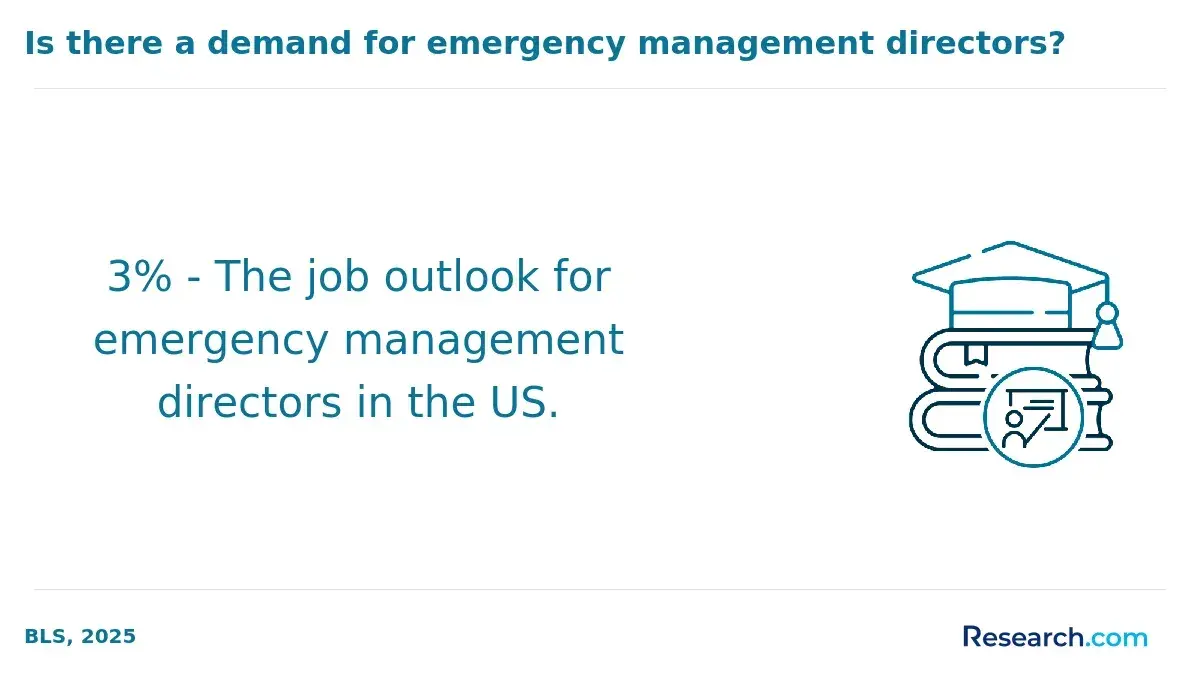
The U.S. Bureau of Labor Statistics projected about 1,000 job openings for emergency management director positions each year, on average, over the decade (US BLS, 2024). That figure should be interpreted carefully: job openings vary by location, sector, budget conditions, experience level, and role type.
Instead of asking only “What degree is right for me?,” students at this stage should ask which emergency management concentration fits their career path. A student interested in public policy may need a different program than an EMS professional seeking administration roles or a student drawn to humanitarian response.
What Other Fields Can I Pursue with a Background in Emergency Management?
Emergency management training can transfer into several adjacent fields because the discipline combines planning, communication, risk analysis, operations, and leadership. Graduates may move toward healthcare administration, public administration, homeland security, cybersecurity, business continuity, public health preparedness, logistics, humanitarian response, or supply chain resilience.
Healthcare administration is one practical example. Emergency management knowledge can help healthcare leaders prepare facilities for disruptions, coordinate resources, and plan for public health emergencies. Students interested in that direction can compare accelerated MHA programs online to understand how healthcare leadership training can build on an emergency management foundation.
What career advancement opportunities are available with an online bachelor’s in emergency management?
An online bachelor’s degree can support advancement when paired with experience, strong references, certifications, and evidence of applied skills. Career movement is often gradual: graduates may start in coordination or specialist roles, then move into planning, supervision, program management, or director-level positions.
- Entry-level to leadership roles. Graduates may begin as emergency management specialists, emergency preparedness coordinators, public safety coordinators, or continuity planning assistants, then move toward director or program leadership roles.
- Specialized practice areas. Professionals may focus on mitigation, recovery, crisis communication, emergency operations, healthcare preparedness, or business continuity.
- Advanced certifications. Credentials such as Certified Emergency Manager (CEM) or FEMA Emergency Management Institute (EMI) training can help demonstrate specialized competence.
- Graduate education. Some graduates pursue a master’s degree in public administration, homeland security, emergency management, public health, healthcare administration, or a related field.
- Public, nonprofit, and private sector pathways. Emergency management professionals work in local, state, and federal agencies, nonprofits, consulting firms, healthcare systems, utilities, universities, and private companies.
How Accelerated Programs Work
Accelerated online programs shorten the academic calendar by using condensed sessions, often lasting 5 to 8 weeks. This can allow motivated students to complete more courses across the year than they would in a traditional semester format.
Some schools also award credit for prior college coursework, professional training, military experience, or documented learning. Transfer credit and prior learning credit can reduce time to completion, but policies differ widely.
Students considering an accelerated emergency management program should confirm accreditation, weekly workload, course availability, transfer rules, and support services. A faster schedule is helpful only if it is realistic for your work, family, and study commitments. To compare rapid completion options, review this guide to the fastest bachelor’s degree programs.
Can a complementary business degree enhance emergency management career prospects?
Business training can strengthen emergency management careers, especially for professionals who want to manage budgets, lead teams, oversee operations, or advise organizations on continuity and resilience. Emergency response decisions often involve cost, staffing, logistics, procurement, risk tolerance, and operational trade-offs.
A business background can help emergency managers communicate with executives, justify preparedness investments, and align response plans with organizational priorities. Professionals who want a broader management credential may compare cheap MBA online programs to evaluate whether graduate business study is a practical next step.
How does an online bachelor’s in emergency management help with risk assessment and emergency planning?
An online bachelor’s degree in emergency management helps students learn how to identify hazards, evaluate vulnerability, estimate potential impact, and create plans that reduce harm. These are core tasks in emergency preparedness and disaster response.
Risk assessment coursework may introduce tools such as geographic information systems, risk matrices, vulnerability assessments, data models, and scenario analysis. Students learn to compare threats such as floods, wildfires, public health emergencies, infrastructure failures, and human-caused incidents, then prioritize planning based on likelihood and consequence.
Emergency planning coursework typically covers evacuation, sheltering, communications, resource allocation, continuity of operations, coordination with public agencies, and recovery planning. Students looking for lower-cost options can compare cheapest online college bachelor degree programs while still checking accreditation and practical training requirements.
How can emergency management strategies strengthen supply chain resilience?
Emergency management and supply chain resilience overlap because both focus on identifying weak points, preparing for disruption, and restoring operations quickly. A disruption can affect transportation, vendors, inventory, workforce availability, communications, and customer access.
Emergency management training helps professionals build continuity plans, conduct risk assessments, coordinate stakeholders, and prepare alternate response strategies. Students who want deeper logistics and operations knowledge may consider an online supply chain management degree as a complementary path.
Can integrating economic principles further optimize emergency management strategies?
Economic thinking can improve emergency management by helping leaders compare costs, allocate limited resources, prioritize mitigation investments, and evaluate trade-offs. Preparedness decisions often require agencies and organizations to decide where limited funding will reduce the most risk.
Understanding incentives, opportunity costs, budgeting, and cost-effectiveness can support better planning before disasters and more disciplined recovery decisions afterward. Students interested in this analytical angle can explore affordable online economics degree programs to see how economics may complement emergency management training.
How can emergency management education enhance business efficiency?
Emergency management can improve business efficiency by helping organizations prepare for disruption before it occurs. Strong continuity plans, communication protocols, vendor backup strategies, and resource allocation processes can reduce confusion and downtime during a crisis.
Business-focused emergency managers can help organizations balance preparedness spending with operational needs. They can also support compliance, safety, insurance planning, and executive decision-making. Students comparing business-related pathways can review how much does it cost to get a bachelors degree in business for additional cost context.
Should I pursue advanced business degrees after my online emergency management degree?
An advanced business degree may be useful if your goal is executive leadership, consulting, operations management, risk management, or organizational resilience. It is not necessary for every emergency management career, so the decision should depend on your target role and expected return on investment.
Before committing, compare the cost, workload, employer expectations, and whether your career path would benefit more from a master’s in public administration, homeland security, public health, healthcare administration, business, or another field. Professionals considering doctoral-level business education can review cheap DBA programs as one possible long-term route.
Are practical experiences essential for building emergency management expertise?
Yes. Practical experience is especially important in emergency management because the work involves real people, urgent decisions, incomplete information, and coordination across organizations. Online coursework is valuable, but students should look for programs that include applied projects, simulations, internships, case studies, tabletop exercises, or capstone planning assignments.
Practical components help students move from theory to judgment. They also give graduates examples to discuss in interviews and evidence of their ability to build plans, analyze scenarios, and communicate under pressure. Professionals who want to pair emergency management experience with strategic leadership training may also consider options such as a 1 year online MBA.
Can integrating healthcare administration with emergency management boost career prospects?
Healthcare administration and emergency management pair well because hospitals, clinics, long-term care facilities, public health agencies, and healthcare systems must prepare for emergencies while maintaining essential services. Professionals with both skill sets can support emergency operations plans, staffing coordination, resource allocation, compliance, budgeting, and continuity of care.
This combination may appeal to students interested in public health emergencies, hospital preparedness, healthcare operations, or leadership in regulated environments. To compare career outcomes and graduate-level options, review what you can do with what can you do with a master's in healthcare administration degree.
Key Insights
- Accreditation should be your first filter. An online emergency management degree is most credible when it comes from an accredited institution with transparent requirements and relevant coursework.
- Online does not always mean fully online. Confirm whether internships, capstones, simulations, campus visits, or synchronous sessions are required.
- Cost comparisons must include more than tuition. Fees, transfer credit policies, textbooks, software, technology, and time to graduation can significantly affect affordability.
- Curriculum focus matters. Emergency services administration, homeland security, humanitarian response, business continuity, and public policy programs can lead to different career paths.
- Employers value demonstrated ability. Planning documents, simulations, internships, certifications, and relevant experience can make an online degree more useful in the job market.
- Practical learning is essential. Emergency management requires applied judgment, communication, coordination, and leadership, not just textbook knowledge.
- Related fields can expand options. Healthcare administration, cybersecurity, supply chain management, economics, business, and public administration can complement emergency management training.
- No program guarantees employment. Job outcomes depend on location, experience, role requirements, networking, certifications, and the strength of your professional portfolio.
References:
- Research and Markets. (2025). Social sciences and humanities services market outlook 2025-2034. https://www.researchandmarkets.com/reports/6186182/social-sciences-humanities-services-market
- US BLS. (2025) Occupational handbook: Emergency management directors. US Bureau of Labor Statistics.
- Zippia. (2025). Emergency management specialist demographics and statistics [2023]: Number of emergency management specialists in the US. Zippia.
- ZipRecruiter. (2026). Salary: Social scientist (March, 2026) United States. https://www.ziprecruiter.com/Salaries/Social-Scientist-Salary
- ZipRecruiter. (2025, July). Salary: Public Affairs (July, 2025) – United States. https://www.ziprecruiter.com/Salaries/Public-Affairs-Salary
Other Things You Need to Know About Online Bachelor’s in Emergency Management Programs
Yes, the perception of online degrees has improved significantly, especially after the COVID-19 pandemic. Many employers recognize the credibility of online degrees, particularly those from accredited institutions. According to surveys, a significant percentage of HR leaders believe that online credentials are comparable in quality to traditionally earned credentials.
A successful career in emergency management requires skills such as critical thinking, decision-making, communication, and leadership. Competencies include risk assessment, crisis management, emergency planning, and understanding public safety protocols. The best programs in 2027 emphasize these crucial skills through comprehensive coursework and practical training.
Requirements for an online bachelor's in Emergency Management vary by institution but typically include a high school diploma or equivalent, a minimum GPA, and sometimes standardized test scores. Students may also need access to a computer and reliable internet to complete coursework and synchronous sessions.
Students need a reliable internet connection, a suitable computer, specific software (such as word processing programs and media players), and familiarity with the institution's learning management system. Webcams and microphones may be required for video conferencing and online discussions.
Online degrees in emergency management from accredited institutions are widely recognized, especially in countries with established educational partnerships. However, recognition may vary in regions less familiar with online education. It is essential to verify international recognition if you plan to work abroad.
An online degree can be as good as a regular degree if it is earned from an accredited institution and meets the same academic standards. Many employers view these degrees as equal in value to traditional degrees, especially when the institution has a strong reputation in the field.
Courses typically include Introduction to Emergency Management, Disaster Response and Recovery, Crisis Communication, Hazard Mitigation and Risk Assessment, Legal and Ethical Issues in Emergency Management, Leadership and Management in Emergency Management, and Public Health in Emergency Management.


