
2027 Easiest Homeland Security Degree Programs

Co-Founder and Chief Data Scientist
Choosing a homeland security degree is really a decision about how quickly, affordably, and credibly you can prepare for work in public safety, emergency management, border security, intelligence, cybersecurity, or critical infrastructure protection. The “easiest” programs are not shortcuts around serious training. They are programs with accessible admissions, clear degree plans, flexible online or hybrid formats, practical coursework, transfer-friendly policies, and student support that helps learners finish.
This guide is for students comparing associate, bachelor’s, graduate, certificate, online, and accelerated homeland security options. It explains what these programs teach, how long they take, what they cost, which schools offer accessible pathways, what jobs may be available after graduation, and how to avoid choosing a program that does not fit your career goals.
Quick Answer: What Is the Easiest Homeland Security Degree Path?
The easiest homeland security degree path for most students is usually an associate degree or an online bachelor’s program with flexible scheduling, generous transfer credit policies, and no unnecessary campus requirements. Associate programs can often be completed in two years, while bachelor’s programs typically take four years. Students who already have college credits, military training, or public safety experience may be able to move faster through accelerated or transfer-friendly programs.
For career entry, an associate degree may support roles in protective services, corrections, emergency response, or security operations. A bachelor’s degree is usually a stronger option for students aiming for federal, intelligence, cybersecurity, emergency management, or supervisory roles. Graduate programs are better suited for professionals pursuing leadership, policy, research, or advanced technical positions.
What are the main benefits of earning a homeland security degree?
- Broad career reach: Graduates may work for federal agencies such as the DHS or NSA, state and local emergency offices, law enforcement organizations, private security firms, critical infrastructure companies, nonprofits, or defense-related employers.
- Multiple salary levels: Depending on education, employer, location, rank, and role, homeland security-related careers may pay from $40,000 to $95,000 each year.
- Strong foundation for specialization: The degree can support further study or credentials in cybersecurity, intelligence analysis, emergency management, law enforcement, political science, criminal justice, or public administration.
What can I expect from a homeland security degree program?
A homeland security degree teaches students how governments, agencies, communities, and private organizations prepare for, prevent, respond to, and recover from threats. These threats may include terrorism, cyberattacks, natural disasters, public health emergencies, border security issues, infrastructure failures, and organized crime.
Most programs combine policy, law, emergency response, security planning, intelligence, risk assessment, and technology. The exact mix depends on the school and degree level. Associate programs focus on fundamentals. Bachelor’s programs add deeper analysis and specialized electives. Master’s and doctoral programs emphasize leadership, policy, research, and advanced problem-solving.
| Program Component | What Students Usually Learn | Why It Matters |
| Core courses | Homeland security systems, emergency management, terrorism, constitutional issues, risk assessment, and public safety operations. | Builds the baseline knowledge needed for entry-level and mid-level security roles. |
| Specialized electives | Cybersecurity, public health emergencies, forensic science, intelligence, counterterrorism, or critical infrastructure protection. | Lets students align coursework with specific career goals. |
| Practical exercises | Simulations, tabletop crisis exercises, role-play scenarios, incident response planning, and security assessments. | Helps students practice decision-making under pressure before entering the workforce. |
| Capstone or research project | Disaster plans, policy analysis, threat assessments, emergency response proposals, or security improvement plans. | Creates a portfolio-style project that may be useful in interviews or graduate applications. |
| Internships or fieldwork | Experience with public agencies, emergency offices, law enforcement partners, or private security organizations. | Builds workplace exposure, references, and professional contacts. |
| Online learning tools | Virtual discussions, digital simulations, case studies, recorded lectures, and online collaboration platforms. | Supports students who need flexibility because of work, family, military service, or location. |
Where can I work with a homeland security degree?
Homeland security graduates can work in any setting where risk, safety, emergency planning, digital protection, border operations, intelligence, or crisis response matter. Some positions require only a degree and relevant experience, while others may require academy training, civil service exams, physical standards, security clearances, certifications, or previous government or military experience.
- Federal government: Agencies such as the Department of Homeland Security (DHS), Federal Emergency Management Agency (FEMA), U.S. Citizenship and Immigration Services (USCIS), and the Federal Bureau of Investigation (FBI) hire professionals in disaster response, immigration, investigations, intelligence, and enforcement.
- State and local government: Police departments, fire departments, emergency management offices, public health agencies, and municipal security teams need employees who can plan for and respond to local incidents.
- Private sector: Employers in cybersecurity, transportation, finance, energy, healthcare, logistics, and risk management use homeland security skills to protect people, systems, facilities, and data.
- Military and defense: Armed forces units and defense contractors employ professionals in national defense, cybersecurity, counterterrorism, intelligence, and operations planning.
- Science and technology: Graduates may support security technology, emergency response tools, data analysis systems, cyber defense platforms, or threat-modeling projects.
- Nonprofit organizations: Disaster relief, humanitarian response, public health, and community resilience organizations need staff who understand logistics, crisis planning, and emergency coordination.
- Intelligence agencies: Organizations such as the Central Intelligence Agency (CIA) and National Security Agency (NSA) depend on professionals who can collect, evaluate, protect, and interpret sensitive national security information.
How much can I make with a homeland security degree?
Income depends heavily on the role, location, employer, rank, experience, clearance level, and education. Homeland security is not one single occupation, so salary ranges vary widely across law enforcement, cybersecurity, emergency management, corrections, investigations, intelligence, and private-sector risk roles.
As a broad estimate, graduates may earn between $40,000 and $95,000 or more annually. Someone with an associate degree might qualify for a role such as correctional officer, with an average salary of $58,810. A bachelor’s degree may support work as a private detective, with an average annual wage of $60,270.
Advanced credentials can help candidates pursue leadership roles such as police department chief, criminal investigator, or emergency management director, where salaries commonly range from $60,000 to $98,000 or more. Police officers, one of the common protective service paths related to this field, earn an average salary of $76,550 annually according to the U.S. Bureau of Labor Statistics, with reported salaries ranging from $45,200 to $111,700 depending on location, rank, and experience.
| Education Level | Possible Role Examples | Salary Information Stated in Source Material |
| Associate degree | Correctional officer, security operations support, emergency services support. | Correctional officer average salary: $58,810. |
| Bachelor’s degree | Private detective, homeland security officer, analyst, emergency management specialist, law enforcement-related roles. | Private detective average annual wage: $60,270. |
| Master’s or doctorate | Emergency management director, criminal investigator, senior analyst, police department chief, policy or leadership roles. | Leadership roles may range from $60,000 to $98,000 or more. |
| Protective services pathway | Police officer or related public safety role. | Police officers average $76,550 annually, with a range from $45,200 to $111,700. |
A degree can improve access to career pathways, but it does not guarantee a specific salary. Students should compare program cost against realistic salaries for the exact job title, region, and employer they plan to pursue.
- Accessible Homeland Security Degree Programs for 2027
- How long does it take to complete a homeland security program?
- How does an online homeland security program compare to an on-campus program?
- What is the average cost of a homeland security program?
- What are the financial aid options for students enrolling in a homeland security program?
- What are the prerequisites for enrolling in a homeland security program?
- What courses are typically in a homeland security program?
- How does cybersecurity training strengthen homeland security education?
- Can an accelerated associate degree program help you enter homeland security faster?
- Can fast-track degree programs accelerate entry into homeland security?
- Is accreditation essential for homeland security programs?
- How do homeland security programs provide real-world experience?
- How do homeland security programs promote diversity and inclusion?
- What types of specializations are available in homeland security programs?
- Can I earn a homeland security degree while working full-time?
- Do homeland security programs prepare you for security clearances?
- What skills are most important for homeland security careers?
- How should I choose the best homeland security program?
- What career paths are available for homeland security graduates?
- What certifications and professional development options should I consider?
- What trends are shaping homeland security education?
- What is the job market for graduates with a homeland security degree?
- References
Accessible Homeland Security Degree Programs for 2027
How do we rank schools?
Research.com’s ranking is designed to help students identify homeland security programs that are easier to access, easier to schedule, and easier to compare without overlooking quality. The ranking process uses Research.com’s published ranking methodology and draws on information from the Integrated Postsecondary Education Data System, Peterson’s database and its Distance Learning Licensed Data Set, College Scorecard, and the National Center for Education Statistics (NCES).
Students should use this list as a starting point, not as the only deciding factor. The best program is the one that matches your transfer credits, schedule, budget, career target, location, and preferred learning format.
1. Monroe Community College
Monroe Community College offers an A.S. in Homeland Security for students interested in fields such as customs inspection, law enforcement, emergency medical response, cybersecurity, and public safety. The program combines classroom instruction, laboratory learning, and field-based activities. Students study homeland security operations, emergency management, terrorism, cybersecurity, and critical infrastructure protection with instructors who bring field experience and local security connections into the classroom.
- Program Length: Two years
- Tracks/Concentrations: Homeland Security
- Cost per Credit: $210 (resident), $420 (non-resident)
- Required Credits to Graduate: 61-63
- Accreditation: Middle States Commission on Higher Education (MSCHE)
2. Keiser University
Keiser University provides an AA in Homeland Security that introduces students to hazardous materials, terrorism response, agency recovery operations, and the legal authority behind homeland security work. The curriculum is built for students preparing for national security, emergency management, or continued education in a related field.
- Program Length: Two years
- Tracks/Concentrations: Homeland Security
- Cost per Semester: $11,928
- Required Credits to Graduate: 60
- Accreditation: Southern Association of Colleges and Schools Commission on Colleges (SACSCOC)
3. Georgia Military College
Georgia Military College offers AA and AS options in Homeland Security and Emergency Management. Students study terrorism, homeland security law, intelligence, counter-intelligence, emergency management, strategic planning, and risk analysis. The program is available online, at the historic Milledgeville campus, and through eleven satellite locations, which can make it more practical for students who need format flexibility.
- Program Length: Two years
- Tracks/Concentrations: Homeland Security & Emergency Management and Terrorism & International Crime
- Cost per Year: $8,280
- Required Credits to Graduate: 90-98 quarter hours
- Accreditation: SACSCOC
4. Embry-Riddle Aeronautical University
Embry-Riddle Aeronautical University offers an online Bachelor of Science in Homeland Security. The program covers security principles, legal and policy frameworks, global conflict, military science, counterterrorism, emergency management planning, risk analysis, and critical infrastructure protection. It may be a better fit for students who want a full bachelor’s pathway rather than a two-year entry credential.
- Program Length: Four years
- Tracks/Concentrations: Emergency Management, Terrorism Studies, Forensic Accounting, Military Science
- Cost per Credit: $522
- Required Credits to Graduate: 120
- Accreditation: SACSCOC
5. New England College
New England College offers an associate degree in Homeland Security and Emergency Preparedness. The program introduces students to homeland security, crisis leadership, political implications of security policy, advocacy, and threat assessment. Its online format may appeal to students who need a structured but flexible path that includes six four-credit homeland security courses, two liberal arts and science courses, three elective courses, and 12 credits of electives.
- Program Length: Two years
- Tracks/Concentrations: Homeland Security and Emergency Preparedness
- Cost per Credit: $375
- Required Credits to Graduate: 60
- Accreditation: New England Commission of Higher Education (NECHE)
Key Data Points About Homeland Security Education and Careers
- From 2021 to 2022, institutions awarded 33,382 associate degrees, 56,901 bachelor’s degrees, 11,580 master’s degrees, and 291 doctoral degrees in homeland security and related fields.
- Around 206,455 of the federal workforce are dedicated to jobs in investigation.
- As of March 2024, 222,539 federal employees worked in the DHS.
- Homeland security officers make $87,000 on average.
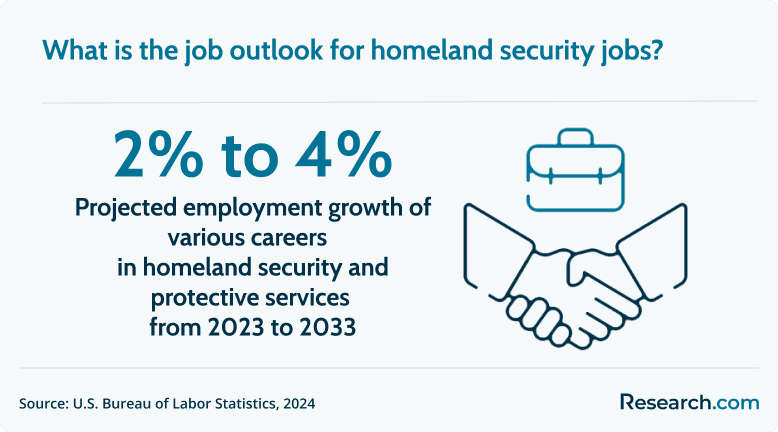
- The employment growth of various careers in homeland security and protective services is 2%–4% from 2023–2033.
How long does it take to complete a homeland security program?
Completion time depends on the credential level, whether you study full time or part time, and whether the school accepts transfer credits, military credits, prior learning, or accelerated coursework. Associate degrees usually take two years. Bachelor’s degrees normally take four years of full-time study. Master’s programs often add another two years, especially when students pursue related areas such as cybersecurity, public administration, emergency management, or a data analytics degree.
Doctoral programs generally take four to six years and are intended for students pursuing advanced research, policy leadership, senior administration, consulting, or academic work. Certificate programs may take only a few months to a year and are often best for students who need focused training in emergency management, cyber defense, intelligence, or security operations rather than a full degree.
| Credential | Typical Completion Time | Best For |
| Certificate | A few months to a year | Professionals adding a targeted skill or testing interest in the field. |
| Associate degree | Two years | Students seeking a lower-cost entry point or a transfer pathway to a bachelor’s degree. |
| Bachelor’s degree | Four years | Students aiming for broader career options, federal roles, analyst positions, or graduate study. |
| Master’s degree | Additional two years | Working professionals targeting leadership, policy, management, or specialized technical roles. |
| Doctoral degree | Four to six years | Students focused on research, advanced policy, executive leadership, or academia. |
From 2021 to 2022, institutions awarded 33,382 associate degrees, 56,901 bachelor’s degrees, 11,580 master’s degrees, and 291 doctoral degrees in homeland security and related fields (National Center for Education Statistics, 2023). These numbers show that students enter the field through several academic levels, not one single route.
This chart displays the total degrees awarded in homeland security and related fields.
How does an online homeland security program compare to an on-campus program?
Online and campus-based homeland security programs may cover similar material, but the learning experience can feel very different. The better choice depends on your schedule, need for in-person networking, access to internships, comfort with technology, and ability to stay organized without regular classroom meetings.
| Factor | Online Homeland Security Program | On-Campus Homeland Security Program |
| Scheduling | Often better for working adults, parents, military students, and learners who need asynchronous classes. | Better for students who prefer fixed meeting times and a campus routine. |
| Interaction | Uses discussion boards, email, video meetings, virtual group projects, and online office hours. | Offers face-to-face conversations, immediate classroom discussion, and in-person faculty access. |
| Learning materials | Depends on digital textbooks, online libraries, recorded lectures, and learning platforms. | May combine printed materials, campus libraries, labs, and classroom-based systems. |
| Networking | Can be effective if the program has active online communities, virtual career events, and internship support. | Often stronger for students who value campus events, local agency relationships, and direct peer contact. |
| Support services | Quality varies; strong programs provide online advising, tutoring, tech support, and career services. | Students may have easier access to libraries, advisors, faculty offices, and campus-based student services. |
| Best fit | Self-directed students who need flexibility and can manage deadlines independently. | Students who learn better with structure, face-to-face accountability, and campus resources. |
Before enrolling online, ask whether simulations, internships, advising, career support, and faculty access are available to distance learners. Before enrolling on campus, confirm whether the commute, schedule, and required attendance are realistic for your life.
What is the average cost of a homeland security program?
Homeland security program costs vary by school type, credential level, residency status, online fees, transfer credits, and whether you attend full time or part time. According to the cited estimate, undergraduate homeland security programs cost around $10,345 to $22,975, while graduate programs cost $10,336 to $18,690 (College Tuition Compare, 2023).
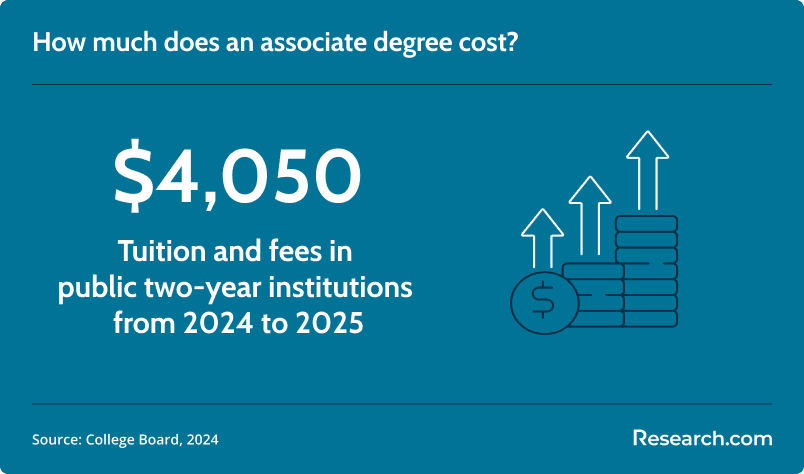
The College Board report by Ma et al. (2024) states that, on average, public two-year institutions from 2024 to 2025 cost $4,050. Tuition and fees at public four-year institutions were $11,610 in-state and $30,780 out-of-state. At private institutions, the amount reached $43,350.
For graduate study, tuition can rise considerably. Master’s degrees typically range from $9,560 to $31,930, while doctoral degree programs cost $11,950 to $49,860. Students comparing public administration, emergency management, and homeland security leadership paths may also want to review affordable online MPA programs because some public administration programs can support similar career goals.
| Cost Category | Amount Stated in Source Material | What to Check Before Enrolling |
| Undergraduate homeland security programs | $10,345 to $22,975 | Whether tuition is per credit, per semester, or total estimated program cost. |
| Graduate homeland security programs | $10,336 to $18,690 | Whether fees, books, and capstone costs are included. |
| Public two-year institutions from 2024 to 2025 | $4,050 | Whether local residency reduces tuition. |
| Public four-year institutions, in-state | $11,610 | Whether online students receive in-state or separate online tuition rates. |
| Public four-year institutions, out-of-state | $30,780 | Whether the school participates in tuition reciprocity or offers online discounts. |
| Private institutions | $43,350 | Whether institutional scholarships lower the actual net price. |
| Master’s degree | $9,560 to $31,930 | Whether employer reimbursement or agency support is available. |
| Doctoral degree | $11,950 to $49,860 | Whether assistantships, grants, or research funding apply. |
Do not compare programs by tuition alone. Also calculate books, technology fees, travel, background checks, internship expenses, lost work time, certification exam fees, and whether credits will transfer if you continue into a higher degree.
What are the financial aid options for students enrolling in a homeland security program?
Students can often combine several funding sources to reduce out-of-pocket costs. The most useful option depends on your school, financial need, grades, military status, employer, and whether you are enrolled in a degree or certificate program.
- Institutional scholarships: Colleges may offer merit-based, need-based, leadership-based, or program-specific scholarships for students in homeland security, criminal justice, emergency management, cybersecurity, or public safety.
- Government financial aid: Eligible students may use federal grants, federal loans, and other aid programs. The Federal Employee Education & Assistance Fund may also help federal employees and their families with education-related expenses.
- Private scholarships: Nonprofits, foundations, professional associations, and public safety organizations may fund students preparing for careers in emergency management, law enforcement, security, or cyber defense.
- Military education benefits: Veterans, active-duty service members, reservists, National Guard members, and eligible family members may have access to tuition assistance or veterans education benefits.
- Employer tuition reimbursement: Some government agencies, contractors, security firms, and public safety employers help employees pay for job-related education.
Students comparing homeland security with law enforcement or corrections pathways may also review programs listed among the most affordable online criminal justice degrees. Criminal justice can overlap with homeland security, but the curriculum may be more focused on courts, policing, corrections, and legal systems.
What are the prerequisites for enrolling in a homeland security program?
Admissions requirements depend on the degree level. Associate and bachelor’s programs usually focus on high school completion, transcripts, and basic college readiness. Master’s and doctoral programs may require a prior degree, stronger academic records, professional experience, recommendations, and a clearer statement of goals.
- Academic credentials: Undergraduate applicants typically need a high school diploma or GED. Graduate applicants usually need a bachelor’s degree and official transcripts.
- Preparatory coursework: Some students may need remedial or foundational courses before beginning core classes. Advanced programs may expect prior coursework in criminal justice, political science, public administration, technology, or general education areas.
- GPA expectations: Some institutions require a minimum GPA of 2.75 or higher, depending on the program and degree level.
- Personal statement: Many schools ask applicants to explain their interest in homeland security, career plans, leadership experience, public service background, or relevant work history.
- Letters of recommendation: Competitive programs may request two or three academic or professional references.
- Additional materials: Depending on the school, applicants may need ACT/SAT scores, a resume, proof of work experience, or other documentation.
Academic readiness is only part of preparation. Homeland security careers often demand sound judgment, communication, ethical reasoning, attention to detail, emotional control, critical thinking, and the ability to manage pressure. Some professionals have reported feeling overwhelmed by workload demands, which makes time management and adaptability especially important for students planning to enter this field.
What courses are typically in a homeland security program?
Homeland security curricula usually combine public safety, law, policy, intelligence, emergency response, and technology. Course names vary, but many programs cover similar themes because graduates must understand both operational response and the legal and ethical limits of security work.
| Common Course | What It Covers | Career Relevance |
| Introduction to Homeland Security | History, mission, major agencies, interagency cooperation, and current threat environments. | Gives students the basic framework for understanding the field. |
| Terrorism and Counterterrorism | Motivations, tactics, threat assessment, intelligence, prevention strategies, and domestic and international responses. | Useful for intelligence, law enforcement, policy, and security analysis roles. |
| Emergency Management and Disaster Response | Preparedness, mitigation, response, recovery, resource coordination, and crisis planning. | Supports work in emergency management offices, public safety agencies, and disaster relief. |
| Physical Security | Facility protection, access control, surveillance, vulnerability assessment, and security planning. | Applies to infrastructure, corporate security, transportation, and public facilities. |
| Cybersecurity | Network protection, encryption, cyber threats, incident response, and digital infrastructure security. | Important because national security increasingly includes digital systems and data protection. |
| Intelligence Processes | Collection, analysis, dissemination, threat identification, and decision support. | Relevant to intelligence, investigations, counterterrorism, and risk roles. |
| Constitutional Law and Civil Rights | Due process, privacy, search and seizure, civil liberties, and the legal limits of security practices. | Helps students understand how to protect security without violating rights. |
Students interested in cyber-heavy homeland security roles may ask whether a cybersecurity certificate is worth it for their goals. Students drawn to evidence, investigations, and crime-scene analysis may also compare homeland security with a forensic science degree online.
As of March 2024, 222,539 federal employees worked in the DHS (Desilver, 2025). This workforce size shows why homeland security education often includes both broad agency knowledge and job-specific technical skills.
This chart shows the number of federal workers in various government agencies.
How does cybersecurity training strengthen homeland security education?
Cybersecurity training is now one of the most important additions to homeland security education because many threats target digital systems as well as physical locations. Critical infrastructure, emergency communications, government databases, transportation systems, healthcare networks, and financial systems all depend on secure technology.
Students who add cybersecurity coursework learn how to recognize cyber threats, protect sensitive information, respond to incidents, and understand how digital attacks can disrupt public safety. For learners who want a more technical path, comparing homeland security programs with the most affordable online cybersecurity degrees can help clarify whether a cyber-focused degree or a homeland security degree with cyber electives is the better fit.
Can an accelerated associate degree program help you enter homeland security faster?
An accelerated associate degree can help students build foundational knowledge quickly, especially if they already have transfer credits, military training, work experience, or the ability to study year-round. These programs are best for motivated learners who can handle condensed courses and consistent deadlines.
Before choosing a short-format program, check whether it is accredited, whether credits transfer into a bachelor’s degree, and whether the curriculum includes practical security, emergency response, or public safety training. Students who want to compare speed-focused two-year options can review an accelerated associate degree online guide, but they should confirm that any fast program still supports their actual career target.
Can fast-track degree programs accelerate entry into homeland security?
Fast-track bachelor’s programs can shorten the path to graduation by using accelerated terms, transfer-friendly policies, prior learning assessment, or year-round schedules. They may be useful for adult learners, public safety workers, military students, or career changers who need a degree without spending four traditional academic years in school.
The trade-off is intensity. Accelerated courses move quickly, and students may have less time to absorb complex topics such as constitutional law, emergency planning, intelligence analysis, and cybersecurity. If speed is a priority, compare formats carefully and consider whether a fast-track bachelor degree online fits your learning style, work schedule, and long-term plans.
Is accreditation essential for homeland security programs?
Yes. Accreditation is one of the first things students should verify. It helps confirm that a school meets recognized academic standards and can affect federal financial aid eligibility, transfer credit acceptance, graduate school admission, and employer confidence in the credential.
Students should verify institutional accreditation through official sources before applying. This is especially important for online, accelerated, and transfer-heavy options, including an accelerated online bachelor’s degree. A program that looks convenient but lacks recognized accreditation can create problems when applying for jobs, graduate programs, or professional credentials.
How do homeland security programs provide real-world experience?
Strong homeland security programs connect classroom learning to realistic decision-making. Students may complete internships, capstone projects, simulations, tabletop exercises, virtual labs, emergency response plans, threat assessments, or agency-based fieldwork.
Real-world experience matters because employers need graduates who can apply policy, law, and risk concepts under pressure. When comparing programs, ask whether online students can access internships, whether the school has relationships with public agencies or private security employers, and whether coursework includes practical projects. Some quick online degrees may be useful for career changers, but students should prioritize programs that include applied training rather than speed alone.
How do homeland security programs promote diversity and inclusion?
Diversity and inclusion matter in homeland security because public safety work serves communities with different languages, cultures, beliefs, risk exposures, and levels of trust in institutions. Programs may support inclusion through mentoring, community engagement, accessible online formats, culturally varied case studies, ethical analysis, and recruitment efforts for underrepresented students.
Students should look for programs that teach cultural awareness, civil rights, ethical decision-making, communication, and community-based emergency planning. Learners seeking shorter or supplemental credentials can also explore FAFSA-approved online certificate programs, while still confirming that the credential is relevant to homeland security goals.
What types of specializations are available in homeland security programs?
Specializations help students turn a broad homeland security degree into a more focused career plan. Some schools offer formal concentrations, while others allow students to choose electives that function like a specialization.
Around 206,455 federal employees are dedicated to jobs in investigation (Desilver, 2025), which shows why investigative, intelligence, and risk-related skills remain important across the federal workforce.
| Specialization | Focus | Good Fit For |
| Emergency Management | Disaster planning, crisis response, recovery, mitigation, resource coordination, and resilience. | Students interested in FEMA, state emergency offices, nonprofits, public health response, or disaster relief. |
| Cybersecurity | Cyber threats, network protection, data security, cyberterrorism, and incident response. | Students who want to protect digital infrastructure and may also compare the fastest cyber security degree options. |
| Intelligence and Counterterrorism | Threat analysis, intelligence collection, surveillance issues, geopolitics, and counterterrorism strategy. | Students aiming for intelligence agencies, investigations, security analysis, or federal work. |
| Critical Infrastructure Protection | Security for transportation, water, energy, communications, facilities, and other essential systems. | Students interested in infrastructure resilience, public policy, utilities, transportation, or private-sector risk. |
| Military Science | Military operations, leadership, tactics, strategy, history, and international relations. | Students with military experience or goals in defense, consulting, national security, or contractor roles. |
Students interested in government, policy, legislation, or public affairs may also compare homeland security with online political science degrees. Political science may be a better fit for students more interested in policy analysis and governance than operational security.
Can I earn a homeland security degree while working full-time?
Yes, many students complete homeland security degrees while working full-time, especially through online or hybrid programs. The most manageable options usually offer asynchronous classes, part-time plans, evening or weekend coursework, digital libraries, online advising, and flexible deadlines within each term.
Working adults should ask schools for a realistic weekly time estimate, not just a credit count. A flexible program can still be demanding. Students should also compare tuition, transfer policies, employer reimbursement, and adult learner support. Research.com’s guide to the most affordable online colleges for working adults can help students compare cost-conscious options for job holders.
Do homeland security programs prepare you for security clearances?
A homeland security program can introduce students to ethics, law, compliance, background investigations, confidentiality, and national security responsibilities, but no degree can guarantee a security clearance. Clearance decisions are made through formal government processes and depend on the position, agency, background investigation, conduct, citizenship requirements, finances, foreign contacts, and other factors.
Programs can still help by teaching students how sensitive information is handled, why integrity matters, and what professional conduct is expected in security-related environments. Students who want to strengthen compliance, risk, or security credentials may also compare online certifications that pay well, especially if those credentials match the job requirements they are targeting.
What skills are most important for homeland security careers?
Successful homeland security professionals need more than technical knowledge. They must communicate clearly, make decisions under pressure, interpret complex information, work across agencies, follow legal boundaries, and act ethically when the stakes are high.
- Risk assessment: Identifying threats, vulnerabilities, likelihood, and potential impact.
- Emergency planning: Preparing response procedures, communication plans, and continuity strategies.
- Cyber awareness: Understanding how digital systems can be attacked, protected, and restored.
- Legal and ethical judgment: Balancing security needs with constitutional rights, privacy, and due process.
- Communication: Writing reports, briefing decision-makers, coordinating teams, and explaining risks to the public.
- Critical thinking: Evaluating incomplete information and choosing defensible actions.
- Adaptability: Responding to changing threats, workload pressure, new technology, and interagency demands.
Students can strengthen these skills through internships, simulations, writing-heavy courses, public speaking practice, emergency drills, and relevant professional credentials. Research.com’s guide to certification programs for careers that pay well can help students compare options beyond the degree.
How should I choose the best homeland security program?
The best homeland security program is the one that fits your career goal, budget, learning style, and timeline while meeting recognized academic standards. A program that is “easy” to enter is not automatically the best choice if it lacks support, career relevance, transfer value, or accreditation.
| Decision Factor | What to Ask | Why It Matters |
| Accreditation | Is the institution accredited by a recognized accreditor? | Affects aid eligibility, credit transfer, employer recognition, and graduate school options. |
| Career alignment | Does the curriculum match emergency management, cybersecurity, intelligence, law enforcement, or policy goals? | Prevents choosing a broad program that does not support your intended job path. |
| Cost and net price | What is the total cost after grants, scholarships, fees, and transfer credits? | Sticker tuition does not show what you will actually pay. |
| Faculty experience | Do instructors have homeland security, law enforcement, emergency management, military, intelligence, or cybersecurity experience? | Field-informed teaching can make coursework more practical. |
| Internships and partnerships | Does the school help students connect with agencies, employers, or field placements? | Practical experience can be important for competitive jobs. |
| Student support | Are advising, tutoring, career services, library access, and technical support available to online and campus students? | Support can affect whether students persist and graduate. |
| Graduate outcomes | Does the school publish employment, salary, transfer, or placement information? | Outcome data can help you judge whether the program delivers value. |
Students interested in fraud, financial investigation, or risk analysis may also compare homeland security pathways with the most affordable online finance degree programs. Finance can be relevant for students targeting fraud prevention, compliance, or financial crime investigation.
Common mistakes to avoid when choosing a homeland security program
- Choosing only because a program is fast: Speed helps only if the credential is respected and the coursework supports your career plan.
- Ignoring accreditation: An unrecognized school can limit aid, transfer, employment, and graduate study options.
- Comparing tuition without fees: Technology fees, books, travel, internship costs, and certification fees can change the real price.
- Assuming online means easier: Online programs require discipline, writing, time management, and reliable technology.
- Overlooking internships: Practical experience can be a major advantage in security, public safety, and emergency management hiring.
- Assuming a degree guarantees federal employment: Federal jobs may require background checks, exams, clearances, experience, location flexibility, and competitive hiring processes.
- Ignoring transfer rules: Students starting with an associate degree should confirm how credits apply to a bachelor’s program before enrolling.
What career paths are available for homeland security graduates?
Homeland security graduates can pursue roles across government, public safety, intelligence, infrastructure protection, cybersecurity, emergency response, and private-sector risk management. Some roles require additional academy training, certifications, background investigations, physical standards, or professional experience.
| Career Path | Average Income Stated in Source Material | Typical Work Focus |
| Emergency Management Directors | $93,690 | Coordinate disaster planning, emergency response, recovery operations, and community preparedness. |
| Homeland Security Officers | $87,000 | Support national security missions, border protection, threat prevention, and agency security operations. |
| Cybersecurity Analysts | $124,740 | Protect networks, systems, sensitive data, and critical infrastructure from cyber threats. A cybercrime degree may be useful for this path. |
| Intelligence Officers | $108,738 | Collect, evaluate, and interpret information related to national security, terrorism, espionage, or emerging threats. |
| Firefighters | $60,390 | Respond to fires, rescues, emergencies, safety inspections, and public education needs. |
| Border Patrol Agents | $72,865 | Protect U.S. borders, monitor crossings, and prevent illegal immigration, human trafficking, and smuggling. |
| Criminal Investigators | $95,930 | Investigate terrorism, organized crime, cybercrime, and other threats to public and national security. |
| Customs and Immigration Officers | $95,000 | Enforce laws governing the movement of goods and people across borders. |
| Risk Management Consultants | $85,773 | Assess organizational risks and recommend security, crisis management, and cyber or physical protection strategies. |
These careers differ significantly in hiring requirements. Before choosing a degree, review actual job postings for your target role and note whether employers ask for a bachelor’s degree, specialized experience, physical ability, law enforcement training, certifications, or a clearance.
This chart illustrates the average incomes of homeland security careers and related jobs in the U.S.
What certifications and professional development options should I consider?
Certifications can help graduates demonstrate focused expertise beyond the degree. The best credential depends on whether you want to work in emergency management, cybersecurity, intelligence, investigations, compliance, counterterrorism, or risk management.
Professional development can also include workshops, conferences, agency training, tabletop exercises, incident command training, continuing education, and networking through public safety or security associations. Students who want a broader view of degree-to-career options can read Research.com’s guide on what you can do with a homeland security degree.
For students moving toward digital threat prevention, cybersecurity master’s degree programs may provide deeper technical preparation than a general homeland security curriculum.
What trends are shaping homeland security education?
Homeland security education is adapting to a threat environment that includes both physical and digital risks. Programs increasingly emphasize cybersecurity, data analysis, simulation-based learning, interagency coordination, infrastructure resilience, public health emergency planning, and ethical issues around surveillance, privacy, and civil rights.
Another trend is flexibility. Working professionals often need shorter, online, or accelerated options to update skills without leaving the workforce. Some students compare specialized graduate paths with one year masters programs online, but they should verify whether a shorter format still provides enough depth, applied practice, and employer relevance.
What is the job market for graduates with a homeland security degree?
The job market for homeland security graduates is broad rather than uniform. Demand depends on the specific occupation. Cybersecurity, emergency management, investigations, law enforcement, firefighting, intelligence, and protective services each follow different hiring cycles and qualification rules.
Government agencies and private employers continue to need workers who can protect critical infrastructure, prepare for emergencies, respond to cyber threats, manage risk, and support public safety. Industries such as finance, healthcare, energy, transportation, and technology also use homeland security-related skills, particularly in cybersecurity, compliance, continuity planning, and risk management.
According to the Bureau of Labor Statistics, employment for emergency management directors is projected to grow 4% from 2023 to 2033. Openings for firefighters are projected to increase by 4.2%, police by 3.9%, supervisors of protective service workers by 3.1%, and criminal investigators by 2.3%. These projections represent around 1,000 to 30,000 annual openings throughout the decade.
Students should also understand the challenges. Homeland security work can involve physical risk, irregular schedules, public pressure, emotional stress, and complex organizational demands. The DHS has faced concerns about worker morale, and ongoing workforce improvements around safety, training, and career development remain important.
Overall, the degree can support many career routes, but students should connect their academic plan to a specific job family and build experience while enrolled.
Key Insights
- The easiest homeland security degree is usually not the least rigorous one; it is the program with flexible scheduling, clear requirements, recognized accreditation, strong advising, and practical coursework.
- An associate degree can be a lower-cost starting point, while a bachelor’s degree is usually stronger for federal, analyst, cybersecurity, emergency management, and supervisory career goals.
- Online programs work well for disciplined students who need flexibility, but they still require time management, writing skills, technology access, and active participation.
- Accreditation should be verified before applying because it can affect financial aid, transfer credits, graduate study, and employer recognition.
- Cybersecurity, emergency management, intelligence, and critical infrastructure protection are among the most practical specialization areas for homeland security students.
- Salary outcomes vary widely. Use the degree as one part of a larger career plan that also includes internships, certifications, job-specific requirements, and relevant experience.
- Before enrolling, compare total cost, transfer policies, internship access, faculty background, online student support, and whether the curriculum matches the exact jobs you want.
References:
- College Tuition Compare. (2023). Homeland Security Program 2024 Tuition. Retrieved January 9, 2025, from https://collegetuitioncompare.com/majors/43.0301/homeland-security
- Desilver, D. (2025, January 7). What the data says about federal workers. Pew Research Center. https://www.pewresearch.org/short-reads/2025/01/07/what-the-data-says-about-federal-workers
- Friedman, D. (2024, November 19). Federal pay rates are falling nearly 25% short of the private sector. Federal News Network. https://federalnewsnetwork.com/pay/2024/11/federal-pay-rates-are-falling-nearly-25-short-of-the-private-sector
- Ma, J., Pender, M., & Oster, M. (2024). Trends in College Pricing and Student Aid 2024. College Board. https://research.collegeboard.org/media/pdf/Trends-in-College-Pricing-and-Student-Aid-2024-ADA.pdf
- National Center for Education Statistics. (2023, September). Digest of Education Statistics. https://nces.ed.gov/programs/digest/current_tables.asp
- U.S. Bureau of Labor Statistics. (2024, August 29). Occupational projections, 2023–33, and worker characteristics, 2023. Employment Projections. https://www.bls.gov/emp/tables/occupational-projections-and-characteristics.htm
Other Things You Should Know About Homeland Security Programs
Most homeland security degree programs do not require a security clearance for admission. Schools usually ask for a high school diploma or GED for associate study, or an accredited bachelor’s transcript for graduate study, plus official transcripts and a completed application. Some internships or federal jobs may require clearance later.
Schools like American Military University and Purdue Global University offer flexible scheduling for Homeland Security degrees in 2027, accommodating full-time professionals with options for evening classes and online learning to fit various lifestyles and commitments.






