2027 Most Affordable Online Public Administration Degrees

Co-Founder and Chief Data Scientist
Choosing an affordable online public administration degree is usually a practical decision: you want a bachelor’s program that can lead to government, nonprofit, public safety, healthcare administration, or community service work without requiring you to pause your job or relocate. The challenge is that programs vary widely in price, format, transfer-credit rules, concentrations, and career alignment.
This guide explains what online public administration programs teach, how much affordable options may cost, what jobs graduates commonly pursue, and how to compare schools before enrolling. It is designed for working adults, transfer students, first responders, military-connected learners, and anyone considering a public service career without committing to an advanced degree first. According to the U.S. Bureau of Labor Statistics (BLS), 64% of graduates hold jobs that require at least a bachelor’s degree.
Quick Answer: Is an Online Public Administration Degree Worth Considering?
An online public administration degree can be a strong fit if you want flexible undergraduate training for public service roles in government agencies, nonprofits, public safety organizations, healthcare settings, or community programs. Affordable programs in this guide may cost between $100 to $330 per credit, though total expenses depend on residency, fees, transfer credits, and program length. BLS data indicates that public policy and social services graduates typically earn about $50,000 annually, but actual pay varies by occupation, location, employer, and experience.
What are the benefits of getting a degree in public administration?
- An online public administration program can prepare you for several public service pathways instead of one narrow occupation.
- Graduates may work in government, nonprofit organizations, healthcare facilities, public safety agencies, public utilities, and related service-focused environments.
- Public policy and social services graduates typically make about $50,000 annually, according to BLS field-of-degree data.
What can I expect from an online public administration degree program?
An undergraduate public administration program teaches students how public institutions operate, how policies are developed, and how organizations manage budgets, personnel, programs, and community-facing services. Coursework commonly includes public policy, administrative law, public finance, ethics, organizational leadership, research methods, and program evaluation.
Online delivery usually combines recorded lectures, readings, discussion boards, written assignments, projects, and exams. Some programs are mostly asynchronous, while others require live virtual meetings. Depending on the school and concentration, students may also complete internships, field experiences, public safety training, or capstone projects with organizations in their local area.
The strongest programs do more than explain government structure. They help students build practical skills in communication, data analysis, problem-solving, budgeting, ethical decision-making, stakeholder engagement, and policy research—skills that employers use across public and nonprofit workplaces.
Where can I work with a public administration degree?
Public administration graduates often pursue roles in local, state, or federal government. These positions may involve policy research, constituent services, public budgeting, program coordination, emergency planning, public safety administration, or community development.
The degree can also apply outside traditional government offices. Nonprofit organizations need staff who can manage programs, write reports, coordinate grants, evaluate community needs, and communicate with stakeholders. Healthcare organizations, public utilities, schools, libraries, international organizations, and NGOs may also value public administration training, especially when roles involve compliance, community outreach, operations, or service delivery.
How much can I make with a public administration degree?
According to the BLS, professionals with public policy and social services degrees typically make about $50,000 a year. This figure should be treated as a broad field-level benchmark rather than a guaranteed outcome. Pay depends heavily on job title, employer type, geographic area, professional experience, graduate education, and whether the role is administrative, analytical, managerial, or direct-service oriented.
For example, social work is a common public service pathway, and the BLS reports a median salary of $55,350 for social workers. Management roles are often higher-paying; BLS reports show that managers make about $128,620 annually. However, many management positions require significant experience and may not be entry-level roles immediately after graduation.
| Career or salary reference | Reported figure | How to interpret it |
| Public policy and social services graduates | About $50,000 annually | A broad BLS field-of-degree benchmark, not a role-specific salary guarantee. |
| Social workers | Median of $55,350 | A common public service occupation, though licensure and degree requirements may vary by role and state. |
| Managers | About $128,620 annually | A higher-paying category that often requires experience, leadership responsibility, and sometimes graduate education. |
- Best Online Public Administration Programs for 2027
- How long does it take to finish an online public administration degree?
- Online vs. campus public administration programs: what is different?
- How much does an online public administration program cost?
- What financial aid can online public administration students use?
- What are typical admission requirements?
- What classes do online public administration majors take?
- What concentrations are available?
- How should you choose an online public administration program?
- What is the return on investment for an online public administration degree?
- What student support services should online learners look for?
- How do online public administration programs use business management concepts?
- Can business management coursework improve public administration career options?
- What challenges come with online public administration programs?
- How does public administration compare with an MBA for advancement?
- How can business strategy strengthen public administration training?
- What jobs can graduates pursue?
- What is the job market for public administration graduates?
- Current trends in public administration
- What skills do online public administration programs build?
- Do online programs offer networking and mentorship?
- Accreditation standards for online public administration programs
List of the Best Online Public Administration Programs for 2027
How do we rank schools?
Research.com reviewed affordable online public administration degree options to help prospective students compare programs more efficiently. The selection process uses information from trusted education data sources, including the IPEDS database, Peterson’s database, the Distance Learning Licensed Data Set from the College Scorecard database, and the National Center for Education Statistics. You can review the full approach in our methodology section.
| School | Online program | Length | Cost information | Credits | Accreditation listed |
| Mount Vernon Nazarene University | BA in Public Administration | 21 months | $398 per credit hour | 43 credit hours | Higher Learning Commission (HLC) |
| University of North Carolina Pembroke | Bachelor of Public & Non-Profit Administration | Four years | $108 per credit hour (in-state), $275 (out-of-state) | 120 hours | Southern Association of Colleges and Schools Commission on Colleges (SACSOC) |
| Southern New Hampshire University | BS in Business Administration with a public administration concentration | Four years | $330 per credit (standard rate), $231 per credit (service member rate) | 120 credits | Accreditation Council for Business Schools and Programs (ACBSP) |
| Barry University | Bachelor of Public Administration | Four years | $16,800 per semester (12-18 credits) | 120 credits | Southern Association of Colleges and Schools Commission on Colleges (SACSCOC) |
| Peru State College | Business Administration with a public administration option | Four years | $309 per credit hour | 120 credits | Higher Learning Commission (HLC) |
| Georgia Southern University | Bachelor of Interdisciplinary Studies with a public administration concentration | Four years | $282 per credit (in-state rate), $743 (out-of-state rate) | 124 credits | Southern Association of Colleges and Schools Commission on Colleges (SACSCOC) |
| Fort Hays State University | Online Public Administration degree | Four years | $243 per credit hour | 120 credit hours | Higher Learning Commission (HLC) |
| Dalton State College | Organizational Leadership with a public service concentration | Four years | $9,635 total cost of attendance | 120-123 credits | Southern Association of Colleges and Schools Commission on Colleges (SACSCOC) |
| Northwestern State University of Louisiana | Unified Public Safety Administration Degree | Four years | $4,374 tuition and fees per semester (in-state), $9,768 tuition and fees per semester (out-of-state) | 120 credits | Southern Association of Colleges and Schools Commission on Colleges (SACSCOC) |
| Southern Illinois University Carbondale | IFSAC-accredited BS in Public Safety Management (PSM) | Four years | $13,244 tuition and fees per year | 120 credits | International Fire Service Accreditation Congress (IFSAC) |
1. Mount Vernon Nazarene University
Mount Vernon Nazarene University’s online BA in Public Administration is structured for students who already have college credit and want to move into leadership roles in government or nonprofit settings. The 21-month curriculum is especially relevant for learners with public service or first responder experience, and it examines public policy through financial, political, sociological, ethical, and Christian worldview perspectives.
- Program Length: 21 months
- Tracks/concentrations: None specified
- Estimated Cost: $398 per credit hour
- Required Credits to Graduate: 43 credit hours
- Accreditation: Higher Learning Commission (HLC)
2. University of North Carolina Pembroke
The University of North Carolina Pembroke offers an interdisciplinary Bachelor of Public & Non-Profit Administration for students interested in government and nonprofit work. The program covers how public and nonprofit organizations are structured, managed, and connected to local, state, national, and international stakeholders. Students may customize their academic plan or choose from four concentrations.
- Program Length: Four years
- Tracks/concentrations: General Public Administration, Allied Health Administration, Public Management, Substance Abuse
- Estimated Cost: $108 per credit hour (in-state), $275 (out-of-state)
- Required Credits to Graduate: 120 hours
- Accreditation: Southern Association of Colleges and Schools Commission on Colleges (SACSOC)
3. Southern New Hampshire University
Southern New Hampshire University offers public administration as a concentration within its online BS in Business Administration. This can suit students who want business fundamentals alongside public sector topics such as government systems, budgeting, administrative management, public policy, and community dynamics.
- Program Length: Four years
- Tracks/concentrations: Public Administration
- Estimated Cost: $330 per credit (standard rate), $231 per credit (service member rate)
- Required Credits to Graduate: 120 credits
- Accreditation: Accreditation Council for Business Schools and Programs (ACBSP)
4. Barry University
Barry University’s Bachelor of Public Administration focuses on public administration with attention to current public safety issues. Classes are synchronous and online through Zoom or similar platforms. Instructors teach from a campus location for at least one session per 7-week course, and students may attend that session in person if they choose, while the remaining sessions are online.
- Program Length: Four years
- Tracks/concentrations: None specified
- Estimated Cost: $16,800 per semester (12-18 credits)
- Required Credits to Graduate: 120 credits
- Accreditation: Southern Association of Colleges and Schools Commission on Colleges (SACSCOC)
5. Peru State College
Peru State College offers a public administration option within its undergraduate Business Administration program. The curriculum introduces students to fiscal, political, and social issues that influence public sector work. Students can study online or on campus and receive faculty guidance through a curriculum that is reviewed and updated over time.
- Program Length: Four years
- Tracks/concentrations: Public Administration
- Estimated Cost: $309 per credit hour
- Required Credits to Graduate: 120 credits
- Accreditation: Higher Learning Commission (HLC)
6. Georgia Southern University
Georgia Southern University’s online public administration concentration is part of its Bachelor of Interdisciplinary Studies program. The concentration is designed for students interested in public and nonprofit management and includes topics such as policy analysis, public program management, administrative law, budgeting, civic engagement, and leadership.
- Program Length: Four years
- Tracks/concentrations: Public Administration
- Estimated Cost: $282 per credit (in-state rate), $743 (out-of-state rate)
- Required Credits to Graduate: 124 credits
- Accreditation: Southern Association of Colleges and Schools Commission on Colleges (SACSCOC)
7. Fort Hays State University
Fort Hays State University’s online Public Administration degree prepares students for roles in government, nonprofit organizations, and research-focused settings. The program introduces core concepts in public administration and public policy while emphasizing applied abilities in policy analysis, personnel management, and public budgeting.
- Program Length: Four years
- Tracks/concentrations: None specified
- Estimated Cost: $243 per credit hour
- Required Credits to Graduate: 120 credit hours
- Accreditation: Higher Learning Commission (HLC)
8. Dalton State College
Dalton State College’s Organizational Leadership program includes a public service concentration for students aiming for careers in public safety, state and local administration, nonprofit management, or public relations. The online curriculum covers public policy, professional ethics, and public management practices.
- Program Length: Four years
- Tracks/concentrations: Public Service
- Estimated Cost: $9,635 total cost of attendance
- Required Credits to Graduate: 120-123 credits
- Accreditation: Southern Association of Colleges and Schools Commission on Colleges (SACSCOC)
9. Northwestern State University of Louisiana
Northwestern State University of Louisiana’s Unified Public Safety Administration Degree is built for students interested in leadership across public safety fields. The program addresses contemporary threats, including homeland security and cybercrime, and develops skills in data analysis, interpersonal communication, intelligence gathering, policing, emergency services, and related public safety areas.
- Program Length: Four years
- Tracks/concentrations: Emergency Management Administration, Fire and Emergency Medical Service Administration, Geo Computation, Law Enforcement Administration, Nuclear Surety Management, Public Facilities Management
- Estimated Cost: $4,374 tuition and fees per semester (in-state), $9,768 tuition and fees per semester (out-of-state)
- Required Credits to Graduate: 120 credits
- Accreditation: Southern Association of Colleges and Schools Commission on Colleges (SACSCOC)
10. Southern Illinois University Carbondale
Southern Illinois University Carbondale offers an online, IFSAC-accredited BS in Public Safety Management. The program is designed for professionals and students seeking management preparation in emergency medical services, fire services, public and private security, corrections, and law enforcement. It includes a specialization in Fire Service Management.
- Program Length: Four years
- Tracks/concentrations: Specialization in Fire Service Management
- Estimated Cost: $13,244 tuition and fees per year
- Required Credits to Graduate: 120 credits
- Accreditation: International Fire Service Accreditation Congress (IFSAC)
Key Findings
- The most affordable online public administration programs in this guide may cost between $100 to $330 per credit, but total costs depend on fees, transfer credits, enrollment pace, and residency status.
- Online programs can offer the same academic focus as campus programs while giving students more control over when and where they study.
- Online learners may qualify for scholarships, grants, tuition discounts, federal loans, and textbook-cost savings.
- Common areas of focus include public affairs, non-profit management, healthcare administration, emergency management, and public policy analysis.
- BLS projections are positive for several related occupations, including political scientists, medical and health services managers, and social and community service managers.
How long does it take to complete an online public administration program?
A bachelor’s degree in public administration usually takes about four years for students who enroll full time and complete a standard course load each term. That timeline is similar to many other undergraduate options, including a cheap project management degree online.
Part-time students may need longer, especially if they are balancing work, caregiving, military service, or rotating shifts. Transfer students may finish faster if the school accepts prior credits. Some schools also offer accelerated online degree programs for working adults, with completion timelines as short as two years for eligible learners.
| Student situation | Likely timeline | Best fit |
| First-time, full-time student | About four years | Students who can take a full course load each semester. |
| Working adult or caregiver | Often longer than four years | Learners who need part-time pacing and flexible scheduling. |
| Transfer student with prior credits | Potentially shorter | Students who have completed general education or major-related coursework. |
| Accelerated program participant | As few as two years | Adults with transfer credits or the ability to take condensed courses. |
How does an online public administration program compare to an on-campus program?
Online and campus-based public administration programs can both prepare students for public service careers. Many reputable online programs use the same curriculum standards as their on-campus versions, similar to how the best online certificate programs are designed to preserve academic quality while increasing access.
The main difference is delivery. Online students may watch lectures, submit assignments, join discussion boards, and attend virtual sessions from any location with reliable internet access. Campus students usually benefit from more in-person interaction, easier access to physical facilities, and informal networking before and after class.
| Factor | Online public administration degree | On-campus public administration degree |
| Schedule | Often more flexible, especially with asynchronous classes. | Usually follows set class meeting times. |
| Location | Can be completed from home or another approved location. | Requires regular campus attendance. |
| Networking | Relies on virtual events, discussion boards, group projects, and alumni platforms. | Offers more spontaneous in-person interaction. |
| Best for | Working adults, transfer students, military-connected learners, and students far from campus. | Students who prefer classroom structure and face-to-face engagement. |
What is the average cost of an online public administration program?
Based on the programs reviewed, affordable online public administration degrees may cost between $100 and $330 per credit. The final price can change significantly based on residency status, required credits, transfer-credit acceptance, technology fees, books, and other institutional charges.
Do not compare programs by tuition alone. A school with a low per-credit rate may still charge additional fees, while a program with a higher listed rate may accept more transfer credits or offer tuition discounts. Always ask for a full cost estimate before enrolling.
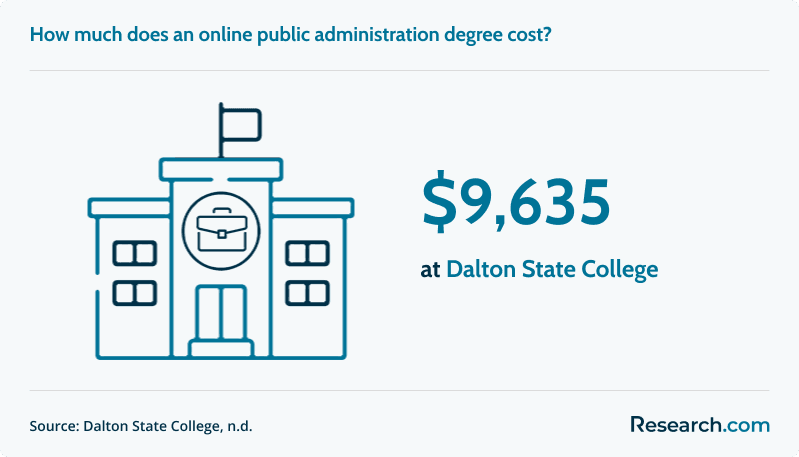
Dalton State College provides a useful example of why total cost matters: its estimated total cost of attendance, including books, supplies, personal expenses, and transportation, is about $9,635.
| Cost factor | Why it matters | Question to ask the school |
| Tuition per credit | This is the base price for academic coursework. | Is the rate different for in-state and out-of-state online students? |
| Required credits | More credits usually mean a higher total degree cost. | How many credits will I need after transfer evaluation? |
| Fees | Technology, application, graduation, or course fees can increase the bill. | What mandatory fees are not included in advertised tuition? |
| Books and supplies | Course materials can add recurring costs each term. | Are free or low-cost textbooks available? |
| Time to completion | Taking longer may increase fees and delay career benefits. | Can I study part time without losing aid eligibility? |
What are the financial aid options for students enrolling in an online public administration program?
Public service careers can be meaningful, but some entry-level roles may pay less than private sector positions available to graduates with a communications degree or other business-oriented credential. For that reason, reducing your borrowing should be part of your enrollment strategy.
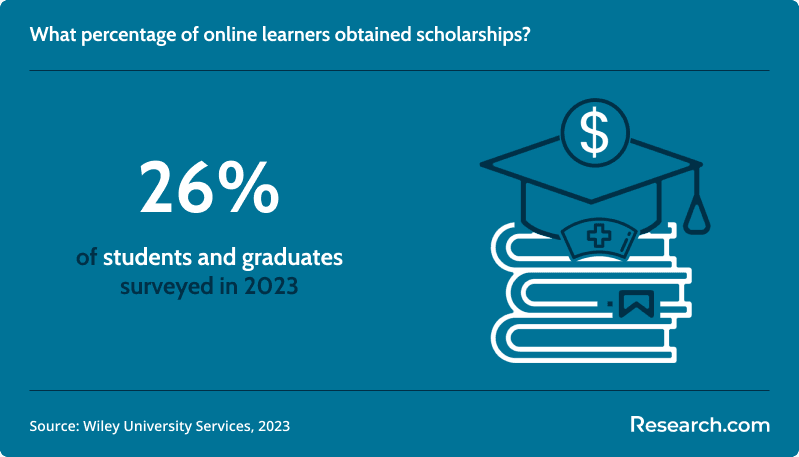
Online students may use scholarships, grants, tuition discounts, federal student loans, employer tuition benefits, military education benefits, and textbook-cost programs when eligible. A 2023 Wiley report found that over a quarter (26%) of online students use scholarships to reduce program costs. The same report notes that tuition discounts (25%) and free or low-cost textbooks (20%) are also common among online learners.
Many aid options require students to complete the Free Application for Federal Student Aid (FAFSA). The FAFSA helps determine eligibility for federal grants, loans, and some school-based aid. Before enrolling, confirm that the institution is accredited and participates in federal financial aid programs.
- Start with grants and scholarships: These do not need to be repaid if you meet the requirements.
- Ask about public service or first responder discounts: Some programs are built for working public servants.
- Compare loan amounts carefully: Borrow only what you need after grants, scholarships, and employer benefits.
- Check textbook policies: Open educational resources and low-cost materials can reduce recurring expenses.
What are the prerequisites for enrolling in an online public administration program?
Admission requirements differ by school, but most bachelor’s programs require a high school diploma or equivalent, an application, transcripts, and sometimes standardized test scores. Transfer-focused or degree-completion programs may also require prior college credit.
Because public administration involves writing, policy research, public finance, and data interpretation, programs may expect students to have a foundation in government, political science, writing, or statistics. GPA thresholds vary, but many programs list minimums such as 2.5 or 3.0.
- High school diploma or equivalent, like a GED
- General education requirements
- Government or political science courses
- Writing skills
- GPA requirements, typically 2.5 or 3.0 at minimum
- Standardized test scores
- Application form and fee
What courses are typically in an online public administration program?
Public administration degrees overlap with other service-oriented majors, but they usually place more emphasis on policy, public law, budgeting, and organizational management than a human services major. Students learn how public institutions make decisions, manage resources, evaluate programs, and remain accountable to communities.
| Common course | What students learn | Why it matters in public service |
| Public Policy Analysis | How policies are created, implemented, measured, and improved. | Public servants need to evaluate whether policies address real community needs. |
| Program Management | How to plan, organize, run, and assess public programs. | Many entry-level and mid-level roles involve coordinating services or initiatives. |
| Budgeting and Public Finance | How public money is raised, allocated, monitored, and reported. | Responsible financial management is central to government and nonprofit work. |
| Public Law and Ethics | Constitutional law, administrative law, ethics rules, and public accountability. | Public employees must understand legal limits, transparency duties, and ethical risks. |
What types of specializations are available in online public administration programs?
Choosing a concentration can make your degree more relevant to your target role. For example, students interested in legislative analysis may benefit from public policy analysis, while those drawn to disaster response may prefer emergency management or public safety administration.
- Public Affairs
- Non-Profit Management
- Healthcare Administration
- Emergency Management
- Public Policy Analysis
If your main interest is public messaging, media strategy, reputation management, or stakeholder communication, you may also compare public administration with affordable online public relations programs.
| Specialization | Best for students interested in | Potential work settings |
| Public Affairs | Community relations, civic communication, and public-facing programs. | Government offices, nonprofits, advocacy organizations. |
| Non-Profit Management | Mission-driven leadership, fundraising support, and program operations. | Charities, foundations, social service agencies. |
| Healthcare Administration | Health systems, compliance, and service coordination. | Hospitals, clinics, public health organizations. |
| Emergency Management | Preparedness, response, mitigation, and public safety planning. | Emergency management agencies, public safety departments. |
| Public Policy Analysis | Research, legislation, policy design, and evaluation. | Government agencies, think tanks, legislative offices. |
How to choose the best online public administration program?
The best online public administration program is the one that fits your career goal, budget, schedule, and transfer-credit situation while holding recognized accreditation. Accreditation matters because it affects financial aid access, credit transfer, graduate school options, and employer confidence in your degree.
Students considering related public safety or justice pathways should apply the same standard. For example, a criminal justice degree online accredited by recognized organizations may carry more credibility because accreditation signals that the program has been reviewed against accepted quality standards.
Questions to ask before enrolling
- Is the institution accredited by a recognized accrediting body?
- Does the online program use the same curriculum standards as the campus version?
- How many of my transfer credits will apply to the major and to graduation requirements?
- Are classes asynchronous, synchronous, or a mix of both?
- Does the program include an internship, capstone, field project, or public service practicum?
- Which concentrations align with my intended career path?
- What is the full cost after tuition, fees, books, and residency rules?
- What career services are available to online students?
What is the return on investment for an online public administration degree?
The return on investment for an online public administration degree depends on what you pay, how much debt you take on, how quickly you finish, and whether the credential helps you qualify for a better role. Because many public service careers value stability, advancement pathways, and benefits in addition to salary, ROI should not be measured by first-year earnings alone.
To evaluate value, compare total program cost against likely career outcomes in your target field. A student aiming for nonprofit program coordination may use a different ROI calculation than a firefighter seeking public safety management advancement or a healthcare employee comparing undergraduate public administration with online masters in healthcare administration degree programs.
How to estimate ROI before you apply
- Request an official transfer-credit review before committing.
- Calculate tuition, fees, books, and expected living or transportation expenses.
- Subtract grants, scholarships, tuition discounts, and employer benefits.
- Estimate monthly loan payments if you plan to borrow.
- Compare the degree with job postings in your preferred city or agency type.
- Ask whether recent graduates obtained roles similar to the ones you want.
What student support services do online public administration programs offer?
Strong online programs provide more than course access. Look for academic advising, transfer-credit counseling, online tutoring, writing support, digital library access, research databases, technical support, and career services designed specifically for distance learners.
Career support can be especially important in public administration because students may pursue many different sectors. Useful services include resume feedback, public sector job-search guidance, virtual career fairs, alumni introductions, internship support, and interview preparation. If you are primarily looking for the least demanding completion route rather than a public service pathway, you may also compare options such as the easiest bachelor degree, but make sure the degree still supports your career goals.
| Support service | Why online students need it |
| Academic advising | Helps students sequence courses, avoid delays, and understand graduation requirements. |
| Transfer-credit evaluation | Can shorten time to completion and lower total cost. |
| Writing and tutoring support | Public administration coursework often requires policy briefs, reports, and research papers. |
| Career services | Connects coursework to government, nonprofit, healthcare, and public safety job searches. |
| Technology support | Reduces disruptions caused by learning platforms, exams, or virtual meetings. |
How Do Online Public Administration Programs Integrate Business Management Principles?
Many public administration programs include business management concepts because public and nonprofit leaders must manage budgets, teams, operations, performance goals, and stakeholder expectations. Courses may cover strategic planning, financial oversight, human resources, project management, and process improvement.
This blend is useful for students who want public service careers with operational responsibility. Programs that combine governance and management can help students think about public accountability while also improving efficiency and service delivery. Students who want a stronger business foundation may compare public administration programs with online colleges for business management.
Can combining public administration with business management studies enhance career prospects?
Combining public administration with business management can be valuable for students who want leadership roles in agencies, nonprofits, healthcare organizations, public-private partnerships, or regulated industries. Public administration emphasizes policy, ethics, governance, and community outcomes, while business management strengthens skills in strategy, operations, finance, and performance measurement.
Students do not always need a dual degree. Sometimes the better option is to select business electives, add a certificate, or pursue graduate education later. Those considering advanced leadership training may compare public administration coursework with a cheap online MBA to decide which credential better matches their long-term goals.
What challenges should I expect in online public administration programs?
Online learning is flexible, but it requires consistent self-management. Students must keep up with readings, deadlines, discussion posts, group projects, and research assignments without the routine of traveling to campus. Live courses can also be difficult for students with irregular work shifts.
Technology issues can interrupt progress if students lack reliable internet, a suitable computer, or familiarity with the learning platform. Networking may also require more effort because informal face-to-face conversations are limited. Students considering long-term administrative or executive roles may eventually explore advanced credentials, including doctorate of business administration cheap programs, but graduate study should be evaluated only after clarifying career needs and cost.
| Common challenge | Better strategy |
| Underestimating weekly workload | Ask the program how many hours per week each course typically requires. |
| Choosing a live online program without checking meeting times | Confirm whether classes are synchronous, asynchronous, or hybrid before enrolling. |
| Ignoring technology requirements | Review hardware, software, webcam, and internet expectations before the first term. |
| Waiting too long to network | Attend virtual events, contact faculty, and use alumni resources early. |
| Assuming online means easier | Treat the degree as a structured academic commitment, not a self-paced hobby. |
How does an online public administration degree compare with an MBA for career advancement?
An online public administration degree and an MBA serve different career goals. Public administration is designed around governance, public accountability, policy analysis, public budgeting, community engagement, and nonprofit or agency operations. An MBA focuses more heavily on corporate strategy, finance, marketing, operations, entrepreneurship, and private-sector leadership.
If your goal is city government, public safety administration, nonprofit management, policy work, or public program coordination, public administration is usually the more direct undergraduate pathway. If your goal is corporate management, consulting, entrepreneurship, or private-sector finance, business training may be more relevant. Students comparing graduate options can review MBA specializations with high salaries to understand how business concentrations may affect career direction.
How can integrating business strategies enhance an online public administration degree?
Business strategy can strengthen public administration training by helping students connect public goals with practical execution. Public agencies and nonprofits must allocate scarce resources, measure outcomes, manage teams, negotiate with partners, and improve services under budget and regulatory constraints.
Useful business-oriented topics include strategic resource management, performance improvement, project planning, budgeting, analytics, and stakeholder negotiation. Students who want a faster business-focused credential may compare public administration programs with the fastest business degree programs online before deciding which pathway fits best.
What career paths are available for graduates of online public administration programs?
An online public administration degree can lead to entry-level roles and may also create a foundation for graduate study. Some students later pursue a master’s degree or a PhD part-time, especially if they want research, teaching, executive, or advanced policy roles.
- Government Agencies: Graduates may work in local, state, or federal offices on policy support, budgeting, constituent services, urban planning, environmental protection, public safety, or program administration.
- Non-Profit Organizations: Graduates may support social services, community development, healthcare administration, grants, outreach, or program evaluation.
- International Organizations/NGOs: Graduates may pursue work connected to poverty reduction, human rights advocacy, sustainable development, emergency response, or global public programs.
Public administration graduates also move into settings beyond government. According to BLS field-of-degree data, about 8% of graduates work in schools or libraries, while 7% work in business and finance. The chart below shows additional career paths for public policy and social services professionals.
What is the job market for graduates with an online public administration degree?
Public administration careers are not always the highest-paying compared with some private-sector tracks, but many public service roles offer stability, mission alignment, and advancement ladders. Similar to how the cheapest online bachelor's degree in education can prepare future educators, a public administration degree can support service-oriented work that communities continue to need.
The job market varies by occupation. BLS projects a 7% increase in opportunities for political scientists between 2022 and 2032, which exceeds the average growth rate for all jobs. Related management occupations also show positive projections: jobs for medical and health services managers are projected to rise by 28%, while social and community service managers can expect a 9% increase.
These projections do not mean every graduate will receive a job offer immediately. Students should gain practical experience, choose relevant concentrations, build writing and data skills, and use internships or current employment to connect the degree to a specific career path.
The following chart highlights fast-growing jobs connected to public administration training.
Emerging Trends in Public Administration
Public administration is changing as agencies and nonprofits respond to digital service delivery, data use, climate resilience, equity concerns, and flexible work models. Students should look for programs that teach both traditional governance foundations and current workplace tools.
Digital transformation in public services
Governments and nonprofits increasingly use digital platforms to deliver services, communicate with residents, track cases, and manage internal operations. Public administrators benefit from understanding data systems, cybersecurity basics, customer relationship management tools, and accessible online service design.
Data-driven decision making
Public agencies are using data to evaluate programs, forecast community needs, and support policy decisions. Familiarity with data visualization, statistical analysis, and tools such as Tableau and SPSS can help graduates contribute to evidence-based decisions.
Sustainability and climate resilience
Communities are planning for climate-related risks, infrastructure stress, and disaster preparedness. Public administrators working in planning, emergency management, public works, and community development may need knowledge of environmental policy and sustainable urban planning.
Equity and inclusion
Modern public administration places more attention on fair access to services, inclusive program design, and the impact of policies on different populations. Students should learn how to evaluate whether programs reach the communities they are intended to serve.
Remote and hybrid work
Some public administration roles now involve remote meetings, digital collaboration, and hybrid schedules. Strong written communication, virtual facilitation, and project management habits are increasingly useful. Students planning graduate study later may compare options such as the quickest cheapest masters degree programs to advance while managing cost.
What are the important skills developed in online public administration programs?
Online public administration programs develop practical skills for leading teams, analyzing policies, managing budgets, communicating with stakeholders, and making ethical decisions in public-facing organizations. These skills can support work in government, nonprofit, healthcare, public safety, and community service settings.
Students who want deeper policy expertise after a bachelor’s degree may later compare affordable online master's in public policy programs, particularly if they are interested in research, legislative analysis, or policy implementation.
| Skill area | What students practice | Why employers value it |
| Leadership and management | Team coordination, conflict resolution, and decision making. | Public programs often require collaboration across departments and stakeholders. |
| Budgeting and financial management | Budget allocation, financial oversight, and cost-benefit analysis. | Public and nonprofit leaders must use limited resources responsibly. |
| Policy analysis and development | Data analysis, research, and advocacy. | Organizations need staff who can evaluate policy effects and recommend improvements. |
| Communication and public relations | Public speaking, writing and reporting, and community outreach. | Public administrators must explain complex issues clearly to varied audiences. |
| Ethical and legal awareness | Ethical decision-making and legal compliance. | Public service requires accountability, transparency, and respect for legal boundaries. |
Do online public administration programs offer networking and mentorship opportunities?
Many online public administration programs now offer virtual networking and mentorship through alumni panels, career webinars, discussion-based courses, group projects, digital communities, and employer events. These opportunities matter because public service hiring often rewards relevant experience, professional references, and familiarity with agency or nonprofit work.
Students should ask whether online learners can access the same career services as campus students. Useful features include mentor matching, internship guidance, public sector resume support, and introductions to alumni in government or nonprofit roles. Students interested in regulatory or legal dimensions of public service may also explore interdisciplinary options such as masters business law online.
Accreditation Standards for Online Public Administration Programs
Accreditation is one of the most important checks before enrolling in an online public administration program. It indicates that a school or program has been reviewed against recognized quality standards. It can also affect financial aid eligibility, transfer credits, graduate school admission, and employer confidence.
Why accreditation matters
- Educational quality: Accredited institutions and programs undergo outside review to confirm that academic standards are being met.
- Employment credibility: Some employers, including government agencies, may prefer or require degrees from accredited institutions.
- Credit transfer: Credits from accredited schools are more likely to be considered by other accredited institutions.
- Federal financial aid: Students generally need to attend an accredited institution to access federal financial aid programs.
Key accreditation bodies for public administration
- Network of Schools of Public Policy, Affairs, and Administration (NASPAA): NASPAA is widely recognized in public service education and reviews areas such as curriculum, faculty qualifications, and student outcomes.
- Accreditation Council for Business Schools and Programs (ACBSP): ACBSP is more commonly associated with business programs, but it may also apply to programs that include public administration within business schools, with attention to teaching quality and student outcomes.
- Council for Higher Education Accreditation (CHEA): CHEA recognizes accrediting organizations that meet quality expectations, helping students identify credible accreditors.
How to verify an accredited online program
- Check the accreditor directly: Do not rely only on a school’s marketing page. Verify the school or program through the accreditor’s official site or through a trusted list of online schools.
- Review the curriculum: A strong program should cover policy analysis, budgeting, ethics, leadership, public law, and organizational management.
- Look at faculty experience: Faculty with public sector, nonprofit, public safety, or policy backgrounds can connect coursework to workplace realities.
- Evaluate online student services: Make sure advising, library access, career support, and technical help are available to online learners.
Common Mistakes to Avoid When Choosing an Online Public Administration Degree
| Mistake | Why it can hurt you | Better approach |
| Choosing a program without checking accreditation | It may affect financial aid, transfer credits, graduate school, and employer acceptance. | Verify accreditation with the accreditor or a recognized education database. |
| Focusing only on tuition per credit | Fees, books, residency rates, and extra credits can change the real cost. | Ask for a full cost-of-attendance estimate. |
| Ignoring transfer-credit policies | You may repeat courses or pay for credits you thought would transfer. | Get an official transfer evaluation before enrolling. |
| Assuming every concentration leads to the same jobs | Emergency management, nonprofit management, and policy analysis prepare students for different roles. | Match the concentration to job postings you actually want. |
| Relying only on rankings | A highly ranked program may not fit your schedule, budget, or career target. | Use rankings as one input, then compare cost, format, support, and outcomes. |
| Assuming salary outcomes are guaranteed | Pay varies by role, location, employer, experience, and credentials. | Research occupation-specific salary data and local job openings. |
References
- Payscale. (2023, October 12). Master of Public Policy (MPP) Salary | PayScale. Payscale. Retrieved March 19, 2024, from https://www.payscale.com/research/US/Degree=Master_of_Public_Policy_(MPP)/Salary
- Payscale. (2024, February 8). Master of Public Administration (MPA) Salary | PayScale. Payscale. Retrieved March 19, 2024, from https://www.payscale.com/research/US/Degree=Master_of_Public_Administration_(MPA)/Salary
- U.S. Bureau of Labor Statistics. (2023, September 6). Political Scientists : Occupational Outlook Handbook: : U.S. Bureau of Labor Statistics. Retrieved March 20, 2024, from https://www.bls.gov/ooh/life-physical-and-social-science/political-scientists.htm
Key Insights
- An online public administration degree is most useful when it connects directly to a public service goal, such as government administration, nonprofit management, healthcare administration, emergency management, or policy work.
- Affordable programs in this guide may cost between $100 to $330 per credit, but students should compare full cost of attendance, transfer credits, fees, and financial aid before deciding.
- Accreditation is non-negotiable. It can affect federal aid, transferability, graduate school options, and employer trust.
- Public administration and business management can complement each other, but the right path depends on whether you want public sector, nonprofit, healthcare, public safety, or private-sector leadership roles.
- Online learning can work well for adults and working students, but success requires time management, reliable technology, active networking, and careful program selection.
- Salary and job growth vary by occupation. Use BLS data, local job postings, and school outcome information to estimate realistic ROI.
Other Things You Should Know About Online Public Administration Degrees
Most programs accept up to 60 transfer credits into a 120-credit bachelor’s degree, but the final 30 credits are usually completed at the school granting the degree. Regionally accredited courses transfer most easily, and schools often require a C grade or better for each accepted course.
Online public administration programs typically require reliable internet access and a computer with updated software, such as Microsoft Office. Some may require specialized software for data analysis, which will be specified by the program at enrollment.