
2027 Fastest Online Master’s Degree in Homeland Security Programs

Co-Founder and Chief Data Scientist
Choosing the fastest online master's in homeland security is not just a question of speed. The real decision is whether an accelerated program can help you move into security leadership, emergency management, intelligence, cyber policy, or public safety roles without sacrificing accreditation, rigor, or employer credibility.
This guide is for working professionals, military-affiliated students, law enforcement personnel, emergency managers, cybersecurity practitioners, and career changers who want a graduate credential on a shorter timeline. You will learn what accelerated homeland security programs usually include, how to compare cost and format, which careers they may support, what salary data shows, and what mistakes to avoid before enrolling.
Quick Answer: What Is the Fastest Online Master's in Homeland Security?
The fastest online master's in homeland security programs are graduate degrees designed for completion in an accelerated format, often in 12 to 18 months, depending on transfer credits, course load, calendar structure, and whether the program uses shorter terms. The best option is not automatically the shortest one. A strong program should be regionally accredited, clearly list tuition and fees, offer relevant coursework in areas such as counterterrorism, emergency management, intelligence analysis, cybersecurity, and infrastructure protection, and provide support for working adults.
What are the benefits of choosing one of the fastest online Master's in Homeland Security programs?
- Faster career positioning: An accelerated graduate degree can help qualified professionals compete for roles such as Intelligence Analyst, Emergency Management Director, Federal Law Enforcement Agent, Cybersecurity Manager, Policy Advisor, or Security Director more quickly than a traditional two-year path.
- Stronger leadership preparation: Coursework usually goes beyond frontline operations and focuses on policy, risk assessment, crisis coordination, interagency collaboration, intelligence, and strategic decision-making.
- Potential salary growth: Professionals with this master's degree can command median salaries in the range of $92,000 to over $116,000 annually, with specialized and senior positions often paying more based on experience, agency, location, and responsibility level.
- Flexible study for working adults: Online delivery can make graduate study more realistic for students who are already employed, deployed, parenting, or balancing shift-based public safety work.
- Broader employment options: The degree can apply across federal agencies, state and local government, private security, infrastructure protection, emergency management, consulting, and cyber risk roles.
What can I expect from the fastest online Master's in Homeland Security programs?
Accelerated online homeland security master's programs compress graduate-level study into a shorter schedule. That usually means heavier weekly reading, faster assignment cycles, and less downtime between courses. Students should expect a practical curriculum that connects security theory with real operational and policy problems.
- Advanced security coursework: Common subjects include counterterrorism analysis, border security policy, critical infrastructure protection, emergency management, intelligence, cyber policy, risk assessment, and homeland defense strategy.
- Online delivery with structured milestones: Programs often combine recorded lectures, discussion boards, live sessions, case studies, policy briefs, simulations, and capstone or research projects.
- Applied decision-making: Students frequently analyze real incidents, evaluate response failures, write threat assessments, and recommend policy or operational improvements.
- Accelerated pacing: Many programs are designed for completion in 12 to 18 months, though actual time to graduation depends on the number of credits, course availability, term length, and whether a student studies full time or part time.
- Professional networking: Online cohorts may include military personnel, police officers, emergency managers, analysts, federal employees, private security professionals, and career changers.
| Program feature | What it means for students | Why it matters |
| Short terms | Courses may run in compressed sessions rather than traditional semesters. | You can finish faster, but the workload is more intense. |
| Fully online classes | Most coursework can be completed remotely. | This helps students maintain employment or military obligations while studying. |
| Capstone or thesis option | Some programs require a final project, applied research paper, or thesis. | The final requirement can affect completion time and career relevance. |
| Specializations | Tracks may include cybersecurity, emergency management, intelligence, or homeland security policy. | The right track can make the degree more useful for targeted roles. |
Where can I work with a qualification from the fastest online Master's in Homeland Security programs?
A homeland security master's degree can support careers in organizations responsible for preventing, preparing for, responding to, and recovering from security threats and disasters. The degree is especially relevant for roles where policy, coordination, intelligence, and risk management intersect.
- Federal government: Graduates may pursue roles connected to the Department of Homeland Security (DHS), FEMA, TSA, Customs and Border Protection, and other agencies involved in national preparedness and border, transportation, infrastructure, or emergency response functions.
- Intelligence and law enforcement agencies: Career paths may include analyst, investigator, agent, or policy roles with organizations such as the FBI, CIA, and the Defense Intelligence Agency (DIA), depending on eligibility, clearance requirements, and hiring needs.
- State and local agencies: Graduates can work in emergency management, public safety, public health preparedness, homeland security offices, fusion centers, and major city security operations.
- Private sector and critical infrastructure: Employers in finance, energy, transportation, healthcare, logistics, and technology hire security professionals to manage risk, continuity planning, incident response, and infrastructure protection.
- Consulting firms: Homeland security expertise can support advisory work for government contractors, corporate risk teams, emergency preparedness projects, and crisis management planning.
- Leadership pathways: With experience, the degree can support advancement toward roles such as Section Chief, Security Director, Program Manager, Emergency Management Director, or Chief Information Security Officer (CISO).
How much can I make with a qualification from the fastest online Master's in Homeland Security programs?
Earnings vary widely by agency, location, clearance level, years of experience, and whether the role is technical, analytical, operational, or managerial. A master's degree can strengthen a candidate's profile, but it does not guarantee a particular salary or promotion.
- Analyst-level roles: Professionals in positions such as Intelligence Analyst or Policy Analyst typically earn between $78,000 and $93,000 annually.
- Management-level roles: Experienced professionals in roles such as Emergency Management Specialist or Program Manager can expect salaries ranging from $98,000 to over $115,000.
- Senior and specialized roles: Higher-level or highly specialized positions such as Federal Special Agent ($116,381) or Section Chief ($159,661) can command top-tier salaries.
- Fastest Online Master's Degrees in Homeland Security for 2027
- What is the average cost of an online Master's degree in Homeland Security?
- What are the financial aid options for an online Master's degree in Homeland Security?
- What are the prerequisites for enrolling in an online Master's degree in Homeland Security?
- What courses are typically in an online Master's degree in Homeland Security?
- What types of specializations are available for Master's degree in Homeland Security graduates?
- How do you choose the best online Master's degree in Homeland Security?
- What career paths are available for graduates of online Master's degree in Homeland Security programs?
- Are there complementary degree options to broaden my homeland security career?
- How much can I earn with an online Master's degree in Homeland Security?
- How do student support and career services impact success in online Homeland Security programs?
- What is the job market like for graduates with an online Master's degree in Homeland Security?
- What are some current and future trends in homeland security?
- Can complementary accelerated programs enhance my Homeland Security career?
Fastest Online Master's Degree in Homeland Security Programs for 2027
How do we rank schools?
Because an accelerated master's degree is a major investment, rankings should be used as a starting point rather than a final decision. Our methodology considers transparent, education-focused data sources to help students compare institutions more carefully.
Sources used in the ranking process include the IPEDS database, Peterson's database including distance learning data, the College Scorecard database, and the National Center for Education Statistics.
Below are the selected programs, followed by details students should verify directly with each university before applying.
1. American Military University (AMU)
American Military University offers a fully online Master of Arts in Homeland Security for students seeking graduate study in national defense, emergency management, critical infrastructure protection, intelligence, terrorism, and homeland defense strategy.
The program is taught by faculty with professional backgrounds in government, military, and defense environments. Students examine modern domestic security challenges, interagency coordination, policy development, resiliency, intelligence, and the legal distinctions between homeland security and homeland defense.
This program may fit working professionals who want a flexible online format and a curriculum connected to government, military, defense, and private-sector security work.
- Program Length: Typically 1.5 to 2 years (varies by course load)
- Tracks/Concentrations: General Homeland Security (with electives in intelligence, terrorism, emergency management, etc.)
- Tuition Cost: $455/credit (standard); $250/credit (Preferred Military Rate); $386.75/credit (with Veteran Grant); $409.50/credit (with APUS Opportunity Grant)
- Required Credits to Graduate: 36
- Accreditation: Higher Learning Commission (HLC)
2. Angelo State University
Angelo State University offers an online Master of Science in Homeland Security that can be completed in as little as 1.5 years. The program is designed for professionals seeking graduate-level preparation in homeland security policy, international terrorism, intelligence analysis, and emergency management.
Coursework emphasizes applied research, policy evaluation, and practical security analysis. The program can be relevant for students pursuing leadership responsibilities in government, law enforcement, intelligence, emergency management, and private security settings.
- Program Length: About 1.5 years
- Tracks/Concentrations: Homeland Security, Intelligence & Analysis
- Tuition Cost: Texas Resident: $823.05/credit; Non-resident: $1,228.05/credit
- Required Credits to Graduate: 36
- Accreditation: Southern Association of Colleges and Schools Commission on Colleges (SACSCOC)
3. Arizona State University
Arizona State University offers an online Master of Arts in Emergency Management and Homeland Security with five concentrations: biosecurity and threat management, community resilience, cybersecurity policy and management, emergency management, and homeland security.
The curriculum covers emergency preparedness, risk analysis, resilience, policy development, and leadership. Students who want a broader emergency management and homeland security degree with multiple concentration choices may find this format useful.
- Program Length: Typically 1.5 to 2 years
- Tracks/Concentrations: Biosecurity and threat management, Community resilience, Cybersecurity policy and management, Emergency management, Homeland security
- Tuition Cost: $8,790/AY
- Required Credits to Graduate: Not specified
- Accreditation: Higher Learning Commission (HLC)
4. Colorado Technical University
Colorado Technical University offers an online Master of Science in Criminal Justice with a Homeland Security concentration. The program blends criminal justice leadership with homeland security topics such as policy development, strategic planning, information sharing, and critical infrastructure protection.
Students study leadership, ethics, criminology, public policy, technology integration, diversity in justice systems, and homeland security operations. This option may be especially relevant for students who want homeland security training within a criminal justice framework.
- Program Length: Accelerated options available (can be completed in as little as 1 year)
- Tracks/Concentrations: Homeland Security
- Tuition Cost: $610/credit
- Required Credits to Graduate: 48
- Accreditation: Higher Learning Commission (HLC)
5. George Washington University
George Washington University offers a Master of Professional Studies in Homeland Security that can be completed online or in a hybrid format. The program focuses on national and global security challenges, including terrorism, cybersecurity, artificial intelligence, intelligence, strategic analysis, and leadership.
Students work with experienced homeland security professionals and develop skills in communicating complex security issues, collaborating across agencies, and analyzing emerging threats. The hybrid option is available in Arlington, Virginia.
- Program Length: 16 months
- Tracks/Concentrations: General Homeland Security
- Tuition Cost: $1,375/credit
- Required Credits to Graduate: 36
- Accreditation: Middle States Commission on Higher Education (MSCHE)
6. Liberty University
Liberty University offers an online Master of Science in National Security with a Homeland Security concentration. The program covers emergency management, border security, terrorism, cyber warfare, counterterrorism, intelligence, and national security institutions.
Courses are delivered in 8-week, fully online formats with no mandatory logins. The curriculum is taught from a Christian worldview, which is an important fit consideration for students evaluating institutional mission and classroom perspective.
- Program Length: 18 months
- Tracks/Concentrations: National Security
- Tuition Cost: $580/credit (Graduate Full-Time); $645/credit (Graduate Part-Time); $290/credit (Military Graduate)
- Required Credits to Graduate: 36
- Accreditation: Southern Association of Colleges and Schools Commission on Colleges (SACSCOC)
7. Northwestern State University of Louisiana
Northwestern State University of Louisiana offers an online Master of Science in Homeland Security focused on threat assessment, policy, ethics, leadership, intelligence, terrorism, transnational crime, and complex organizational challenges.
The curriculum includes coursework in international terrorism, domestic extremist threats, executive leadership, research design, counter-terrorism, intelligence analysis, and electives such as cyberterrorism, network security, international conflict, or globalization. Students may choose a thesis or non-thesis route.
- Program Length: Typically 1.5 to 2 years
- Tracks/Concentrations: Cyberterrorism, network security, international conflict, or globalization
- Tuition Cost: $2,590 (In-State); $2,590 (Out-of-State)
- Required Credits to Graduate: 30 (thesis), 36 (non-thesis)
- Accreditation: Southern Association of Colleges and Schools Commission on Colleges (SACSCOC)
8. Nova Southeastern University
Nova Southeastern University offers an online Master of Science in National Security Affairs and International Relations for students interested in security policy, international relations, intelligence, border protection, U.S. foreign policy, and ethics.
Students can study full time or part time and may choose online or hybrid classes at the Fort Lauderdale/Davie campus. Electives include terrorism and economic statecraft, with options for practicum, internships, or a thesis. An optional Cybersecurity concentration focuses on cyber conflict and threat analysis, supporting demand for analysts expected to rise over the next five years.
- Program Length: Typically 1.5 to 2 years
- Tracks/Concentrations: National Security Affairs, Cybersecurity (optional)
- Tuition Cost: $843.00/credit
- Required Credits to Graduate: 36
- Accreditation: Southern Association of Colleges and Schools Commission on Colleges (SACSCOC)
9. St. John's University
St. John's University offers a Master of Professional Studies in Homeland Security and Criminal Justice Leadership that combines homeland security, criminal justice, public administration, and leadership. Students can study online or on campus in New York City.
Core coursework includes ethical leadership, U.S. homeland protection, and public administration policy. Electives allow exploration of terrorism, intelligence, infrastructure, and cybersecurity, while the program concludes with an applied capstone project.
- Program Length: Typically 1.5 to 2 years
- Tracks/Concentrations: Homeland Security
- Tuition Cost: $1,640/credit
- Required Credits to Graduate: 36
- Accreditation: Middle States Commission on Higher Education (MSCHE)
10. The University of Maryland Global Campus (UMGC)
The University of Maryland Global Campus offers an online Master of Science in IT with a homeland security management concentration. The program is designed for students who want technical and managerial preparation for homeland security roles connected to information technology.
Students study IT systems, architecture, project management, resilience planning, biosecurity, emergency IT management, risk assessment, disaster recovery, and infrastructure protection. The program begins with Information Technology Foundations and ends with a Seminar in Homeland Security capstone.
- Program Length: Typically 2 years (must be completed within 5 years)
- Tracks/Concentrations: Information Technology with Homeland Security Management
- Tuition Cost: $544/credit (in-state); $659/credit (out-of-state); $336/credit (military)
- Required Credits to Graduate: 36
- Accreditation: Middle States Commission on Higher Education (MSCHE)
What is the average cost of an online Master's degree in Homeland Security?
The cost of an online Master's degree in Homeland Security depends on the institution, tuition model, residency rules, military discounts, transfer credit policies, and required credit hours. Many programs require between 30 to 36 credit hours, though some require more.
| Cost factor | Typical impact | What to verify before enrolling |
| Public university in-state tuition | In-state online tuition can range from approximately $15,000 to $30,000 for the full program. | Confirm whether online students receive in-state rates or a separate online tuition rate. |
| Public university out-of-state tuition | Out-of-state students may pay between $30,000 and $50,000. | Ask whether distance learners qualify for tuition waivers or reduced online rates. |
| Private university tuition | Private universities often charge total program costs ranging from $30,000 to over $60,000. | Compare net cost after grants, employer aid, and military benefits. |
| Per-credit tuition | Per-credit costs can range from around $400 to over $1,000. | Multiply tuition by total required credits, not just advertised annual tuition. |
| Fees and materials | Technology fees, application fees, books, digital materials, and graduation fees can raise the final cost. | Request a full cost-of-attendance estimate from the school. |
Students trying to reduce total cost should compare both tuition and time to completion. Related options, such as the shortest online masters in emergency management degree programs, may be worth reviewing if your main goal is disaster response, public safety, or emergency management leadership rather than a broader homeland security curriculum.
Cost decisions should also be viewed in light of the field's operational demands. U.S. Customs and Border Protection (CBP) enforcement activity shows how quickly homeland security priorities can shift. Total encounters increased from 2017 to 2019, fell to 646,822 in FY20 during the COVID-19 pandemic, then rose to over 3.2 million in FY23 before easing to 2.9 million in FY24.
Because Title 8 and Title 42 data have been included since March 2020, these figures reflect a volatile environment shaped by global migration patterns, enforcement changes, and operational pressure on the Office of Field Operations and U.S. Border Patrol. For students, the larger point is clear: graduate programs should teach adaptive planning, data interpretation, border policy, and operational coordination, not just security theory.
What are the financial aid options for an online Master's degree in Homeland Security?
Financial aid can substantially change the true cost of an online homeland security master's degree. Before comparing programs by sticker price alone, students should calculate their net cost after aid, military benefits, employer support, scholarships, and transfer credits.
Students considering other accelerated leadership fields, including an accelerated online master's degree in organizational leadership, should use the same approach because shorter formats often require careful cash-flow planning.
- Federal Student Aid: Graduate students can complete the Free Application for Federal Student Aid (FAFSA),1 to determine eligibility for federal aid, including Direct Unsubsidized Loans.
- Military and veteran benefits: Active-duty service members, veterans, and eligible family members should ask about Post-9/11 GI Bill benefits, Yellow Ribbon Program participation, military tuition rates, and institutional veteran grants.
- Employer tuition assistance: Public agencies, defense contractors, emergency management offices, law enforcement departments, and corporate security employers may offer tuition reimbursement or professional development funding.
- Scholarships and grants: Universities and professional associations may offer awards for students pursuing homeland security, criminal justice, emergency management, cybersecurity, or public service careers.
- State-specific aid: Some states offer grants or tuition support to residents pursuing graduate education, particularly in public service or high-need workforce areas.
The best next step is to request a written financial aid estimate from each school. Ask whether aid applies to accelerated terms, whether military rates reduce eligibility for other grants, and whether dropping below full-time enrollment changes your award.
What are the prerequisites for enrolling in an online Master's degree in Homeland Security?
Admission requirements vary by university, but most online master's programs in homeland security expect applicants to show graduate-level readiness through prior education, writing ability, professional goals, and sometimes relevant work experience.
- Bachelor's degree: Applicants usually need a bachelor's degree from a regionally accredited institution. Students who still need an undergraduate credential may compare the fastest online homeland security degree programs to build foundational knowledge in security policy, intelligence analysis, and emergency response.
- Minimum GPA: Many programs look for a minimum undergraduate GPA of around 3.0 on a 4.0 scale, though some schools may offer conditional admission to applicants below that threshold.
- Professional experience: Some universities prefer or require experience in law enforcement, emergency management, cybersecurity, military service, public administration, intelligence, or a related field.
- Application materials: Common requirements include transcripts, a resume, letters of recommendation, and a statement of purpose explaining why the degree fits your career goals.
- Standardized tests: Many online programs no longer require GRE or GMAT scores, but applicants should verify requirements for each school.
Comparable graduate admissions expectations also appear in other specialized accelerated fields, such as fast-track sports analytics masters online, where schools assess whether applicants are prepared for intensive, applied coursework.
Before applying, review whether your target program requires prerequisite courses, professional references, clearance eligibility, writing samples, or minimum professional experience. These details can affect both admission and your readiness for the accelerated pace.
What courses are typically in an online Master's degree in Homeland Security?
Online homeland security master's programs usually combine policy, operations, intelligence, law, risk management, emergency response, and technology. The strongest programs help students connect national security problems with practical decision-making.
| Course area | What students learn | Career relevance |
| Introduction to Homeland Security | History, mission, structure, and responsibilities of homeland security agencies. | Useful for students new to the field or moving from adjacent public safety roles. |
| Terrorism and Counterterrorism | Threat actors, tactics, ideologies, prevention strategies, and response policies. | Relevant for intelligence, law enforcement, policy, and security analysis roles. |
| Emergency Management and Disaster Preparedness | Planning, response, recovery, mitigation, continuity, and interagency coordination. | Important for emergency management, public safety, and resilience careers. |
| Critical Infrastructure Protection | Protection of energy, transportation, cyber networks, communications, finance, and other essential systems. | Useful for government agencies and private-sector risk teams. |
| Intelligence and Strategic Analysis | Collection, evaluation, synthesis, and dissemination of information to support decisions. | Relevant for analysts, investigators, policy advisors, and security planners. |
| Homeland Security Law and Policy | Legal authority, constitutional concerns, civil liberties, privacy, and policy constraints. | Essential for leadership roles where security decisions must withstand legal scrutiny. |
| Cybersecurity Policy and Planning | Cyber threats, incident response, digital infrastructure protection, and governance. | Increasingly important for infrastructure, agency, and corporate security roles. |
Students who want hands-on technical cyber preparation may supplement graduate coursework with accelerated cyberops training bootcamps online, especially if they need practical experience in network defense, threat detection, and incident response.
For students planning long-term academic or executive leadership pathways, some master's-level courses can also prepare them for doctoral study, including a future doctorate of strategic leadership program, depending on admissions requirements.
What types of specializations are available for Master's degree in Homeland Security graduates?
Specializations help students align a homeland security master's degree with a specific career path. The best concentration depends on whether you want to work in cyber risk, emergency management, intelligence, border security, public health preparedness, criminal justice, or policy leadership.
- Cybersecurity: Focuses on protecting networks, systems, data, and digital infrastructure from unauthorized access, disruption, theft, or attack.
- Emergency Management: Prepares students to plan, coordinate, respond to, and recover from disasters, terrorist incidents, technological hazards, and public emergencies.
- Counterterrorism: Examines terrorist organizations, radicalization, ideologies, prevention strategies, intelligence, and response policies.
- Intelligence Studies: Develops skills in information collection, analysis, assessment, dissemination, and strategic decision support.
- Criminal Justice: Connects homeland security with law enforcement, courts, corrections, investigations, and legal policy.
- Public Health Preparedness: Focuses on public health emergencies, pandemics, bioterrorism, health data, and coordinated response. Students interested in the health data side of preparedness may also compare fast-track online HIM degree programs.
- Border and Immigration Security: Covers border management, immigration policy, enforcement coordination, transnational threats, and lawful trade and travel considerations.
- Doctoral study: Some senior policy and executive roles may favor terminal degrees. After a master's, students may explore online doctoral programs in leadership if their goal is high-level administration, consulting, research, or academic work.
| If your goal is... | Consider this specialization | Why it fits |
| Cyber policy, infrastructure defense, or security operations | Cybersecurity | Builds technical-policy fluency for cyber risk and incident response environments. |
| Disaster response or public safety leadership | Emergency Management | Emphasizes planning, coordination, continuity, and recovery. |
| Analyst or threat assessment work | Intelligence Studies | Develops structured analysis and decision-support skills. |
| Law enforcement advancement | Criminal Justice or Counterterrorism | Connects operational security with legal and investigative frameworks. |
| Health emergency planning | Public Health Preparedness | Bridges security, public health, data, and emergency response. |
How do you choose the best online Master's degree in Homeland Security?
The best online homeland security master's program is the one that matches your career target, schedule, budget, and learning style while meeting recognized academic standards. Do not choose solely because a program advertises the shortest completion time.
- Confirm accreditation: Make sure the institution is accredited by a recognized accrediting agency. Accreditation affects employer confidence, credit transfer, financial aid eligibility, and future doctoral admissions.
- Match the curriculum to your goal: Review required courses and electives. A student aiming for cyber policy should not choose a program with only one general cybersecurity course.
- Evaluate faculty experience: Look for faculty with backgrounds in homeland security, intelligence, law enforcement, emergency management, cybersecurity, military leadership, public administration, or security policy.
- Check the online format: Ask whether courses are asynchronous, synchronous, hybrid, or self-paced. Confirm whether any campus visits, residencies, practicums, internships, or capstones are required.
- Calculate total cost: Compare tuition, required credits, fees, books, technology charges, travel, and the cost of reducing work hours if the accelerated schedule is demanding.
- Review student support: Online students should have access to advising, library services, writing support, tech support, career coaching, and faculty communication.
- Ask about career outcomes: Request information on employer partnerships, alumni roles, internship options, federal hiring support, resume guidance, and networking events.
These criteria also apply when comparing leadership-oriented graduate options such as a fast-track online MBA in nonprofit management, where accreditation, curriculum fit, and scheduling flexibility can strongly affect return on investment.
| Question to ask | Why it matters |
| Is the institution regionally accredited? | Accreditation is one of the strongest baseline indicators of institutional legitimacy. |
| Can I realistically complete the program while working? | Accelerated programs can require substantial weekly time commitments. |
| Does the curriculum fit my target role? | A general degree may not be enough if you need cyber, intelligence, or emergency management specialization. |
| Are tuition discounts available? | Military rates, employer aid, and scholarships can change the net cost significantly. |
| What happens if I need to slow down? | Some accelerated programs have rigid course sequencing that can delay graduation if you pause. |
What career paths are available for graduates of online Master's degree in Homeland Security programs?
A master's degree in homeland security can support career growth in public agencies, law enforcement, intelligence, emergency management, cybersecurity, public health preparedness, and private-sector risk management. The degree is most valuable when paired with relevant experience, certifications, clearances, technical skills, or leadership accomplishments.
- Emergency Management Director: Leads planning, preparedness, response, recovery, and crisis management for natural disasters,2 wartime events, technological disasters, hostage situations, or other emergencies.
- Intelligence Analyst: Collects, reviews, and interprets information to identify threats and support decisions for organizations such as the CIA, FBI, DHS, or related employers.
- Cybersecurity Analyst: Helps protect government or corporate networks, develop security controls, monitor threats, and respond to incidents.
- Federal Law Enforcement Agent: A graduate degree may strengthen an application for agencies such as the U.S. Secret Service, U.S. Customs and Border Protection, and Immigration and Customs Enforcement (ICE), though hiring depends on agency requirements and selection processes.
- Policy Advisor: Supports security legislation, agency strategy, emergency planning, and policy analysis for public agencies, think tanks, contractors, or elected officials.
- Private Sector Security Consultant: Assesses risks, develops security plans, supports continuity planning, and advises corporations on domestic and international security issues. Students who want stronger business preparation may also consider an accelerated online business degree.
- Public Health Preparedness Coordinator: Plans and coordinates responses to pandemics, bioterrorism, health system disruptions, and other public health emergencies.
Professionals who want nonprofit leadership roles in disaster relief, humanitarian aid, or public service organizations may also compare the shortest online MBA in non-profit management to build budgeting, governance, grant management, and mission-driven leadership skills.
| Career path | Best-fit background | Helpful graduate focus |
| Emergency management leadership | Public safety, fire service, public administration, emergency response | Emergency management, continuity, resilience, crisis leadership |
| Intelligence analysis | Military, law enforcement, political science, data analysis, security operations | Intelligence studies, counterterrorism, strategic analysis |
| Cybersecurity policy or risk | IT, cybersecurity, infrastructure, compliance, security operations | Cybersecurity policy, critical infrastructure, incident response |
| Federal law enforcement | Law enforcement, military, investigations, criminal justice | Counterterrorism, criminal justice, homeland security law |
| Private-sector risk consulting | Security, operations, consulting, business continuity | Risk management, infrastructure protection, strategic planning |
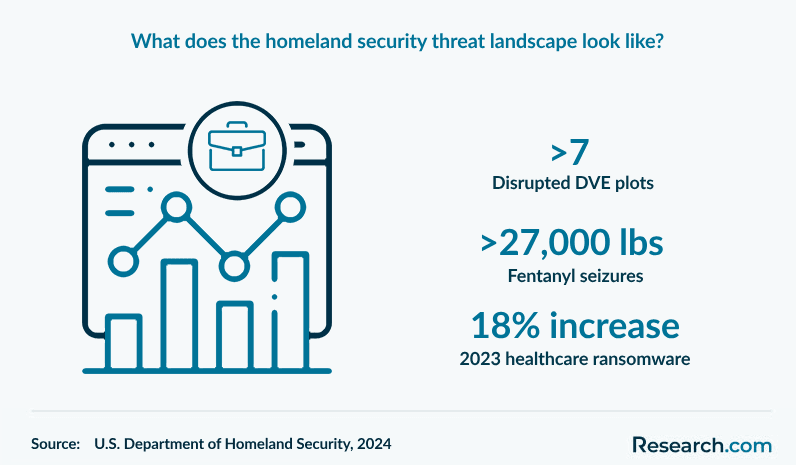
The homeland security threat environment remains broad. Between September 2023 and July 2024, domestic violent extremists (DVEs) launched 4 attacks (1 fatal) and had 7 plots disrupted, while homegrown violent extremists (HVEs) carried out 2 attacks and were stopped in 3 more, partly influenced by the Israel-HAMAS conflict. Foreign groups like ISIS-K conducted major 2024 attacks in Iran and Russia, killing 95 and 140, respectively.
The U.S. also faced 8 non-ideological mass casualty attacks with 38 deaths, and 18 chemical or biological incidents resulting in 1 fatality. Drug trafficking remained a top threat, with 27,000+ pounds of fentanyl and 2,200 pill presses seized in FY2024, and a 4% rise in cocaine and meth overdoses in 2023.
Authorities encountered 139 individuals on the terrorist watchlist at the southern and 283 at the northern border through July 2024. Human trafficking generates $2.5 billion annually for transnational criminal groups operating in the U.S. China is actively preparing cyberattacks on U.S. critical infrastructure, while ransomware attacks on the healthcare sector rose 18% in 2023. Over 20 individuals have been charged since 2023 for intellectual property theft benefiting China, Iran, and Russia.
Are there complementary degree options to broaden my homeland security career?
A homeland security master's degree is specialized, but many leadership roles also require budgeting, personnel management, procurement, data interpretation, project management, and organizational strategy. Students who want to move into executive, consulting, contractor, or administrative roles may benefit from pairing security expertise with business, analytics, technology, or leadership training.
For example, an affordable online MBA can help homeland security professionals strengthen skills in financial management, operations, organizational strategy, innovation, and executive decision-making. This can be useful for professionals who manage programs, lead teams, oversee grants, supervise contractors, or coordinate security initiatives across complex organizations.
How much can I earn with an online Master's degree in Homeland Security?
Salary outcomes depend on job title, agency, level of responsibility, location, security clearance, technical specialization, and years of experience. A master's degree can improve competitiveness for advanced positions, but employment and salary are never guaranteed.
Some students also pursue complementary credentials, including the shortest master's degree in nonprofit management online, to develop grant management, organizational leadership, and emergency response administration skills relevant to public agencies and nonprofit organizations.
- Intelligence Analyst: The average salary for an intelligence analyst with a master's degree can range from approximately $70,000 to over $100,000 annually, depending on agency and experience level.
- Emergency Management Director: Leadership roles in emergency management often pay between $80,000 and $130,000 per year, with higher earnings possible in some federal roles.
- Cybersecurity Analyst: Professionals with cybersecurity specialization and a master's degree can expect salaries in the range of $90,000 to $140,000 or higher.
- Federal Law Enforcement: Advanced education may help candidates enter at a higher pay grade, with potential earnings ranging from $60,000 to well over $150,000 with experience and promotions.
- Management and supervisory roles: Graduates who move into leadership positions within the Department of Homeland Security or related organizations can see salaries exceed $150,000 annually.
2025 salary data from PayScale.com, shown in the graph below, shows a clear increase as roles become more specialized, analytical, technical, or managerial. Operational and support positions start the scale, with a transportation security officer earning around $43,259.
Administrative and technical support roles, including information specialist and security supervisor, fall in a similar range, from approximately $53,000 to $55,400. Pay rises for specialized field and analysis roles. Border patrol agents earn an average of $77,102, while analyst salaries generally fall between $73,000 and $93,000. A policy analyst averages $78,836, while an intelligence analyst earns $92,790.
Higher salaries are associated with advanced technical expertise, significant management responsibility, or specialized investigative and legal work. Cybersecurity analysts and information technology specialists earn salaries in the upper $90,000s. Management and program analysts can earn around $98,438, while an emergency management specialist averages $101,575. Federal special agents and government attorneys earn approximately $116,381 and $113,969, respectively.
At the top end, a detective or criminal investigator earns around $134,949, while executive roles such as contracts director and section chief earn $153,516 and $159,661, respectively. Data scientists earn around $128,420, and students interested in that path can compare cheap MS in data science courses in USA universities as a possible complementary career option.
The main takeaway is that specialization matters. Cybersecurity, intelligence, data, investigations, management, and executive responsibility tend to raise earning potential more than the degree title alone.
How do student support and career services impact success in online Homeland Security programs?
Student support can make the difference between enrolling in an accelerated program and actually finishing it. Online homeland security students often work full time, serve in the military, manage family obligations, or operate on irregular schedules. Strong support services help students stay on track academically and connect the degree to real career opportunities.
- Academic advising: Advisors should help students plan course sequences, avoid scheduling conflicts, and understand capstone or thesis requirements.
- Career coaching: Resume reviews, interview preparation, federal hiring guidance, and LinkedIn support can help students translate coursework into career advancement.
- Faculty access: Students should know how quickly faculty respond, whether office hours are available online, and whether instructors have field experience.
- Technical support: Reliable support is essential in compressed online courses where missed access can quickly affect grades.
- Networking opportunities: Speaker events, alumni groups, agency connections, and professional association links can help students build career contacts.
Students comparing programs should ask for examples of how online graduates are supported after admission and after graduation. Those considering broader management pathways can also review the top MBA programs online to compare how business schools structure career services and alumni networks.
What is the job market like for graduates with an online Master's degree in Homeland Security?
The job market for homeland security graduates is shaped by government priorities, cybersecurity threats, infrastructure risk, emergency preparedness needs, law enforcement hiring, and private-sector demand for resilience and continuity planning. A master's degree can help candidates qualify for higher-level roles, but relevant experience remains important.
- Federal government: DHS and component agencies such as FEMA, TSA, and Customs and Border Protection are major employers, along with agencies such as the FBI and CIA.
- State and local government: Opportunities exist in emergency management agencies, public health departments, law enforcement, fusion centers, and city or state homeland security offices.
- Private sector: Companies hire security professionals to protect critical infrastructure, manage corporate risk, plan business continuity, and coordinate crisis response.
- Non-profit organizations: Disaster relief, humanitarian aid, international security, and public health organizations may value homeland security training.
- High-demand specializations: Cybersecurity, intelligence analysis, and emergency management remain especially relevant. Students focused on cyber pathways may compare the cheapest online masters in cyber security degree programs.
According to 2025 data from the U.S. Bureau of Labor Statistics, the median pay for police and detectives in 2024 was $77,270 per year, equal to $37.15 per hour. In 2023, there were approximately 796,800 jobs in this field. From 2023 to 2033, the occupation is projected to grow 4%, which is considered as fast as the average for all occupations. That growth represents about 28,700 new jobs over the ten-year period.
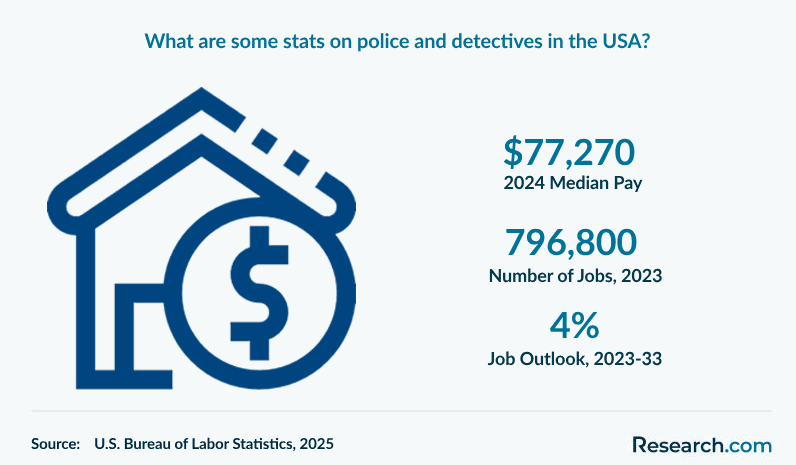
These figures show steady rather than explosive growth for police and detective roles. For homeland security graduates, the strongest opportunities may come from combining the degree with experience, clearance eligibility, cyber skills, emergency management credentials, language ability, data analysis, or specialized investigative expertise.
What are some current and future trends in homeland security?
Homeland security is changing as threats become more digital, decentralized, data-driven, and cross-sector. Graduate programs should prepare students for both traditional physical security issues and emerging risks involving cyberattacks, misinformation, climate-related disasters, biosecurity, and critical infrastructure vulnerability.
- Artificial intelligence and machine learning: Agencies and security teams increasingly use advanced analytics for threat detection, anomaly identification, surveillance support, and large-scale data review.
- Cybersecurity and critical infrastructure protection: Threats against government systems, energy infrastructure, healthcare, transportation, and financial networks continue to make cyber policy and technical literacy central to homeland security. Students who want deeper technical preparation can explore online cybersecurity degrees.
- Domestic terrorism prevention: Security professionals must understand threats that originate inside the United States as well as threats linked to foreign organizations.
- Bioterrorism and public health threats: Concerns involving biological agents, pandemics, and health system disruption have made public health preparedness a permanent part of homeland security planning.
- Disinformation and misinformation: False or manipulated information can undermine trust, intensify crises, and complicate emergency communication.
- Climate and environmental security: More frequent or severe natural disasters can increase demand for resilience planning, emergency management, infrastructure protection, and continuity operations.
- Unmanned aerial systems: The growing availability of drones creates security, privacy, aviation, and infrastructure protection challenges.
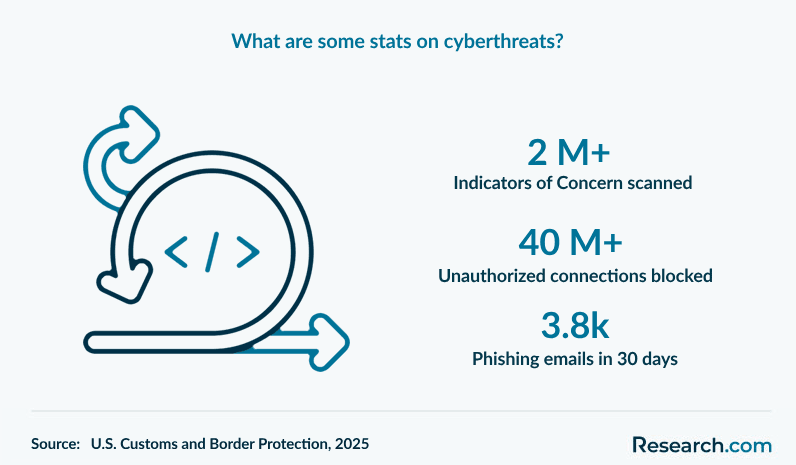
CBP's technology environment illustrates the scale of modern homeland security operations. By the end of FY2023, U.S. Customs and Border Protection had scanned over 2 million Indicators of Concern monthly across 130,000 assets, blocked 40 million unauthorized proxy connections, and received 3,800 phishing reports in 30 days. It also produced dozens of cyber threat intelligence reports and approved Authority to Operate for 30 systems. These efforts were supported by a $1.8 billion budget.
Can complementary accelerated programs enhance my Homeland Security career?
Complementary accelerated programs can be useful when they fill a specific skills gap. The key is to choose an additional credential because it supports your career target, not because it is simply fast.
For example, data analytics can help intelligence and risk professionals interpret large datasets. Cybersecurity training can support infrastructure protection and incident response. Crisis management or public administration coursework can help emergency managers lead complex operations. Even fields such as event and venue management may have limited relevance for risk assessment in large public gatherings; students interested in that angle can compare an accelerated sports management bachelor's degree online.
| Complementary area | Best for | How it can strengthen homeland security work |
| Cybersecurity | Infrastructure protection, incident response, cyber policy | Adds technical fluency to security leadership. |
| Data science or analytics | Intelligence, risk modeling, threat analysis | Improves evidence-based decision-making. |
| MBA or management | Program leadership, contracting, budget oversight | Builds executive and operational management skills. |
| Emergency management | Disaster response, continuity planning, resilience | Deepens practical preparedness and response training. |
| Public health or health information | Biosecurity, pandemic planning, health emergency response | Connects security planning with health systems and data. |
Common mistakes to avoid when choosing an accelerated online Homeland Security master's program
- Choosing speed over credibility: A 12-month program is only valuable if the institution is accredited, the curriculum is rigorous, and employers recognize the credential.
- Ignoring total workload: Accelerated courses can be demanding. Ask how many hours per week students typically spend reading, writing, and completing projects.
- Comparing tuition without fees: Per-credit tuition does not always include technology fees, books, graduation fees, or residency-related expenses.
- Assuming online means self-paced: Many online programs have weekly deadlines, live sessions, group work, or fixed course sequences.
- Overlooking specialization fit: A general homeland security degree may not prepare you for cyber, intelligence, or public health roles unless electives support those goals.
- Forgetting employer requirements: Some roles may require security clearance eligibility, law enforcement academy training, certifications, citizenship, physical fitness standards, or prior experience.
- Relying only on rankings: Rankings can narrow your list, but your final choice should depend on cost, accreditation, curriculum, format, faculty, support, and career fit.
Key Insights
- The fastest program is not always the best program: Prioritize accreditation, curriculum quality, faculty expertise, student support, and career alignment before choosing based on completion time.
- Accelerated formats require discipline: Programs that can be finished in 12 to 18 months often compress graduate-level reading, writing, case analysis, and capstone work into a demanding schedule.
- Specialization drives value: Cybersecurity, intelligence analysis, emergency management, critical infrastructure, and public health preparedness can lead to different roles, so choose electives based on your target career.
- Cost varies widely: Public in-state programs may cost approximately $15,000 to $30,000, out-of-state public options may fall between $30,000 and $50,000, and private programs often range from $30,000 to over $60,000.
- Salary outcomes depend on role and responsibility: PayScale.com data shows salaries ranging from around $43,259 for a transportation security officer to $159,661 for a section chief, with higher pay generally tied to specialization, technical skill, and leadership.
- The threat landscape is broadening: Border security volatility, cyberattacks, fentanyl trafficking, violent extremism, human trafficking, ransomware, and infrastructure threats all shape employer demand for skilled homeland security professionals.
- Federal data shows steady growth in related protective roles: The U.S. Bureau of Labor Statistics reported 2024 median pay of $77,270 per year for police and detectives and projected 4% growth from 2023 to 2033.
- Support services matter: Advising, technical help, career coaching, alumni networks, and federal hiring guidance are especially important in accelerated online programs.
- Complementary credentials can help when targeted: Cybersecurity, data science, emergency management, business, and public health training can strengthen a homeland security master's degree when they support a clear career goal.
References:
- Department Of Homeland Security Average Salaries. (2025, January). Salary.com. https://www.salary.com/research/company/department-of-homeland-security-salary
- Homeland Security Salary. (2025, June). Salary.com.
- How much do Department of Homeland Security As employees make? (2025, January). Salary.com.
- PayScale. (2024, October 27). Average salary for U.S. Department of Homeland Security employees. PayScale.
- Security Specialist Salary at Homeland Security. (2025, May). Salary.com. Department of Homeland Security salary data
- U.S. Bureau of Labor Statistics. (2025, April 18). Police and detectives. In Occupational Outlook Handbook. U.S. Department of Labor. U.S. Bureau of Labor Statistics.
- U.S. Customs and Border Protection. (2025, June 18). CBP enforcement statistics, fiscal year 2024. U.S. Department of Homeland Security.
- U.S. Customs and Border Protection. (2025, May). CBP IT Strategy, 2024–2028. U.S. Department of Homeland Security.
- U.S. Department of Homeland Security, Office of Intelligence and Analysis. (2024, September 30). Homeland Threat Assessment 2025 (Publication 24‑320‑IA). U.S. Department of Homeland Security.
Other Things You Should Know About Online Master's Degree in Homeland Security Programs
Most accelerated online homeland security master’s programs require a capstone, not a thesis. A capstone is usually completed in the final term and may be 3 to 6 credits. Thesis options are less common in fast-track formats because they add research time and extra approval steps.
In 2027, institutions such as American Military University and University of Phoenix offer accelerated completion options, allowing students to finish an online Master's in Homeland Security in as little as one year by taking condensed courses or leveraging prior experience for credit.


