
2027 Fastest Online MBA Programs in Nonprofit Management

Co-Founder and Chief Data Scientist
Choosing a fast online MBA in nonprofit management is really a three-part decision: how quickly you need the credential, how much you can afford to spend, and whether the program will prepare you for leadership in mission-driven organizations. Nonprofits now compete for leaders who can manage budgets, measure impact, raise funds, work with boards, and make strategic decisions under financial pressure. A general passion for service is not enough for many director-level roles.
This guide is for working professionals, nonprofit employees, recent graduates, public service workers, and career changers who want an accelerated graduate business degree focused on nonprofit leadership. You will learn how the fastest programs compare, what they cost, how long they take, what courses they include, which careers they can support, and how to evaluate accreditation, return on investment, and career services before enrolling.
Quick answer: What is the fastest online MBA in nonprofit management?
The fastest online MBA programs in nonprofit management can be completed in as little as 12 months, usually through accelerated 5-, 7-, or 8-week course terms. Most require 30 to 36 credits and combine core MBA subjects with nonprofit-focused training in fundraising, governance, ethics, grant management, budgeting, and strategic leadership. The best option is not automatically the shortest one; it is the accredited program that fits your schedule, budget, career goals, and level of work experience.
What are the benefits of getting an online MBA degree in nonprofit management?
- It can help you qualify for leadership roles. Graduates often pursue positions such as program director, development director, nonprofit executive, fundraising manager, operations director, or community services leader in healthcare, education, advocacy, social services, and public sector organizations.
- It builds business skills for mission-focused work. A strong program teaches practical decision-making in budgeting, ethics, board relations, program evaluation, fundraising, organizational leadership, and strategic planning.
- It can improve earning potential. Social and community service managers earn a median annual salary of $78,240, while some management roles in local government, healthcare, and larger nonprofit systems can pay more depending on role, employer, and location.
What can I expect from the fastest online MBA programs in nonprofit management?
Fast online MBA programs in nonprofit management are designed to deliver graduate-level business training on a compressed schedule. They cover the same broad management foundation found in many MBA programs, but they apply those concepts to tax-exempt organizations, charities, foundations, healthcare nonprofits, schools, advocacy groups, and community service agencies.
Most accelerated programs require 30 to 36 credits. Students usually take core MBA courses in accounting, economics, marketing, organizational behavior, strategy, finance, and leadership, then add nonprofit-specific coursework in fundraising, grant writing, nonprofit financial management, ethics, board governance, public policy, nonprofit law, or program evaluation.
The pace is the main difference. Instead of following a traditional semester schedule, many fast programs use shorter terms and fewer breaks. Students may take two or more courses per term, which can be manageable for highly organized learners but demanding for those working long hours or managing family responsibilities.
| Program feature | What it usually means for students | Decision point |
| 30 to 36 credits | Most programs can be completed with focused full-time study or a structured part-time plan. | Check whether foundation courses add extra credits or cost. |
| 5-, 7-, or 8-week courses | Courses move quickly, with frequent assignments and limited downtime. | Make sure you can study consistently every week. |
| GMAT or GRE waivers | Many schools no longer require test scores, especially for applicants with work experience. | Confirm whether waivers are automatic or based on GPA, experience, or prior coursework. |
| Nonprofit concentration | Students take MBA courses plus nonprofit leadership electives. | Review actual course titles, not just the concentration name. |
| Applied project or capstone | Students may solve a real organizational problem or develop a strategic plan. | Prioritize programs that help you produce portfolio-ready work. |
Where can I work with an online MBA degree in nonprofit management?
An online MBA in nonprofit management can prepare you for leadership roles wherever mission-driven organizations need business discipline. According to the BLS, 66.3% of nonprofit jobs are in healthcare and social assistance, representing more than 8 million jobs. That makes healthcare and social services the largest nonprofit employment area by a wide margin.
| Nonprofit employment area | Share of nonprofit jobs | Examples of roles | Best fit for students interested in |
| Healthcare and social services | 66.3% | Program director, clinic manager, operations lead, community health executive | Health equity, behavioral health, housing services, community care, patient support programs |
| Educational services | 16.4% | Development officer, grants manager, school nonprofit director, student services leader | Colleges, private schools, after-school programs, education access initiatives |
| Other services | 6.3% | Executive director, outreach coordinator, donor relations manager | Faith-based organizations, youth programs, volunteer organizations, local charities |
| Arts, entertainment, and recreation | 2.6% | Fundraising manager, marketing director, cultural program manager | Museums, theaters, community arts organizations, cultural institutions |
Graduates may also work in philanthropic foundations, international development organizations, policy institutes, public-private partnerships, humanitarian organizations, and social impact ventures. In smaller nonprofits, leaders often wear several hats. In larger organizations, roles are usually more specialized by function, such as finance, development, operations, strategy, or evaluation.
How much can I make with the fastest online MBA degree in nonprofit management?
Compensation after an online MBA in nonprofit management depends on the employer, budget size, geographic location, job level, and your prior experience. The degree can strengthen your qualifications for management roles, but it does not guarantee a specific salary.
According to 2025 BLS data, social and community service managers earn a median annual salary of $78,240. Managers in local government roles, excluding hospitals and schools, earn a median annual salary of $101,620. Managers in outpatient care centers, mental health programs, or housing services often earn between $85,000 and $95,000, depending on experience and the size of the role. Development directors and fundraising leaders at large organizations may also reach six-figure compensation, especially in healthcare and education.
The BLS also reports that professionals with a master’s degree generally earn more than those whose highest credential is a bachelor’s degree. Still, MBA graduates should evaluate likely outcomes by role and employer type rather than assuming all nonprofit leadership jobs pay the same.
- Fastest Online MBA Programs in Nonprofit Management for 2027
- How long does an accelerated online MBA in nonprofit management take?
- Online vs. on-campus MBA in nonprofit management
- Average cost of an online MBA in nonprofit management
- Financial aid options for nonprofit MBA students
- Admissions requirements and prerequisites
- Common courses in nonprofit management MBA programs
- Specializations available in online nonprofit MBA programs
- Return on investment for an online MBA in nonprofit management
- How to verify accreditation and outcomes
- Networking and career support to look for
- How to choose the best fast online MBA in nonprofit management
- Career paths after an online MBA in nonprofit management
- Job market outlook for nonprofit MBA graduates
How do we rank schools?
Research.com evaluates programs using transparent data sources so students can compare options with more confidence. Our review process considers information from the IPEDS database, College Scorecard, Peterson’s, and the National Center for Education Statistics.
These sources help us compare schools on measurable factors relevant to students seeking the fastest online MBA programs in nonprofit management. For more detail on our ranking process, review Research.com’s methodology page.
List of the Fastest Online MBA Programs in Nonprofit Management for 2027
The programs below are designed for students who want a shorter path to graduate business training with a nonprofit leadership focus. Use the list as a starting point, then verify admissions rules, tuition, fees, course delivery, and current completion timelines directly with each school.
| School | Program highlights | Credits | Length | Cost | Accreditation |
| Springfield College | MBA in Nonprofit Management with strategy, leadership, business fundamentals, applied learning, and an internship tied to nonprofit challenges. | 30 | 1 year | $745 per credit | International Accreditation Council for Business Education (IACBE) |
| Touro University Worldwide | 100% online MBA concentration in Nonprofit Management focused on leadership, organizational problem-solving, and management strategies for mission-based organizations. | 36 | 1 year | $500 per credit (estimated) | WASC Senior College and University Commission (WSCUC) |
| Bushnell University | MBA in Nonprofit Leadership with ethical stewardship, program evaluation, strategic planning, a Christian-centered approach, and 8-week course blocks. | 36 | 12 months (full-time) | $760 per credit | International Accreditation Council for Business Education (IACBE) |
| Murray State University | MBA in Nonprofit Leadership emphasizing ethical leadership, mission-driven management, and free concurrent prep courses in accounting and economics. | 30 | 12–18 months | $581.50 per credit | Association to Advance Collegiate Schools of Business (AACSB) |
| Trevecca Nazarene University | MBA with a nonprofit leadership concentration that blends core business study with values-based instruction and collaborative learning. | 36 | 15 months (accelerated option) | $590 per credit | Southern Association of Colleges and Schools Commission on Colleges (SACSCOC) |
| Calvin University | Hybrid MBA with online coursework, two brief in-person intensives, leadership and innovation content, optional focus areas, and possible introductory course waivers. | 36 | 13–25 months | $693 per credit | Higher Learning Commission (HLC) |
| Wilmington University | MBA in Nonprofit Management available online and in person, built around core business preparation and nonprofit leadership development. | 36 | As few as 12 months | Estimated $654 per 3-credit course (~$218 per credit) | Middle States Commission on Higher Education (MSCHE) |
| Lakeland University | MBA concentration in Nonprofit Leadership with ethical leadership, communication, strategic planning, and flexible scheduling. | 36 | Varies by student pace | $700 per credit | Higher Learning Commission (HLC) |
| Endicott College | Professional MBA nonprofit track with leadership, marketing, fundraising, strategy, collaborative learning, and international study options. | 36 | 18–24 months | Estimated $790 per credit | New England Commission of Higher Education (NECHE) |
| John Carroll University | Boler Online MBA with nonprofit administration specialization options, financial management, program evaluation, and flexible pacing. | 30 | 12–36 months | $1,440 per credit | Association to Advance Collegiate Schools of Business (AACSB) |
How long does it take to complete the fastest online MBA programs in nonprofit management?
The fastest online MBA programs in nonprofit management can be completed in as little as 12 months, but that schedule usually requires full-time enrollment, careful planning, and steady weekly study time. Programs that take 15 to 18 months may be more realistic for students balancing work, family, or nonprofit responsibilities.
Some accelerated MBA formats resemble other fast online business degrees, such as an accelerated online bachelor's degree in supply chain management, because they compress coursework into shorter sessions and focus on efficient progression.
| Completion timeline | How it usually works | Who it fits best |
| 12 months | Full-time schedule, multiple courses per term, limited breaks, highly structured pacing. | Students who can prioritize school heavily for one year. |
| 15 to 18 months | Accelerated but slightly more flexible, often using 8-week terms. | Working professionals who can handle a steady but less compressed workload. |
| 24 months | Still faster or comparable to many traditional MBA routes, often with part-time options. | Students who need more balance while continuing to work full time. |
| 12–36 months | Flexible or self-paced structure that allows students to speed up or slow down. | Learners who want control over pace but still want the option to finish quickly. |
The chart below illustrates the industries in which candidates of post-graduate business education are most interested, as reported by the GMAC in 2025.
How does an online MBA program in nonprofit management compare to an on-campus program?
An online MBA in nonprofit management can offer the same academic foundation as an on-campus program, provided the institution is accredited and the curriculum is comparable. The major differences are scheduling, delivery format, campus access, and the way students build professional relationships.
Accelerated online graduate programs in other business fields follow a similar logic. For example, an accelerated master’s in taxation management online degree is still expected to meet graduate-level standards, but its format is built for students who want to advance quickly while studying remotely.
| Factor | Online MBA in nonprofit management | On-campus MBA in nonprofit management |
| Schedule | Often asynchronous or partly asynchronous, with flexible weekly deadlines. | Usually tied to scheduled class meetings and campus calendars. |
| Speed | More likely to offer accelerated 12- to 18-month formats. | May follow a more traditional semester-based pace. |
| Networking | Built through virtual discussions, group projects, online events, alumni platforms, and mentoring. | Built through in-person classes, campus events, student organizations, and local employer connections. |
| Best for | Working adults, career changers, rural students, and those who cannot relocate. | Students who want face-to-face interaction, campus resources, and local networking. |
| Employer perception | Generally strongest when the school is accredited and well supported. | Also strongest when the school is accredited and recognized by employers. |
If you are still comparing graduate business options, it may help to review the difference between masters in accounting and MBA programs. A master’s in accounting is more technical and accounting-focused, while an MBA in nonprofit management is broader and typically better suited for students who want to manage people, programs, partnerships, and strategy.
What is the average cost of an online MBA program in nonprofit management?
The average cost of an online MBA in nonprofit management ranges from approximately $18,000 to $50,000. Your total price depends on the number of credits, the per-credit tuition rate, fees, whether the school is public or private, and how quickly you finish.
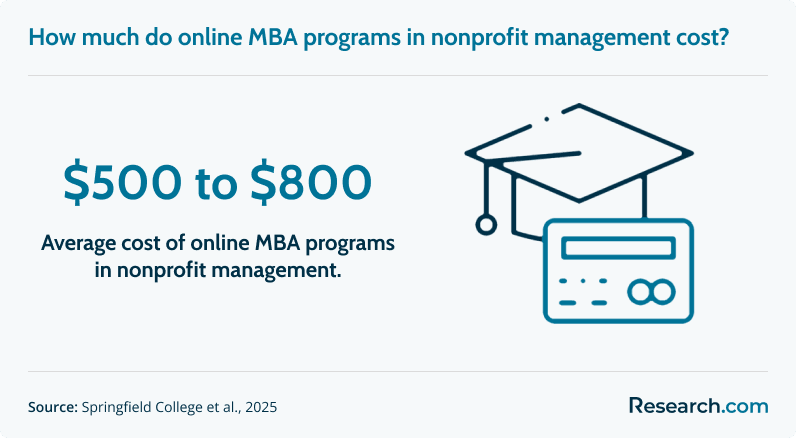
Most programs charge between $500 and $800 per credit hour, while the programs listed in this guide include tuition figures ranging from Estimated $654 per 3-credit course (~$218 per credit) to $1,440 per credit. Because most programs require 30 to 36 credits, small differences in per-credit cost can significantly change the total bill.
| Cost factor | Why it matters | What to ask before enrolling |
| Per-credit tuition | This is the biggest driver of total program cost. | Is the listed rate the same for online, out-of-state, and graduate students? |
| Total credits | A 30-credit program may cost less than a 36-credit program if tuition rates are similar. | Are foundation, prerequisite, or internship credits included in the published total? |
| Fees | Technology, graduation, course materials, and student service fees can add to the final price. | What is the full estimated cost of attendance, not just tuition? |
| Program length | Finishing faster may reduce time away from advancement opportunities, but it can also increase short-term workload. | Can I afford both the financial and time commitment of an accelerated schedule? |
| Scholarships and employer support | A higher sticker price may be offset by aid or reimbursement. | What institutional aid, nonprofit scholarships, or employer tuition benefits are available? |
The same cost logic applies to other accelerated MBA options, including a fast-track MBA in environmental management online, where credit requirements, tuition, and pacing strongly affect value. Students comparing advanced business credentials may also research the cheapest DBA online, although a DBA is usually more research-oriented and executive-focused than an MBA.
What are the financial aid options for students enrolling in an online MBA program in nonprofit management?
Online MBA students in nonprofit management may be able to use federal loans, institutional scholarships, employer reimbursement, private awards, service-based benefits, and loan forgiveness programs. The right mix depends on your employment status, school, citizenship status, credit load, and long-term career plans.
- Federal student aid: Complete the FAFSA (Free Application for Federal Student Aid) to determine eligibility for federal aid. Graduate students are not eligible for Pell Grants, but many use federal unsubsidized loans.
- School scholarships and fellowships: Many universities offer awards for MBA students, public service leaders, nonprofit employees, or students with strong academic or professional backgrounds.
- Employer tuition assistance: Some nonprofit, government, education, and private employers help pay for graduate study. Certain organizations offer up to $5,250 in annual tuition reimbursement as a tax-free benefit.
- Private scholarships and service awards: Students committed to public service may explore awards connected to organizations such as the Truman Scholarship Foundation, AmeriCorps Education Award, and Nonprofit Leadership Alliance.
- Public Service Loan Forgiveness: Graduates who work for qualifying public service or nonprofit employers may be eligible for Public Service Loan Forgiveness (PSLF) after 120 qualifying payments on eligible federal loans.
What are the prerequisites for enrolling in an online MBA program in nonprofit management?
Admissions requirements vary, but most online MBA programs in nonprofit management expect applicants to have an accredited bachelor’s degree, academic readiness for graduate business coursework, and application materials showing leadership potential or interest in mission-driven work.
| Requirement | What schools commonly expect | How to prepare |
| Bachelor’s degree | An accredited undergraduate degree in any field. | Request transcripts early and confirm whether international credentials need evaluation. |
| Minimum GPA | Many programs look for a 2.75 to 3.0 GPA. | If your GPA is lower, highlight work experience, leadership, recommendations, and recent coursework. |
| Work experience | Some programs prefer 1–3 years in business, nonprofit, public service, education, or leadership roles. | Use your resume to show supervision, budgeting, project management, service, or volunteer leadership. |
| Business prerequisites | Applicants without accounting, economics, or statistics may need foundation courses. | Ask whether prerequisites can be waived, taken concurrently, or completed at lower cost. |
| Recommendations and statement | Schools often want evidence of motivation, professionalism, and fit. | Choose recommenders who can speak to leadership, judgment, and mission commitment. |
| GMAT or GRE | Many online MBA programs waive test scores, though some still request them. | Confirm test policy before applying, especially if you want the fastest admissions path. |
If you are not yet ready for graduate school, earning the most affordable online bachelor’s in management may be a practical first step. A low-cost management degree can build business fundamentals while helping you control the total cost of your education pathway.
The chart below illustrates the trends in the interest of post-graduate management education (GME) students in working in the nonprofit and government industry, as reported by the GMAC in 2025.
What courses are typically in an online MBA program in nonprofit management?
An online MBA in nonprofit management blends general MBA coursework with nonprofit leadership training. The goal is to help students understand both business operations and the unique accountability, funding, governance, and mission challenges of nonprofit organizations. Like a fast-track master's in supply chain management online, the format is often designed for motivated professionals who want advanced skills without a long campus-based schedule.
| Course area | What you learn | Why it matters in nonprofit leadership |
| Accounting for Managers | How to interpret financial statements, budgets, and reports. | Leaders need to explain financial health to boards, funders, and staff. |
| Managerial Economics | How economic conditions affect resource allocation and decision-making. | Nonprofits often make difficult trade-offs with limited funding. |
| Organizational Behavior | How teams, motivation, culture, and leadership affect performance. | Mission-driven organizations depend heavily on people management and collaboration. |
| Strategic Management | How to set goals, analyze challenges, and build long-term plans. | Executives must align programs, funding, staffing, and community impact. |
| Business Ethics | How to address ethical issues in leadership, finance, and fundraising. | Public trust is central to nonprofit credibility. |
| Fundraising and Development | Donor relations, campaign strategy, grant writing, and gift planning. | Revenue generation is essential for program sustainability. |
| Nonprofit Financial Management | Budgeting, cost control, compliance, and reporting for tax-exempt organizations. | Leaders must manage restricted funds and demonstrate accountability. |
| Board Governance and Leadership | Board roles, executive relationships, oversight, and governance practices. | Strong board management supports strategy, fundraising, and risk control. |
| Program Evaluation and Impact Assessment | How to measure outcomes and use data for improvement. | Funders increasingly expect evidence of impact. |
| Capstone Project | Application of MBA concepts to a real or simulated organizational problem. | Students can build a practical work sample for career advancement. |
What types of specializations are available in an online MBA program in nonprofit management?
Some online MBA programs offer a nonprofit management concentration, while others allow students to customize electives around a particular mission area. Choosing a specialization should depend on the type of organization you want to lead and the skills you need most.
- Nonprofit Leadership: Best for students aiming for executive director, chief operating officer, or senior program leadership roles. Coursework usually emphasizes strategy, ethics, governance, and staff leadership.
- Healthcare Administration: Useful for students working in hospitals, public health nonprofits, behavioral health agencies, or community care organizations. It can also complement early research into social worker requirements and broader care systems.
- Fundraising and Development: Strong fit for students who want to lead donor relations, grant strategy, major gifts, annual campaigns, or advancement teams.
- Public Administration: Appropriate for students interested in policy, government partnerships, budgeting, public programs, or civic leadership. A fast-track public administration master's degree online may also be worth comparing if your goals are more government-centered than business-centered.
- Social Entrepreneurship: Designed for students who want to launch or grow mission-driven ventures that use business tools to address social problems.
- Project Management: Valuable for leaders managing events, community initiatives, implementation plans, grants, or cross-functional nonprofit projects.
- International Development: Relevant for students interested in humanitarian aid, NGOs, cross-border partnerships, and global nonprofit operations.
What is the return on investment for an online MBA in nonprofit management?
The return on investment for an online MBA in nonprofit management depends on the total cost of the degree, the time it takes to finish, the salary increase or promotion it helps you pursue, and the value of the network and career support you gain. Because nonprofit salaries vary widely, students should calculate ROI conservatively rather than assuming an MBA will automatically lead to a six-figure role.
A fast program may improve ROI by reducing opportunity cost, especially if you can finish in 12 to 18 months and move into a higher-level role sooner. However, speed only helps if the program is accredited, affordable, manageable, and aligned with your goals. Students who want to keep debt low should compare tuition carefully and may also review MBA online affordable options before making a final decision.
| ROI factor | Why it matters | How to evaluate it |
| Total program cost | Debt can reduce the financial benefit of a promotion. | Compare full tuition, fees, books, and interest if borrowing. |
| Completion time | Shorter programs may help you apply for advancement sooner. | Ask whether the advertised timeline is realistic for working adults. |
| Career goal | ROI differs for development, operations, program, policy, and executive roles. | Match coursework to the job family you want next. |
| Employer support | Tuition reimbursement can dramatically reduce out-of-pocket cost. | Confirm reimbursement rules before enrolling. |
| Network and placement support | Career connections can matter as much as the credential. | Ask for examples of nonprofit partnerships, internships, and alumni outcomes. |
How can you verify accreditation and long-term outcomes for an online MBA in nonprofit management?
Start by confirming institutional accreditation and, when available, business-specific accreditation. Business accreditors such as AACSB, ACBSP, or IACBE can signal that a program follows recognized standards for curriculum quality, faculty qualifications, assessment, and continuous improvement. Students should also review institutional accreditation because it affects federal financial aid eligibility and transferability.
Accreditation alone is not enough. Ask schools for career outcomes, graduation rates, student support details, alumni advancement examples, employer partnerships, and information about how often the curriculum is updated. If a program advertises speed but cannot explain student outcomes, advising, or career support, be cautious. For comparison, students reviewing other accelerated professional programs may look at quality benchmarks similar to those discussed in the fastest construction management degree guide.
What networking and career support services enhance an online MBA in nonprofit management?
Career support is especially important in online MBA programs because students may not have the same informal access to campus events and local recruiting. Strong programs create structured ways for online learners to meet faculty, alumni, nonprofit executives, mentors, and classmates.
- Dedicated graduate career advising: Helps students target executive director, development, operations, program management, finance, or advocacy roles.
- Virtual networking events: Connects students with alumni, nonprofit leaders, and peers across regions.
- Internships or applied projects: Gives students practical experience and work samples, especially useful for career changers.
- Mentoring: Matches students with experienced professionals who can explain hiring expectations and leadership realities.
- Resume and interview support: Helps students translate nonprofit service, volunteer work, and program experience into management language.
- Employer or community partnerships: Can support capstone projects, internships, consulting assignments, or job leads.
Students who want a broader view of strong online MBA features can compare formats, support systems, and program structures across MBA degree programs online.
How to choose the best and fastest online MBA program in nonprofit management?
To choose the best fast online MBA in nonprofit management, look beyond the advertised completion time. A 12-month program can be a smart choice if you can handle the workload and the curriculum fits your goals. It can be a poor choice if it forces you to rush, borrow more than necessary, or sacrifice the nonprofit training you actually need.
Step-by-step checklist for comparing programs
- Confirm accreditation. Verify institutional accreditation and review business accreditation. If you are comparing IACBE vs AACSB, remember that AACSB is often associated with research-intensive business schools, while IACBE emphasizes outcomes and teaching quality.
- Calculate the real total cost. Include tuition, fees, books, technology costs, travel for residencies, and loan interest if applicable.
- Check the actual schedule. Ask how many courses students take at once, how long each term lasts, and whether courses are asynchronous, synchronous, or hybrid.
- Review nonprofit-specific coursework. Look for fundraising, grant writing, governance, nonprofit finance, program evaluation, and ethics.
- Ask about applied learning. Capstones, consulting projects, internships, or field-based assignments can help you demonstrate practical leadership ability.
- Evaluate student support. Fast programs require strong advising, responsive faculty, technology support, tutoring, and career services.
- Compare career alignment. Choose a program that matches your intended role, whether that is executive leadership, development, healthcare nonprofit management, operations, policy, or social entrepreneurship.
Professionals comparing multiple industries may also look at the fastest online real estate degree programs to understand how program length, specialization, and career outcomes differ across business-related fields.
Common mistakes to avoid
| Mistake | Why it can hurt you | Better approach |
| Choosing the shortest program without checking fit | A very fast format can become overwhelming if you work full time or have limited study hours. | Ask for a sample weekly workload and course calendar. |
| Looking only at tuition per credit | Fees, extra courses, and residency costs can change the true price. | Request the full estimated cost of attendance. |
| Ignoring accreditation | Unaccredited or weakly accredited programs may limit aid eligibility, transfer options, or employer confidence. | Verify institutional and business accreditation before applying. |
| Assuming all online MBAs are identical | Some programs have deep nonprofit content, while others offer only one or two related electives. | Compare course descriptions and faculty expertise. |
| Relying only on rankings | A ranked program may still be too expensive, too rigid, or poorly matched to your goals. | Use rankings as one data point, not the whole decision. |
| Not asking about career outcomes | You may miss whether graduates actually move into relevant nonprofit leadership roles. | Ask for alumni roles, employer partnerships, and career support examples. |
What career paths are available for graduates of an online MBA program in nonprofit management?
Graduates of online MBA programs in nonprofit management can pursue leadership roles in charities, foundations, healthcare organizations, schools, advocacy groups, social service agencies, cultural institutions, and public service organizations. The best career path depends on your previous experience and the functional skills you build during the program.
| Career path | Main responsibilities | Strong preparation areas |
| Executive Director or CEO | Set strategy, oversee senior staff, manage board relationships, guide fundraising, and represent the organization. | Governance, finance, strategic planning, leadership, fundraising |
| Development Director | Lead fundraising campaigns, donor relations, grant strategies, and revenue planning. | Fundraising, communications, analytics, relationship management |
| Program Manager | Manage services, staff, budgets, timelines, and program outcomes. | Program evaluation, budgeting, operations, people management |
| Director of Operations | Improve internal systems across HR, finance, technology, compliance, and administration. | Operations, organizational behavior, finance, project management |
| Grants Manager | Find funding opportunities, write proposals, track awards, and manage reporting requirements. | Grant writing, nonprofit finance, compliance, evaluation |
| Marketing and Communications Manager | Build public awareness, manage campaigns, shape messaging, and support donor engagement. | Marketing, communications, branding, digital strategy |
| Financial Manager or Controller | Oversee budgeting, reporting, forecasting, and financial accountability. | Accounting, financial management, compliance, analytics |
| Policy Analyst or Advocacy Director | Research policy issues, develop advocacy strategy, and influence public decision-making. | Public administration, research, communications, stakeholder management |
Students interested in disaster relief, crisis response, or public safety nonprofits may also combine business leadership training with an accelerated online master's degree in emergency management to prepare for roles involving emergency planning, response coordination, and humanitarian operations.
The chart below lists the most common educational attainment of nonprofit managers in the US, as published by Zippia in 2025.
What is the job market for graduates with an online MBA program in nonprofit management?
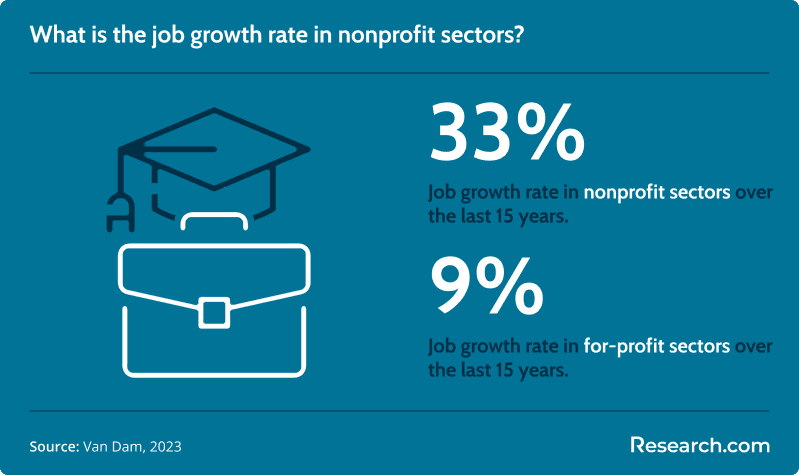
The nonprofit job market continues to offer opportunities for professionals who can combine mission commitment with management skill. Nonprofit employment has grown by 33% over the past 15 years, compared to 9% growth in the for-profit sector. That growth does not mean every role is easy to obtain, but it does show sustained demand for organizations that serve healthcare, education, housing, community development, advocacy, and social service needs.
Students who want a nonprofit-specific graduate degree but are not sure they need an MBA may compare this option with a fast-track master's in nonprofit management online. A master’s in nonprofit management may go deeper into mission-based administration, while an MBA usually provides broader business training that can transfer across sectors.
The outlook is particularly relevant for social and community service management roles. Employment of social and community service managers is projected to grow 8% from 2023 to 2033, which is faster than the average for all occupations. These roles commonly involve managing staff, budgets, programs, community partnerships, and outcomes, making them closely aligned with nonprofit MBA training.
Current trends affecting nonprofit management careers
- Demand for measurable impact: Funders and boards increasingly expect leaders to demonstrate outcomes through data, evaluation, and reporting.
- Complex funding environments: Nonprofit leaders must combine grants, donations, contracts, earned revenue, and partnerships while managing restrictions and compliance.
- Technology and AI adoption: Organizations are using digital tools for donor management, communications, reporting, volunteer coordination, and program operations. Leaders need enough technical fluency to evaluate tools responsibly.
- Workforce pressure: Nonprofits often operate with limited staffing and high service demand, making leadership, retention, and operational efficiency critical.
- Cross-sector collaboration: Many social problems require partnerships among nonprofits, government agencies, schools, healthcare providers, and private funders.
Questions to ask before enrolling
- Is the school institutionally accredited, and does the business program hold AACSB, ACBSP, or IACBE accreditation?
- Can the program truly be completed in 12 to 18 months by someone with my work schedule?
- How many nonprofit-specific courses are required, and what are their titles?
- Does the program include fundraising, nonprofit finance, governance, and program evaluation?
- What is the full cost, including fees and any required residencies?
- Are GMAT or GRE scores required, waived, or optional?
- What career services are available to online students?
- Can I use employer tuition assistance, scholarships, federal loans, or PSLF-eligible employment after graduation?
- What jobs have recent graduates accepted, and in what types of organizations?
- Will I complete a capstone, internship, consulting project, or other applied experience?
Key Insights
- The fastest online MBA programs in nonprofit management can be completed in 12 to 18 months, but the shortest program is only worthwhile if the workload, cost, accreditation, and curriculum fit your goals.
- Most programs require 30 to 36 credits and combine core MBA coursework with nonprofit-focused subjects such as fundraising, governance, nonprofit finance, ethics, grant writing, and program evaluation.
- Published program costs vary widely, with examples in this guide ranging from Estimated $654 per 3-credit course (~$218 per credit) to $1,440 per credit.
- Nonprofit career outcomes depend heavily on role and employer type. Social and community service managers earn a median annual salary of $78,240, while local government managers excluding hospitals and schools earn a median annual salary of $101,620.
- Healthcare and social assistance dominate nonprofit employment, accounting for 66.3% of nonprofit jobs and more than 8 million jobs.
- The nonprofit sector has shown strong employment growth, with nonprofit jobs increasing 33% over the past 15 years compared with 9% in the for-profit sector.
- Employment of social and community service managers is projected to grow 8% from 2023 to 2033, supporting demand for leaders who can manage programs, budgets, teams, and outcomes.
- Before enrolling, verify accreditation, total cost, completion timeline, support services, alumni outcomes, and whether the curriculum includes the nonprofit leadership skills required for your intended career path.
References:
- Bureau of Labor Statistics (BLS). (2025a). Nonprofit organizations: state and regional employment trends. Monthly Labor Review. BLS.
- Bureau of Labor Statistics (BLS). (2025b). Social and Community Service Managers. Occupational Outlook Handbook. BLS.
- Graduate Management Admission Council (GMAC). (2025a). Demand for Graduate Business Degrees. Prospective Students Survey 2025 Data Report. GMAC.
- Graduate Management Admission Council (GMAC). (2025b). Post-GME Career Aspirations. Prospective Students Survey 2025 Data Report. GMAC.
- Van Dam, A. (2023). The real reason America’s nonprofit sector is seeing massive growth, and more!. Department of Data. The Washington Post.
- Zippia. (2025). Nonprofit Manager Education Requirements. Zippia.
Other Things You Should Know About the Fastest Online MBA Programs in Nonprofit Management
For 2027, top institutions offering expedited online MBA programs in Nonprofit Management include the University of Southern California, Syracuse University, and Northeastern University. These programs are recognized for their accelerated formats, allowing students to graduate quicker while preparing for leadership roles in nonprofit sectors.
Admissions requirements for the fastest online MBA programs in Nonprofit Management often include a bachelor's degree, a minimum GPA, and relevant work experience. Some programs may also require GMAT or GRE scores, though many are waiving these in 2027 to encourage broader applications.
Many accelerated online MBA programs in nonprofit management require a supervised practicum or capstone instead of a traditional internship. Commonly, students complete 3 to 6 credits and submit a project tied to nonprofit budgeting, fundraising, or board governance, often with an approved organization and faculty review.


