2027 Cybersecurity Careers Most Resilient to AI and Automation

Co-Founder and Chief Data Scientist
Choosing a cybersecurity career now means asking a harder question: Which roles will still need human judgment as AI tools automate routine monitoring, scanning, and reporting? CyberSeek's 2024 U.S. labor market data showed more than 450,000 cybersecurity job openings, signaling strong demand but also rising expectations.
This guide is for students, career changers, and IT professionals who want durable roles, smarter education choices, and realistic salary context. You will learn which paths are most resilient, what skills matter, and how to choose a program that supports long-term mobility.
Key Things You Should Know
- The most AI-resilient cybersecurity careers combine technical depth with judgment-heavy work, including security architecture, cloud security, incident response, governance, threat intelligence, and application security.
- The U.S. Bureau of Labor Statistics projects information security analyst employment to grow 33% from 2023 to 2033, much faster than average, but the strongest opportunities usually require hands-on security skills beyond entry-level tool use.
- A future-proof path usually blends an accredited degree or structured technical training, practical labs, certifications such as Security+, CISSP, or cloud security credentials, and experience translating cyber risk into business decisions.
Which cybersecurity careers are most resilient to AI and automation risks?
The cybersecurity careers most resilient to AI and automation are the ones where professionals make high-stakes decisions under uncertainty. AI can speed up log review, malware triage, vulnerability detection, and policy drafting, but it still struggles with context. Deciding whether an alert matters to a specific business, how to contain an incident without stopping operations, or how to design controls for a regulated environment.
As a rule, roles are more resilient when they require cross-functional communication, adversarial thinking, architecture decisions, legal or regulatory interpretation, and accountability for business risk. Roles built mainly around repetitive ticket handling or basic tool operation are more exposed to automation unless they evolve toward analysis, engineering, or leadership.
The table below compares common cybersecurity career paths by automation exposure and long-term durability. Use it to identify roles that match your current skills and the level of education or experience you are willing to build.
| Career path | Why it is resilient | Typical responsibilities | Best fit |
| Security architect | Requires system design, risk trade-offs, and business context | Designing secure networks, cloud environments, identity systems, and enterprise controls | Experienced IT or cybersecurity professionals who like strategy and engineering |
| Incident response lead | Requires fast judgment, coordination, and crisis communication | Leading breach containment, forensic scoping, executive updates, and recovery planning | People who can stay calm under pressure and communicate clearly |
| Cloud security engineer | Requires platform-specific engineering and secure deployment decisions | Securing AWS, Azure, or Google Cloud environments, identity permissions, containers, and pipelines | IT, DevOps, or networking professionals moving into security |
| Governance, risk, and compliance specialist | Requires interpretation of regulations, audits, evidence, and business priorities | Managing risk assessments, control frameworks, vendor reviews, and compliance documentation | Professionals with analytical, legal, business, or audit strengths |
| Application security engineer | Requires secure coding judgment and collaboration with developers | Threat modeling, code review, secure SDLC design, and vulnerability remediation | Software developers or students with programming interest |
| Threat intelligence analyst | Requires interpreting attacker behavior and organizational relevance | Tracking threat actors, analyzing campaigns, and advising security teams | Researchers, analysts, and strong writers with technical curiosity |
The practical takeaway is simple: Do not aim only to "work in cybersecurity." Aim for a role where you can own decisions, explain risk, and improve systems. Those responsibilities are harder to automate than running a scan or closing routine alerts.
What skills make cybersecurity professionals harder to replace by AI and automation?
Cybersecurity professionals become harder to replace when they can use AI as a force multiplier rather than compete with it. Employers increasingly value people who can validate AI-generated findings, investigate ambiguous signals, and decide what action is appropriate for a specific organization.
The following skill groups are especially important because they combine technical execution with human judgment. They also help entry-level workers move beyond roles that are most likely to be reshaped by automation:
- Risk-based decision-making: The ability to rank threats by business impact, not just technical severity, helps teams avoid wasting time on low-priority alerts.
- Cloud and identity security: Modern breaches often involve misconfigured permissions, exposed cloud services, or weak identity controls, so platform knowledge is increasingly valuable.
- Incident communication: During a cyber event, organizations need professionals who can brief executives, coordinate legal and IT teams, and document defensible decisions.
- Secure automation: Knowing how to use scripting, security orchestration, and AI-assisted workflows makes a professional more productive instead of more replaceable.
- Adversarial thinking: Attackers adapt quickly, so resilient professionals understand how systems fail, how users behave, and how criminals chain weaknesses together.
- Data interpretation: Security teams need people who can separate meaningful signals from noisy dashboards and explain what evidence supports a conclusion.
Students who want to deepen the AI side of this skill set may also compare cybersecurity coursework with an applied artificial intelligence degree, especially if they are interested in AI security, model risk, or automated threat detection. The best choice depends on whether you want to defend systems broadly or specialize in building and governing AI-driven tools.
What education or degree is recommended for long-term cybersecurity career stability?
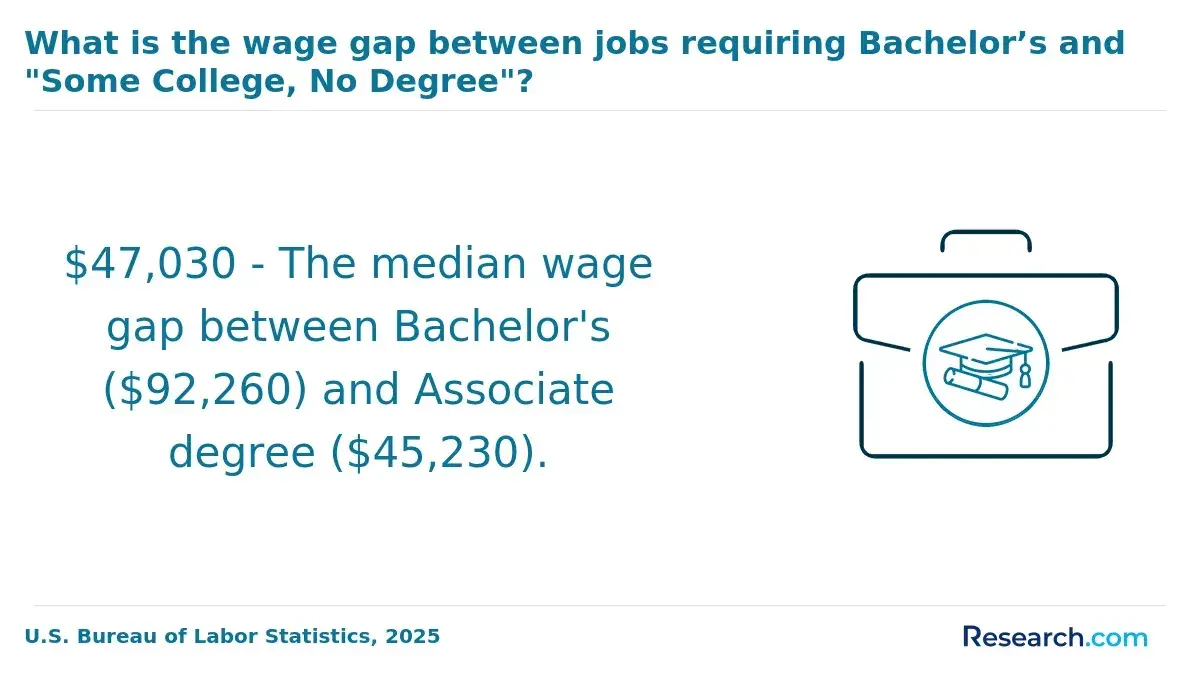
For long-term cybersecurity stability, the most practical education path is usually a bachelor's degree in cybersecurity, computer science, information technology, computer engineering, or information systems, combined with labs, internships, projects, and certifications. A degree is not the only path into cybersecurity, but it can make advancement easier in roles involving architecture, management, compliance, or government contracting.
The BLS reported a 2023 median annual wage of $120,360 for information security analysts in data published through its current occupational outlook materials. That figure should not be read as an entry-level promise, but it does show why many students treat cybersecurity education as a long-term career investment rather than a short course.
The table below summarizes common education options and when each makes sense. This comparison is useful because the "best" credential depends on your background, budget, and target role.
| Education option | Typical fit | Strengths | Limitations |
| Cybersecurity certificate or bootcamp | Career changers testing the field or IT workers filling skill gaps | Shorter timeline, focused labs, lower commitment than a degree | May not satisfy degree preferences for advanced or government roles |
| Associate degree | Students seeking an affordable start or transfer pathway | Can build networking, systems, and security foundations | May need a bachelor's degree for higher-level advancement |
| Bachelor's degree | New students and professionals seeking broad career mobility | Strong foundation for analyst, engineering, GRC, and management tracks | Higher cost and longer timeline than certificates |
| Master's degree | Professionals targeting leadership, architecture, research, or specialized technical roles | Can support specialization in cloud security, policy, digital forensics, or AI security | Best value when tied to clear career goals |
| Doctoral degree | Professionals interested in research, academia, advanced analytics, or senior technical strategy | Supports original research and deep analytical expertise | Usually unnecessary for most operational cybersecurity jobs |
Advanced learners who want to focus on security analytics, AI-enabled risk modeling, or cyber research may also explore a doctorate in data analytics online. That route is best for research-heavy or executive analytics goals, not for someone who simply wants an entry-level security analyst role.
How do online and campus-based cybersecurity programs compare for future-proof careers?
Online and campus-based cybersecurity programs can both prepare students for durable careers if they include rigorous technical practice, qualified faculty, recognized accreditation, and employer-relevant projects. The format matters less than whether the program builds real capability in networking, operating systems, cloud platforms, risk management, incident response, and secure development.
According to the National Center for Education Statistics' 2024 Digest data, distance education remains a major part of U.S. higher education after its pandemic-era expansion. For cybersecurity students, that matters because many working adults now expect flexible options, but flexibility should not come at the expense of labs, mentorship, or career support.
The table below compares online and campus-based options through a career-resilience lens. Use it to decide which format fits your learning style and constraints.
| Factor | Online cybersecurity program | Campus-based cybersecurity program |
| Best for | Working adults, military students, parents, and self-directed learners | Students who want face-to-face structure, labs, and campus recruiting |
| Hands-on learning | Strong if the program includes virtual labs, cloud sandboxes, and cyber ranges | Strong if the school maintains physical labs and supervised technical projects |
| Networking | Depends on live sessions, cohort design, faculty access, and employer events | Often easier through clubs, career fairs, and local employer relationships |
| Cost considerations | May reduce relocation and commuting costs, though tuition varies widely | May include housing, transportation, and campus fees |
| Risk to watch | Choosing a program with limited interaction or weak lab requirements | Paying more for location without stronger outcomes or support |
Choose online if you need flexibility and can stay disciplined. Choose campus-based study if you benefit from direct structure, local networking, and in-person support. In either case, ask to see sample lab environments, internship support, and recent career outcomes before enrolling.
Which cybersecurity specializations offer the strongest job security and growth prospects?
The strongest cybersecurity specializations for job security and growth are tied to areas where organizations face rising risk, complex regulation, or rapid technology change. These include cloud security, identity and access management, application security, incident response, governance and compliance, digital forensics, security architecture, and AI security.
A useful way to compare specializations is to ask whether the work is reactive, preventive, strategic, or compliance-driven. The most resilient professionals often combine more than one category, such as cloud security plus incident response, or GRC plus technical risk assessment.
The table below summarizes high-value specializations and the type of learner or professional each may suit. It can help you avoid choosing a niche only because it sounds trendy.
| Specialization | Why demand is durable | Good preparation path |
| Cloud security | Organizations continue moving infrastructure, data, and applications into cloud environments | Networking, Linux, cloud platforms, identity, scripting, and cloud security labs |
| Identity and access management | Compromised credentials remain central to many attacks | Directory services, zero trust concepts, privileged access, and governance workflows |
| Application security | Software vulnerabilities create business, privacy, and operational risk | Programming, secure coding, threat modeling, and DevSecOps tools |
| Incident response and forensics | Organizations need human-led investigation when attacks disrupt operations | Operating systems, logs, malware basics, evidence handling, and communication practice |
| GRC and cyber risk | Boards, insurers, regulators, and customers increasingly expect documented controls | Risk frameworks, audit evidence, policy writing, and business communication |
| AI security | AI systems introduce new risks around data leakage, model misuse, and automated attacks | Machine learning basics, data governance, secure development, and adversarial testing |
Some students also connect cybersecurity with fintech, smart contracts, and distributed systems. If that direction interests you, a blockchain masters degree can be relevant when paired with security coursework in cryptography, secure software design, fraud prevention, and financial risk controls.
What accredited cybersecurity programs best prepare students for evolving AI threats?
The best accredited cybersecurity programs for evolving AI threats are not defined by a single school name or ranking. They are programs that combine institutional accreditation, strong computing fundamentals, hands-on security labs, ethical and legal training, and coursework that addresses automation, data security, cloud systems, and adversarial AI.
Accreditation matters because it affects transfer credit, federal financial aid eligibility, graduate admissions, and employer confidence. Program-level signals can also help. For example, some schools are designated by the National Security Agency as Centers of Academic Excellence in Cybersecurity, which can indicate alignment with recognized cybersecurity education standards.
Before you compare schools, look for evidence that the curriculum is keeping up with AI-shaped threats. Strong programs usually include the following features:
- Institutional accreditation: Confirm that the college or university is accredited by an agency recognized by the U.S. Department of Education or the Council for Higher Education Accreditation.
- Hands-on labs: Look for cyber ranges, virtual machines, cloud labs, packet analysis, secure coding exercises, and incident simulations.
- AI-aware coursework: Favor programs that discuss AI-enabled phishing, automated vulnerability discovery, data poisoning, model privacy, and secure use of generative AI tools.
- Faculty with current experience: Review whether instructors publish, consult, maintain certifications, or have industry security backgrounds.
- Career support: Ask about internships, employer partnerships, security clubs, capture-the-flag teams, and alumni outcomes.
- Ethics and governance: Make sure the program covers privacy, compliance, responsible disclosure, and legal boundaries for security testing.
A common mistake is choosing the most technical-looking program without checking whether credits transfer, labs are current, or career services understand cybersecurity hiring. A future-proof program should prepare you to adapt, not just memorize today's tools.
How do certifications like CISSP, CEH, or Security+ impact career resilience?
Certifications can improve cybersecurity career resilience when they validate skills employers already need. They are most valuable when paired with hands-on practice, a degree or equivalent foundation, and work experience. They are less valuable when treated as shortcuts to senior roles.
Certifications also help professionals signal specialization as automation changes job descriptions. For example, if AI reduces some routine security operations center tasks, credentials in cloud security, incident response, auditing, or architecture can support movement into higher-judgment roles.
The table below explains how common certifications fit into a resilient career plan. Requirements and employer preferences vary, so always compare certifications against job postings in your target region and industry.
| Certification | Career stage | How it supports resilience | Important limitation |
| CompTIA Security+ | Entry level or early career | Validates broad security fundamentals and helps with analyst, technician, and junior security roles | Usually not enough by itself for specialized engineering roles |
| Certified Ethical Hacker | Early to mid-career | Signals familiarity with offensive security concepts, testing methods, and attacker techniques | Employers may prefer practical pentesting portfolios or advanced offensive credentials for red-team roles |
| CISSP | Mid-career to senior | Supports security management, architecture, governance, and leadership pathways | Requires experience and is not designed as an entry-level credential |
| Cloud security certifications | Early to senior, depending on credential | Help validate ability to secure modern infrastructure and identity systems | Need ongoing renewal because cloud platforms change quickly |
| GIAC or specialized incident response certifications | Mid-career specialist | Can strengthen credibility in forensics, malware analysis, detection, or response | Often costly, so ROI should be tied to a specific role or employer need |
The smartest sequence for many beginners is to build IT fundamentals first, then earn Security+, then specialize based on evidence from job postings and projects. Chasing too many certifications without experience can dilute your focus and increase costs without improving readiness.
What salary ranges can AI-resilient cybersecurity professionals expect in the U.S.?
AI-resilient cybersecurity professionals can expect wide salary variation in the U.S. based on role, region, industry, clearance requirements, education, certifications, and experience. Salaries are usually higher in specialized engineering, architecture, cloud security, and leadership roles than in entry-level support or basic monitoring positions.
The most reliable broad benchmark is the BLS information security analyst category, which reported a 2023 median annual wage of $120,360 in its current occupational data. This category does not capture every cyber role, and it should not be used as a guaranteed starting salary, but it gives a credible midpoint for established professionals in the field.
The table below provides practical salary context by career level rather than promising exact outcomes. Use it to estimate progression and identify which roles may require additional education or specialization.
| Career level | Common roles | Typical salary context | What usually improves earnings |
| Entry level | Security analyst, SOC analyst, IT security technician, junior GRC analyst | Often below the BLS median because these roles require supervision and foundational experience | Networking skills, scripting, labs, Security+, internships, and clear incident documentation |
| Mid-career | Cloud security engineer, incident responder, application security analyst, cyber risk specialist | Can approach or exceed the BLS median when the role requires specialized technical judgment | Cloud platforms, threat hunting, secure coding, CISSP or specialized credentials, and measurable projects |
| Senior level | Security architect, security manager, principal engineer, senior incident response lead | Often above the broad analyst median in high-demand industries or high-cost regions | Architecture ownership, leadership, regulatory knowledge, business communication, and incident leadership |
| Executive or expert | CISO, director of security, principal security strategist, senior consultant | Highly variable and often tied to industry, company size, and risk exposure | Business strategy, board communication, budget ownership, crisis leadership, and governance expertise |
When evaluating salary potential, compare local job postings rather than relying only on national averages. Also look at total compensation, remote-work policies, clearance premiums, on-call expectations, and whether the role builds skills that remain valuable as AI tools improve.
How can mid-career professionals transition into more automation-proof cybersecurity roles?
Mid-career professionals can transition into more automation-proof cybersecurity roles by building on their existing domain knowledge rather than starting from zero. IT support workers may move toward cloud or identity security, software developers may move into application security, auditors may move into GRC, and military or operations professionals may move into incident response or risk management.
The transition should be deliberate because cybersecurity hiring is skills-based but not random. Employers want evidence that you can solve realistic problems, document your reasoning, and work within legal and operational constraints.
The following sequence can help career changers move toward resilient roles without wasting time on scattered training:
- Map your current strengths to a cybersecurity track, such as cloud security for systems administrators, application security for developers, or GRC for audit and compliance professionals.
- Fill foundational gaps in networking, Linux, Windows administration, identity, scripting, and security principles before attempting advanced specialties.
- Build a small portfolio with lab reports, cloud hardening projects, threat models, incident write-ups, or policy-to-control mapping examples.
- Earn one credential that matches your target role instead of collecting unrelated certifications.
- Apply for bridge roles such as security analyst, IAM analyst, cloud support security associate, vulnerability management analyst, or IT risk analyst.
- Use AI tools carefully for practice and productivity, but always verify outputs and document your own reasoning.
A major mistake is assuming a short course will erase the need for practical experience. Another is ignoring adjacent paths that may fit your life better. For example, someone comparing flexible online career training across fields might also review best online medical billing and coding schools if they want a healthcare administrative technology route rather than a high-pressure security operations path.
What criteria should students use to choose a future-proof cybersecurity degree program?
Students should choose a future-proof cybersecurity degree program by looking beyond rankings and marketing language. The right program should match your target role, budget, schedule, learning style, and need for practical experience. It should also prepare you for the reality that tools will change, while fundamentals, judgment, and communication remain valuable.
Use the criteria below when comparing programs. These questions help reveal whether a degree is likely to build durable capability or simply provide a credential.
- Accreditation: Is the institution properly accredited, and will credits transfer if your plans change?
- Curriculum depth: Does the program cover networking, operating systems, cloud security, secure coding, risk, privacy, and incident response?
- Hands-on requirements: Are labs required in multiple courses, and do students work in realistic environments rather than only reading case studies?
- AI and automation coverage: Does the curriculum address AI-enabled threats, secure automation, data governance, and responsible use of security tools?
- Faculty access: Can students interact with instructors who understand current cybersecurity practice?
- Career outcomes: Does the school provide transparent information about internships, employer connections, job support, and alumni pathways?
- Total cost: Have you compared tuition, fees, books, equipment, exam vouchers, travel, and time away from work?
- Credit policies: Does the school accept transfer credits, military credits, prior learning, or industry certifications?
- Program fit: Is the format realistic for your schedule, and does it support your preferred specialization?
The most important red flag is a program that promises fast, high-paying cybersecurity outcomes without showing the curriculum, lab structure, accreditation, or career support behind those claims. A strong program should make its requirements and outcomes easy to verify.
Other Things You Should Know About Cybersecurity Degrees
Yes, for people willing to build technical and analytical depth. AI can detect patterns and speed up investigations, but organizations still need humans to validate findings, set priorities, communicate risk, and make decisions during incidents.
Yes. Many professionals enter through IT support, networking, military experience, compliance, software development, or focused training. However, you still need proof of skills through labs, projects, certifications, internships, or related work experience.
The time to become job-ready in cybersecurity varies. Generally, a bachelor’s degree takes about four years, but many programs offer shorter boot camps. Certifications like CompTIA Security+ can be obtained in a few months, helping to fast-track entry into the field.
References
- Will AI Replace Cybersecurity Professionals? - TCM Security https://tcm-sec.com/will-ai-replace-cybersecurity-professionals/
- 20 Coolest Cybersecurity Careers and Jobs | SANS Institute https://www.sans.org/cybersecurity-focus-areas/cybersecurity-careers/20-coolest-cyber-security-careers
- Navigating Mid-Career Shifts in Cybersecurity https://ine.com/blog/navigating-mid-career-shifts-in-cybersecurity
- Cybersecurity Degree: Your Guide to Top Online and On-Campus Programs https://alnafi.com/blog/cybersecurity-degree
- Cyber Security Salary: 7 Highest-Paid Cyber Security Jobs | NEIT https://www.neit.edu/blog/cyber-security-salary
- What Degree Do I Need for a Career in Cybersecurity? | Cyber Degrees https://www.cyberdegrees.org/resources/degree-required-for-cybersecurity-career/