
2027 Most Affordable Accelerated Executive MBA Online Programs

Co-Founder and Chief Data Scientist
An accelerated online Executive MBA is built for experienced professionals who want senior-level business training without leaving the workforce. The decision is not simply whether an EMBA is “good.” The real question is whether the speed, cost, format, accreditation, residency requirements, and career value match your goals. This guide explains what accelerated online EMBA programs involve, how they compare with campus-based options, what they may cost, which affordable programs are available, and how to evaluate return on investment before applying.
Quick Answer: Is an Accelerated Online Executive MBA Worth It?
An accelerated online EMBA can be worth it for mid-career and senior professionals who already have management experience and want to move into executive leadership, change industries, strengthen strategic decision-making, or build a stronger professional network. Most accelerated executive MBA online programs take 12 to 18 months, but formats vary widely. Some are fully online, while others require weekend residencies, monthly campus visits, or international travel.
The value depends on fit. A strong program should have recognized accreditation, a curriculum aligned with your career goals, experienced faculty, executive coaching or career support, a practical schedule, and a total cost you can justify through employer support, scholarships, loans, or expected career mobility.
What are the benefits of getting an online accelerated executive MBA online?
- Graduates of EMBA programs often pursue senior leadership roles such as Chief Executive Officer, Chief Financial Officer, Director of Operations, Marketing Director, Chief Operating Officer, and Vice President of Operations.
- In the United States, the expected annual salary for an Executive Director with an EMBA degree is $257,599, with an average yearly salary of $165,629.
- Accelerated executive MBA online programs can make graduate business education more manageable for working professionals because they usually offer flexible pacing, weekend or asynchronous coursework, and fewer career interruptions than traditional full-time MBA formats.
What can I expect from an accelerated online EMBA?
An accelerated online EMBA is an intensive graduate business program designed for professionals who already have substantial workplace experience. Unlike a standard MBA that may serve early-career students, an EMBA usually assumes that students can connect coursework to real management problems, organizational decisions, and leadership challenges.
You can expect advanced study in strategy, finance, operations, organizational behavior, leadership communication, analytics, ethics, and global business. Many programs use case studies, simulations, executive coaching, team consulting projects, and capstones so students can apply new concepts immediately in their current roles.
The accelerated format usually compresses the timeline into 12 to 18 months. That speed can be attractive, but it also means the weekly workload can be demanding. Students should be prepared to manage deadlines around work travel, family responsibilities, executive meetings, and group projects.
| Feature | What it means for students | Why it matters |
| Accelerated schedule | Coursework is completed faster than in many traditional MBA programs. | Useful for professionals who want career momentum, but it requires strong time management. |
| Online or hybrid delivery | Classes may be asynchronous, live online, weekend-based, or combined with residencies. | The format affects flexibility, travel costs, networking, and workload. |
| Executive focus | Assignments often center on leadership, strategy, and organizational decision-making. | Best suited for experienced professionals rather than those seeking basic business foundations. |
| Cohort model | Students may move through the program with the same peer group. | A strong cohort can support networking, accountability, and peer learning. |
Where can I work with an accelerated online EMBA degree?
An accelerated online EMBA can support career growth across corporate, nonprofit, government, consulting, healthcare, technology, finance, manufacturing, logistics, and entrepreneurial settings. It is not limited to one industry because the degree focuses on leadership, strategic planning, financial decision-making, organizational performance, and cross-functional management.
INSEAD’s survey of 2021 Global Executive MBA (GEMBA) graduates reported that 82% of participants were already in managerial, directorial, or vice presidential positions before enrolling. The report also noted that some graduates moved into C-level executive positions within less than a year after completing the program. This should be viewed as evidence of the senior profile of EMBA students, not as a guarantee that every graduate will receive an executive promotion.
Common sectors for EMBA degree holders include technology, media, and telecom (TMT) (21%), financial services (17%), manufacturing/conglomerates (13%), healthcare (13%), and consulting (9%). Professionals in operations, procurement, distribution, and supply chain leadership may also connect EMBA training to a career in logistics.
The same survey indicated an increase of almost 50% in the number of entrepreneurs among graduates. That suggests EMBA programs may be especially useful for professionals who want to launch ventures, acquire businesses, or move from functional leadership into broader ownership and strategy roles.
How much can I make with an accelerated online EMBA degree?
Compensation after an EMBA depends on industry, geography, employer size, leadership scope, prior experience, and whether the graduate changes roles after completion. The degree can strengthen a promotion case, but it does not guarantee a specific salary.
EMBA graduates typically report stronger compensation after completing their programs, including a 17.7% increase in salary and bonuses combined. In the United States, EMBA degree holders have an average base salary of approximately $127,000 per year.
Top executive roles show wide salary ranges. CEOs may earn from $108,000 to $405,000 per year, while CFOs and COOs can earn salaries just shy of $300,000 annually. These figures show why many professionals consider the EMBA a career investment, but applicants should compare program cost against realistic advancement opportunities in their own field.
Programs Table of Contents
- 2027 affordable accelerated Executive MBA online programs
- How long does it take to complete an accelerated Executive MBA online program?
- How does an accelerated online EMBA compare to an on-campus program?
- What is the average cost of an accelerated EMBA online program?
- What are the financial aid options for students enrolling in an accelerated EMBA online program?
- What are the prerequisites for enrolling in an accelerated EMBA online program?
- What courses are typically in an accelerated EMBA online program?
- What types of specializations are available in accelerated executive MBA online programs?
- How to choose the best accelerated EMBA online program?
- What accreditation and quality standards should I consider for accelerated online EMBA programs?
- What challenges might graduates face when transitioning into executive roles?
- What should international students consider when pursuing an accelerated online EMBA program?
- What are the emerging trends shaping accelerated online EMBA programs?International student planning details
- Can I combine an accelerated online EMBA with another graduate degree?
- How can I maximize my learning experience in an accelerated online EMBA program?
- How do accelerated EMBA programs support post-graduation career transitions?
- What career paths are available for graduates of accelerated EMBA online programs?
- What is the job market for graduates with an EMBA?
- What are the unique leadership skills that can be developed in an accelerated online EMBA program?
- ROI of Accelerated EMBA Programs
- What are the best accelerated online degree programs for working professionals?ROI comparisonleadership skillsjob market outlookadditional career outcomes
2027 List of the Most Affordable Accelerated Executive MBA Online Programs
How do we rank schools?
Research.com builds school rankings to help students compare education options with clearer information about cost, delivery, and academic quality. Our ranking process is explained in the research methodology section and uses data from recognized sources such as the IPEDS database, Peterson’s databases, the Distance Learning Licensed Data Set, the College Scorecard database, and the National Center for Education Statistics. Students should still verify current tuition, residency requirements, and admissions policies directly with each school before applying.
| School | Program length | Cost information | Best fit |
| University of the Cumberlands | 15 months | $549 per credit | Students seeking a flexible partially online program with multiple concentrations. |
| Florida Atlantic University | 23 months | $965 per credit | Professionals who value executive coaching, cohort networking, and elective flexibility. |
| University of North Carolina Wilmington | 12 months | $517.60 for North Carolina residents; $1,360.71 for non-North Carolina residents | Experienced candidates who want a fast format with residency components. |
| Southeastern Louisiana University | 17 months | $20,676 for the entire program | Practicing managers who prefer a structured Saturday schedule. |
| University of Arkansas | 24 months | $1,262.19 per credit | Managers who want online learning with monthly campus interaction. |
| Purdue University | 19 months | $90,000 for the entire program excluding airfare | Senior professionals with at least 10 years of business leadership experience. |
| University of Missouri-Columbia | 21 months | $1,000 per credit | Professionals seeking a blended format and international residency. |
| The University of Alabama | 17 months | $3,937.50 per course | Working professionals who can attend monthly in-person weekend sessions. |
| Bethel University | 21 months | $631 per credit | Students with management experience who want a no-GRE, writing-based format. |
| Florida International University | 16 months | $48,000 for Florida residents and $52,000 for non-residents for the entire program | Executives and entrepreneurs interested in a global residency experience. |
1. University of the Cumberlands
The University of the Cumberlands Executive MBA is a low-cost online executive MBA option delivered in a flexible partially online format. The program is designed for domestic students and international graduate students in the U.S. who want a hybrid structure that connects professional experience with applied coursework. Students study practical business issues, leadership approaches, managerial accounting, and strategic decision-making.
- Program Length: 15 months
- Tracks/concentrations: Accounting, Project Management, Strategic Management, Entrepreneurship, Healthcare Administration, Marketing
- Cost per Credit: $549
- Required Credits to Graduate: 31
- Accreditation: Southern Association of Colleges and Schools Commission on Colleges (SACSCOC)
2. Florida Atlantic University
Florida Atlantic University’s Executive MBA program emphasizes leadership development through an Individual Leadership Profile and Assessment, private executive coaching sessions, and an optional international business trip. Students attend class weekends every third weekend, with an average class size of 35. The program also offers world-class faculty, online electives at varied times, VIP Concierge Service, and access to a state-of-the-art Executive Education Facility.
- Program Length: 23 months
- Tracks/concentrations: Hospitality and Tourism Management, Finance, Operations Management, International Business, Business Analytics, Management Information Systems, Health Administration, Marketing, and Accounting
- Cost per Credit: $965
- Required Credits to Graduate: 40-46 credits
- Accreditation: Association to Advance Collegiate Schools of Business (AACSB)
3. University of North Carolina Wilmington
The University of North Carolina Wilmington Executive MBA serves highly qualified candidates with at least five years of full-time professional experience. The program combines online MBA coursework with on-campus and international residencies. A one-week international residency in Europe or Asia gives students exposure to global consulting work and international business challenges. With a 12-month timeline, it is one of the fastest online EMBA programs listed here.
- Program Length: 12 months
- Tracks/concentrations: Executive MBA
- Cost per Credit: $517.60 (North Carolina residents); $1,360.71 (Non-North Carolina residents)
- Required Credits to Graduate: 42
- Accreditation: AACSB
4. Southeastern Louisiana University
Southeastern Louisiana University’s Executive MBA program is structured for practicing managers and executives who want an MBA format aligned with full-time work. The lock-step program is delivered primarily online, with 40% of coursework online and a Saturday-only schedule. Workshops and lectures supplement the core curriculum and give students additional opportunities to connect classroom concepts to management practice.
- Program Length: 17 months
- Tracks/concentrations: Health Care Management, Accounting and Finance, Business Electives
- Cost: $20,676 for the entire program
- Required Credits to Graduate: N/A
- Accreditation: AACSB
5. University of Arkansas
The University of Arkansas online Executive MBA is offered through the Sam M. Walton College of Business for working managers and executives. Most coursework is online, but students meet on campus one Saturday each month. This format may work well for professionals who want online convenience while still benefiting from in-person cohort engagement.
- Program Length: 24 months
- Tracks/concentrations: Business Analytics, General Business Administration, Finance, Innovation and Entrepreneurship, Retail, Supply Chain, Healthcare Administration
- Cost per Credit: $1,262.19
- Required Credits to Graduate: 38
- Accreditation: AACSB
6. Purdue University
Purdue University’s Executive MBA program is intended for professionals with at least 10 years of experience in business leadership. The curriculum is delivered through six modules that combine preparation periods, on-campus residencies, online exams, and company visits at Purdue and international locations. During residencies, students may participate in facility tours and discussions with senior management teams.
- Program Length: 19 months
- Tracks/concentrations: N/A
- Cost: $90,000 for the entire program excluding airfare
- Required Credits to Graduate: 48
- Accreditation: AACSB
7. University of Missouri-Columbia
The University of Missouri-Columbia online Executive MBA uses a blended format with 75% online coursework and 25% on-campus components. Students complete most coursework remotely and meet on campus four times annually with their cohort. The program also includes an international residency in which participants visit two global locations for up to 10 days.
- Program Length: 21 months
- Tracks/concentrations: N/A
- Cost per Credit: $1,000
- Required Credits to Graduate: N/A
- Accreditation: AACSB, Higher Learning Commission
8. The University of Alabama
The Executive MBA Program at the University of Alabama uses a blended instructional model for MBA candidates with at least five years of professional work experience. Established in 1985, the program combines in-class sessions with weekly interactive online classes. Students meet in person one weekend a month, making it a practical option for experienced professionals who can commit to periodic campus attendance.
- Program Length: 17 months
- Tracks/concentrations: N/A
- Cost: $3,937.50 per course
- Required Credits to Graduate: 48
- Accreditation: AACSB
9. Bethel University
Bethel University’s MBA Online Executive Concentration is designed for students with significant management-level experience. The program uses a writing-based approach and does not require the GRE. Students may move faster by taking several courses at the same time or slow the pace by taking one class at a time.
- Program Length: 21 months
- Tracks/concentrations: Executive MBA
- Cost per Credit: $631
- Required Credits to Graduate: 36
- Accreditation: Accreditation Council for Business Schools and Programs (ACBSP)
10. Florida International University
Florida International University’s Professional MBA for Executives is built for seasoned professionals, senior managers, executives, entrepreneurs, and high-potential applicants with at least five years of management-level experience. The program includes an experience-driven curriculum, a week-long international residency through the EMBA Consortium for Global Business Innovation, and a mix of in-person and online Saturday-only sessions.
- Program Length: 16 months
- Tracks/concentrations: N/A
- Cost: $48,000 (Florida residents) and $52,000 (non-residents) for the entire program
- Required Credits to Graduate: 36
- Accreditation: AACSB International
Here’s what graduates have to say about their accelerated online EMBA
“My online executive MBA strengthened how I think about strategy while giving me the flexibility I needed as a working professional. The virtual classroom helped me connect with people from different industries and regions, which broadened my perspective and made the network valuable beyond the coursework. The experience improved my leadership confidence and created lasting professional relationships.” Zoya
“The online executive MBA format made it possible for me to keep up with a demanding schedule. What surprised me most was the quality of the virtual discussions. Learning alongside professionals from different backgrounds gave me practical ideas I could use at work, and the remote platform made collaboration easier than I expected.” Jason
“Choosing an online EMBA helped me move forward without stepping away from my role. The asynchronous elements let me review material when I could focus, and the program’s emphasis on real business applications made the lessons relevant right away. The online tools also helped me build meaningful peer connections.” Lee
Key Findings
- In the U.S., the expected annual salary for an Executive Director with an EMBA degree is $257,599.
- INSEAD’s 2021 Global Executive MBA report found that 82% of participants held managerial, directorial, or vice presidential roles before enrolling, and some moved into C-level positions within less than a year after completion.
- Accelerated EMBA graduates can pursue leadership opportunities across many sectors, with technology, media, and telecom or TMT appearing as the most common sector in the cited graduate outcomes.
- Entrepreneurship is a notable pathway for EMBA graduates, with almost a 50% increase in entrepreneurs among program participants.
- EMBA graduates often report improved compensation, including a 17.7% increase in salary and bonuses combined.
How long does it take to complete an accelerated executive MBA online program?
Accelerated executive MBA online programs typically take 12 to 18 months, though some programs on this list run longer. The completion time depends on course sequencing, residency requirements, credit load, cohort structure, and whether the school uses modules, semesters, or weekend sessions.
A shorter timeline can help professionals move quickly, but it may also mean heavier weekly reading, group work, and project deadlines. Longer programs may give students more breathing room and more time to build relationships with classmates and faculty.
| Timeline factor | How it affects completion | What to ask before enrolling |
| Module-based format | Courses may run in intensive blocks with defined breaks. | How many hours per week should I expect during each module? |
| Semester-based format | Work is spread across standard academic terms. | Are courses synchronous, asynchronous, or both? |
| Residency requirements | Campus or international sessions can add travel time. | How many residencies are required, and are travel costs included? |
| Part-time executive structure | Designed around working professionals but may extend the calendar. | Can I pause or reduce course load if work demands increase? |
How does an accelerated online EMBA compare to an on-campus program?
The best format depends on how you learn, how much travel you can manage, and how important in-person networking is to your goals. Online and hybrid EMBAs often appeal to professionals who cannot relocate or leave full-time employment. On-campus programs may offer stronger face-to-face immersion but less scheduling flexibility.
| Factor | Accelerated online or hybrid EMBA | On-campus EMBA |
| Flexibility | Students can often complete lectures, discussions, and assignments around work obligations. | Students follow a more fixed in-person schedule. |
| Networking | Networking happens through virtual groups, cohort projects, residencies, and alumni events. | Networking is usually more frequent and face-to-face. |
| Learning environment | Requires self-direction, comfort with digital platforms, and strong communication habits. | Provides more classroom structure and immediate in-person interaction. |
| Cost considerations | May reduce relocation or commuting costs but can include technology fees and residency travel. | May involve commuting, relocation, campus fees, or more frequent travel. |
| Best for | Working executives who need flexibility and can stay disciplined. | Students who want a highly immersive campus experience. |
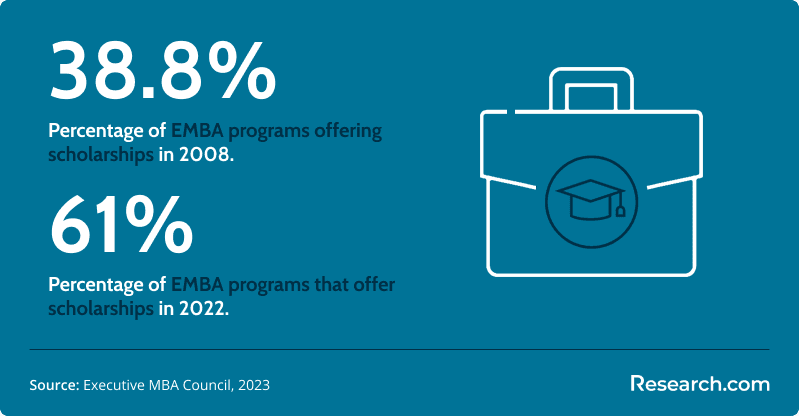
Cost should be evaluated beyond tuition. EMBA programs may require residencies, which can create travel expenses. Scholarship access has improved: the number of EMBA programs offering scholarships increased by more than 20% from 2008 to 2022. Students should also compare employer sponsorships, federal loans, private loans, and payment plans.
The image below displays the percentage of EMBA programs that provide scholarships in 2008 and 2022:
What is the average cost of an accelerated EMBA online program?
The average cost of an accelerated EMBA online program varies by school type, brand reputation, program length, residency model, and included services. A general estimate places the average cost of an accelerated EMBA online program in the range of $50,000 to $150,000.
Public universities may charge lower tuition than private institutions, although out-of-state rates can change the total significantly. Shorter programs may have higher per-credit costs, while longer programs may cost more overall because students take more credits or attend more residencies.
| Cost category | Why it matters | How to evaluate it |
| Tuition | The largest published expense. | Compare total program cost, not only cost per credit. |
| Residencies | Campus or international sessions may add airfare, lodging, meals, and time away from work. | Ask whether travel, lodging, and international fees are included. |
| Technology and materials | Online programs may require software, platforms, textbooks, or case materials. | Request a complete fee schedule before committing. |
| Opportunity cost | Even if you keep working, the program may limit consulting, overtime, or travel flexibility. | Estimate the weekly time commitment and its effect on income. |
What are the financial aid options for students enrolling in an accelerated EMBA online program?
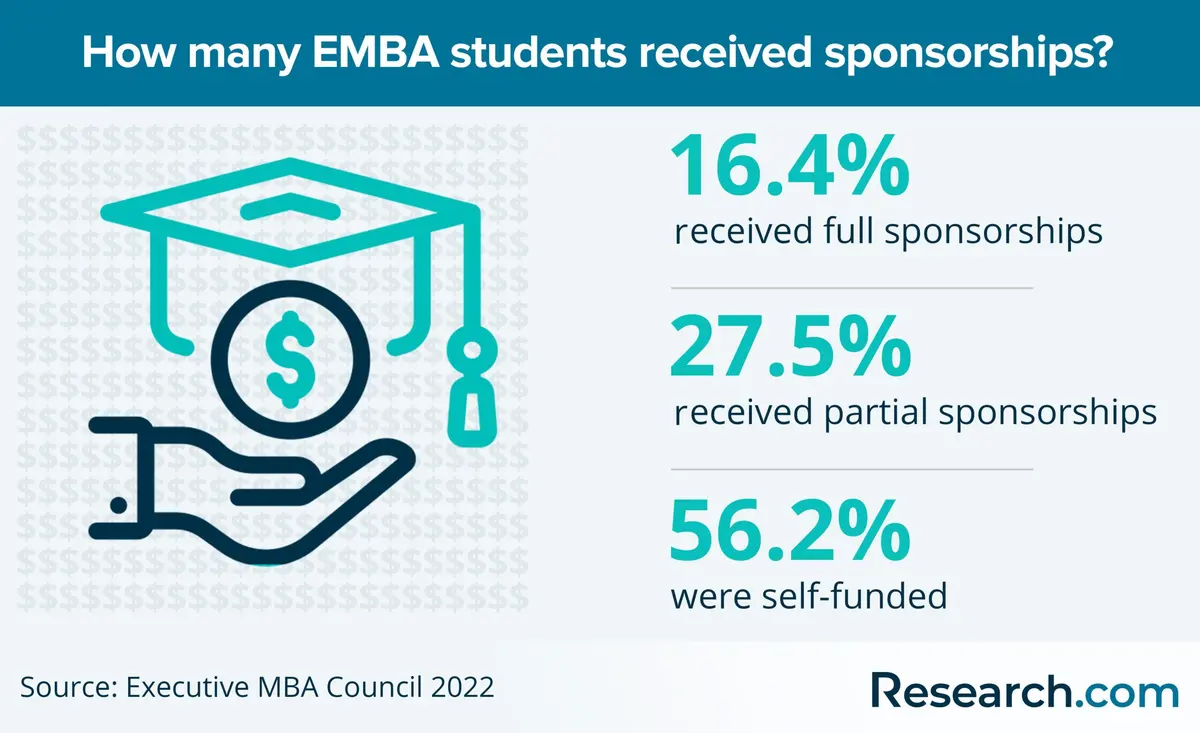
Executive MBA students often finance their degrees through a combination of personal funds, employer support, scholarships, and loans. The right strategy depends on your income, company policy, credit profile, and how soon you expect the degree to support career advancement.
- Federal student loans. Some eligible students may use federal graduate loans such as Unsubsidized Stafford Loans and Grad PLUS Loans. Availability can depend on the school and program structure.
- Company sponsorships. Some employers pay all or part of EMBA tuition as leadership development. Ask whether sponsorship creates a work commitment after graduation.
- Private student loans. Private graduate loans may offer higher borrowing limits, but applicants should compare interest rates, fees, cosigner requirements, and repayment flexibility.
- Institutional scholarships. As of 2022, 61% of EMBA programs primarily based in the U.S. provide scholarships or fellowships. These awards may consider academic history, professional achievement, leadership potential, or industry background.
The image below displays how students finance their EMBA studies:
What are the prerequisites for enrolling in an accelerated EMBA online program?
Admission requirements vary by school, but accelerated online EMBA programs usually look for applicants who can contribute meaningful professional experience to the cohort. These programs are rarely designed for students entering business education directly after college.
- Bachelor’s degree. Most programs require a bachelor’s degree from an accredited institution. A business major may help, but it is not always required.
- Professional experience. Many programs require at least five years of professional experience, preferably with management, supervisory, budget, project, or leadership responsibilities.
- Standardized test scores. Some schools still request GMAT or GRE scores, while others waive them for experienced applicants. If testing is a concern, compare MBA programs without GMAT or GRE requirements.
- English language proficiency. International applicants may need TOEFL or IELTS scores to show they can participate fully in graduate-level discussions and writing assignments.
- Interview. Some programs interview applicants to assess leadership readiness, communication skills, career goals, and program fit.
What courses are typically in an accelerated EMBA online program?
Curricula differ by institution, but most accelerated online EMBA programs cover advanced business functions through an executive leadership lens. Electives and specializations may allow students to focus on industry-specific or role-specific goals.
- Strategic Leadership. Students learn how to set direction, evaluate competitive conditions, and guide organizations through complex decisions.
- Financial Management. Coursework builds skill in financial analysis, corporate finance strategy, capital decisions, and performance measurement.
- Organizational Behavior and Design. Students study motivation, culture, team performance, organizational structure, and change readiness.
- Negotiation and Communication Skills. Courses strengthen executive communication, stakeholder influence, persuasion, and conflict management.
- Global Business Strategy. Students examine international markets, cross-border operations, global risk, and multicultural leadership.
- Business Ethics and Corporate Social Responsibility. Coursework explores ethical decision-making, governance, stakeholder accountability, and responsible leadership.
What types of specializations are available in accelerated executive MBA online programs?
Specializations vary, but they can help students connect executive-level business training to a particular industry, function, or career direction. Before choosing a concentration, compare course titles, faculty expertise, employer relevance, and whether the specialization appears on the transcript.
- Technology Management. Focuses on digital transformation, technology strategy, product innovation, and leadership in technology-driven organizations.
- Healthcare Administration. Builds leadership knowledge in healthcare delivery, hospital administration, policy, operations, and organizational performance. Students comparing healthcare leadership pathways may also review a healthcare administration degree.
- Finance. Supports professionals interested in corporate finance, investment strategy, banking, financial leadership, or financial technology.
- Innovation and Entrepreneurship. Helps students evaluate opportunities, build business models, lead innovation, and prepare for venture creation or intrapreneurship.
- International Business. Develops skills in global market analysis, international operations, cross-cultural leadership, and multinational strategy.
How to choose the best accelerated EMBA online program?
The best accelerated EMBA online program is the one that fits your career direction, schedule, budget, experience level, and preferred learning environment. A highly ranked program may still be the wrong choice if it requires travel you cannot manage or offers concentrations unrelated to your goals.
- Clarify your career goal. Decide whether you want a promotion, industry change, entrepreneurial launch, broader executive scope, or stronger leadership credibility.
- Match the format to your life. Review live class times, residency dates, group project expectations, and whether coursework is asynchronous or scheduled.
- Calculate total cost. Include tuition, fees, books, technology, travel, lodging, and time away from work.
- Check accreditation. Look for institutional accreditation and relevant business accreditation such as AACSB or ACBSP when available.
- Review the curriculum carefully. Make sure courses cover the skills you actually need, not just broad business topics you already know.
- Evaluate faculty and executive support. Look for instructors with academic credentials, executive experience, research activity, consulting background, or industry recognition.
- Test the online learning platform. Ask about technical support, collaboration tools, mobile access, live session recordings, and group project systems.
- Investigate networking and career services. Ask how the program connects students with alumni, executive coaches, recruiters, mentors, and industry leaders.
| Question to ask | Why it matters |
| Is the program fully online, hybrid, or residency-based? | The format affects flexibility, travel costs, and networking. |
| What percentage of students receive employer support or scholarships? | This can change the real cost of attendance. |
| How many years of work experience do classmates usually have? | Peer quality is central to the EMBA learning experience. |
| What career services are designed specifically for executives? | Standard student career services may not be enough for senior professionals. |
| What outcomes data does the school publish? | Transparent salary, promotion, and alumni data help you estimate value. |
What accreditation and quality standards should I consider for accelerated online EMBA programs?
Accreditation is one of the first quality checks applicants should complete. Institutional accreditation confirms that the university meets recognized academic standards, while business-specific accreditation can signal additional review of the business school’s curriculum, faculty, learning outcomes, and continuous improvement processes.
AACSB and ACBSP are commonly discussed business accreditors, and some global programs may reference EQUIS. Accreditation does not guarantee career results, but it can affect employer perception, transferability, academic credibility, and access to financial aid. Students comparing business programs more broadly can also review options through an online business school guide.
What challenges might graduates face when transitioning into executive roles?
An EMBA can strengthen leadership readiness, but moving into executive roles still requires political judgment, organizational trust, measurable performance, and the ability to lead across functions. Graduates may find that the hardest part is not learning strategy but applying it inside an established culture.
Common transition challenges include managing larger teams, influencing without direct control, communicating with boards or investors, handling ambiguity, and implementing change without alienating key stakeholders. Programs with executive coaching, alumni mentoring, and applied leadership projects may be more helpful during this transition. Professionals comparing accelerated MBA models can review a 12-month MBA online option to understand how speed and support differ across programs.
What should international students consider when pursuing an accelerated online EMBA program?
International students should evaluate time zones, synchronous class schedules, residency requirements, visa implications for in-person components, English language expectations, payment options, and whether career services support global job markets. A program that works well for U.S.-based executives may be difficult if live classes regularly occur overnight in another region.
International applicants should also review whether the curriculum includes global business perspectives, multinational case studies, and cross-cultural teamwork. Cost is another major factor; students comparing tuition-sensitive options may want to explore an MBA online cheapest resource while still checking accreditation and employer recognition.
What are the emerging trends shaping accelerated online EMBA programs?
Accelerated online EMBA programs are changing as business problems become more digital, global, and data-driven. Many programs now place more emphasis on artificial intelligence, analytics, digital transformation, sustainability, virtual collaboration, and real-time executive decision-making.
Technology is also changing how students learn. Online cohorts increasingly use collaboration platforms, simulations, recorded lectures, live case discussions, and digital team workspaces. These tools can improve access, but they also require students to be comfortable leading and participating in virtual environments. For additional cost-focused comparisons, review EMBA programs online.
Can I combine an accelerated online EMBA with another graduate degree?
Some professionals pursue a dual degree when they need both executive business training and specialized knowledge in another field. This can be useful in healthcare, technology, public administration, engineering management, or other sectors where leaders must understand both business strategy and technical or professional practice.
A dual degree can broaden options, but it also increases cost, workload, and time commitment. Before choosing this route, compare whether the second credential is truly necessary for your target role. For example, professionals in healthcare leadership may consider how a dual MBA MSN online degree online combines management education with sector-specific expertise.
How can I maximize my learning experience in an accelerated online EMBA program?
Students who get the most value from an accelerated online EMBA usually treat it as a leadership laboratory, not just a credential. Bring real workplace problems into assignments when appropriate, ask faculty for feedback on current challenges, and use group projects to practice influence across different working styles.
- Create a weekly executive study block. Protect time for reading, discussion posts, group meetings, and reflection before work crises consume your schedule.
- Use your cohort intentionally. Build relationships with classmates in different industries, not only those with similar roles.
- Apply coursework immediately. Connect finance, strategy, operations, and leadership concepts to decisions you are already making at work.
- Meet with faculty and coaches early. Do not wait until the final term to ask for guidance on leadership goals or career positioning.
- Document outcomes. Track projects, process improvements, presentations, and leadership examples that can support promotions or interviews.
Professionals comparing flexible healthcare education pathways may also find it useful to review Which nursing school is the easiest to get into?
How do accelerated EMBA programs support post-graduation career transitions?
Strong EMBA programs support career movement through executive coaching, leadership assessments, alumni networks, mentoring, networking events, and career counseling. For senior professionals, the most useful services are often not entry-level job boards but help with positioning, executive presence, board readiness, industry transition strategy, and negotiation.
Graduates should ask whether career support continues after graduation and whether alumni have access to coaching, events, or employer connections. Professionals in healthcare who are considering stacked or alternative credentials may also compare easy RN to BSN degrees as part of a broader career diversification plan.
What career paths are available for graduates of accelerated EMBA online programs?
Accelerated executive MBA online programs can support advancement into senior management, general management, operations leadership, finance leadership, consulting, entrepreneurship, product leadership, healthcare administration, global business roles, and C-suite pathways. The degree is most valuable when combined with strong prior work experience and a clear plan for using the credential.
Among 2021 EMBA graduates, 25% pursued international opportunities. Another 21% transitioned to different sectors after graduation, and some moved into C-level director positions. These outcomes show that EMBA programs can support mobility, but individual results depend on work history, market conditions, networking, and performance.
| Career path | How an EMBA can help | Best suited for |
| Executive leadership | Builds strategic, financial, and organizational leadership skills. | Managers preparing for director, VP, or C-suite roles. |
| Entrepreneurship | Develops business model, finance, market strategy, and leadership capabilities. | Professionals planning to start, buy, or scale a business. |
| Industry transition | Provides broader business credibility and cross-functional knowledge. | Leaders moving from one sector into another. |
| Consulting | Strengthens problem-solving, client communication, and strategic analysis. | Experienced professionals who want advisory roles. |
| Global management | Supports international strategy, cross-cultural leadership, and global market insight. | Professionals targeting multinational organizations. |
What is the job market for graduates with an EMBA?
The job market for EMBA graduates is tied closely to demand for experienced leaders. The U.S. Bureau of Labor Statistics projects 3% growth in overall employment of top executives from 2022 to 2032, which is about as fast as the average for all occupations.
The BLS also projects 311,600 openings for top executives each year over the decade. These openings include new roles and replacement needs as workers move into other occupations or leave the labor force. Graduates using EMBA training for advancement may also compare related leadership pathways in a business administration jobs list.
The chart below shows the change in the employment rate for top executive positions during the 2022-2032 period:
What are the unique leadership skills that can be developed in an accelerated online EMBA program?
An accelerated online Executive MBA develops leadership capabilities through compressed, applied, and often cohort-based learning. The strongest programs focus on skills that executives use under pressure: setting direction, making trade-offs, communicating across stakeholders, leading change, and managing uncertainty.
- Strategic thinking and vision: Students learn to evaluate markets, competitors, organizational capabilities, and long-term growth options.
- Decision-making under pressure: Case studies and simulations help students practice making timely decisions with incomplete information.
- Change management and adaptability: Coursework prepares students to lead transformation, manage resistance, and align teams around new priorities.
- Executive communication and influence: Students practice presenting ideas clearly, persuading stakeholders, and building trust across functions.
- Crisis management and resilience: Many programs help leaders think through resource allocation, team morale, risk, and continuity during disruption.
Comparing Costs of Accelerated Executive MBA Programs Across Institutions
Cost comparison should go beyond published tuition. Program duration, course load, residency requirements, international travel, technology fees, books, and employer reimbursement policies can all affect affordability. A program with a low per-credit price may not be the least expensive if it requires more credits or significant travel.
If accreditation and affordability are both priorities, comparing the cheapest AACSB online MBA programs can help students find lower-cost options that still meet recognized business school quality standards. Applicants should weigh tuition against faculty quality, career services, alumni network strength, and the likelihood that the degree will support their next career move.
ROI of Accelerated EMBA Programs
The return on investment of an accelerated EMBA depends on both measurable and non-measurable outcomes. Salary growth is important, but so are promotion readiness, employer sponsorship, network access, leadership confidence, business ownership opportunities, and the ability to solve larger organizational problems.
Increased Earning Potential
One of the main reasons professionals choose an EMBA is the possibility of higher compensation. EMBA graduates may benefit from promotion, expanded responsibility, or movement into more lucrative industries. However, earnings vary significantly by role, employer, location, and prior experience, so applicants should not treat salary averages as guaranteed outcomes.
Career Advancement Opportunities
Accelerated EMBA programs are designed for experienced professionals, many of whom already manage teams, budgets, or business units. The degree can help them move toward director, vice president, executive, or CEO roles by strengthening strategic decision-making and cross-functional leadership.
Expanding Your Professional Network
Networking is a major part of EMBA value. Cohorts often include managers, entrepreneurs, executives, and specialists from different sectors. These relationships may lead to partnerships, referrals, board opportunities, consulting projects, or long-term professional support.
Improved Leadership and Strategic Skills
EMBA coursework typically emphasizes advanced management skills that transfer across industries. Students build stronger judgment in finance, operations, strategy, organizational design, negotiation, and change leadership.
Global Recognition and Mobility
Programs with international residencies, global business coursework, or multinational cohorts can help students develop a broader perspective. This may be especially useful for professionals targeting global companies, cross-border roles, or international expansion.
Financial Aid and Scholarships
ROI improves when students reduce out-of-pocket cost. Employer sponsorship, scholarships, fellowships, federal loans, private loans, and payment plans can all affect the real cost of the degree. Because many EMBA students continue working full time, they may also preserve income while studying.
Professionals comparing shorter programs may want to review the best 1-year online MBA programs in the USA to understand how accelerated MBA and EMBA formats differ.
What are the best accelerated online degree programs for working professionals?
Accelerated online degree programs can help working adults earn credentials faster while maintaining employment. These programs are most useful when they are flexible, properly accredited, clearly priced, and aligned with a realistic career objective.
Accelerated executive MBA programs are one option for experienced business professionals who want advanced leadership training. Other accelerated online degrees may fit students in healthcare, education, technology, public administration, or other fields where a graduate credential supports advancement.
To compare broader options, review this guide to accelerated online degree programs for working adults, which highlights flexible pathways for professionals balancing school, work, and personal responsibilities.
Common Mistakes to Avoid When Choosing an Accelerated Online EMBA
| Mistake | Why it can hurt you | Better approach |
| Choosing only by speed | The fastest program may not have the best network, support, or fit. | Balance timeline with curriculum quality and career value. |
| Ignoring accreditation | Accreditation affects credibility and sometimes financial aid eligibility. | Verify institutional and business accreditation before applying. |
| Looking only at tuition | Residencies, fees, books, and travel can change the real cost. | Ask for the total estimated program cost in writing. |
| Assuming online means no travel | Many EMBA programs require campus weekends or international residencies. | Review every in-person requirement before enrolling. |
| Expecting guaranteed promotion | A degree can support advancement, but employers promote based on performance, timing, and need. | Build a career plan before starting the program. |
| Underestimating workload | Accelerated programs can be demanding alongside full-time leadership roles. | Discuss time commitment with your employer and family before enrolling. |
References:
- EMBAC. (2023). 2022 EMBAC Student Exit Survey. Executive MBA Council. Retrieved December 20, 2023.
- EMBAC. (n.d.). Other avenues of funding EMBA education. Executive MBA Council. Retrieved January 4, 2024.
- Glassdoor. (2023, October 29). How much does an executive director, executive MBA program make? Glassdoor.com. Retrieved December 20, 2023.
- INSEAD. (2022). Furthering your potential Executive MBA employment report 2021. INSEAD.edu. Retrieved January 3, 2024.
- Payscale. (2023, November 15). Executive masters of business administration (Exec MBA) salary. Payscale.com. Retrieved January 3, 2024.
- Randstan. (2023). Work monitor 2023. Randstand.com. Retrieved January 16, 2024.
Key Insights
- An accelerated online EMBA is best for experienced professionals who already have leadership exposure and need executive-level business training without leaving work.
- Most accelerated executive MBA online programs take 12 to 18 months, but some listed programs run from 15 months to 24 months depending on format and requirements.
- Published tuition is only part of the cost. Students should also account for residencies, technology fees, books, international travel, and time away from work.
- Accreditation matters. Look for recognized institutional accreditation and, when possible, business accreditation such as AACSB or ACBSP.
- Career outcomes depend on prior experience, industry, employer support, networking, and performance. The EMBA can strengthen advancement potential, but it does not guarantee promotion or a specific salary.
- The strongest program choice is the one that aligns with your leadership goals, schedule, budget, learning style, and target industry—not simply the one with the fastest timeline or lowest tuition.
Other Things You Should Know About Affordable Accelerated Executive MBA Online Programs
In 2027, admission requirements for affordable accelerated Executive MBA programs typically include a bachelor's degree, at least five years of professional experience, a resume, letters of recommendation, and GMAT or GRE scores. Some programs may also require an interview and personal statement.
Yes. Most Executive MBA programs require at least 5 to 10 years of full-time professional experience, and many prefer 7 or more years. Some also ask for current managerial responsibility, a résumé, and an employer endorsement before admission.





