2027 Fastest Online Real Estate Degree Programs

Co-Founder and Chief Data Scientist
If you want to move into real estate without spending years in a traditional campus program, a fast online real estate degree can be a practical route—especially if your goal is more than getting a sales license. The challenge is that “real estate education” can mean very different things: a short pre-licensing course, a non-credit certificate, a bachelor’s degree, a finance degree with a real estate concentration, or a graduate real estate program.
This guide is designed for students, career changers, agents, property professionals, and business students comparing accelerated online real estate degree programs. You will learn what these programs actually cover, how fast they can be completed, what they cost, which schools offer strong options, how to evaluate accreditation, and what careers may be available after graduation.
Quick answer: Is a fast online real estate degree worth it?
A fast online real estate degree can be worth it if you want broader career options in property management, commercial real estate, appraisal, development, real estate finance, asset management, or corporate real estate. It is less necessary if your only goal is to become a residential sales agent, because state licensure—not a degree—is usually the required credential for that path.
The best candidates for accelerated online real estate degrees are students who want business training, flexible scheduling, a recognized academic credential, and a faster route into professional roles that require financial, legal, analytical, and management knowledge.
Why consider an accelerated online real estate degree?
- It can expand your career beyond sales: A degree can support paths in property management, appraisal, development, corporate real estate, real estate finance, and investment analysis.
- It may improve access to salaried or specialized roles: Commission-based agent income can be unpredictable, while management, finance, and analyst roles may offer more structured compensation.
- It fits working adults better than many campus programs: Accelerated online formats often use shorter course blocks, asynchronous classes, and multiple start dates.
- It builds skills that licensure courses do not fully cover: Degree programs usually go deeper into finance, valuation, contracts, markets, investment analysis, and business strategy.
What should I expect from the fastest online real estate degree programs?
The fastest online real estate degree programs usually combine a business foundation with real estate-specific coursework. A bachelor’s degree generally requires 120 credits, while some graduate programs require fewer credits but expect prior undergraduate preparation. “Fast” usually means the school offers accelerated course sessions, transfer credit opportunities, credit for prior learning, or a condensed graduate schedule—not that academic requirements disappear.
| Program feature | What it means for students | Why it matters |
| Business core | Courses in finance, accounting, economics, marketing, law, and management | Real estate decisions often depend on financial analysis, contracts, negotiation, and market strategy. |
| Real estate specialization | Study of real estate principles, valuation, finance, investment, law, property management, and development | Specialized coursework can prepare students for commercial, management, appraisal, and investment-related roles. |
| Applied projects | Case studies, market analysis assignments, development scenarios, valuation work, or portfolio exercises | Practical assignments help students connect theory to property transactions and asset decisions. |
| Accelerated format | Shorter course sessions, flexible pacing, multiple start dates, or intensive graduate schedules | This can shorten completion time, especially for transfer students or highly motivated full-time learners. |
| Industry-informed faculty | Instructors may include experienced professionals, researchers, or business faculty with real estate expertise | Faculty experience can strengthen classroom examples, networking, and career relevance. |
Where can I work after earning a fast online real estate degree?
Graduates can pursue roles across residential, commercial, industrial, corporate, nonprofit, and public-sector real estate. The degree is especially useful for students who want to move into analytical, management, or investment-focused positions rather than limit themselves to sales.
- Brokerage companies: Graduates may work in residential or commercial sales, leasing, client development, office management, recruiting, or training.
- Property management firms: These employers need professionals to manage leases, budgets, tenant relations, maintenance coordination, compliance, and owner reporting.
- Development companies: Real estate development roles may involve site research, feasibility analysis, financing, entitlement, construction coordination, and project marketing.
- Appraisal and valuation organizations: Graduates may work with appraisal firms, lenders, government agencies, or assessment offices to support property valuation work.
- Corporate real estate departments: Large companies employ real estate professionals to manage locations, leases, acquisitions, dispositions, facilities, and workplace strategy.
- Real estate investment trusts: REITs may hire graduates for acquisitions, asset management, financial analysis, portfolio support, and investor-related functions.
How much can I make with a fast online real estate degree?
Real estate earnings vary widely because compensation depends on role, license status, location, property type, commission structure, experience, and market conditions. A degree does not guarantee a specific salary, but it can help students qualify for positions where finance, analysis, management, and valuation skills matter.
- Property and community association managers: Median salaries are commonly described as around $60,000 to $75,000, while top earners in commercial property management may exceed $110,000.
- Real estate appraisers and assessors: Certified appraisers may earn an average of $65,000 to over $100,000 annually, depending on certification level, market, and specialty.
- Asset and investment management positions: A real estate degree can support progression into roles such as real estate asset manager, where average salaries range from $105,000 to $127,000, with senior positions often paying more.
- Fastest Online Real Estate Degree Programs for 2027
- Cost of an Online Real Estate Degree
- Financial Aid for Online Real Estate Students
- Admission Requirements for Online Real Estate Degrees
- Common Courses in an Online Real Estate Degree
- Popular Real Estate Degree Specializations
- How to Choose the Right Accelerated Online Real Estate Program
- Career Paths for Online Real Estate Degree Graduates
- Career Services and Networking in Online Programs
- Complementary Programs That Can Strengthen a Real Estate Career
- Online vs. Campus-Based Real Estate Degrees
- Salary Potential with an Online Real Estate Degree
- Job Market for Real Estate Degree Graduates
- Current and Future Real Estate Trends
Fastest Online Real Estate Degree Programs for 2027
How Research.com evaluates schools
Because a real estate degree can require a major financial and time commitment, our rankings are built to help students compare programs using transparent information. Our ranking methodology draws from recognized education data sources, including:
- the IPEDS database
- Peterson's database, including the Distance Learning Licensed Data Set
- the College Scorecard database
- the National Center for Education Statistics
Below are the programs selected for this guide.
1. Columbia College
Columbia College offers a fully online Bachelor’s in Real Estate Management for students who want a business-centered degree focused on property transactions, real estate law, finance, marketing, and management. The program is designed to develop professional judgment, critical thinking, negotiation ability, and practical problem-solving.
The curriculum includes contemporary real estate issues and technology-related topics, including digital marketing, consumer behavior, and advertising. Columbia College is also the exclusive educational partner of the National Association of REALTORS®, which may appeal to students seeking a degree with industry visibility.
The online structure can work well for adults who need flexibility or who want to move through coursework as quickly as their transfer credits, schedule, and course load allow. Graduates may pursue real estate management, sales, consulting, and related business roles.
- Program Length: Accelerated options available (exact duration varies)
- Tracks/Concentrations: Real estate; Real estate finance; Real estate law; Strategic sales and customer experience management; Negotiation and conflict
- Tuition Cost: $375 per credit
- Required Credits to Graduate: 120
- Accreditation: Higher Learning Commission (HLC)
2. Florida International University
Florida International University offers an online Master of Science in International Real Estate that can be completed in as little as 10 to 12 months. The program is built for students interested in global real estate transactions, advanced investment strategy, valuation, asset management, and real estate finance.
Students use industry tools such as ARGUS and can earn credits toward professional designations. Coursework includes contracts, financing, development modeling, product-type analysis, urban growth, and market research using public and proprietary data.
The finance-focused curriculum also covers risk management, capital markets, REITs, and mortgage-backed securities, making this program especially relevant for students pursuing investment, international real estate, or advanced analytical roles.
- Program Length: 10–12 months
- Tracks/Concentrations: International Real Estate
- Tuition Cost: Florida residents: $28,000; Non-residents and international students: $30,000
- Required Credits to Graduate: 30
- Accreditation: Association to Advance Collegiate Schools of Business (AACSB); Southern Association of Colleges and Schools Commission on Colleges (SACSCOC)
3. Liberty University
Liberty University offers an accelerated online Bachelor of Science in Business Administration – Real Estate. The program combines core business education with real estate finance, investment, property management, and market analysis.
Courses are delivered 100% online in flexible 8-week sessions, which can help students balance school with work, military service, or family responsibilities. The curriculum emphasizes negotiation, communication, ethical decision-making, and real estate market evaluation.
Students with prior work experience or professional certifications may qualify for credit that can reduce time to completion. Graduates may pursue roles such as real estate agent, broker, property manager, or analyst, and the degree can also support future graduate study such as an MBA in Real Estate Development.
- Program Length: 3.5 years (accelerated track)
- Tracks/Concentrations: Real Estate
- Tuition Cost: Undergraduate full time: $390/credit; Undergraduate part time: $455/credit; Military undergraduate: $250/credit
- Required Credits to Graduate: 120
- Accreditation: Accreditation Council for Business Schools and Programs (ACBSP); Southern Association of Colleges and Schools Commission on Colleges (SACSCOC)
4. Penn State World Campus
Penn State World Campus offers an online Bachelor of Science in Business with a Real Estate concentration. The program blends business fundamentals with coursework in real estate finance, investment valuation, development, appraisal, and urban and regional economics.
Students learn to evaluate markets, analyze investment opportunities, understand legal and risk considerations, and apply negotiation strategies. The asynchronous online format can be useful for working students who need schedule flexibility.
Students may also benefit from connections to the Borrelli Institute for Real Estate Studies, the Penn State Real Estate Advisory Board, the annual Real Estate Boot Camp, and the Penn State Real Estate Association. Graduates may pursue careers in corporate real estate, commercial brokerage, consulting, property management, mortgage lending, and development.
- Program Length: Accelerated format (8-week courses; completion time varies by course load)
- Tracks/Concentrations: Real Estate (customizable)
- Tuition Cost: $632 per credit (in-state), $678 per credit (out-of-state)
- Required Credits to Graduate: 120
- Accreditation: Middle States Commission on Higher Education (MSCHE)
5. University of Arizona Global Campus
The University of Arizona Global Campus offers an accelerated online Bachelor of Arts in Real Estate Studies. The program is intended for students who want a flexible degree covering real estate terminology, ethics, deeds, listing agreements, purchase agreements, contracts, and valuation-related decisions.
Coursework addresses how the legal system affects property transactions, including contracts, wills, zoning, environmental law, and constitutional issues. Students also study property listing, advertising, escrow, sales, client development, property management, mortgage lending, equity investment, and brokerage.
The program uses 5- to 6-week classes, allowing students to focus on one course at a time. It also offers transfer policies, credit for work/life experience, 24/7 access to course materials, and WSCUC accreditation.
- Program Length: As little as 3 years (with continuous enrollment and accelerated course blocks)
- Tracks/Concentrations: Real Estate Studies
- Tuition Cost: $460.00/credit
- Required Credits to Graduate: 120
- Accreditation: WASC Senior College and University Commission (WSCUC)
6. University of Alabama
The University of Alabama offers a fully online Bachelor of Science with a major in Real Estate through the Culverhouse College of Business. The program prepares students for entry-level roles in property and facility management, brokerage and leasing, appraisal, real estate finance and investment, development, project management, and corporate real estate advisory services.
The curriculum combines business coursework with real estate topics such as land use policy, real estate law, marketing procedures, agency management, brokerage, property inspection and appraisal, real estate investing, and commercial property management.
Students can choose between two tracks: Real Estate Finance and Investments or Real Estate Brokerage and Management. Asynchronous delivery supports flexible scheduling, and the program also prepares students for state real estate broker and salesperson licensing exams.
- Program Length: Typically 4 years (flexible pacing available)
- Tracks/Concentrations: Real Estate Finance and Investments; Real Estate Brokerage and Management
- Tuition Cost: $399 per credit hour (same for in-state and out-of-state)
- Required Credits to Graduate: 120
- Accreditation: Association to Advance Collegiate Schools of Business (AACSB)
7. University of Memphis
The University of Memphis offers an online Bachelor of Business Administration with a major in Finance and a concentration in Real Estate. The program uses 7-week courses and multiple start dates, making it a flexible choice for students who want to advance more quickly.
Students study real estate principles, finance, appraisal, property management, and real estate law. Elective options allow students to shape their studies around residential, commercial, or industrial real estate interests.
Graduates may pursue mortgage banking, development, investment, valuation, assessment, government, sales, and property management roles. Students may also consider the Minor in Real Estate or the Professional Real Estate Program for additional focus.
- Program Length: Accelerated format (7-week courses; completion time varies)
- Tracks/Concentrations: Real Estate
- Tuition Cost: $447 per credit hour (in-state and out-of-state)
- Required Credits to Graduate: 120
- Accreditation: Association to Advance Collegiate Schools of Business (AACSB)
8. Fordham University
Fordham University offers a Bachelor of Science in Real Estate through the School of Professional and Continuing Studies. The curriculum focuses on real estate investment, development, legal issues, urban economics, accounting, finance, valuation, construction, and management.
Courses are available in evening and online formats, which can benefit working adults and nontraditional students. Fordham emphasizes small classes, engaged faculty, practical learning, and career-oriented study.
Students may be able to use transfer credit and credit for life experience to shorten completion time. The Fordham Real Estate Institute and the university alumni network may also support professional connections. Graduates can pursue brokerage, development, investment, appraisal, property management, and consulting roles.
- Program Length: Typically 4 years (flexible pacing with evening and online courses)
- Tracks/Concentrations: Real Estate major (no sub-concentrations)
- Tuition Cost: $1,085/credit
- Required Credits to Graduate: 120 credits
- Accreditation: Middle States Commission on Higher Education (MSCHE)
9. Louisiana State University
Louisiana State University offers a fully online Bachelor of Science in Finance with a Real Estate concentration through LSU Shreveport’s College of Business. The program is designed to connect finance theory with real estate decision-making.
Coursework covers real estate industry operations, after-tax financial measures, investment development, financing concepts, valuation, and appraisal techniques. Students learn to assess markets, value properties, and prepare investment presentations.
The online format can accommodate working and nontraditional students. Graduates may pursue real estate finance, investment analysis, brokerage, development, and property management roles.
- Program Length: Typically 4 years (full-time online)
- Tracks/Concentrations: Real Estate concentration within the Bachelor of Science in Finance
- Tuition Cost: $306/credit
- Required Credits to Graduate: 120
- Accreditation: Association to Advance Collegiate Schools of Business (AACSB)
10. University of West Georgia
The University of West Georgia offers an accelerated online Bachelor of Business Administration in Real Estate. The program includes 8-week courses and rolling admissions, which can help students enter and progress through the program more efficiently.
The curriculum covers real estate principles, finance, law, and appraisal. Students prepare for entry-level opportunities in commercial and residential real estate, including sales, brokerage, appraising, and property management.
Faculty bring academic and professional experience to the online classroom. The program is housed in the Richards College of Business, which is accredited by the Association to Advance Collegiate Schools of Business.
- Program Length: Accelerated format (8-week courses; completion time varies)
- Tracks/Concentrations: Real Estate
- Tuition Cost: $187 per credit hour (in-state), $675 per credit hour (out-of-state)
- Required Credits to Graduate: 120
- Accreditation: Association to Advance Collegiate Schools of Business (AACSB)
What is the average cost of an online real estate degree program?
Online real estate degree costs depend on school type, residency rules, transfer credits, fees, and whether the program is undergraduate or graduate. Students should compare total estimated cost, not just advertised tuition.
- Public universities for in-state students: Tuition is often the lowest option, frequently ranging from $300 to $500 per credit hour, which can create a total program cost between $36,000 and $60,000.
- Public universities for out-of-state students: Nonresident tuition can be much higher, although some online programs charge the same rate for all students.
- Private universities: Tuition may exceed $600 per credit hour, and total costs can often surpass $70,000.
- Extra charges: Students should ask about technology fees, online learning fees, digital materials, exam proctoring fees, graduation fees, and course-specific costs.
| Cost factor | Question to ask before enrolling | Why it affects affordability |
| Transfer credit | How many credits will the school accept from prior colleges? | Accepted credits can reduce both time and tuition. |
| Residency rate | Do online students pay in-state, out-of-state, or a separate online tuition rate? | Residency rules can substantially change the final price. |
| Course load | Will full-time enrollment change tuition, aid eligibility, or fees? | Accelerating completion may require a heavier academic schedule. |
| Fees | Are online, technology, materials, or proctoring fees included in the published estimate? | Fees can make a lower-tuition program more expensive than expected. |
| Career goal | Does the program align with the role I want after graduation? | A cheaper program is not a good value if it lacks the courses or support needed for your target career. |
The same cost-comparison logic applies across career-focused online degrees. Students who are comparing niche business fields, for example, may also review the shortest esports business management programs online to understand how accelerated formats affect cost and time to completion.
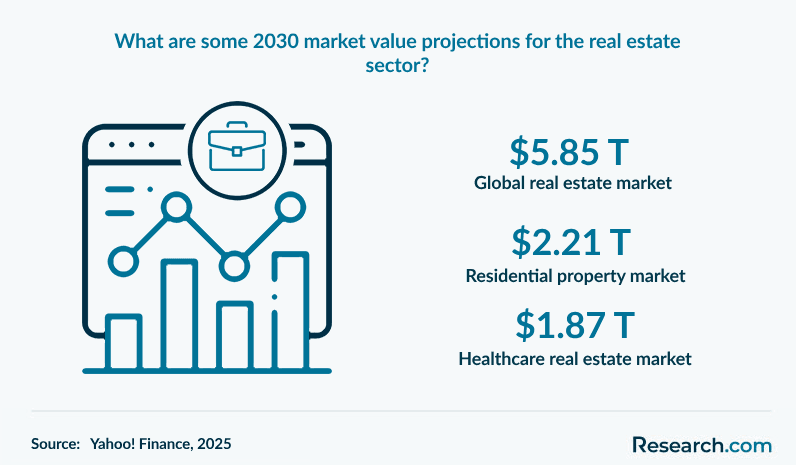
Market conditions also shape the long-term value of real estate education. According to 2025 market forecasts cited by Yahoo! Finance, the global real estate sector is projected to reach $5.85 trillion by 2030 with a compound annual growth rate of 5.2% from 2022.
Urbanization is a major driver, with 65% of the world's population expected to live in urban areas. In 2021, Asia Pacific held a 52.6% market share. The residential property segment is forecast to reach $2.21 trillion by 2030 at a 6.0% CAGR, while the rental market, valued at $1.92 trillion in 2021, is expected to reach $3.04 trillion by 2030.
Related markets are also expanding. The modular construction market is projected to grow from $103.864 billion in 2025 to $131.182 billion by 2030 at a 4.78% CAGR. The e-brokerage market is projected to rise from $13.5 billion in 2024 to $22.5 billion by 2030, reflecting an 8.9% CAGR.
In the United States, healthcare real estate is another important niche. This market was valued at $1.32 trillion in 2024 and is projected to reach $1.87 trillion by 2030, growing at a 6.20% CAGR.
Demographic shifts are central to that growth. Baby boomers will constitute 20% of the U.S. population by 2030 and account for 37% of national healthcare spending. The healthcare system currently includes 6,093 hospitals, or 1.84 per 100,000 people. Medical Outpatient Buildings reached 92.8% occupancy in late 2024, and hospitalizations are projected to rise from 36.2 million in 2025 to 40.2 million by 2035. Some of these figures are shown below.
Students interested in healthcare facilities, medical office buildings, or senior housing may eventually pair real estate training with an affordable online Masters in Healthcare Administration to better understand healthcare operations and facility strategy.
What financial aid options are available for an online real estate degree?
Online students at accredited institutions may qualify for many of the same financial aid options as campus students. The most important step is to confirm that the school and program are eligible for the type of aid you plan to use.
- Federal student aid: Completing the Free Application for Federal Student Aid can determine eligibility for federal grants, work-study, and federal loans.
- Scholarships: Students may find awards from universities, private foundations, real estate associations, and groups such as the National Association of REALTORS®.
- Employer tuition assistance: Real estate firms, banks, property management companies, and corporate employers may help pay for job-related education.
- State grants: Many states offer aid for residents attending eligible institutions, including some online programs.
To reduce borrowing, compare aid packages carefully, apply early, and ask schools whether scholarships are renewable or only available for the first term.
What are the prerequisites for enrolling in an online real estate degree?
Admission requirements vary by school and degree level, but most undergraduate online real estate programs require proof that the applicant is ready for college-level coursework. Similar application expectations appear in other accelerated professional programs, including a fast-track education specialist degree online, where schools assess whether applicants can handle a compressed academic format.
- High school diploma or GED: Undergraduate applicants generally need proof of secondary school completion.
- Minimum GPA: Many schools set a minimum GPA, often around a 2.5 or higher, while more selective programs may expect a 3.0 or above.
- Standardized test scores: Some institutions are test-optional, but others may request or recommend SAT or ACT scores.
- Application documents: Students may need official transcripts, an application form, recommendation letters, and a personal statement or essay.
Graduate programs may ask for additional materials such as a bachelor’s degree, resume, statement of purpose, or professional experience. That is also common in career-advancing graduate options such as a fast-track master's in nonprofit management online.
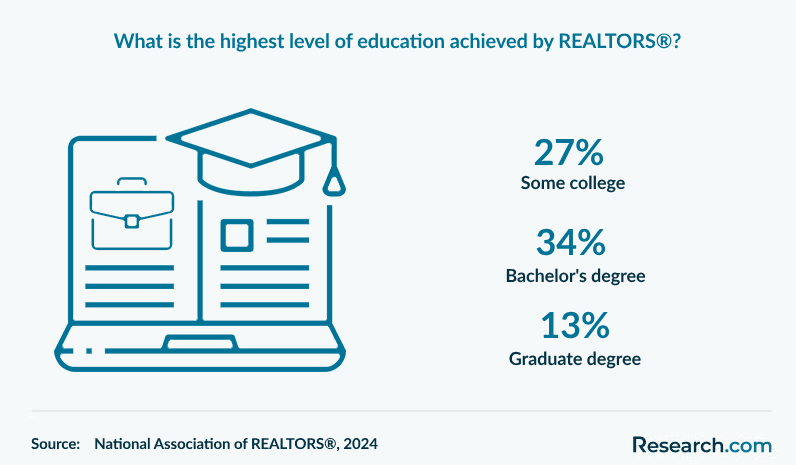
The 2024 member profile from the National Association of REALTORS® shows that higher education is common among members. The largest share, 34%, hold a bachelor's degree. Another 27% attended some college, 13% hold an associate degree, 13% hold a graduate degree or higher, 5% completed some graduate school, and 7% are high-school graduates.
In total, 93% of REALTORS® have education beyond a high school diploma. The chart below illustrates how common postsecondary education is among members of the association.
What courses are typically included in an online real estate degree?
Online real estate degrees usually combine general business coursework with property-specific study. The result is a broader education than a state pre-licensing course, which is designed primarily to meet licensing requirements. Like the shortest online entrepreneurship MBA programs, many real estate degrees are built for students who want practical business skills in a flexible format.
- Real Estate Principles: Introduces property rights, ownership, markets, terminology, and the structure of the real estate industry.
- Real Estate Finance and Investment: Covers mortgage lending, investment analysis, capital sources, leverage, and financing decisions.
- Property Law: Examines contracts, ownership interests, land use, landlord-tenant law, zoning, and legal risk.
- Real Estate Appraisal and Valuation: Teaches methods used to estimate residential and commercial property value.
- Market Analysis: Helps students evaluate local and regional markets, demand patterns, risks, and opportunities.
- Business Core Courses: Includes accounting, economics, business finance, marketing, management, and business law.
Students should not assume real estate is one of the easiest college majors. Strong programs require quantitative reasoning, legal understanding, market analysis, communication, and business judgment.
What specializations are available in online real estate degree programs?
Specializations allow students to build deeper expertise in a specific part of the real estate field. The right concentration depends on whether you want to manage property, analyze deals, develop projects, value assets, or oversee corporate portfolios.
| Specialization | Best fit for students interested in | Common career directions |
| Property Management | Operations, leasing, tenant relations, maintenance, budgets, and owner reporting | Property manager, community association manager, portfolio manager |
| Real Estate Development | Land acquisition, feasibility, construction coordination, financing, and project delivery | Development associate, project coordinator, acquisitions support |
| Real Estate Finance and Investment | Capital markets, valuation, investment analysis, portfolio strategy, and risk | Investment analyst, asset management analyst, REIT support roles |
| Corporate Real Estate | Site selection, lease strategy, facilities, workplace planning, and portfolio oversight | Corporate real estate analyst, lease administrator, facilities strategist |
In 2023, the real estate profession included approximately 113,600 brokers and 430,700 sales agents. Independent work was common: 54% of real estate brokers and 53% of real estate sales agents were self-employed.
The real estate and rental and leasing sector employed 42% of brokers and 39% of sales agents. The construction industry employed 3% of sales agents. These employment patterns are shown in the graphic below.
How do you choose the best fast online real estate degree program?
The best program is not automatically the shortest or cheapest. It is the one that matches your career goal, accepts your prior credits, fits your schedule, holds appropriate accreditation, and provides coursework relevant to the real estate role you want.
Students who compare technical or trade programs often use a similar process when researching the cheapest HVAC certification schools: check the total price, verify credential recognition, look for hidden fees, and confirm that the program actually supports the target job.
- Verify accreditation: Confirm institutional accreditation and, when relevant, business accreditation. Research.com’s guide to nationally accredited online colleges can help students understand accreditation terminology.
- Match the curriculum to your goal: Development, finance, property management, appraisal, and brokerage require different skill sets.
- Check licensing alignment: If you plan to become licensed, ask whether the program helps satisfy any state education requirements or only provides broader academic preparation.
- Review faculty backgrounds: Look for a balance of academic expertise and real-world real estate experience.
- Compare format and pace: Decide whether you prefer asynchronous learning, scheduled live classes, 5- to 6-week courses, 7-week courses, 8-week courses, or a more traditional term.
- Calculate full cost: Include tuition, fees, books, software, travel if required, and lost income if you reduce work hours.
- Ask about career services: Strong programs may offer employer connections, internship guidance, resume support, alumni networks, or student real estate organizations.
Common mistakes to avoid when choosing an online real estate degree
- Confusing a license course with a degree: A pre-licensing class may help you sit for a state exam, but it is not the same as an accredited college degree.
- Choosing based only on speed: A faster program is only useful if it provides the courses, recognition, and flexibility you need.
- Ignoring transfer policies: Transfer credit can be one of the biggest factors in shortening a bachelor’s degree.
- Assuming online means easier: Accelerated online courses often require strong time management because assignments move quickly.
- Not checking state licensing rules: Real estate licensing requirements vary by state, and an online degree may not automatically satisfy them.
- Comparing tuition without fees: A low per-credit rate can become less affordable when fees and materials are added.
What career paths are available for online real estate degree graduates?
An online real estate degree can prepare graduates for many roles beyond residential sales. The strongest opportunities often require a mix of business knowledge, financial analysis, communication, legal awareness, and market judgment.
- Property and asset management: Professionals oversee residential, commercial, or industrial properties and work to protect or increase asset value.
- Commercial real estate brokerage: Brokers and agents focus on office, retail, industrial, multifamily, or specialized commercial property transactions.
- Real estate development: Development professionals help acquire land, assess feasibility, arrange financing, coordinate construction, and bring projects to market.
- Real estate appraisal and valuation: Real estate appraisers estimate property value for lenders, governments, investors, and private clients.
- Corporate real estate: These professionals manage an organization’s real estate footprint, including leases, sites, facilities, and portfolio strategy.
- Real estate investment analysis: Analysts review market and financial data to support acquisitions, dispositions, REIT decisions, and portfolio planning.
Some professionals later move into training, management education, or organizational leadership. In those cases, a fast-track education specialist degree online may be relevant for roles involving professional development, association leadership, or internal learning programs.
What career support and networking opportunities are available in online real estate programs?
Strong online real estate programs do more than deliver lectures. They may offer career coaching, resume reviews, interview preparation, job boards, internship guidance, licensing exam resources, alumni events, virtual speaker sessions, and connections to local or national real estate organizations.
Before enrolling, ask whether online students receive the same career services as campus students. Also ask whether the program has relationships with brokerage firms, property management companies, development firms, lenders, appraisal organizations, or real estate investment companies. Students considering business leadership roles may also compare advanced options such as the cheapest MBA programs online.
Could complementary programs strengthen my real estate career?
Yes. Real estate overlaps with finance, construction, law, analytics, marketing, healthcare, sustainability, and public policy. Complementary education can help students specialize and compete for more targeted roles.
For example, a student interested in development may benefit from a 2-year construction management degree online, because development work often requires understanding construction schedules, budgets, permitting, contractors, and project delivery risks.
How do online real estate degree programs compare with traditional on-campus programs?
| Factor | Online real estate degree | Campus-based real estate degree |
| Schedule | Often more flexible, with asynchronous or accelerated courses | Usually follows fixed class times and academic terms |
| Networking | May rely on virtual events, alumni networks, and online student groups | May offer more in-person events, local employer visits, and campus clubs |
| Pace | Can be faster when courses are shorter and transfer credits are accepted | May follow a more traditional semester schedule |
| Learning style | Best for self-directed students who can manage deadlines independently | Best for students who prefer face-to-face interaction and campus structure |
| Career access | Can be strong if the program has active career services and industry ties | Can be strong when the campus is near major real estate markets or employers |
Students comparing long-term advancement options may also consider whether an MBA would add value. For broader business leadership preparation, review Research.com’s guide to the best online MBA programs for career advancement 2025.
How much can I earn with an online real estate degree?
Salary potential depends on the job, market, employer, experience, license status, and property sector. A degree can help open doors to specialized or management-level roles, but it does not guarantee income.
Real estate professionals who want to strengthen client acquisition, branding, and market positioning may later consider an accelerated online MBA in marketing, especially if they plan to lead teams, manage business development, or build a brokerage brand.
- Property Manager: The national average salary is around $65,000, with professionals managing large commercial properties or multiple sites often earning over $100,000 annually.
- Commercial Real Estate Analyst: Starting salaries often fall in the $70,000 to $90,000 range, while experienced analysts may earn well over six figures.
- Real Estate Appraiser: Certified appraisers may earn between $65,000 and $95,000 on average, with top earners in specialized areas surpassing $120,000.
- Corporate Real Estate Manager: Professionals managing large corporate property portfolios may earn average salaries between $100,000 and $130,000, with senior roles paying more.
According to 2025 PayScale data shown below, graduate business education can significantly affect earnings in several real estate and business roles. For example, a real estate analyst with a Bachelor of Science degree earns around $47,899, while the same role with an MBA pays nearly $80,000.
The pattern continues in management roles. An accounting manager with an MBA earns about $74,912, while a project manager earns roughly $85,000. Students seeking an advanced executive business credential may compare an affordable executive MBA degree as part of a long-term advancement plan.
Specialization and seniority can raise compensation further. A real estate development manager with an MBA earns $115,761, and an underwriter in commercial real estate earns about $103,795. Executive roles show the highest figures in this data set, including a director of mergers and acquisitions at $162,148 and a vice president of asset management at $182,993.
These figures show why some real estate professionals combine industry experience with advanced business education. The highest earnings generally require more than a degree alone; they also depend on experience, performance, market knowledge, leadership ability, and professional networks.
What is the job market like for online real estate degree graduates?
The real estate job market is large but competitive. Demand changes with interest rates, construction cycles, population trends, local economies, and property values. A degree can help graduates compete for roles that require analysis, finance, management, and strategic decision-making.
- Demand remains broad: Property management, appraisal, leasing, brokerage, investment, and corporate real estate continue to require trained professionals in many market conditions.
- Specialized skills matter: Data analytics, sustainable development, real estate finance, and corporate portfolio management can strengthen employability. Students who want stronger data skills may also explore the fastest online bachelor's degree programs in analytics.
- Degrees can help in competitive roles: Commercial real estate, investment analysis, development, and corporate real estate often favor candidates with deeper business and finance preparation. Students should also understand accreditation before enrolling; Research.com’s guide explains what online schools are nationally accredited.
- Location matters: Job availability is often stronger in large metropolitan areas and regions with population growth, business expansion, and active development.
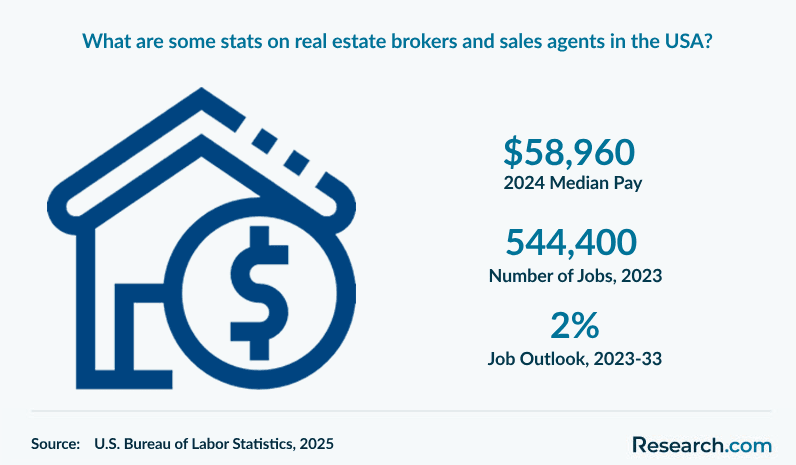
According to 2025 data from the U.S. Bureau of Labor Statistics, the median pay for real estate brokers and sales agents in 2024 was $58,960 per year, or $28.35 per hour. The field included 544,400 jobs in 2023. For 2023-33, employment is projected to grow by 2%, which is slower than average and represents an estimated 10,100 new jobs.
The graphic below summarizes these labor market figures. The data points to a large occupation with modest projected growth, meaning graduates should build differentiated skills, pursue relevant licenses where required, and develop strong professional networks.
What current and future trends are shaping real estate?
Real estate is being reshaped by technology, demographics, affordability pressures, workplace changes, sustainability concerns, and data-driven decision-making. Students choosing a degree program should look for coursework and experiences that prepare them for these shifts.
- PropTech and automation: Digital platforms, virtual tours, transaction tools, AI-supported analytics, and property management software are changing how real estate professionals work.
- Sustainability and green building: Energy efficiency, climate risk, building performance, and sustainable development are increasingly important in investment and development decisions.
- Demographic change: Millennial and Gen Z buyers, aging homeowners, and shifting household preferences influence housing demand and location choices.
- Remote and hybrid work: Workplace flexibility continues to affect office demand, suburban growth, residential preferences, and corporate real estate strategy.
- Housing affordability: Developers, policymakers, lenders, and community organizations are under pressure to address affordability constraints.
- Data-driven decisions: Market forecasting, valuation, investment analysis, and marketing increasingly rely on data. Students who want advanced preparation may compare the cheapest data science masters programs as a complementary path.
Questions to ask before enrolling
- Is the institution accredited, and is the business program separately accredited if that matters for my goals?
- How many of my transfer credits will apply toward the degree?
- Does the program help with state real estate licensing requirements, or is licensure separate?
- Are courses asynchronous, live, accelerated, or self-paced?
- What is the total cost after tuition, fees, books, and technology charges?
- Does the program offer internships, career coaching, employer connections, or alumni networking?
- Which specialization best fits my intended career: finance, development, property management, brokerage, appraisal, or corporate real estate?
- What outcomes do graduates pursue, and does the school publish career support information?
Key Insights
- A fast online real estate degree is most useful for career depth: It is valuable for students targeting property management, development, appraisal, corporate real estate, commercial brokerage, finance, or investment roles—not just basic sales licensure.
- Speed depends heavily on format and transfer credit: Short course blocks can help, but the biggest time savings often come from accepted prior credits, continuous enrollment, and clear degree planning.
- Accreditation should be non-negotiable: Always verify institutional accreditation before enrolling, especially if you may transfer credits, pursue graduate school, use financial aid, or seek employer recognition.
- Costs vary widely: Public in-state tuition often ranges from $300 to $500 per credit hour, while private institutions may exceed $600 per credit hour and total costs can often surpass $70,000.
- Real estate education is common among professionals: NAR’s 2024 member profile shows that 93% of REALTORS® have education beyond high school, with a bachelor’s degree being the most common credential at 34%.
- The job market is competitive: BLS data reports 544,400 real estate broker and sales agent jobs in 2023 and projected 2% growth for 2023-33, so specialized skills can help graduates stand out.
- Technology and analytics are changing the field: PropTech, AI-supported analysis, virtual tools, sustainability, and data-driven investment decisions are becoming increasingly important.
- Do not treat salary figures as guarantees: Earnings depend on role, geography, market cycles, experience, licensure, and performance, especially in commission-based paths.
References:
- National Association of REALTORS®. (2024, July 8). Quick real estate statistics. National Association of REALTORS®.
- PayScale. (2025). Bachelor's Degree, Real Estate Salary. PayScale.
- PayScale. (2025). Master of Business Administration (MBA), Real Estate Salary. PayScale.
- PayScale. (2025). Master of Science (MS), Real Estate Salary. PayScale.
- U.S. Bureau of Labor Statistics. (2025). Appraisers and assessors of real estate. U.S. Bureau of Labor Statistics.
- U.S. Bureau of Labor Statistics. (2023, May). Occupational employment and wages, May 2023: Real estate sales agents (41‑9022). U.S. Bureau of Labor Statistics.
- U.S. Bureau of Labor Statistics. (2023, May). Occupational employment and wages, May 2023: Real estate brokers (41‑9021). U.S. Bureau of Labor Statistics.
- U.S. Bureau of Labor Statistics. (2025). Real estate brokers and sales agents. U.S. Bureau of Labor Statistics.
- Yahoo Finance. (2025, May 27). E‑Brokerage Industry Forecast Report 2025–2030: AI‑Based Risk Profiling and Portfolio Rebalancing Tools Improve Client Retention and Satisfaction, Driving Revenues to $22.5 Billion. Yahoo Finance.
- Yahoo Finance. (2025, April). Modular Construction Market Forecast Report 2025–2030: Growing Construction Activities in China and India Are Forecast to Drive Market Expansion. Yahoo Finance.
- Yahoo Finance. (2025, May 22). U.S. Healthcare Real Estate Market Report 2025–2030: Market valued at USD 1.32 trillion in 2024, projected to reach USD 1.87 trillion by 2030. Yahoo Finance.
Other Things You Should Know About the Fastest Online Real Estate Degree Programs
Yes. If the program is meant to lead to licensure, its coursework should align with the state real estate commission and the exam requirements set by the relevant licensing body. In many states, candidates must complete pre-licensing education before taking the real estate salesperson exam.
The fastest online real estate degree programs typically take between 12 to 24 months to complete. This accelerated timeline allows students to quickly gain the necessary skills and credentials to enter the real estate industry while accommodating their schedules.