
2027 Fastest Online Bachelor's Degree in Entrepreneurship Programs

Co-Founder and Chief Data Scientist
If you want to earn a bachelor’s degree in entrepreneurship quickly, the main challenge is not finding an online business program; it is finding one that is flexible, accredited, transfer-friendly, and practical enough to help you build real business skills while you study.
Entrepreneurship degrees can serve different goals. Some students want to launch a startup, buy or grow a small business, or formalize experience they already have. Others want business training they can use in corporate innovation, product development, marketing, consulting, nonprofit leadership, or operations. The fastest online programs are usually built around shorter course terms, multiple start dates, year-round schedules, and policies that allow students to apply eligible transfer credits.
This guide explains what to expect from an online bachelor’s degree in entrepreneurship, how accelerated programs work, what they cost, which schools offer fast online options, and how to compare programs without choosing based on speed alone. It is designed for working adults, transfer students, career changers, military learners, and first-time college students who want a business degree that fits a realistic timeline.
Quick answer: What is the fastest way to earn an online bachelor’s degree in entrepreneurship?
The fastest path is usually an accredited online entrepreneurship bachelor’s program that offers short 5-, 7.5-, or 8-week courses, several start dates per year, and generous transfer credit policies. Most bachelor’s programs require about 120 credit hours and take three to four years, but students with prior college credit, military training, professional learning, or an associate degree may be able to shorten that timeline.
Speed should not be the only factor. Before enrolling, confirm accreditation, total cost, transfer credit limits, course format, business curriculum, student support, and whether the program matches your career goal: starting a company, working in an established organization, or preparing for graduate business study.
Why students choose an online bachelor’s degree in entrepreneurship
- Flexible scheduling: Online coursework can make it easier to study while working, raising a family, serving in the military, or managing a business idea.
- Transferable business skills: Entrepreneurship programs typically cover leadership, finance, marketing, operations, strategy, and innovation—skills used in startups and established organizations.
- Lower indirect costs: Online students may avoid expenses such as campus housing, relocation, parking, and commuting, although tuition and fees still vary widely by school.
What can I expect from an online entrepreneurship degree?
An online entrepreneurship degree is a business-focused bachelor’s program that teaches students how to evaluate opportunities, build business models, manage resources, market products or services, and lead teams. Most programs combine core business courses with entrepreneurship-specific classes on venture creation, small business operations, entrepreneurial finance, innovation, and business planning.
Students can expect a mix of accounting, finance, management, marketing, business law, strategy, and technology coursework. Many programs also include applied assignments, case studies, pitch projects, or a capstone in which students create a business plan or solve a real business problem.
The online format may be asynchronous, synchronous, or a mix of both. Asynchronous courses allow students to complete weekly assignments on their own schedule, while synchronous courses require live online meetings. Accelerated programs often compress courses into shorter terms, which can help students move faster but may also require stronger time management.
Where can I work with an online bachelor’s degree in entrepreneurship?
An entrepreneurship degree is not limited to starting a company. Graduates may pursue work in startups, small businesses, corporate innovation teams, marketing departments, consulting firms, nonprofit organizations, product teams, sales organizations, incubators, and business development units.
Common career directions include founder, small business manager, business consultant, product manager, marketing manager, innovation strategist, sales leader, nonprofit director, or social enterprise manager. The best fit depends on your experience, industry knowledge, risk tolerance, technical skills, and whether you want to build your own venture or apply entrepreneurial thinking inside an existing organization.
How much can I make with an online degree in entrepreneurship?
Earnings vary widely because entrepreneurship graduates enter very different roles. Business owners and startup founders may earn from around $50,000 to well over $100,000, but income depends heavily on the company’s revenue, costs, market, funding, and long-term survival. Salaried roles may provide more predictable compensation.
For traditional roles, business consultant and marketing manager positions commonly report average annual salaries between $75,000 and $100,000. Product managers and innovation-focused roles may exceed $110,000 in some cases. These figures should be treated as benchmarks, not guarantees; location, industry, experience, employer size, and performance can significantly affect pay.
- Fastest online bachelor’s degrees in entrepreneurship
- How long an online entrepreneurship bachelor’s takes
- Online vs. on-campus entrepreneurship programs
- Average cost of an online entrepreneurship degree
- Financial aid options for online entrepreneurship students
- Admissions requirements and prerequisites
- Common entrepreneurship degree courses
- Available entrepreneurship specializations
- How to choose the right online program
- Career paths after an entrepreneurship bachelor’s
- Job market for entrepreneurship graduates
- Accreditation and industry alignment
- Long-term return on investment
- Pathways to advanced business education
- Factors that affect entrepreneurship salary range
Fastest Online Bachelor’s Degrees in Entrepreneurship Programs
How do we rank schools?
Research.com evaluates online entrepreneurship programs using our methodology, with attention to factors such as program availability, academic credibility, online delivery, tuition information, and student-focused program features. To support the rankings process, we also reference established education data sources, including:
- IPEDS database
- Peterson's database, including the Distance Learning Licensed Data Set
- College Scorecard database
- National Center for Education Statistics
Program comparison at a glance
| School | Program | Reported program length | Cost per credit or course | Accreditation listed |
| Mount St. Mary’s University | Online Accelerated Undergraduate Degree in Entrepreneurship | Three years | $580 per credit | Middle States Commission on Higher Education (MSCHE) |
| Southern New Hampshire University | Online BSBA in Entrepreneurship | Three to four years | $330 per credit | New England Commission of Higher Education (NECHE) |
| American Public University | Online BA in Entrepreneurship | Four years | $350 standard rate; $250 military preferred rate; $315 Veteran Grant or APUS Opportunity Grant | Higher Learning Commission (HLC) |
| Lynn University | Online B.S. in Entrepreneurship | Four years | $375 per credit | International Accreditation Council for Business Education (IACBE) |
| Arizona State University Online | B.S. in Technological Entrepreneurship and Management | Four years | Varies based on credits; see tuition estimator on ASU’s site | Higher Learning Commission (HLC) |
| Louisiana State University | Online B.S. in Business Administration, Entrepreneurship Concentration | Four years | $340 per credit | Accreditation Council for Business Schools and Programs (ACBSP) |
| Wilson College Online | Bachelor of Science in Entrepreneurship | Four years | $380 | Middle States Commission on Higher Education |
| University of North Carolina Greensboro | B.S. in Entrepreneurship | Four years | $689.63 per credit (in-state online rate) | Southern Association of Colleges and Schools Commission on Colleges (SACSCOC) |
| Lamar University | Online Bachelor of Business Administration in Entrepreneurship | Four years | $314 per credit, including distance learning fee | AACSB; SACSCOC institutional accreditation |
| Strayer University | Bachelor of Business Administration, Entrepreneurship concentration | Four years | $1525 per course | Middle States Commission on Higher Education and ACBSP |
1. Mount St. Mary’s University - Online Accelerated Undergraduate Degree in Entrepreneurship
Mount St. Mary’s University offers an accelerated online entrepreneurship degree designed for adults who want a shorter path to a business-focused bachelor’s credential. Courses are delivered year-round in flexible 5- and 8-week sessions, using a combination of synchronous and asynchronous formats. The curriculum emphasizes business development, management, organizational leadership, and practical application, allowing students to connect coursework to workplace or venture-building situations.
- Program Length: Three years
- Tracks/concentrations: N/A
- Cost per Credit/Tuition: $580 per credit
- Accreditation: Middle States Commission on Higher Education (MSCHE)
2. Southern New Hampshire University – Online BSBA in Entrepreneurship
Southern New Hampshire University offers an online entrepreneurship concentration within a business administration degree. Students study core business areas such as accounting, finance, human resources, and marketing while also completing entrepreneurship courses in small business management and business plan development. The program runs year-round in six 8-week terms, provides flexible start dates, and allows students to transfer up to 90 credits, which can shorten time to completion for eligible learners.
- Program Length: Three to four years
- Tracks/concentrations: N/A
- Cost per Credit/Tuition: $330 per credit
- Accreditation: New England Commission of Higher Education (NECHE)
3. American Public University - Online BA in Entrepreneurship
American Public University provides a fully online BA in Entrepreneurship for students interested in launching, managing, or growing a business. The program covers business planning, marketing, operations, finance, money management, legal considerations, technological innovation, innovation design, and strategic growth. Courses are offered in flexible eight-week terms, which can help students maintain momentum while balancing work or other responsibilities.
- Program Length: Four years
- Tracks/concentrations: N/A
- Cost per Credit/Tuition: $350 (standard rate), $250 (military preferred rate), $315 (Veteran Grant or APUS Opportunity Grant).
- Accreditation: Higher Learning Commission (HLC)
4. Lynn University – Online B.S. in Entrepreneurship
Lynn University offers a fully online B.S. in Entrepreneurship for students interested in venture creation, funding, valuation, negotiation, and business scaling. The curriculum pairs entrepreneurship-specific coursework with core business subjects such as marketing, finance, management, and strategy. Students complete project-based assignments tied to business scenarios, learn from faculty with entrepreneurial experience, and take courses in 8-week terms with three start dates each year.
- Program Length: Four years
- Tracks/concentrations: N/A
- Cost per Credit/Tuition: $375 per credit
- Accreditation: International Accreditation Council for Business Education (IACBE)
5. Arizona State University Online – B.S. in Technological Entrepreneurship and Management
Arizona State University offers an online program focused on technology-driven entrepreneurship and management. Students study ideation, operations, growth strategy, disruptive technology, and problem-solving through a STEAM-based approach that integrates science, technology, engineering, arts, and math. The program includes 42 courses across 120 credit hours, delivered in 7.5-week sessions with three annual start dates.
- Program Length: Four years
- Tracks/concentrations: N/A
- Cost per Credit/Tuition: Varies based on credits; see tuition estimator on ASU’s site
- Accreditation: Higher Learning Commission (HLC)
6. Louisiana State University – Online B.S. in Business Administration, Entrepreneurship Concentration
Louisiana State University Alexandria offers a 120-credit online B.S. in Business Administration with an entrepreneurship concentration, delivered by faculty from the E. J. Ourso College of Business. The program combines business fundamentals with entrepreneurial training and includes practical opportunities such as pitch competitions, internships, the LEEPS entrepreneurship immersion, incubator access, and tech-transfer resources.
- Program Length: Four years
- Tracks/concentrations: Entrepreneurship
- Cost per Credit/Tuition: $340 per credit
- Accreditation: Accreditation Council for Business Schools and Programs (ACBSP)
7. Wilson College Online – Bachelor of Science in Entrepreneurship
Wilson College offers an online Bachelor of Science in Entrepreneurship centered on applied business planning, accounting, case analysis, and practical venture skills. Courses are delivered asynchronously, which can benefit students who need schedule flexibility. The program also emphasizes ethical innovation and social responsibility, making it relevant for students interested in community-focused or mission-driven ventures. The average class size is small, with a 13:1 ratio.
- Program Length: Four years
- Tracks/concentrations: N/A
- Cost per Credit/Tuition: $380
- Accreditation: Middle States Commission on Higher Education
8. University of North Carolina Greensboro - B.S. in Entrepreneurship (Fully Online Option Available)
University of North Carolina at Greensboro offers an entrepreneurship major with focus areas that include social entrepreneurship, international ventures, healthcare, franchising, sports, family business, creative industries, and technology. The program emphasizes experiential learning through external projects, internships, pitch competitions, campus organizations, and connections with regional businesses and incubators.
- Program Length: Four years
- Tracks/concentrations: Creative Industries; International; Family Business; Social; Healthcare; Franchising; Sports; Technology & Innovation
- Cost per Credit/Tuition: $689.63 per credit (in-state online rate)
- Accreditation: Southern Association of Colleges and Schools Commission on Colleges (SACSCOC)
9. Lamar University – Online Bachelor of Business Administration in Entrepreneurship
Lamar University offers an online BBA in Entrepreneurship for students who want to develop practical business skills across accounting, finance, management, marketing, data analysis, and SAP training. The 120-credit program includes courses such as Entrepreneurial Market Opportunities and Business Analysis I, helping students connect business concepts to venture planning and operations.
- Program Length: Four years
- Tracks/concentrations: Entrepreneurship concentration within B.B.A.
- Cost per Credit/Tuition: $314 per credit (includes distance learning fee)
- Accreditation: AACSB; SACSCOC institutional accreditation
10. Strayer University – Bachelor of Business Administration (Concentration in Entrepreneurship)
Strayer University offers an online BBA with an entrepreneurship concentration focused on practical small business and venture skills. The 120+ credit curriculum includes Technology & Innovation in Entrepreneurship, Financing Entrepreneurship, and Feasibility & Analysis. Students take flexible eight-to-eleven-week courses, may transfer up to 28 credits, and can access no-cost general education classes through Sophia Learning.
- Program Length: Four years
- Tracks/concentrations: Entrepreneurship
- Cost per Credit/Tuition: $1525 per course
- Accreditation: Middle States Commission on Higher Education and ACBSP
How long does it take to complete an online bachelor’s degree in entrepreneurship program?
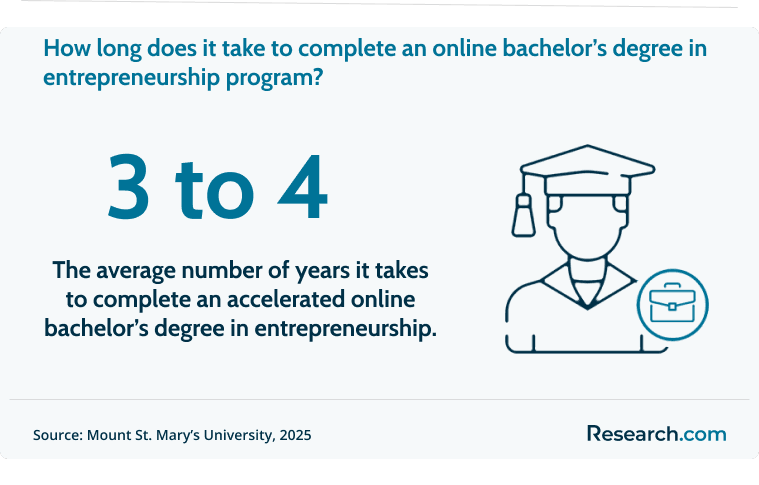
Most online bachelor’s degrees in entrepreneurship take three to four years, depending on the number of credits required, the student’s transfer credits, and whether the program uses accelerated terms. A typical bachelor’s program requires around 120 credit hours, which usually matches a four-year full-time timeline.
Accelerated online programs can shorten the path by offering 5-, 7-, 7.5-, or 8-week courses, multiple start dates, and year-round enrollment. However, shorter courses are often more intense. Students who work full time should compare weekly workload expectations before enrolling in several accelerated courses at once.
Transfer credit is one of the biggest time-saving factors. Some programs, like flexible options sometimes found in BCBA programs online, allow students to apply eligible prior credits toward degree requirements. Students with an associate degree or substantial previous coursework should request a formal transfer evaluation before committing to a school.
| Student situation | Likely timeline | What to check before enrolling |
| First-time full-time student | Usually four years | Course sequencing, annual start dates, and summer availability |
| Student with transfer credits | Potentially three years or less, depending on accepted credits | Maximum transfer credit limit and how credits apply to major requirements |
| Working adult studying part time | Often four years or longer | Part-time pacing, course load limits, and financial aid eligibility |
| Highly motivated accelerated learner | May finish faster in programs with short terms | Weekly workload, prerequisite chains, and burnout risk |
How does an online bachelor’s degree in entrepreneurship program compare to an on-campus program?
Online and on-campus entrepreneurship degrees often cover similar academic content, but the learning experience differs. The right choice depends on your schedule, learning style, networking needs, budget, and whether you want a campus-based college experience.
| Factor | Online entrepreneurship degree | On-campus entrepreneurship degree |
| Schedule | Often more flexible, especially if courses are asynchronous | Usually follows set class times and campus calendars |
| Pace | May offer accelerated terms, rolling starts, and year-round study | Often follows semester or quarter schedules |
| Networking | May include virtual events, online groups, remote mentoring, and digital collaboration | Provides in-person clubs, pitch events, guest speakers, and informal peer connections |
| Cost | Can reduce relocation, commuting, and housing expenses | May include additional campus-based costs, but scholarships and in-state tuition can matter |
| Best for | Working adults, parents, transfer students, military learners, and self-directed students | Students who want face-to-face learning, campus resources, and in-person entrepreneurship communities |
Students comparing fast business-related options may also look at the shortest economics degree programs online if they want a stronger foundation in markets, policy, and economic analysis. Online networking and support models are also common in other adult-focused programs, including affordable online ESL graduate certificate programs, where remote students often need flexible advising and career support.
What is the average cost of an online bachelor’s degree in entrepreneurship program?
The cost of an online bachelor’s degree in entrepreneurship depends on tuition rate, transfer credits, fees, course load, residency status, military discounts, institutional grants, and whether books or technology costs are included. As with the fastest online MBA programs in sports management, students should compare total program price rather than tuition rate alone.
- Southern New Hampshire University, standard full-time or part-time: $39,600 total for 120 credit hours in the online B.S. in Business Administration with an Entrepreneurship concentration, delivered in 8-week terms.
- Southern New Hampshire University, active-duty military and spouses: $27,720 total for 120 credit hours through the discounted military rate.
- American Public University, Veteran Grant or APUS Opportunity Grant: $37,800 total for 120 credit hours for eligible students in the online B.A. in Entrepreneurship.
Some students may later pursue graduate business study. If that is part of your plan, it can help to understand differences between applied business and education-focused doctoral routes, such as DBA vs EdD, before choosing a long-term academic path.
The chart below summarizes estimated total cost for 120 credit hours at selected schools and enrollment scenarios.
What are the financial aid options for students enrolling in an online bachelor’s degree in entrepreneurship program?
Online entrepreneurship students may qualify for many of the same aid sources as campus-based students, as long as the institution and program meet eligibility requirements. Always confirm aid eligibility with the school’s financial aid office before enrolling.
- Federal financial aid: Students can submit the Free Application for Federal Student Aid (FAFSA) to be considered for federal grants, loans, and work-study programs.
- State aid: Some states provide grants or scholarships for residents attending eligible online programs. Rules vary by state and institution.
- School scholarships and discounts: Colleges may offer awards for online learners, business majors, transfer students, military-affiliated students, or first-generation college students.
- Employer tuition assistance: Working students should ask whether their employer reimburses tuition for business, leadership, management, or entrepreneurship-related coursework.
- Military and veteran education benefits: Active-duty service members, veterans, spouses, and dependents may be able to use GI Bill®, Tuition Assistance, or school-specific military rates.
Questions to ask about cost before you enroll
- What is the total estimated cost after transfer credits are applied?
- Are online students charged technology, distance learning, graduation, or course material fees?
- Will taking accelerated courses affect my financial aid eligibility?
- Do tuition discounts apply every term or only under specific conditions?
- How much will I pay out of pocket if my transfer credits are not accepted?
What are the prerequisites for enrolling in an online bachelor’s degree in entrepreneurship program?
Admissions requirements for online entrepreneurship bachelor’s programs are usually similar to other undergraduate business degrees. Like an accelerated sports management bachelor's degree online, these programs often appeal to students who want a practical business credential with flexible pacing.
- High school diploma or GED: Applicants generally need proof of high school completion or an equivalent credential.
- Minimum GPA: Some schools require a minimum cumulative GPA, commonly around 2.0 to 2.5, while others may review applicants more holistically.
- Standardized tests: Many online undergraduate programs are test-optional, though policies vary by institution.
- Application and fee: Students typically complete an online application and may need to pay an application fee unless a waiver is available.
- Transfer transcripts: Applicants with prior college coursework must usually submit official transcripts for credit evaluation.
- English proficiency: Non-native English speakers may need to provide TOEFL or IELTS scores, depending on school policy.
Students who are planning beyond the bachelor’s degree may also compare graduate options such as the fastest online master’s in emergency management programs if they are interested in crisis leadership, homeland security, or disaster response careers. Likewise, comparing outcomes in other fields, such as a human services degree salary, can help students think more clearly about cost, career fit, and return on investment.
What courses are typically in an online bachelor’s degree in entrepreneurship program?
Online entrepreneurship degrees usually combine broad business education with applied venture-building coursework. Students learn how organizations operate, how markets behave, how to manage financial decisions, and how to evaluate whether a business idea is viable. Similar to an accelerated online digital photography degree, entrepreneurship programs often combine technical knowledge with creative, market-facing application.
| Course area | What students usually learn | Why it matters |
| Principles of Management | Planning, organizing, leading, decision-making, and team supervision | Helps students understand how businesses coordinate people and operations, including roles related to what is a logistics manager |
| Entrepreneurial Finance | Cash flow, budgeting, forecasting, funding options, and early-stage financial decisions | Supports realistic business planning and reduces the risk of underestimating capital needs |
| Marketing for Entrepreneurs | Customer research, positioning, branding, digital marketing, and campaign planning | Builds the ability to reach buyers efficiently, a skill also relevant in an accelerated graphic design degree online |
| Business Plan Development | Market analysis, revenue models, financial projections, and strategic goals | Often prepares students for a capstone, pitch, or venture proposal |
| Small Business Management | Hiring, customer service, compliance, daily operations, and profitability | Helps students understand the realities of running a small organization |
| Legal Issues in Business | Contracts, liability, intellectual property, business formation, and regulatory concerns | Reduces avoidable legal and compliance mistakes |
| E-Commerce and Digital Business | Online business models, digital storefronts, platforms, and web-based marketing | Prepares students for internet-based ventures and digital revenue channels |
Students who want deeper analytical training after completing an entrepreneurship degree may explore what can you do with a master's in business analytics degree, especially if they are interested in consulting, product strategy, or data-informed decision-making.
What types of specializations are available in an online bachelor’s degree in entrepreneurship program?
Not every online entrepreneurship bachelor’s program offers formal concentrations, but many provide electives or focus areas that allow students to tailor the degree. Choosing a specialization can help you align coursework with the type of business, industry, or role you want after graduation.
| Specialization | Best for students interested in | Common topics |
| Small Business Management | Owning, managing, or improving a local or service-based business | Staffing, budgeting, operations, customer retention, and profitability |
| Digital Entrepreneurship | E-commerce, online services, content businesses, or technology-enabled ventures | Digital marketing, platforms, online sales, and web-based business models |
| Social Entrepreneurship | Mission-driven ventures, nonprofits, community enterprises, or sustainability-focused businesses | Impact models, funding, stakeholder management, and social value creation |
| Innovation and Product Development | New product ideas, prototyping, product management, or corporate innovation | Ideation, design thinking, testing, launch planning, and scaling |
| Family Business or Franchise Management | Students entering an existing family company or franchise system | Succession, brand standards, operations, ownership structure, and growth strategy |
| Global Entrepreneurship | International business models or ventures serving global markets | Cross-border operations, international markets, culture, and trade considerations |
Students who want to combine entrepreneurial skills with advanced technology management may later consider an accelerated master's degree in management information systems online, especially if they want to work at the intersection of business strategy, systems, and digital transformation.
How do I choose the best online bachelor’s degree in entrepreneurship program?
The best online entrepreneurship program is the one that matches your goal, budget, schedule, transfer credit profile, and learning style. A fast program is useful only if it is credible, manageable, and aligned with the work you want to do.
- Verify accreditation: Confirm institutional accreditation through a recognized accreditor such as the Higher Learning Commission or another approved regional accreditor. Accreditation affects financial aid, transfer credit, graduate school eligibility, and employer recognition.
- Compare delivery format: Decide whether asynchronous courses, live online sessions, or a hybrid model best fits your schedule and learning preferences.
- Request a transfer evaluation: Do not rely on general transfer promises. Ask how many credits will apply to general education, business core, electives, and major requirements.
- Calculate total cost: Include tuition, fees, books, technology costs, graduation fees, and the impact of transfer credits or discounts.
- Review the curriculum: Look for courses in finance, marketing, business planning, legal issues, operations, strategy, and digital business. If graduate study is a goal, choose a program that can connect well with a fast-track online entrepreneurship master's degree.
- Check student support: Online students should have access to academic advising, tutoring, career services, library resources, technology help, and faculty communication.
- Look for applied learning: Pitch projects, capstones, internships, incubators, mentorship, and business plan assignments can make the degree more useful than theory alone.
Common mistakes to avoid when choosing an online entrepreneurship degree
| Mistake | Why it can hurt you | Better approach |
| Choosing only the fastest program | A shorter timeline may mean heavier weekly workloads or fewer support services | Compare pace, workload, advising, and completion requirements |
| Ignoring accreditation | Credits may not transfer, financial aid eligibility may be limited, and graduate schools may not accept the degree | Confirm institutional accreditation before applying |
| Looking only at tuition per credit | Fees, books, and unaccepted transfer credits can increase total cost | Ask for a full cost estimate based on your credit evaluation |
| Assuming online means self-paced | Many online programs still have weekly deadlines or required live sessions | Ask whether courses are asynchronous, synchronous, or both |
| Expecting guaranteed startup success | A degree can build skills, but businesses still face market, funding, and operational risk | Use the program to test ideas, build networks, and develop realistic financial plans |
What career paths are available for graduates of online bachelor’s degrees in entrepreneurship programs?
An online bachelor’s degree in entrepreneurship can support self-employment, management roles, consulting, marketing, product development, innovation, and nonprofit leadership. The degree is especially useful for students who want a broad business foundation with an emphasis on identifying opportunities and turning ideas into action. Similar skill sets also appear in an accelerated online public administration degree, particularly for students interested in leadership, budgeting, and organizational problem-solving.
- Business Owner/Founder ($70,781): Graduates may start product-based companies, service businesses, consulting practices, online ventures, or local enterprises. Income varies substantially based on business performance.
- Business Consultant ($99,275): Consultants advise organizations on strategy, operations, market positioning, process improvement, and growth opportunities.
- Product Manager ($103,314): Product managers coordinate product strategy, customer needs, development priorities, marketing alignment, and product lifecycle decisions.
- Marketing Manager ($81,302): Marketing managers plan campaigns, analyze audiences, manage brand messaging, and support revenue growth through customer engagement.
- Innovation Strategist or Corporate Intrapreneur ($134,587): These professionals help established organizations develop new business models, processes, products, or internal ventures. Students who want to pair innovation with data skills may also research how to become a business intelligence developer.
- Nonprofit Director or Social Enterprise Manager ($79,805): Graduates interested in impact-focused work may lead mission-driven organizations, manage programs, or build social enterprises.
The chart below compares common career options and reported pay figures for entrepreneurship graduates.
What is the job market for graduates with an online bachelor’s degree in entrepreneurship?
The job market for entrepreneurship graduates is broad because the degree develops skills used across business and financial occupations, management, marketing, consulting, product work, and operations. According to labor projections, overall employment in business and financial occupations is expected to grow faster than the average for all occupations from 2023 to 2033.
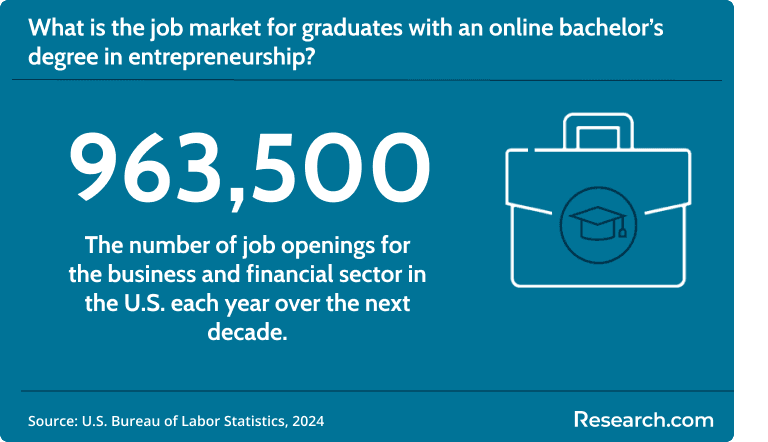
On average, around 963,500 job openings are projected each year in the business and financial sector. This does not mean every entrepreneurship graduate will enter a business or financial occupation, but it does show continued demand for professionals with analytical, strategic, financial, and organizational skills.
Graduates may apply entrepreneurship training in niche areas as well. For example, a student could build an e-commerce or creative venture after completing affordable jewelry design programs online, or add operational expertise through an accelerated online bachelor's degree in supply chain management to pursue logistics, procurement, or supply chain roles.
Current trends affecting entrepreneurship students
- Digital business models are standard: Students should expect to learn or independently develop skills in e-commerce, digital marketing, analytics tools, and online customer acquisition.
- Employers value applied experience: Projects, internships, business plans, pitch competitions, and portfolio evidence can help graduates demonstrate practical ability.
- AI and automation are changing business tasks: Entrepreneurs increasingly need to understand how technology affects marketing, operations, customer service, product development, and decision-making.
- Credential stacking is common: Some graduates add certificates, MBAs, analytics training, or industry credentials to strengthen specialized expertise.
Are online entrepreneurship programs accredited and aligned with industry needs?
Accreditation is one of the most important checks for any online entrepreneurship degree. Institutional accreditation indicates that a school meets recognized academic standards, and it can affect federal financial aid eligibility, transfer credits, graduate admissions, and employer confidence.
Industry alignment is a separate but related question. A credible entrepreneurship program should do more than teach business theory. Look for applied projects, faculty with business experience, advisory boards, internships, pitch opportunities, incubator access, mentorship, or partnerships with local businesses. Programs with practical components, such as those found in accelerated finance online programs, can help students connect academic learning to market realities.
What graduates say about earning an entrepreneurship degree online
-
: "
"Studying entrepreneurship online let me keep building my business while taking courses I could use right away. The assignments were practical, and my instructors helped me think through real launch decisions." – Maggie
"
-
: "
"I had a full-time job and two children, so an online format made the degree possible. It still required discipline, but I could move through the program without walking away from my responsibilities." – Carlos
"
-
: "
"Online learning forced me to become organized, independent, and resourceful. Those habits now show up every day in how I manage my startup and work with people in different locations." – Rosa
"
What is the long-term return on investment for an online entrepreneurship degree?
The long-term ROI of an online entrepreneurship degree depends on cost, debt, transfer credits, career path, business success, salary growth, and whether the student uses the program to build marketable skills. For some students, the value comes from launching or improving a business. For others, it comes from qualifying for management, consulting, product, marketing, or innovation roles.
ROI is stronger when students choose an accredited program, minimize unnecessary borrowing, complete the degree efficiently, build a portfolio of business projects, and use school resources such as career services, mentorship, and networking. Graduates who want additional advancement may later pursue a most affordable online MBA to deepen leadership, finance, and strategy skills without overextending their budget.
How can an online entrepreneurship degree lead to advanced business education?
An entrepreneurship bachelor’s degree can prepare students for graduate-level business education by building a foundation in management, finance, marketing, operations, and strategic thinking. Students who later want executive leadership roles may consider advanced programs that focus on global strategy, organizational leadership, finance, and high-level decision-making.
For experienced professionals, comparing options such as the best value for money executive MBA online program can help identify graduate programs that build on entrepreneurial training while supporting career growth. Before applying, students should check GPA requirements, work experience expectations, accreditation, delivery format, and employer tuition support.
What factors impact your entrepreneurship salary range?
Entrepreneurship salaries vary because graduates follow different paths. A founder’s income may depend on revenue, profit margins, funding, industry, customer demand, and the maturity of the business. Salaried graduates may see compensation shaped by role, employer size, location, industry, experience, technical skill, and leadership responsibility.
Professional networks, internships, industry knowledge, sales ability, digital marketing skills, financial literacy, and adaptability can also affect earnings. Students comparing possible outcomes can review the broader entrepreneurship salary range to understand how different roles and pathways may influence pay.
Key Insights
- The fastest online entrepreneurship bachelor’s programs usually combine short terms, year-round scheduling, multiple start dates, and transfer-friendly policies.
- Most programs take three to four years and require around 120 credit hours, but prior college credit can significantly change the timeline.
- Do not choose a program based on speed alone. Accreditation, total cost, curriculum quality, transfer rules, support services, and applied learning matter just as much.
- Estimated program costs in this guide range from $27,720 to $39,600 for selected 120-credit scenarios, depending on school, student status, and discounts.
- Entrepreneurship graduates can pursue self-employment, consulting, marketing, product management, innovation, nonprofit leadership, or small business management.
- Business and financial occupations are projected to have around 963,500 openings each year from 2023 to 2033, but individual outcomes depend on experience, role, industry, and location.
- The strongest ROI comes from pairing the degree with practical projects, market testing, networking, financial discipline, and careful borrowing decisions.
References:
- American Public University. (2025). About the Online Entrepreneurship Degree Program. APU
- Forbes. (2024). Small Business Owner | Average Age, Salary, More. Forbes
- Glassdoor. (2025). Salary: Product Manager in the United States 2025. Glassdoor
- Mount St. Mary’s University. (2025). Online Accelerated Undergraduate Degree in Entrepreneurship. MSMU
- Southern New Hampshire University. (2025). Entrepreneurship Degree Online. SNHU
- U.S. Bureau of Labor Statistics. (2025). OOH: Business and Financial Occupations. U.S. BLS
- ZipRecruiter. (2025). Salary: Business Consultant (June, 2025) United States. ZipRecruiter
Other Things You Should Know About the Fastest Online Bachelor's Degree in Entrepreneurship Programs
Yes. Many online entrepreneurship bachelor’s programs accept up to 90 transfer credits toward a 120-credit degree, which can cut completion time by about half. Schools usually require official transcripts and may limit how many credits can come from lower-division or prior business courses.
Admission prerequisites typically include a high school diploma or GED, a minimum GPA of 2.5, and submission of standardized test scores such as SAT or ACT. Some programs may also require a statement of purpose or letters of recommendation.
Yes, fast online Bachelor's Degree in Entrepreneurship programs for 2027 can be accredited by recognized bodies such as AACSB or the Distance Education Accrediting Commission. Accreditation ensures program quality and that credits are transferable, impacting future employment and advanced studies.


