2027 Best Accelerated Marketing Degree Programs Online

Co-Founder and Chief Data Scientist
An accelerated online marketing degree is designed for students who want a faster route into marketing, digital strategy, analytics, advertising, brand management, or market research without spending the standard four years in a traditional program. It can be a practical option for working adults, transfer students, military learners, career changers, and professionals who already have college credits or relevant experience.
The key decision is not simply whether the degree is “fast.” The better question is whether the program is accredited, affordable, career-aligned, flexible enough for your schedule, and strong enough to help you compete in a marketing job market shaped by analytics, artificial intelligence, privacy rules, content platforms, and digital advertising tools. This guide explains what accelerated online marketing degrees include, how long they take, what they cost, which careers they can support, and how to compare programs before applying.
Quick answer: Is an accelerated online marketing degree worth it?
An accelerated online marketing degree can be worth it if you choose an accredited program, can handle a compressed course schedule, and want to enter or advance in marketing sooner. These programs may help students finish faster than a traditional bachelor’s timeline, especially when they allow transfer credits, year-round terms, competency-based coursework, or prior learning credit. Graduates may pursue roles such as marketing manager, advertising and promotions manager, market research analyst, digital marketing manager, or digital marketer. Reported salary figures in this guide include $157,620 for marketing managers and $74,680 for market research analysts, while other role-specific figures vary by occupation, industry, location, and experience.
What are the main benefits of an accelerated online marketing degree?
- Faster completion: Accelerated formats reduce time in school by using shorter terms, intensive coursework, transfer-friendly policies, or competency-based pacing.
- Flexible access: Online delivery can make it easier to study while working, caregiving, serving in the military, or managing other responsibilities.
- Career-focused training: Many programs emphasize digital marketing, consumer behavior, market research, analytics, brand strategy, and campaign planning.
- Potential salary upside: Marketing roles can pay competitively, with marketing managers listed at $157,620 and market research analysts at $74,680.
- Practical portfolio opportunities: Strong programs include projects, case studies, internships, or capstones that help students show employers what they can do.
What can I expect from an accelerated online marketing degree?
An accelerated online marketing degree covers the same core business and marketing concepts found in many traditional programs, but the pacing is more condensed. Students typically study marketing strategy, consumer behavior, research methods, digital campaigns, branding, social media, marketing analytics, and business communication. Because accelerated formats move quickly, learners should expect frequent deadlines, shorter breaks, and a heavier weekly workload than a standard semester-based schedule.
The best programs do more than teach marketing theory. They require students to analyze audiences, interpret campaign data, build marketing plans, evaluate competitors, develop brand messages, and use digital platforms. This matters because employers increasingly expect entry-level and mid-level marketing candidates to understand both creative strategy and measurable performance.
| What to evaluate | Why it matters | What to look for |
| Accreditation | It affects degree credibility, financial aid eligibility, transfer options, and employer recognition. | Regional accreditation and, where available, business accreditation such as ACBSP or AACSB. |
| Program pace | Accelerated does not mean easier; it usually means more work in less time. | Clear term length, weekly workload expectations, and realistic completion timelines. |
| Transfer policy | Transfer credits can make the largest difference in how quickly and affordably you finish. | Generous credit transfer, prior learning assessment, and transparent credit evaluation. |
| Career alignment | Marketing is broad, so the curriculum should match your intended role. | Courses in analytics, digital marketing, brand strategy, social media, market research, or sales. |
| Experiential learning | Employers often want proof of applied skills, not only completed coursework. | Capstones, internships, portfolio projects, client simulations, or live case studies. |
Where can I work with an accelerated online marketing degree?
Marketing graduates work across many sectors because organizations need to understand customers, position products, communicate value, and measure campaign performance. The original labor market data cited for this guide highlights opportunities in industries such as:
- Advertising, Public Relations, and Related Services
- Sound Recording Industries
- Management of Companies and Enterprises
- Lessors of Nonfinancial Intangible Assets (except Copyrighted Works)
Marketing and research roles are also concentrated in major states and jurisdictions such as:
- New York
- Maine
- Maryland
- the District of Columbia
- Connecticut
- Colorado
How much can I make with an accelerated online marketing degree?
Earnings depend on the job title, employer, location, experience level, industry, and whether the role is entry-level, specialist, managerial, or executive. Based on Bureau of Labor Statistics’ May 2023 data cited in the original article, market research analysts can earn $74,680, while marketing managers make around $131,870. Elsewhere in the same source material, marketing managers are listed at $157,620.
The highest-paying industry examples cited for marketing-related occupations include:
- Wholesale Trade Agents and Brokers for Advertising and Promotions Managers, who can earn $223,700.
- Web Search Portals, Libraries, Archives, and Other Information Services for Marketing Managers, Market Research Analysts, and Marketing Specialists, with cited earnings of $265,300 and $136,560, respectively.
Top-paying cities cited for advertising and promotions managers are:
- New York: $216,080
- New Jersey: $178,480
- California: $ 175,080
Top-paying cities cited for market research analysts and marketing specialists are:
- Washington: $106,420
- California: $100,040
- New York: $96,200
These figures should be treated as benchmarks, not guarantees. A degree can improve your qualifications, but salary outcomes also depend on your portfolio, technical skills, internships, certifications, networking, and local job market conditions.
- 2027 Best Accelerated Marketing Degree Programs Online
- How long does it take to complete an online marketing degree?
- How does an online marketing degree compare to an on-campus program?
- What is the average cost of an online marketing degree?
- What are the financial aid options for students enrolling in an online marketing degree?
- What are the prerequisites for enrolling in an online marketing degree?
- What courses are typically in an online marketing degree?
- What types of specializations are available in online marketing degrees?
- How to Choose the Best Online Marketing Degree
- What are the emerging trends shaping the future of online marketing professionals?
- What other specializations can I pursue within an online marketing degree?
- What are the potential challenges of pursuing an accelerated online marketing degree?
- What career paths are available for graduates of online marketing degrees?
- How are internships and real-world projects integrated into accelerated online marketing degree programs?
- How can networking and mentorship accelerate career growth in marketing?
- Should I Pursue a Doctoral Degree to Enhance My Marketing Career?
- Why is accreditation essential for accelerated online marketing degree programs?
- Is an Accelerated Online Marketing Degree Ideal for Career Switchers?
- What is the job market for graduates with an online marketing degree certificate?
- What is the return on investment of an accelerated online marketing degree?
- How can professional certifications enhance the value of your accelerated online marketing degree?
- How to apply to an accelerated online marketing degree program?
- How to further advance your marketing career with graduate programs?
2027 Best Accelerated Marketing Degree Programs Online
The programs below are examples of accelerated online pathways for students comparing marketing degrees. Use this list as a starting point, then verify current tuition, transfer rules, accreditation, course sequencing, and completion estimates directly with each school. Marketing managers are cited in the original data at an average salary of $131,870 per year, but salary should not be the only reason to choose a program.
How do we rank schools?
Research.com rankings are built from research and data analysis. You can review the full process on our methodology page. Sources used for this ranking include:
- IPEDS database
- Peterson’s database
- Distance Learning Licensed Data Set, College Scorecard database
- National Center for Education Statistics
| School | Shortest possible time to complete | Tuition | Credits or classes required | Accreditation listed |
| Colorado State University – Global Campus | one year | $356 per credit | 120 credits | ACBSP |
| Southern New Hampshire University | One year | $330 per credit | 120 credits | ACBSP |
| Sullivan University | One and a half years | $320 per credit | 180 credits | ACBSP |
| Colorado Technical University | two years | $325 per credit | 180 credits | ACBSP |
| Western Governors’ University | two years | $3,755 per six-month term is | 35 classes (estimated 105 credits) | ACBSP |
1. Colorado State University – Global Campus
Colorado State University – Global Campus is the online campus of the public Colorado State University System and was established in 2007. CSU-Global operates as an independent, self-governing institution focused on distance education for working adults. Its fast Bachelor in Marketing combines marketing theory, applied communication, quantitative tools, and management concepts.
- Shortest possible time to complete: one year
- Tracks/Concentrations: Consumer Behavior, Product and Brand Management, Promotion and Public Relations, International and Multi-Cultural Marketing.
- Tuition: $356 per credit.
- Required Credits to Graduate: 120 credits.
- Accreditation: Accreditation Council for Business Schools and Programs (ACBSP)
2. Southern New Hampshire University
Southern New Hampshire University is a nonprofit private institution in Manchester, New Hampshire, founded in 1932. The university serves 73,177 students, including around 60,000 online learners. Its online bachelor’s in marketing includes career-focused coursework in brand communication, consumer behavior, market research, and social media.
- Shortest possible time to complete: One year
- Tracks/Concentrations: Social Media, Integrated Marketing Communications, Strategic Brand Management, Consumer Behavior.
- Tuition: $330 per credit
- Required Credits to Graduate: 120 credits.
- Accreditation: ACBSP
3. Sullivan University
Sullivan University is a private university in Louisville, Kentucky, established in 1962. It serves 3,165 students and offers academic programs from diplomas through doctoral degrees. Its Bachelor’s in Business Administration with a concentration in Marketing is built for students seeking a flexible, career-oriented business pathway.
- Shortest possible time to complete: One and a half years
- Tracks/Concentrations: Marketing Research, Sales Management, Building a Brand.
- Tuition: $320 per credit.
- Required Credits to Graduate: 180 credits.
- Accreditation: ACBSP
4. Colorado Technical University
Colorado Technical University, located in Colorado Springs, is a private university with a strong distance education presence. Founded in 1965, CTU offers programs in areas such as Accounting, Computer Science, Business Administration, and Health Sciences. More than 92% of its 26,000 students are enrolled online, and its Bachelor’s in Business Administration with a concentration in Marketing is structured for online learners.
- Shortest possible time to complete: two years
- Tracks/Concentrations: Consumer Behavior, Applied Marketing Management, Marketing and the Virtual Marketplace, Advertising and Public Relations.
- Tuition: $325 per credit.
- Required Credits to Graduate: 180 credits.
- Accreditation: ACBSP
5. Western Governors’ University
Western Governors University, headquartered in Salt Lake City, Utah, was founded in 1997 and serves 78,709 non-traditional learners. WGU uses a competency-based model, which can help motivated students move through material more quickly after demonstrating mastery. Transfer credits may also shorten the path to completion.
- Shortest possible time to complete: two years
- Tracks/Concentrations: Marketing Fundamentals, Marketing Applications, Principles of Management, Marketing Management Tasks.
- Tuition: $3,755 per six-month term is
- Required Credits to Graduate: 35 classes (estimated 105 credits)
- Accreditation: ACBSP
If you are comparing business-related alternatives, you may also want to review programs in finance, such as affordable online MBA in finance options, especially if your long-term goals are closer to corporate finance, investment analysis, or financial management than marketing.
What online marketing graduates say about their programs
- “Online study helped me keep my full-time job and family schedule while I worked toward career growth. I could use new marketing concepts at work almost immediately, and the flexible format made the degree possible.” Sarah
- “The program gave me current industry knowledge and practical assignments I could apply right away. I valued the online discussions and the access to instructors when I needed support.” Mark
- “Earning a marketing degree online gave me the freedom to study from anywhere while still covering the core topics I needed. The convenience and course quality were stronger than I expected.” Emily
Key Findings
- Online marketing degree graduates may pursue competitive roles, with marketing managers cited at around $157,620 annually.
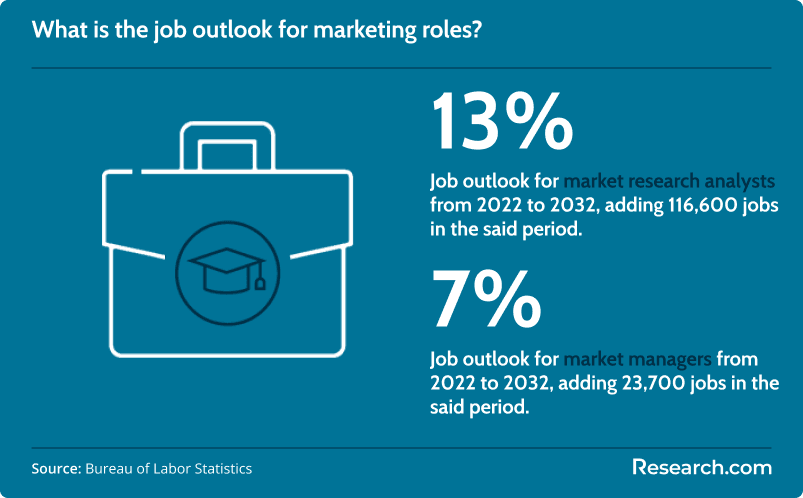
- Market research analysts are projected to see 13% job growth from 2022 to 2032, adding approximately 116,600 new jobs.
- Advertising and promotions managers are projected to see 2% employment growth, adding 600 new positions by 2032.
- A master’s degree in marketing is cited with a median annual income of $55,038, compared with $41,756 for a bachelor’s degree.
- The cited return on investment for a master’s degree becomes substantially positive from the 10-year to the 40-year mark.
- Web Search Portals are among the top-paying industries cited, where marketing managers can earn up to $265,300 annually.
How long does it take to complete an online marketing degree?
A traditional online bachelor’s degree in marketing often takes about four years for full-time students. Accelerated programs can shorten that timeline through condensed terms, transfer credits, year-round enrollment, prior learning assessment, or competency-based coursework. Students comparing business majors may notice similar fast-track structures in related programs, such as an accelerated online accounting degree.
The examples in this guide show wide variation. Colorado State University – Global Campus and Southern New Hampshire University list a one-year shortest possible completion time. Sullivan University lists One and a half years. Colorado Technical University and Western Governors University list two years. These timelines are usually most realistic for students who bring substantial transfer credits, enroll continuously, and can manage a demanding workload.
| Student profile | Likely completion pattern | Best-fit format |
| Many transfer credits already completed | May qualify for the fastest timelines | Transfer-friendly accelerated bachelor’s program |
| Working full time | May need a slower pace despite accelerated course options | Asynchronous or competency-based online program |
| No prior college credit | May take longer than advertised shortest timelines | Structured online bachelor’s with advising support |
| Experienced marketer without a degree | May benefit from prior learning or competency assessments | Competency-based or credit-for-experience program |
How does an online marketing degree compare to an on-campus program?
An online marketing degree can carry the same value as an on-campus degree when it comes from a properly accredited institution and offers a rigorous curriculum. Employer perception is strongest when the school has recognized accreditation, a clear academic reputation, and, in some cases, a traditional campus presence. According to the cited Drexel University discussion of online and traditional degrees, 76% of academic leaders believe online degrees are equal to on-campus degrees, and that figure rises to 89% when the online program is connected to a traditional campus.
The delivery format matters less than the quality signals. A credible online program should list its accreditation clearly, provide faculty access, include applied assignments, offer student services, and produce transcripts that do not create uncertainty about academic standards. For marketing specifically, online learning can be especially relevant because much of modern marketing work happens in digital platforms, analytics tools, remote teams, and campaign management systems.
| Online marketing degree | On-campus marketing degree |
| Best for students who need schedule flexibility, live far from campus, work while studying, or prefer asynchronous learning. | Best for students who want face-to-face instruction, campus clubs, in-person networking, and a structured weekly routine. |
| May reduce relocation, commuting, and housing costs. | May provide easier access to campus events, local internships, and in-person faculty relationships. |
| Requires strong self-motivation and time management. | Provides more built-in structure but may be less flexible for working adults. |
| Can be equal in value when accredited and academically rigorous. | Can offer strong employer recognition, especially from well-known institutions. |
What is the average cost of an online marketing degree?
The average cost of an online marketing degree cited in the original article ranges from $15,000 to $60,000, depending on the institution, tuition model, number of required credits, and transfer credits accepted. Program examples include Colorado State University – Global Campus at $356 per credit and Colorado Technical University at $325 per credit. College Tuition Compare lists traditional marketing degree costs at around $10,386 for in-state undergraduates or $30,008 for out-of-state.
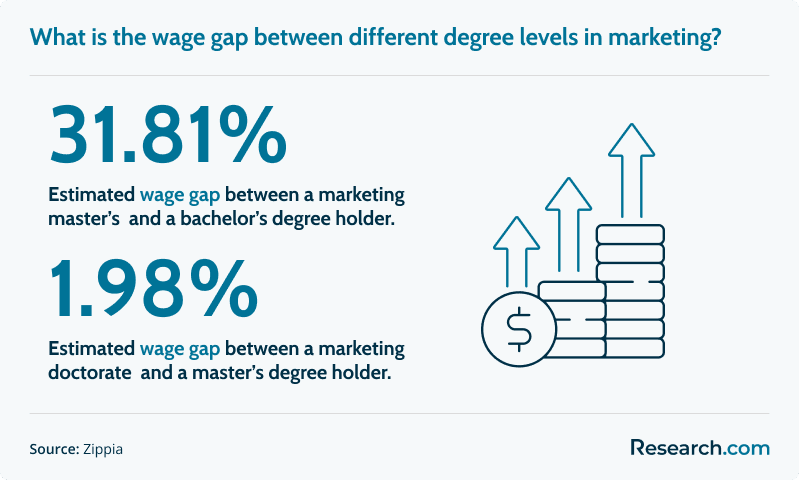
Costs also vary by specialization and school type. For example, the cited digital marketing degree cost range for private institutions is approximately $19,100 to $19,896. Students considering graduate study should compare tuition against career outcomes because the bachelor’s and MBA in marketing salary gap can be meaningful, as shown in the visual below.
What are the financial aid options for students enrolling in an online marketing degree?
Online students may be eligible for several types of financial aid, but eligibility depends on the school, accreditation, enrollment status, citizenship status, academic progress, and program structure. Always confirm whether an accelerated online program qualifies for federal aid before enrolling.
- Merit-based scholarships: Awards may be based on grades, leadership, activities, professional background, or program-specific criteria.
- Need-based grants: Grants can help reduce out-of-pocket costs for students with demonstrated financial need.
- Federal financial aid: Completing the FAFSA can determine eligibility for federal grants, loans, and work-study programs.
- Institutional aid: Colleges may offer scholarships, tuition discounts, or aid packages for eligible online marketing students.
- Private student loans: Banks and private lenders may provide additional funding, though repayment terms should be reviewed carefully.
- Employer sponsorship: Some employers provide tuition assistance or reimbursement for job-relevant marketing education.
- Financial aid programs: Platforms like Coursera may offer aid for digital marketing courses that supplement degree study.
- Cost-effective options: Shorter certificate programs can build specific digital marketing skills at a lower cost than a full degree, though they do not replace a bachelor’s credential.
What are the prerequisites for enrolling in an online marketing degree?
Most online bachelor’s programs in marketing require a high school diploma or GED. Schools may also request official transcripts, standardized test scores if required, recommendation letters, a personal statement, and application fees. Transfer students usually need transcripts from every college previously attended.
- High School Diploma/GED: Applicants must show proof of secondary education completion.
- Transcripts: Schools use official records to evaluate admission eligibility and transfer credits.
- Standardized Test Scores: Some institutions may request SAT or ACT scores, while others are test-optional.
- Letters of Recommendation: Recommendations may come from teachers, supervisors, employers, or mentors.
- Personal Statement: Applicants may need to explain their academic goals, career plans, and interest in marketing.
Students applying to accelerated programs should also ask whether they need prerequisite business courses before entering upper-division marketing classes.
What courses are typically in an online marketing degree?
An online marketing degree usually combines a business core with specialized marketing coursework. The business foundation helps students understand organizations, finance, management, and communication, while marketing courses develop skills in customer analysis, campaign planning, research, and digital channels.
- Principles of Marketing: Introduces essential marketing concepts, customer value, segmentation, positioning, and strategy.
- Consumer Behavior: Explores why individuals and organizations make purchasing decisions.
- Marketing Research: Teaches methods for gathering, interpreting, and presenting market data.
- Digital Marketing: Covers online channels such as social media, search, content, paid media, and SEO.
- Strategic Marketing Management: Focuses on building and executing marketing plans tied to business objectives.
- Business-to-Business Marketing: Examines marketing strategies for companies selling to other organizations.
- Marketing Analytics: Builds data interpretation skills used to evaluate campaign performance and customer behavior.
What types of specializations are available in online marketing degrees?
Specializations help students match their degree to a specific career direction. A student interested in campaign performance may choose analytics, while someone focused on brand voice and engagement may prefer content or social media marketing. Students who want broader management training may compare marketing with a business management degree.
- Digital Marketing: Focuses on SEO, paid media, social platforms, email, web campaigns, and online customer journeys.
- Content Marketing: Emphasizes content planning, storytelling, editorial strategy, audience engagement, and brand publishing.
- Social Media Marketing: Builds skills in platform strategy, content creation, community management, and campaign analysis.
- Marketing Analytics: Trains students to interpret data, measure results, and support evidence-based decisions.
- Public Relations: Centers on reputation management, media communication, messaging, and stakeholder relationships.
- Marketing Management: Prepares students for leadership-oriented work in planning, brand management, and team coordination.
How to Choose the Best Online Marketing Degree
The best online marketing degree is not automatically the cheapest, fastest, or highest-ranked program. It is the program that fits your goals, budget, schedule, prior credits, and preferred marketing path. Before enrolling, compare programs using concrete evidence rather than promotional claims.
- Confirm accreditation: Check that the institution is properly accredited. You can begin your research with this Research.com guide to nationally accredited online universities.
- Consider campus association and reputation: The cited data notes that 89% of academic leaders consider an online degree equivalent to an on-campus degree when the college has a traditional campus.
- Review school recognition: Employer familiarity can matter, especially for early-career applicants. The original article notes that schools established for over 95 years are particularly valued.
- Read the curriculum carefully: Look for digital marketing, analytics, consumer behavior, research, brand strategy, and social media coursework.
- Match format to your life: Decide whether you need asynchronous courses, live online meetings, self-paced terms, or structured deadlines.
- Calculate total cost: Compare tuition, fees, transfer credits, books, technology costs, and financial aid rather than looking only at per-credit price.
Students choose online colleges for various reasons, including affordability, school reputation, and the ability to continue work or personal responsibilities while studying. The chart below summarizes those motivations.
What are the emerging trends shaping the future of online marketing professionals?
Marketing work is changing quickly because companies now rely on data, automation, digital content, privacy-aware targeting, and measurable customer experiences. Students choosing a degree should look for programs that teach durable marketing principles while also exposing them to current tools and practices.
Artificial intelligence and machine learning are increasingly used for audience segmentation, campaign testing, personalization, content workflows, customer insights, and predictive analytics. This does not remove the need for human marketers; it raises expectations. Professionals need to understand how to use tools responsibly, interpret outputs, protect brand voice, and make ethical decisions.
Short-form video continues to influence content strategy on platforms such as TikTok, Instagram Reels, and YouTube Shorts. Voice search optimization is also relevant as voice assistants and smart devices influence how consumers find information. At the same time, privacy rules and changes in tracking have made first-party data more important, forcing marketers to balance personalization with consent, transparency, and consumer trust.
If you want a broader list of market-aligned options, compare top-rated online marketing degree programs and look for courses that connect strategy, analytics, digital tools, and ethical marketing practices.
What other specializations can I pursue within an online marketing degree?
Beyond general marketing, online programs may let students focus on social media, digital marketing, analytics, brand management, public relations, sales, content strategy, or integrated marketing communications. A social media marketing degree online can be useful for students interested in platform strategy, content creation, audience growth, influencer coordination, and campaign reporting.
Choose your specialization based on the work you want to do every week. If you like numbers and dashboards, analytics may fit. If you enjoy writing, storytelling, and audience engagement, content marketing may be stronger. If you want to lead campaigns across multiple channels, integrated marketing or marketing management may offer a broader foundation.
What are the potential challenges of pursuing an accelerated online marketing degree?
Accelerated programs can save time, but they are not ideal for every learner. The pace can be intense, especially for students who are working full time or returning to school after a long break. Condensed courses may leave less time for reflection, revision, and deep exploration of complex topics such as analytics, research design, buyer psychology, or brand strategy.
Students who need a broader, slower academic foundation may want to compare alternatives before committing. For example, a student still exploring multiple career fields might consider the cheapest online liberal arts degree as a lower-cost starting point before transferring into a business or marketing bachelor’s program.
| Common challenge | Why it matters | Better approach |
| Underestimating the workload | Accelerated courses may require frequent assignments and fast turnaround times. | Ask admissions advisors for expected weekly study hours before enrolling. |
| Choosing speed over fit | The fastest program may not offer the specialization or support you need. | Compare curriculum, advising, career services, and experiential learning. |
| Ignoring transfer rules | Completion time depends heavily on accepted credits. | Request an official transfer credit evaluation early. |
| Skipping portfolio development | Marketing employers often want evidence of applied skill. | Build campaign samples, analytics reports, content plans, or capstone projects. |
What career paths are available for graduates of online marketing degrees?
An online marketing degree can support several business, advertising, research, and digital roles. The best path depends on your specialization, experience, technical skills, and portfolio. Below are common marketing roles and the salary figures cited in the original article.
- Marketing Manager: Plans, coordinates, and evaluates marketing strategy. Median annual wage: $157,620.
- Advertising and Promotions Manager: Oversees advertising campaigns, promotions, budgets, and creative execution. Median annual wage: $131,870.
- Market Research Analyst: Studies data about markets, consumers, competitors, and buying behavior. Median annual wage: $74,680.
- Digital Marketing Manager: Manages online channels such as social media, SEO, paid ads, email, and web campaigns. Average annual pay: $87,719.
- Digital Marketer: Implements digital campaigns across platforms and reports on results. Average annual pay: $77,381.
For a broader salary comparison by major and role, review Research.com’s guide to marketing major salary outcomes.
How are internships and real-world projects integrated into accelerated online marketing degree programs?
Strong accelerated online marketing programs include practical work because marketing is a performance-based field. Students may complete internships, simulated campaigns, live business cases, client projects, marketing plans, analytics reports, social media audits, brand strategy assignments, or capstone projects. These experiences help students connect classroom concepts to real business problems.
For online learners, experiential learning may be remote. A student might analyze website traffic, build a content calendar, prepare a paid media proposal, run a mock product launch, or present a campaign strategy through a virtual classroom. These projects can become portfolio samples, which are especially useful for career changers and students without prior marketing experience. If speed is your top priority, compare whether the program belongs among the fastest degree to get online options while still offering applied learning.
How can networking and mentorship accelerate career growth in marketing?
Networking matters in marketing because many opportunities come through referrals, professional communities, industry events, alumni connections, and platform-specific groups. Mentors can help students understand which skills employers actually want, how to build a portfolio, what entry-level titles to target, and how to move from specialist roles into management.
Online students should not assume they will automatically build a network. They may need to be intentional: attend virtual events, participate in discussion boards, join professional associations, ask faculty about internship leads, connect with alumni, and request informational interviews. These habits can support long-term advancement, including movement toward roles associated with the highest paying master degree jobs.
Should I Pursue a Doctoral Degree to Enhance My Marketing Career?
A doctoral degree in marketing is usually not necessary for most marketing management, digital marketing, advertising, or market research roles. It may make sense for professionals who want to teach at the college level, conduct advanced research, become subject-matter experts, or pursue high-level strategy roles that require deep research expertise.
Doctoral study can strengthen research design, data interpretation, theory development, and academic writing skills. However, it also requires a major time commitment. Before applying, compare the cost, completion timeline, research expectations, and career payoff. Students seeking lower-cost doctoral options can review the most affordable online PhD programs.
Why is accreditation essential for accelerated online marketing degree programs?
Accreditation is one of the most important quality checks for any online degree. It helps confirm that a school meets recognized academic standards and may affect federal financial aid eligibility, transfer credit acceptance, graduate school admission, and employer confidence. For business programs, accreditation from organizations such as ACBSP or AACSB can provide an additional program-level signal.
Never assume an online program is legitimate because it has professional-looking marketing materials. Verify institutional accreditation through official school pages and recognized accreditation databases. If you are still weighing shorter academic options, compare degree types carefully and review resources such as Research.com’s discussion of what is the easiest associates degree to get.
Is an Accelerated Online Marketing Degree Ideal for Career Switchers?
An accelerated online marketing degree can work well for career switchers who need a structured way to build business, digital, analytics, and communication skills quickly. It may be especially useful for professionals coming from sales, communications, journalism, design, customer service, retail management, entrepreneurship, or data-related roles.
Career switchers should focus on more than completing the credential. They need a portfolio, role-specific skills, and proof that they can apply marketing concepts. Professional certificates can help fill tool-specific gaps, and Research.com’s guide to the highest paying certificate programs can help students compare credential options outside the degree pathway.
What is the job market for graduates with an online marketing degree certificate?
The job market for marketing graduates and certificate holders varies by role, but the cited outlook includes several areas of growth. Employment of market research analysts is projected to grow by 13% from 2022 to 2032, adding 116,600 new jobs. Marketing managers are projected to grow by 7%, resulting in 23,700 new positions. Advertising and promotions managers are projected to grow by 2%, adding 600 jobs.
A certificate may help with a specific skill, such as analytics, SEO, paid search, content marketing, or social media, but it is not always a substitute for a bachelor’s degree when employers require one. Students aiming for management or specialized business leadership may eventually compare graduate options, including a master's degree in business.
What is the return on investment of an accelerated online marketing degree?
ROI depends on how much you pay, how much time you save, how quickly you increase earnings, and whether the program helps you qualify for better roles. An accelerated format may improve ROI if it allows you to graduate sooner, reduce opportunity cost, avoid unnecessary credits, and move into paid marketing work faster. But a fast program with high tuition, weak support, or poor employer recognition may deliver a weaker return.
To estimate ROI, compare total program cost against realistic career outcomes. Include tuition, fees, books, technology, interest on loans, lost work time, and transfer credits. Then compare likely entry-level and long-term roles, not only top salaries. Some professionals later add graduate education, such as a one year online masters, to pursue higher-level marketing, communications, analytics, or management positions.
How can professional certifications enhance the value of your accelerated online marketing degree?
Marketing certifications can add tool-specific proof to a broader academic degree. This is useful because many employers want candidates who understand strategy and can also work with platforms, analytics dashboards, automation tools, SEO systems, advertising accounts, or content workflows.
- Improving employability
- Credentials such as Google Analytics, HubSpot Content Marketing, and Facebook Blueprint can show familiarity with widely used marketing tools and platforms.
- Some digital marketing employers treat certifications as preferred or expected qualifications for platform-heavy roles.
- Building specialized skills
- Certificates may focus on SEO, email marketing, social media, programmatic advertising, marketing automation, or analytics.
- They can help students practice with tools that may not be covered deeply in a degree curriculum.
- Supporting earning potential
- Specialized credentials may help candidates compete for roles such as Digital Marketing Strategist or Marketing Analyst.
- A Google Ads-certified marketer, for example, may be more competitive for PPC-focused roles.
- Expanding professional networks
- Some certification providers connect learners with professional communities, events, forums, or employer resources.
- These networks can lead to mentorship, collaboration, and job referrals.
- Staying current
- Marketing tools change quickly, so certifications can help professionals refresh skills after graduation.
- Ongoing learning signals adaptability in a field shaped by changing platforms and consumer behavior.
How to apply to an accelerated online marketing degree program?
Applying to an accelerated bachelor's degree online requires more planning than submitting a standard application. Because timelines are compressed, you should confirm that you are academically, financially, and logistically ready before committing.
- Research accredited programs: Verify institutional accreditation and, when relevant, business accreditation such as ACBSP or AACSB. Accreditation can affect financial aid, transfer credit, graduate admission, and employer recognition.
- Confirm admission requirements: Check whether the program requires a high school diploma or GED, prior college credits, minimum GPA, prerequisite courses, SAT or ACT scores, or work experience.
- Request a transfer credit review: If you have previous college coursework, ask for an official evaluation before estimating cost or completion time.
- Prepare application materials: Gather official transcripts, a resume or CV, recommendation letters, a personal statement, and any required test scores.
- Submit before the deadline: Accelerated programs may use rolling admissions, multiple start dates, or specific application windows, so verify dates early.
- Apply for aid: Complete the FAFSA and research scholarships, grants, institutional aid, employer tuition assistance, and payment plans.
- Prepare for interviews if required: Some programs may ask about your goals, readiness for accelerated coursework, and ability to manage time.
- Complete enrollment steps: After acceptance, follow instructions for deposits, registration, orientation, technology setup, and advising.
How to further advance your marketing career with graduate programs?
After earning an accelerated online marketing degree, some professionals continue into a master’s program to deepen expertise in strategy, analytics, leadership, consumer behavior, digital marketing, or brand management. A Master’s in Marketing or an MBA with a marketing concentration may help professionals pursue senior roles such as Marketing Director, Chief Marketing Officer (CMO), Digital Marketing Manager, or strategy-focused leadership positions.
Graduate study is not the right next step for everyone. It can be valuable when your target roles request advanced credentials, when your employer supports tuition costs, or when the program offers measurable career benefits. If your work is closely tied to messaging, leadership, media, and organizational communication, you may also compare affordable online master's degree in communications programs.
Common mistakes to avoid when choosing an accelerated online marketing degree
- Choosing only by speed: A one-year or two-year timeline is useful only if the program fits your background, transfer credits, and workload capacity.
- Ignoring accreditation: Accreditation should be verified before you apply, not after you enroll.
- Looking only at tuition: Total cost includes fees, books, technology, transfer credit loss, and potential loan interest.
- Assuming all online degrees are viewed the same: Employer perception depends on accreditation, reputation, curriculum, and your demonstrated skills.
- Skipping career services: Ask about internships, portfolio support, alumni networks, resume help, and job search resources.
- Not building technical skills: Marketing graduates should be comfortable with analytics, digital channels, content tools, and campaign measurement.
- Assuming salary outcomes are guaranteed: Published salary figures are useful benchmarks, but individual results vary widely.
Questions to ask before enrolling
- Is the institution regionally accredited or otherwise properly accredited?
- Does the business or marketing program hold ACBSP, AACSB, or another relevant programmatic accreditation?
- How many of my credits will transfer, and can I get that evaluation in writing?
- What is the realistic completion time for a student with my number of transfer credits?
- How many hours per week should I expect to study?
- Are courses asynchronous, synchronous, self-paced, or term-based?
- Does the program include internships, capstones, live projects, or portfolio development?
- Which marketing tools, platforms, and analytics skills are taught?
- What is the total cost after tuition, fees, books, and financial aid?
- What career services are available to online students?
Key Insights
- An accelerated online marketing degree is best for motivated students who need flexibility and can manage a compressed academic schedule.
- Accreditation, transfer credit policy, curriculum quality, cost, and applied projects are more important than speed alone.
- Marketing careers vary widely: cited salaries include $157,620 for marketing managers, $131,870 for advertising and promotions managers, and $74,680 for market research analysts.
- Program completion can range from one year to two years in the examples listed, but the fastest timelines often depend on transfer credits and continuous enrollment.
- Online degrees can be comparable to campus degrees when they come from reputable, accredited institutions with strong academic standards.
- Students should build a portfolio, pursue relevant certifications, and network intentionally because marketing employers often look for demonstrated skill, not just a credential.
- Before enrolling, calculate total cost, verify accreditation, ask for a transfer credit review, and confirm that the program’s specialization matches your target role.
References:
- Advertising and Promotions Managers. (2023, April 25). Bureau of Labor Statistics.
- Advertising, Promotions, and Marketing Managers: Occupational Outlook Handbook. (2024, April 17). Bureau of Labor Statistics.
- Digital Marketer. (2024). ZipRecruiter.
- Digital Marketing Manager. (2024). ZipRecruiter.
- Market Research Analysts: Occupational Outlook Handbook. (2024, April 17). Bureau of Labor Statistics.
- Market Research Analysts and Marketing Specialists. (2023, April 25). Bureau of Labor Statistics.
- Marketing Managers. (2023, April 25). Bureau of Labor Statistics.
- Marketing. (2024). ZipRecruiter.
Other Things You Should Know About Online Marketing Degrees
Yes. Strong online marketing programs are usually housed in business schools accredited by AACSB, and many others hold ACBSP accreditation. AACSB is the more selective seal. For job and graduate-school value, check the school’s regional accreditation and the business school’s programmatic accreditation before enrolling.
In 2027, accelerated marketing degree programs online typically require 120 credit hours for completion. These programs are designed to be fast-paced, allowing students to complete the degree in as little as 18 months, depending on transfer credits.
Students need a reliable high-speed internet connection, a computer with updated operating systems, and specific software like Adobe Creative Cloud for design courses to succeed in online accelerated marketing programs in 2027. Verify with your chosen program for additional tech specifications.