2027 Is Marketing a Good Major? Jobs, Salary & Requirements

Co-Founder and Chief Data Scientist
Choosing a marketing major is not just a question of liking ads, social media, or brand campaigns. It is a decision about whether you want a business degree built around customers, data, communication, creativity, and measurable growth. In 2026, that decision matters because marketing roles are being reshaped by artificial intelligence, analytics platforms, privacy expectations, short-form content, automation, and tighter employer demand for job-ready skills.
This guide is for students comparing marketing with other business majors, adults considering an online or accelerated degree, and early-career professionals who want to know whether a marketing credential can help them move into digital marketing, brand management, market research, public relations, product marketing, or related roles. You will learn what marketing majors study, how long the degree usually takes, what it may cost, which career paths are realistic, what employers look for, and how to choose a program without relying only on rankings or broad promises.
Quick Answer: Is a Marketing Major Worth Considering?
A marketing major can be a strong fit if you want a business degree that combines strategy, consumer behavior, communication, research, analytics, and creative problem-solving. It is especially useful for students interested in digital campaigns, brand growth, audience research, product positioning, advertising, sales strategy, or customer insights.
- A marketing major can lead to roles in market research, digital marketing, advertising, brand management, public relations, product management, sales, and marketing analytics.
- Marketing and advertising jobs will grow by 7% through 2034.
- The average salary of a marketing major is $76,950.
- The best programs usually combine business fundamentals, marketing strategy, analytics, digital tools, internships, and portfolio-building projects.
- Students should compare accreditation, cost, transfer policies, online flexibility, internship access, faculty experience, and career support before enrolling.
- Marketing versus finance, management, and other business majors
- Typical timeline for completing a marketing major
- Marketing degree cost and major cost drivers
- Scholarships, FAFSA, grants, loans, and work-study options
- Common admission and course prerequisites
- Core marketing major courses
- How branding, market research, and social media courses help students
- How to select the right marketing program
- Career options for marketing graduates
- How public relations can strengthen a marketing career
- When a communications graduate degree may make sense
- Why communication skills matter in marketing
- How creative writing supports marketing strategy
- Certifications that can add value to a marketing degree
- How design skills improve marketing work
- When creative and technical studies can support marketing goals
- Marketing salary expectations
- Networking opportunities for marketing students
- How online marketing programs may reduce time and cost
- How social media marketing programs build niche expertise
- Accelerated marketing degrees and fast-track options
What Marketing Graduates Often Value About the Major
Students who complete marketing programs frequently point to flexibility as one of the degree’s biggest advantages. A working parent may value the ability to complete an online program while balancing employment and family responsibilities, then apply those skills to freelance consulting, social media services, or a small business venture.
Other graduates appreciate that online and hybrid marketing programs can connect them with classmates, faculty, and industry examples beyond their local area. That broader exposure can be useful in a field where consumer behavior, digital channels, and campaign expectations vary across regions and industries.
Many students also find that marketing coursework helps them build practical habits: writing for a defined audience, analyzing campaign results, presenting ideas clearly, managing deadlines, and adapting to new tools. Those habits matter because employers often want evidence that a graduate can contribute to real campaigns, not just explain marketing theory.
Key Findings for 2026
- In fall 2025, among business track bachelor's degree enrollees, 159,451 majored in marketing.
- In 2026, 61% of marketing heads will increase temporary hiring during the first quarter of the year.
- Advertising, marketing, promotions, public relations, and sales managers are expected to have a 5.2% increase in job opportunities by 2034. In particular, marketing managers will gain a 6.6% job outlook.
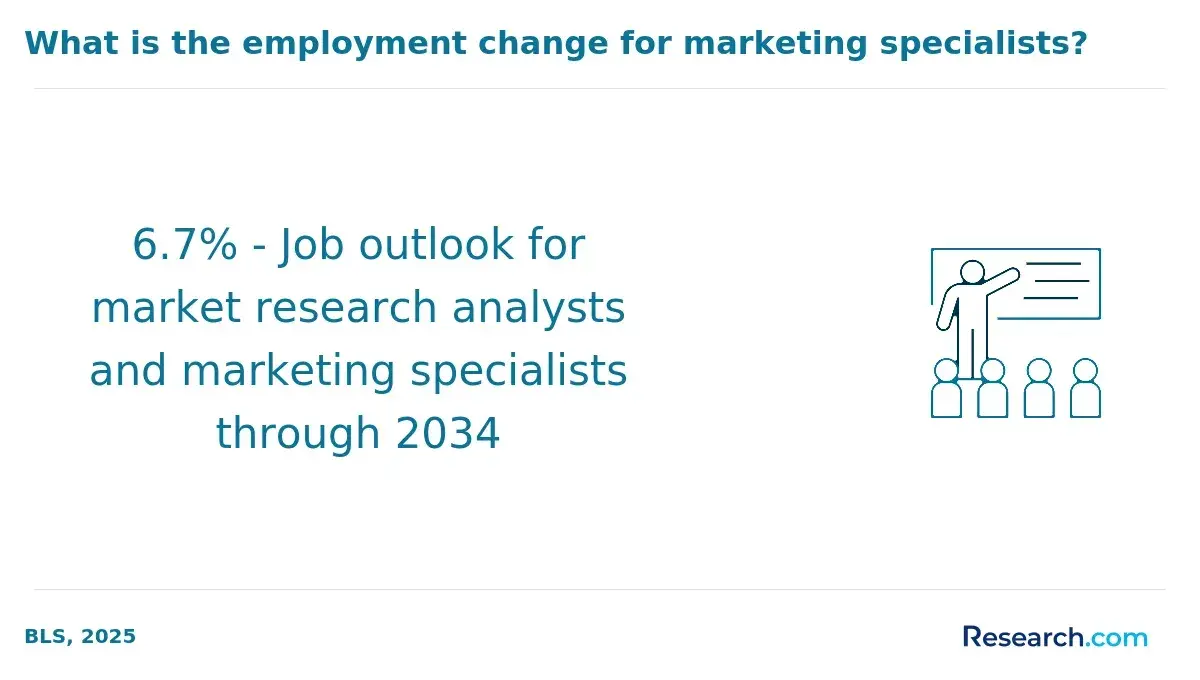
- The job outlook for market research analysts and marketing specialists is expected to expand 6.7% by 2034.
- 57% of marketing professionals in the United States have a bachelor's degree.
How Does Marketing Compare With Finance, Management, and Other Business Majors?
In fall 2025, among business track bachelor's degree enrollees, 159,451 majored in marketing, according to the National Student Clearinghouse Research Center. When comparing marketing with other business majors, the most important question is not which major sounds more impressive. The better question is which business function you want to work in: customers and growth, money and risk, or people and operations.
| Business Major | Best Fit For Students Who Like | Common Coursework | Typical Career Direction |
| Marketing | Understanding customers, shaping messages, analyzing markets, building brands, and improving campaign performance | Consumer behavior, digital marketing, market research, brand strategy, advertising, analytics, and marketing planning | Digital marketing, brand management, market research, advertising, public relations, product marketing, and sales strategy |
| Finance | Working with numbers, investments, financial models, risk, markets, and business valuation | Corporate finance, investment analysis, financial markets, risk management, accounting, and financial reporting | Banking, corporate finance, financial planning, investment analysis, insurance, and risk management |
| Management | Leading teams, improving operations, solving organizational problems, and coordinating resources | Organizational behavior, leadership, human resources, operations management, project management, and strategy | General management, operations, human resources, consulting, project management, entrepreneurship, and nonprofit administration |
Choose marketing if you want customer-facing business work
Marketing focuses on how organizations identify customer needs, position products, create demand, communicate value, and measure results. It can be a good match for students who enjoy both analysis and creativity.
Choose finance if you prefer financial decision-making
Finance is usually a better fit for students who want to evaluate investments, manage financial resources, assess risk, or work in banking, corporate finance, insurance, or capital markets.
Choose management if you want broad leadership preparation
Management majors study how organizations operate, how teams function, and how leaders make decisions. This path can work well for students who want a broader business foundation instead of a specialized customer-growth focus.
How Long Does It Take to Complete a Marketing Major?
Most students complete a bachelor’s degree with a marketing major in about four years of full-time study. The timeline may change if you attend part time, transfer credits, enroll in summer courses, choose an accelerated format, or need to complete additional general education or business core requirements.
A business degree with a major in marketing usually begins with general education and introductory business courses, then moves into specialized marketing classes, electives, internships, and capstone work.
| Stage | What Students Usually Study | Why It Matters |
| First year | General education, writing, communication, math, introductory business, economics, and basic college requirements | Builds the academic and business foundation needed for upper-level coursework |
| Second year | Principles of marketing, business statistics, accounting, management, consumer behavior, and market research foundations | Introduces marketing concepts and the data skills used in later courses |
| Third year | Advertising, digital marketing, brand management, marketing analytics, strategic marketing, and possible internship experience | Helps students connect classroom concepts to real campaigns and employer expectations |
| Fourth year | Advanced electives, capstone projects, practicums, portfolio work, and career preparation | Allows students to demonstrate applied skills and prepare for entry-level roles |
How Much Does a Marketing Major Cost?
The price of a marketing degree depends heavily on the school, residency status, delivery format, fees, housing, books, technology costs, and how many credits you need to complete. Tuition is only one part of the total cost, so students should compare the full cost of attendance before choosing a program.
| Institution Type | Estimated Annual Tuition |
| Public in-state | $10,500 - $28,000 |
| Public out-of-state | $20,000 - $33,000 |
| Private | $35,000 - $48,000 |
Public colleges often charge lower tuition to in-state students than to out-of-state students. Private institutions may have higher listed tuition, although scholarships and institutional aid can change the net price a student actually pays.
Online marketing programs may reduce some expenses by removing relocation, campus housing, and commuting costs. However, online students should still review technology fees, course materials, proctoring fees, and whether the program offers the same career support as the campus option.
Are Scholarships and Financial Aid Available for Marketing Majors?
Annually, in-state marketing students enrolled in public institutions are estimated to allot at least $7,196 for tuition. Because costs vary widely, students should build a funding plan early rather than waiting until after admission decisions arrive.
Common funding options
- Institutional scholarships: Many colleges award scholarships through business schools, marketing departments, honors programs, alumni funds, or need-based aid offices.
- National and private scholarships: Foundations, employers, professional groups, community organizations, and scholarship databases may list awards for business or marketing students.
- Marketing-related scholarships: Organizations such as the American Marketing Association and the American Advertising Federation may offer student funding opportunities connected to marketing, advertising, or communications.
- Federal financial aid: Students can complete the FAFSA to be considered for federal grants, loans, and work-study options.
- State and local aid: State higher education agencies and local programs may provide grants or scholarships for residents attending eligible colleges.
- Work-study and employer support: Some students reduce borrowing through campus work-study, part-time jobs, paid internships, or employer tuition assistance.
How to compare financial aid offers
- Separate scholarships and grants from loans because loans must be repaid.
- Check whether each scholarship renews automatically or requires a minimum GPA.
- Compare net cost, not just published tuition.
- Ask whether online, transfer, and part-time students qualify for the same aid as campus students.
- Confirm whether internships are paid, unpaid, required, optional, local, or remote.
What Are the Prerequisites for Marketing Majors?
According to a recent Robert Half survey, 45% of employers found it more difficult to hire skilled marketing professionals than a year ago. That matters for students because programs that build writing, analytics, research, and digital execution skills may offer better preparation than programs focused only on broad business theory.
Prerequisites vary by institution, but most marketing majors complete a mix of general education, business core, and introductory marketing courses before moving into advanced classes.
General education and business foundation
- Writing and communication: Marketing students need to explain ideas clearly, write for different audiences, present recommendations, and collaborate with clients or teams.
- Mathematics and statistics: Students often use quantitative reasoning to evaluate campaign performance, interpret survey data, understand budgets, and work with marketing metrics.
- Social sciences: Psychology, sociology, anthropology, or related courses can help students understand consumer motivation, culture, decision-making, and group behavior.
- Business fundamentals: Courses in economics, accounting, management, and business law help students understand how marketing decisions fit into a larger organization.
Marketing-specific preparation
- Principles of marketing: This introductory course usually covers segmentation, targeting, positioning, pricing, product strategy, promotion, distribution, and customer value.
- Market research foundations: Some programs require an introductory research course before students can take advanced analytics, consumer insights, or strategy classes.
What Core Courses Are Included in a Marketing Major?
Advertising, marketing, promotions, public relations, and sales managers are expected to have a 5.2% increase in job opportunities by 2034. In particular, marketing managers will gain a 6.6% job outlook. A strong marketing curriculum should therefore teach students both the strategic thinking and applied tools needed to compete for roles in a changing labor market.
Principles of Marketing
This foundational course introduces the marketing process, customer value, segmentation, positioning, product decisions, pricing, promotion, distribution, and campaign planning.
Market Research
Students learn how to collect, organize, analyze, and interpret information about customers, competitors, industries, and trends. Coursework may include surveys, interviews, focus groups, sampling, and data interpretation.
Marketing Management
This course focuses on how marketing plans are built, funded, implemented, monitored, and adjusted. Students examine objectives, budgets, performance measures, and cross-functional coordination.
Advertising and Promotion
Students study how organizations use paid, earned, shared, and owned media to communicate with target audiences. Topics may include message strategy, media selection, campaign execution, and evaluation.
Consumer Behavior
This class explores the psychological, social, cultural, and economic factors that influence how people discover, evaluate, purchase, and use products or services.
Digital Marketing
Digital marketing coursework often covers search engine optimization, search engine marketing, social media, email campaigns, website performance, digital analytics, and conversion strategy.
Brand Management
Students learn how brands are positioned, differentiated, extended, protected, and measured. The course may also cover brand identity, equity, messaging, and reputation.
Marketing Analytics
This course teaches students how to use data to evaluate audiences, campaigns, customer segments, and marketing performance. Students may work with dashboards, visualizations, predictive models, or customer data.
Strategic Marketing Planning
A capstone or advanced planning course typically asks students to apply previous coursework to a realistic business problem, campaign proposal, product launch, or marketing plan.
How Do Specialized Marketing Courses Help Students?
Specialized courses help students move beyond general marketing concepts and develop a clearer career direction. Branding, market research, social media marketing, analytics, and public relations electives can also help students create portfolio work that is easier to discuss in interviews.
The job outlook for market research analysts and marketing specialists is expected to expand 6.7% by 2034, with 87,200 jobs every year. That makes research, analytics, and evidence-based decision-making especially important for students who want a durable marketing skill set.
| Specialization | What Students Learn | Best For Students Interested In |
| Branding | Brand identity, positioning, differentiation, storytelling, equity, competitive analysis, and brand audits | Brand management, product marketing, advertising, creative strategy, and customer experience |
| Market Research | Survey design, interviews, focus groups, data analysis, consumer insights, competitor research, and reporting | Market research analyst roles, customer insights, analytics, strategy, and consulting |
| Social Media Marketing | Platform strategy, content planning, paid social, influencer campaigns, audience engagement, analytics, and optimization | Social media management, digital marketing, content strategy, community management, and brand communications |
Why specialization matters
- It gives students a stronger answer when employers ask what type of marketing work they want to do.
- It helps students build samples such as campaign plans, dashboards, research reports, brand audits, or content calendars.
- It can make internship searches more focused and less overwhelming.
- It allows students to combine marketing with adjacent strengths such as writing, design, analytics, communications, or sales.
How Do You Choose the Best Marketing Major Program?
According to CareerOneStop, 57% of marketing professionals in the United States have a bachelor's degree, 4% have an associate degree, whereas 22% have a master's degree. A bachelor’s degree is common in the field, but not every marketing program offers the same value. The right choice depends on career goals, cost, learning format, employer connections, and the type of marketing work you want to pursue.
Use this checklist before enrolling
- Accreditation: Confirm that the institution is accredited and review whether the business school holds a recognized business accreditation, such as AACSB International.
- Curriculum quality: Look for courses in digital marketing, market research, branding, advertising, analytics, consumer behavior, strategy, and marketing in the age of AI.
- Applied learning: Prioritize programs with internships, practicum courses, client projects, simulations, student agencies, case competitions, or capstone work.
- Career services: Ask whether marketing students receive resume support, interview preparation, employer introductions, internship leads, alumni networking, and portfolio feedback.
- Faculty and industry access: Review whether instructors have current marketing, analytics, advertising, brand, or agency experience.
- Format and flexibility: Compare campus, online, hybrid, part-time, evening, and accelerated options based on your schedule and learning style.
- Cost and completion path: Calculate total tuition, fees, books, technology, housing, commuting, transfer credits, and time to graduation.
Questions to ask admissions or academic advisors
- What percentage of marketing students complete internships before graduation?
- Can online students access the same career services and faculty as campus students?
- Which courses require group projects, analytics tools, or portfolio assignments?
- How many transfer credits will the program accept?
- Are there separate fees for online courses, labs, software, or proctored exams?
- Does the program help students prepare for entry-level roles in digital marketing, research, branding, sales, or advertising?
What Career Paths Can You Pursue With a Marketing Major?
A marketing major can lead to entry-level and long-term opportunities across agencies, corporations, nonprofits, technology companies, healthcare organizations, retail brands, media firms, financial services, startups, and government contractors. Based on a McKinsey survey of chief marketing officers on marketing in the age of big data, 36.6% of companies have at least three growth- and customer-related roles that report directly to the CEO. These upper-level roles receive an average salary of $158,000.
| Career Path | What the Role Usually Involves | Helpful Skills to Build During College |
| Advertising Account Executive | Coordinates client needs, campaign plans, timelines, budgets, and communication between strategy and creative teams | Client communication, project management, campaign planning, presentation, and writing |
| Brand Manager | Develops brand positioning, messaging, product strategy, campaign direction, and customer perception goals | Brand strategy, consumer behavior, market research, storytelling, and public relations |
| Digital Marketing Specialist or Manager | Plans and improves online campaigns across search, social, email, websites, paid media, and analytics platforms | SEO, paid media, email marketing, analytics, content strategy, and conversion optimization |
| Market Research Analyst | Studies customer preferences, competitors, trends, and market conditions to guide business decisions | Statistics, survey design, data analysis, visualization, reporting, and critical thinking |
| Marketing Coordinator or Assistant | Supports campaign execution, content creation, event coordination, reporting, communications, and vendor tasks | Organization, writing, spreadsheets, social media tools, teamwork, and deadline management |
| Media Planner or Buyer | Selects and purchases advertising placements across traditional and digital channels to reach target audiences | Media strategy, budgeting, audience analysis, negotiation, reporting, and campaign measurement |
| Product Manager | Works on product positioning, customer needs, pricing input, launch strategy, competitive analysis, and lifecycle planning | Market analysis, cross-functional communication, customer research, strategy, and business judgment |
How Can Public Relations Strengthen a Marketing Career?
Marketing and public relations often overlap because both shape how audiences understand an organization. Marketing usually focuses on demand, customers, campaigns, and revenue goals, while public relations emphasizes reputation, media relationships, stakeholder trust, and crisis communication.
Students who add PR knowledge can become stronger brand communicators. A public relation degree can provide a more specialized foundation in media strategy, reputation management, public messaging, and crisis response. Those skills can be useful for brand managers, communications specialists, content strategists, and marketing professionals who work in highly visible industries.
Should You Pursue an Advanced Degree in Communications for a Marketing Career?
A graduate communications credential may be worth considering if your goals include leadership, integrated marketing communications, corporate communications, crisis management, public affairs, or brand strategy. It may be less necessary if your immediate goal is an entry-level digital marketing role and you have not yet built work experience.
Students comparing graduate options can review online master of communications programs to see how curricula address audience strategy, persuasion, media, research, messaging, and leadership. Before enrolling, compare cost, employer demand, your existing experience, and whether the degree will support a specific promotion or career shift.
How Can Communication Skills Improve Marketing Outcomes?
Strong communication skills help marketers turn research into strategy and strategy into action. A marketer may need to write an email campaign, present a media plan, explain analytics to executives, brief a designer, respond to a customer concern, or adjust messaging during a crisis.
Students who want to combine marketing with audience strategy, media relations, internal communications, or brand storytelling can explore related highest paying jobs with communications degree options. The goal is not simply to add another credential, but to build the ability to communicate clearly with customers, colleagues, executives, and the public.
How Can Creative Writing Skills Support Marketing Strategy?
Creative writing can make marketing messages more memorable, persuasive, and human. It is especially relevant for content marketing, email campaigns, social media, brand voice, advertising copy, landing pages, video scripts, and storytelling-driven campaigns.
Students who struggle with copywriting or want to build a stronger voice may benefit from coursework in storytelling, editing, audience awareness, and persuasive writing. An affordable online bachelors in creative writing degree can be useful for learners who want deeper writing preparation alongside marketing or communications goals.
What Industry Certifications Should Complement a Marketing Degree?
Certifications can help marketing students show practical ability in specific tools or campaign areas. They are most valuable when they align with a target role, such as digital analytics, paid advertising, content strategy, email marketing, search optimization, or social media management.
A certification should not replace a strong portfolio, internship, or degree plan. Instead, use certifications to demonstrate current platform knowledge and hands-on skill. Students focused on social platforms may also consider an accelerated social media marketing degree online if they want a faster academic pathway that emphasizes platform strategy and digital campaign execution.
How Do Creative Design Skills Strengthen Marketing Work?
Marketers do not always need to become professional designers, but they do need visual judgment. Design literacy helps marketers evaluate ads, landing pages, social posts, presentations, brand guidelines, packaging, and campaign assets more effectively.
Students who understand layout, typography, color, user experience, and visual hierarchy can collaborate more effectively with creative teams. For those who want stronger visual communication preparation, graphic design programs can complement marketing coursework and support careers in creative strategy, content production, brand management, and digital campaigns.
Can Creative and Technical Studies Support a Marketing Career?
Modern marketing increasingly rewards people who can connect creative ideas with technical execution. Skills in user experience, interactive media, product thinking, analytics, storytelling, and audience engagement can help marketers work across digital products, games, apps, websites, and immersive campaigns.
Students comparing creative technology fields can review Is a game design degree worth it? to understand how design, interactivity, storytelling, and technical production may connect with marketing goals. This type of interdisciplinary exploration is most useful when it supports a clear career direction, such as product marketing, user engagement, digital experience, or creative strategy.
What Is the Average Salary for Marketing Professionals?
Based on BLS data, the median annual wage of marketing professionals was $76,950, with the 10th percentile at $42,070 and the 90th percentile at $144,610. Salary outcomes vary, so students should treat these figures as labor market reference points rather than guaranteed earnings.
- Experience: Entry-level coordinators, assistants, and specialists usually earn less than managers, directors, or senior strategists.
- Location: Pay can shift based on regional labor demand and cost of living.
- Industry: Technology, finance, healthcare, retail, consumer goods, agencies, and nonprofit employers may offer different compensation patterns.
- Role type: Analytics, product marketing, performance marketing, and management positions may have different pay ranges than general support roles.
- Portfolio and results: Employers often value evidence of campaign execution, data interpretation, writing samples, and measurable project outcomes.
What Networking Opportunities Should Marketing Students Pursue?
Networking is not just about collecting contacts. For marketing students, it is a way to learn how the field works, discover internships, find mentors, understand hiring expectations, and build confidence before entering the job market.
- Join professional associations: Student memberships in groups such as the American Marketing Association or the Public Relations Society of America can provide access to events, webinars, job boards, competitions, and industry conversations.
- Use campus career resources: Attend career fairs, employer panels, guest lectures, alumni sessions, resume workshops, and mock interviews offered through your college.
- Build a LinkedIn presence: Follow companies, join marketing groups, comment thoughtfully, share projects, and connect with alumni or professionals in roles you want to understand.
- Attend industry events: Conferences, seminars, webinars, and local meetups can expose students to current tools, campaign examples, and employer expectations.
- Pursue internships and part-time work: Practical experience helps students meet supervisors, clients, vendors, and peers who may later provide references or referrals.
- Stay connected with classmates and faculty: Professors and peers often become sources of recommendations, project leads, graduate school advice, and job referrals.
Consistent networking can clarify your marketing career path and help you make better decisions about electives, internships, certifications, and first jobs.
Can Online Marketing Programs Be Faster or More Affordable?
Online marketing programs can be a practical option for students who need flexibility, want to avoid relocation, or plan to continue working while earning a degree. Some online formats also offer accelerated tracks that may help students complete coursework in as little as 12-18 months.
Online programs are not automatically cheaper or easier. Students should compare tuition, fees, course length, transfer credit rules, faculty access, internship support, and whether the school is properly accredited. A low advertised price may not reflect the full cost if the program charges technology fees or accepts fewer transfer credits than expected.
| Online Marketing Program May Be a Good Fit If | Be Careful If |
| You need to study around work, family, military service, or caregiving responsibilities | You learn best through face-to-face interaction and structured campus routines |
| You already have transfer credits and want a more flexible completion path | The school has unclear accreditation or weak student support |
| You want exposure to digital tools used in remote marketing work | The program does not offer internships, portfolio projects, or career services |
| You want to reduce housing or commuting costs | Online fees, software costs, or limited transfer credit reduce the expected savings |
Students exploring graduate-level affordability can compare quickest cheapest masters degree options, especially if they are considering a marketing-related master’s degree after gaining experience.
How Can a Specialized Social Media Marketing Program Help Your Career?
A social media marketing program can help students focus on platform strategy, audience development, content calendars, paid social campaigns, influencer coordination, community engagement, and performance analytics. This path may be useful for students who already know they want to work in digital brand management, social media strategy, content marketing, or online community roles.
A social media degree online may be especially appealing to students who want an affordable, flexible path into a specialized digital marketing niche. Before enrolling, check whether the curriculum includes real campaign work, analytics practice, writing assignments, portfolio projects, and current platform strategy.
How Can You Fast-Track a Marketing Degree With Accelerated Programs?
Accelerated marketing programs are designed for students who want to complete coursework in a shorter timeframe. Some programs allow students to finish in as little as 12 to 18 months, depending on transfer credits, course load, program structure, and enrollment status.
This option can work well for disciplined students who can manage intensive courses and fewer breaks. It may also suit adults changing careers, students with significant prior credits, or learners who want to enter the workforce sooner. However, accelerated programs can be demanding, and the faster pace may leave less time for internships, networking, or portfolio development if students do not plan carefully.
Students interested in a faster route can compare accelerated marketing degree programs online accredited to evaluate program length, accreditation, transfer policies, cost, and student support. The goal is not simply to finish quickly; it is to finish with a credential, skills, and work samples that employers can understand.
Common Mistakes to Avoid When Choosing a Marketing Major
- Choosing a program without checking accreditation: Accreditation affects transferability, financial aid eligibility, and employer confidence.
- Looking only at tuition: Fees, housing, commuting, technology, books, and lost work time can change the real cost.
- Ignoring internships and portfolio work: Marketing employers often want proof that you can write, analyze, plan, and execute.
- Assuming all online programs offer equal support: Online students should verify access to advisors, faculty, career services, and networking opportunities.
- Picking electives without a career direction: Electives should support a target path such as analytics, brand management, digital marketing, public relations, content strategy, or market research.
- Expecting salary outcomes to be guaranteed: Pay depends on role, location, industry, experience, skills, and market conditions.
- Waiting too long to build practical skills: Students should start developing writing samples, campaign examples, analytics experience, and professional connections before senior year.
Key Insights
- A marketing major is best for students who want a business degree centered on customers, communication, market evidence, campaigns, and growth strategy.
- Marketing differs from finance and management because it focuses more directly on consumer behavior, brand positioning, demand generation, research, and campaign performance.
- Most bachelor’s programs take about four years, but online and accelerated options may shorten or simplify the path for some students.
- Cost varies widely by institution type, residency, delivery format, fees, living expenses, and transfer credits, so students should compare total cost instead of tuition alone.
- Core coursework should include consumer behavior, market research, digital marketing, analytics, advertising, brand management, and strategic planning.
- Specializations in analytics, branding, social media, public relations, writing, or design can make a marketing degree more career-focused.
- Marketing salaries and job outcomes vary by role, industry, location, experience, and portfolio quality; no degree guarantees a specific salary.
- The strongest marketing students graduate with more than credits: they have internships, campaign samples, research projects, analytics experience, professional contacts, and a clear story about the kind of marketing work they want to do.
References:
- American Marketing Association. (2025). Marketing in the Age of Disruption: The Skills Marketers Need in 2025 and Beyond. https://www.ama.org/2025/01/31/2025-marketing-skills-report
- CareerOneStop. (2026). Market Research Analysts and Marketing Specialists. https://www.careeronestop.org/Toolkit/Careers/Occupations/occupation-profile.aspx?keyword=Market%20Research%20Analysts%20and%20Marketing%20Specialists&location=US&onetcode=13-1161.00
- Mordor Intelligence. (2026). United States Marketing Agencies Market Size & Share Analysis - Growth Trends and Forecast (2026 - 2031). https://www.mordorintelligence.com/industry-reports/united-states-marketing-agencies-industry
- National Student Clearinghouse Research Center. (2026, January 15). Final Fall Enrollment Trends. https://nscresearchcenter.org/final-fall-enrollment-trends
- Robert Half. (2026). 2026 marketing and creative hiring trends. https://www.roberthalf.com/us/en/insights/salary-hiring-trends/demand-for-skilled-talent/marketing-creative
- U.S. Bureau of Labor Statistics. (2025, August 28). Occupational projections and worker characteristics. Retrieved March 2026, from https://www.bls.gov/emp/tables/occupational-projections-and-characteristics.htm
Other Things You Should Know About Marketing as a Major
Yes, there is a significant future for marketing jobs in the digital age. The digital revolution has transformed the way businesses reach and engage with consumers, creating a high demand for skilled professionals who can navigate and leverage digital channels effectively.
Here are some reasons why marketing jobs in the digital age are poised for growth:
- Increasing importance of online presence: With the proliferation of the internet and mobile devices, consumers are spending more time online, making digital marketing essential for businesses to reach their target audiences effectively.
- Explosion of digital channels: Digital marketing encompasses a wide range of channels, including social media, search engines, email, websites, blogs, mobile apps, and online advertising platforms. As new digital channels emerge and existing ones evolve, there is a growing need for specialists who can leverage these channels to connect with consumers.
- Data-driven decision-making: Digital marketing allows for precise tracking and measurement of campaign performance, enabling marketers to analyze data and insights in real-time and make data-driven decisions to optimize marketing strategies and improve ROI.
- Personalized and targeted marketing: Digital technologies enable marketers to collect and analyze customer data to create personalized and targeted marketing campaigns. By understanding customer preferences, behaviors, and demographics, marketers can deliver relevant content and offers to engage and convert customers more effectively.
In 2027, most marketing degree programs require internships as part of the curriculum. These practical experiences are crucial for gaining real-world skills and networking. Requirements vary by institution, with internships typically accounting for a certain number of credit hours needed for graduation.
Certification is not mandatory for marketing majors to advance, but obtaining credentials like the Professional Certified Marketer (PCM) can enhance career prospects. The American Marketing Association offers the PCM, which requires passing an exam and ongoing education to maintain.
As of 2027, careers in digital marketing, social media management, and data analytics are in high demand. These roles focus on leveraging online platforms and data-driven strategies to engage consumers and drive brand growth, reflecting the industry's shift towards digital solutions.
Most bachelor’s marketing majors require about 120 semester credit hours total, with roughly 30 to 45 credits in the major. Programs usually include principles of marketing, consumer behavior, marketing research, digital marketing, and a capstone course or internship.
Marketing degree programs integrate data analytics into their curriculum by offering specialized courses that focus on data-driven decision-making, consumer behavior analysis, and market research techniques. Students learn to use advanced analytical tools and software to interpret data, identify trends, and develop actionable insights. Coursework often includes training in statistical analysis, data visualization, and predictive modeling. Programs may also provide hands-on projects and internships where students apply data analytics to real-world marketing challenges. This comprehensive approach ensures that graduates are equipped with the skills to leverage data effectively, making them valuable assets in the increasingly data-centric field of marketing.