
2027 Best Online Strategic Communication Degree Programs

Co-Founder and Chief Data Scientist
You’ve built a solid career in PR or marketing, but moving beyond the mid-level has become increasingly difficult. You’re ready to lead strategy, not just support it—yet without the right credentials, making that shift can feel out of reach.
With 76% of professionals in the field holding only a bachelor’s degree, pursuing an online strategic communication degree offers a clear path to stand out. It positions you for advancement in a field that’s still growing, with a recent 3.18% annual increase in workforce size. This guide was curated by career planning experts to help you find the most effective programs for making that next move.
What are the benefits of getting an online strategic communications degree?
- It provides the strategic credentials needed to move from tactical roles into senior leadership positions.
- You gain access to higher earning potential, with marketing managers earning a median salary of $161,030 annually.
- The online format offers the flexibility to earn your degree without having to step away from your current career.
What can I expect from an online strategic communications degree program?
You should expect a rigorous, graduate-level curriculum focused on turning you into a strategic leader. These programs move beyond teaching the latest social media tactics to build your understanding of the core principles that drive business success: influence, reputation, and leadership. Think of it as a program that teaches the "why" behind organizational leadership, not just the "how" of tactical execution.
The coursework is designed to shift your thinking from day-to-day execution to long-term planning. You’ll dive deep into communication theory, research methods, data analytics, and ethical frameworks. The goal is to equip you with the mental models to analyze complex problems, advise C-suite executives, and lead an organization's communication strategy with confidence.
Where can I work with an online strategic communications degree?
A degree in strategic communication prepares you for leadership roles in nearly every industry. The skills you gain are not confined to a traditional PR or marketing agency. Graduates lead communication teams in-house at Fortune 500 corporations, direct public affairs for government agencies, and manage fundraising and outreach for major non-profits.
The ability to manage reputation, engage stakeholders, and shape narrative is a core business function, making you a valuable asset in any sector. We're also seeing a growing demand for senior communicators inside large organizations to lead internal communication and define corporate purpose strategies. This opens up new, high-impact roles that didn't exist a decade ago.
How much can I make with an online strategic communications degree?
Earning an online strategic communication degree positions you for a significant increase in earning potential. The salary reflects the shift in responsibility from executing tasks to owning strategic business outcomes.
While a public relations specialist earns a median salary of around $69,780, moving into a leadership role brings a substantial jump. Marketing managers, for example, earn a median annual wage of $161,030. For those who reach the highest levels of the profession, the rewards are even greater. The top 10% of earners in marketing and advertising make more than $239,200 annually.
- List of the Best Online Strategic Communications Degree Programs for 2027 List of Programs
- How long does it take to complete an online strategic communications degree program? Completion Time
- How does an online strategic communications degree program compare to an on-campus program? How does an online strategic communications degree program compare to an on-campus program?
- What is the average cost of an online strategic communications degree program? Program Cost
- What are the financial aid options for students enrolling in an online strategic communications degree program? Financial Aid
- What are the prerequisites for enrolling in an online strategic communications degree program? What are the prerequisites for enrolling in an online strategic communications degree program?
- What courses are typically in an online strategic communications degree program? What courses are typically in an online strategic communications degree program?
- What types of specializations are available in an online strategic communications degree program? What types of specializations are available in an online strategic communications degree program?
- How to Choose the Best Online Strategic Communications Degree Program How to Choose the Best Online Strategic Communications Degree Program
- What career paths are available for graduates of an online strategic communications degree program? What career paths are available for graduates of an online strategic communications degree program?
- What is the job market for graduates with an online strategic communications degree program? Job Market
- How does creative expertise enhance strategic communications? How does creative expertise enhance strategic communications?
- How does digital innovation drive effective strategic communication? How does digital innovation drive effective strategic communication?
Best Online Strategic Communications Degree Programs for 2027
Choosing an online strategic communications program is not just about finding a convenient graduate degree. For many working professionals, it is a decision about whether to move from execution-focused work into higher-level roles involving reputation strategy, crisis response, public affairs, internal communication, brand leadership, digital campaigns, and executive advising.
This guide is designed for professionals comparing online master’s degrees and graduate certificates in strategic communication. You will find ranked program options, cost and time comparisons, admissions expectations, online-versus-campus trade-offs, career outcomes, and practical questions to ask before enrolling. The goal is to help you choose a program that fits your career stage, budget, schedule, and long-term leadership goals.
Quick Answer: What is the best online strategic communications program?
The best online strategic communications program depends on your goals. A full master’s degree is usually the stronger option if you want senior communication leadership, corporate affairs, public relations management, or executive advising roles. A graduate certificate can make more sense if you already have strong experience and want targeted training in areas such as crisis communication, public affairs, digital strategy, or analytics without committing to a full degree.
Based on the programs reviewed here, online strategic communication master’s programs commonly require 30 to 45 credits, while graduate certificates may require 9 to 15 credits. Costs vary widely, from $520 per credit in some certificate programs to $2,746 per credit in more selective graduate programs.
How We Ranked the Programs
Because graduate education can be a major financial and professional commitment, our ranking process emphasizes transparent data and practical student decision-making. Research.com reviews program information using established sources, including the IPEDS database, Peterson's database, the College Scorecard database, and The National Center for Education Statistics.
These sources help compare schools using available information on institutional quality, costs, outcomes, and student-centered factors. You can learn more about how Research.com evaluates schools on our methodology page.
| Program | Credential | Length | Credits | Cost | Accreditation |
| Columbia University | Master of Science in Strategic Communication | Up to 3 years | 36 | $2,746 per credit | Middle States Commission on Higher Education (MSCHE) |
| University of Iowa | Master of Arts in Strategic Communication | 2-4 years | 30 | $648 per credit | Higher Learning Commission (HLC) |
| Purdue University | Strategic Communication Management Graduate Certificate | 9 months | 9 | $520 in-state; $820 out-of-state per credit | Higher Learning Commission (HLC) |
| Michigan State University | Master of Arts in Strategic Communication | 2 years | 30 | $893 in-state; $1,792.50 out-of-state per credit | Higher Learning Commission (HLC) |
| Northeastern University | Master of Science in Corporate and Organizational Communication | 12-18 months | 45 | $39,800 total tuition | New England Commission of Higher Education (NECHE) |
| University of Florida | Global Strategic Communication Graduate Certificate | 1 year | 12 | $850 per credit | Southern Association of Colleges and Schools Commission on Colleges (SACSCOC) |
| University of Maryland Global Campus | Strategic Communications Graduate Certificate | 9 months | 15 | $544 in-state; $659 out-of-state per credit | Middle States Commission on Higher Education (MSCHE) |
| University of Missouri | Master of Arts in Journalism with an emphasis in strategic communication | 2 years | 33 | $1,102.50 per credit | Higher Learning Commission (HLC) |
1. Columbia University - Master of Science in Strategic Communication
Columbia University offers a graduate program built for professionals who want to operate at a senior strategic level. The curriculum combines communication theory, leadership practice, analytics, and applied strategy. Its part-time, mostly online structure also includes in-person residencies that support networking, intensive learning, and peer collaboration.
- Program Length: Up to 3 years
- Required Credits to Graduate: 36
- Cost per Credit: $2,746
- Accreditation: Middle States Commission on Higher Education (MSCHE)
2. University of Iowa - Master of Arts in Strategic Communication
The University of Iowa provides a fully online program that works well for employed professionals who need scheduling flexibility. Students can shape their coursework around specific interests and complete a capstone project that applies communication strategy to a practical organizational challenge.
- Program Length: 2-4 years
- Required Credits to Graduate: 30
- Cost per Credit: $648
- Accreditation: Higher Learning Commission (HLC)
3. Purdue University - Strategic Communication Management Graduate Certificate
Purdue University offers a concise graduate certificate for professionals who want advanced communication training without completing a full master’s degree. The 8-week asynchronous course format is designed for focused skill-building in areas such as social media, crisis communication, and communication leadership.
- Program Length: 9 months
- Required Credits to Graduate: 9
- Cost per Credit: $520 (in-state); $820 (out-of-state)
- Accreditation: Higher Learning Commission (HLC)
4. Michigan State University - Master of Arts in Strategic Communication
Michigan State University emphasizes the connection between communication strategy, technology, marketing, and public relations. The program is a strong fit for students who want to use digital tools, data, and emerging communication platforms to lead campaigns and organizational messaging.
- Program Length: 2 years
- Required Credits to Graduate: 30
- Cost per Credit: $893 (in-state); $1,792.50 (out-of-state)
- Accreditation: Higher Learning Commission (HLC)
5. Northeastern University - Master of Science in Corporate and Organizational Communication
Northeastern University focuses on organizational communication, applied problem-solving, and professional portfolio development. Students can choose from six concentrations and may engage in experiential learning options such as co-ops, consulting projects, and ePortfolio work.
- Program Length: 12-18 months
- Required Credits to Graduate: 45
- Total Tuition: $39,800
- Accreditation: New England Commission of Higher Education (NECHE)
6. University of Florida - Global Strategic Communication Graduate Certificate
The University of Florida offers a certificate that centers on global communication challenges, intercultural messaging, activism, and public affairs. It may be a practical option for professionals who want specialized global communication training in two semesters rather than a complete master’s program.
- Program Length: 1 year
- Required Credits to Graduate: 12
- Cost per Credit: $850
- Accreditation: Southern Association of Colleges and Schools Commission on Colleges (SACSCOC)
7. University of Maryland Global Campus - Strategic Communications Graduate Certificate
The University of Maryland Global Campus offers a certificate focused on practical public relations and communication skills. Coursework is designed to build competence in audience analysis, message development, communication analytics, and applied campaign planning, with preparation that may support professional certification exam goals.
- Program Length: 9 months
- Required Credits to Graduate: 15
- Cost per Credit: $544 (in-state); $659 (out-of-state)
- Accreditation: Middle States Commission on Higher Education (MSCHE)
8. University of Missouri - Master of Arts in Journalism with an Emphasis in Strategic Communication
The University of Missouri is a good match for media and journalism professionals who want to move into strategic campaign leadership. The program builds on storytelling ability while adding ethics, management, data interpretation, and strategic communication planning.
- Program Length: 2 years
- Required Credits to Graduate: 33
- Cost per Credit: $1,102.50
- Accreditation: Higher Learning Commission (HLC)
How Long Does an Online Strategic Communications Degree Take?
Most online master’s programs in strategic communication take about 18 to 24 months for students enrolled full time. Part-time students often need longer, especially if they are balancing coursework with a demanding communications, marketing, public relations, or corporate affairs role.
Graduate certificates are usually shorter. In this list, certificate options range from 9 months to 1 year, while master’s programs range from 12-18 months to up to 3 years, depending on the school and enrollment pace.
| Credential Type | Best For | Typical Commitment in This Ranking | Decision Point |
| Graduate certificate | Experienced professionals who need targeted training | 9 months to 1 year | Choose this if you want specific skills quickly and do not need a full master’s credential. |
| Online master’s degree | Professionals aiming for senior leadership or broader career mobility | 12-18 months to up to 3 years | Choose this if you want deeper academic preparation, a stronger credential, and a capstone or portfolio experience. |
The time commitment matters because a strategic communication graduate program is not simply a collection of writing or media courses. Strong programs help students shift from tactical execution to strategy, measurement, leadership, ethics, and organizational influence. That distinction is important in a field where only 20% of professionals hold a master's degree.
Professionals with visual storytelling responsibilities may also benefit from related creative training, including online digital photography programs, especially if their work involves multimedia campaigns, brand content, social media assets, or integrated marketing projects.
How to Balance Graduate Study With a Full-Time Communications Job
The hardest part of an online graduate program is often not the academic content; it is the weekly rhythm. Before enrolling, estimate how coursework, group projects, live sessions, readings, and capstone work will fit around work deadlines, family obligations, and travel. Strong online programs usually understand that students are working adults, but flexibility does not eliminate the need for consistent time management.
- Ask whether courses are asynchronous, synchronous, or a blend of both.
- Review how often group projects require live coordination.
- Check whether the capstone can be aligned with your current employer or industry.
- Tell your manager early if course deadlines may overlap with major work projects.
- Plan for heavier workloads during final projects, residencies, or portfolio preparation.
Online vs. On-Campus Strategic Communications Programs: What Changes?
At accredited universities, an online strategic communications program is generally designed to meet the same academic standards as its campus-based counterpart. The core differences usually involve delivery format, scheduling, classroom interaction, networking style, and the amount of location-based access students have to campus events or regional employers.
For working professionals, online delivery can be the deciding factor. It allows students to remain employed, avoid relocation, and consider programs outside their local market. That flexibility can matter for professionals interested in government, defense, intelligence, or public-sector communication roles. Government roles for communication specialists are among the highest paying, with an average salary of $78,220, and students considering that direction may also compare related options such as accelerated online military studies degree programs.
| Factor | Online Program | On-Campus Program | Which May Fit Better? |
| Schedule | Often built for working adults | May require fixed class times and commuting | Online is often better for full-time professionals. |
| Networking | Relies on virtual discussions, residencies, alumni platforms, and group projects | Offers more face-to-face interaction and campus events | Campus may suit students who want frequent in-person contact. |
| Location | Can expand access to schools outside your region | Usually tied to a specific city or commute | Online is stronger if relocation is not realistic. |
| Learning style | Requires self-direction and digital collaboration | Provides more structured physical classroom routines | Choose based on how you stay accountable. |
Employer Perception in a Hybrid Work Environment
Remote and hybrid work have made digital collaboration a standard professional skill. Employers typically care more about the credibility of the institution, the relevance of the curriculum, and the results you can produce than whether you completed coursework online or on campus. The key is to choose an accredited program and graduate with evidence of applied skills, such as campaigns, analytics projects, writing samples, or a capstone portfolio.
How Much Does an Online Strategic Communications Degree Cost?
Based on the programs in this ranking, total tuition for an online master’s in strategic communication is generally around $30,000 to $35,000, though costs vary by school, credit load, residency requirements, and in-state or out-of-state tuition policies.
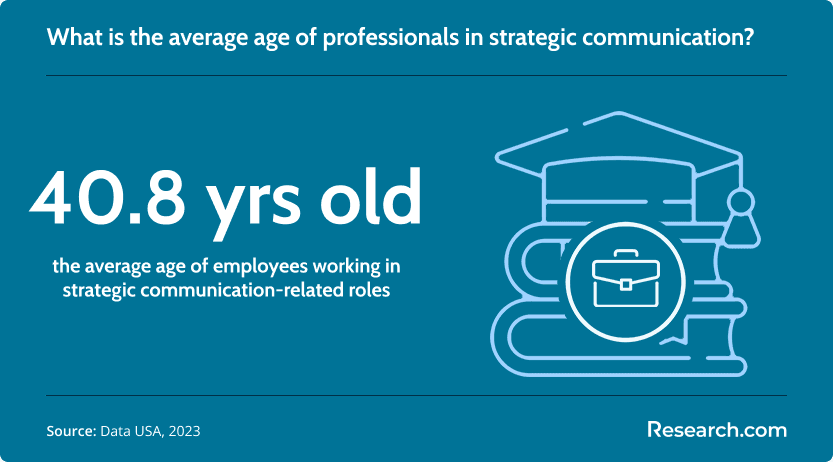
Cost should be evaluated against your career stage and professional goals. The average age of individuals in the strategic communication field is over 40 years old, which means many students are midcareer professionals making a targeted investment rather than choosing a first degree. For professionals working in athletics, coaching, or athlete development, related training such as the fastest online sports psychology degree may also complement communication leadership in performance-focused environments.
Look Beyond Tuition Before Deciding
Tuition is only one part of the financial picture. You should also consider fees, required technology, books, travel for residencies, time away from work, and whether the program includes career support, alumni access, research tools, or portfolio development. A lower tuition rate is helpful, but the cheapest program is not automatically the best choice if it lacks the curriculum, faculty, accreditation, or professional network you need.
| Cost Factor | Why It Matters | Question to Ask |
| Per-credit tuition | Determines the base cost for most programs | Is the published price the same for online students? |
| Total credits | A lower per-credit rate may still cost more if the program requires more credits | How many credits are required to graduate? |
| Residencies | Travel and lodging can add significant expenses | Are any in-person sessions required? |
| Employer support | Tuition assistance can reduce out-of-pocket costs | Will my employer reimburse tuition, fees, or books? |
| Career services | Support can affect how well you convert the degree into advancement | What career coaching, alumni networking, or portfolio help is included? |
Financial Aid Options for Online Strategic Communications Students
Students in eligible graduate programs may use federal aid by completing the FAFSA. Other possible funding sources include private student loans, university scholarships, military or public-service benefits, payment plans, and employer tuition assistance.
How to Approach Employer Tuition Assistance
For many working professionals, employer support is the most practical funding source. The strongest request is not simply, “Will you pay for my degree?” Instead, explain how the program will help you solve current business problems, improve stakeholder communication, manage crises, strengthen brand reputation, or support leadership priorities.
- Identify the skills from the program that directly connect to your job responsibilities.
- Describe a current company challenge the coursework could help address.
- Estimate what the employer would gain from your improved strategic capability.
- Ask about reimbursement rules, grade requirements, annual caps, and repayment obligations.
- Clarify whether you must remain with the employer for a certain period after receiving support.
If you are comparing education pathways in another professional field, similar funding and career-planning questions apply to specialized graduate routes such as accelerated BSN to PhD online bridge programs.
Admissions Requirements for Online Strategic Communications Programs
Admissions requirements vary by school, but online strategic communication graduate programs commonly ask for a bachelor’s degree from an accredited institution, a professional resume, two to three letters of recommendation, and a statement of purpose or admissions essay. Some programs may also request writing samples, interviews, or evidence of professional experience.
These materials allow applicants to show more than academic history. For midcareer candidates, admissions committees often look for leadership potential, communication experience, career direction, and evidence that the applicant can contribute meaningfully to graduate-level discussions.
Are GRE Scores Required?
Many graduate programs have become test-optional or have removed GRE requirements for applicants with substantial work experience. This reflects a broader shift toward evaluating professional readiness, writing ability, leadership history, and career goals. Similar admissions changes can be seen in other fields, including online master’s in speech-language pathology programs with no GRE requirements.
Common Courses in an Online Strategic Communications Degree
Strategic communication curricula differ by university, but most strong programs combine theory, research, message strategy, ethics, analytics, and applied planning. The strongest courses help students understand not only what to say, but why, when, to whom, through which channels, and how success should be measured.
| Course Area | What You Learn | How It Applies at Work |
| Strategic Communication Management | How to design communication plans that support organizational objectives | Useful for leading campaigns, advising executives, and coordinating departments |
| Persuasive Communication and Storytelling | How audiences interpret messages and what makes communication credible | Supports speeches, brand narratives, stakeholder messaging, and internal communication |
| Ethics in Communication | How to handle transparency, privacy, misinformation, social responsibility, and public trust | Important for crisis response, reputation management, and policy communication |
| Communication Research and Insights | How to use qualitative and quantitative evidence to understand audiences | Helps measure campaigns, evaluate sentiment, and make data-supported decisions |
| Capstone Project | How to apply program learning to a real communication problem | Creates portfolio evidence for promotion, consulting, or job searches |
Why the Capstone Matters
The capstone is often the most career-relevant part of the degree. It gives students a structured way to apply strategic models, research methods, and messaging frameworks to a real-world problem. While a low-cost online philosophy degree may explore the foundations of ethics, rhetoric, and reasoning, a strategic communication capstone usually asks students to use those concepts to solve current organizational challenges.
Strategic Communications Specializations to Consider
Specializations help you align the degree with a specific career direction. Before choosing a concentration, think about whether you want to lead internal communication, public affairs, crisis response, digital campaigns, advocacy, analytics, or brand storytelling.
- Organizational Communication Management: Focuses on communication inside companies, employee engagement, leadership messaging, and stakeholder alignment.
- Strategic Digital Media Campaigns and Analytics: Covers campaign planning, digital performance measurement, channel strategy, and data-informed decision-making.
- Strategic Storytelling: Develops narrative techniques for brands, leaders, nonprofits, public institutions, and advocacy campaigns.
- Effective Social Media Strategy: Teaches how to plan and manage social platforms in support of broader communication goals.
- Crisis Communication: Prepares students to manage messaging during reputational threats, emergencies, public criticism, or organizational disruption.
- Communication Strategies for Social Change: Explores how communication can support movements, communities, and public-interest initiatives.
- Communication Strategies for Public Policy and Advocacy: Examines messaging, stakeholder influence, and communication planning in policy and advocacy settings.
How to Match a Specialization to Your Career Goal
| If You Want To... | Consider This Focus | Why It Fits |
| Lead brand or campaign strategy | Digital media campaigns and analytics | Builds planning and measurement skills for multichannel communication. |
| Advise leaders during high-risk situations | Crisis communication | Develops judgment, timing, message discipline, and stakeholder awareness. |
| Work in government, nonprofit, or advocacy settings | Public policy, advocacy, or social change | Connects communication strategy with public trust, influence, and civic outcomes. |
| Move into internal communication leadership | Organizational communication management | Prepares students to support culture, change management, and employee engagement. |
| Strengthen creative campaign work | Strategic storytelling | Improves narrative development for executives, brands, and public-facing initiatives. |
How to Choose the Best Online Strategic Communications Program
The right program should match your career target, learning style, budget, and current experience level. A tactical credential, such as a fast-track online social media marketing degree, may be useful if you mainly want platform-specific marketing skills. A strategic communication master’s degree should go further by preparing you for leadership, research, reputation management, analytics, and executive-level decision-making.
Program Selection Checklist
- Confirm accreditation: Choose an institution with recognized accreditation so your credential is credible to employers and eligible for relevant forms of financial aid.
- Compare the curriculum: Look for strategy, analytics, research, ethics, crisis communication, digital communication, and applied projects.
- Evaluate faculty backgrounds: Faculty with both academic and professional expertise can connect theory to current communication challenges.
- Review capstone or portfolio requirements: Applied work can help demonstrate your value during promotion conversations or job searches.
- Study graduate outcomes: Look for evidence that alumni move into roles similar to the ones you want.
- Check flexibility carefully: “Online” does not always mean fully asynchronous, self-paced, or residency-free.
- Calculate total cost: Include tuition, fees, books, technology, travel, and time away from work.
Common Mistakes to Avoid
| Mistake | Why It Can Hurt You | Better Approach |
| Choosing only by school name | A prestigious name may not guarantee the right specialization, schedule, or cost fit. | Compare curriculum, faculty, outcomes, and total cost. |
| Ignoring accreditation | An unaccredited or poorly recognized credential may limit employer confidence and aid options. | Verify institutional accreditation before applying. |
| Focusing only on tuition | Fees, travel, books, and lost work time can change the real cost. | Build a full cost estimate before enrolling. |
| Assuming online means easier | Graduate-level online work still requires discipline, writing, collaboration, and research. | Ask current students about weekly workload and project intensity. |
| Skipping alumni research | You may miss signs that the program does not align with your target roles. | Review alumni profiles and request informational interviews. |
Use Informational Interviews Before Enrolling
Marketing pages can explain program features, but current students and recent alumni can tell you how the program actually works. Reach out through LinkedIn or alumni networks and ask about workload, faculty responsiveness, group projects, career impact, and whether they would choose the same program again. A short conversation can reveal details that rankings and brochures often miss.
Career Paths With an Online Strategic Communications Degree
An online strategic communications degree can support advancement into roles where communication decisions affect reputation, revenue, policy, trust, employee alignment, and stakeholder relationships. Graduates often pursue leadership roles across corporations, nonprofits, healthcare organizations, government agencies, universities, consulting firms, and media-related organizations.
Common career paths include Director of Communications, Vice President of Corporate Affairs, Public Affairs Manager, communications consultant, public relations leader, internal communications director, and brand strategy leader. Professionals in these roles often collaborate with leaders trained in public administration, policy, and organizational management, including graduates from programs such as the fastest online public administration degree programs.
| Career Path | What the Role Emphasizes | Relevant Program Features |
| Director of Communications | Department leadership, messaging strategy, media relations, and internal alignment | Management, research, executive communication, and capstone work |
| Public Affairs Manager | Policy communication, stakeholder engagement, advocacy, and public trust | Public policy, advocacy, ethics, and crisis communication |
| Corporate Affairs Leader | Reputation, external relationships, executive messaging, and organizational positioning | Strategic planning, storytelling, stakeholder analysis, and analytics |
| Crisis Communication Specialist | Rapid response, reputation risk, media statements, and coordinated messaging | Crisis communication, ethics, media strategy, and simulations |
| Strategic Communications Consultant | Advising multiple clients on complex communication problems | Portfolio projects, research skills, leadership communication, and specialization depth |
Consulting as a Career Option
Experienced graduates may use the degree to move into independent consulting or agency leadership. This path can be attractive for professionals who want autonomy, diverse client work, and the ability to advise organizations on reputation, campaigns, crisis readiness, public affairs, and internal communication. Consulting usually requires more than the degree itself; you also need a clear niche, strong client relationships, persuasive case studies, and evidence of measurable results.
Job Market Outlook for Strategic Communications Graduates
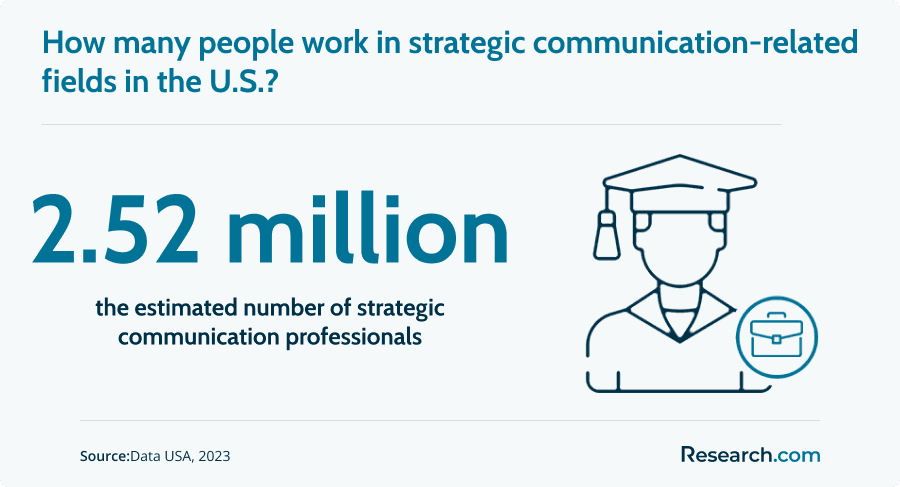
The job market for professionals with strategic communication training is supported by broad demand across communications, marketing, public relations, media, government, and corporate leadership. More than 2.5 million people in the U.S. work in roles related to strategic communication.
The U.S. Bureau of Labor Statistics projects faster-than-average growth for key related roles, with employment for marketing and promotions managers expected to grow by 8% through 2033. Openings are expected to come from both new positions and replacement needs as workers retire, change occupations, or move into different roles.
How AI and Digital Tools Are Changing Strategic Communication
AI is changing communications work, but it is not removing the need for strategic judgment. Automation can assist with drafting, monitoring, summarizing, segmentation, and content testing. However, organizations still need human leaders to set strategy, interpret reputational risk, manage ethical issues, understand stakeholders, and make decisions when trust is at stake.
The highest-value communicators will likely be those who can combine human judgment with data, AI-assisted workflows, audience research, and ethical governance. This is similar to demand patterns in other specialized professions; for comparison, readers can review current analysis of speech pathologist demand.
How Creative Expertise Strengthens Strategic Communication
Strategic communication depends on analysis, planning, and measurement, but creative skill still matters. Leaders must often translate complex information into messages that people understand, remember, and act on. Creative writing, visual storytelling, design thinking, and narrative development can make communication strategies more persuasive and emotionally credible.
Professionals who want to deepen the creative side of their work may explore what you can do with an MFA in creative writing, particularly if their career involves executive speechwriting, brand storytelling, advocacy campaigns, thought leadership, or long-form content strategy.
Can a Complementary Creative Degree Help Your Communications Career?
A complementary creative degree is not required for most strategic communication roles, but it can be useful for professionals whose work depends heavily on storytelling, content leadership, publishing, campaign concepts, or audience engagement. If cost is a concern, comparing the most affordable online MFA programs can help you decide whether creative graduate study is a realistic addition to your professional development plan.
How Digital Innovation Drives Strategic Communication
Digital innovation has made strategic communication more measurable, faster-moving, and more audience-specific. Programs increasingly address tools and methods such as predictive analytics, automation, multimedia production, and digital campaign measurement. These capabilities help communication professionals test messages, monitor audience response, and adjust strategy in real time.
User experience principles are also becoming more relevant. Communicators who understand audience journeys, usability, accessibility, and digital behavior can design clearer messages and more effective content ecosystems. Professionals interested in that skill set may compare online user experience design degree programs as a related path.
What Graduates Say About Online Strategic Communications Programs
- : "The biggest change for me was confidence. I used to feel anxious when presenting recommendations to senior leaders. After the program, I could explain stakeholder engagement, reputation risk, and communication strategy with much more authority because I had stronger academic and practical grounding. — Courtney"
- : "I did not expect an online program to feel as connected as it did. My classmates were experienced professionals across the country, and many were facing the same workplace challenges I was. The discussions and peer relationships became one of the most valuable parts of the experience. — Harold"
- : "I entered from a different industry, so I did not have a traditional communications portfolio. The capstone helped me prove I could do strategic work and gave me a serious project to discuss in interviews. — Mia"
Questions to Ask Before You Apply
- Is the institution properly accredited?
- Does the program offer a master’s degree, a graduate certificate, or both?
- Are courses asynchronous, synchronous, or hybrid?
- Are there required residencies, and what will they cost?
- Does the curriculum include analytics, ethics, crisis communication, and applied strategy?
- Can the capstone be used to build a portfolio or solve a real problem at work?
- What career services are available to online students?
- Where do graduates work after completing the program?
- Will your employer provide tuition assistance?
- Does the program support the specialization you actually need?
References:
- Data USA. (2023). Communications. Retrieved May 24, 2024, from https://datausa.io/profile/cip/communications?redirect=true
- National University. (n.d.). What can I do with a strategic communication degree? Retrieved May 24, 2024, from https://www.nu.edu/blog/what-can-i-do-with-a-strategic-communications-degree/
- O*NET Online. (n.d.). Public relations specialists (27-3031.00). Retrieved May 24, 2024, from https://www.onetonline.org/link/summary/27-3031.00
- U.S. Bureau of Labor Statistics. (2025, April). Advertising, promotions, and marketing managers. Occupational Outlook Handbook. Retrieved May 24, 2024, from https://www.bls.gov/ooh/management/advertising-promotions-and-marketing-managers.htm#tab-1
- U.S. Bureau of Labor Statistics. (2025, April). Media and communication occupations. Occupational Outlook Handbook. Retrieved May 24, 2024, from https://www.bls.gov/ooh/media-and-communication/
- U.S. Bureau of Labor Statistics. (2025, April). Public relations specialists. Occupational Outlook Handbook. Retrieved May 24, 2024, from https://www.bls.gov/ooh/media-and-communication/public-relations-specialists.htm#tab-1
- Zippia. (2025, August). Strategic communications consultant jobs. Retrieved May 24, 2024, from https://www.zippia.com/strategic-communications-consultant-jobs/
Key Insights
- An online strategic communications master’s degree is best for professionals who want broader leadership preparation, while a graduate certificate is better for focused skill-building in less time.
- Program length varies significantly: certificates in this ranking take 9 months to 1 year, while master’s programs range from 12-18 months to up to 3 years.
- Cost should be judged by total value, not tuition alone. Compare credits, residency requirements, fees, employer tuition support, career services, and portfolio opportunities.
- Accreditation is non-negotiable. It affects credibility, transferability, employer confidence, and access to certain aid options.
- AI is increasing the value of strategic judgment. Tools can automate some communication tasks, but organizations still need leaders who can manage trust, ethics, crisis response, stakeholder relationships, and reputation.
- The strongest program choice is the one that matches your target role. Crisis communication, public affairs, digital analytics, organizational communication, and storytelling each lead to different career advantages.
- Before enrolling, speak with current students or alumni. Their feedback on workload, faculty quality, online engagement, and career impact can be more useful than a brochure.
Other Things You Should Know About Online Strategic Communications Degree Programs
The program should be accredited by a U.S. regional accreditor recognized by the Department of Education or the Council for Higher Education Accreditation. Common accreditors include HLC, SACSCOC, MSCHE, NECHE, WSCUC, NWCCU, and ACCSC. Separate programmatic accreditation is uncommon in this field.
Typical admission requirements for 2027 online strategic communication degree programs include a completed application, a high school diploma or equivalent, official transcripts, and letters of recommendation. Some programs might also require a personal statement or relevant work experience, depending on the institution.


