2027 Salary Expectations After an AI Master's Degree

Co-Founder and Chief Data Scientist
Before enrolling in an artificial intelligence master’s program, the central question is not simply whether AI is a growing field. It is whether the degree can realistically improve your salary, job options, and long-term mobility enough to justify the time, tuition, and opportunity cost. For professionals coming from computer science, engineering, statistics, business analytics, or even unrelated undergraduate majors, the answer depends on program quality, technical preparation, employer demand, location, and the roles you target after graduation.
This guide explains what AI master's degree graduates can expect in 2026, including salary ranges, industry differences, career progression, admissions standards, online versus campus formats, complementary credentials, program length, total cost, common job titles, accreditation, and labor market demand. Use it to compare programs more carefully, estimate return on investment, and identify the skills and credentials that matter most to employers.
Key Things You Should Know
- Graduates with a master's degree in artificial intelligence in 2027 can expect average starting salaries around $115,000, with senior roles surpassing $160,000 annually in major U.S. tech hubs.
- Demand for AI skills continues growing rapidly, increasing salary prospects by approximately 7% year-over-year, driven by advances in machine learning and automation technologies.
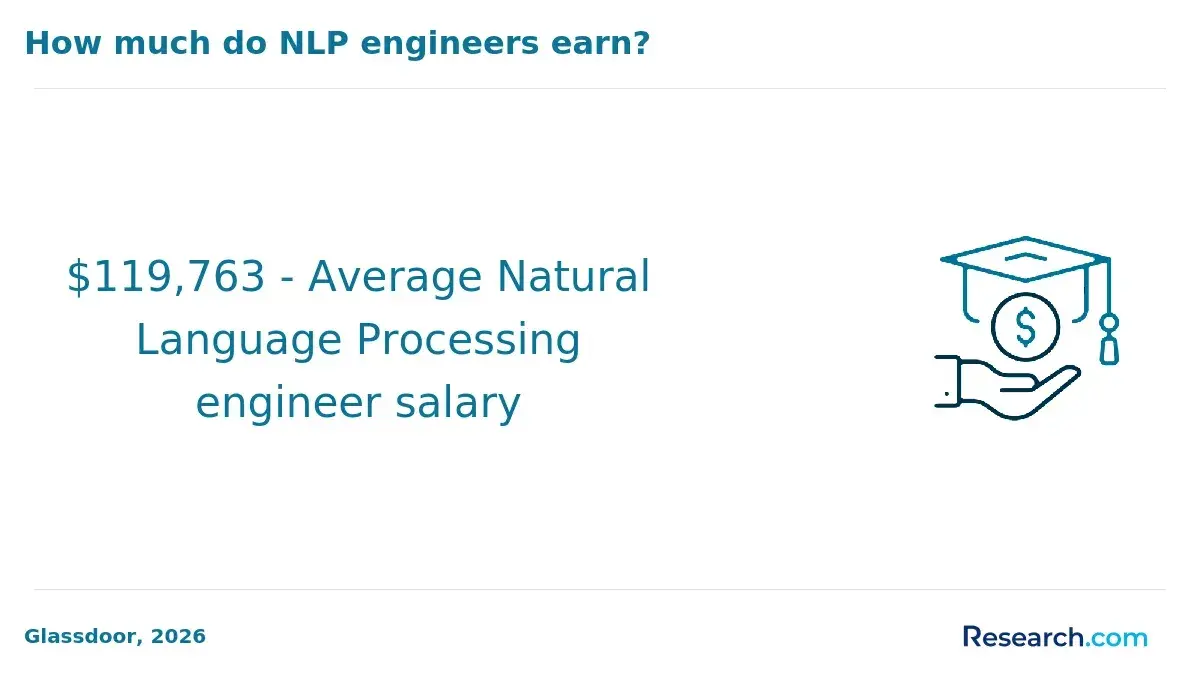
- Specializing in subfields like natural language processing or computer vision can boost salaries by 10-15%, reflecting employers' need for targeted expertise in complex AI applications.
What is the average salary for AI master's degree graduates in the United States?
AI master's degree graduates in the United States generally enter the market with strong earning potential. A typical average starting salary falls between $120,000 and $135,000 annually, based on Glassdoor and PayScale data for roles commonly held by artificial intelligence master's degree holders. Entry-level positions such as machine learning engineer, data scientist, and AI research analyst often fall within this range, although actual pay can vary significantly by employer, location, and technical depth.
The salary range is not uniform across the country. Graduates working in major technology and finance hubs such as San Francisco or New York often earn salaries exceeding $130,000, while graduates in smaller cities, early-stage startups, or lower-cost regions may start closer to $120,000. Compensation can also rise quickly for candidates who bring applied expertise in deep learning, natural language processing, computer vision, model deployment, or large-scale data systems.
Industry choice also shapes total compensation. Finance, healthcare, automotive, and technology employers use AI for high-value problems such as fraud detection, diagnostic tools, autonomous systems, and predictive modeling. These organizations may offer bonuses, equity, or stock options that make total compensation higher than base salary alone. Candidates who combine AI training with software engineering, cybersecurity, cloud architecture, or domain-specific expertise are often better positioned to negotiate above-average offers.
When estimating return on investment, compare salary expectations against tuition, living costs, lost income if studying full time, and the type of role you are realistically prepared to pursue. If you still need undergraduate-level computing preparation before applying to an AI master's program, a 2 year computer science degree online may provide a more flexible route into the field.
How do AI master's degree salaries vary by industry and employer type?
AI master's degree salaries vary sharply by industry because employers value AI skills differently depending on revenue impact, regulatory pressure, data maturity, and competition for talent. Financial services are among the highest-paying sectors, with a median salary of $165,000. That is 23% higher than healthcare, where salaries average $134,000. Finance pays a premium because AI is closely tied to trading algorithms, risk modeling, fraud detection, portfolio optimization, and operational automation.
Employer type matters as much as industry. Large multinational corporations usually have larger compensation budgets, more mature data infrastructure, and clearer promotion tracks than many small or medium-sized employers. Major technology companies and cloud providers often compete directly with finance for AI talent and may supplement salary with bonuses or equity. Consulting firms may also pay well for professionals who can advise clients on AI strategy, implementation, governance, and transformation.
Startups can be attractive, but compensation is less predictable. Some offer lower base salaries with equity upside, while others compete aggressively for specialized AI engineers. Government agencies and non-profits typically offer lower median salaries, but they may provide stronger job stability, mission-driven work, retirement benefits, and opportunities to apply AI in public health, security, infrastructure, or social services.
Healthcare illustrates an important trade-off. Although AI adoption is increasing in diagnostics, personalized medicine, clinical decision support, and operations, salaries remain comparatively lower than finance because of budget constraints, regulatory complexity, and slower procurement cycles. Location can further widen or narrow these gaps, especially in metropolitan hubs such as San Francisco and New York where wages are higher but cost of living is also substantial.
Prospective students should not choose an industry based only on median pay. Consider the kind of AI work you want to do, how much technical specialization the role requires, whether the employer has production-ready data systems, and how quickly you can advance. For students seeking a lower-cost path into analytics and AI-adjacent roles, an affordable data science degree can be a practical alternative or stepping stone.
What entry-level and mid-career salary progression can graduates expect after completing an AI master's program?
Salary progression after an AI master's program can be rapid, but it depends on whether graduates move into technical AI roles, applied analytics roles, research positions, or leadership tracks. At entry level, graduates commonly start between $90,000 and $120,000 annually in the U.S., depending on industry, location, prior experience, and portfolio strength. Typical roles include AI research engineer, machine learning specialist, and data scientist.
According to LinkedIn Salary data, AI professionals see an average salary increase of 18-22% within three years of graduation. This early growth is often tied to moving from model-building or analyst responsibilities into production machine learning, applied research, technical ownership, or team leadership. Graduates who can demonstrate that their models improve revenue, reduce risk, automate workflows, or scale reliably tend to have stronger negotiating leverage.
Mid-career salary progression is even more pronounced. AI master's graduates with 5-7 years of experience generally earn between $180,000 and $220,000. High-tech companies, finance, healthcare, and consulting firms are key employers at this stage. Deployment-focused AI engineers may earn toward the lower end of the range, while research scientists, principal machine learning engineers, and managers at large firms may reach or surpass the higher end.
What accelerates salary growth?
- Specialization: Natural language processing, computer vision, reinforcement learning, and deep learning can improve earnings when matched with employer demand.
- Production experience: Employers value candidates who can move models from experiments into reliable systems.
- Complementary technical skills: Software engineering, cloud computing, data engineering, and model monitoring can make graduates more valuable than candidates who only know theory.
- Business and product judgment: Professionals who can connect AI work to measurable business outcomes often progress faster.
- Location strategy: San Francisco, Seattle, and New York can offer higher salaries, but the higher cost of living must be factored into net gains.
For students who want broader technical preparation before specializing in AI, an online engineering degree can be a flexible option. Regardless of path, salary growth beyond mid-career depends on continuous learning, visible project outcomes, and the ability to adapt as AI tools, frameworks, and governance expectations change.
What are the core admission requirements for accredited AI master's degree programs?
Accredited artificial intelligence master's programs are usually selective because students need enough mathematical and computing preparation to succeed in advanced coursework. About 78% of top-ranked programs require a minimum GPA of 3.5, reflecting how competitive admission can be at leading U.S. institutions. A strong GPA helps, but admissions committees also look closely at quantitative readiness, programming ability, recommendations, and fit with the program's curriculum or research strengths.
Most applicants are expected to have completed coursework in calculus, linear algebra, probability and statistics, algorithms, and data structures. These areas are foundational because AI courses often require mathematical modeling, optimization, statistical inference, and efficient programming. Applicants without this background may need prerequisite courses, bridge coursework, or professional experience that demonstrates equivalent preparation.
GRE policies vary. Some programs still consider GRE scores, while others have relaxed or removed the requirement. Where the GRE is optional, strong quantitative scores can still strengthen an application, especially for candidates whose undergraduate record does not clearly show advanced math or computing ability.
Common application components
- Academic transcripts: Used to verify GPA, prerequisite coursework, and overall academic rigor.
- Programming experience: Often demonstrated through Python, Java, or C++ coursework, employment, research, internships, or projects.
- Letters of recommendation: Strong letters usually come from professors, supervisors, or technical leads who can speak to quantitative skill, coding ability, research potential, or professional judgment.
- Personal statement: A focused statement should explain why AI is the right field, which areas of AI interest you, and how the program supports your goals.
- Resume or CV: This should highlight technical projects, research, internships, publications, work experience, and tools used.
Applicants from unrelated undergraduate majors should be realistic about preparation. Admissions committees may value career maturity and domain knowledge, but they still need evidence that you can handle graduate-level AI. If your background is closer to analytics than computer science, masters in data science online programs may offer a more accessible route while still including foundational AI coursework.
How do online and campus-based AI master's programs differ in curriculum, cost, and career outcomes?
Online and campus-based AI master's programs can lead to similar career outcomes, but they differ in learning format, networking access, research exposure, and total cost. Online programs are usually designed for working professionals who need flexibility and want to keep earning while studying. Campus programs often provide more direct access to faculty, labs, research groups, recruiting events, and in-person peer collaboration.
Curriculum differences are often a matter of emphasis rather than academic level. Online programs frequently focus on applied, project-based learning in machine learning, data engineering, model deployment, and business use cases. Campus programs may offer more opportunities for research assistantships, advanced seminars, lab-based projects, and faculty-led research in areas such as robotics, natural language processing, computer vision, or AI theory.
Cost is a major differentiator. Online master's degrees typically range from $35,000 to $50,000, while campus programs often cost between $60,000 and $90,000. Campus students may also face additional expenses for housing, relocation, commuting, parking, and reduced work hours. Online students may avoid many of those costs, although they still need to budget for fees, technology, and the time required to complete rigorous coursework.
Career outcomes for both formats are largely comparable, with job placement rates showing about 89% similarity. The stronger option depends on how well the format supports your goals. A campus program may be better for students pursuing research-heavy roles, doctoral study, or employers that recruit heavily on-site. An online program may be better for professionals seeking promotion, career change, or specialization without leaving the workforce.
How to choose the right format
- Choose online if you need schedule flexibility, want to keep working, or need a lower total cost.
- Choose campus-based if you want lab access, in-person faculty mentorship, research opportunities, or stronger campus recruiting.
- Compare both formats by outcomes, not convenience alone: Review placement data, capstone quality, employer connections, alumni network strength, and access to technical support.
- Look at project depth: Employers care less about format and more about whether you can demonstrate applied AI skills through credible projects.
What specialized certifications or professional credentials complement an AI master's degree?
Specialized certifications can strengthen an AI master's degree when they add practical, employer-recognized skills that the degree alone may not fully cover. The best credentials depend on your target role. A machine learning engineer may benefit most from cloud and deployment credentials, while an AI governance professional may need security, compliance, or project management expertise.
Cloud computing credentials are among the most useful because many AI systems are built, trained, deployed, and monitored on cloud platforms. AWS Certified Solutions Architect, Google Cloud Professional Data Engineer, and Microsoft Certified: Azure AI Engineer Associate are especially relevant for professionals working with production AI infrastructure. Data from the 2024 O'Reilly Skills Index shows that professionals with both an AI master's degree and cloud certifications earn 15-20% more than those with only the degree.
Industry-recognized AI and data credentials can also help candidates demonstrate applied proficiency. The Certified Artificial Intelligence Professional (CAIP), machine learning certificates from platforms such as Coursera or edX, Certified Data Scientist from the Data Science Council of America (DASCA), and Cloudera Certified Professional Data Scientist can support roles in machine learning, analytics, data platforms, and applied AI development.
Security and governance credentials are increasingly important as organizations adopt AI in sensitive environments. Certified Information Systems Security Professional (CISSP) can be valuable for AI professionals working in cybersecurity, finance, healthcare, defense, or regulated data environments. Project management credentials such as PMI's Project Management Professional (PMP) can help graduates lead AI deployments, coordinate technical teams, manage stakeholders, and deliver projects on schedule.
Match the credential to the career path
- AI infrastructure or MLOps: Prioritize cloud, data engineering, and deployment credentials.
- Machine learning engineering: Look for credentials that validate practical model-building and production skills.
- AI strategy or consulting: Consider project management and business-facing credentials.
- Security-sensitive AI work: Add cybersecurity or governance credentials that show awareness of risk, compliance, and model security.
Certifications should not be collected randomly. The strongest combination is an AI master's degree, a credible project portfolio, and targeted credentials that align with the roles you plan to pursue.
How long does an AI master's degree typically take to complete, and what is the total cost?
An AI master's degree typically takes one to two years of full-time study. Accelerated programs may allow students to finish in as little as 12 months, while part-time programs can extend up to three years for working professionals. Online and hybrid formats can make scheduling easier, but they may lengthen completion time if students take fewer courses per term.
The total cost to earn an AI master's degree generally ranges between $70,000 and $120,000, including tuition, fees, and sometimes textbooks or technology expenses. Public universities often charge lower tuition for in-state students, reducing costs by 20-40%, while private institutions are more likely to fall at the higher end. Students attending in person should also account for housing, commuting, relocation, and potential lost income if they reduce work hours or leave a job to study full time.
According to data from the National Association for College Admission Counseling, students typically recover their educational investment within about 2.8 years after graduation through increased earnings. That estimate can be useful, but individual outcomes vary. A student who earns while studying part time may take longer to reach a higher salary, while a full-time student may graduate sooner but absorb more immediate financial pressure.
Cost and timeline trade-offs
- Accelerated study: Faster completion can speed up access to higher salaries, but the workload may be intense and less compatible with full-time employment.
- Full-time study: Often completed in one to two years, but students must plan for tuition and living costs without assuming uninterrupted income.
- Part-time study: Allows students to keep working and spread out costs, but salary gains may be delayed.
- Online or hybrid study: Can reduce relocation and commuting costs, though students still need strong time management and technical support.
Before enrolling, calculate total program cost, expected debt, employer tuition assistance, scholarship opportunities, likely salary change, and how quickly the program can help you qualify for the roles you want.
What job titles and roles are most common for AI master's degree holders?
AI master's degree holders most commonly move into technical and analytical roles that require advanced modeling, programming, data interpretation, and AI system design. Machine Learning Engineer, AI Research Scientist, and Data Scientist are the most common job titles, together accounting for 67% of job placements. According to data from the Bureau of Labor Statistics and LinkedIn Jobs, the market for these positions is growing at an annual rate of 28%.
Machine Learning Engineers build, test, and deploy algorithms that allow systems to learn from data. Their work often involves Python or R, model training, evaluation, feature engineering, cloud tools, and production deployment. This role is a strong fit for graduates who enjoy software engineering as much as modeling.
AI Research Scientists focus on advancing AI methods, testing new approaches, and conducting experiments in areas such as natural language processing, computer vision, robotics, and deep learning. These roles may require stronger research preparation and can be more common in large technology companies, research labs, and advanced product teams.
Data Scientists use statistical methods, machine learning, and AI tools to analyze large datasets, build predictive models, and support business decisions. Some data science roles are highly technical, while others are more business-facing. Graduates should read job descriptions carefully to distinguish between advanced AI roles and analytics roles that use AI tools more lightly.
Related roles include Deep Learning Engineer, Computational Linguist, and AI Product Manager. Deep Learning Engineers typically work on neural network architectures and large-scale model performance. Computational Linguists focus on language technologies and natural language processing. AI Product Managers guide AI-enabled products, translate technical capabilities into user value, and coordinate engineering, design, legal, and business teams.
Employers increasingly look for hands-on experience with frameworks such as TensorFlow and PyTorch, as well as domain knowledge in healthcare, finance, autonomous systems, or other applied fields. Students can improve employability by choosing specializations, capstone projects, internships, and portfolios that match the job titles they plan to pursue.
Which accreditation bodies and quality standards should prospective students verify when choosing an AI master's program?
Prospective students should verify both institutional accreditation and program-level quality before enrolling in an AI master's program. Recognized regional accreditors such as the Middle States Commission on Higher Education or the Western Association of Schools and Colleges help confirm that the institution meets established academic and administrative standards. Where applicable, ABET accreditation for computing, engineering, or computer science-related programs can also be a strong signal of curriculum quality and outcomes assessment.
Accreditation matters because it affects more than reputation. It can influence financial aid eligibility, credit transfer, employer recognition, and confidence that the program undergoes external review. According to 2024 ABET outcome surveys, employer satisfaction for graduates from accredited programs is 94%, compared with only 71% for those from non-accredited programs. In a competitive AI labor market, that difference can affect employability and salary expectations.
Students should also examine whether the curriculum covers the core areas employers expect: machine learning, data analytics, programming, algorithms, model evaluation, and ethics in artificial intelligence. Strong programs regularly review faculty qualifications, computing resources, student outcomes, advising quality, and curriculum relevance. Programs without reputable accreditation or transparent quality controls may offer outdated or insufficient preparation.
Professional alignment can provide additional assurance. Endorsements, curriculum guidance, or involvement from organizations such as the IEEE Computer Society or ACM may indicate that coursework reflects current computing standards. Programs that reference standards from the National Institute of Standards and Technology (NIST) may also demonstrate attention to AI risk, governance, security, and responsible deployment.
Quality checks before applying
- Confirm institutional accreditation through a recognized accreditor.
- Check whether ABET or another relevant program-level accreditation applies.
- Review required courses, electives, capstone expectations, and hands-on project work.
- Look for faculty with current AI research, industry experience, or applied technical expertise.
- Ask for published graduate outcomes, including employment rates and average salaries.
- Verify whether employers recruit from the program or engage through projects, internships, or advisory boards.
Choosing an accredited, outcomes-focused program helps protect your investment and reduces the risk of earning a credential that employers do not value.
What is the job outlook and labor market demand for AI professionals with a master's degree?
The job outlook for AI professionals with a master's degree is strong because organizations across industries are moving from experimentation to practical AI deployment. Projections from the U.S. Bureau of Labor Statistics indicate a 35% growth rate through 2032, well above average job growth. This demand reflects the need for professionals who can design, evaluate, implement, and govern AI systems rather than simply use off-the-shelf tools.
Employers value candidates who combine technical depth with judgment. AI work increasingly requires more than model building. Professionals must understand data quality, model performance, privacy, bias, security, deployment constraints, and business context. Graduates with strong portfolios and applied experience are better positioned than those who rely only on coursework.
Demand spans healthcare, finance, automotive, technology, consulting, and other sectors. In healthcare, AI professionals may support diagnostic tools, clinical workflows, and personalized medicine. In finance, they may build fraud detection algorithms, risk models, or trading systems. In automotive and autonomous systems, AI experts may work on perception, decision-making, simulation, or safety-related modeling. In technology companies, roles often involve platform development, product AI features, infrastructure, and research.
The labor market is favorable, but it is also becoming more specialized. Graduates should expect to keep learning new frameworks, model architectures, data engineering practices, and responsible AI methods. Proficiency with machine learning frameworks, data engineering, and ethical AI practices is increasingly important for long-term employability.
Prospective students should prioritize programs that include hands-on projects, industry collaboration, capstones, internships, and opportunities to build a public or employer-ready portfolio. In a high-demand market, the degree can open doors, but demonstrated skill is what helps candidates compete for the best roles.
Other Things You Should Know About Artificial Intelligence
In 2027, the job market for AI master's graduates is expected to be robust. With advancements in machine learning and big data, salaries typically range from $120,000 to $160,000 annually, depending on experience and location. Industry demand spans areas like tech, finance, and healthcare, ensuring diverse career paths for graduates.
In 2027, AI master's graduates can anticipate starting salaries ranging from $85,000 to $120,000 annually. Salaries vary based on experience, location, and industry demand, with top-paying positions typically found in tech hubs like Silicon Valley, and in sectors focusing on autonomous systems and analytics.
Salary for AI master's graduates in 2027 is influenced by factors such as industry demand, geographic location, level of technical expertise, and previous work experience. Specific roles in sectors like finance and technology tend to offer higher salaries due to increased demand for AI skills.
Yes, many federal AI jobs require at least a public trust or Secret clearance before start date. In the United States, clearance processing is handled through the sponsoring agency and can take 3 to 12 months, depending on the investigation level and background review.
References
- Application and admission - Master Artificial Intelligence https://www.uva.nl/shared-content/programmas/en/masters/artificial-intelligence/application-and-admission/international-prior-education/international-prior-education-foldout-menu.html
- 10 Most Demanded Job Roles in Artificial Intelligence - GeeksforGeeks https://www.geeksforgeeks.org/blogs/most-demanded-job-roles-in-artificial-intelligence/
- University Degree vs AI Bootcamp: Which is Best Career Path? https://agilefever.com/university-degree-vs-ai-bootcamp-which-is-best/
- Masters in Artificial Intelligence Salary: Earning The Degree & The Dollars https://aifwd.com/career/masters-in-artificial-intelligence-salary/
- Who Accredits Artificial Intelligence (AI) Degree Programs? - AI Degrees Online https://aidegreesonline.com/accreditation/who-accredits-ai-degree-programs/
- Certifications in AI that would allow you standout in job hunting https://community.deeplearning.ai/t/certifications-in-ai-that-would-allow-you-standout-in-job-hunting/871654
- 6 High-Paying Jobs With a Master’s in AI | University of Bridgeport https://www.bridgeport.edu/news/high-paying-jobs-with-a-masters-in-ai/
- AI Degrees & Certs for Specialized Professional Fields https://aidegreeguide.com/what-type-of-ai-student-are-you/ai-tools-for-professional-fields/
- Top AI Certifications for 2026: A Guide to Advancing Your Tech Career | DataCamp https://www.datacamp.com/blog/top-ai-certifications
- AI Career Insights: Salary Trends by Industry https://www.acedit.ai/blog/ai-career-insights-salary-trends-industry