2027 Scholarships for Community College Students Studying AI

Co-Founder and Chief Data Scientist
Many community college students face financial barriers when pursuing degrees related to artificial intelligence, limiting their ability to access quality education and hands-on experience. The rapid expansion of AI careers demands skilled professionals, yet affordable pathways remain scarce.
Without adequate funding, students may struggle to complete their studies or gain competitive advantages in the field. This article examines the most current 2027 scholarships specifically available to community college students studying artificial intelligence, highlighting opportunities that can reduce financial burdens and support successful entry into the AI workforce.
Key Things You Should Know
- In 2026, over 60% of community colleges nationwide offer scholarships specifically for students pursuing ai-related fields, reflecting growing industry demand.
- Many scholarships prioritize underrepresented groups, with funding increases of 25% from 2024 to 2025 to promote diversity in ai technology careers.
- Scholarship amounts range widely, from $1,000 to full tuition coverage, often requiring enrollment in accredited ai certificates or associate degree programs.
What scholarships are specifically available for community college students pursuing artificial intelligence degrees?
Several scholarships specifically support community college students enrolled in artificial intelligence programs. Technology companies, professional associations, and nonprofit foundations offer many of these awards.
For instance, the AI Scholars Fund provides up to $5,000 annually to community college students demonstrating both academic excellence and financial need in AI-related studies. The Women in AI Initiative awards $3,000 scholarships to female students to help increase gender diversity within the AI fields.
These opportunities highlight the growing emphasis on community college scholarships for artificial intelligence students.
Broader STEM scholarships also play a key role by including AI disciplines as qualifying fields. The National Science Foundation's S-STEM program funds students in high-demand STEM areas, including AI, typically granting between $2,500 and $7,000 annually.
Local and state education departments sometimes partner with community colleges to provide additional scholarships supporting AI studies. These options enhance the range of scholarships for AI degree programs at community colleges.
Grant aid averages about $3,300 per year for community college students, with AI-focused scholarships increasing by 23% recently. This growth reflects governmental and industry efforts to strengthen AI education pipelines at the associate degree level.
Prospective applicants should apply early and consult their college financial aid office for tailored advice. Many scholarships require proof of enrollment in AI-specific courses, portfolios, or letters demonstrating commitment to AI careers. Seeking aid aimed at underrepresented groups or veterans may also unlock extra funds.
Students exploring career options can learn more about potential paths after earning an AI degree through resources such as artificial intelligence degree jobs, which provide valuable guidance on employment opportunities and industry trends.
What are the admission requirements and prerequisites for community college AI programs?
Admission requirements for community college artificial intelligence programs tend to be accessible, usually requiring a high school diploma or GED. Some colleges may also expect a minimum GPA of 2.0 to 2.5 on a 4.0 scale, but this varies. Prerequisites for enrolling in community college AI courses often emphasize foundational math skills.
About 68% of these programs require no more than basic algebra or precalculus, making them more approachable than traditional four-year computer science degrees that demand higher-level math such as calculus.
Basic programming knowledge in languages like Python or Java is sometimes recommended, with many colleges offering introductory courses concurrently or as prerequisites. Placement tests in math and English may be used to assess student readiness, and developmental classes might be necessary for those who do not meet the criteria.
International students face additional admission steps, such as proof of English proficiency through exams like TOEFL or IELTS, along with possible personal statements or interviews for competitive AI tracks.
Students concerned about meeting prerequisites should seek advice early from academic counselors to plan course sequences or preparatory options. Many community colleges provide bridge programs to build essential skills before starting AI curricula.
For those also interested in engineering education options, exploring the cheapest mechanical engineering degree online can be a practical alternative or complement.
What does an artificial intelligence curriculum typically include at the community college level?
An AI course curriculum for community colleges typically begins with foundational programming courses, focusing heavily on Python, which is essential for developing machine learning models and neural networks. Mathematics classes cover key areas such as linear algebra, calculus, and probability, all crucial for grasping AI algorithms.
Core subjects in community college artificial intelligence programs include machine learning techniques like supervised and unsupervised learning, as well as neural networks encompassing convolutional and recurrent architectures. Recent data from the Computing Accreditation Commission (CAC) shows that 87% of community colleges now incorporate machine learning and neural networks, up from 52% a few years ago, reflecting swift curriculum updates driven by industry needs.
Students also learn data handling skills, including collecting, cleaning, and analyzing large datasets. Ethical considerations such as bias and privacy are frequently addressed to prepare learners for responsible AI development.
Practical projects in areas like natural language processing and computer vision give hands-on experience with real-world problems.
Electives might include robotics, reinforcement learning, or cloud-based AI deployment, allowing students to align their studies with career goals. Many programs expose students to modern tools like TensorFlow and PyTorch.
For more flexible options, students can explore affordable community college video game programs through video game programs that often include AI components related to game development.
How long does it take to complete an AI associate degree at a community college, and what is the typical cost?
An associate degree in artificial intelligence at a community college typically requires two years of full-time study. Students opting for part-time enrollment may extend this to three years or more, while accelerated or summer programs can shorten the timeline.
The curriculum blends foundational computer science, data analysis, and machine learning courses with specialized topics like neural networks and robotics.
The typical cost of an artificial intelligence associate degree at community colleges is significantly lower than at four-year universities. Based on data from the U.S. Department of Education's National Center for Education Statistics (NCES), the average total yearly expense for full-time community college students, including tuition, fees, and living costs, is approximately $15,570.
Over two years, this totals around $31,140, offering a more affordable route to AI education without substantial debt.
Actual expenses can vary by institution and region, and students should budget for additional costs such as textbooks and AI-related software. Many community colleges provide financial aid and scholarships tailored to STEM and AI fields, with advising offices helping students identify these opportunities.
Prospective students comparing their options might also explore an online cyber security degree as an alternative or complementary path in the tech domain.
What is the job outlook for AI professionals, and which entry-level roles do community college graduates qualify for?
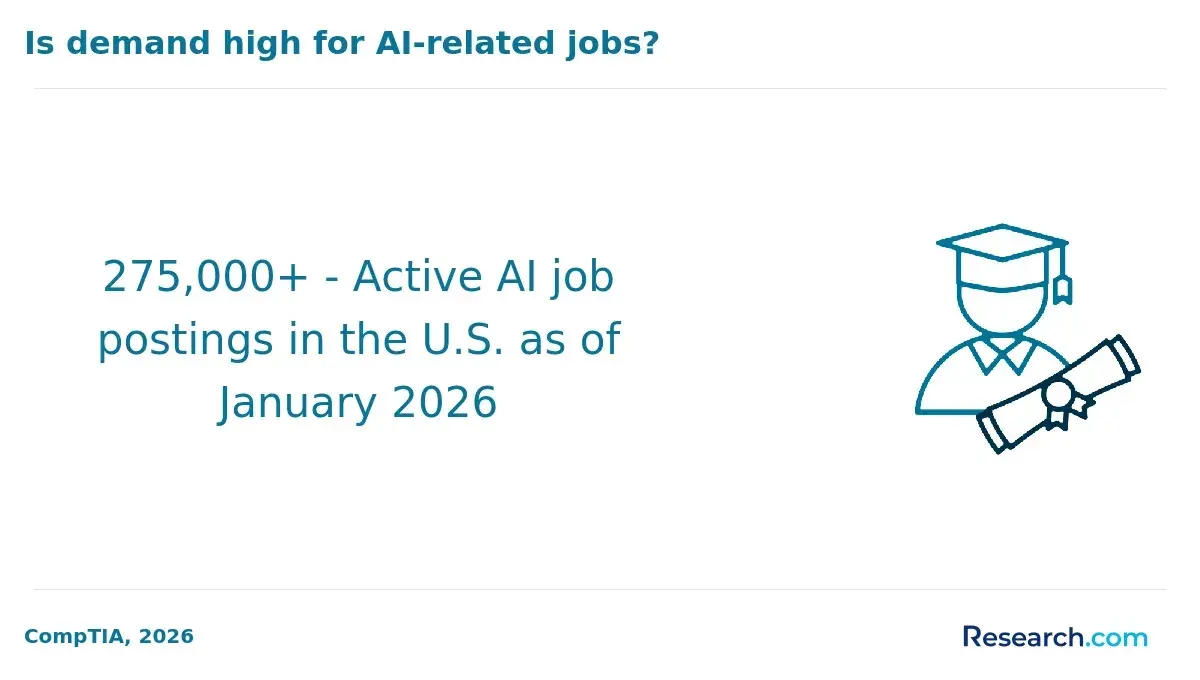
The job outlook for AI professionals is extremely positive, with specialist positions expected to grow by 35% through 2032, based on data from the U.S. Bureau of Labor Statistics 2024 Occupational Outlook Handbook. This growth markedly surpasses the 3.5% average across all occupations, highlighting strong and sustained demand for AI skills in many industries.
Community college graduates with training in artificial intelligence can enter the workforce through a variety of entry-level roles such as AI technician, data analyst, machine learning support specialist, and automation tester. These positions typically require a good foundation in programming, data management, and basic machine learning concepts, which are covered in associate degree programs or specialized certificate courses.
Many community colleges emphasize practical skills that prepare students to support AI development, application support, and data preprocessing roles.
Salaries for entry-level AI-related jobs generally range from $65,000 to $75,000 per year, reflecting strong employer demand for these technical abilities early on. Hands-on experience with tools like Python or TensorFlow is highly valued and can accelerate progression into advanced AI roles.
As the use of AI expands into sectors like healthcare, finance, and manufacturing, graduates who build project portfolios showing relevant skills will find diverse career opportunities. The continuing expansion of AI roles includes specialists focused on ethics, quality assurance, and system deployment support.
How do online AI programs at community colleges compare to campus-based options for working adults?
Online AI programs at community colleges offer distinct advantages for working adults compared to campus-based options. Enrollment in online community college programs rose by 16% year-over-year, with 42% of online students working full-time versus 28% on campus, according to data from the Babson Survey Research Group.
This growth reflects how online programs better accommodate busy schedules by providing flexible, asynchronous classes accessible anytime, enabling study during evenings or weekends without commute times.
Campus programs offer benefits such as direct access to labs, hands-on projects, and face-to-face networking opportunities that support applied learning in fields like machine learning and data analysis. Some students prefer hybrid formats that combine online coursework with occasional in-person labs to balance flexibility with practical experience.
Working adults should weigh their learning preferences and career goals when choosing a program. Online AI degrees suit self-motivated learners seeking schedule flexibility and greater access to digital resources and tutor support, which is crucial for mastering evolving AI concepts.
Campus options may attract those seeking immersive, interactive experiences and access to on-site scholarships or internships.
Financial considerations also matter; online programs can reduce travel and housing expenses, while campus programs may offer opportunities that offset costs. Carefully assessing these factors helps students select the AI education path best aligned with their professional and personal needs.
What certifications or industry credentials should community college AI students pursue alongside their degree?
Community college students studying artificial intelligence benefit significantly from earning industry-recognized certifications alongside their degrees. Certifications such as the Google Cloud Professional Machine Learning Engineer and AWS Certified Machine Learning - Specialty validate practical skills in deploying AI solutions on leading cloud platforms, complementing academic knowledge with hands-on expertise.
The Coursera 2024 Global Skills Report highlights that candidates holding both an associate degree and relevant certifications earn 31% higher starting salaries than those with degrees alone, emphasizing the financial value of these credentials.
Additional respected options include Microsoft Certified: Azure AI Fundamentals, IBM AI Engineering Professional Certificate, and the TensorFlow Developer Certificate, which cover diverse technologies and frameworks to match various career goals.
Many students also pursue certifications in data analytics, programming languages such as Python, and cybersecurity fundamentals, all of which support effective AI implementation. Preparing for these certifications often involves practical project work, helping build portfolios that employers find attractive.
By combining degree programs with targeted industry credentials, community college graduates address employer concerns about workplace readiness and position themselves for stronger job offers and accelerated career advancement within the evolving AI sector.
What is the average starting salary for community college graduates with an AI degree or certificate?
Community college graduates with an artificial intelligence certificate typically start with an average salary of $58,000, representing a 28% salary premium over high school graduates entering tech roles without specialized training. According to PayScale's 2024 community college outcomes analysis, this salary reflects a 15% return on investment during the first year after graduation, showcasing the financial benefits of such credentials.
Pursuing an AI-focused certificate at a community college can lead to earnings competitive with some four-year degree holders, making it an attractive path for many students. Salary variations depend on location and specific AI subfields, with graduates in metropolitan tech hubs often earning more-sometimes reaching the mid-$60,000 range-while smaller markets may offer closer to $50,000.
Supplementing certificates with internships or skills like data analysis and programming languages such as Python further enhances earning potential. Beyond salary, assessing program cost and time commitment is important, as the strong return on investment suggests good value for students.
Graduates with AI skills often find rapid advancement opportunities due to sustained demand and evolving industry needs. Choosing community college programs with current curricula and strong industry connections can improve employability and salary prospects for AI certificate holders.
How do you evaluate whether a community college AI program is properly accredited and recognized by employers?
Verifying a community college's artificial intelligence program accreditation begins by confirming approval from reputable agencies such as ABET. ABET accreditation evaluates computing and engineering programs against stringent quality criteria, ensuring graduates are workforce-ready. Community colleges with ABET-accredited AI programs have a 94% employer recognition rate, compared to 67% for non-accredited ones.
This translates to 18% faster job placement for ABET-accredited graduates, according to the ABET 2024 employer survey.
Prospective students should check the ABET website to confirm a program's accreditation status and review the college's AI or computer science webpages for clear accreditation statements. Programs simply labeled "computer science" might lack AI-specific curricula recognized by employers, making accreditation verification critical.
Employer recognition also depends on industry partnerships and job placement support. Programs with advisory boards, internship opportunities, and strong employer connections typically offer better hiring outcomes.
Contacting alumni and examining published job placement data can provide valuable insights into program effectiveness.
Using official accreditation databases, direct communication with colleges, and third-party employment statistics helps students validate the legitimacy and career relevance of AI credentials before enrolling in a community college program.
What transfer pathways exist for community college AI students pursuing a four-year bachelor's degree?
Community college students pursuing artificial intelligence can take advantage of established transfer pathways to four-year bachelor's programs. Often, students enroll in associate degree programs backed by articulation agreements between community colleges and universities. These agreements ensure earned credits transfer smoothly, minimizing credit loss and shortening graduation time. For instance, California's Associate Degree for Transfer (ADT) program enables students completing an Associate of Science in artificial intelligence or related fields to transfer to California State Universities with junior status.
Many states offer STEM-focused statewide transfer pathways that simplify course equivalencies and admissions processes for artificial intelligence students. Consulting academic advisors and university transfer centers is essential to identify specific AI transfer tracks. Dual admission programs are also available at some institutions, granting students a guaranteed spot at a partnering university with pre-approved course sequences.
Transfer pathways show strong outcomes: the National Student Clearinghouse Research Center's 2024 report reveals that about 71% of community college students who transfer complete their bachelor's degree within four years, outperforming the 55% rate of those starting at four-year universities.
This highlights the effectiveness of community college preparation for AI studies.
Students should verify GPA requirements, coursework prerequisites in math, programming, and data science, as well as application materials. Flexible transfer agreements serve veterans and working adults, while online and hybrid transfer options broaden access beyond traditional campuses.
Other Things You Should Know About Artificial Intelligence
Success in artificial intelligence requires strong programming skills, especially in languages such as Python, R, and Java. Critical thinking, data analysis, and a solid understanding of machine learning algorithms are also essential. Additionally, knowledge of statistics, linear algebra, and problem-solving abilities helps students apply AI concepts effectively.
Artificial intelligence increasingly influences many fields, including healthcare, finance, and manufacturing, by automating tasks and improving decision-making processes. In healthcare, AI assists in diagnostics and personalized medicine; in finance, it enhances fraud detection and algorithmic trading. This interdisciplinary reach creates opportunities for community college students to apply AI skills in various industries.
Ethics in artificial intelligence involves concerns about privacy, bias, and accountability in AI systems. Developers must ensure that algorithms do not perpetuate discrimination or unfair treatment based on race, gender, or socioeconomic status. Transparency and responsible use of AI technology are critical topics for students to understand as part of their education.
Yes, foundational skills gained in community college AI programs provide a strong base for further academic or professional pursuits in AI research. Topics like data processing, machine learning basics, and programming prepare students for advanced studies or entry-level roles. However, advanced research typically requires continued education at the bachelor's or graduate level.
References
- Artificial Intelligence, Associate of Science Degree https://catalog.cccd.edu/coastline/pathways/computer-cyber-sciences/information-computer-sciences/artificial-intelligence-as/
- Most community college students plan to get 4-year degrees. Few actually do https://www.npr.org/2024/08/21/nx-s1-4930527/community-college-affordable-bachelors-degree
- The Community College Method Guide for Students https://www.edvisorly.com/student-guides/community-college-method
- Entry-level jobs in the age of AI https://www.ccdaily.com/2026/02/entry-level-jobs-in-the-age-of-ai/
- Data Science Scholarships (2026 Cycle) — Verified Awards for Undergrad, Master’s & PhD - ScholarshipsandGrants.us https://scholarshipsandgrants.us/major/data-science/
- Transfer Pathways Steer Students and Institutions to Undergraduate Success https://agb.org/trusteeship-article/transfer-pathways-steer-students-and-institutions-to-undergraduate-success/
- 5 Ways for Community Colleges to Market Stackable Credentials https://aperturecm.com/5-ways-for-community-colleges-to-market-stackable-credentials
- Artificial Intelligence Course Eligibility: Requirements & Prerequisites https://www.mygreatlearning.com/artificial-intelligence/courses/eligibility
- OPINION: Community colleges are uniquely positioned to train the nation’s AI workforce https://hechingerreport.org/opinion-community-colleges-are-uniquely-positioned-to-train-the-nations-ai-workforce/
- Associate Degree in Artificial Intelligence https://aidegreeguide.com/degrees/ai-associate-degree-and-certificate-programs/