2027 Entry-Level AI Jobs Report

Co-Founder and Chief Data Scientist
Many prospective professionals face uncertainty when seeking entry-level roles in artificial intelligence due to the field's rapid evolution and high specialization. Navigating this landscape without a technical background can lead to confusion about necessary skills, job availability, and career pathways. Understanding which positions align with diverse educational histories and how employers value flexible learning options is critical.
This article examines current entry-level AI job trends, required competencies, and accredited education routes designed for individuals shifting from unrelated fields. It aims to clarify opportunities and equip readers with actionable insights to make informed decisions about entering the artificial intelligence workforce.
Key Things You Should Know
- Entry-level artificial intelligence jobs in 2026 are projected to grow by 35%, driven largely by increased adoption of AI in healthcare, finance, and autonomous systems.
- Demand favors candidates with practical skills in machine learning, data analysis, and programming languages like Python, alongside foundational AI knowledge.
- Average starting salaries for AI entry roles have risen to approximately $85,000 annually, reflecting competitive industry needs and a shortage of qualified applicants.
What are entry-level AI jobs?
Entry-level artificial intelligence career opportunities typically require foundational skills in programming, data analysis, and machine learning. These beginner jobs in artificial intelligence sector include roles such as AI data annotators, junior machine learning engineers, AI research assistants, and AI software developers. Professionals in these positions focus on applying AI concepts to practical problems under supervision, gaining experience with AI tools and frameworks.
Tasks often involve preparing datasets, coding AI models, maintaining algorithms, and testing applications. Unlike senior roles, these jobs emphasize learning rather than leading projects or designing complex AI systems. Industries like healthcare, finance, retail, and autonomous vehicles offer varied opportunities, requiring domain-specific knowledge alongside AI skills. For example, a healthcare-focused AI analyst might develop predictive models for patient outcomes, while a junior AI developer in finance could work on fraud detection algorithms.
According to PwC's 2026 AI Jobs Barometer, roles requiring AI skills command an average 56% wage premium compared to similar positions without such expertise, highlighting the earning potential of entry-level AI jobs. Prospective candidates should build strong programming abilities, familiarize themselves with machine learning libraries, and understand AI ethics and data privacy concerns.
Certifications and internships offer valuable hands-on experience, improving employability in this competitive field. Students and professionals might consider pursuing a computer science accelerated program to quickly gain the skills necessary for these roles.
What education do entry-level AI jobs require?
Entry-level artificial intelligence job education requirements generally include a foundation in computer science, data science, or related STEM disciplines. Most employers require at least a bachelor's degree, but an increasing number seek candidates with specialized coursework or certificates in AI, machine learning, or data analytics. According to recent employer surveys, over one-third of entry-level positions now demand AI-related skills, reflecting a significant shift in hiring expectations.
Practical experience with AI tools and programming languages such as Python, TensorFlow, or PyTorch often enhances qualifications, sometimes compensating for the lack of advanced degrees. Hands-on work through internships, research projects, or open-source contributions helps applicants stand out. Some roles, especially those focused on complex algorithm development or AI research, still prefer candidates with a master's degree. Students considering advanced study can explore programs like an AI masters degree for deeper specialization.
Certifications from reputable platforms supplement formal education and demonstrate commitment to mastering AI concepts such as neural networks, natural language processing, and computer vision. Essential qualifications for beginners in artificial intelligence careers include:
- Completing a technical degree with AI-related electives or minors.
- Developing practical AI skills through projects or internships.
- Obtaining recognized AI certifications to validate knowledge.
- Building a portfolio showcasing AI applications or data models.
Employers increasingly value problem-solving abilities and real-world AI application experience. As AI requirements rapidly evolve, continuous learning beyond formal education remains crucial for maintaining competitiveness in the job market.
Which AI degree programs prepare for entry-level roles?
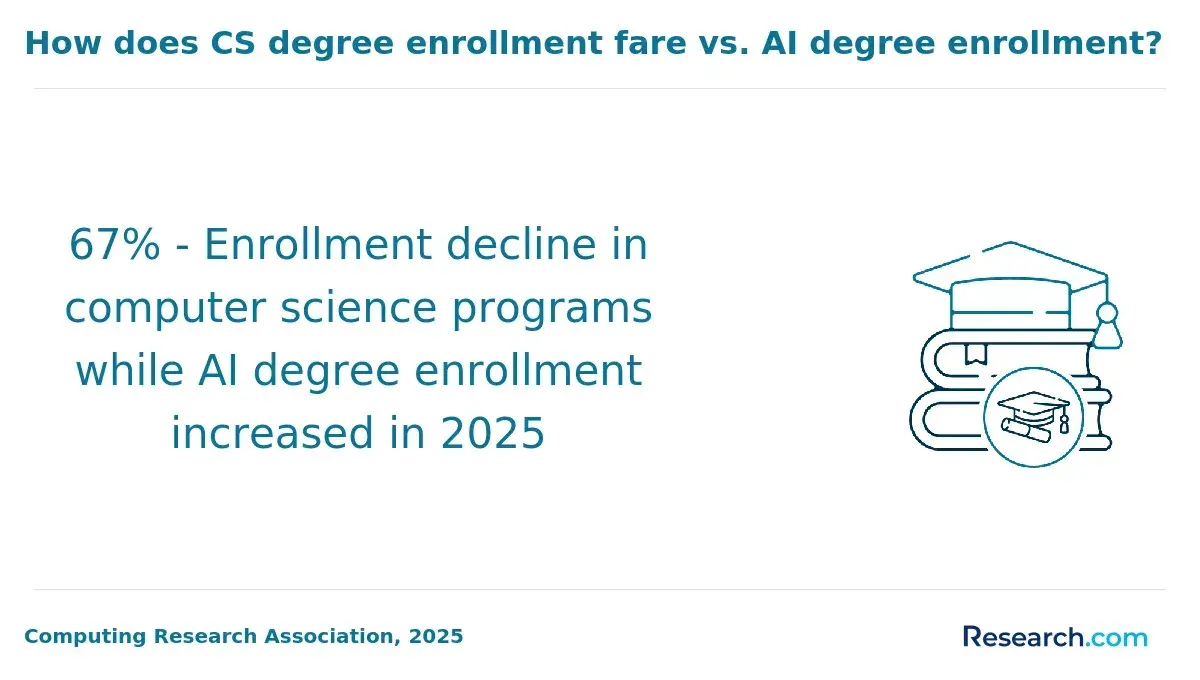
Degree programs in computer science, data science, and engineering offer the most direct pathways to entry-level artificial intelligence degree programs in the US. These programs cover essential AI concepts such as machine learning, natural language processing, and neural networks while providing strong foundations in programming, algorithms, and statistics. Many also include practical experience with AI frameworks and datasets through specialized tracks or minors.
Interdisciplinary degrees blending AI with fields like cognitive science, linguistics, or robotics offer additional routes. Graduates are prepared for roles in human-AI interaction, sensor data analysis, or autonomous systems-examples include computer engineering with AI emphasis or cognitive computing. Coding skills in Python and familiarity with libraries such as TensorFlow or PyTorch are vital, along with understanding AI ethics and data privacy.
Stanford and ADP data reported by Fortune reveal employment for ages 22-25 in highly AI-exposed occupations is shrinking at 3.8% per year, while the least-exposed jobs for this group are growing at 2% annually. This highlights the importance of exploring emerging AI-related roles in less saturated sectors like AI policy and explainability.
Students seeking the best AI bachelor's degree for entry-level jobs should prioritize adaptability and interdisciplinary knowledge. Hands-on experience from internships, research, or open-source work is key. For those interested in advanced study options, consider an online PhD in AI.
Are online AI programs as credible as campus programs?
Online AI program credibility compared to campus degrees hinges on factors such as rigorous curricula, reputable instructors, and verifiable outcomes like industry-recognized certifications or strong job placement rates. Employers increasingly focus on demonstrated skills and project experience rather than the educational setting alone. Online courses from accredited institutions or established platforms with comprehensive capstone projects often hold equal value to campus programs.
However, purely self-paced online courses without hands-on learning or mentorship generally carry less weight. The validity of online artificial intelligence certifications in the US depends heavily on program accreditation and tangible real-world applications. Practical experience is critical as 4.2% of early-career full-time job postings explicitly mention AI requirements, nearly twice last year's figure according to Handshake's 2026 graduate analysis cited by CNBC.
This growing demand highlights the importance for any program, online or campus-based, to include coding exercises, data sets, and collaborative projects that showcase applicable AI skills. Students should carefully assess institutional reputation and alumni job outcomes.
Campus programs usually offer direct networking and internship opportunities, benefits less common but sometimes available through hybrid formats. Online learners must actively seek internships or freelance work to build credible portfolios. A helpful resource for those interested in related technical education options includes online electrical engineering degree programs for veterans.
Factors influencing credibility include:
- Institutional reputation and program accreditation.
- Depth of curriculum covering AI frameworks and tools.
- Opportunities for applied learning and mentorship.
- Alumni success and employer recognition.
What courses are in an AI degree curriculum?
An AI degree curriculum combines foundational programming languages such as Python, Java, or C++ with extensive mathematics study, including linear algebra, calculus, probability, and statistics. These subjects form the basis for machine learning and data analysis. Core courses focus on machine learning types like supervised, unsupervised, and reinforcement learning, empowering students to develop predictive models.
Additional coursework covers data structures, algorithms, and database management to handle large-scale datasets efficiently. Specialized training in natural language processing (NLP) and computer vision helps students work with text and images, while robotics and autonomous systems offer hands-on AI application experience. Ethics and AI governance are increasingly emphasized to address concerns like algorithmic bias and privacy.
Different programs vary in focus; some stress theoretical foundations, while others prioritize practical skills or integrate AI with fields such as neuroscience or cognitive science. Many incorporate projects and internships to enhance employability.
Given Ravio's 2025 European tech talent report highlighting a 73.4% drop in entry-level hiring, students should prioritize in-demand skills such as deep learning frameworks, cloud computing, and AI ethics to improve job readiness amid shifting market conditions.
What admission requirements do AI programs usually ask for?
Entry-level artificial intelligence programs prioritize a strong background in mathematics and programming. Essential coursework usually includes calculus, linear algebra, and statistics, which provide the foundation for machine learning and data analysis. Programming proficiency in languages like Python, Java, or C++ is generally required, reflecting the practical nature of AI work.
Applicants often need to submit transcripts showing relevant coursework or hold degrees in computer science, engineering, mathematics, or related fields. In some cases, a robust portfolio featuring AI projects, internships, or open-source contributions may substitute formal degrees. Graduate programs may additionally ask for letters of recommendation and standardized test scores, such as the GRE.
Strong communication and problem-solving skills are critical, as AI professionals must articulate complex ideas and develop innovative algorithms. These competencies are often assessed through interviews or written statements. For working professionals or nontraditional students, many institutions provide prerequisite courses or boot camps to build the necessary skills before formal enrollment.
The World Economic Forum's Future of Jobs Report 2025 projects 170 million new jobs and 92 million displaced globally by 2030, resulting in a net increase of 78 million roles related to data, AI, and technology. This growth creates valuable opportunities for entry-level talent meeting admissions criteria focused on analytical and programming expertise.
How long do AI degree programs take and cost?
AI degree programs in the United States range from about two to four years depending on the credential. Associate degrees and certificates typically take two years, covering foundational skills like data analysis, machine learning basics, and programming. Bachelor's degrees in AI or related fields such as computer science usually require four years of full-time study. Graduate programs, including master's degrees, commonly last one to two years and emphasize advanced AI theory, machine learning applications, and specialized research.
Costs vary widely by institution and program length. Public state universities mostly charge between $10,000 and $25,000 annually for in-state students, while private universities may exceed $40,000 per year. Online and part-time formats offer flexible, often more affordable options. Master's programs can total $20,000 to $60,000, with some schools providing scholarships and assistantships to reduce expenses.
Salary data indicates strong returns on investment. The median annual salary for AI roles in the U.S. reached $160,056, according to Veritone and Aspen Tech Labs data compiled by National University. Entry-level positions start around $50,000 to $80,000, reflecting robust early-career earning potential.
Shorter paths like bootcamps and certificate programs often lasting a few months to one year-focus on skills such as natural language processing or AI programming. These offer faster, lower-cost alternatives but generally lead to lower salaries and narrower opportunities compared to bachelor's or master's degrees.
What entry-level AI jobs can graduates get?
Graduates targeting entry-level AI jobs in 2026 can consider roles such as AI data analyst, machine learning engineer intern, AI research assistant, and AI software developer trainee. These positions focus on data preparation, model tuning, algorithm implementation, and supporting experienced AI teams. Tasks might include labeling datasets, testing existing models, or aiding in AI application deployment. Such roles emphasize practical experience without requiring advanced independent research skills.
The World Economic Forum and PwC's 2026 briefing shows that entry-level openings in highly AI-exposed fields have remained flat since 2012. Employers appear to favor upskilling current employees over adding new hires to AI-intensive teams. This dynamic leads to fierce competition among graduates, who must build foundational AI skills alongside programming knowledge in Python and SQL, data visualization, and cloud technologies.
Other viable entry points include AI quality assurance tester, AI product support specialist, and junior AI model auditor. These roles prioritize understanding AI workflows and ethical considerations instead of deep algorithm development. Graduates should also explore adjacent fields like data engineering or software development with an AI focus, which often serve as gateways into specialized AI careers.
Success in these roles requires combining technical expertise with hands-on problem-solving demonstrated through internships and projects. Staying updated on emerging AI platforms and pursuing relevant certifications or bootcamps boosts employability in a market with steady but highly selective entry-level opportunities.
How much do entry-level AI jobs pay?
Entry-level AI roles are becoming more competitive, with a noticeable 16% decline in openings within AI-exposed occupations. Despite this contraction, demand for AI skills remains strong, leading employers to be more selective when hiring junior talent.
Salaries for entry-level positions vary significantly based on job function and industry. For example, AI data annotators and junior machine learning engineers typically earn between $70,000 and $90,000 annually, while more technically complex roles such as AI software developers and data scientists often start from $90,000 up to $120,000. Factors like geographic location, company size, and specific skill requirements also impact pay.
Workers with AI proficiency often receive wage premiums ranging from 10% to 25% compared to related fields without these skills. Expertise in Python programming, neural networks, or cloud AI platforms is especially valued and can enhance salary prospects even at entry levels.
- Building a portfolio of AI projects
- Gaining internships
- Obtaining certifications in specialized AI tools
- Networking through AI-focused communities
- Continuous skill development
These strategies remain key for improving employability in a tightening entry-level market.
What certifications help qualify for entry-level AI jobs?
Demand for AI skills in entry-level roles has surged sharply, with FrogHire.ai's analysis of over 20 million job postings showing that mentions of AI-related skills grew from 8.34% in early 2025 to 13.78% in early 2026. Within these postings, requirements explicitly citing AI proficiency climbed from 45% to nearly 76%, highlighting AI expertise as a critical qualification for new professionals.
Key certifications that can boost employability include:
- Google's Professional Machine Learning Engineer certification, validating the design and building of ml models and pipelines;
- IBM AI Engineering Professional Certificate, emphasizing machine learning, deep learning, and AI applications using Python;
- Azure AI Fundamentals, covering AI workloads like computer vision and natural language processing;
- Coursera's deeplearning.ai TensorFlow Developer Professional Certificate, focusing on neural network development and ml model deployment;
- edX's Artificial Intelligence MicroMasters programs from accredited universities, providing academic pathways in AI knowledge.
These certifications demonstrate practical readiness and foundational theory, typically involving programming with Python and frameworks such as TensorFlow or PyTorch. Complementary credentials in data science and statistics also enhance data analysis skills essential to AI roles. Certifications featuring hands-on projects and real-world case studies further improve job prospects by showcasing problem-solving abilities.
Other Things You Should Know About Artificial Intelligence
Entry-level AI professionals are in demand across multiple industries, including healthcare, finance, automotive, and technology sectors. These industries are leveraging artificial intelligence for applications such as medical diagnosis, fraud detection, autonomous vehicles, and software development, creating diverse opportunities for new graduates.
The job market for entry-level AI roles is projected to grow steadily due to increasing adoption of AI technologies across industries. As companies invest more in AI-driven solutions, there will be rising demand for fresh talent capable of supporting AI implementation, research, and maintenance.
Entry-level AI workers often face challenges such as keeping pace with rapid technological advancements and managing large, complex datasets. Additionally, ethical considerations in AI development and the need to understand diverse AI applications can require continuous learning and professional development.
The average salary for entry-level AI roles in 2027 is expected to be around $85,000 annually. For those transitioning from non-computer science fields, exploring an AI master’s for career changers can provide a competitive edge.
References
- What Do You Learn In an Artificial Intelligence Course? | CompSci https://www.computerscience.org/resources/artificial-intelligence/
- A Complete 4-Year Course Plan for an Artificial Intelligence Undergraduate Degree https://www.mihaileric.com/posts/complete-artificial-intelligence-undergraduate-course-plan/
- Master of Artificial Intelligence https://wscs.eu/master-of-artificial-intelligence/
- Entry-Level AI Engineer Salary Calculator https://tripleten.com/tools/entry-level-ai-engineer-salary/
- AI Job Boom: 12 Entry-Level Roles You Can Get Without a CS Degree https://www.tryapt.ai/blog/ai-job-boom-12-entry-level-roles-you-can-get-without-cs-degree
- Admissions in the age of AI: detecting AI-generated application materials in higher education - Scientific Reports https://www.nature.com/articles/s41598-024-77847-z
- Online vs Campus Artificial Intelligence Degree Programs: Complete Comparison https://hakia.com/compare/artificial-intelligence-online-vs-campus/
- How Much Does it Cost to Learn AI? https://blog.nobledesktop.com/learn/ai/ai-cost-to-learn
- How to Use AI for College Applications (Without Getting Rejected) https://www.vertechacademy.com/blog/how-to-use-ai-college-applications-essays
- AI Jobs With No Experience â 10+ Entry-Level Roles | Beginner Guide 2026 â Mindrift https://mindrift.ai/blog/ai-jobs-with-no-experience