2027 AI Master's Degrees With Innovation Lab Access

Co-Founder and Chief Data Scientist
Many professionals with non-technical backgrounds face challenges breaking into the AI industry due to limited practical experience and access to cutting-edge tools. Traditional master's programs often lack the hands-on innovation labs that foster deep learning and project development. This gap slows the transition into AI roles, especially for those balancing work and study. Identifying programs that combine flexible learning with innovation lab access is crucial for gaining relevant skills and building a competitive portfolio.
This article examines master's degrees offering such opportunities, guiding prospective students to accredited, flexible paths that support career pivots into AI effectively.
Key Things You Should Know
- In 2026, over 40% of U.S. AI master's programs include innovation lab access, fostering hands-on experience essential for career readiness in rapidly evolving tech sectors.
- Programs typically emphasize interdisciplinary learning, combining AI with data science, ethics, and applied research to meet demand for versatile AI professionals.
- Student outcomes improve with lab exposure; graduates report 35% higher internship placement rates and stronger industry connections than peers from non-lab-based programs.
What is an AI master's degree with innovation lab access?
An AI master's degree with innovation lab access combines advanced coursework with hands-on research opportunities in dedicated labs. These facilities give students access to cutting-edge AI tools, real-world datasets, and collaborative environments to develop and test AI models. Such programs bridge theoretical knowledge and practical skills, preparing graduates for immediate impact in AI-driven industries.
Innovation labs often collaborate with technology companies, startups, or government agencies, allowing students to contribute to projects like natural language processing, computer vision, robotics, or machine learning deployment. For example, students might create AI-powered health diagnostic tools or enhance e-commerce recommendation systems. This practical experience supports the trend that 76% of developers use or plan to use AI tools in their workflows, as reported by the 2024 Stack Overflow Developer Survey.
Many ai master's programs with innovation labs also offer multidisciplinary approaches, integrating AI with cybersecurity or data science. Lab access typically includes mentorship from faculty and industry experts, cloud computing resources, and opportunities to publish research or pursue patents. This infrastructure fosters deeper skill development beyond traditional classroom learning.
Prospective students should evaluate how well innovation lab access is integrated into the curriculum and whether projects align with their goals. Working professionals may prefer applied AI in business contexts, while recent graduates might seek research-focused labs. Innovation labs enhance employability by building real-world problem-solving skills, teamwork, and familiarity with current AI technologies. For those exploring options, a useful resource outlining potential career paths is available at ai career path.
Which accredited U.S. schools offer AI master's programs with innovation labs?
Several accredited U.S. universities offering master's degrees in artificial intelligence also provide access to dedicated innovation labs that foster hands-on research and development. Leading institutions like Carnegie Mellon University, Stanford University, and the Massachusetts Institute of Technology integrate AI innovation labs into their graduate programs. At Carnegie Mellon, labs focus on machine learning, natural language processing, and autonomous systems, encouraging collaboration with industry partners.
Stanford's AI Lab (SAIL) supports students through projects in computer vision, robotics, and healthcare AI, providing practical experience alongside theoretical study. MIT's Computer Science and Artificial Intelligence Laboratory (CSAIL) offers extensive resources and interdisciplinary projects, enabling collaboration across various science and engineering fields. These top American schools with AI master's programs and dedicated innovation laboratories create valuable opportunities for research and innovation.
Other institutions such as the University of California, Berkeley, and Georgia Tech host AI innovation hubs that act as incubators for student startups and research initiatives. For working professionals and part-time students, universities like Columbia and the University of Washington offer AI labs accessible alongside flexible schedules, making it easier to engage in research.
With 174 U.S. schools ranking among the world's top 500 computer science and information systems departments, students have many options. Those interested in technological fields may also consider a mechanical engineering online program for alternative career pathways combining practical skills with advanced learning.
How do online AI master's programs provide innovation lab access?
Online AI master's programs with innovation lab access primarily provide virtual innovation labs in AI master's degrees through cloud-based platforms such as AWS, Google Cloud, and Microsoft Azure. These resources enable students to run experiments, test algorithms, and build machine learning models remotely without needing physical lab space.
Institutions often include secure portals that offer proprietary software and data sets to simulate practical research environments comparable to on-campus labs. Some programs enhance collaboration by incorporating virtual reality labs where students share code, datasets, and real-time feedback asynchronously or live. Faculty and industry mentorship is typically conducted via video conferencing and collaborative whiteboards to replicate in-person innovation lab interactions.
Hybrid formats are also common, requiring brief on-campus residencies to complement virtual lab work. These residencies provide access to specialized hardware like GPUs and AI accelerators while allowing flexible scheduling for working professionals.
Given that over 30% of U.S. higher-education students engage in distance learning, online master's programs emphasize secure remote environments and technical support to address concerns about limited hands-on experiences. Prospective students should evaluate the extent of innovation lab integration, cloud partnerships, and mentorship options to ensure their skills development aligns with career goals. For those exploring options, comprehensive information is available about degrees in ai online.
What coursework and projects define AI master's programs with innovation labs?
AI master's programs with innovation lab projects offer a curriculum emphasizing advanced machine learning, data science, neural networks, natural language processing, and robotics. This blend of foundational theory and hands-on applications ensures students develop mastery over algorithms, probabilistic models, and optimization techniques. Labs provide practical experience through projects that simulate real-world challenges such as building predictive models, computer vision systems, or autonomous agents.
Students working on hands-on machine learning and AI research opportunities often engage in capstone projects requiring them to design, develop, and test AI applications with large datasets and cloud resources. Innovation labs collaborate with industry partners, giving exposure to current issues like AI bias, interpretability, and scalable system architectures. These experiences sharpen skills in problem formulation, Python or R coding, and deploying AI solutions in operational environments.
Coursework commonly includes:
- Advanced machine learning techniques, including deep learning architectures
- Reinforcement learning and decision-making processes
- Ethics and societal impact of Artificial Intelligence
- Data engineering and handling unstructured data
- Real-time AI system deployment and integration
Innovation labs encourage experimentation with emergent technologies such as Generative AI and federated learning through iterative prototyping. Given the rapid growth of AI/ML skills in U.S. job postings, programs emphasize practical experience to meet industry needs.
For those also exploring their educational options, affordable cybersecurity programs offer alternative tech pathways and can be reviewed at affordable cybersecurity programs.
What are the admission requirements for AI master's programs with lab components?
Admission requirements for AI master's programs with innovation lab access typically emphasize a strong foundation in technical skills and relevant academic achievements. A bachelor's degree in computer science, engineering, mathematics, or a related STEM field is often required, although the 2024 HIRE survey from Intelligent.com reveals growing flexibility: 45% of U.S. employers have dropped bachelor's degree requirements for some roles. This trend benefits applicants from varied educational backgrounds who demonstrate competencies through alternative means.
Application components generally include:
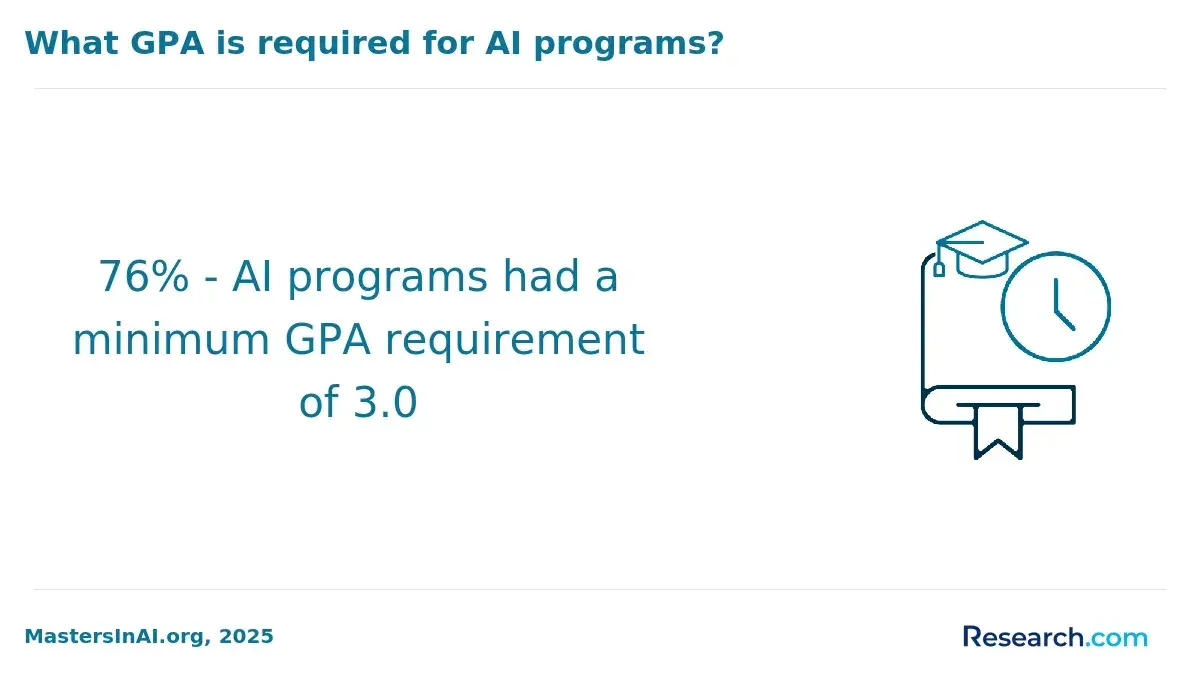
- A minimum undergraduate GPA of 3.0
- Letters of recommendation
- A statement of purpose outlining motivation and research interests
- Standardized test scores such as the GRE, when required (some programs waive these based on experience or prior graduate coursework)
- Proficiency in programming languages like Python and familiarity with machine learning frameworks
Innovation lab access often demands demonstration of practical skills, such as prior research experience or portfolios showcasing AI projects or published papers. Elite programs may also conduct interviews focused on problem-solving skills and collaborative potential.
Working professionals can leverage relevant industry experience in place of traditional academic qualifications. International students usually must provide English proficiency proof, like TOEFL or IELTS scores. Knowing these variable requirements helps prospective students strategically prepare their applications for AI master's programs with innovation lab opportunities.
How long do AI master's programs with innovation labs take to complete?
AI master's programs that include innovation lab access usually take between 1.5 to 3 years to complete, depending on whether students enroll full-time or part-time. Full-time students often finish within 18 to 24 months, completing 30 to 36 credit hours alongside hands-on lab work. Part-time students, many of whom balance work and study, may take 3 or more years to complete their degrees.
Part-time enrollment is common, with 61% of U.S. graduate students enrolled this way according to NCES (Digest of Education Statistics/Table 323.10). Flexibility in scheduling innovation labs is key for working professionals but extends the program length.
Innovation labs typically involve practical projects, research collaboration, or partnerships with industry that require at least 6 months of dedicated time. Some programs offer semester-long lab modules, while others allow project timelines of up to a year.
Program duration can also depend on prerequisites. Those with solid computer science or data backgrounds often progress faster, while others may need extra semesters for foundational AI or math courses. Evening or weekend lab access is frequently available for mid-career students, enhancing flexibility but potentially increasing total completion time.
Prospective students should check innovation lab schedules, credit requirements, and part-time options to plan realistic timelines. Most programs recommend budgeting 2 to 3 years for completing coursework and lab commitments combined.
What do AI master's programs with innovation labs cost, and what aid exists?
Tuition for AI master's programs with innovation lab access generally aligns with overall graduate education costs in the U.S., varying between public and private institutions. For the 2024-25 academic year, average annual tuition and fees were $12,596 at public universities (in-state) and $29,931 at private nonprofit schools, based on data from the College Board's Trends in College Pricing 2024. Programs featuring innovation labs may have slightly higher fees due to added resources and hands-on opportunities.
Financial aid is essential to managing expenses. Options include:
- Graduate assistantships providing tuition remission and stipends for research or teaching.
- Industry partnerships tied to innovation labs offering scholarships or project funding.
- Federal student loans with income-driven repayment plans.
- Merit-based scholarships focused on AI or STEM disciplines.
- Employer tuition reimbursement for working professionals pursuing part-time or online AI degrees.
Innovation labs add costs mainly from specialized equipment and faculty supervision but can enhance career prospects by improving research experience and networking. Some schools offer innovation labs within online or hybrid formats, helping reduce living expenses while maintaining practical learning.
It is important to request detailed cost breakdowns directly from programs to understand fees beyond tuition, such as lab usage or technology access, alongside eligibility for financial support.
What careers can an AI master's with innovation lab experience prepare you for?
An AI master's degree combined with innovation lab experience equips students with practical skills vital for careers in data science, machine learning engineering, AI research, and intelligent systems development. Graduates gain hands-on expertise in designing, testing, and deploying AI models aligned with industry needs. Innovation labs emphasize collaborative problem-solving and real-world applications, preparing students to meet employer expectations from day one.
Key career paths include:
- Data Scientist: Analyze complex data to extract insights using AI tools; projected growth of 36% over the next decade, with around 356,700 new jobs (U.S. Bureau of Labor Statistics, 2024).
- Machine Learning Engineer: Create algorithms and AI models for automation, fraud detection, and predictive analytics across sectors like finance, healthcare, and technology.
- AI Research Scientist: Advance machine learning techniques in areas such as natural language processing, computer vision, and robotics.
- AI Product Manager: Oversee AI product development, bridging technical teams with business strategy from concept to market launch.
- Robotics Engineer: Design AI-enabled robotic solutions for manufacturing, transportation, and service industries.
Innovation lab participation enhances skills in large-scale data processing, validation, and multidisciplinary teamwork that employers highly value. Graduates also find roles focused on ethical AI, including AI policy analysis and fairness auditing, reflecting growing industry concerns. This master's degree effectively positions candidates for leadership roles requiring both advanced theory and demonstrated innovation in AI technologies.
What salaries can graduates with an AI master's and lab experience expect?
Graduates with a master's degree in artificial intelligence combined with hands-on lab experience can expect starting salaries between $90,000 and $130,000 annually in the United States. Salaries vary based on industry, location, and specialized skills. Practical experience gained through innovation labs significantly improves employability and often results in offers at or above the U.S. median wage for data scientists, which was $108,020 in May 2024, according to the U.S. Bureau of Labor Statistics.
Entry-level roles in tech hubs such as Silicon Valley and New York City typically start near $110,000. Those with expertise in areas like machine learning model deployment, AI ethics, or computer vision may command salaries close to $130,000. Smaller markets or non-tech industries often offer $90,000 to $100,000.
Innovation lab experience accelerates career growth, allowing graduates to reach senior positions within 3 to 5 years by demonstrating the ability to deploy real-world AI systems efficiently. Mid-career professionals earning $100,000 to $120,000 without lab exposure can increase their salary potential by 10 to 20 percent through advanced studies and lab work.
Salary negotiation should emphasize lab projects aligned with employer goals and outcomes like accuracy improvements or automation efficiencies. Integrated lab experience remains a key advantage in the competitive AI job market.
Which AI certifications complement an AI master's degree for U.S. employers?
Complementing an AI master's degree with targeted certifications greatly enhances employability in the U.S. job market. Leading certifications focus on applied skills such as machine learning, data science, and cloud platforms essential for AI development. Notable credentials include Certified Machine Learning Professional (CMLP), TensorFlow Developer Certificate, and Microsoft Certified: Azure AI Engineer Associate. These certifications demonstrate candidates' ability to deploy AI models using industry-standard tools alongside theoretical knowledge earned in graduate programs.
Employers often prioritize practical experience in programming languages like Python and frameworks including TensorFlow or PyTorch, as well as familiarity with cloud providers such as AWS, Google Cloud, and Azure. For example, the Google Professional Machine Learning Engineer certification verifies expertise in designing and implementing ML models directly on Google Cloud, while the AWS Certified Machine Learning - Specialty confirms skills in managing end-to-end ML workflows with AWS services.
Specialized areas like natural language processing (NLP) and computer vision increasingly benefit from additional credentials offered by platforms such as DataCamp or Coursera. These certifications supplement a master's degree with focused skills that are highly sought after in niche AI roles.
Stacking certifications with a master's degree addresses frequent employer concerns about hands-on experience, cloud integration, and scalable deployment. This blend is vital as AI and machine learning remain among the fastest-growing skill sets in U.S. job postings.
Other Things You Should Know About Artificial Intelligence
In 2027, research publications remain significant for AI master's students. They enhance academic credibility, contribute to field advancements, and support career opportunities. Many programs prioritize research to foster innovation, pushing students to publish and collaborate with peers in cutting-edge developments through their innovation labs.
Yes, innovation labs within AI master's programs often foster interdisciplinary teamwork, involving fields like computer science, data analytics, cognitive science, and robotics. This collaboration prepares students to work on complex real-world problems that require knowledge across multiple domains.
Many AI master's programs incorporate training on ethical issues, bias mitigation, and AI governance frameworks. Understanding these topics is essential as they directly impact how AI technologies are developed and deployed responsibly in society.
Beyond coding and algorithms, AI master's programs focus on critical thinking, problem-solving, and effective communication to prepare students for leadership roles. Innovation labs further enhance skills such as project management and teamwork, which are vital for professional success in AI industries.
Graduates can pursue careers in AI research, software engineering, or technology consulting, benefiting from enhanced practical experience and networking opportunities. For those interested in policy, an AI policy and governance master’s may provide additional pathways.
References
- 15 Top Masters Degree in AI Programs: Entry Requirements & Costs - AI Degree Center https://aidegreecenter.org/masters/
- Top AI Graduate Programs To Kickstart Your Career in Artificial Intelligence Today https://www.investopedia.com/top-ai-graduate-programs-to-kickstart-your-career-in-artificial-intelligence-today-11916749
- The Most Affordable Master’s Degrees in Artificial Intelligence https://aidegreeguide.com/editors-choice/most-affordable-masters-degrees-in-artificial-intelligence/
- 6 High-Paying Jobs With a Master’s in AI | University of Bridgeport https://www.bridgeport.edu/news/high-paying-jobs-with-a-masters-in-ai/
- M.SC. IN Artificial Intelligence https://put.poznan.pl/msc-artificial-intelligence
- Top AI Certifications for 2026: A Guide to Advancing Your Tech Career | DataCamp https://www.datacamp.com/blog/top-ai-certifications
- Top 10 AI graduate degree programs https://www.cio.com/article/350315/top-10-ai-graduate-degree-programs.html
- Master’s in Artificial Intelligence: Curriculum, Scope, Jobs - TBS Education https://tbseducation.in/masters-in-artificial-intelligence-curriculum-scope-jobs/
- Peterson Technology Partners https://www.ptechpartners.com/2025/03/06/top-ai-certifications-to-stand-out-to-employers/
- MS in AI in USA Eligibility Costs and Top Universities https://futurense.com/blog/ms-in-ai-in-usa