
2027 Teacher Certification Types & Requirements in Illinois

Co-Founder and Chief Data Scientist
Getting certified to teach in Illinois is not just a paperwork step. It determines which classrooms you can legally teach in, which endorsements you can add, how quickly you can move into a full-time role, and whether your license remains valid over time. For aspiring teachers, career changers, substitute teachers, and licensed educators moving into Illinois, the process can feel confusing because requirements vary by license type, subject area, grade level, and preparation route.
This guide explains the main Illinois teacher certification options, education and testing requirements, alternative routes, costs, timelines, renewal rules, reciprocity, and common mistakes to avoid. It is designed to help you compare pathways and decide which route best fits your background, budget, career goals, and preferred teaching setting.
Quick Answer: How Teacher Certification Works in Illinois
Most full-time public school teachers in Illinois need a Professional Educator License (PEL) issued through the Illinois State Board of Education. The standard pathway usually requires a bachelor’s degree, completion of an approved educator preparation program, supervised student teaching, and passing the required Illinois Licensure Testing System content-area exam. Career changers may qualify through alternative licensure programs, while individuals who want short-term classroom assignments may pursue a substitute teaching credential instead.
Key Points About Teacher Certification Types and Requirements in Illinois
- Illinois uses several educator credentials, including the Professional Educator License (PEL), substitute teaching licenses, provisional or temporary options, alternative licensure routes, and subject or specialty endorsements.
- Most certification pathways require approved coursework, field experience, student teaching or a residency, background checks, and state exams tied to the subject or grade level you plan to teach.
- The Illinois teacher job market includes needs across urban, suburban, and rural districts, and the average salary is around $70,000, making certification a meaningful credential for long-term teaching employment in the state.
- Before choosing a program, confirm that it is approved for Illinois licensure, matches your intended endorsement, fits your timeline, and clearly explains tuition, testing fees, clinical experience costs, and licensure application steps.
- What are the different types of teaching certifications in Illinois?
- What are the education requirements to become a certified teacher in Illinois?
- What tests are required for teacher certification in Illinois?
- What are the best certification programs in Illinois?
- Are there alternative routes to teacher certification in Illinois?
- How much does it cost to get a teaching certification in Illinois?
- How long does it take to get certified as a teacher in Illinois?
- What common pitfalls should I avoid during the Illinois teacher certification process?
- What are the subject-specific certification options available in Illinois?
- What are the ESL teacher requirements in Illinois?
- How can I effectively prepare for Illinois teacher certification exams?
- How do I become a certified PE teacher in Illinois?
- How do you renew Illinois teaching certification?
- Is teacher certification in Illinois transferable to other states?
- What are the benefits of having a teacher certification in Illinois?
What are the different types of teaching certifications in Illinois?
Illinois has more than one route into the classroom. The right credential depends on whether you want to become a full-time teacher, substitute teach, add a subject endorsement, transition from another career, or move into an advanced education role.
The most important credential for full-time public school teaching is the Professional Educator License. Other permits and endorsements serve narrower purposes, such as short-term substitute teaching, temporary service, specialized instruction, or entry through an alternative preparation model.
| Illinois credential or pathway | Best for | What to check before choosing it |
| Professional Educator License (PEL) | Candidates who want to teach full time in Illinois public schools | Confirm that your program is approved by the Illinois State Board of Education and leads to the endorsement you need. |
| Provisional and temporary licenses | Educators who do not yet meet every standard requirement but may qualify under specific circumstances | Review expiration rules, limitations, supervision requirements, and what you must complete to move to a standard license. |
| Substitute teaching permit | Individuals with at least a bachelor’s degree who want short-term teaching assignments | Check district requirements, assignment limits, registration steps, and whether substitute work supports your long-term goals. |
| Alternative route certification | Career changers and professionals with a bachelor’s degree who want a faster route into teaching | Ask whether the program includes paid residency options, mentoring, content test requirements, and a path to the PEL. |
| Subject-specific and special education endorsements | Licensed or prospective teachers who want to teach a specific subject, grade band, special education area, bilingual education, or English learners | Verify required coursework, testing, field experiences, and whether the endorsement matches the job postings you want. |
| Advanced professional licenses or endorsements | Experienced educators pursuing leadership, specialized instruction, or school support roles | Review experience requirements, graduate coursework expectations, and renewal obligations. |
If you are at the beginning of your education pathway and want a lower-cost starting point, reviewing the best online associate in education programs can help you understand early education coursework options before moving into a bachelor’s or licensure-completion program.
What are the education requirements to become a certified teacher in Illinois?
To become a certified teacher in Illinois, you generally need a bachelor’s degree, an approved educator preparation program, clinical classroom experience, and coursework aligned with the students and subject area you plan to teach. The state’s requirements are designed to show that you can teach content effectively, manage a classroom, support diverse learners, and meet professional standards.
- Bachelor’s degree from an accredited college or university: Most candidates must earn at least a bachelor’s degree from a regionally accredited institution. Education majors usually complete licensure requirements as part of the degree, while non-education majors may need a post-baccalaureate or alternative program.
- Illinois-approved educator preparation program: Candidates pursuing the PEL must complete a program approved by the Illinois State Board of Education. These programs typically include instructional methods, classroom assessment, child and adolescent development, classroom management, and strategies for teaching students with varied learning needs.
- Supervised student teaching or clinical practice: Teacher candidates complete fieldwork and a supervised teaching placement under the guidance of experienced educators. This experience is where candidates demonstrate that they can plan lessons, deliver instruction, assess student progress, and respond to real classroom challenges.
- Coursework for diverse learners: Illinois preparation programs commonly include study in reading instruction, content-area literacy, English learner support, special education foundations, and inclusive teaching practices.
- Alternative licensure coursework for career changers: Candidates who already hold a bachelor’s degree may use an alternative route that combines focused pedagogy coursework with supervised classroom practice, especially in areas where districts need qualified teachers.
Illinois has over 130 approved teacher preparation programs statewide, which gives candidates several ways to meet certification requirements. If you need flexibility because of work, location, or family responsibilities, compare quality online education programs carefully and confirm that any online option is approved for Illinois licensure before enrolling.
Traditional vs. post-baccalaureate vs. alternative teacher preparation
| Pathway | Who it fits best | Typical advantage | Main caution |
| Traditional bachelor’s in education | Students who know early that they want to teach | Licensure coursework, fieldwork, and student teaching are usually built into the degree plan. | It may take longer if you change majors, transfer late, or need to repeat prerequisite coursework. |
| Post-baccalaureate certification | Adults who already have a bachelor’s degree but not teacher preparation | Can focus directly on licensure requirements without completing a second full bachelor’s degree. | Prior credits may not cover endorsement requirements, so transcript review matters. |
| Alternative certification | Career changers who want a structured route into a classroom role | May include accelerated coursework, mentorship, and a residency model. | Workload can be intense because candidates may balance teaching responsibilities with coursework. |
What tests are required for teacher certification in Illinois?
Illinois teacher certification exams are used to verify that candidates have the academic skills, subject knowledge, and instructional readiness needed for the license or endorsement they are seeking. Exact testing requirements can vary by preparation program, endorsement area, and state policy, so candidates should always verify current requirements through their program and the Illinois Licensure Testing System.
- Basic skills requirement: Candidates may satisfy this requirement through the Test of Academic Proficiency (TAP) or qualifying ACT or SAT scores. This step is meant to demonstrate readiness in core academic areas such as reading, writing, and mathematics.
- Content area tests: These exams are central to Illinois licensure. They measure knowledge in the subject and grade range you plan to teach, such as early childhood, elementary education, secondary mathematics, science, social science, or another endorsement field.
- Teacher Performance Assessment: The edTPA has been officially waived through August 31, 2025. However, some educator preparation programs may still use performance-based assessments or require related portfolio work, so ask your program what it expects before student teaching.
- Language, bilingual, or world language assessments: Candidates pursuing bilingual, ESL-related, or world language roles may need additional exams that assess language proficiency and readiness to teach language learners.
How to avoid testing delays
- Identify the exact test code for your endorsement before registering.
- Ask your program whether a test must be passed before student teaching, before entitlement, or before licensure.
- Schedule exams early enough to allow for score reporting and possible retesting.
- Use official test frameworks and sample questions rather than relying only on generic study guides.
- Keep copies of score reports and confirm that scores appear correctly in your licensure record.
What are the best certification programs in Illinois?
The best Illinois teacher certification program is the one that is approved for the license and endorsement you want, offers strong clinical placements, has clear advising, fits your schedule, and discloses total costs. A well-known school can be helpful, but licensure alignment is more important than brand name alone.
Several Illinois institutions are commonly recognized for teacher preparation pathways that combine academic coursework, field experience, and student teaching. Examples include:
- University of Illinois at Urbana-Champaign – College of Education: This program is known for pairing rigorous academic preparation with field placements and mentoring that lead toward the Illinois Professional Educator License.
- Illinois State University – College of Education: ISU offers multiple preparation routes from early childhood through secondary education and benefits from district partnerships that support student teaching placements.
- Northern Illinois University – College of Education: NIU is CAEP-accredited and emphasizes practical classroom experience through sequenced fieldwork.
- DePaul University – College of Education: DePaul’s programs focus heavily on urban education, equity, and preparation for diverse Chicago-area classrooms while meeting Illinois licensure requirements.
- Loyola University Chicago – School of Education: Loyola combines theory, classroom-based practice, and placements in urban and suburban settings.
Traditional Illinois teacher preparation usually requires an approved program, required state exams, and student teaching. Career switchers should also compare post-baccalaureate and alternative options instead of assuming that a traditional undergraduate program is the only route.
If your long-term plan includes school leadership, advanced instructional roles, or doctoral-level study, you may also want to compare flexible graduate options such as the cheapest EdD online programs. For initial licensure, however, make sure any program you choose directly satisfies Illinois certification requirements.
Questions to ask before enrolling in an Illinois teacher certification program
| Question | Why it matters |
| Is the program approved by the Illinois State Board of Education for my intended license and endorsement? | Approval determines whether the program can lead to the credential you need. |
| What endorsement will I be eligible for after completion? | Endorsements affect which subjects and grade levels you can teach. |
| When are field experiences and student teaching scheduled? | Clinical requirements can affect work schedules, transportation, and income. |
| What are the pass-rate expectations and testing checkpoints? | Some programs require exams before admission, student teaching, or licensure recommendation. |
| How much will I pay beyond tuition? | Exam fees, background checks, clinical fees, materials, and licensure costs can add up. |
| Does the program support job placement or district networking? | Strong district relationships can help candidates transition from student teaching to employment. |
Are there alternative routes to teacher certification in Illinois?
Yes. Illinois offers alternative routes for people who already have a bachelor’s degree and want to become teachers without completing a traditional undergraduate education major. These pathways are especially relevant for career changers, professionals with subject-matter expertise, and candidates interested in high-need teaching areas.
- Eligibility requirements: Alternative-route candidates generally need a bachelor’s degree from a regionally accredited institution. Programs often look for a minimum GPA around 3.0, require transcript review, and may require candidates to pass the relevant content area test before moving further into the program.
- Program format: Alternative programs usually combine accelerated pedagogy coursework with supervised classroom experience. Many include a paid residency of one to two years, during which candidates teach under structured support and mentoring.
- Program types: Options may include post-baccalaureate licensure programs, residency-based models, and fast-track formats that can lead to the Professional Educator License (PEL) in as little as 12-15 months. Some programs also allow candidates to work toward a Master of Arts in Teaching (MAT) while completing licensure requirements.
- Support features: Strong alternative programs provide coaching from faculty, mentoring from school-based educators, feedback on classroom practice, and advising tailored to adults entering teaching from another field. Some use online or hybrid coursework to support working professionals.
-
: "
One Illinois teacher who entered the profession through an alternative route described the transition as challenging but manageable because the residency model connected coursework to daily classroom practice. Being paid while learning, receiving mentor feedback, and working directly with students helped turn a career change into a realistic teaching pathway.
"
Who should consider an alternative route?
- Professionals with strong subject expertise who want to teach at the middle or high school level.
- Adults who already hold a bachelor’s degree and do not want to complete another full undergraduate program.
- Candidates who can manage an intensive schedule that may combine teaching, coursework, testing, and mentoring.
- People interested in shortage areas or districts that partner with alternative licensure providers.
Who may be better served by a traditional program?
- First-time college students who want a full undergraduate experience with built-in fieldwork.
- Candidates who need more time to build classroom confidence before becoming a teacher of record.
- Students pursuing endorsement areas with complex clinical or coursework requirements.
- Individuals who prefer a slower academic pace or more campus-based support.
How much does it cost to get a teaching certification in Illinois?
The cost of Illinois teacher certification depends heavily on your route. Traditional undergraduate programs at public universities generally cost between $10,000 and $15,000 per year for in-state students, while private institutions can exceed $25,000 annually. Graduate-level options, including Master of Arts in Teaching programs, typically range from $12,000 to $25,000 for the full program, with private colleges often costing more.
Alternative certification may be shorter, but it is not free. Many programs cost between $5,000 and $10,000. One example is Blackburn College, which charges approximately $5,600 per 16-week semester for its online licensure program.
Certification candidates should also budget for expenses beyond tuition. These may include clinical experience fees, such as the $790 charge at the University of Illinois at Urbana-Champaign; ILTS exam fees ranging from $122 to $300; fingerprinting and background checks of about $50; and Professional Educator License application and registration fees that can total up to $150.
Books, supplies, software, transportation to field placements, and test preparation materials can add another $200 to $1,000, depending on the program and candidate needs. Some students may reduce costs through federal aid, TEACH Grants, Public Service Loan Forgiveness eligibility, the Minority Teachers of Illinois Scholarship, special education tuition waivers, employer partnerships, or district-supported residency routes.
| Cost category | Typical amount stated | Decision tip |
| Public undergraduate education program for in-state students | Between $10,000 and $15,000 per year | Compare total degree cost, not just one year of tuition. |
| Private undergraduate institution | Can exceed $25,000 annually | Ask about institutional scholarships and net price after aid. |
| Graduate-level licensure or MAT program | Typically $12,000 to $25,000 for the full program | Check whether the program includes licensure recommendation and endorsement coursework. |
| Alternative certification program | Typically between $5,000 and $10,000 | Confirm whether the route includes paid residency options or additional university fees. |
| Blackburn College online licensure example | Approximately $5,600 per 16-week semester | Use published program costs as a starting point, then request a full fee breakdown. |
| Clinical experience fee example | $790 at the University of Illinois at Urbana-Champaign | Ask whether clinical or placement fees are charged separately from tuition. |
| ILTS exam fees | Ranging from $122 to $300 | Budget for possible retesting if you do not pass on the first attempt. |
| Fingerprinting and background check | About $50 | Complete this early if your program requires clearance before field placement. |
| PEL application and registration fees | Can total up to $150 | Keep track of ELIS deadlines and registration requirements. |
| Materials and exam preparation | May add $200 to $1,000 | Start with official resources before buying commercial test-prep packages. |
Although the list of affordable online masters degrees in library science focuses on a different field, it can be useful as an example of how to compare graduate program costs, delivery formats, and affordability factors. For teacher licensure, always prioritize Illinois approval and endorsement alignment.
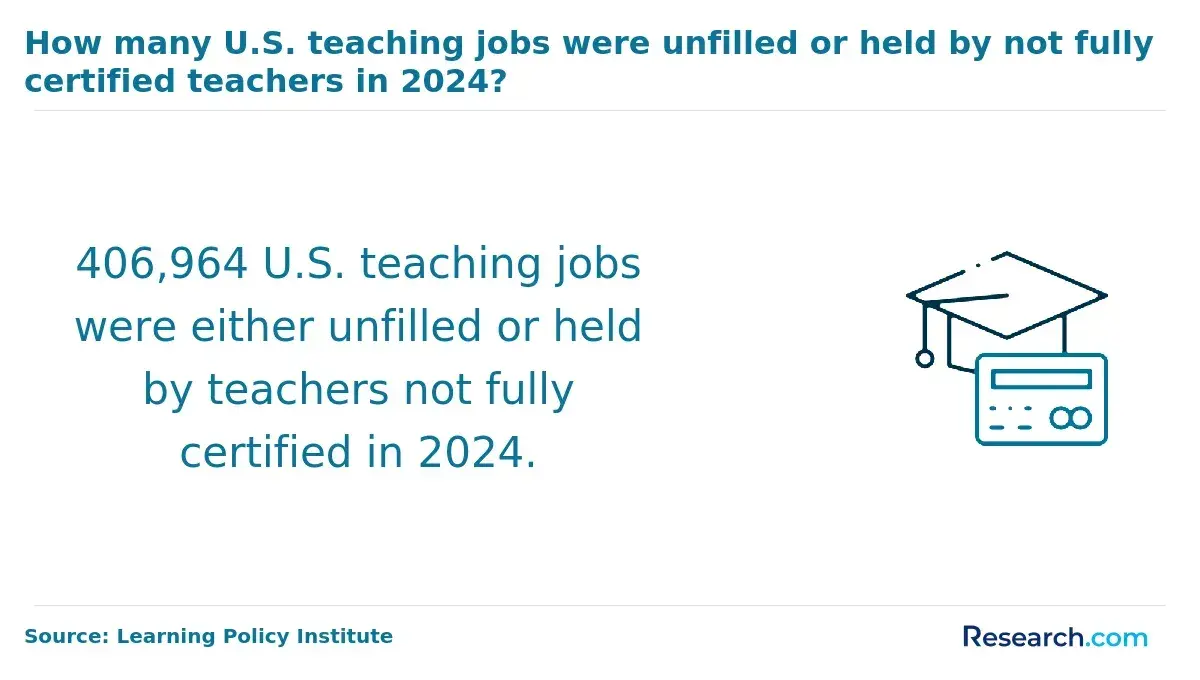
To better understand why affordable and accessible certification routes matter, the visual below shows how many U.S. teaching positions are filled by educators who are not fully certified.
How long does it take to get certified as a teacher in Illinois?
The time required to become a certified teacher in Illinois depends on your education level when you start, the route you choose, and whether you study full time or part time. Most candidates complete the process in 2–4 years, but some career changers in accelerated or alternative programs may finish more quickly if they already meet content and degree requirements.
- Traditional bachelor’s degree route: This pathway usually takes four years and combines general education, major coursework, professional education classes, field experiences, and a final student teaching placement.
- Post-baccalaureate certification: Candidates who already hold a bachelor’s degree often need 1–2 years to complete remaining licensure coursework, clinical practice, and testing requirements.
- Alternative certification: Career changers may complete an intensive program in 1–2 years, often through a structure that combines coursework with a paid internship or residency.
Most candidates complete around 16 weeks of supervised student teaching or an internship. Additional time may be needed for content exam preparation, score reporting, background checks, transcript review, and licensure processing.
After the preparation program recommends or entitles a candidate, the Illinois State Board of Education processes the licensure application through ELIS. This can take 1–5 weeks. Timelines can stretch if documents are missing, tests are delayed, background checks are incomplete, or candidates pursue certification part time. Transfer credits, prior coursework, and accelerated program formats may shorten the route for some applicants.
| Starting point | Estimated certification timeline | Best next step |
| No bachelor’s degree yet | Usually four years through a traditional bachelor’s route | Choose an approved educator preparation program tied to your intended endorsement. |
| Bachelor’s degree in a non-education field | Often 1–2 years through post-baccalaureate or alternative licensure | Request a transcript review before applying so you know what coursework remains. |
| Career changer with strong subject background | May take 1–2 years through an alternative program | Compare residency structure, mentoring, testing requirements, and total cost. |
| Candidate waiting on licensure processing | ELIS processing can take 1–5 weeks after program completion and application submission | Check that all scores, documents, fees, and entitlement records are complete. |
What common pitfalls should I avoid during the Illinois teacher certification process?
The Illinois certification process is manageable when you track requirements carefully, but small errors can delay licensure, student teaching, employment, or renewal. The most common problems involve assuming a program is approved, misunderstanding testing rules, underestimating fees, or waiting too long to submit documents.
| Common mistake | Why it causes problems | Better approach |
| Enrolling before confirming Illinois approval | A program may offer education coursework without leading to Illinois licensure. | Verify approval and endorsement alignment directly before paying tuition. |
| Choosing based only on tuition | Low tuition may not include testing, clinical, background check, or licensure fees. | Build a full cost estimate that includes all required expenses. |
| Waiting too long to take required exams | Testing windows and score reporting can delay student teaching or licensure recommendation. | Create a testing calendar with your advisor during your first term. |
| Assuming online programs automatically meet Illinois rules | Online delivery does not guarantee state approval or local placement access. | Ask whether the program is approved for Illinois and how it arranges fieldwork. |
| Submitting incomplete ELIS records | Missing transcripts, fees, test scores, or entitlement information can slow processing. | Use a checklist and confirm every item before submission. |
| Ignoring endorsement details | A license without the right endorsement may not qualify you for the jobs you want. | Match your endorsement to real district job postings before choosing a route. |
If affordability is a major factor, review practical guidance on the cheapest way to get a teaching credential in Illinois while still checking program approval, endorsement fit, student teaching requirements, and long-term career value.
What are the subject-specific certification options available in Illinois?
Illinois uses endorsements to identify the subjects, grade levels, and specialized student populations a teacher is prepared to serve. A candidate may pursue endorsements during an initial licensure program or add endorsements later through additional coursework, exams, or approved professional preparation.
Subject-specific options may include academic disciplines such as mathematics, science, English language arts, social science, world languages, music, physical education, and other teaching fields. Specialized endorsements can also support work with students with disabilities, bilingual learners, or English learners.
Before pursuing an endorsement, compare your interests with district hiring needs, required tests, fieldwork expectations, and the grade band you want to teach. For example, candidates interested in arts instruction can use this guide on how to become a music teacher in Illinois to understand a subject-specific pathway in more detail.
What are the ESL teacher requirements in Illinois?
ESL teachers in Illinois need preparation beyond general classroom teaching because they support students who are developing English proficiency while also learning academic content. Requirements typically include targeted coursework, field experience with English learners, and assessments aligned with language instruction.
- Coursework: ESL preparation commonly covers language acquisition, linguistics, assessment of English learners, culturally responsive instruction, and methods for teaching academic language.
- Field experience: Candidates are expected to gain supervised experience in classrooms or settings serving English learners.
- Assessment: Candidates may need to demonstrate knowledge of ESL instruction and, for bilingual settings, language proficiency or additional endorsement-specific competencies.
- Licensure alignment: Candidates should confirm whether they need an ESL endorsement, bilingual endorsement, or another credential based on the role they want.
For a focused breakdown of the pathway, see the guide to ESL teacher requirements in Illinois.
How can I effectively prepare for Illinois teacher certification exams?
Strong exam preparation starts with the exact test framework, not a generic study schedule. Illinois certification exams are tied to specific endorsement areas, so candidates should identify their required test, review official competencies, and focus study time on the domains where they are weakest.
- Confirm the required exam: Ask your preparation program which content test applies to your endorsement and when it must be passed.
- Download official materials: Use candidate handbooks, test frameworks, sample questions, and score-report information from official sources.
- Take a diagnostic practice test: Identify weak domains before buying study materials or creating a calendar.
- Study by competency area: Break the exam into content domains and assign specific study sessions to each one.
- Practice timed responses: Build endurance and pacing, especially if you have been away from standardized testing for several years.
- Schedule early: Leave time for score reporting and retesting if needed.
- Connect exam prep to classroom practice: Use lesson planning, fieldwork, and student teaching to reinforce tested concepts.
If you are trying to coordinate testing with coursework, student teaching, and licensure processing, the guide How long does it take to be a teacher in Illinois? can help you plan a realistic certification timeline.
How do I become a certified PE teacher in Illinois?
To become a physical education teacher in Illinois, candidates generally need to complete an approved educator preparation program that supports PE licensure or endorsement, pass the relevant content-area requirements, and complete supervised classroom or school-based experience. Preparation often includes coursework in physical fitness, movement science, health-related instruction, motor development, sports pedagogy, assessment, and safe activity planning.
PE teachers need more than athletic ability. They must be able to design inclusive lessons, adapt activities for students with different physical needs, manage active learning spaces, assess student progress, and promote lifelong wellness. For a detailed state-specific pathway, review the guide on how to become a PE teacher in Illinois.
How do you renew Illinois teaching certification?
Illinois teaching licenses are renewed on a five-year cycle. Renewal is not automatic; educators must complete professional development, record activities correctly, keep license registration current, and submit renewal through ELIS by the required deadline.
- Complete 120 hours of approved professional development: Teachers and school support personnel must complete 120 clock hours of approved professional development during each five-year renewal cycle. One approved clock hour equals one professional development hour.
- Enter professional development in ELIS: Educators must record each activity in the Illinois Educator Licensure Information System, including the activity name, date, provider, and number of hours. Records must be accurate in case of audit.
- Meet Administrator Academy requirements if they apply: Educators with administrative or teacher-leader endorsements who serve in applicable roles must complete one Administrator Academy (IAA) course each year in addition to professional development hours. These annual courses cannot be carried forward.
- Register the license and pay required fees: Educators must pay a ~$10 annual registration fee, totaling $50 per five-year cycle, through ELIS. Registration must be active in at least one teaching region.
- Renew between April 1 and June 30: Renewal opens in ELIS on April 1 of the license expiration year and must be submitted by June 30. Any missing professional development hours must be finished by September 1 to prevent a lapse.
- Handle lapses quickly: If a license is not renewed on time, it lapses on September 1. Reinstatement may require completing missing professional development, paying a reinstatement fee, or completing nine semester credit hours if choosing that reinstatement option instead of completing professional development.
Keeping a license active protects your eligibility for teaching roles and future advancement. If you are evaluating broader education career options, see what can you do with a teaching certificate to understand where an active credential may lead. The chart below adds context about the age profile of certified teachers in the U.S.
Is teacher certification in Illinois transferable to other states?
Illinois teacher certification may help when applying for licensure in another state, but it does not transfer automatically. Illinois participates in the NASDTEC Interstate Agreement, which includes over 40 states, including California, Texas, New York, and Georgia. The agreement can simplify parts of the process, but every state still controls its own licensure rules.
Teachers moving out of Illinois may need to submit transcripts, verification of licensure, test scores, background checks, experience documentation, or additional coursework. Some states issue provisional licenses while incoming teachers complete remaining requirements. Illinois also offers options for educators coming from other states, but applicants still need to satisfy Illinois-specific rules.
Steps to take before moving your Illinois teaching license
- Identify the licensing agency in the state where you plan to teach.
- Compare that state’s endorsement, testing, and experience requirements with your Illinois credential.
- Request official transcripts and license verification early.
- Ask whether you qualify for a provisional license while completing additional requirements.
- Do not resign, relocate, or accept a position until you understand the receiving state’s timeline and conditions.
-
: "
An Illinois-certified teacher who moved to another state described the process as paperwork-heavy and slower than expected. Her Illinois credential helped her begin the application, but she still needed additional testing and coursework. Her advice was to start early, document everything, and treat a provisional license as a bridge rather than a final step.
"
What are the benefits of having a teacher certification in Illinois?
Teacher certification in Illinois gives educators access to roles that are not typically available to unlicensed candidates. It also signals that a teacher has completed state-approved preparation, met testing requirements, and agreed to ongoing professional development. For many educators, the PEL is the credential that turns teaching from temporary work into a long-term career path.
- Access to public school teaching roles: Certification is generally required for full-time teaching positions in Illinois public schools and many structured education programs.
- More career flexibility: Endorsements can allow teachers to move across subjects, grade levels, or specialized areas as they gain additional preparation.
- Stronger employment stability: Licensed teachers are better positioned for permanent classroom roles than candidates limited to short-term or emergency assignments.
- Potential salary and advancement benefits: Certified educators may qualify for salary schedules, additional pay tied to credentials, and future leadership roles such as department chair, instructional coach, or administrator, depending on district rules and experience.
- Eligibility for targeted financial support: Illinois offers supports such as the Minority Teachers of Illinois Scholarship and special education tuition waivers for eligible candidates.
- Ongoing professional growth: Renewal requirements keep teachers engaged in professional development and current instructional practices.
- Stronger preparation for diverse classrooms: Certification pathways require training in instruction, assessment, classroom management, special education awareness, and support for English learners.
Is Illinois teacher certification worth it?
Illinois teacher certification is worth pursuing if you want to teach full time in public schools, build a stable education career, add endorsements, or eventually move into leadership. It may not be the right immediate step if you only want occasional classroom work, are unsure about teaching as a career, or cannot yet commit to student teaching, testing, and program costs. In those cases, substitute teaching, classroom aide roles, tutoring, or education-related volunteer experience can help you test your interest before entering a full licensure program.
What Teachers in Illinois Say About Their Certification
Earning certification in Illinois changed the direction of my teaching career. The schedule gives me room to manage personal responsibilities, and the average pay makes the investment feel practical. I also feel that the credential helps my work be taken seriously. – Franz
Certification gave me a clearer path inside the Illinois school system than I had before. It opened possibilities for specialized roles and future leadership, and it keeps me focused on growing as an educator while supporting students and colleagues. – Harriett
The professional development expectations have helped me stay current. Workshops, training sessions, and ongoing learning have improved my classroom practice and reminded me why I wanted to teach in the first place. – Lin
Related Articles for Nearby States
- 2027 Teacher Certification Types & Requirements in Indiana
- 2027 Teacher Certification Types & Requirements in Wisconsin
- 2027 Teacher Certification Types & Requirements in Iowa
- 2027 Teacher Certification Types & Requirements in Missouri
- 2027 Teacher Certification Types & Requirements in Kentucky
- 2027 Teacher Certification Types & Requirements inMichigan
- 2027 Teacher Certification Types & Requirements in Minnesota
- 2027 Teacher Certification Types & Requirements in Ohio
- 2027 Teacher Certification Types & Requirements in Tennessee
- 2027 Teacher Certification Types & Requirements in Arkansas
Key Insights
- The Professional Educator License is the main credential for full-time public school teaching in Illinois, but substitute permits, alternative routes, temporary licenses, and endorsements serve different career needs.
- Your best certification route depends on your starting point: first-time college students usually follow a bachelor’s pathway, while degree holders may compare post-baccalaureate and alternative licensure programs.
- Do not enroll in any program until you confirm Illinois approval, endorsement alignment, field placement support, exam requirements, and total cost.
- Certification expenses include more than tuition. Candidates should plan for testing, background checks, clinical fees, materials, ELIS fees, and possible retesting.
- Most candidates need 2–4 years to become certified, though alternative and post-baccalaureate routes may take 1–2 years for applicants who already hold a bachelor’s degree.
- Renewal matters. Illinois educators must complete 120 professional development hours during each five-year cycle and renew through ELIS by the required deadline.
- Illinois certification can support licensure in another state through reciprocity pathways, but every state may impose its own testing, coursework, background check, or provisional license requirements.
- The strongest candidates choose certification strategically: they match endorsement areas to real job demand, budget carefully, prepare early for exams, and use advisors to prevent avoidable delays.
References:
- AllEducationSchools.com. (n.d.). Learn How to Earn Teacher Certification in Illinois. AllEducationSchools.com
- Coffey, C. (2024). New Illinois Law Updates Teacher Certification Process. West40
- Illinois.gov. (2025). Re-Certify, Prepare for, & Obtain a Teacher Certification. Illinois.gov
- Illinois Education Association. (n.d.). How To Become A Teacher in Illinois. IEA
- Illinois Licensure Testing System. (n.d.). Important Announcements. ILTS
- North Park University. (2025). Illinois Teacher Licensure Requirements. NPUIEA resource
- South Cook Intermediate Service Center. (n.d). Out of State or Out of Country Applicants. South Cook
- Teachers of Tomorrow. (2025). How to Become a Teacher in Illinois? 6 Steps to Become a Teacher. ToTIEA guidance
- University of Illinois. (2025). Teaching Certificates. UI CITL
- Zippia Team. (2025). Certified Teacher skills for your resume and career. Zippia
Other Things You Should Know About Teacher Certification Types and Requirements in Illinois
Before student teaching, Illinois candidates must finish a state-approved teacher preparation program, pass the required content-area test, and complete coursework in pedagogy and methods. Most programs also require a criminal background check and a minimum cumulative GPA, often 2.5, before placement in a classroom.
In 2027, Illinois teacher certification requires passing the edTPA and the Illinois Licensure Testing System (ILTS) tests. These examinations evaluate teaching skills and subject-specific knowledge necessary for certification across various types and levels of teaching in the state.


