2027 Best AI Master's Degrees for Applied Machine Learning Careers

Co-Founder and Chief Data Scientist
Many professionals with unrelated undergraduate degrees face challenges entering applied machine learning roles due to the lack of specialized education. Traditional programs often require prior experience, limiting opportunities for career changers. Additionally, balancing work and study demands flexibility, while accreditation ensures credential value in competitive job markets. Navigating these factors complicates the search for suitable master's degrees designed to bridge this gap effectively.
This article examines top-tier, accredited AI master's programs that offer flexible pathways, helping prospective students transition confidently into applied machine learning careers.
Key Things You Should Know
- Master's degrees in applied machine learning consistently report a 15% higher employment rate within six months post-graduation compared to general computer science programs, according to 2025 labor data.
- Top programs emphasize practical skills with coursework in deep learning, data engineering, and AI ethics, reflecting industry demand for well-rounded expertise.
- Tuition varies widely, but investing in accredited programs with strong industry ties significantly improves internship and job placement opportunities in AI-focused roles.
What are the best AI master's degrees for applied machine learning careers?
The best AI master's degrees for applied machine learning careers in the US combine strong computer science foundations with specialized coursework in machine learning and data science. Leading programs at universities such as Carnegie Mellon, Stanford, MIT, UC Berkeley, and UIUC consistently rank high for producing top talent in this field. Many top master's programs in AI and applied machine learning offer hands-on experience using real-world datasets and frameworks like TensorFlow and PyTorch alongside theoretical courses in algorithms, statistics, and optimization.
- Access to interdisciplinary labs integrating AI with robotics, healthcare, or natural language processing.
- Strong industry partnerships providing internships or projects with tech companies and startups.
- Capstone projects involving collaboration with Silicon Valley firms, as seen in UC Berkeley's program.
- Options for part-time or online study to accommodate working professionals.
For careers in applied machine learning, it's essential to select programs that balance foundational theory with real-world projects and maintain faculty expertise and research impact. Stanford's AI Lab emphasizes ethics and human-centered AI, while Carnegie Mellon's focus on reinforcement learning suits those pursuing autonomous systems roles. Exploring details such as faculty achievements and practical opportunities can enhance readiness and competitiveness.
Prospective students interested in career outcomes should also consider information on artificial intelligence degree salary to better understand potential returns on investment.
What accreditation should an AI master's program have in the United States?
In the United States, accreditation standards for AI master's programs depend on institutional accreditation granted by agencies recognized by the U.S. Department of Education (DOE). There is no specialized accreditation exclusively for AI or applied machine learning degrees. Students must verify that the institution offering the master's degree holds valid regional or national accreditation acknowledged by the DOE to ensure academic quality and degree legitimacy.
Recognized accrediting bodies for applied machine learning degrees US include major regional accreditors such as the Higher Learning Commission (HLC), Middle States Commission on Higher Education (MSCHE), and Western Association of Schools and Colleges (WASC). These accrediting agencies assess the entire institution, including academic quality, faculty qualifications, and administrative support, rather than focusing on AI specifically.
Employers and government agencies typically require degrees from institutions with such accreditation for licensure, grants, and certification eligibility. Without recognized institutional accreditation, students face challenges with credit transfers and limited access to federal financial aid. Additionally, AI master's students should consider if their program's technical curriculum aligns with accreditation standards in related areas like computer science or engineering to further support rigor.
Prospective students can consult data science programs ranking resources to compare affordability and quality of programs in AI and related fields. This ensures informed decisions based on both reputation and cost.
What jobs can you get with an AI or machine learning master's degree?
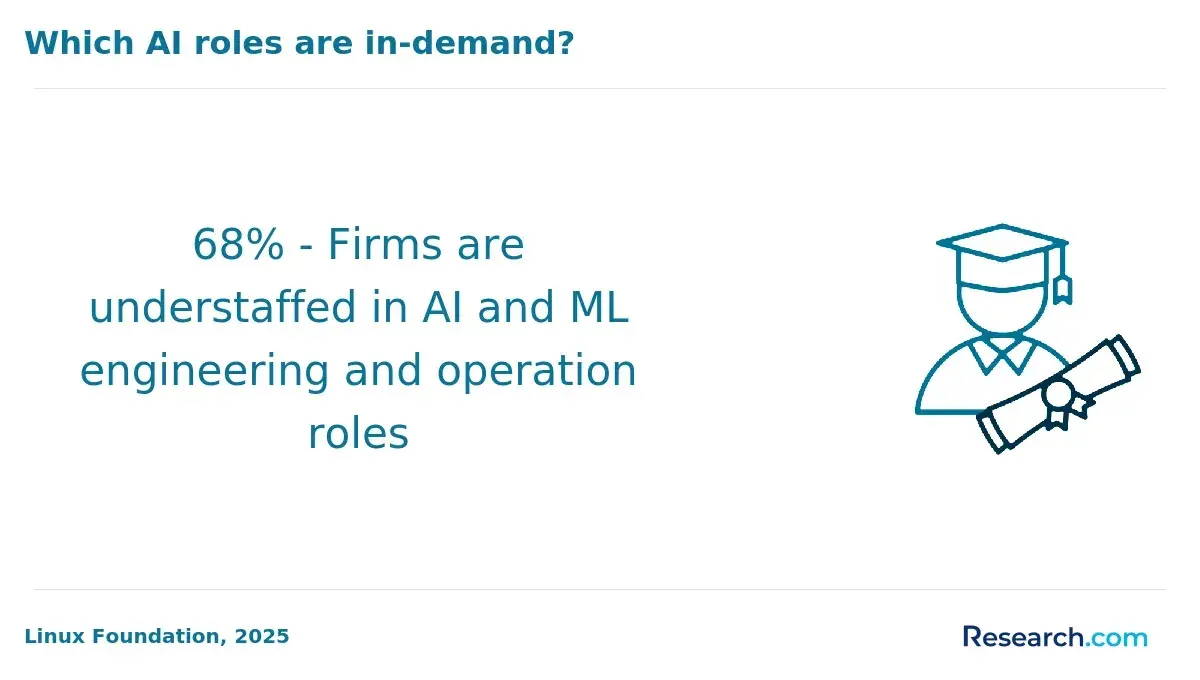
Graduates with a master's degree in AI or machine learning qualify for advanced technical roles requiring strong applied skills. Common jobs in AI and machine learning with a master's degree include machine learning engineer, data scientist, AI research scientist, and applied AI specialist. These roles involve designing algorithms, processing large datasets, building predictive models, and deploying AI solutions across industries like healthcare, finance, automotive, and technology.
Data scientist positions are especially in demand, supported by the U.S. Bureau of Labor Statistics' projection of 36% employment growth from 2023 to 2033, much faster than average. These professionals leverage machine learning techniques to extract insights, enhance recommendations, optimize supply chains, and develop business strategies.
Machine learning engineers focus on software development, creating scalable models and integrating them into production. AI research scientists work in corporate R&D or academia to innovate new algorithms. Emerging roles include AI product manager and AI ethics specialist, blending technical expertise with management and policy understanding.
Specializations such as natural language processing, computer vision, robotics, and reinforcement learning allow career tailoring toward sectors like autonomous vehicles, medical diagnostics, or cybersecurity. Employers seek candidates with hands-on experience in applied machine learning career opportunities, strong programming skills in Python, and familiarity with frameworks like TensorFlow and PyTorch.
For those interested in pursuing these paths, exploring online ai degrees can provide flexible options. Building a solid foundation combined with domain-specific knowledge and interdisciplinary collaboration is key to securing high-paying, growth-oriented roles in AI and machine learning fields.
How do online AI master's programs compare with on-campus programs?
Online AI master's programs often offer the same curriculum rigor and faculty expertise as on-campus programs but provide greater flexibility and convenience for working professionals. Many online degrees use identical course materials and professors, allowing learners to study advanced topics like deep learning, natural language processing, and computer vision at their own pace. However, access to specialized AI labs or hardware is more limited online and may rely on virtual labs or cloud platforms.
The flexibility and career outcomes of online AI degrees are important benefits. According to Wiley University Services' "Voice of the Online Learner" report, 58% of prospective students enroll primarily to enhance their job prospects. This drives online programs to focus heavily on applied skills, industry partnerships, and project-based learning tailored to real-world challenges.
Differences also arise in networking and peer collaboration. On-campus students benefit from face-to-face events and research groups, which can lead to internships and job placements. Online learners engage through virtual meetups, forums, and mentorship programs but must be proactive for meaningful connections.
For those considering options, it's useful to explore an online master in data science as a related pathway with comparable flexibility and outcomes. Ultimately, selecting the right program depends on individual goals, whether focused on practical AI skills or immersive campus experiences.
What courses and skills define an applied machine learning master's curriculum?
An applied machine learning master's program blends practical skills with a strong theoretical foundation, preparing students to impact industry immediately. Core coursework includes supervised and unsupervised learning, deep learning architectures, and reinforcement learning, ensuring students master key algorithms for data-driven decision-making. They gain experience in data preprocessing, feature engineering, and model optimization using tools like TensorFlow and PyTorch.
Data engineering is another essential focus, covering large-scale data processing, distributed computing, and database management to handle real-world datasets. Students also learn model deployment techniques such as containerization with Docker, cloud services like AWS and GCP, and MLOps strategies to maintain scalable, reproducible ML systems.
Statistical methods and probability underpin the robustness of machine learning algorithms, with training in evaluation methods such as cross-validation and A/B testing. Projects simulate end-to-end workflows from data ingestion to model monitoring, bridging theory and practice effectively.
Ethics and explainability are integrated, using tools like SHAP and LIME to address transparency and trust in AI models. Collaborative, interdisciplinary projects develop soft skills like teamwork and communication, crucial for professional environments.
The World Economic Forum's Future of Jobs Report 2025 emphasizes "AI and big data" as rapidly growing skills, highlighting the demand for expertise in ML algorithms, data pipelines, and deployment strategies for career readiness in applied machine learning.
What are typical admission requirements for AI and machine learning master's programs?
Admission to AI and machine learning master's programs generally requires a bachelor's degree in computer science, engineering, mathematics, statistics, or physics. Strong programming skills in languages like Python, Java, or C++ are essential, alongside a solid grasp of calculus, linear algebra, probability, and statistics. Many programs expect applicants to have a GPA above 3.0 and require letters of recommendation to evaluate research potential and academic readiness.
A statement of purpose outlining career goals and motivations for pursuing the degree is standard. The 2024 Council of Graduate Schools (CGS) report highlights that many U.S. graduate programs continue GRE-optional policies, so while some schools may require the GRE, many AI and machine learning programs do not. This shift reflects a broader move away from reliance on standardized test scores.
Relevant work experience in data science, software development, or research can enhance an application or sometimes replace formal prerequisites. Some programs provide conditional admission or require preparatory coursework for candidates without a traditional background. International students often need to submit English proficiency test scores like TOEFL or IELTS. Preparing a portfolio showcasing projects or publications is another effective way to stand out.
Since requirements vary widely, applicants should carefully review each program's criteria to improve their chances of acceptance.
How long do AI master's programs take, and how much do they cost?
Master's programs in artificial intelligence generally take 1.5 to 2 years of full-time study, with part-time or online options extending the timeline to 3-4 years. Specialized applied machine learning programs often require 30 to 45 credits, blending foundational AI topics with hands-on projects. Some universities offer accelerated tracks that can be completed in as little as 12 months, though these demand intensive study and commitment.
Costs vary widely by institution type. The National Center for Education Statistics reports average annual graduate tuition and fees of about $12,596 at public universities and $29,931 at private nonprofit schools. Consequently, a two-year program may total around $25,000 at public institutions and nearly $60,000 at private ones, excluding living expenses and additional fees.
Part-time study can ease short-term financial strain but often increases the overall cost due to longer duration. Prospective students should explore funding options such as advanced assistantships, employer tuition aid, and scholarships. Many programs also offer modular pricing per credit or course, making them accessible for working professionals.
Choosing the right artificial intelligence program requires balancing duration, format, and cost against your career goals. Researching curriculum details and financial aid opportunities is essential for making an informed decision about investing in advanced AI education.
What salaries can applied machine learning graduates expect in the United States?
Graduates with a master's degree in applied machine learning in the United States often find salaries competitive with other high-demand technical roles. The U.S. Bureau of Labor Statistics reports a median annual wage of $145,080 for computer and information research scientists, a role closely related to applied machine learning.
Starting salaries usually fall between $90,000 and $120,000 depending on factors such as industry, location, and experience. Tech hubs like Silicon Valley, Seattle, and Boston tend to offer salaries at the higher end due to increased demand and living costs.
Professionals with specialization in areas like natural language processing, computer vision, or large-scale data infrastructure typically earn over $160,000. Leadership roles or jobs involving research management and product innovation can see salaries above $200,000.
Salary variations also depend on sectors, with finance, healthcare, and government research labs sometimes providing bonuses and long-term incentives in addition to base pay. Total compensation may include stock options, signing bonuses, and relocation allowances.
Ongoing skill development in programming languages, cloud AI platforms, and advanced algorithms is key to higher pay. Practical machine learning expertise combined with a master's degree remains a strong driver of above-average compensation in this evolving field.
Which certifications complement an AI master's for machine learning careers?
Certifications that complement a master's degree in AI for applied machine learning careers emphasize practical, industry-recognized skills beyond academic theory. Cloud platform certifications play a crucial role. According to the 2024 Stack Overflow Developer Survey, AWS is the most widely used cloud platform by professional developers, highlighting the value of AWS-focused machine learning credentials. Earning the AWS Certified Machine Learning - Specialty certification proves expertise in designing, implementing, and maintaining ML solutions on AWS infrastructure, a vital skill in today's job market.
Advanced certifications also boost career prospects. Google's Professional Machine Learning Engineer credential, for example, tests deployment and operationalization of models in production, bridging research with business needs.
Additional key certifications include:
- Microsoft Certified: Azure AI Engineer Associate - for Azure AI services integration relevant to enterprises
- Certified TensorFlow Developer - validating proficiency in a leading open-source ML framework
- Certified Data Scientist programs from recognized organizations like DASCA - broadening skills in data manipulation and ML algorithm selection
For those targeting roles combining AI and software engineering, certifications in methodologies such as Agile and DevOps enhance the ability to integrate AI models into applications. Experience with MLOps platforms and certificates focused on ML lifecycle management improve readiness for industry demands.
How can you choose a reputable AI master's program and avoid scams?
Verify institutional accreditation when choosing an AI master's program by consulting recognized agencies like the U.S. Department of Education or the Council for Higher Education Accreditation (CHEA). Confirm program details through official school websites or trusted academic databases. Be cautious of red flags such as unverifiable contacts, missing faculty credentials, or promises of fast degrees without rigorous coursework.
Carefully review the curriculum to ensure it covers essential topics like machine learning, deep learning, and data ethics. Look for faculty with doctoral degrees and relevant industry experience. Transparent admission criteria and clear tuition fees often indicate legitimate programs.
Alumni feedback and career placement data provide insight into program effectiveness. Reliable programs share graduate employment rates in AI-related fields and certifications from recognized professional organizations. Verify claimed partnerships with industry leaders or research bodies by contacting those entities directly.
According to the Federal Trade Commission's Data Book, consumers lost $1.7 billion to imposter scams, highlighting the importance of verifying school identity and accreditation to avoid fraud. Steer clear of programs requesting upfront cash without contracts or pressuring quick enrollment. Use state higher education commission resources to confirm licensing. For online learning, check technology platforms and support services.
Seek recommendations from professional AI or machine learning societies. Focus on programs with transparent faculty listings, proven results, and verifiable endorsements to protect your financial investment and ensure a valuable AI degree.
Other Things You Should Know About Artificial Intelligence
When selecting an AI master's program for applied machine learning in 2027, consider the course curriculum's emphasis on real-world applications, faculty expertise, industry partnerships, and available specialization tracks. Additionally, review the program's flexibility for online or part-time study options, career support services, and financial aid opportunities.
Programming experience is highly important before starting an AI master's degree, as most programs require proficiency in languages like Python, R, or Java. Practical coding skills enable students to implement machine learning algorithms, work with data sets, and develop AI models effectively. Many programs recommend prior coursework or experience in computer science fundamentals.
Yes, many artificial intelligence master's degrees provide pathways to research careers, especially those offered by universities with strong research programs. Students often engage in projects involving machine learning innovation, algorithm development, or AI ethics. Graduates can pursue PhD studies or work in research labs within academia or industry.
Ethics is increasingly integrated into AI master's programs to address challenges such as bias, privacy, and accountability in AI systems. Courses or modules on AI ethics teach students how to design responsible algorithms and consider societal impacts. This focus prepares graduates to create fair and transparent AI applications in real-world settings.
References
- AI/Machine Learning Graduate Jobs | Gradcracker - Careers for STEM Students https://www.gradcracker.com/search/computing-technology/ai-machine-learning-graduate-jobs
- Top AI Graduate Programs To Kickstart Your Career in Artificial Intelligence Today https://www.investopedia.com/top-ai-graduate-programs-to-kickstart-your-career-in-artificial-intelligence-today-11916749
- M.SC. IN Artificial Intelligence https://put.poznan.pl/msc-artificial-intelligence
- Find Accredited Programs https://accreditation.org/find-accredited-programs/university-search
- Online AI Degrees vs On-Campus: Which Is Right for You in 2026? https://aidegreeonline.com/online-ai-degrees-vs-on-campus-which-is-right-for-you-in-2026/
- 25 Best Master's in AI Programs - MastersInAI.org https://www.mastersinai.org/degrees/best-masters-in-artificial-intelligence/
- Applied Machine Learning (Master's Degree) https://www.hamk.fi/en/degree/applied-machine-learning-masters-degree/
- Application and admission - Master Artificial Intelligence https://www.uva.nl/shared-content/programmas/en/masters/artificial-intelligence/application-and-admission/international-prior-education/international-prior-education-foldout-menu.html
- 16 Artificial Intelligence Career Paths https://www.calmu.edu/news/artificial-intelligence-career-paths
- What aspirants must know before pursuing a Masters in Machine Learning https://www.avanse.com/blog/what-aspirants-must-know-before-pursuing-a-masters-in-machine-learning