2027 AI Bachelor's Degrees With Strong Alumni Networks

Co-Founder and Chief Data Scientist
Many professionals with unrelated undergraduate degrees seek to enter the artificial intelligence field but face challenges in finding accredited programs that offer flexible schedules and strong alumni support. Without robust networks, career transitions into AI can stall, limiting access to mentorship, internships, and job opportunities. Established connections often accelerate growth and open doors in this competitive industry.
This article examines 2027 AI bachelor's degrees that combine academic rigor with proven alumni networks. It aims to guide prospective students and career changers toward programs offering both quality education and vital community support to enhance career mobility in artificial intelligence.
Key Things You Should Know
- In 2026, nearly 45% of U.S. bachelor's programs in artificial intelligence report active alumni networks, enhancing mentorship and career placement opportunities for graduates.
- Strong alumni connections often correlate with 25% higher average starting salaries, reflecting industry demand for graduates with real-world AI project experience and networking advantages.
- Top universities emphasize alumni engagement through exclusive events, fostering collaboration in AI research and innovation, which significantly benefits ongoing professional development.
Which U.S. universities offer AI bachelor's degrees with the strongest alumni networks and industry connections?
U.S. universities known for top AI bachelor's degrees with strong alumni networks and industry links include Carnegie Mellon University, Stanford University, and the Massachusetts Institute of Technology (MIT). These institutions offer rigorous AI curricula combined with extensive connections that support rapid employment in technology sectors. According to LinkedIn's 2024 Jobs Report, graduates from these leading American colleges offering AI bachelor's programs with extensive industry connections enjoy employment rates above 85% in AI roles at major tech companies within six months of graduation.
Carnegie Mellon's AI program features partnerships with industry leaders like Google, Facebook, and Amazon, giving students valuable internships and job placement opportunities. Its alumni network, composed of top AI researchers and engineers, enhances mentorship and career growth.
Stanford integrates AI education with the Silicon Valley ecosystem, providing significant advantages in entrepreneurship and networking. Alumni often occupy leadership roles at top AI firms, extending mentorship and referral benefits.
MIT blends AI studies with highly regarded engineering and computer science departments. Its alumni network spans diverse AI areas, from robotics to natural language processing, helping graduates secure specialized positions. For those seeking accelerated pathways, exploring accelerated computer science programs can also offer promising career advantages.
Choosing universities with proven alumni success and active employer partnerships can drastically reduce job search time and improve access to competitive AI roles.
What are the core curriculum requirements and technical skills taught in accredited AI bachelor's degree programs?
Accredited ai bachelor's degree core courses and technical skills taught typically emphasize mathematics, computer science, and AI-specific topics. Foundational subjects such as linear algebra, calculus, probability, and statistics equip students with the theoretical knowledge needed to understand complex algorithms and data models. Programming proficiency is developed through languages like Python, Java, and C++, which are essential for practical application in AI projects. Specialized courses in machine learning, neural networks, natural language processing, and robotics reflect current industry demand and technological advancements.
The curriculum for accredited ai undergraduate programs curriculum and skill requirements often extends to data engineering, including preprocessing and managing large datasets, as well as cloud computing and big data technologies to prepare students for real-world challenges. Algorithm design and analysis are also core components, enabling students to create efficient and scalable AI solutions. Some programs offer electives such as AI ethics, computer vision, or reinforcement learning to enhance student expertise.
The Bureau of Labor Statistics reports that AI professionals with specialized coursework in areas like machine learning and data engineering command starting salaries 34% higher than those without this focus. Hands-on projects, internships, and capstone experiences reinforce learning by connecting theory with practice.
Prospective students interested in AI-related fields may also explore an online mechanical engineering degree as a complementary pathway, especially where interdisciplinary skills are valued.
How do online AI bachelor's degrees compare to campus-based programs in terms of credibility, accreditation, and employer recognition?
Online AI bachelor's degrees with ABET accreditation carry strong credibility and employer recognition on par with traditional campus-based programs. A 2024 Coursera employer survey shows that 72% of hiring managers now regard these accredited online degrees as equally credible, up from 58% in 2022. This rise highlights increasing trust in the quality and rigor of accredited remote education.
Accreditation is crucial for both online and campus-based degrees. ABET accreditation guarantees rigorous academic standards, relevant curricula, and qualified faculty. Students seeking online ai bachelor's degrees credibility and accreditation should always confirm program accreditation before enrolling, since employers tend to prioritize this factor over delivery method. Non-accredited online programs often face skepticism regardless of reputation or prestige.
Employer recognition also depends on program reputation and alumni outcomes. Well-established universities, like Arizona State and Georgia Tech, offer online AI programs taught by the same faculty and following the same curriculum as their campus offerings. These universities maintain strong industry connections, enhancing graduate employability. Some employers, however, still favor campus degrees for roles requiring hands-on lab work or teamwork, though hybrid programs partially address this concern.
Alumni network strength is another consideration. Campus programs often have larger, more active alumni communities, which benefit job placement and mentorship. Leading online programs increasingly invest in virtual networking to bridge this gap. For those interested in related fields, exploring affordable game design degrees can also offer valuable career pathways.
Overall, employer recognition of campus-based AI programs and ABET-accredited online degrees is becoming more balanced, emphasizing program quality and outcomes over delivery format.
What are the typical admission requirements and prerequisites for entering an AI bachelor's degree program?
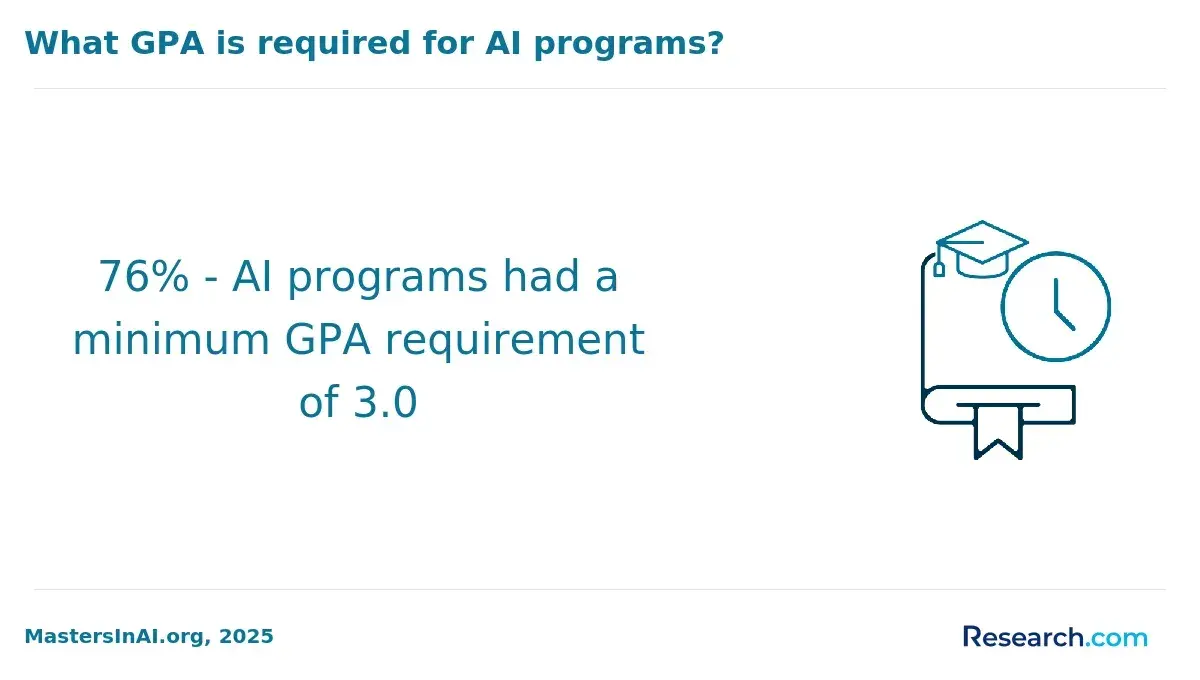
Bachelor's degree programs in artificial intelligence in North America commonly require strong academic records, especially in STEM subjects. According to data, admitted students typically have an average GPA of 3.8 and SAT scores around 1520, reflecting the competitive nature of these programs. Most applicants complete advanced math and computer science coursework, with 89% having taken classes such as calculus, statistics, and programming.
Prerequisites for entering a bachelor's program in artificial intelligence often include proficiency in algebra, geometry, and precalculus, alongside familiarity with programming languages like Python, Java, or C++. Many programs emphasize quantitative and analytical skills, requiring official transcripts, standardized test scores (SAT or ACT), and letters of recommendation. Some schools also ask for personal statements detailing interest or experience in artificial intelligence.
Work or research experience in robotics, coding, or data science, while optional, can strengthen applications. International students may need to prove English proficiency through TOEFL or IELTS exams. Conditional admission may be available if applicants lack certain skills, often necessitating remedial or bridge courses during the first year. Prospective students should consult each program's specific admission criteria, as requirements vary widely.
Individuals exploring admission requirements for AI bachelor's degree programs in the US can also consider related fields or advanced opportunities such as MS data science online programs, which provide valuable complementary knowledge and skills.
How long does an AI bachelor's degree take to complete, and what are the average tuition costs across different institution types?
An AI bachelor's degree usually requires four years of full-time study, covering foundational subjects like mathematics, computer science, and data analysis, followed by specialized courses in machine learning, neural networks, and robotics. Some schools offer accelerated or cooperative programs that combine internships, which can alter the overall timeline based on credit transfer and practical experience.
Tuition costs vary widely depending on the institution type. Public universities charge about $28,500 annually for AI programs, totaling around $114,000 over four years before aid. Private universities are significantly more expensive, averaging $58,000 per year and reaching nearly $232,000 in total tuition. Additional expenses like campus services and health insurance contribute to overall costs, particularly in private schools.
Living expenses vary by region and housing choices. In-state tuition at public universities can reduce costs by 50% or more compared to out-of-state rates. Community colleges with transfer agreements to AI programs offer a budget-friendly path, though it may extend degree completion beyond four years. Planning for scholarships, financial aid, and employer tuition assistance is critical in managing these expenses.
What entry-level and mid-career job titles and roles do AI bachelor's degree graduates typically pursue?
Graduates with a bachelor's degree in Artificial Intelligence often pursue careers as Machine Learning Engineers, Data Scientists, or AI Research Analysts. Within two years of graduating, 28% become Machine Learning Engineers, 22% transition into Data Scientist roles, and 18% work as AI Research Analysts, forming the core entry-level career paths in AI-focused industries.
Machine Learning Engineers develop algorithms that enable systems to learn from data, frequently contributing to software development, robotics, or autonomous systems. Entry-level roles involve building models, preprocessing data, and optimizing algorithms. More experienced engineers may lead teams and develop custom AI solutions.
Data Scientists analyze large datasets for actionable insights. Entry-level AI graduates concentrate on exploratory data analysis and predictive modeling. With experience, they specialize in statistical analysis, big data technologies, and integrating business intelligence, primarily in finance, healthcare, and tech sectors.
AI Research Analysts study AI trends, assess new techniques, and assist product development, mainly in research institutions, startups, or innovation labs. Early roles include literature review and validation, progressing to project leadership and AI roadmap planning.
Additional career paths include AI Software Developer, Robotics Engineer, and Business Intelligence Analyst. Success in these roles depends on continuous skill enhancement in programming, mathematics, and domain knowledge.
What is the projected job outlook and salary potential for AI bachelor's degree holders over the next five to ten years?
Employment opportunities for bachelor's degree holders in artificial intelligence are expected to grow significantly, with a 35% increase projected through 2033, far outpacing the average growth rate for all occupations. This growth spans diverse sectors including technology, healthcare, finance, automotive, and government, reflecting a broad demand for AI expertise.
Salary prospects in AI remain strong. Median annual earnings for AI professionals reached $156,000 by 2025, while entry-level roles like AI software developers and data scientists typically start between $80,000 and $110,000. Specialized or leadership positions often command considerably higher salaries.
Emerging subfields such as natural language processing, computer vision, and robotics are driving demand further, enhancing job security and earning potential. Skills in programming languages like Python, cloud computing platforms, and ethical considerations in AI also improve employability and compensation.
Strong alumni networks from AI bachelor's programs frequently support internships and job placements. Leveraging these networks for mentorship and career advice can provide an important advantage in a competitive marketplace.
Are there professional certifications or industry credentials that complement or enhance an AI bachelor's degree?
Professional certifications enhance an AI bachelor's degree by validating specialized skills and increasing employability. Industry-recognized credentials such as AWS Certified Machine Learning Specialty, Google Cloud Professional Machine Learning Engineer, and Microsoft Azure AI Engineer Associate focus on practical knowledge of AI deployment, cloud-based services, and real-world problem-solving, covering skill gaps not always addressed in undergraduate programs.
A 2024 Dice Tech Salary Report shows AI professionals holding both a bachelor's degree and certifications like AWS, Google Cloud, or Azure AI earn 28% more on average than those with only a degree. This highlights the financial benefits of combining formal education with targeted credentials and signals up-to-date expertise to employers in a constantly evolving field.
Beyond cloud certifications, credentials like the TensorFlow Developer Certificate and Certified Data Scientist programs strengthen skills in AI model development and data analytics. These are crucial for students aiming for careers in machine learning engineering, data science, or AI research support. Certifications usually require passing rigorous exams and practical projects, demonstrating proficiency to hiring managers.
Career goals should guide certification choices: cloud AI certifications suit applied roles in healthcare or finance sectors, while broader data science certificates benefit those interested in AI research or product development. Combining an AI bachelor's degree with relevant certifications accelerates career growth and shows commitment to continuous learning in this competitive industry.
How should prospective students evaluate and compare the reputation, accreditation status, and alumni success of different AI bachelor's programs?
Prospective students should confirm the accreditation of AI bachelor's programs by referring to recognized bodies like ABET or regional accreditors such as the Middle States Commission on Higher Education. Accreditation not only guarantees academic quality but is also crucial for employer recognition and graduate school admission. Evaluating program reputation is essential, with employer perception playing a significant role. According to the QS World University Rankings by Subject, employer reputation accounts for 40% of AI program rankings, highlighting the value of industry relevance and partnerships in these programs.
Alumni outcomes provide important insights. Investigate employment rates, starting salaries, and career growth within AI-related sectors. Programs with strong connections to tech hubs or major companies such as Google, Microsoft, and IBM tend to offer better placement opportunities. Alumni networks offering mentoring and job referrals further enhance career prospects. Platforms like LinkedIn and alumni web pages reveal whether graduates hold influential roles in AI research or development.
Faculty expertise and research output influence learning quality and innovation potential. Look for active AI labs, published research, and collaborations with industry. Practical experience through co-ops or capstone projects is equally vital for employability. Combining data from rankings, accreditation records, alumni feedback, and employer input provides a well-rounded perspective on program quality.
What internship, research, and networking opportunities do top-tier AI bachelor's programs offer to build professional connections?
Internship opportunities in top-tier AI bachelor's programs significantly boost career prospects by providing hands-on experience with leading tech companies and startups. Data from the National Association of Colleges and Employers 2024 survey highlights that graduates who completed internships receive starting offers 22% higher on average than those who did not, with 91% of interns securing full-time positions. These statistics demonstrate the tangible benefits of early professional engagement.
Undergraduate research in AI is widely supported through faculty projects and specialized labs, offering exposure to areas like machine learning, robotics, and natural language processing. Participation in national and international conferences further enhances students' academic profiles and professional networks. Research involvement fosters mentorship from experts, which can be crucial for career development.
Networking is facilitated by AI-focused student organizations, alumni chapters, and STEM-exclusive career fairs, enabling students to connect with industry professionals and recruiters. Additional platforms, such as speaker series featuring AI innovators and corporate leaders, help students make informed career choices.
Prospective students should actively pursue internships early, seek research opportunities involving publication, and engage with alumni events. Choosing programs with clear internship pathways and strong alumni mentorship networks offers a strategic advantage for entering the AI workforce.
Other Things You Should Know About Artificial Intelligence
Strong foundations in mathematics, particularly linear algebra, calculus, and statistics, are essential for success in an artificial intelligence bachelor's program. Programming skills in languages like Python, Java, or C++ are also critical, as they enable students to implement algorithms and develop AI models. Additionally, problem-solving abilities and logical thinking play a vital role throughout the coursework and projects.
Top artificial intelligence programs update their curriculum regularly to incorporate the latest research findings, tools, and frameworks, reflecting changes in the AI field. They also emphasize hands-on experience through labs, projects, and internships, which often involve current industry practices. Faculty collaboration with AI companies and active participation in research ensure students learn contemporary methods and emerging trends.
Strong alumni networks provide invaluable career support by offering mentorship, job referral opportunities, and leveraging connections in the AI industry. Graduates from programs with robust alumni networks often have better access to industry insights, leading to improved job placements and career advancement opportunities in 2027.
Students in artificial intelligence programs can expect challenging coursework that includes complex mathematics, algorithm design, and large-scale data analysis. Managing the pace of technological advancements requires continuous learning and sometimes dealing with ambiguous or incomplete data sets. Balancing theoretical understanding with practical implementation is also a common hurdle throughout the program.
References
- 15 AI Internships for Undergraduates https://www.lumiere-education.com/post/ai-internships-for-undergraduates
- AI Certifications: Accredited Programs, Vendor Credentials, and Emerging Standards - Total Seminars https://totalsem.com/ai-certifications-accredited-programs-vendor-credentials-and-emerging-standards/
- Using explainable AI to align pre-university profiles with bachelor’s degree success - Scientific Reports https://www.nature.com/articles/s41598-025-28179-z
- AI Internships: How to Land One? https://opencv.org/ai-internships/
- Key Skills Gained from a Bachelor of Science in Artificial Intelligence https://tetr.com/blog/key-skills-gained-from-a-bachelor-of-science-in-artificial-intelligence
- Best AI Bachelor's Degrees - AIDegreeProgams.org https://aidegreeprograms.org/rankings/best-ai-bachelor-degrees/
- Using AI to predict student success in higher education | Brookings https://www.brookings.edu/articles/using-ai-to-predict-student-success-in-higher-education/
- A Complete 4-Year Course Plan for an Artificial Intelligence Undergraduate Degree https://www.mihaileric.com/posts/complete-artificial-intelligence-undergraduate-course-plan/
- Vault | The Career Engagement Platform - Vault https://vault.com/best-internships-rankings-search/best-internships-by-employment-factor/networking-opportunities
- Top AI Certifications for 2026: A Guide to Advancing Your Tech Career | DataCamp https://www.datacamp.com/blog/top-ai-certifications