2027 Artificial Intelligence Degree Programs for Students With No Coding Experience

Co-Founder and Chief Data Scientist
Many individuals with backgrounds outside technology struggle to find graduate programs that offer a meaningful entry into artificial intelligence without requiring prior coding skills. This gap creates barriers for career changers and professionals seeking growth in a competitive job market. Traditional programs often assume technical fluency, leaving non-coders overwhelmed or excluded. Understanding accessible, accredited degree options can enable these learners to build foundational knowledge and gain practical experience effectively. This article examines artificial intelligence degree programs designed for students with no coding experience, highlighting flexible pathways and key features that support a successful transition into the field.
Key Things You Should Know
- In 2027, over 40% of U.S. artificial intelligence degree programs offer tailored tracks for students with no coding background, emphasizing conceptual understanding and ethical implications.
- Many programs now incorporate user-friendly tools and platforms, reducing technical barriers and enabling hands-on experience through drag-and-drop AI model building and visual coding.
- Projected job market growth of 25% in AI roles by 2030 creates strong demand for graduates with foundational AI knowledge, even without extensive programming skills.
What is an artificial intelligence degree program for beginners with no coding?
Artificial intelligence degree programs for beginners without coding experience are designed to introduce foundational AI concepts without requiring prior programming knowledge. These AI degree courses designed for students with no programming experience often emphasize practical learning through no-code platforms, visual tools, and guided exercises that build skills gradually. Core subjects include machine learning theory, data analysis, and real-world AI applications focused on industries such as healthcare, finance, and marketing.
Many programs prioritize problem-solving and understanding AI outcomes over intensive coding at the start. Students learn to interpret AI results, evaluate ethical considerations, and explore the broader impact of AI technologies. Such approaches support career changers and professionals from non-technical backgrounds who want to enter growing AI fields.
- Introductory courses covering statistics, logic, and AI fundamentals
- Hands-on training using no-code AI tools to create simple models
- Project-based learning focused on practical applications
- Resources and guidance for transitioning into entry-level roles or further AI study
Enrollment in generative AI courses has surged significantly, illustrating the demand for accessible AI education paths. Prospective students should seek programs offering clear progressions from foundational knowledge to hands-on practice and career readiness, with strong academic support to ease technical challenges.
For those interested in career opportunities, learning what is applied AI engineering can broaden understanding of practical AI roles in today's job market.
Which AI degree pathways suit non-coders: associate, bachelor's, master's, or certificate?
Certificate programs offer the most accessible pathway into artificial intelligence education options without coding experience. These short, skills-first credentials focus on practical tools like no-code AI platforms and foundational concepts, providing essential knowledge quickly without prior programming skills. Lightcast 2024 reports a more than 4× year-over-year increase in U.S. job postings requesting "generative AI" skills, highlighting certificates as a fast on-ramp for non-coders.
Bachelor's degrees in artificial intelligence or related fields often include introductory programming but typically accommodate beginners through structured learning. Non-coders can benefit by selecting majors with AI concentrations emphasizing applied AI, ethics, and data literacy, paired with electives on AI tools rather than heavy coding. This approach suits those seeking the best artificial intelligence degree programs for non-coders.
Associate degrees suit those aiming for entry-level roles or further study, often covering basic AI principles and some programming. Community colleges may provide AI pathways integrating practical AI methods with minimal coding demands, requiring dedication to build competence.
Master's degrees usually demand strong coding and math backgrounds, with most applicants needing undergraduate preparation in computer science or related fields. However, some professional master's tracks focus on AI management, policy, or human-centered AI with less coding intensity, needing careful review of prerequisites for non-coders.
For those exploring affordable options, consider programs ranked in the affordable data science degree list, which may offer relevant AI education pathways with manageable costs.
Do AI degree programs require coding experience, and how can beginners prepare?
AI degree programs without prior coding experience are designed to welcome beginners, often starting with foundational courses in Python or applied coding tailored to AI tasks. Students new to programming can prepare by engaging in basic tutorials available online or through platforms like Coursera and edX, which provide hands-on exercises. These preparatory steps help ease the learning curve and build essential skills.
Beginners seeking how to prepare for artificial intelligence degrees should consider leveraging AI-assisted programming tools. According to IEEE Spectrum, GitHub Copilot users complete coding tasks about 55% faster, showing how AI tools reduce barriers by suggesting code snippets and assisting with debugging. This support enables students to focus more on core AI concepts instead of syntax challenges.
Some programs incorporate visual programming or low-code frameworks so students can experiment without deep coding experience. However, as the curriculum advances, more complex programming using languages like Python, R, or JavaScript becomes essential. Ignoring coding skills completely is unwise since steady development is critical to success.
For those evaluating cost-effective options, consider the cheapest online industrial engineering degree programs, which often include AI-related coursework and provide accessible pathways to degree completion.
What prerequisites and admissions requirements do AI programs have for non-coders?
Most artificial intelligence degree programs designed for non-coders prioritize foundational skills and demonstrated interest over prior programming knowledge. Applicants usually need a bachelor's degree in any field, though some schools may require coursework in basic math or statistics. Strong quantitative reasoning is important, so transcripts showing competence in algebra, calculus, or probability are often required. For instance, backgrounds in business, social sciences, or humanities are accepted when accompanied by strong analytical aptitude.
Admissions requirements for artificial intelligence programs without coding experience increasingly focus on readiness to learn AI tools rather than prior coding skills. According to the GMAC 2024 Prospective Students Survey, 65% of prospective business master's students prefer programs emphasizing AI skills training. This trend favors applicants who have completed AI bootcamps, introductory machine learning courses with graphical interfaces, or data analysis projects using user-friendly platforms.
Standardized tests such as the GRE or GMAT remain common but are considered along with portfolios or personal statements outlining the applicant's AI interests and career goals. Recommendation letters that highlight problem-solving skills and experience with software like Excel, SQL, or Tableau are also beneficial.
Applicants without programming experience should expect bridge or foundational courses to build basic coding skills. Many programs encourage taking free or affordable Python or R introductions to improve both eligibility and academic success. Motivated learners willing to develop technical and conceptual AI knowledge will find these programs most accessible. Prospective students may explore options such as the online masters in data science for flexible opportunities.
How do you verify accreditation for AI programs and schools in the United States?
To verify accreditation for artificial intelligence programs in the United States, students should use the U.S. Department of Education's Database of Accredited Postsecondary Institutions and Programs (DAPIP). This official tool lists institutions recognized by approved accreditors, ensuring programs qualify for federal student aid, which supports billions annually.
It is important to confirm both institutional and programmatic accreditation. Institutional accreditation covers the entire school, while some AI programs may have specialized accreditation from organizations like ABET or AACSB, especially if the program is technical or business-oriented. For example, an AI degree within an ABET-accredited engineering school offers added assurance of quality.
Students should be cautious of third-party websites or advertisements that might misrepresent accreditation status. Cross-referencing accreditors through the Council for Higher Education Accreditation (CHEA) database helps ensure legitimacy.
When considering online or hybrid AI degrees, verify that accreditation applies to all delivery modes, as some accreditors limit accreditation to certain formats.
- Contact the institution's registrar or admissions office for verification.
- Request official accreditation documentation.
- Ensure enrollment is in programs eligible for federal aid and credit transfer.
These steps protect students from unaccredited programs that lack federal aid eligibility or transferable credits, which is crucial for career and educational advancement.
What courses do no-code-friendly AI degree programs typically include?
No-code-friendly artificial intelligence degree programs focus on practical skills that require little to no coding knowledge. These programs emphasize AI literacy, ethical considerations, and the application of tools accessible to non-technical learners. Key competencies include prompt engineering, data interpretation, and integrating AI into business settings, making these programs ideal for students without a programming background.
- Introduction to AI Concepts: Covers foundational AI principles such as machine learning basics and natural language processing with minimal technical jargon.
- Prompt-based Workflows: Teaches how to create effective prompts for AI models, enabling automation and problem solving without coding.
- Applied Data Analytics with Low-code Platforms: Utilizes visual interfaces like Microsoft Power BI or Tableau for data analysis and model building.
- Ethics and AI Governance: Addresses bias, privacy, and societal impact to foster responsible AI use in business and policy.
- AI in Business Contexts: Focuses on AI project management, strategy, and implementation for managers and analysts.
The Microsoft Work Trend Index indicates that 75% of global knowledge workers already use AI in their jobs. This highlights the importance of beginner-friendly AI education and low-code analytics. Degree programs often include hands-on projects with accessible AI tools like chatbots and automated reporting, helping students gain job-ready skills efficiently.
How do online AI degrees compare with on-campus programs for beginners?
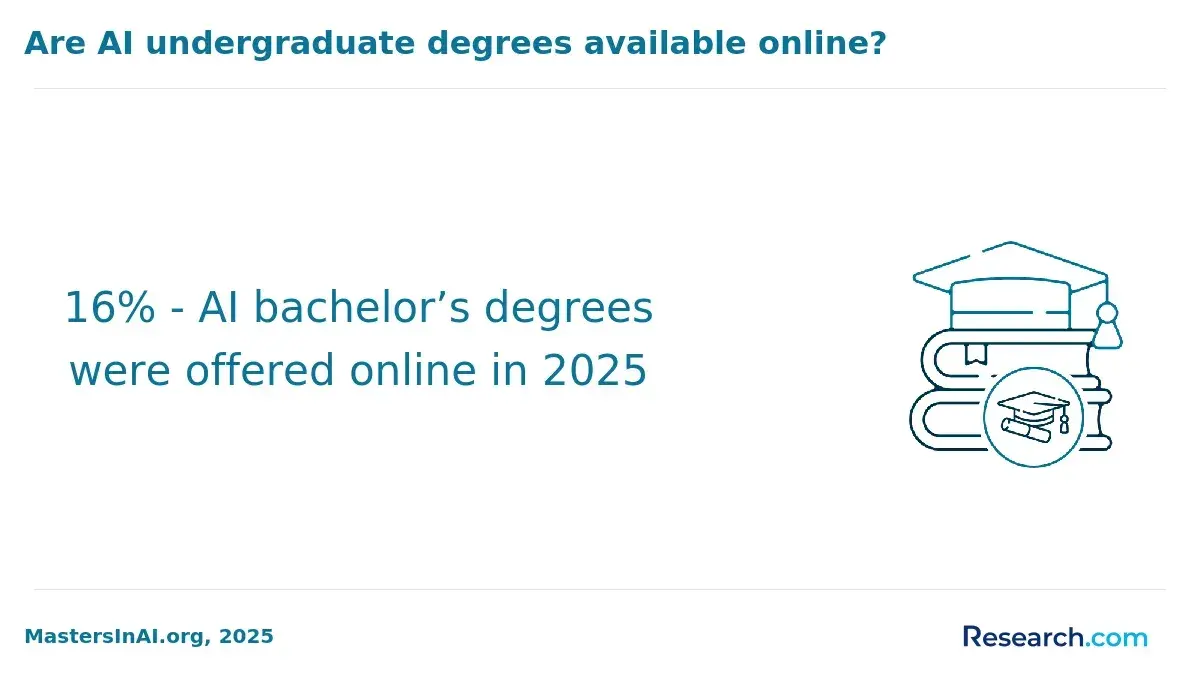
Online artificial intelligence degree programs offer flexibility and accessibility that often surpass on-campus options, making them ideal for beginners without coding experience. According to the National Center for Education Statistics (NCES), most U.S. undergraduates have taken at least one distance-education course, highlighting the mainstream appeal of online and hybrid learning formats. These programs typically feature beginner-friendly curricula with interactive platforms and self-paced modules that gradually build coding skills alongside core AI concepts.
On-campus programs provide more immediate access to faculty, peer collaboration, and hands-on lab experiences, benefiting students who thrive in structured environments and value direct mentorship. However, these programs often presume prior coding knowledge, which can be challenging for newcomers.
Many online artificial intelligence degrees include preparatory programming courses, often in languages like Python, targeted at learners without technical backgrounds. They also offer virtual tutoring, peer forums, asynchronous lectures, and coding sandbox environments to replicate interactive practice remotely.
When choosing between formats, students should consider factors such as learning style, time availability, and need for personal interaction. Beginners seeking flexibility and gradual skill development might prefer online programs, while those wanting immersive campus resources could select traditional options. Both approaches can succeed if the curriculum supports entry-level learners with adequate resources.
How long do AI degrees take and what do they cost?
AI degree programs usually span two to four years, depending on the credential level. An associate degree or diploma can be earned in about two years, while bachelor's degrees often require four years of full-time study. Master's degrees typically add one to two years beyond a bachelor's. Some programs include introductory courses in programming and math for students with no coding background, which may extend the timeline slightly.
Costs vary widely by institution type. Public four-year colleges in the U.S. have an average in-state tuition of around $11,610 per year, based on College Board 2024-25 data. A full bachelor's degree may total $40,000 to $60,000 in tuition at public universities, and private institutions often charge twice as much. Certificates and shorter AI courses from community colleges or online platforms are more affordable, ranging from several hundred to a few thousand dollars and completed within months.
These affordable options suit career switchers seeking foundational knowledge without a long-term commitment, whereas full degrees offer comprehensive theoretical training and stronger employer recognition. Additional costs such as textbooks, software, and living expenses can increase total study costs by 20-30%. Financial aid, scholarships, and employer tuition assistance can help offset tuition fees. Comparing program duration and cost ensures better alignment of education investments with career goals.
What AI jobs can you get without strong coding skills after graduation?
Graduates with an artificial intelligence degree who may lack strong coding skills can still access various career paths that leverage AI without deep programming expertise. Key roles include AI product managers, who coordinate development teams and align AI initiatives with business goals, requiring understanding AI capabilities rather than building models.
Other prominent roles emphasize AI ethics and compliance, focusing on ensuring AI systems follow legal and ethical standards. These positions rely on analytical skills and AI knowledge but involve minimal coding. Risk analysts in AI-driven fields also assess the impacts of algorithms, managing operational risks linked to AI implementations.
Specialists in user experience (UX) design concentrate on crafting interfaces that complement AI functionality. Their focus on front-end user interaction reduces the need for coding expertise. Similarly, data consultants interpret AI outputs to provide actionable business insights, translating complex data without extensive programming.
According to the World Economic Forum Future of Jobs Report 2025, AI and machine learning specialists are rapidly growing roles. However, complementary careers in product management, risk, compliance, and UX, which utilize AI tools, also show significant growth. This trend emphasizes that strong coding skills are not mandatory for meaningful AI careers.
Graduates should prioritize developing domain-specific knowledge, analytical abilities, and familiarity with user-friendly AI tools to enhance job prospects in these fields.
What salaries and job outlook can AI graduates expect in the U.S. market?
Graduates from artificial intelligence degree programs enjoy strong job prospects and competitive salaries in the U.S. labor market. According to the U.S. Bureau of Labor Statistics, employment of data scientists-an important AI-related role-is expected to grow 36% between 2024 and 2034, significantly outpacing the average for all occupations. This reflects high demand for AI skills, even for those without advanced coding expertise.
Entry-level jobs for graduates without coding experience typically include AI project coordinators, data annotators, AI trainers, or technical sales specialists, with salaries ranging from $60,000 to $85,000 depending on location and employer. With additional experience and technical training, professionals can advance to roles such as data analyst or junior machine learning engineer, with salaries between $90,000 and $120,000.
Employers increasingly value candidates who blend domain knowledge with AI literacy, creating opportunities in sectors like healthcare, finance, marketing, and manufacturing. Roles focusing on AI ethics, user experience, or implementation support often require less programming skill. Earning certifications related to AI tools and data frameworks can help close skills gaps.
Projected job growth and median wages show the value of artificial intelligence education in the U.S. market. Graduates should target roles that emphasize interdisciplinary strength and real-world AI applications to capitalize on rising industry demand.
Other Things You Should Know About Artificial Intelligence
Most programs require basic college algebra and introductory statistics, and some ask for a placement score or prior coursework in pre-calculus. Many 2027 AI degrees for non-coders also include a math or analytics bridge course during the first term before students begin machine learning and data analysis classes.
In 2027, AI degree programs for non-coders often require capstone projects that focus on designing AI-driven solutions using visual programming tools or AI platforms like IBM Watson without manual coding. These projects aim to showcase practical applications of AI concepts learned during the program.
Data preprocessing is a critical skill emphasized in artificial intelligence programs, even for beginners. It involves cleaning and organizing raw data to improve its quality before feeding it into AI algorithms. Learning basic data preprocessing techniques equips students with practical skills that improve model accuracy and performance, which is essential regardless of coding experience.
Admission requirements typically include a high school diploma or equivalent, a personal statement, and basic math proficiency. Some programs may require an entrance exam. These criteria ensure students are prepared for the non-coding focus of the AI degree.
References
- B.Sc. in Artificial Intelligence https://www.studyinpoland.pl/en/programme
- AI for non-programmers: https://arxiv.org/html/2403.05547v1
- AI for Absolute Beginners: No Coding Required https://reviewnprep.com/blog/ai-for-absolute-beginners-no-coding-required/
- AI jobs for non-programmers | edX https://www.edx.org/resources/ai-jobs-for-non-programmers
- AI Prerequisites https://www.nobledesktop.com/learn/ai/prerequisites
- Online vs On-Campus Artificial Intelligence Degrees: Which Is Better? https://hakia.com/degrees/artificial-intelligence/online-vs-campus/
- Top AI Certifications for 2026: A Guide to Advancing Your Tech Career | DataCamp https://www.datacamp.com/blog/top-ai-certifications
- Step-by-step blueprint to mastering AI as a non-tech professional https://www.mygreatlearning.com/blog/master-ai-without-coding/
- AI Master’s Without a CS Degree: A Visual Roadmap https://aidegreeprograms.org/resources/ai-masters-without-cs-degree-map/
- AI Certification – AI Certification Programs Online https://aidegreeguide.com/ai-certification/