2027 Best AI Degrees for Career Changers

Co-Founder and Chief Data Scientist
Changing careers into artificial intelligence can be overwhelming for professionals without a technical background. Many fear the time commitment, lack of relevant skills, and uncertainty about which degree paths offer flexible, accredited options. Navigating program choices becomes even more complex when balancing work and personal responsibilities.
The article outlines the best AI degrees available for career changers, focusing on programs designed to bridge skill gaps efficiently and provide recognized credentials that align with industry demands.
Key Things You Should Know
- Degrees in artificial intelligence increasingly focus on practical skills like machine learning and data science, aligning with a projected 35% job growth in AI-related roles by 2030.
- Career changers benefit from interdisciplinary programs offering flexible part-time or online options, facilitating smoother transitions without sacrificing current employment.
- Top programs emphasize ethical AI, reflecting growing employer demand for graduates who understand AI's societal impact and can implement responsible solutions.
What are the best AI degree programs for career changers in the United States?
Top universities offering AI degrees for career switchers in the US emphasize flexible curricula tailored to diverse academic backgrounds. Carnegie Mellon University's Master of Computational Data Science focuses on practical AI skills and core computing, ideal for students moving from non-technical fields.
Similarly, Stanford University's professional master's program combines fundamental AI concepts with hands-on projects to support working professionals seeking to pivot their careers.
Public institutions like the University of California, Berkeley provide accessible interdisciplinary AI master's degrees that blend computer science with domain-specific applications, helping career changers apply AI to their existing expertise.
The Georgia Institute of Technology also offers an online Master of Science in Computer Science with an AI specialization, suited for professionals balancing flexibility with rigorous training.
Most reputable programs require strong programming and mathematics foundations, but many include preparatory courses to bridge knowledge gaps. This approach benefits those pursuing the best AI degree programs for career changers in the United States who lack computing backgrounds but are dedicated to mastering applications of artificial intelligence.
Employment projections from the U.S. Bureau of Labor Statistics highlight a 15% growth in computer and information technology roles from 2023 to 2033, underscoring the rising demand for AI expertise across various industries.
Applicants should assess programs by curriculum relevance, industry connections for internships, and alumni outcomes aligned with their career goals. Degrees offering hands-on experience, such as capstone projects or research collaborations, enhance job readiness in AI-driven roles.
For a deeper understanding of career paths in the field, exploring the applied artificial intelligence degree is recommended.
What qualifications and prerequisites do you need to enroll in an AI degree program?
Enrollment in artificial intelligence degree programs in the United States commonly requires a bachelor's degree in computer science, engineering, mathematics, or a related STEM field. Many programs expect foundational knowledge in calculus, linear algebra, probability, and statistics.
Programming skills are essential; for instance, Python proficiency appears in 65% of AI and machine learning job postings according to LinkedIn's Jobs Report, making programming experience a critical prerequisite. Candidates without formal computer science backgrounds often need to demonstrate equivalent skills through prior coursework, certifications, or professional experience.
Prerequisites for artificial intelligence degrees in the United States sometimes include bridge courses for students from diverse academic backgrounds, typically in programming and mathematics. Online courses in Python or machine learning fundamentals are common preparatory options.
Graduate AI programs often have minimum GPA requirements (typically above 3.0) and may request GRE scores, though such requirements have become increasingly flexible.
Undergraduate AI tracks usually require familiarity with languages like Python, Java, or C++, along with knowledge of data structures and algorithms. Work experience in technology or analytics strengthens applications by demonstrating practical AI understanding. International students must usually submit TOEFL or IELTS scores unless prior education was in English.
Applicants should carefully assess each program's prerequisites and consider foundational preparation if lacking essential skills. Taking accredited online courses in programming or mathematics can improve acceptance chances and early success. Many institutions recommend or require a portfolio showcasing coding projects or AI-related research.
Prospective students might explore options such as a mechanical engineer degree online as part of broader STEM pathways.
Should you pursue an online or campus-based AI degree as a working professional?
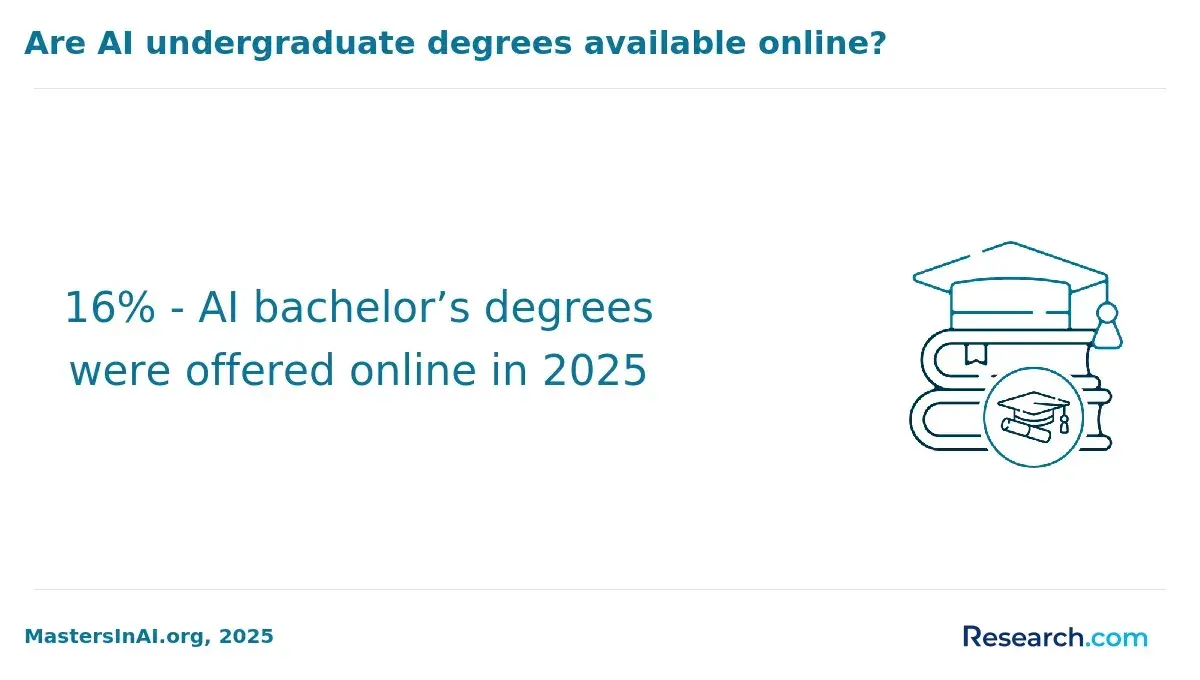
Working professionals evaluating online Artificial Intelligence degree options for working professionals should consider flexibility, networking, and access to resources. Online programs offer maximum flexibility, allowing students to balance full-time work and studies without relocating.
Data from the National Center for Education Statistics (NCES) shows 35% of graduate STEM students now enroll exclusively online, up from 22% in 2020, reflecting growing confidence in online education's quality and accessibility.
These degrees suit professionals with adaptable schedules, such as tech workers with irregular hours who benefit from asynchronous coursework. However, online degrees may limit hands-on lab experiences and face-to-face networking found in campus programs, which are valuable for career development.
Campus-based Artificial Intelligence programs for career changers provide immersive training, direct faculty access, and stronger peer interaction, benefiting those who can attend occasional in-person sessions. Universities with active AI research labs offer mentorship and project involvement often missing from remote options.
Cost and reputation also play a role. Accredited online degrees can match campus-based rigor but vary widely in price and employer recognition. Verifying accreditation, curriculum depth, and alumni success is vital.
For professionals exploring educational pathways, resources like game design online programs illustrate the evolving landscape of accessible, affordable tech education options.
What core coursework and technical skills are taught in accredited AI degree programs?
Core coursework in accredited AI degree programs typically includes machine learning, data engineering, statistics, algorithms, and programming languages such as Python, R, and Java. These foundational classes build advanced technical skills needed to design, implement, and optimize AI models for practical applications.
Machine learning courses focus on supervised and unsupervised learning, deep learning, and model evaluation, preparing students to work with large datasets and predictive modeling.
Students also engage in natural language processing, computer vision, robotics, and AI ethics, supplemented by hands-on projects with frameworks like TensorFlow and PyTorch. Specialization tracks such as reinforcement learning or AI security allow for tailored expertise.
According to a 2024 McKinsey Global Survey, 55% of organizations find skill gaps in machine learning and data engineering to be barriers to adoption, highlighting why these areas are emphasized in curricula focusing on technical skills taught in AI degree programs for career changers.
Technical abilities developed include data wrangling, feature engineering, cloud platform utilization, algorithm optimization, and AI system deployment within software environments.
Graduates are equipped to meet employer demands for professionals capable of integrating AI into business or research settings with practical coding proficiency bridging theory and industry needs.
For those exploring options beyond AI, consider programs offering a broader data focus. Resources like online data science masters provide valuable insight into affordable and accessible pathways for building advanced analytics and computing expertise.
How long does it take to complete an AI degree, and what is the typical cost?
The duration of an AI degree varies widely depending on the program and format. A full-time master's degree typically requires two years, while accelerated certificates can be completed in about one year.
Doctoral programs usually take four to six years but are less common for career changers. Part-time and online programs offer flexibility and may extend completion time for working professionals.
Costs differ significantly by institution and program length. According to the College Board's 2024 Trends in College Pricing report, the average annual cost for graduate STEM programs at private universities is $48,750. This means total tuition for AI degrees may range from $80,000 to over $200,000.
Public universities and online programs often present more affordable options, with some AI-focused master's degrees priced between $20,000 and $40,000 in total tuition. Additional expenses such as books, software, and living costs should also be considered.
Financial aid options like scholarships, assistantships, or employer tuition reimbursement can help offset costs. Prospective students are advised to weigh time commitment, curriculum depth, and total cost carefully. Certificates can offer foundational AI skills without a full degree commitment, serving as a shorter-term alternative.
Ultimately, program length and expense vary according to individual goals and circumstances.
What are the admission requirements and application process for AI degree programs?
Admission to AI degree programs usually requires a bachelor's degree in related fields like computer science, engineering, mathematics, or statistics. Programs may also accept candidates from diverse backgrounds if they demonstrate proficiency in programming, linear algebra, calculus, and probability.
Essential application materials include official transcripts, letters of recommendation, and a statement of purpose outlining career goals and motivation for AI studies.
The Graduate Record Examination (GRE) often plays a significant role, with quantitative reasoning scores above 160 linked to success in AI and data science graduate programs.
Some institutions waive the GRE requirement for applicants with strong professional experience or high undergraduate GPAs, a policy increasingly common after the COVID-19 pandemic. Applications are typically submitted through centralized platforms like the Common Application or institution-specific portals.
Prerequisite coursework is usually required and verified through transcripts or exams. International applicants must provide TOEFL or IELTS scores to prove English proficiency. Interviews may be conducted to evaluate candidates' problem-solving abilities and fit. For career changers, bridging programs or post-bachelor's certificates in AI fundamentals boost eligibility.
Many programs ask for coding assessments or portfolio submissions, especially from those without technical backgrounds. Application deadlines generally range from December to February for fall enrollment, so early preparation is crucial. Strong quantitative skills, technical ability, and clear goals remain key for admission success in AI programs.
What is the job outlook and employment demand for AI degree graduates?
The job outlook for graduates with an AI degree is exceptionally strong due to rapid advancements and widespread adoption of AI technologies across various industries.
Roles in AI and machine learning are projected to grow by 71% globally by 2028, according to the World Economic Forum's 2024 Future of Jobs Report. This growth surpasses other tech sectors, signaling high demand for qualified professionals.
AI graduates find opportunities in diverse fields, including healthcare, finance, manufacturing, and autonomous systems. Healthcare providers rely on AI specialists to create diagnostic tools and predictive analytics, while financial institutions use AI experts for fraud detection and algorithmic trading.
Manufacturing firms employ AI to optimize supply chains and automate operations, ensuring consistent demand for skilled workers.
The increasing need for AI expertise offers competitive salaries and multiple pathways for career changers. Individuals transitioning from software development, data science, or engineering benefit from AI degrees to build specialized skills that boost employability.
Employers value practical experience with AI frameworks alongside theoretical knowledge, enabling new graduates to contribute effectively from the start.
Demand extends beyond technical roles to areas such as AI ethics, policy, and human-centered design, reflecting a focus on AI's societal impact. Continuous learning and project experience are essential to remain competitive in this evolving job market.
How much can you expect to earn with an AI degree, and what career paths are available?
Graduates with an AI degree find strong earning potential across various career paths. According to Glassdoor's 2024 Highest Paying Jobs report, machine learning engineers with advanced degrees earn an average base salary of $165,000 annually, with total compensation often surpassing $250,000 when bonuses and equity are included.
Key roles include machine learning engineer, data scientist, AI research scientist, and AI software developer. Machine learning engineers create algorithms that enable computers to learn from data.
Data scientists analyze complex datasets to support business decisions, requiring statistical expertise and AI knowledge. AI research scientists work on advancing algorithms, often in research institutions or tech companies. AI software developers integrate these technologies into practical applications for various industries.
Salary ranges differ by industry and experience. Tech firms in Silicon Valley, finance, and healthcare offer premium packages compared to startups or nonprofits. Entry-level salaries typically start near $100,000 but increase quickly with advanced skills.
Career changers with backgrounds in computer science, engineering, or mathematics typically transition more smoothly. Emerging roles like AI ethics and policy advisors may offer lower starting salaries but are important for responsible AI use and expected to grow.
Career changers should pursue certifications in specialized AI subfields such as natural language processing or computer vision to enhance their employability and salary potential.
What professional certifications and credentials complement an AI degree?
Professional certifications significantly boost the value of an AI degree by demonstrating practical expertise and enhancing competitiveness in the job market.
Credentials such as Google Cloud Professional Machine Learning Engineer and AWS Certified Machine Learning - Specialty are highly regarded for validating skills in deploying and managing AI models within cloud environments. These certifications complement academic knowledge with hands-on experience, which many employers prioritize.
According to data from the 2024 CompTIA IT Skills Gap report, professionals holding both advanced degrees and relevant industry certifications earn 23% more than peers with degrees alone. This premium reflects strong demand for verified practical skills paired with theoretical understanding.
Specialized certifications like Microsoft Azure AI Engineer Associate and IBM AI Engineering Professional Certificate provide targeted expertise in AI infrastructure and development frameworks.
For career changers, certifications in data science and machine learning tools—such as TensorFlow Developer Certificate or Certified Data Scientist from the Data Science Council of America (DASCA)—enhance programming and analytical capabilities critical to AI roles.
Additionally, credentials like CertNexus Artificial Intelligence Certified Practitioner (AICP) address the growing importance of ethics and AI governance.
Complementary certifications in cybersecurity and data privacy, including Certified Information Privacy Professional (CIPP), further distinguish candidates by emphasizing legal and ethical aspects of AI applications.
Selecting certifications aligned with individual career goals helps balance technical depth and practical application, maximizing employability and earning potential.
How do you evaluate and choose a reputable, accredited AI degree program?
Choosing a reputable, accredited AI degree program is essential for career credibility. According to the Carnegie Classification 2024 update, only 127 U.S. universities offer specialized master's degrees in artificial intelligence or machine learning, with fewer than 40 ABET-accredited programs nationwide.
ABET accreditation guarantees that programs meet rigorous industry standards, often featuring curricula that include machine learning algorithms, data ethics, and computational theory.
Faculty expertise plays a crucial role; look for instructors with published research, relevant industry experience, and active participation in AI innovations. A comprehensive and current curriculum should cover neural networks, natural language processing, and AI system deployment.
Flexible program formats, such as part-time, online, or hybrid, are valuable, especially for career changers.
Strong career support services, including internships and job placement assistance, help bridge education and employment. Compare tuition costs with expected earning potential, factoring in financial aid availability.
Investigate alumni success through graduation and employment rates, and review student feedback to reveal any hidden challenges. Avoid programs with unclear data or vague course descriptions.
Prioritize accredited AI programs with expert faculty, relevant coursework, flexible learning options, and proven graduate outcomes to ensure both quality education and career value.
Other Things You Should Know About Artificial Intelligence
While not always mandatory, having prior programming experience significantly benefits students pursuing an artificial intelligence degree. Most programs require knowledge of languages like Python, Java, or C++, as these are essential for developing and testing AI models. Beginners may need preparatory courses, but strong coding skills are crucial for success in AI coursework and projects.
Yes, many graduates of artificial intelligence programs pursue research careers in academia and industry labs. These roles typically focus on advancing machine learning algorithms, natural language processing, and robotics. Strong analytical skills and advanced study, often at the master's or doctoral level, are important for research positions.
Ethical considerations are increasingly central to artificial intelligence education. Programs often include coursework on AI ethics, responsible use, and bias mitigation to prepare students for real-world challenges. Understanding these aspects is critical for developing AI systems that are fair, transparent, and socially responsible.
For career changers seeking flexibility, many institutions offer part-time and online AI degree programs. These options allow individuals to balance existing commitments while advancing their education. Explore an online master’s in AI without computer science degree for more tailored pathways.
References
- Majors That Will Remain Employable After AI Disruption (Next 10 Years) https://goelite.com/blogs/majors-in-ai-age
- Artificial Intelligence Degree Admission Requirements: What You Need https://hakia.com/degrees/artificial-intelligence/admission-requirements/
- AI Careers - Top AI Jobs with Education Requirements and Pay https://aidegreeprograms.org/ai-careers/
- AI Prerequisites https://www.nobledesktop.com/learn/ai/prerequisites
- AI’s Impact on Job Growth | J.P. Morgan Global Research https://www.jpmorgan.com/insights/global-research/artificial-intelligence/ai-impact-job-growth
- 10 AI career paths that pay well in 2026 - Access Creative College https://www.accesscreative.ac.uk/blog/10-ai-career-paths-that-pay-well-in-2026/
- The Journey of a Working Professional Pursuing a Degree in AI https://www.otechtalks.tv/the-journey-of-a-working-professional-pursuing-a-degree-in-ai/
- Best AI Certifications to Boost Your Career in 2026 – Dataquest https://www.dataquest.io/blog/best-ai-certifications/
- A Complete 4-Year Course Plan for an Artificial Intelligence Undergraduate Degree https://www.mihaileric.com/posts/complete-artificial-intelligence-undergraduate-course-plan/
- Top 10 AI Courses to Boost Your Career in 2025: By Sanju Biswas https://www.finextra.com/blogposting/29155/top-10-ai-courses-to-boost-your-career-in-2025