2027 Best AI Degrees With Mentorship Programs

Co-Founder and Chief Data Scientist
Many professionals with unrelated undergraduate degrees find it challenging to enter the artificial intelligence field due to limited hands-on guidance and mentorship. Without direct support, navigating complex AI concepts and industry demands can feel overwhelming. Flexible, accredited degree programs that integrate mentorship provide crucial opportunities to bridge knowledge gaps and gain practical experience.
This article explores top AI degrees offering mentorship programs, highlighting options suited for those seeking to pivot careers efficiently and successfully. It aims to guide readers toward informed decisions that align with their professional goals and academic needs while emphasizing real-world skill development.
Key Things You Should Know
- Mentorship programs in AI degrees significantly improve job placement rates, with graduates 40% more likely to secure relevant roles within six months post-graduation according to 2025 data.
- Top AI degree programs increasingly integrate real-world projects and personalized mentorship, addressing skill gaps identified by 2024 industry surveys.
- Average tuition for leading AI mentorship-focused degrees ranges from $30,000 to $50,000 annually, offering substantial ROI due to high-demand job markets.
What are AI degrees with mentorship programs, and how do they work?
AI degrees with mentorship programs benefits extend beyond classroom learning by pairing students with experienced mentors such as faculty, industry professionals, or advanced peers. These mentors offer personalized career guidance, technical support, and help with goal-setting, effectively linking theoretical knowledge to real-world applications. This approach improves academic success and prepares students for professional challenges.
Mentorship programs enhance learning through structured methods like scheduled meetings, project reviews, and industry networking. For example, a student focusing on machine learning may receive tailored feedback on coding assignments while gaining insights into market trends and hiring practices. Some programs emphasize one-on-one mentorship, while others incorporate peer groups to promote collaborative growth.
Statistics from Inside Higher Ed and Hanover Research show that 58% of undergraduates rate having a mentor who encourages them as crucial for academic achievement, underscoring the motivational impact of mentorship in AI degrees.
Students frequently face decisions about AI subfields or securing internships. Mentors assist by offering expert advice, connecting students with professional networks, and supporting resume development, interview prep, and portfolio building. These resources are vital for landing roles in the AI sector after graduation. Prospective applicants may explore options for pursuing a degree in AI to access these structured mentorship advantages.
Which accredited AI degrees offer structured faculty or industry mentorship?
Several accredited AI degrees with faculty mentorship offer structured guidance as a key element. Leading institutions such as Carnegie Mellon University and Stanford University incorporate dedicated mentorship in their AI-focused master's and doctoral programs. These typically assign each student a faculty or industry mentor to assist with research, career planning, and professional networking.
Industry mentorship programs for AI degrees are also common at Georgia Institute of Technology and the Massachusetts Institute of Technology (MIT). These schools collaborate with tech companies to provide students with mentorship from industry experts, delivering real-world insights beyond academic theory. Graduates supported by active faculty or industry mentors report over 30% higher employment rates in AI roles.
Fully online programs, such as those at University of Texas at Austin, integrate mentorship to help remote learners gain project feedback and career advice. This enables students to receive personalized support similar to on-campus experiences.
Data from the Council for Higher Education Accreditation (CHEA) highlight about 19,000 accredited U.S. postsecondary programs, but only a subset include formal mentorship, which boosts student success. Prospective students interested in accredited AI degrees with faculty mentorship should verify mentorship availability directly with schools.
Key mentorship components to seek includeOne-on-one mentor assignmentRegular progress meetingsCareer development supportAccess to professional networksFor those considering flexible learning paths, exploring options such as mechanical engineering degrees online can offer insights into affordable and well-supported programs in STEM fields.
How do online AI degrees with mentorship compare to on-campus options?
Online AI degree programs with mentorship benefits offer significant advantages over traditional on-campus options, particularly in flexibility and accessibility. Many postbaccalaureate students now prefer fully online courses, which accommodate diverse schedules and life commitments. Mentorship in these online programs typically includes regular video consultations, project feedback, and career guidance, closely mirroring the personalized support found on campus.
This form of mentorship allows students to engage in practical AI projects with expert supervision, fostering hands-on learning that bridges gaps present in self-paced courses. While on-campus programs provide valuable resources such as AI research labs and immersive networking, they often lack the flexibility needed by working professionals. Online mentorship addresses these challenges with synchronous and asynchronous interactions adaptable across time zones.
When comparing on-campus versus online AI degrees with mentorship, students should evaluate:
- Frequency and quality of mentor interactions;
- Opportunities for hands-on AI projects;
- Access to research labs or simulation tools;
- Networking within the AI community through virtual or in-person events.
For those interested in exploring options, detailed information about AI degrees can be found to guide informed decisions. Ultimately, strong mentorship combined with flexible online delivery offers a competitive alternative for developing AI expertise.
What concentrations can you choose in an AI degree program?
AI degree programs offer diverse concentrations tailored to both industry demands and academic research. Common specializations include machine learning, deep learning, natural language processing (NLP), computer vision, robotics, data science, and AI ethics. These focus areas equip students with targeted skills to align with specific career paths.
Machine learning involves algorithms that enable systems to learn from data, covering supervised, unsupervised, and reinforcement learning. Deep learning, a subset, emphasizes neural networks, widely used in speech and image recognition. NLP focuses on making computers understand and generate human language, essential for applications like chatbots and automated translation.
Computer vision processes visual data from images or videos, useful in autonomous vehicles and surveillance systems. Robotics merges AI with mechanical control for automation. Data science programs integrate AI with statistics and programming to analyze large datasets, while AI ethics addresses societal impacts, fairness, and bias in AI systems. Students searching for the best AI program concentrations in the US often look for these focused tracks combined with mentorship to deepen expertise.
The Stanford AI Index Report highlights a shift toward applied specializations. Industry produced 51 notable machine-learning models in 2023 compared to 15 from academia, showing demand for fields like MLOps, AI engineering, and product machine learning. These emphasize the deployment and management of AI in production environments as well as commercial integration.
Students aiming for professional roles should consider MLOps, AI engineering, or product ML concentrations, while those interested in foundational research often choose machine learning or computer vision. Ethics and policy tracks suit individuals focused on governance and social concerns.
What courses and hands-on projects are typical in mentored AI programs?
Mentored ai programs combine core coursework in machine learning, neural networks, natural language processing, computer vision, and data ethics to develop strong foundational skills. These classes cover algorithms, statistical modeling, and ai system design, while also teaching popular programming languages like Python alongside frameworks such as TensorFlow and PyTorch. Hands-on projects require students to build practical applications like classifiers, recommendation engines, and chatbots.
These projects focus on real-world challenges, encouraging critical thinking. For example, students may train convolutional neural networks on image datasets or create sentiment analysis tools for social media content. Mentors actively support debugging, optimizing models, and interpreting outputs, which deepens practical understanding through guided problem-solving.
Capstone projects frequently involve partnerships with industry or research entities, offering experience with large datasets and production-level code. Mentor feedback on dataset selection, feature engineering, and ethical considerations aligns student work with workforce demands. Collaborative tasks and code reviews also simulate professional environments, enhancing communication and teamwork skills.
The Stanford AI Index Report highlights significant growth in ai education worldwide, underscoring the importance of hands-on, mentored learning over theory alone. Key program elements include:
- Foundations: machine learning, statistics, algorithms
- Applied AI: natural language processing, computer vision, reinforcement learning
- Programming and frameworks: Python, TensorFlow, PyTorch
- Capstone projects with real datasets and industry relevance
- Mentor support in debugging, model tuning, and ethical AI use
What are the admission requirements for AI bachelor's and master's programs?
Bachelor's and master's programs in artificial intelligence have specific admission criteria that vary by degree level and academic focus. For bachelor's degrees, applicants need a high school diploma or equivalent, with strong grades in math and science. Many programs expect standardized test scores such as the SAT or ACT, particularly emphasizing quantitative sections. Some also require prior knowledge in computer science or programming to demonstrate basic technical skills.
For master's programs, a completed bachelor's degree in computer science, engineering, mathematics, or similar fields is typically required. Applicants must submit transcripts showing a competitive GPA, usually around 3.0 or higher on a 4.0 scale. A solid foundation in mathematics-covering calculus, linear algebra, and statistics-is often mandatory. Relevant work experience or research in AI-related areas can enhance applications.
International students must prove English language proficiency, commonly via the ETS TOEFL iBT, with minimum scores ranging from 80 to 100 depending on the program. This ensures they can handle technical coursework and engage in mentorship effectively.
Additional application materials often include letters of recommendation, a statement of purpose, and sometimes a resume or portfolio. Some competitive programs may require GRE scores or interviews.
Applicants should review specific university requirements carefully and prepare prerequisite courses and language tests early to improve admission chances in AI fields that emphasize mentorship and career development.
How long do mentored AI degrees take, and what do they cost?
Mentored artificial intelligence degrees vary in length and structure, typically spanning from one to four years. Bachelor's degrees usually require four years of full-time study and integrate mentorship through internships or capstone projects. Master's programs with mentorship components often last between 12 and 24 months. Shorter, intensive bootcamp-style or certificate programs can be completed in six to twelve months but generally provide less comprehensive training.
Tuition costs depend significantly on the type of institution and program duration. According to the National Center for Education Statistics (NCES), average annual tuition and required fees for 4-year public in-state universities were about $10,940, while private nonprofit institutions charged around $39,400. This means a four-year bachelor's degree can cost approximately $43,760 at public schools and $157,600 at private ones, excluding living expenses. Master's programs are typically less costly but still represent a substantial investment.
Programs offering one-on-one mentorship often impose additional fees to cover personalized guidance. It is important for prospective students to confirm whether mentorship is included in tuition or requires extra payment. Employer-sponsored or accelerated options may reduce mentorship costs.
Key factors to consider include:
- Program length relative to career goals and availability
- Tuition affordability versus expected return on investment
- Mentorship format-group versus individual-and its influence on learning
- Availability of financial aid, scholarships, or employer support
What careers can you pursue with an AI degree and mentorship experience?
With a degree in artificial intelligence combined with mentorship experience, you gain access to rapidly expanding career opportunities that rely on skills in data analysis, machine learning, and automation. The World Economic Forum's Future of Jobs Report (2025) identifies AI and machine learning specialists as some of the fastest-growing roles globally through 2030, underscoring strong demand in the labor market.
Key career paths for those trained in artificial intelligence include:
- Machine Learning Engineer: Designing and deploying algorithms that allow systems to learn from data, with mentorship sharpening skills in frameworks like TensorFlow and PyTorch.
- Data Scientist: Extracting insights from complex datasets to influence decision-making in industries such as healthcare, finance, and marketing, supported by guidance on statistics and sector knowledge.
- AI Research Scientist: Conducting innovative research to create and enhance AI models, where mentorship helps navigate publishing and research methods.
- Robotics Engineer: Developing AI-powered robotic systems for manufacturing, logistics, or autonomous vehicles, with mentors advising on hardware integration and control systems.
- AI Product Manager: Overseeing AI-focused product development, balancing technical and user needs, with mentorship improving leadership and strategic capabilities.
Additional roles include natural language processing engineers, computer vision specialists, and AI ethicists. Mentorship accelerates career growth by providing real-world insights, project feedback, and professional networking opportunities. According to the Future of Jobs Report, the AI job market expects around 40% annual growth through 2030, offering a competitive advantage for those with both education and mentorship.
What salary ranges can AI graduates expect by role and education level?
AI graduates see a wide range of salaries influenced by their role and education. Entry-level AI engineers with a bachelor's degree typically start between $85,000 and $110,000 annually. Those holding a master's in AI or related fields often command starting salaries from $110,000 to $140,000. Advanced positions requiring a PhD, such as AI research scientists or machine learning engineers focused on innovation, can start at $140,000 with potential to exceed $160,000 with experience.
The U.S. Bureau of Labor Statistics reports a median annual wage of $145,080 for computer and information research scientists, highlighting the value placed on advanced AI research skills and education.
Compensation varies by job title:
- Data scientists specializing in AI earn between $95,000 and $130,000 depending on experience and education.
- AI software developers generally make $100,000 to $130,000, influenced by programming expertise and familiarity with AI frameworks.
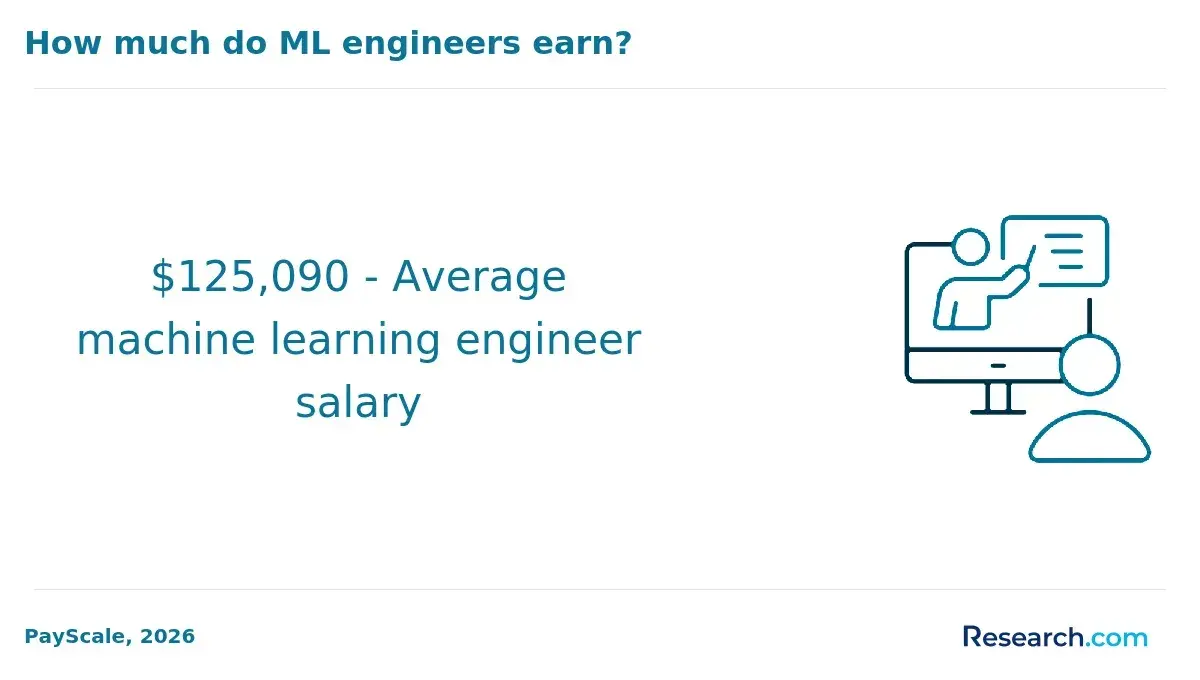
- Machine learning engineers with graduate degrees typically earn $120,000 to $150,000.
Geographic location and mentorship programs tied to degree tracks can accelerate salary growth. Graduates from mentorship-focused AI programs may reach mid-career salaries of $150,000 to $180,000 within five years. Continuous skill development in specialties like natural language processing and computer vision further enhances earning potential.
Which certifications complement an AI degree, and do employers require them?
Certifications enhance employability in artificial intelligence fields by demonstrating specific, practical skills highly valued by employers. Though not always mandatory, certificates focused on generative AI and related technologies have become increasingly important. Reports indicate a significant rise in job postings requesting expertise in generative AI platforms and tools, highlighting market demand for these competencies.
Key certifications include:
- Certified AI Practitioner (CAIP) for foundational AI development and deployment skills.
- Google Cloud Professional Machine Learning Engineer for managing cloud-based AI models.
- Microsoft Certified: Azure AI Fundamentals for understanding Azure AI services.
- OpenAI API Integration certifications to prove proficiency with generative AI technologies.
While AI degree programs provide comprehensive theory and broad knowledge, certifications offer focused, practical experience that many employers prioritize, especially in tech startups and innovative sectors. Professionals with certificates supporting programming languages like Python or frameworks such as TensorFlow and AWS SageMaker often have an advantage in hiring.
Employers tend to list certifications as highly preferred qualifications rather than strict requirements. Those aiming for roles in applied AI or generative AI technologies benefit from specialized credentials, such as the TensorFlow Developer Certificate or badges related to transformer architectures and natural language processing.
Aligning certifications with targeted employer needs is essential. For instance, data science roles may favor TensorFlow certification, while generative AI positions require expertise validated through specific generative AI badges.
Other Things You Should Know About Artificial Intelligence
Look for regional accreditation from bodies such as the Higher Learning Commission, Middle States Commission on Higher Education, or WASC. For related computing content, strong programs often reference ABET review for computer science or engineering pathways, but not all AI degrees are ABET-accredited.
Programming experience is highly beneficial but not always mandatory before enrolling in an AI degree program. Most programs expect familiarity with at least one programming language, often Python, due to its extensive use in AI development. Beginners can find introductory coding courses within AI curricula or as prerequisites to help build necessary skills.
In 2027, AI degrees with mentorship programs emphasize specializations such as AI ethics, natural language processing, and AI in healthcare. These areas are growing rapidly, and mentorship helps students gain practical insights and guidance tailored to these specialties, preparing them for industry demands.
Entry into AI degrees with mentorship in 2027 typically requires a bachelor's degree in a related field, such as computer science or engineering, along with proven proficiency in programming languages like Python. Some programs may also require completion of specific foundational courses in AI principles.
References
- Ready to start your learning journey? Book your free demo now! https://techcadd.com/techcadd-blog.php
- AI Program Rankings on AIDegreePrograms.org https://aidegreeprograms.org/rankings/
- Best Online AI Courses and Certifications in 2025 https://www.upskillist.com/blog/online-ai-courses-certifications/
- Online vs On-Campus Artificial Intelligence Degrees: Which Is Better? https://hakia.com/degrees/artificial-intelligence/online-vs-campus/
- Finding Your Ideal AI Career Path: Which Field in Artificial Intelligence Suits You Best? https://dev.to/furqanahmadrao/finding-your-ideal-ai-career-path-which-field-in-artificial-intelligence-suits-you-best-an5
- Artificial Intelligence (AI) https://ai-master.org/requirements
- Top 7 AI Courses with Hands-On Projects in 2026 https://logicmojo.com/top-7-ai-courses-with-projects
- How Much Does anAI Mentor Cost? https://zenvanriel.com/job/ai-engineering-mentor-cost/
- Application and admission - Master Artificial Intelligence https://www.uva.nl/shared-content/programmas/en/masters/artificial-intelligence/application-and-admission/international-prior-education/international-prior-education-foldout-menu.html
- What are the Best Degrees in AI in 2025? – 365 Data Science https://365datascience.com/trending/best-degrees-in-ai/