2027 AI Master's Degrees for Mathematicians and Statisticians

Co-Founder and Chief Data Scientist
Many professionals with backgrounds in mathematics or statistics encounter challenges when transitioning into artificial intelligence roles. The specialized nature of AI demands skills beyond traditional quantitative analysis, including programming, machine learning, and data engineering. Without targeted education, navigating this pivot can prove difficult and inefficient.
This article explores master's degree programs designed specifically to bridge that gap, emphasizing flexibility and accreditation. It aims to guide prospective students through available options that accommodate non-technical undergraduate degrees while preparing them for competitive careers in artificial intelligence.
Key Things You Should Know
- Master's degrees in artificial intelligence for mathematicians and statisticians saw a 25% enrollment increase from 2024 to 2025, reflecting growing industry demand for quantitative AI skills.
- Key curricula emphasize machine learning, statistical modeling, and ethical AI applications, blending theory with practical data science tools essential for AI roles.
- Graduates report median starting salaries near $110,000, with strong job placement in tech, finance, and healthcare sectors seeking advanced mathematical AI expertise.
What is an AI master's degree for mathematicians and statisticians?
An ai master's degree programs for mathematicians and statisticians leverage strong quantitative skills to prepare graduates for careers in artificial intelligence. These specialized programs focus on integrating mathematical theories, statistical models, and computational techniques to develop AI algorithms.
The curriculum often includes courses in machine learning, optimization, probability theory, data mining, and programming, emphasizing a deep mathematical foundation.
Advanced artificial intelligence studies for math and stats professionals enable a smooth transition into AI roles by enhancing analytical thinking and data interpretation skills. For instance, a statistician might concentrate on probabilistic modeling used in natural language processing, while a mathematician could design neural network architectures.
Such targeted training bridges theory with practical applications in healthcare, finance, and robotics.
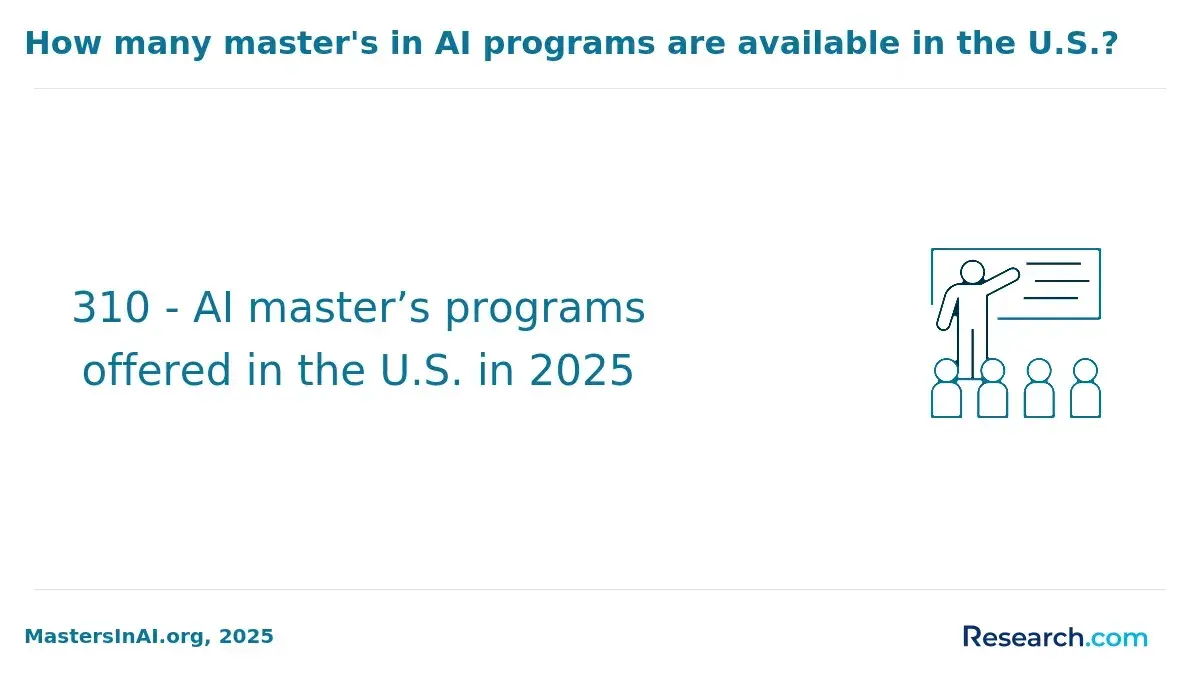
The number of U.S. master's-level AI programs grew from 393 to 480, according to the Stanford Institute for Human-Centered Artificial Intelligence AI Index 2024, indicating rising demand for professionals with this combined expertise. Prospective students should seek programs that offer hands-on projects, internships, and interdisciplinary collaboration to build technical and applied problem-solving skills.
Strong programming proficiency in Python and R is also crucial. Overall, these programs equip students with the rigor and experience needed for cutting-edge AI roles requiring advanced analytical capabilities.
For more insight on career pathways, explore AI degree resources.
Which AI master's programs best fit math and statistics backgrounds?
Master's programs designed for mathematicians and statisticians focusing on advanced AI degrees emphasize machine learning, probabilistic modeling, and data analytics. These programs build on strong quantitative backgrounds and highlight the theoretical foundations of artificial intelligence. Degrees such as "Data Science," "Machine Learning," or "Applied Mathematics with AI" integrate statistical methods with AI techniques to prepare students for this evolving field.
Key coursework typically includes:
- Statistical learning theory and inference
- Optimization and numerical methods
- Algorithmic complexity and data structures
- High-dimensional data analysis
- Probabilistic graphical models
Institutions like Carnegie Mellon University and Stanford University offer specialized tracks tailored to individuals pursuing AI master's programs for mathematicians and statisticians. These tracks deepen understanding of AI algorithms through rigorous mathematical and statistical lenses.
Some universities also provide joint degrees or certificates to complement existing math or statistics master's programs.
Demand in data science remains strong, with 36,152 master's degrees awarded nationally. The best advanced AI degrees for math and statistics graduates emphasize computational skills and practical AI applications alongside theory.
Prospective students should evaluate programs by faculty expertise, research labs, and industry partnerships that enable hands-on projects.
For a comprehensive view of top programs, consider exploring the top data science master's programs in the US. Graduates from these programs are well-prepared for careers in AI research, data analysis, and algorithm development.
How do you choose an accredited AI master's program in the U.S.?
Choosing one of the best accredited AI master's degrees in the United States involves verifying regional accreditation, which affects credit transfer and employer recognition. Look for programs endorsed by organizations like ABET or professional AI and computing bodies. Accreditation is not the sole indicator of quality; ensure the curriculum matches your career focus, whether in machine learning, data science, or AI ethics.
To evaluate program outcomes, tools such as the U.S. Department of Education's College Scorecard provide median earnings data four years after graduation. This aids comparison by financial return, highlighting schools that enhance career prospects.
Factors beyond accreditation and salary should influence your choice:
- Faculty expertise and relevant research areas
- Internships and industry partnerships offering practical AI experience
- Flexible formats including online or part-time options
- Graduation and retention rates reflecting program support
Request detailed syllabi and alumni results to assess rigor. For those interested in top U.S. programs for AI master's in mathematics and statistics, verify the inclusion of advanced quantitative methods and statistical learning. Consider location and financial aid to balance cost with career benefits.
To explore affordability alongside quality, review AI degrees for additional guidance.
What admissions requirements are common for math and stats applicants?
Most AI master's degrees in mathematics and statistics require a solid foundation in mathematics, statistics, and programming. Typical prerequisites for AI master's degrees in mathematics and statistics include coursework in linear algebra, probability, statistics, and calculus, along with proficiency in programming languages like Python or R. Experience with data structures and algorithms is also often expected.
Applicants usually submit transcripts from relevant quantitative fields. A bachelor's degree in mathematics, statistics, computer science, or engineering is standard. Many programs set minimum GPA requirements around 3.0 on a 4.0 scale.
Letters of recommendation from professors or professionals familiar with the candidate's quantitative skills and research potential are important, as is a statement of purpose outlining interest in AI and preparation for interdisciplinary work.
Standardized tests are less emphasized today. According to ETS GRE Program reports, many U.S. graduate programs, especially STEM-related ones, no longer require GRE scores. However, some master's programs still ask for GRE subject tests in mathematics or computer science if prerequisite coursework is insufficient.
Relevant work or research experience may sometimes substitute formal requirements.
Additional admissions steps can include coding challenges or interviews to evaluate problem-solving skills. International applicants generally must prove English proficiency through TOEFL or IELTS. Exploring related fields like cybersecurity degrees can also complement studies in AI.
Applicants should carefully verify specific admissions details to meet common admissions requirements for math and statistics graduate programs effectively.
What core courses and skills do AI master's programs typically require?
Master's programs in artificial intelligence for mathematicians and statisticians focus on a strong foundation in essential courses like machine learning, data mining, and statistical modeling. These build skills to analyze complex data and understand AI's algorithmic frameworks through mathematics-intensive subjects such as linear algebra, probability theory, and optimization.
Programming proficiency is critical, with Python being the top requested skill in AI job postings according to labor-market analytics from Lightcast (formerly Burning Glass). Python enables the implementation of AI algorithms and the use of prominent libraries like TensorFlow, PyTorch, and scikit-learn, making it indispensable.
Specialized courses often include natural language processing, computer vision, and deep learning. These prepare students to tackle diverse applications such as text analysis or image recognition. Hands-on practicums or capstone projects reinforce learning through real-world problem solving.
Key skills developed include:
- Programming languages, especially Python, and sometimes R or MATLAB
- Statistics for model validation, hypothesis testing, and uncertainty quantification
- Algorithm design focused on efficiency and scalability
- Data engineering skills for handling large datasets and cloud platforms
- Ethics and fairness in artificial intelligence to address bias and societal impact
Prospective students should target programs combining rigorous mathematical theory with practical coding exercises. This blend builds deep analytical reasoning and technical fluency sought by employers in AI research, development, and applied roles.
How do online AI master's programs compare with on-campus options?
Online AI master's programs offer unmatched flexibility, especially beneficial for working professionals and those balancing personal commitments. A significant number of graduate students now enroll fully online or in hybrid formats, showing a broad acceptance of remote graduate education according to NCES IPEDS Distance Education Enrollment data.
These programs rely on asynchronous lectures, virtual labs, and cloud-based coding platforms, enabling students to study at their own pace from any location. In contrast, on-campus programs provide more direct face-to-face interaction with faculty and peers, which may benefit those seeking immediate feedback and networking.
Prospective students should weigh key differences such as:
- Online programs use digital collaboration tools but may lack spontaneous discussions and instant instructor access seen on campus.
- On-campus settings often offer hands-on AI projects utilizing specialized hardware, although many online programs now provide remote access to computing clusters or GPUs.
- Online study saves time and eliminates commuting or relocation costs but requires strong self-motivation to manage coursework independently.
- Internships and research assistantships are more accessible locally on campus, while online students must proactively seek virtual or local opportunities.
For mathematicians and statisticians, rigorous quantitative coursework in online AI degrees is comparable to on-campus options. It is essential to review course delivery methods, faculty expertise, and student support services to ensure the program aligns with career goals.
How long do AI master's programs take, and what do they cost?
Master's programs in artificial intelligence designed for mathematicians and statisticians generally require one to two years of full-time study. Many U.S. universities offer flexible options, including part-time or online enrollment, which can extend completion times to three years or more based on individual schedules.
Specialized tracks like machine learning theory, data science, or robotics often increase program length due to extra coursework and projects.
The cost varies widely depending on institution type and residency. For public in-state graduate students, average annual tuition and fees run about $12,600, while public out-of-state students pay roughly $29,150. Private nonprofit institutions typically charge around $30,000 annually.
Over two years, tuition for public in-state programs might total approximately $25,200 compared to over $60,000 at private nonprofits.
When budgeting, consider delivery format as online programs may have lower base fees but sometimes add technology charges. Financial aid options like scholarships, assistantships, and employer sponsorship are common and help offset costs.
Part-time study reduces yearly tuition outlay but extends total expenses and program duration.
Highlights to consider:
- Full-time completion generally takes 1-2 years.
- Part-time or online formats increase flexibility and duration.
- Tuition ranges significantly by residency and school type.
- Additional living costs and fees can impact total expenses.
Evaluating these factors lets students balance time, costs, and career goals in the evolving field of artificial intelligence.
What careers can mathematicians and statisticians pursue after an AI master's?
Mathematicians and statisticians with a master's in artificial intelligence have diverse career opportunities across growing industries that demand AI skills. Common roles include data scientist, machine learning engineer, and AI research analyst, all of which rely on advanced mathematical modeling, statistical analysis, and algorithm development.
Data scientists analyze large data sets to extract insights, while machine learning engineers create algorithms enabling systems to learn adaptively.
Other in-demand positions are quantitative analysts in finance, who build predictive market models, and AI product managers who combine technical expertise with business strategy. Mathematicians can also work as operations researchers, optimizing logistics and resource allocation in sectors like manufacturing, healthcare, and transportation.
Job postings in the U.S. increasingly emphasize AI skills, with specialties such as natural language processing and computer vision driving demand. Strengthening programming skills in languages like Python and R, along with expertise in AI frameworks such as TensorFlow or PyTorch, adds significant value.
Additionally, familiarity with ethical AI use and cloud computing platforms enhances employability and performance in this evolving field.
Developing a foundational knowledge of AI ethical considerations and gaining hands-on experience with cloud services are essential steps to succeed and stay competitive in the AI job market.
What salary ranges can AI graduates with quantitative backgrounds expect?
Graduates with strong quantitative backgrounds in artificial intelligence typically secure competitive salaries reflecting their advanced technical skills. According to the U.S. Bureau of Labor Statistics, statisticians earned a median annual wage of $104,110, while computer and information research scientists, many of whom specialize in AI, had a median wage of $140,910.
Professionals with expertise in machine learning, data modeling, and algorithm development often exceed these figures.
Entry-level AI specialists holding master's degrees in quantitative fields generally start with salaries ranging from $90,000 to $110,000. Experienced professionals in sectors like finance, healthcare, and technology frequently earn between $130,000 and $160,000.
Those in leadership roles at major tech companies or research institutions can command salaries above $180,000.
Key factors impacting salary include:
- Proficiency in AI tools such as deep learning frameworks and statistical software
- Applying AI in sectors like autonomous systems, cybersecurity, or predictive analytics
- Geographic location, with tech hubs such as Silicon Valley and New York offering higher pay
- Additional skills in software and data engineering
Aligning practical AI skills with quantitative expertise is crucial for maximizing earning potential. Continuous learning beyond the master's level remains essential for reaching top-tier positions in a competitive job market.
Which certifications strengthen AI careers for mathematicians and statisticians?
Certifications significantly enhance AI careers for mathematicians and statisticians by validating both theoretical knowledge and practical skills. Leading cloud providers offer valuable credentials such as AWS Certified Machine Learning - Specialty, Google Professional Machine Learning Engineer, and Microsoft Certified: Azure AI Engineer Associate, which show expertise in designing and deploying AI solutions on scalable platforms.
Data science certifications like the Certified Analytics Professional (CAP) or SAS Certified Data Scientist help bridge the gap between theoretical statistics and applied analytics, improving job prospects in AI-related roles. The CompTIA IT Industry Outlook 2024 highlights AI/ML certifications and cloud-provider credentials as among the fastest-growing in tech job postings, emphasizing their high industry demand.
Certifications focusing on algorithmic rigor combined with practical machine learning workflows are especially beneficial. For instance, the TensorFlow Developer Certificate emphasizes deep learning and neural network implementation, complementing mathematical foundations.
Specialized credentials in areas such as natural language processing or computer vision also align well with industry-specific AI applications, increasing professional versatility.
- Cloud AI/ML certifications: AWS, Google Cloud, Microsoft Azure
- Data science and analytics certifications: CAP, SAS Data Scientist
- Framework-specific credentials: TensorFlow Developer Certificate
- Domain-specific AI certificates: NLP or computer vision specialization
These certifications validate hands-on skills, helping professionals transition from theory to applied AI and enhancing competitiveness in the growing AI job market.
Other Things You Should Know About Artificial Intelligence
Admission to a 2027 AI master's program for mathematicians and statisticians typically requires GRE scores. Some programs may also require a strong background in quantitative sections. Verify specific requirements with individual institutions to ensure compliance with their admission criteria.
Yes. Most 2027 AI master’s programs for mathematicians and statisticians require transcripts showing linear algebra, multivariable calculus, probability, and introductory statistics. Some also expect a first course in machine learning or optimization. Admissions committees use these courses to confirm readiness for graduate-level AI theory and methods.
A 2027 AI master's curriculum typically includes core subjects such as machine learning algorithms, data science techniques, advanced statistical modeling, and computational mathematics. These courses equip mathematics and statistics graduates with skills essential for AI-focused careers.
Graduates of 2027 AI master's degrees with a mathematics or statistics background can pursue roles such as data scientists, AI engineers, machine learning specialists, and quantitative analysts. These positions are found across industries such as finance, healthcare, technology, and academia, reflecting strong demand for their analytical skills.
References
- Introduction | MS in Statistics and Data Science | Department of Mathematics and Statistics https://www.unr.edu/math/graduate/ms-in-statistics-and-data-science-handbook/introduction
- Top College Degrees for Securing the Highest-Paying AI Jobs in 2026 https://www.investopedia.com/top-college-degrees-for-securing-the-highest-paying-ai-jobs-in-2026-11946777
- Applied Mathematics, Computing, and Machine Learning, Master of Arts (M.A.) https://www.stjohns.edu/academics/programs/applied-mathematics-computing-and-machine-learning-master-arts-ma
- AI & Mathematical Science Occupations: Timeline & Impact https://myjobvsai.com/jobs/mathematical-science-occupations-all-other
- M.SC. IN Artificial Intelligence https://put.poznan.pl/msc-artificial-intelligence
- 25 Best Master's in AI Programs - MastersInAI.org https://www.mastersinai.org/degrees/best-masters-in-artificial-intelligence/
- Maths Degree Entry Requirements UK https://www.uniadmissions.co.uk/application-guides/maths-entry-requirements/
- Mathematics for Machine Learning and Data Science Specialization https://www.deeplearning.ai/courses/mathematics-for-machine-learning-and-data-science-specialization/
- Masters Artificial Intelligence https://www.udacity.com/masters-artificial-intelligence
- Best AI Certifications to Boost Your Career in 2026 – Dataquest https://www.dataquest.io/blog/best-ai-certifications/