2027 AI Degree Curriculum Trends

Co-Founder and Chief Data Scientist
Many prospective graduate students face difficulty identifying degree programs that balance foundational knowledge with emerging technologies in ai. This challenge is especially critical for those switching from unrelated fields seeking relevant, up-to-date skills without lengthy prerequisites. As universities adapt, understanding the latest curriculum trends becomes essential to choosing programs that offer practical experience alongside theoretical grounding.
This article examines current ai degree curriculum developments and highlights flexible, accredited pathways that enable effective career transitions into the ai industry for diverse learners.
Key Things You Should Know
- By 2026, 70% of U.S. AI degree programs include ethics and bias mitigation courses, reflecting growing concerns around responsible AI development.
- Curricula increasingly prioritize hands-on AI applications, with over 65% incorporating real-world projects and industry partnerships for practical experience.
- Interdisciplinary integration is rising, as 58% of programs combine AI with healthcare, business, or robotics to meet expanding job market demands.
What types of artificial intelligence degrees and majors do U.S. colleges offer?
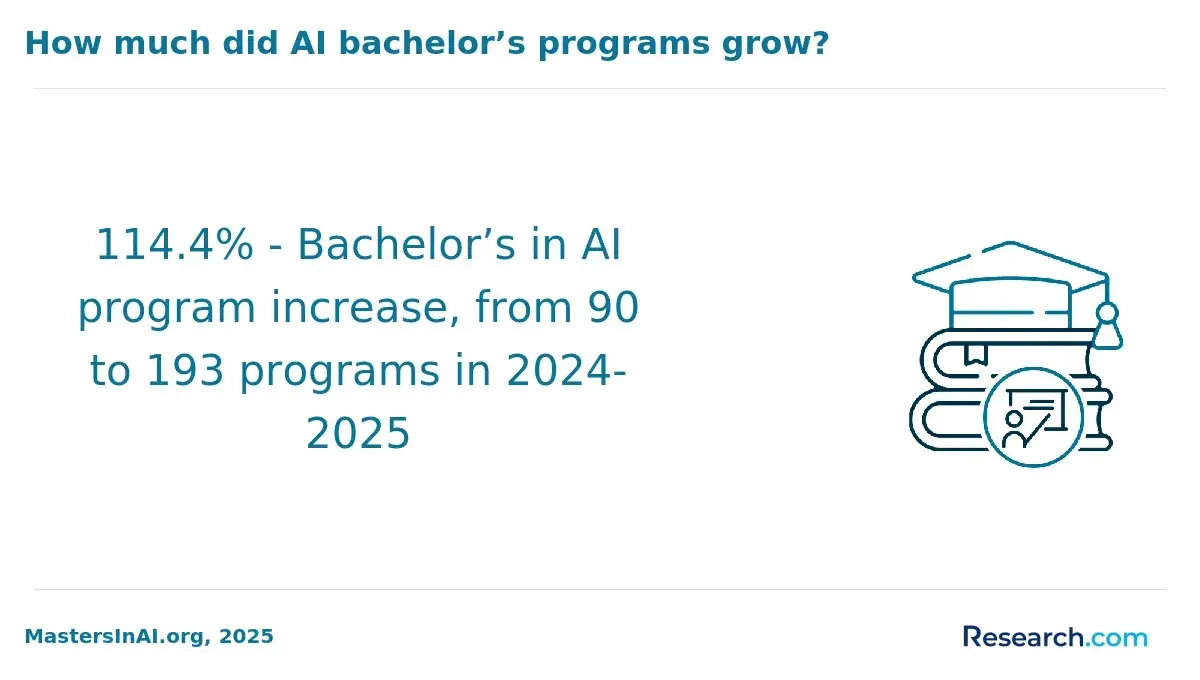
U.S. colleges offer a wide variety of ai degree programs in U.S. universities at both undergraduate and graduate levels. Bachelor's programs focused solely on artificial intelligence have grown by 114% in one year, jumping from 90 programs in 2024 to 193 in 2025, according to LeapScholar's 2026 report. These undergraduate majors typically cover foundational areas such as ai algorithms, machine learning, data science, and robotics. Popular choices include artificial intelligence, computer science with an AI concentration, data analytics, and cognitive science.
Graduate ai majors offered in the United States have expanded even more rapidly. Master's programs grew from 116 in 2022 to 310 in 2026, nearly tripling in number. These advanced programs emphasize specialized skills like natural language processing, computer vision, advanced machine learning, and ethical AI. Degrees vary, encompassing artificial intelligence, machine learning engineering, applied AI, and AI for business analytics.
Students often weigh pure technical majors against interdisciplinary programs combining AI with healthcare, finance, or cybersecurity. For instance, AI for healthcare applies machine learning to medical data, while cybersecurity-focused AI tackles threat detection algorithms. Reviewing course curricula is essential to align education with career goals. Programs with strong industry ties and research opportunities tend to offer better experiential learning and job placement.
For those seeking efficient pathways, a fast track computer science degree can be an effective option to enter the AI field sooner.
How do AI degree programs differ from computer science and data science pathways?
AI degree programs differ from computer science and data science pathways by focusing on designing, developing, and applying algorithms that simulate human cognition. Unlike computer science, which offers a broad foundation in software engineering, systems, and theory, AI curricula emphasize machine learning, neural networks, natural language processing, and robotics. In comparison to data science, which centers on data analysis, statistics, and visualization, AI degrees prioritize building models for autonomous decision-making and problem-solving. These distinctions highlight the key points of ai degree vs computer science curriculum differences.
Core AI courses commonly include deep learning, reinforcement learning, and computer vision, while computer science students might see these topics only as electives. Data science pathways focus more on statistical modeling, big data technologies, and data ethics, reflecting ai programs compared to data science pathways with less emphasis on AI architectures.
As of April 2026, 62 standalone AI majors have been identified in U.S. universities, reflecting growing demand for specialized AI education. Decision-makers should note that AI programs suit students targeting careers in AI research, autonomous systems, or specialized AI development, whereas computer science provides a broader tech base and data science supports roles focused on extracting insights from large datasets.
Some AI degrees also integrate ethics, human-computer interaction, and practical AI projects, offering flexibility not always found in other programs. Prospective students seeking affordable options may consider exploring online AI degrees that balance cost and comprehensive training.
What core courses and skills are taught in a typical AI curriculum?
Core courses in artificial intelligence programs in North America typically emphasize foundational skills in algorithms, programming, and data structures. Students gain proficiency in languages like Python, R, and Java, essential for building AI models and managing large datasets. Key topics include machine learning, covering supervised, unsupervised, and reinforcement learning, as well as deep learning with neural networks and advanced architectures like convolutional and recurrent networks.
Mathematics forms a critical base, with courses in linear algebra, calculus, probability, and statistics helping to understand algorithm mechanics and model optimization. Programs also cover natural language processing (NLP) for human-computer interaction and computer vision for image recognition. Ethics and AI governance address bias, fairness, and societal impact, reflecting growing concerns in the field.
Essential skills taught in AI degree programs in the US and Canada include data preprocessing, feature engineering, and model evaluation metrics. Hands-on experience with tools such as TensorFlow, PyTorch, and cloud computing platforms is common, alongside projects and labs. Electives often involve robotics, AI in healthcare, and AI-powered cybersecurity, expanding career pathways.
According to a 2025 Microsoft-backed analysis by Faculty Focus, the global AI education market reached $7.57 billion in 2025 and is projected to exceed $112 billion by 2034. This growth highlights the rising demand for expertise organized in modern AI degree programs. Students interested in specializing in security might explore an online cybersecurity degree to complement AI knowledge.
What are the admission requirements and prerequisites for AI bachelor's and master's programs?
Bachelor's programs in artificial intelligence typically expect applicants in the United States to have a strong foundation in mathematics, including calculus and linear algebra, along with programming skills in languages like Python or Java. Additional coursework in physics and statistics is often recommended. While some schools still consider SAT or ACT scores, many have adopted test-optional policies. Admission requirements for AI bachelor's programs in the United States are evolving to focus more on practical skills and relevant experience.
Master's programs usually require a bachelor's degree in computer science, engineering, mathematics, or related STEM fields. Applicants must demonstrate prior knowledge of algorithms, data structures, machine learning basics, and software development. GRE scores, letters of recommendation, and a statement of purpose outlining research interests or career goals in AI are commonly requested. Practical experience such as internships or projects has become increasingly important.
An industry-wide shift stresses hands-on learning: a recent policy report recommends increasing practical exposure from 25-30% to 40-75% of total study time. This means admissions committees may favor candidates with real-world projects and industry experience. Some programs may also require foundational AI courses or conditional classes upon admission. Part-time or online options often ask working professionals to provide proof of relevant expertise instead of traditional academic credentials.
Those exploring AI training jobs will find that strong practical skills and applied knowledge provide a significant advantage in today's competitive landscape. Further guidance is available at AI training jobs.
Prerequisites for master's degree in AI studies in North America vary by institution, so researching specific program details is essential for future applicants.
How do online artificial intelligence degrees compare to campus-based programs in quality and outcomes?
Online artificial intelligence degrees now rival campus-based programs in quality, benefiting from improved digital infrastructure and carefully designed curricula. Both formats cover essential topics such as machine learning, neural networks, and natural language processing, ensuring students gain foundational knowledge. However, campus programs typically offer more in-person lab experiences, collaboration, and networking opportunities vital for advanced AI projects.
Access to institutional resources significantly impacts educational outcomes. For instance, India's AICTE 2026 reform mandates AI coursework across engineering branches and grants students access to powerful GPUs like NVIDIA H100 at subsidized rates, emphasizing the value of hands-on computing resources. While such infrastructure is mostly available in well-funded campus environments, select online programs partnering with major cloud providers offer similar advantages.
Students should carefully assess the following factors:
- Availability of high-performance compute resources for training AI models.
- Hands-on group projects and internship prospects.
- Faculty expertise combined with curriculum updates driven by industry trends.
- Opportunities to engage in networking through events and research collaborations.
Online degrees often appeal to working professionals seeking flexibility and quicker completion times, though they demand proactive engagement in practical AI challenges. Campus programs remain attractive for immersive experiences offering peer and mentor interaction. Hybrid models are emerging to blend flexibility with essential hands-on AI learning, reflecting evolving educational practices.
How can students verify accreditation and program quality for AI degrees in the U.S.?
Students seeking reliable AI degrees in the U.S. should first verify institutional accreditation from recognized agencies such as the Accrediting Commission for Senior Colleges and Universities of the Western Association of Schools and Colleges (WASC) or the Higher Learning Commission (HLC). These regional accreditors confirm that schools meet rigorous educational quality standards. Additionally, program-specific certifications like the ABET Computing Accreditation Commission signal strong technical foundations.
Beyond formal accreditation, alignment with industry needs is crucial. Hiring and curriculum reports from 2025-2026 emphasize employer preferences for role-based AI certifications and enterprise-focused capstone projects. Programs with embedded AI governance, compliance, and risk management modules show responsiveness to critical ethical and regulatory issues, adding to program relevance.
Students can take practical steps to ensure quality:
- Confirm the institution's accreditation status on official databases.
- Check if the AI program offers recognized certifications, such as those from AIcerts or industry partners.
- Look for mandatory capstone projects addressing real-world challenges.
- Assess coursework coverage on AI governance and risk management.
- Seek insights from alumni and employers on graduate outcomes.
Following these verification steps helps students invest in AI degrees that combine academic rigor with employer expectations, enhancing career readiness in a competitive field.
How long do AI degree programs take to complete, and what do they cost?
AI degree programs typically span two to four years, based on the level and study format. Bachelor's degrees in AI or related fields like computer science with an AI focus usually require four years of full-time study. Master's degrees often take 18 to 24 months, with accelerated tracks for working professionals. Doctoral programs, emphasizing research, generally require three to six years or more.
Costs vary widely by institution type, residency, and program delivery. In-state tuition at public universities typically ranges from $10,000 to $20,000 annually, while out-of-state and private institutions can exceed $40,000. Online programs may offer flexible pricing, often charging between $500 and $2,000 per credit hour.
Financial aid and scholarships are essential for managing expenses. Students should explore funding opportunities aimed at AI and STEM fields. Partnerships between universities and tech companies sometimes provide scholarships and internships that reduce costs.
The surge in demand is highlighted by AcademicJobs' 2026 report, "AI Course Demand Explodes in Higher Ed," showing triple-digit enrollment growth. Many schools now offer accelerated pathways that allow faster degree completion without sacrificing depth.
Options such as part-time study, online learning, and certificates can complement or shorten degree timelines, tailored to career goals and lifestyle.
What entry-level and advanced career paths can an AI degree lead to?
An AI degree opens doors to various entry-level roles such as data analyst, machine learning engineer, AI software developer, and research assistant. These positions typically involve programming neural networks, evaluating AI system performance, and managing datasets in industries like healthcare and finance.
Advanced careers often require specialized expertise and focus, including roles like AI research scientist, deep learning engineer, AI ethics specialist, and AI product manager. These professionals design novel architectures, conduct pioneering research, ensure algorithmic fairness, and transform AI innovations into viable products. They are usually employed by academic institutions, tech companies, and government agencies.
Specializations extend to fields such as natural language processing, computer vision, robotics, and generative AI. By 2025, 86% of education organizations adopted generative AI-the highest across any industry, according to Microsoft and Faculty Focus. Graduates skilled in generative AI are in strong demand within edtech, personalized learning platforms, and content generation.
AI professionals are increasingly expected to blend technical skills with domain expertise. For example:
- Combining AI with cybersecurity leads to roles like AI security analyst.
- Understanding the ethical and legal landscape opens opportunities in policy advisory.
Gaining practical experience through internships or research projects is essential to stand out in today's competitive market.
What salary ranges and earning potential can graduates with AI degrees expect?
Graduates with AI degrees can expect starting salaries ranging from $85,000 to $120,000 annually, influenced by region, industry, and specific roles. Mid-career professionals often earn between $130,000 and $180,000, while senior-level positions, especially in tech hubs like Silicon Valley, New York, and Boston, exceed $200,000. Industries such as finance, healthcare, autonomous systems, robotics, and biotech offer some of the highest pay.
Salary differences largely depend on specialization. For instance, machine learning engineers and natural language processing experts tend to earn more than general data analysts. Skills in deploying AI models, managing large datasets, and ensuring ethical AI use also increase earning potential. Advanced certifications or a master's degree can boost salaries by $15,000 to $30,000.
Emerging trends highlight AI's role in education. According to an EDUCAUSE survey cited in X-Pilot's trends report, 83% of institutions plan to deploy AI teaching assistants by the end of 2026, with AI handling 60-80% of routine teaching tasks like grading and student queries. This growth creates new career paths in edtech and AI system design, offering competitive salaries.
What professional certifications or industry credentials complement an AI degree for better job prospects?
Professional certifications and industry credentials play a crucial role in enhancing job prospects for graduates with an Artificial Intelligence degree by validating practical skills and matching expertise with employer needs. Certifications such as the Certified Artificial Intelligence Practitioner (CAIP) and Google's Professional Machine Learning Engineer credential are widely respected for proving proficiency in deploying AI models and managing AI projects.
Important certifications also include the Microsoft Certified: Azure AI Engineer Associate, which demonstrates the ability to build and deploy AI solutions on cloud platforms, responding to the fast-growing demand for cloud-integrated AI expertise. Data-focused professionals may pursue the Certified Data Scientist (CDS) or the IBM Data Science Professional Certificate to validate their skills in advanced analytics that support AI development.
Additional credentials in related fields, such as the Certified Information Systems Security Professional (CISSP) for cybersecurity and Project Management Professional (PMP) for leading AI initiatives, further increase a candidate's marketability.
- Microlearning modules and adaptive learning platforms integrated into AI curricula improve skill acquisition
- These methods have shown a 42% improvement in learning outcomes among over 1 million students, based on X-Pilot's 2026 education trends report
- Ongoing certification and skill upgrading post-degree are critical to staying relevant
Prospective professionals should carefully evaluate certifications aligned with their career goals, prioritizing technologies and methodologies most relevant to industry demands.
Other Things You Should Know About Artificial Intelligence
Ethics is increasingly emphasized in AI education to address issues such as bias, privacy, and responsible use of AI technologies. Many programs include dedicated courses or modules on AI ethics, covering topics like algorithmic fairness and the societal impacts of AI. This prepares students to develop AI solutions that are socially responsible and legally compliant.
Most artificial intelligence degree programs encourage or require practical experience through internships, co-op placements, or lab projects. These opportunities allow students to apply theoretical knowledge to real-world challenges, gain industry insights, and build professional networks. Hands-on experience is considered crucial for employability after graduation.
Mathematics forms the foundation of artificial intelligence, with a strong focus on linear algebra, probability, statistics, and calculus. These areas are essential for understanding machine learning algorithms, data modeling, and optimization techniques. A solid mathematical background enables students to design, analyze, and improve AI systems effectively.
In 2027, AI degree programs are increasingly offering specializations in AI ethics, machine learning, and AI governance. These specializations align with industry needs, preparing students for roles that address societal impacts and regulations. A popular choice is a master’s in AI governance, catering to those interested in policy and ethical frameworks.
References
- Study in Germany: Master’s in Human and Artificial Intelligence https://www.utn.de/en/study/human-and-artificial-intelligence/
- 11 AI certifications to grow your career https://www.cio.com/article/4175403/11-ai-certifications-to-grow-your-career.html
- How Long Does It Take to Learn AI Completely? https://blog.nobledesktop.com/learn/ai/how-long-do-ai-courses-take
- How AI is challenging the credibility of some online courses https://theconversation.com/how-ai-is-challenging-the-credibility-of-some-online-courses-264851
- How to Verify a US Partner School's Accreditation Before Committing https://www.amerigoeducation.com/news/how-to-verify-a-us-partner-schools-accreditation-before-committing
- Choosing a master’s degree: data science or artificial intelligence | edX https://www.edx.org/resources/choosing-a-masters-degree-data-science-or-artificial-intelligence
- 16 Artificial Intelligence Career Paths https://www.calmu.edu/news/artificial-intelligence-career-paths
- Number of Universities Offering AI Programs in the US - Programs.com https://programs.com/resources/universities-offering-ai-programs/
- Online vs Campus Artificial Intelligence Degree Programs: Complete Comparison https://hakia.com/compare/artificial-intelligence-online-vs-campus/
- AI Careers: Roles, Salaries, and Certifications to Get You Hired - ONLC https://www.onlc.com/blog/ai-careers-roles-salaries-certifications/