2027 AI Master's Degrees for Accountants and Finance Professionals

Co-Founder and Chief Data Scientist
Accountants and finance professionals face growing pressure to integrate advanced technologies into their workflows to enhance data analysis, fraud detection, and decision-making. Without specific expertise, adapting to these changes can be overwhelming, limiting career advancement and relevance in a competitive market. Many seek graduate programs that combine financial acumen with technical skills to bridge this gap efficiently.
This article explores master's degrees designed to equip accounting and finance professionals with Artificial Intelligence knowledge and practical skills, highlighting flexible, accredited options to facilitate a smooth career pivot into the AI industry. Readers will gain insights to make informed educational choices.
Key Things You Should Know
- Master's degrees in artificial intelligence tailored for accountants and finance professionals integrate machine learning, data analytics, and automation to enhance financial decision-making and risk management.
- By 2025, 65% of finance roles will require proficiency in artificial intelligence tools, underscoring the growing demand for specialized graduate education in this field.
- Top programs focus on practical applications such as fraud detection, algorithmic trading, and financial reporting automation, preparing graduates for advanced data-driven finance careers.
What is an AI master's degree for accounting and finance professionals?
An AI master's degree programs for accounting professionals combine advanced artificial intelligence technologies with essential financial principles. These specialized degrees focus on applying AI tools like machine learning, predictive analytics, and automation to improve accounting, auditing, financial analysis, and risk management tasks. Practical applications include streamlining operations, enhancing fraud detection, and increasing decision-making accuracy.
Curriculums often include data science, programming languages such as Python or R, AI model development, and financial regulations. Students gain skills to handle large datasets, build algorithmic trading models, and create AI-driven financial reporting systems. Additionally, courses may cover natural language processing to automate the interpretation of financial documents, reducing manual bookkeeping efforts.
Incorporating artificial intelligence applications in finance degrees is critical given the shift in job markets. According to the World Economic Forum's Future of Jobs Report 2025, AI and Big Data are among the fastest-growing skills through 2030, while accounting-related roles are declining rapidly. This trend highlights the importance for finance professionals to reskill with AI competencies to stay relevant.
Graduates often pursue careers as financial data scientists, AI auditors, or designers of automated systems. Some programs focus on accountants enhancing efficiency with AI, while others prepare professionals to develop or manage AI-based financial technologies. For more detailed career insights, explore degrees in AI.
What jobs can you get with an AI master's in accounting or finance?
An AI master's degree in accounting or finance unlocks career opportunities in roles that blend domain expertise with advanced analytical capabilities. Professionals with AI-driven accounting career opportunities often work as financial data scientists, developing predictive models to enhance investment strategies and risk assessment. These experts apply machine learning to detect fraud, forecast market trends, and optimize credit scoring.
Other important finance professional roles with AI expertise include AI business analysts and quantitative analysts, who create algorithms to automate accounting tasks and generate actionable financial insights. Automation specialists use robotic process automation (RPA) and AI techniques to improve reporting, compliance, and auditing efficiency.
Risk management is a growing field where AI risk managers utilize data-driven models to monitor credit, operational, and market risks in real time, helping firms limit losses. AI consultants support financial companies by integrating machine learning tools tailored to regulatory compliance and portfolio management.
The U.S. Bureau of Labor Statistics projects a 35% growth in employment for data scientists-a closely related category-from 2022 to 2032, reflecting robust demand for professionals who combine AI skills with finance knowledge. For those pursuing these careers, skills in Python or R programming and familiarity with AI platforms can increase employability.
Students interested in this area may consider an affordable data science degree as a foundation to build technical expertise while enhancing their understanding of financial regulations and AI application frameworks.
How much do AI accountants and finance professionals earn?
AI accountants and finance professionals earn competitive salaries reflecting their advanced skills. According to the U.S. Bureau of Labor Statistics (May 2024), the median annual wage for data scientists-a role closely linked to AI-driven finance jobs-is $108,020. This median salary provides a strong baseline for professionals applying AI to financial analysis, reporting optimization, and decision-making.
Salary ranges vary due to experience, role, company size, and location. Entry-level AI accountants generally make between $70,000 and $85,000 annually, while seasoned experts with AI mastery and leadership roles can surpass $130,000 per year. Finance professional earnings with artificial intelligence skills are often higher than traditional roles due to growing demand.
- AI financial analysts leveraging machine learning for forecasting earn $90,000 to $120,000.
- Accountants automating audit and compliance with AI tools earn $75,000 to $95,000.
- Finance managers using AI-driven risk assessments and portfolio management earn $110,000 to $140,000 annually.
Employers favor candidates capable of developing algorithms, interpreting AI models, and managing big data, which boosts demand and salaries within accounting and finance fields. Prospective students aiming to maximize their potential should consider enrolling in an AI degree online program.
Professionals should monitor labor statistics regularly and invest in ongoing AI education to enhance career advancement and earning potential in the competitive U.S. market for ai accountant salary in the United States.
What accreditation should AI master's programs have in the United States?
The primary accreditation that AI master's programs in the United States need is AACSB accreditation. The Association to Advance Collegiate Schools of Business (AACSB) is widely recognized for ensuring high academic standards and federal financial aid eligibility through regional accreditation for AI master's programs in the United States. AACSB requires schools to integrate emerging technologies such as data analytics and artificial intelligence into their curriculums, ensuring a rigorous academic foundation.
Programs lacking AACSB accreditation may not offer rigorous oversight for technology integration. Prospective students should confirm that AI applications within accounting and finance-including machine learning, predictive analytics, and automated decision-making tools-are explicitly covered to meet recognized accreditation standards for AI graduate degrees in US finance.
Endorsements or partnerships with professional organizations like the AICPA or CFA Institute can further signal a program's relevance to industry standards, though these groups do not accredit degrees themselves. Practical exposure to AI tech through lab work or fintech collaborations is also important for career readiness.
Students exploring specialized fields may also consider a cybersecurity degree online, which shares overlapping technology and security aspects.
What prerequisites and admissions requirements do AI master's programs typically require?
AI master's programs for accounting and finance professionals typically require strong quantitative skills and relevant academic backgrounds. Applicants often hold bachelor's degrees in finance, accounting, economics, computer science, mathematics, or engineering.
Proficiency or coursework in calculus, linear algebra, statistics, and programming languages like Python or R is commonly expected. Some programs accept candidates with sufficient professional experience demonstrating analytical and technical expertise, particularly in finance or data analysis roles.
Standardized test scores such as the GRE or GMAT are usually part of admissions requirements. High quantitative reasoning scores, particularly above the 75th percentile, enhance admission prospects for math- and programming-intensive curricula.
Application materials typically include a detailed statement of purpose addressing career goals and technical skills, letters of recommendation from academic or professional contacts, and sometimes a resume highlighting relevant experience.
Additional prerequisites may involve online courses for those without direct AI or computer science backgrounds. Interviews often assess problem-solving skills and understanding of AI's applications in finance. International applicants must satisfy English proficiency standards like TOEFL or IELTS.
Applicants are advised to improve coding skills before applying, as advanced AI modeling demands programming competence. Early communication with program advisors is recommended to clarify prerequisites and avoid enrollment delays.
What courses and skills are taught in AI master's programs for finance and accounting?
Master's programs focused on artificial intelligence for finance and accounting professionals combine technical, analytical, and domain-specific training. Core coursework covers machine learning for financial modeling, risk assessment, fraud detection, and auditing automation. Advanced data analytics, especially Python programming, is emphasized, reflecting its prominence in millions of U.S. job postings as identified by Lightcast (2025 Skills & Job Posting Analytics).
Students gain hands-on experience with Python libraries like Pandas, NumPy, and Scikit-learn to handle data manipulation and predictive modeling. Natural language processing courses enhance the ability to analyze large volumes of unstructured financial documents.
Risk management training integrates AI tools to improve credit scoring, optimize investment portfolios, and ensure regulatory compliance. Ethical AI usage and cybersecurity principles are also key components, preparing graduates to protect sensitive financial data and promote transparent decision-making algorithms.
Practical skills developed include:
- Building automated dashboards and real-time reporting systems.
- Developing AI-driven forecasting models for revenue, expenses, and market trends.
- Applying neural networks and deep learning to detect anomalies and financial fraud.
- Using robotic process automation (RPA) to streamline repetitive accounting tasks.
- Interpreting financial statements with AI-enhanced insights.
Many programs also incorporate projects involving simulated datasets or live case studies, requiring proficiency in SQL and cloud platforms such as AWS or Azure to manage big data. This blend of skills equips graduates to address complex AI-driven challenges in finance and accounting.
How do online AI master's programs compare with on-campus options?
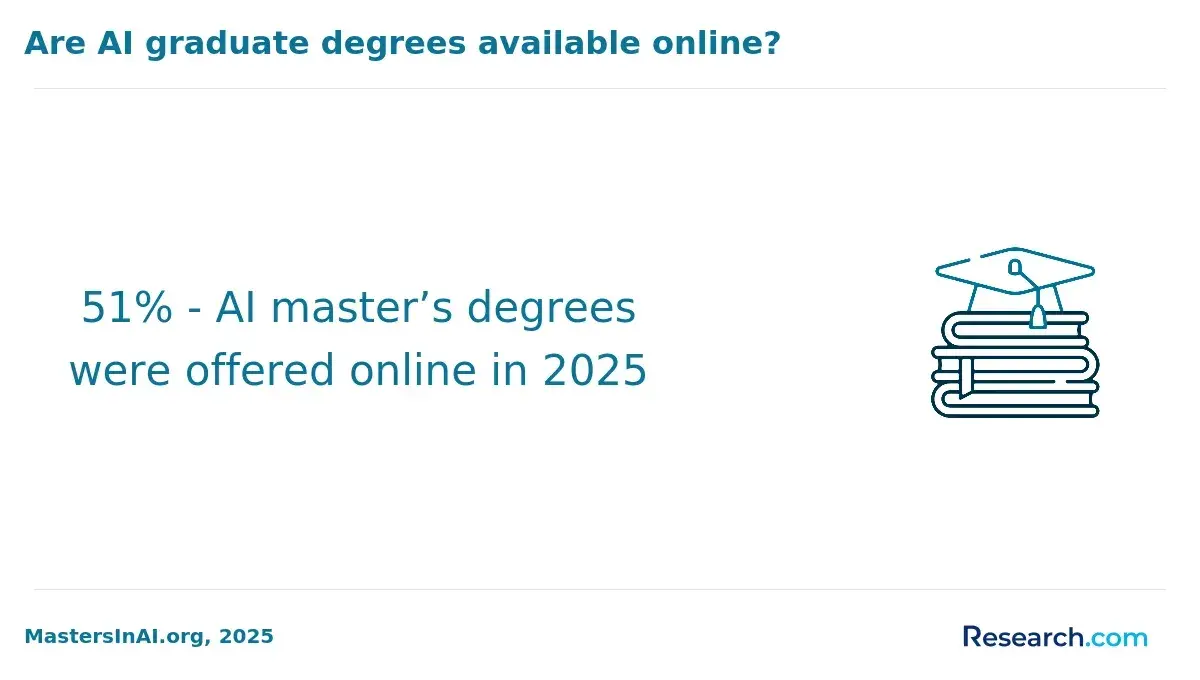
Online AI master's programs offer exceptional flexibility for working accountants and finance professionals, with many students completing degrees entirely through distance education, as reported by the National Center for Education Statistics (IPEDS, 2024 release).
This format supports balancing full-time work and study with asynchronous coursework and recorded lectures, ideal for managing client deadlines and financial reporting cycles.
On-campus programs provide benefits such as more direct faculty interaction, peer networking, collaborative projects, and access to campus resources like labs and career centers. Hybrid programs-partially online with some on-campus residencies-blend flexibility with face-to-face engagement, appealing to those seeking hands-on experience.
When selecting a program, consider whether it includes practical components like capstone projects or internships, which are vital for applying AI skills in accounting and finance. Cost is another factor; online degrees often reduce expenses related to housing, commuting, and campus fees. However, accreditation and curriculum relevance to current financial technology trends remain crucial to ensure program value.
- Flexibility through asynchronous studies
- Networking and collaboration opportunities in on-campus or hybrid models
- Practical experience via projects and internships
- Cost savings compared to traditional programs
- Importance of accreditation and current curriculum alignment
With proper institutional support and credible accreditation, online AI master's degrees provide effective upskilling pathways for finance professionals aiming to advance their careers.
How long do AI master's programs take, and what do they cost?
Master's programs in artificial intelligence tailored for accountants and finance professionals usually take between 1 and 2 years to complete. The duration varies based on full-time or part-time enrollment, with flexible schedules often available for working students. Accelerated options can reduce the timeframe to as little as 12 months, while standard programs typically span 18 to 24 months.
Tuition costs differ widely depending on the university, residency status, and program format. Many U.S. institutions charge per credit hour, often resulting in total tuition fees around $30,000 to $40,000 for 30 credits, excluding additional fees and living expenses. Public universities may charge lower rates for in-state students, whereas private institutions tend to be more expensive. Online programs can offer savings on relocation and commuting but may have comparable tuition rates.
Financial aid, employer tuition reimbursement, and scholarships can substantially ease financial burdens. Prospective students should weigh both the credential's value and program quality, as faculty expertise and curriculum vary significantly.
Typical curricula focus on practical applications such as machine learning for financial forecasting, automated auditing, and risk analysis. Programs generally require 30 to 36 credits, combining core artificial intelligence topics with specialized electives in finance or accounting.
Which professional certifications pair best with an AI master's for finance?
Certified Public Accountant (CPA) and Chartered Financial Analyst (CFA) designations pair highly effectively with a master's degree focused on artificial intelligence in finance. The CPA credential enhances expertise in accounting principles, compliance, and auditing, while leveraging AI tools for automated financial reporting and predictive analytics.
The CFA designation, particularly after the 2024 curriculum update by the CFA Institute, emphasizes data science and AI-related skills, including machine learning applications, reflecting the growing importance of AI in investment management.
Professionals combining a CPA with an AI master's can excel in fraud detection, risk assessment, and dynamic financial modeling by integrating regulatory knowledge with AI-driven data analysis. CFAs add value by enhancing portfolio management, algorithmic trading, and financial forecasting through AI insights. Additional certifications like Financial Risk Manager (FRM) and Certified Management Accountant (CMA) complement AI skills in risk analytics and strategic finance, respectively.
Choosing certifications alongside AI studies should focus on career relevance, integration of data analytics content, and market demand. The CFA Institute's 2024 Candidate Body of Knowledge revision highlights AI's role, giving candidates a competitive edge in applying AI techniques to complex financial products and markets. Combining AI expertise with these certifications meets employer demands for finance professionals adept at using advanced technologies across areas like valuation, regulatory compliance, and strategy.
How can you choose a reputable AI master's program for accounting and finance?
Analyzing a master's program that combines artificial intelligence with accounting and finance involves several crucial factors impacting education quality and career potential. Verify that the curriculum integrates ai methods with financial principles, including practical tools like machine learning, predictive analytics, and automation tailored for finance tasks.
Accreditation ensures academic standards, so look for regional accreditation and business or technology-specific endorsements such as AACSB or ABET. Faculty expertise is equally important; programs staffed by professors active in both ai and finance fields, published in respected journals, or engaged in industry initiatives can enhance learning quality.
Use data from the U.S. Department of Education's College Scorecard to assess median earnings and debt for graduate programs adjacent to artificial intelligence. This helps measure return on investment objectively-programs where graduates earn substantially more than their debt indicate better financial prospects.
Program flexibility, including part-time or online options, supports working professionals. Additionally, assess career services and industry partnerships that might provide internships or job placements.
- Does the program offer ai tools for financial modeling and fraud detection?
- Are capstone projects or research collaborations with financial firms available?
- What portion of graduates secure relevant employment within six months?
Answering these questions with reliable data and evaluation helps prospective students select a master's program aligned with their career goals in accounting and finance.
Other Things You Should Know About Artificial Intelligence
Look for regional accreditation from a recognized agency such as AACSB, ACBSP, or IACBE for business content. If the program is outside the United States, confirm approval from the country’s national higher-education regulator and that the degree is accepted by employers and licensing bodies.
Internships are often required in 2027 AI master's programs for accounting and finance to provide hands-on experience. Requirements vary by institution but typically involve completing a set number of hours at a participating company to gain practical insights and skills.
Finance professionals should strengthen skills in data analytics, programming languages like Python or R, and a solid understanding of financial regulations and accounting principles. Communication and critical thinking are also essential for interpreting AI-generated insights and integrating them effectively into business strategies.
Many programs offer part-time, online, or hybrid formats to accommodate working professionals. Curriculums often include self-paced classes and evening or weekend sessions. Explore additional details about flexible options for an AI finance master's.
References
- The VIPs of AI in finance are making millions https://www.efinancialcareers.com/news/2022/12/ai-finance-pay
- M.SC. IN Artificial Intelligence https://put.poznan.pl/msc-artificial-intelligence
- Application and admission - Master Artificial Intelligence https://www.uva.nl/shared-content/programmas/en/masters/artificial-intelligence/application-and-admission/international-prior-education/international-prior-education-foldout-menu.html
- Best Courses of AI in Finance for Professionals - CFTE https://blog.cfte.education/best-ai-in-finance-courses/
- The Best AI Courses for Accounting and Finance Professionals https://www.epw.com/blog/courses/which-ai-course-is-best-for-accounting-and-finance
- Online AI Degrees vs On-Campus: Which Is Right for You in 2026? https://aidegreeonline.com/online-ai-degrees-vs-on-campus-which-is-right-for-you-in-2026/
- Choosing a master’s degree: data science or artificial intelligence | edX https://www.edx.org/resources/choosing-a-masters-degree-data-science-or-artificial-intelligence
- The five best AI software for finance and accounting | Trullion https://trullion.com/blog/the-five-best-ai-software-for-finance-and-accounting/
- Master of Artificial Intelligence https://wscs.eu/master-of-artificial-intelligence/
- AI Accounting Roles: Finance Career Evolution - ChatFin https://chatfin.ai/blog/ai-accounting-roles-finance-career-evolution/