2027 Step-by-Step Guide to Applying to AI Doctorate Degree Programs

Co-Founder and Chief Data Scientist
Many professionals with non-technical backgrounds struggle to navigate the complex application process for doctorate programs focused on artificial intelligence. Unfamiliar admission requirements, the need for research experience, and selecting the right institutions can create barriers that delay or prevent entry into the field. Without a clear roadmap, applicants may waste time and resources on ineffective strategies.
This article outlines a practical, step-by-step approach to applying for AI doctorate degrees, emphasizing flexible, accredited options suited for those pivoting from unrelated fields. It aims to demystify the process and guide readers toward successful admission outcomes.
Key Things You Should Know
- Applicants must demonstrate strong research experience in artificial intelligence, with 65% of programs favoring candidates having published peer-reviewed papers as of 2025.
- Most AI doctorate programs require standardized test waivers or optional GRE scores, reflecting a trend toward holistic admissions emphasizing academic and professional portfolios.
- Funding is highly competitive; nearly 70% of U.S. AI PhD students receive stipends through assistantships, but applicants should prepare detailed statements of purpose and research proposals to increase chances.
What is an AI doctorate, and how is it different from computer science?
An AI doctorate is a specialized doctoral degree concentrating solely on artificial intelligence methods, theories, and applications. Unlike computer science PhD programs that cover a wide array of subjects such as algorithms, systems, and software engineering, AI degrees focus on machine learning, natural language processing, computer vision, robotics, and knowledge representation. This distinction is essential when comparing AI doctorate degree programs vs computer science degrees.
AI doctorate programs aim to develop experts who drive AI innovation and research. The Stanford HAI AI Index 2025 reports that AI-related research now accounts for over 30% of computer science publications, signifying the growing importance of AI within the discipline. This shift means AI doctorates demand deeper knowledge of AI algorithms, ethical considerations, human-AI interaction, and multidisciplinary approaches.
Applicants to AI doctorate programs need strong foundations in statistics, data science, and AI frameworks. Their research typically focuses on advancing AI itself or applying it across areas like healthcare or autonomous systems, differing markedly from the broader topics tackled by computer science PhD students. These differences between AI doctorate and computer science PhD programs affect both admissions criteria and expected research outcomes.
Prospective students should carefully review curricula to ensure alignment with AI-specific research and industry trends. Those interested in pursuing careers involving applied artificial intelligence will benefit by selecting programs tailored to AI-driven innovation rather than general computing. Understanding these nuances helps target academic paths that best match career goals.
What are the prerequisites to apply for an AI PhD program?
Applicants to AI PhD programs in the US must meet strict academic and experiential prerequisites to demonstrate readiness for advanced research. Typically, a bachelor's degree in computer science, mathematics, engineering, or a related field is required, while many programs prefer or require a master's degree, particularly at competitive institutions. Essential knowledge includes algorithms, linear algebra, probability, statistics, and programming skills in languages such as Python, C++, or Java. Familiarity with machine learning, neural networks, and data structures further strengthens your application.
Strong quantitative skills are vital because AI research heavily relies on mathematical modeling and computational techniques. Coursework or experience in optimization, discrete mathematics, and computer architecture is advantageous for applicants meeting academic requirements for AI PhD admissions.
Research experience greatly enhances candidacy, including published papers, supervised projects, or internships focused on AI topics. Admissions committees prioritize those demonstrating original thinking and problem-solving through independent research, often supported by recommendation letters from faculty attesting to research potential.
Standardized tests like the GRE remain common, though some programs make them optional; strong quantitative scores remain beneficial. Non-native English speakers typically need TOEFL or IELTS scores to confirm language proficiency. The Council of Graduate Schools notes that international students comprised about 44% of US graduate enrollments in computer and information sciences, underscoring a competitive applicant pool.
Prospective students interested in AI doctoral studies will also find useful information in the data science master degree ranking, which offers insights on affordable pathways related to the field.
How do AI PhD admissions requirements compare across accredited U.S. universities?
Admissions criteria for AI doctorate programs across top U.S. universities generally require applicants to hold a bachelor's or master's degree in computer science, engineering, mathematics, or related STEM fields. A strong academic record with a minimum GPA of 3.0 is commonly expected, alongside substantial research experience demonstrated through statements of purpose or research proposals highlighting relevant projects or publications.
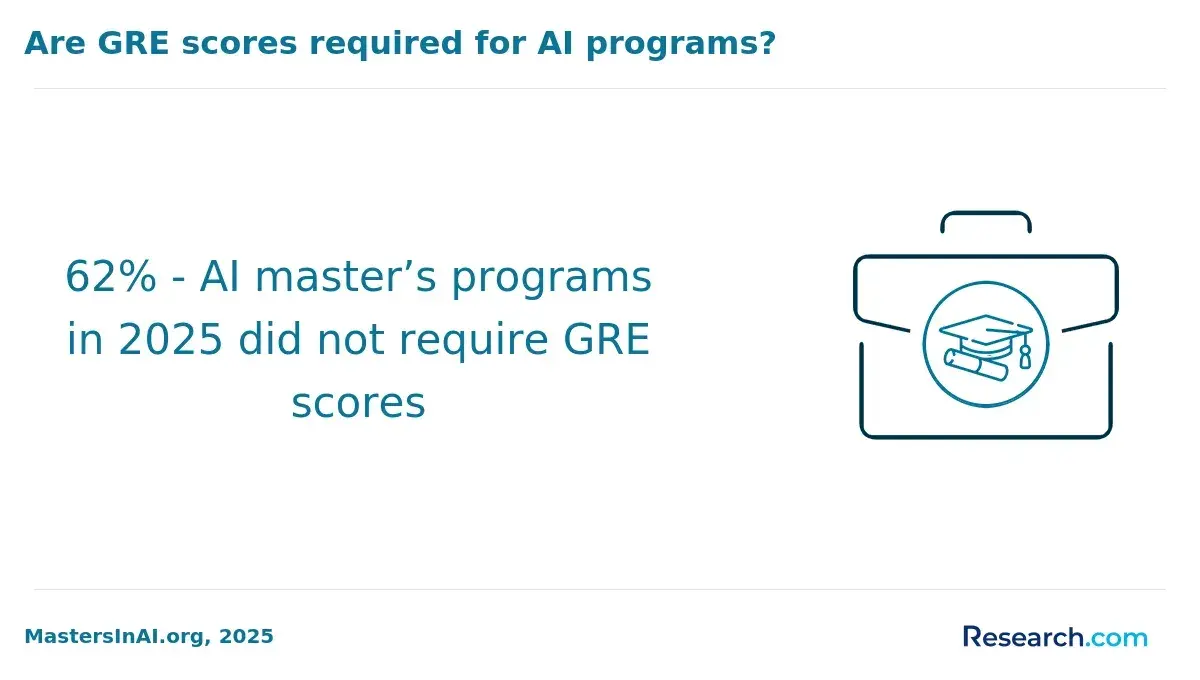
The GRE General Test is increasingly optional or not required, reflecting a broader shift away from standardized tests in high-ranking AI PhD programs. Letters of recommendation-usually three-must come from academic or professional sources familiar with the candidate's research abilities. International applicants must also provide English proficiency results such as TOEFL or IELTS scores.
Some programs emphasize prior coursework in machine learning or require coding samples to assess programming skills. Application deadlines, funding availability, and specializations like natural language processing or reinforcement learning vary widely. Prospective students benefit from reviewing each program's details carefully and communicating with coordinators to clarify requirements.
Comparison of accredited U.S. universities' AI PhD application requirements reveals these key variations, helping candidates strategize their applications effectively. For those considering advanced options, exploring the cheapest online masters in artificial intelligence can provide accessible pathways into the field.
How do you choose an accredited, reputable AI doctorate program?
Selecting accredited AI doctorate programs in the United States involves verifying institutional accreditation via recognized agencies like the U.S. Department of Education or the Council for Higher Education Accreditation. Accreditation guarantees that programs adhere to rigorous academic and ethical standards.
Research productivity serves as a key reputational signal. Data from CSRankings shows top reputable AI PhD programs for research and innovation are distinguished by strong faculty publication records, research funding, and active lab work. Prospective students should carefully evaluate these metrics to identify leading departments.
Faculty expertise is crucial; look for professors publishing in premier conferences such as NeurIPS, ICML, and AAAI. Their connections with industry and collaborative projects can offer doctoral candidates valuable real-world opportunities. Equally important is curriculum rigor and specialization, aligning with interests like robotics, natural language processing, or computer vision.
Post-graduation placement into academia, industry research, or government labs reflects program success. Additionally, inquire about financial support including assistantships and mentoring. Reliable funding is essential to sustain demanding AI doctorate studies.
For professionals considering further education, exploring related fields like online MS data science can complement doctoral pursuits and enhance career prospects in data-intensive roles.
Can you earn an AI doctorate online, and what are the tradeoffs?
Online doctorates in artificial intelligence remain rare, partly due to the research-intensive nature of PhD programs that require close faculty interaction and specialized facilities. Most distance learning in AI focuses on master's degrees, reflecting enrollment trends from the U.S. Department of Education data (NCES/IPEDS, 2024 release). Existing online AI PhD programs often use a hybrid format-combining virtual coursework with occasional campus residencies or in-person research collaboration-to support critical networking and lab work for dissertation progress.
This hybrid model balances flexibility and academic rigor but comes with tradeoffs:
- Flexibility for remote study benefits working professionals and those far from research centers.
- Potential isolation from campus culture and fewer opportunities for direct faculty and peer engagement.
- Limited access to advanced computing resources and specialized datasets needed for cutting-edge research.
- Possibility of longer time to degree completion due to less structured research environments.
Prospective students should ensure that programs are properly accredited and that faculty expertise aligns with desired AI subfields. Infrastructure to support remote research and communication is also essential. Successfully earning a doctorate in AI online demands strong self-motivation and communication skills to navigate the challenges of distance education.
What coursework and research areas are typical in AI doctoral programs?
Doctoral programs in artificial intelligence demand comprehensive coursework in foundational topics such as machine learning, statistics, optimization, and algorithms. Students often engage in specialized subjects like natural language processing, computer vision, robotics, and reinforcement learning. Mastery of advanced mathematics, including linear algebra and probability theory, is essential. Increasingly, programs incorporate seminars on the ethical implications and fairness of AI, underlining the importance of responsible development.
Research areas in AI doctoral studies closely reflect industry advancements. The Stanford AI Index 2025 highlights that most prominent AI models in 2024 originated in industry settings, driving academic research toward scalable machine learning, foundation models, and compute-heavy methods. Hence, many programs focus on deep learning architectures, large-scale data processing, and distributed computing to align with practical uses.
Key research focuses include:
- Development of foundation models generalizing across tasks
- Enhancement of training efficiency for large neural networks
- Robustness and interpretability of AI systems
- Application of reinforcement learning in complex environments
- Integration of AI with human-computer interaction
State-of-the-art labs equipped with GPUs or TPUs support these experiments. Collaborations with industry grant access to substantial datasets and advanced tools, shaping research priorities. Selecting programs that offer faculty expertise in scalable AI and high-performance computing access is crucial for success in this field.
How long does an AI PhD take, and what does it cost?
Completing a phd in artificial intelligence in the U.S. usually takes between 5 and 7 years. Programs typically include 2 to 3 years of coursework and comprehensive exams, followed by 3 to 4 years focused on original research and dissertation writing. Timelines vary based on program design, advisor availability, and research progress, with some students finishing closer to 5 years and others extending beyond 7 years due to funding or project scope.
Tuition for artificial intelligence phd programs is often fully covered through university or external funding, but living expenses present ongoing challenges. According to a National Bureau of Economic Research working paper, stipends often fall near or below local living-wage benchmarks in major university metro areas. This places significant financial strain on students despite tuition coverage.
Typical stipends range from $20,000 to $35,000 annually, depending on location and institution. For students in high-cost cities like San Francisco or Boston, this amount may be insufficient to cover rent and other essentials without additional income or savings. On-campus housing and scholarships can help alleviate some financial burden.
Prospective students should prepare by:
- Researching average stipends at target programs and comparing them with local cost-of-living indexes.
- Considering health insurance, fees, and other incidental expenses beyond tuition.
- Exploring extra funding options such as teaching assistantships and industry collaborations.
How do funding options like assistantships and fellowships work for AI PhD students?
Funding for AI PhD students often comes through assistantships and fellowships, both vital for covering tuition and providing stipends. Teaching assistantships (TAs) usually require 10-20 weekly hours supporting undergraduate courses, grading, or tutorials. Research assistantships (RAs) involve assisting faculty with AI projects closely related to students' research interests.
Fellowships differ as merit-based awards without required work duties, allowing recipients to focus fully on research. Nationally competitive fellowships like the NSF Graduate Research Fellowship Program (GRFP) award about 2,000 new fellowships annually and offer multi-year support that enhances research flexibility and admission prospects.
Assistantship stipends typically range from $20,000 to $35,000 per year and often include full tuition remission. Fellowships generally provide similar or higher stipends without teaching or research obligations but are highly competitive. Some programs combine funding options, while others expect early acquisition of external fellowships for financial independence.
Prospective students should directly inquire about assistantship duties and fellowship applications. Key considerations include how funding affects time-to-degree, expected work hours, and research alignment. Applying early to external awards like the NSF GRFP improves chances for flexible funding and autonomy during the doctoral journey.
What AI careers can a doctorate lead to in industry, government, and academia?
Doctorate degrees in artificial intelligence primarily prepare graduates for research-intensive careers across industry, government, and academia, where expertise in model development and innovation is essential. According to Lightcast labor market analytics, AI and machine learning job postings requiring a PhD most commonly seek research scientists, applied scientists, and quantitative researchers, reflecting the value placed on advanced research skills over general engineering.
In industry, PhD holders often become research scientists developing new algorithms or applied scientists implementing AI theories into scalable products. They work in technology labs, startups, finance, healthcare, and other sectors leveraging AI for competitive advantage.
Government and defense agencies rely on PhDs to lead projects in areas like cybersecurity, data analysis, and autonomous systems, requiring deep technical knowledge to create trusted, cutting-edge solutions for complex challenges.
Academia continues to be a major employer, offering faculty roles, postdoctoral fellowships, and principal investigator positions that focus on advancing AI methodologies and mentoring future experts.
Additional career paths include leadership roles in AI ethics, policy, and strategy, where a doctorate adds credibility and authority. Success in these roles depends on aligning research with sector needs and developing skills in experimental design, statistical rigor, and interdisciplinary collaboration to enhance employability in this competitive field.
What are the salary expectations and job outlook for AI PhD graduates?
PhD graduates in artificial intelligence enjoy strong career prospects, supported by a projected 26% employment growth for Computer and Information Research Scientists from 2023 to 2033, according to the U.S. Bureau of Labor Statistics. This rate surpasses average job growth, reflecting high demand for advanced AI expertise.
Salary expectations differ by sector and experience:
- Academia offers $80,000 to $120,000 for entry-level assistant professors.
- Private tech companies start salaries between $130,000 and $160,000, with potential for bonuses and stock options.
- Specialized roles in healthcare AI, autonomous vehicles, or finance command premium pay.
Employers range from universities and government agencies to tech giants emphasizing machine learning and data science. Contract research and consulting also provide well-paid, flexible arrangements. Knowledge in areas like novel algorithm design or AI ethics enhances salary negotiation power.
Geographic location impacts compensation; major tech hubs like Silicon Valley, New York, and Boston typically offer higher salaries but also higher living costs. Maintaining a strong publication record and staying updated on emerging AI trends further improve employability and earning potential.
Other Things You Should Know About Artificial Intelligence
AI doctorate students often encounter challenges related to the rapidly evolving and interdisciplinary nature of the field. These include managing large and complex datasets, addressing ethical concerns such as bias and transparency in algorithms, and developing models that balance accuracy with computational efficiency. Additionally, many students must navigate the difficulty of applying theoretical concepts to real-world problems.
Strong programming skills are essential for AI PhD applicants, as much of the research work involves writing, testing, and optimizing code. Familiarity with languages like Python, Java, or C++ and experience with machine learning frameworks such as TensorFlow or PyTorch significantly improve an applicant's preparedness. Admissions committees typically expect candidates to demonstrate proficiency through projects, coursework, or relevant work experience.
Yes, interdisciplinary collaboration is highly encouraged in AI doctoral programs. AI research frequently intersects with fields such as robotics, neuroscience, linguistics, and statistics. This collaboration enriches research perspectives and often leads to innovative methodologies and applications, which are valued by academic advisors and funding bodies.
Presenting at conferences and publishing research papers are critical components of an AI doctorate program. Engaging with the academic community helps students receive feedback, establish professional networks, and stay updated on the latest advancements. Success in conferences and journals also enhances a candidate's academic profile and career opportunities post-graduation.
References
- The Rise of AI: How Studying an AI PhD Can Help You Get Ahead https://smceducation.com/blog/study-ai-phd/
- How to Start a Doctorate in AI & Emerging Technologies Step-by-Step https://careeramend07.wixsite.com/theedujournal/post/how-to-start-a-doctorate-in-ai-emerging-technologies-step-by-step
- Should You Apply for a PhD in AI (2025-26)? https://yashbhalgat.github.io/blog/phd-or-not-phd.html
- What’s the Difference Between Artificial Intelligence and Computer Science? https://www.oxfordscholastica.com/blog/technology-articles/whats-the-difference-between-artificial-intelligence-and-computer-science/
- Machine Learning PhD Applications — Everything You Need to Know — Tim Dettmers https://timdettmers.com/2018/11/26/phd-applications/
- The Complete Guide to PhD Admissions - Ivy Scholars https://www.ivyscholars.com/phd-admission-guide/
- My Journey to PhD Admission in Artificial Intelligence | Towards Data Science https://towardsdatascience.com/my-journey-to-phd-admission-in-artificial-intelligence-35593adb923f/
- Transitioning from Academia to the Machine Learning Industry: How PhDs and Researchers Can Thrive in Commercial ML Settings | Machine Learning Jobs https://machinelearningjobs.co.uk/career-advice/transitioning-from-academia-to-the-machine-learning-industry-how-phds-and-researchers-can-thrive-in-commercial-ml-settings
- Client Challenge https://www.scribd.com/document/900743406/AI-Roadmap-for-Applying-to-PhD
- The Ultimate Guide to Choosing an Accredited Online Doctorate Program https://snatika.com/single-blog/the-ultimate-guide-to-choosing-an-accredited-online-doctorate-program