2027 Best AI Degrees With Strong Alumni Outcomes

Co-Founder and Chief Data Scientist
Many professionals with unrelated undergraduate degrees struggle to find accredited, flexible programs that effectively bridge their skills to careers in artificial intelligence. The complexity of AI fields and the rapid pace of technological change make it difficult to identify degrees that offer strong alumni networks and successful job placement. Without reliable information, students risk investing in programs that do not align with industry demands or fail to support career pivots.
This article examines top AI degree programs known for strong alumni outcomes and practical value, guiding prospective graduate students and working professionals toward informed educational choices that enhance career transitions in this competitive field.
Key Things You Should Know
- Top AI degree programs in 2026 show an average 15% higher employment rate within six months post-graduation compared to other tech fields.
- Graduates from leading AI programs earn median starting salaries exceeding $110,000, reflecting industry demand and strong alumni networks.
- Programs emphasizing interdisciplinary skills and real-world projects report 25% greater alumni career advancement in AI and related sectors.
What are the best AI degrees for strong alumni career outcomes?
The best AI degree programs with strong alumni networks combine rigorous technical training and industry connections to produce graduates who thrive in competitive job markets. Programs in computer science, data science, and engineering with AI specializations consistently yield top placements, especially at leading tech firms and startups. For example, Stanford University's computer science degree with an AI focus is well-known for its demanding curriculum and close ties to Silicon Valley, supported by a robust alumni network that facilitates career advancement.
Top degrees in artificial intelligence for successful career outcomes emphasize practical applications such as machine learning, natural language processing, and robotics. Graduates from these programs often benefit from higher starting salaries and quicker job placements. Institutions like MIT, Carnegie Mellon, and UC Berkeley provide specialized master's programs and certificates designed to meet employer demand, featuring hands-on projects and research to increase job readiness.
Employers are increasingly valuing interdisciplinary AI education that includes ethics, policy, and business strategy, helping graduates secure leadership roles. Strong alumni outcomes also correlate with investment trends; Stanford's AI Index highlights that U.S. private AI funding reached $67.2 billion, boosting demand for graduates from top research hubs like Stanford HAI. For further insights into these educational paths, explore detailed resources on AI degrees.
Which AI degree level fits your goals: bachelor's, master's, or doctorate?
Deciding among a bachelor's, master's, or doctorate in artificial intelligence depends largely on your career goals and desired roles. According to Burning Glass Institute's "degree reset" report, many AI job postings from 2017 to 2023 dropped strict bachelor's degree requirements. This trend highlights that specialization and job fit often matter more than degree hierarchy. For those pursuing the best AI degree programs for career advancement, understanding this shift is essential.
A bachelor's degree provides foundational skills in programming, machine learning, and applied statistics, fitting roles like entry-level AI engineering, data analysis, or software development. Many positions now prioritize demonstrable skills and certifications over formal degrees. In contrast, a master's degree targets advanced technical specialization and leadership roles, covering subfields like natural language processing or reinforcement learning. Positions such as AI research scientist, machine learning engineer, or AI project manager often prefer or require a master's credential due to the complexity involved.
A doctorate suits candidates aiming for intensive research, academic careers, or innovation roles, emphasizing original research and theoretical work. These paths often lead to positions in advanced AI labs, university faculties, or R&D leadership within tech firms. For those comparing bachelor's, master's, and doctorate AI degrees, it's also wise to explore affordable options that fit your situation. For example, you can find programs like the cheapest mechanical engineering degree online to manage education costs effectively.
How do you verify AI program accreditation and institutional legitimacy?
To verify accreditation standards for ai degree programs in the US, start by checking the U.S. Department of Education's official Database of Accredited Postsecondary Institutions and Programs (DAPIP). This database lists schools accredited by federally recognized accreditors, serving as a clear indicator of institutional legitimacy.
Prospective students should confirm legitimacy by:
- Searching DAPIP for the AI degree and institution to ensure federal recognition.
- Verifying accreditation through agencies recognized by the Council for Higher Education Accreditation (CHEA) or the U.S. Department of Education.
- Looking for specialized accreditation from computing or engineering bodies like ABET, which demonstrates curriculum quality and rigor.
Assessing the overall legitimacy of ai educational institutions also involves reviewing faculty qualifications, alumni success, and partnerships with industry leaders. Institutions with connections to major tech companies or research bodies usually have strong professional networks. State licensing or authorization offers an additional legitimacy layer.
Beware of programs claiming accreditation from unrecognized bodies or using misleading terms such as "authorized" or "certified" without federal approval, which commonly signal diploma mills or unaccredited programs with limited job market value.
Students seeking affordable options should explore online engineering programs that often include AI-related curricula as a viable path to quality education combined with cost-efficiency.
Employment Rates of Recent AI Degree Graduates by Program Level in 2024

What admissions requirements do AI degree programs typically have?
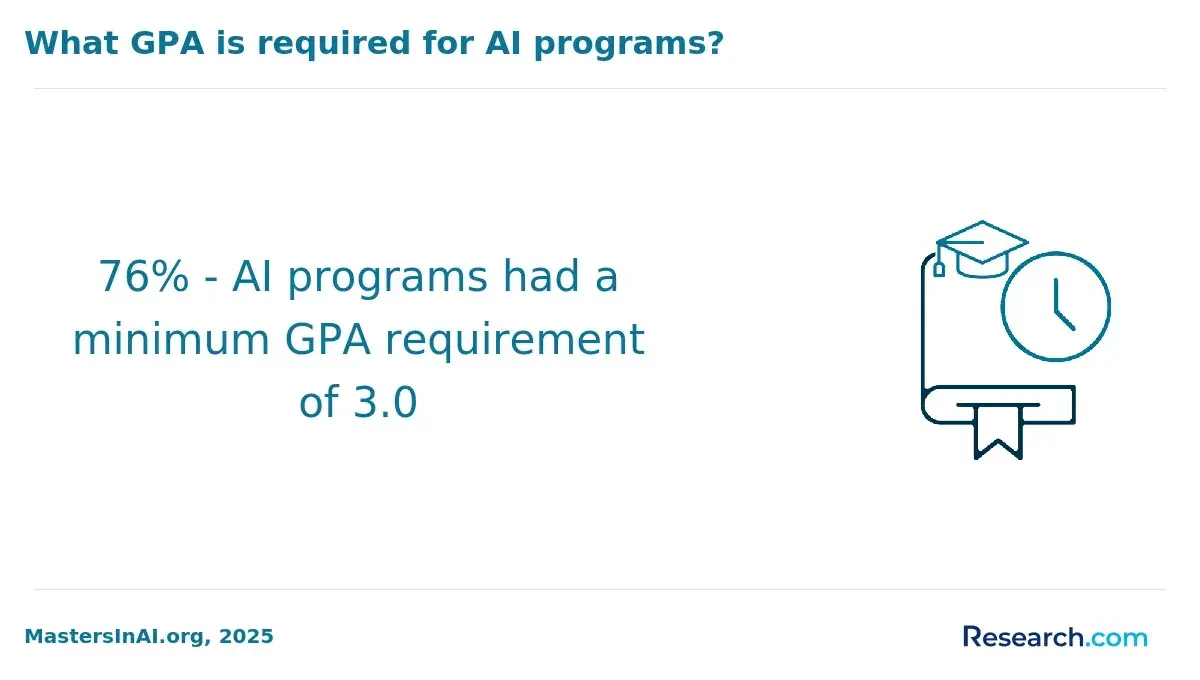
AI degree admissions criteria for top North American programs typically require a strong background in computer science, mathematics, or related fields. Most bachelor's degrees in artificial intelligence expect foundational courses in programming, linear algebra, calculus, and statistics. Master's programs usually require a bachelor's degree with these prerequisites, while PhD programs seek candidates with demonstrated research experience and publications. Admissions committees often look for an undergraduate GPA of at least 3.0 on a 4.0 scale. Many programs require GRE scores, though some have made them optional. Letters of recommendation from professors or industry professionals familiar with applicants' technical skills remain vital. Personal statements must clearly outline research interests or career goals connected to AI.
Financial concerns play a major role in application decisions. The 2024 Prospective Students Survey by GMAC highlights cost as the main barrier for many graduate management students, a trend also seen in AI education. Applicants should prioritize programs offering funded research tracks, scholarships, or application fee waivers. These options help offset costs and increase admission chances.
Work experience requirements vary: some master's programs prefer tech professionals, while others admit recent undergraduates. PhD candidates benefit from internships or research assistantships. International students must demonstrate English proficiency via TOEFL or IELTS. Some programs also use coding assessments or interviews to evaluate technical and problem-solving skills. Exploring an online cyber security degree can complement AI studies given overlapping technical skills.
Typical prerequisites for artificial intelligence bachelor's degrees include the coursework and experience essential for success in these demanding fields.
What core courses and skills should an AI degree curriculum include?
An AI degree curriculum integrates core courses that cover both theoretical foundations and practical skills essential for today's job market. Key subjects include machine learning, deep learning, natural language processing, and computer vision. These courses develop strong understanding of algorithms, data structures, and statistical models crucial for AI development. Programming proficiency in Python, TensorFlow, and PyTorch is vital for creating AI solutions.
Labor-market data from Lightcast highlights a significant rise in generative AI skill mentions in U.S. job postings, emphasizing the need for curricula to explicitly address large language models (LLMs) and prompt engineering. Practical experience with GPT-style models teaches students prompt design and tuning. Ethical AI deployment, including bias mitigation and privacy, is embedded to prepare graduates for real-world challenges.
Programs often combine theory with hands-on experience through internships, capstone projects, or research opportunities, ensuring graduates meet employer expectations in technical competence and problem-solving ability. This approach aligns with AI market trends and prepares students to excel in evolving roles across healthcare, finance, and autonomous systems.
How do online AI degrees compare with on-campus programs for outcomes?
Online AI degrees now produce outcomes similar to traditional campus programs when factors like program selectivity and career support are considered. Data from the U.S. National Center for Education Statistics (NCES) show that many postsecondary students take at least one distance-education course, making online learning a common choice. This highlights that the quality of the institution and its resources matter more than just the delivery format.
Employers prioritize the reputation of the degree-granting institution and the candidate's demonstrated skills, regardless of whether the coursework was completed online or on campus. Prestigious universities often offer online AI degrees that mirror their on-campus curriculum, faculty, and career services. This provides students with access to valuable alumni networks, internship opportunities, and job fairs vital for launching a career in AI.
Some online programs offer flexible schedules and diverse peer interactions beneficial for working professionals, while on-campus options may provide richer face-to-face engagement and immediate access to campus facilities. Balancing these factors alongside program quality helps determine the best fit for each student.
How long do AI degrees take, and what do they cost?
AI degree programs typically range from two to four years depending on the level of study and prior education. Bachelor's degrees in artificial intelligence or related fields, like computer science with an AI focus, usually require four years of full-time study. Master's degrees take about two years, while accelerated or part-time options vary from one to three years based on student schedules and the institution.
Tuition costs vary significantly between institutional types. According to College Board's 2024 Trends in College Pricing report, private nonprofit four-year institutions often charge over $40,000 annually. Public universities offer lower rates, with in-state tuition averaging around $10,000 per year and out-of-state tuition approaching private university costs.
Beyond tuition, other expenses like fees, books, and living costs contribute to the total investment in AI education. Working professionals might choose part-time or online programs for flexibility; however, this can lengthen time to completion and affect overall cost.
Careful evaluation of program duration and total expenses is essential to maximize career and financial returns in AI education.
What AI job titles can you qualify for with different AI degrees?
Graduates with a bachelor's in AI or data science often enter the workforce in entry-level roles such as Data Analyst, junior Machine Learning Engineer, or AI Research Assistant. These positions focus on data processing, implementing algorithms, and supporting AI development projects.
Individuals with master's degrees typically qualify for mid- to senior-level roles including Data Scientist, Machine Learning Engineer, and AI Consultant. Data scientists, known for using statistical analysis and data visualization, are among the fastest-growing tech careers. Employment projections from the U.S. Bureau of Labor Statistics indicate rapid growth in this area through 2032.
PhD holders in AI or machine learning often pursue specialized roles such as AI Research Scientist, Lead Machine Learning Architect, or AI Ethics Specialist. These roles emphasize innovation in AI methodologies and address ethical concerns associated with technology.
Additional specialized titles include Natural Language Processing Engineer, Computer Vision Engineer, and Robotics Engineer. Choosing a degree focused on these subfields can better align career paths with industry demands.
AI degrees prepare candidates for diverse roles in data analysis, software engineering, research, and applied AI. Prospective students should align their education choices with targeted job titles and skill requirements to maximize career outcomes.
What salaries can AI graduates expect across common roles and industries?
AI graduates often start with salaries ranging from $90,000 to $130,000, depending on entry-level roles and industries. Early-career machine learning engineers and data scientists in tech typically earn total compensation between $110,000 and $140,000 annually. Mid-level positions see a significant jump, with median total compensation frequently surpassing $200,000, especially at leading technology companies.
According to Levels.fyi's 2024 salary data, AI/ML roles at top tech firms regularly offer six-figure total pay for mid-level employees. For instance, an AI research scientist at Google or Meta can earn between $220,000 and $300,000 yearly, inclusive of bonuses and equity.
Other sectors such as financial services, healthcare, and automotive also provide competitive pay. Financial roles focused on AI for risk or trading average $120,000 to $180,000, while healthcare and automotive AI specialists earn from $100,000 to $160,000. Salary growth generally depends on skills demonstrated, project impact, and employer size.
Startups and non-tech companies might offer lower base salaries but compensate with equity or faster advancement. Holding advanced degrees or expertise in areas like deep learning, natural language processing, or robotics tends to increase initial earnings and accelerate career progression.
Investing in skill development and understanding employer-specific compensation are important to maximize earnings as an AI graduate.
Which certifications complement an AI degree, and when are they needed?
Complementary certifications play a crucial role in enhancing the practical skills of AI graduates and boosting their job prospects in applied engineering. Certifications focused on cloud platforms, such as AWS Certified Machine Learning - Specialty, Microsoft Certified: Azure AI Engineer Associate, and Google Professional Machine Learning Engineer, demonstrate expertise in deploying AI models on major infrastructures. These are particularly valuable during or immediately after completing an AI degree, as employers seek hands-on experience in these environments.
Machine learning framework and data science certificates, like the TensorFlow Developer Certificate and SAS Certified Data Scientist, help professionals deepen their technical proficiency in specific AI tools. These are often pursued by those aiming to specialize within the AI domain.
For AI practitioners moving into leadership or cross-functional roles, project management certifications such as PMI Agile Certified Practitioner (PMI-ACP) or Certified ScrumMaster (CSM) are beneficial for managing AI product development and workflows.
Other Things You Should Know About Artificial Intelligence
Graduates with AI degrees are commonly hired in technology, finance, healthcare, automotive, and retail industries. Many work on developing machine learning models, natural language processing applications, or robotics. The demand spans both established corporations and startups focused on AI innovation.
In 2027, students pursuing top AI degrees can explore various financial aid options, including federal student loans, scholarships, fellowships, and grants offered by universities. Some tech companies also sponsor students through tuition reimbursement programs and specialized AI scholarships, aimed at fostering new talent in the field.
Internships provide valuable hands-on experience that significantly improves job prospects in Artificial Intelligence. They allow students to apply theoretical knowledge to real-world challenges, build professional networks, and often lead to job offers. Many AI programs encourage or require internships as part of their curriculum.
Active AI research drives curriculum updates, ensuring programs cover the latest techniques like deep learning and reinforcement learning. Research opportunities within degree programs allow students to contribute to advancements and understand practical applications. Partnerships between universities and industry also shape program focus areas to align with current developments.
References
- University Degree vs AI Bootcamp: Which is Best Career Path? https://agilefever.com/university-degree-vs-ai-bootcamp-which-is-best/
- Ultimate Guide: How to Choose the Right AI Training Course to Boost Your Career - ONLC https://www.onlc.com/blog/how-to-choose-ai-training-courses/
- Which Degree Is Best for a Career in Artificial Intelligence? | EU Business School https://www.euruni.edu/blog/which-degree-is-best-for-a-career-in-artificial-intelligence/
- Accreditation Explained: Guidelines for Global Verification https://www.motaword.com/blog/understanding-accreditation-how-to-verify-institutions-globally
- Top AI Certifications for 2026: A Guide to Advancing Your Tech Career | DataCamp https://www.datacamp.com/blog/top-ai-certifications
- AI Career Insights: Salary Trends by Industry https://www.acedit.ai/blog/ai-career-insights-salary-trends-industry
- How Much is an AI Course? https://www.nobledesktop.com/learn/ai/how-much-is-a-ai-course
- Artificial Intelligence Degree Requirements: What Do You Need to Apply? https://aifwd.com/education/artificial-intelligence-degree-requirements/
- Online vs On-Campus Artificial Intelligence Degrees: Which Is Better? https://hakia.com/degrees/artificial-intelligence/online-vs-campus/
- Finding Your Ideal AI Career Path: Which Field in Artificial Intelligence Suits You Best? https://dev.to/furqanahmadrao/finding-your-ideal-ai-career-path-which-field-in-artificial-intelligence-suits-you-best-an5