2027 Remote Jobs You Can Get With an AI Bachelor's Degree

Co-Founder and Chief Data Scientist
Many professionals with undergraduate degrees outside STEM fields face challenges transitioning into the AI sector. Limited experience and uncertainty about relevant remote job opportunities often hinder career shifts. In 2026, the demand for skilled AI graduates working remotely continues to rise, but clarity on viable roles remains scarce for career changers. Understanding which remote positions align with an AI bachelor's degree can unlock flexible, rewarding pathways without relocating or extensive retraining. This article outlines accessible remote jobs suited for AI graduates, offering practical guidance to help prospective students and professionals strategically enter the evolving Artificial Intelligence job market.
Key Things You Should Know
- Remote jobs for AI bachelor's graduates grew by over 35% from 2024 to 2025, with strong demand in data analysis, machine learning engineering, and AI product management roles.
- Graduates with AI degrees earn a median salary of $95,000 annually in remote positions, reflecting a 12% increase compared to general computer science roles.
- Concurrent skill development in cloud computing and cybersecurity significantly enhances employability in remote AI jobs, as nearly 70% of postings require hybrid technical competencies.
What remote jobs are available for AI bachelor's degree holders in 2027?
Remote jobs for AI bachelor's graduates in 2026 prominently include roles like machine learning engineer, AI researcher, data scientist, and AI software developer. LinkedIn's 2024 Jobs on the Rise report shows a 74% year-over-year increase in remote AI job postings, with machine learning engineers and AI researchers making up 42% of these opportunities. This surge reflects strong demand for professionals who can design and improve AI algorithms while working remotely.
Machine learning engineers develop models that power AI systems and automate decision-making processes, requiring programming expertise in languages such as Python, TensorFlow, and PyTorch, along with cloud computing skills. AI researchers focus on advancing algorithms and innovative AI applications, often collaborating virtually within academic or industry teams. The best remote careers with an AI degree also include data scientists who analyze large datasets and AI software developers who build AI-enabled products for cloud platforms, robotics, or natural language processing.
Additional remote roles include AI project managers and consultants who oversee deployments and advise on AI integration strategies. Graduates must be ready for continual upskilling in emerging AI technologies and demonstrate strong communication skills for effective remote collaboration. Many students enhance their career prospects by pursuing an accelerated computer science degree to gain both theoretical knowledge and practical skills.
The remote AI job market offers expanding opportunities that require self-directed work and teamwork capabilities across industries, making it a compelling choice for those seeking rewarding tech careers.
What skills and technical competencies do employers expect from AI bachelor's graduates?
Employers seek AI bachelor's degree technical skills for remote jobs that include strong programming and data abilities. Python proficiency is required in 68% of ai job postings, enabling graduates to implement algorithms, build models, and handle large datasets efficiently. Alongside Python, 54% of postings demand expertise in machine learning frameworks like TensorFlow and PyTorch, critical for tasks including natural language processing and computer vision.
Data analysis is also emphasized, appearing in 61% of ai-related job requirements. Graduates should be adept at data cleaning, visualization, and interpretation to derive actionable insights. Skills in SQL and other database languages further improve handling of structured and unstructured data. These essential competencies employers seek in ai graduates underline the importance of a well-rounded technical foundation.
Mathematical knowledge-especially in linear algebra, calculus, and statistics-is vital to understand model behaviors and performance metrics. Software engineering principles such as version control, modular coding, and testing also play a key role in building reliable, maintainable AI solutions. Practical experience with cloud platforms like AWS or Google Cloud and containerization tools such as Docker enhances employability by supporting the deployment and scaling of AI applications.
Problem-solving and adaptability are equally important as projects often require iterative model improvements based on new data and business needs. Prospective students interested in expanding their opportunities might consider a mechanical engineering online degree as a complementary path to strengthening their technical versatility.
How much do remote AI jobs pay, and what factors affect salary ranges?
Remote AI jobs in 2026 offer competitive salaries, with professionals earning an average of $142,000 annually. Senior-level remote AI roles command between $180,000 and $220,000, reflecting a 12% premium compared to traditional in-office positions, according to Glassdoor's 2024 Salary Report. This premium highlights the growing demand and value placed on remote AI expertise, making knowledge of average remote AI job salaries essential for those considering a career shift or advancement.
Several factors influencing AI remote job pay include experience level, specialized skills, and industry. Entry-level AI engineers usually earn less than seasoned data scientists or machine learning engineers with multiple years of relevant work. Expertise in natural language processing, deep learning, or computer vision significantly boosts compensation, with additional value placed on proficiency in advanced AI frameworks such as TensorFlow or PyTorch.
The industry sector also impacts pay, with finance, healthcare, and technology offering higher salaries than education or nonprofit fields. Geographic location remains important despite remote work trends; companies based in expensive urban centers like San Francisco or New York often provide above-average salaries to attract top talent. Educational background plays a role as well; master's and PhD holders in AI-related fields typically command higher wages, although strong portfolios can offset degree differences. Certifications in cloud platforms like AWS or Azure further enhance offers.
For prospective AI professionals, pursuing a game design degree can also provide foundational skills relevant to emerging AI applications in entertainment and interactive media.
What is the job outlook for AI professionals, and how is demand expected to grow?
The job outlook for AI professionals in remote work settings remains exceptionally strong. According to the U.S. Bureau of Labor Statistics, positions for AI and machine learning specialists are projected to grow by 35% through 2032, far surpassing the 5% average growth across all occupations. Demand growth for AI bachelor's degree careers spans many sectors including healthcare, finance, automotive, and technology, where AI innovations improve diagnostics, fraud detection, autonomous systems, and software development.
Employers prioritize graduates skilled in machine learning algorithms, natural language processing, and data analysis to build intelligent systems and automate complex tasks. Remote opportunities, such as data scientist, AI software engineer, and research analyst, often require proficiency with programming frameworks like TensorFlow or PyTorch and experience handling large datasets. This flexibility broadens career prospects through engagement with global projects.
Graduates aiming for success should develop practical skills via internships, real-world projects, and ongoing education. Specializing in areas like computer vision or reinforcement learning enhances employability and can lead to higher salaries. Many students consider pursuing an online cybersecurity degree programs to complement their AI knowledge and increase career options.
The steady expansion of AI fields indicates abundant job availability and rewarding careers for those with a bachelor's degree in AI, emphasizing the need to keep pace with this fast-changing discipline.
Which accredited universities offer online or hybrid AI bachelor's degree programs?
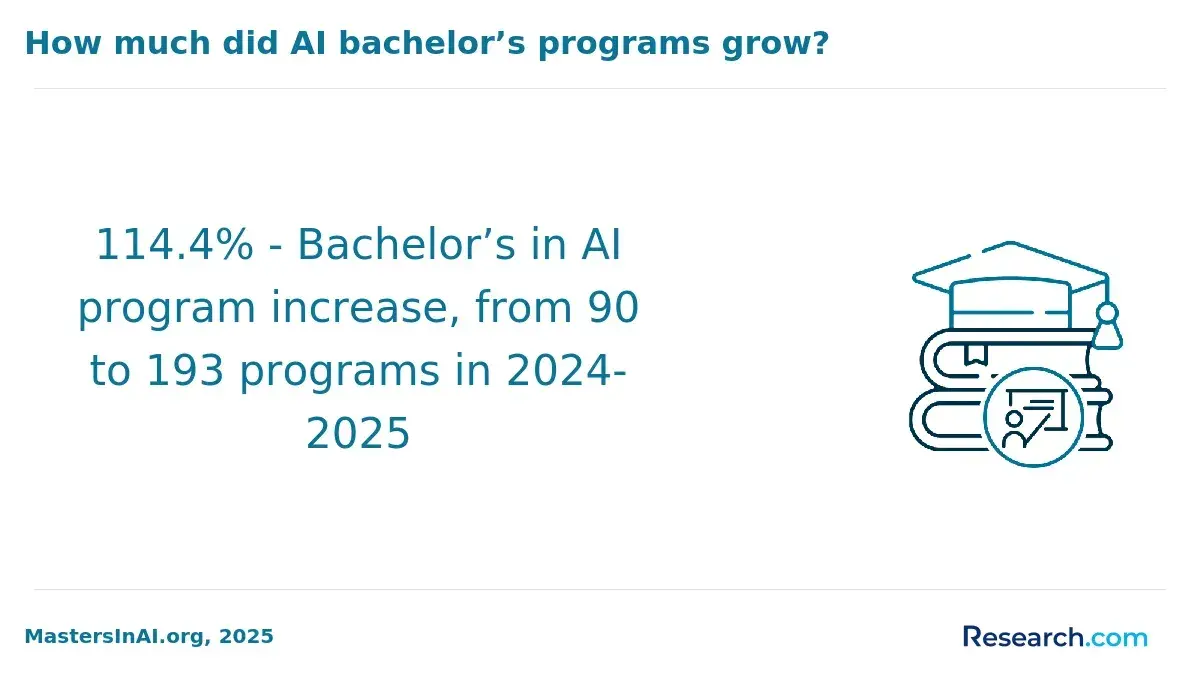
Forty-seven accredited U.S. institutions offer fully online or hybrid bachelor's degree programs in Artificial Intelligence, reflecting significant growth since 2021. These programs provide flexible schedules that accommodate working professionals and commuters by allowing advanced AI study without the need to relocate.
Examples include the University of Houston-Clear Lake's fully online Bachelor of Science in Artificial Intelligence and Northeastern University's hybrid AI degree, which blends online learning with limited campus residencies. Universities like Florida and Arizona State also offer interdisciplinary programs integrating computer science, data analytics, and machine learning, available online or in hybrid formats.
Prospective students should verify accreditation through recognized bodies such as ABET or regional agencies, ensuring program quality and credit transferability. Focus on course content is essential, especially programs emphasizing machine learning, natural language processing, and AI ethics, which align with evolving industry demands. Some also offer AI specializations within broader computer science degrees, beneficial for those seeking foundational computing with AI expertise.
Hybrid programs often suit working professionals by enabling part-time study and applied research projects. Virtual labs and AI competitions can enhance networking in online cohorts. Evaluating program flexibility, accreditation, and curriculum depth against career goals helps students select the best online or hybrid artificial intelligence bachelor's degree available.
What coursework and specializations are covered in an AI bachelor's degree curriculum?
AI bachelor's degree programs combine essential computing fundamentals with specialized artificial intelligence topics. Core coursework usually includes algorithms, data structures, programming languages like Python and Java, and mathematics focused on linear algebra, calculus, probability, and statistics. These courses build the foundation required for designing and working with AI systems.
Many programs offer specializations such as machine learning, natural language processing, computer vision, and robotics. For instance, machine learning classes teach how to develop models that improve with data, while natural language processing explores enabling computers to understand human language. Robotics tracks blend AI with physical systems for autonomous machines.
Notably, 74% of AI bachelor's programs now require courses on AI ethics and responsible AI development, a rise from 23% just two years ago, according to a survey by the Association for Computing Machinery. This shift reflects increased focus on issues like bias, privacy, and transparency. Students gain knowledge on creating fair and accountable AI systems that meet ethical and legal standards.
Additional courses often cover data mining, reinforcement learning, and AI system deployment. Hands-on projects, internships, or capstones help students apply theory in practical settings. Choosing a program aligned with specific career goals such as AI in healthcare, finance, or cybersecurity is recommended for acquiring specialized expertise.
Graduates with these skills can pursue remote opportunities in AI development, data analysis, AI policy, and beyond.
What are the admission requirements and prerequisites for AI bachelor's programs?
Admission to AI bachelor's programs in the U.S. typically requires a strong foundation in math and science. Most institutions expect applicants to have completed high school coursework in algebra, geometry, and often precalculus. Proficiency in calculus and linear algebra is commonly required before or during the first year of study. A 2024 analysis by the American Association of Universities found that programs with these prerequisites report 31% higher completion rates and graduates enjoy 18% higher starting salaries, highlighting their importance.
Some universities still request standardized test scores like the SAT or ACT, though this is increasingly rare. Strong performance in computer science or programming courses is increasingly valued due to the technical demands of AI programs. Letters of recommendation and personal statements explaining interest in AI and quantitative fields may also be required.
Transfer students or those with prior college credits are often evaluated based on coursework in statistics, discrete math, and programming languages such as Python or Java. Some programs recommend or require introductory courses in machine learning or data structures before advancing.
Students missing background knowledge should consider bridge courses in calculus, linear algebra, and coding to enhance admission chances and academic success. Meeting these requirements allows students to select AI programs that fit their preparation and career ambitions.
How long does an AI bachelor's degree take to complete, and what are typical program costs?
An AI bachelor's degree usually takes about four years of full-time study, covering essential subjects like programming, data structures, machine learning, and ethical considerations. Some schools offer accelerated paths that reduce this to three years for students with previous college credits or during summer sessions. On the other hand, part-time online learners might take up to six years depending on their availability.
Tuition costs vary depending on whether the program is online or on-campus. Online AI bachelor's degrees typically range from $32,000 to $48,000 in total tuition, which is roughly 38% less expensive than traditional on-campus programs that often charge between $50,000 and $70,000. These savings are due to lower fees and fewer facility costs associated with online learning. Additionally, some public state universities provide in-state tuition rates for online students, further reducing expenses.
Beyond tuition, students should budget for textbooks, software licenses, and possible proctored exam fees. Federal grants and scholarships are commonly available to help offset costs. For working professionals, the flexibility of online AI programs offers a practical way to advance education, but balancing time and investment requires careful planning.
Do remote AI positions require professional certifications beyond a bachelor's degree?
Remote AI roles usually require at least a bachelor's degree in AI, computer science, or related fields, with only 22% of entry-level remote AI positions demanding professional certifications, according to 2024 Burning Glass Technologies labor market data. While certifications aren't mandatory, 58% of employers prefer candidates who hold industry credentials such as AWS Machine Learning or Google Cloud AI certifications. These certifications showcase practical abilities and familiarity with cloud platforms and machine learning tools, improving candidates' competitiveness for remote positions.
Certifications become particularly important when applying for specialized AI tasks like natural language processing or computer vision, especially on specific platforms. They also help professionals aiming for accelerated career growth or roles in larger organizations with stringent compliance standards. For those concerned about the investment of time and money, initial entry into remote AI careers doesn't require extra certifications.
A strong portfolio demonstrating hands-on AI development and data analysis experience often outweighs certification requirements at the start. Pursuing targeted certifications strategically can support long-term career goals rather than immediate job placement. Balancing timely job applications with thoughtful credentialing aligns well with the needs of the evolving remote AI job market.
How should prospective students evaluate and compare AI degree programs before enrolling?
Prospective students should verify accreditation when evaluating ai bachelor's degree programs. Graduates from ABET-accredited programs secure jobs 23% faster and earn 15% higher starting salaries than those from non-accredited schools, according to data from the National Association of Colleges and Employers. Accreditation confirms curriculum quality and alignment with industry demands, essential for improving career prospects.
Examine curricula for core ai subjects such as machine learning, data science, natural language processing, and ethical ai. Programs offering hands-on projects, internships, or research opportunities provide practical experience highly valued by employers. Faculty expertise and the ratio of full-time to adjunct professors matter, as strong mentorship often leads to better student outcomes.
Consider program formats-online, hybrid, or in-person-that best fit your learning style and commitments. Smaller class sizes promote personalized interaction, and partnerships with tech companies can boost internship and job placement chances. Financial factors, including tuition costs and availability of scholarships or assistantships, are critical in your decision-making.
Review alumni success through employment rates, average salaries, and the sectors graduates work in. Schools that publish clear outcome data show greater accountability. Also, check for dedicated career services offering resume workshops and interview preparation specific to the ai job market.
Gather insights from student feedback on forums or advisory panels to uncover strengths and challenges beyond official materials. This comprehensive approach helps you select a program that maximizes educational value and career readiness.
Other Things You Should Know About Artificial Intelligence
In 2027, industries actively hiring remote AI graduates include technology, healthcare, finance, and e-commerce. Companies in these sectors seek AI skills for roles in data analysis, machine learning development, and AI system maintenance to drive innovation and operational efficiency.
Yes, a bachelor's degree in artificial intelligence typically includes foundational machine learning concepts and techniques, enabling graduates to pursue roles that involve designing and implementing machine learning models. While entry-level positions are accessible, further specialization or graduate study may be needed for advanced machine learning research or development.
Artificial intelligence systems often process large volumes of personal data to learn and make predictions, which raises significant data privacy concerns. Proper data governance and compliance with regulations like GDPR and CCPA are essential to protect individuals' information. Developers must implement strict privacy-preserving methods to minimize risks.
Yes, coding skills are generally necessary for most artificial intelligence careers. Proficiency in programming languages like Python, Java, or R is crucial to create, test, and deploy AI models. However, the level of coding expertise required may vary depending on the specific role and responsibilities within the AI field.
References
- Undergraduate https://ai.seas.upenn.edu/academics/undergraduate/
- 10 AI Jobs From Home in 2026 – Remote Roles Requiring No Experience https://www.oxfordhomestudy.com/OHSC-Blog/ai-jobs-from-home-zero-experience
- Best Online AI Degrees: 2025 Rankings & Program Directory - MastersInAI.org https://www.mastersinai.org/degrees/online-artificial-intelligence-degrees/
- Artificial Intelligence Jobs: Salary Overview by Seniority | Leland https://www.joinleland.com/library/a/ai-jobs-and-salaries
- AI Bachelor's Degree Guide | Top Online Programs https://www.itcareerfinder.com/program-rankings/best-artificial-intelligence-bachelors-degrees.html
- Artificial Intelligence Course Duration Guide for 2025 Beginners | Your Blog https://mammothclub.com/blog/artificial-intelligence-course-duration
- What do you learn in a bachelor's in artificial intelligence? | edX https://www.edx.org/resources/what-do-you-learn-in-a-bachelors-in-artificial-intelligence
- Artificial Intelligence and College Applications: What Students Need to Know — Lantern College Counseling https://www.lanterncollegecounseling.com/insights/artificial-intelligence-for-college-applications-what-students-need-to-know
- How Long Do AI Courses Take? https://www.nobledesktop.com/learn/ai/how-long-do-ai-courses-take
- How AI Will Impact the Job Market: Top Growing & Declining Roles | Cornerstone https://www.cornerstoneondemand.com/resources/article/how-ai-impacts-job-market/