2027 AI Master's Degrees That Include Google Cloud AI Training

Co-Founder and Chief Data Scientist
Choosing an AI master’s program with Google Cloud training is mainly a practical decision: Will the degree help you move from theory into building, deploying, and managing AI systems on a cloud platform employers actually use? For career changers, working professionals, and technical graduates who want cloud-based machine learning experience, the strongest programs combine graduate-level AI coursework with supervised labs, production-focused projects, and preparation for relevant Google Cloud credentials.
This guide explains what these programs usually include, how Google Cloud AI content appears in coursework and labs, what admissions committees look for, how long programs take, what they may cost, and which jobs and certifications align best with this training. It also highlights the trade-offs between online, hybrid, and campus formats so you can compare programs with a clearer view of cost, flexibility, accreditation, and career fit.
Key Things You Should Know
- In 2026, over 40 U.S. universities offer AI master's programs integrating Google Cloud AI certifications, aligning curricula with industry demands and cloud technology trends.
- Completing Google Cloud AI training within these degrees boosts graduate employability by approximately 25%, emphasizing hands-on skills with real-world AI applications.
- Such programs often combine foundational machine learning theories with Google Cloud tools, preparing students for careers in data science, AI engineering, and cloud computing.
What is a master's in AI with Google Cloud AI training?
A master’s in AI with Google Cloud AI training is a graduate program that teaches artificial intelligence and machine learning concepts while giving students hands-on experience with cloud-based AI development. Instead of studying models only in local or theoretical environments, students learn how to build, train, deploy, monitor, and scale AI systems using Google Cloud tools such as AutoML, TensorFlow, and Vertex AI.
This type of program is designed for students who want more than a general AI credential. The Google Cloud component matters because many AI jobs require production skills: moving data through pipelines, managing compute resources, deploying models securely, and maintaining systems after launch. Since 2020, more than 4 million learners have benefited from Google Cloud training, which reflects the growing demand for cloud-based technical skills across AI, analytics, and software roles.
Most programs combine academic AI foundations with applied cloud work. Common curriculum areas include:
- Machine learning algorithms, model training, and model optimization
- Data engineering, cloud storage, and scalable data pipelines
- Natural language processing and computer vision using Google Cloud services
- TensorFlow-based development and model deployment workflows
- AI ethics, privacy, security, and responsible implementation
- MLOps practices such as versioning, monitoring, automation, and governance
Program formats vary. Some degrees are fully online and built for working adults, while others use campus labs, hybrid residencies, or team-based research projects. A strong program should clearly state whether Google Cloud work is required in core courses, available only as an elective, or offered through optional certification preparation.
Students comparing options should look for evidence of practical learning: sandboxed cloud environments, Google Cloud credits, supervised labs, capstone projects, and faculty or industry mentors with experience deploying AI systems. Those who still need broader computing preparation may also consider a computer science accelerated program before or alongside advanced AI study.
Which accredited universities offer AI master's degrees with Google Cloud content?
Accredited universities that may offer AI master’s degrees with Google Cloud content include institutions such as the University of Illinois Urbana-Champaign, New York University, and Georgia Institute of Technology. These schools are examples of universities associated with advanced computing, data science, or AI education, and some programs connect cloud training to resources listed in Google Cloud’s “Build your future with Google Cloud” directory, which connects over 1,000 global academic and training partners.
When evaluating universities, the key question is not simply whether a program mentions Google Cloud. Applicants should confirm how deeply Google Cloud content is built into the degree. Some programs require hands-on Google Cloud projects in machine learning or data engineering courses. Others recommend Google Cloud Skills Boost labs or certification preparation as supplemental learning outside the core curriculum.
Look for these indicators of meaningful Google Cloud integration:
- Required cloud-based coursework: Courses should include assignments using Google Cloud Platform rather than only discussing cloud computing conceptually.
- AI deployment projects: Strong programs require students to deploy, test, and monitor models on cloud infrastructure.
- Relevant tools: Coursework may involve TensorFlow, AutoML, Vertex AI, BigQuery, Cloud Storage, and AI APIs.
- Capstone or practicum work: Applied projects should use real or realistic datasets and require cloud-based workflows.
- Certification alignment: The program may encourage credentials such as Google Professional Machine Learning Engineer or Google Professional Data Engineer.
- Accreditation and academic quality: The university should be institutionally accredited, and the degree should have clear faculty oversight, admissions standards, and learning outcomes.
New York University’s AI master’s content may include coursework using TensorFlow and AutoML on GCP, while Georgia Tech has been associated with scalable AI project work using Google Cloud technology. Prospective students should verify current course requirements directly with the university because cloud tools, elective availability, and partner resources can change by term.
For cost-conscious students, the best choice is not always the most recognizable school. Compare total tuition, transfer-credit policies, online availability, career support, and the amount of required Google Cloud work. Students researching lower-cost pathways can also review data science undergraduate rankings to understand affordable academic options that may support later AI or cloud specialization.
How do these programs integrate Google Cloud AI labs and projects?
AI master’s programs integrate Google Cloud AI labs and projects by embedding cloud-based assignments into machine learning, data engineering, MLOps, and capstone courses. The goal is to move students from understanding algorithms to using those algorithms in a production-like environment. Many programs use Google Cloud Skills Boost, which features over 1,000 specialized labs and quests focused on cloud and AI technologies.
In a well-designed program, Google Cloud labs are not isolated tutorials. They support course objectives and require students to make technical decisions: which model to use, how to prepare data, how to manage compute resources, how to evaluate performance, and how to deploy the model safely.
Common ways programs use Google Cloud AI labs include:
- Guided lab assignments: Students complete structured Qwiklabs or Google Cloud Skills Boost activities tied to course topics.
- Model deployment exercises: Students train and deploy TensorFlow models, AutoML models, or Vertex AI workflows.
- Data engineering projects: Assignments may require students to store, clean, transform, and analyze datasets using Google Cloud infrastructure.
- Capstone projects: Students build end-to-end AI solutions in Google Cloud environments, often involving natural language processing, computer vision, predictive analytics, or recommendation systems.
- Team-based simulations: Groups use shared cloud tools to mirror workplace collaboration, version control, testing, and deployment practices.
- MLOps practice: Projects may include Vertex AI pipelines, model monitoring, retraining workflows, and governance documentation.
Good programs also teach students to manage practical cloud challenges. Cloud environments can create cost, configuration, permissions, and security issues if they are poorly supervised. Strong programs reduce that risk by using shared Google Cloud accounts, sandboxed lab environments, preset budgets, or instructor-managed resources.
Students should ask whether lab completion leads to Google Cloud skill badges, whether cloud credits are included, and whether projects can be shown in a portfolio. These details matter for job readiness because employers often want proof that a graduate can work with deployed AI systems, not only write code in a classroom setting. Learners comparing affordable options can review degrees in ai online that may include Google Cloud AI resources.
Are AI master's degrees with Google Cloud training available online or on campus?
AI master’s degrees with Google Cloud training are available in online, on-campus, and hybrid formats. The right format depends on your schedule, learning style, location, career goals, and need for in-person academic or professional networking.
Online AI master’s degrees with Google Cloud training are often the most flexible option for working professionals. Because Google Cloud tools run in browser-based environments, students can complete many labs, projects, and certification-prep activities remotely. Online programs may be a strong fit if you need to keep working full time, live far from a campus, or want access to programs outside your local area.
Campus-based programs may offer more direct access to faculty, research groups, in-person labs, employer events, and peer collaboration. They can be especially useful for students who want structured academic support, assistantship opportunities, or stronger campus recruiting connections. Many campus programs still use virtual Google Cloud labs because cloud AI work is naturally suited to remote computing environments.
Hybrid programs combine both models. They may deliver lectures online while requiring occasional campus sessions for labs, networking, presentations, or intensive project work.
- Online programs: Best for flexibility, remote access, and working professionals who can learn independently.
- On-campus programs: Best for students who value in-person mentorship, research access, and local recruiting opportunities.
- Hybrid programs: Best for learners who want online convenience but still benefit from campus interaction and structured events.
Before enrolling, confirm whether the delivery format affects tuition, access to faculty, career services, lab resources, internship eligibility, or completion time. Also check whether Google Cloud content is equivalent across formats. Some schools advertise the same degree online and on campus, but electives, project options, or faculty access may differ. Students comparing related programs may also find value in reviewing data science degrees with cloud-based coursework.
What courses and specializations typically include Google Cloud AI tools?
Google Cloud AI tools typically appear in courses that require students to work with large datasets, build machine learning models, deploy AI applications, or manage production workflows. The most relevant specializations are usually AI engineering, machine learning, data science, cloud computing, and MLOps.
Common course areas include:
- Machine learning engineering: Students build, train, evaluate, and deploy models, often using Vertex AI and TensorFlow.
- Deep learning: Courses may use TensorFlow with Google Cloud infrastructure for neural networks, computer vision, and natural language processing.
- Data engineering: Students may use BigQuery and Cloud Storage to prepare, manage, and analyze datasets for AI projects.
- MLOps: Coursework focuses on productionizing models through automation, monitoring, retraining, pipelines, and governance.
- Cloud AI APIs: Students may use pre-built services for natural language processing, vision AI, translation, and other applied AI functions.
- AI ethics and security: Courses may address responsible AI, model bias, privacy, access control, and secure deployment in cloud environments.
- Capstone or applied practicum: Students integrate multiple tools to solve a business, research, or social problem using a cloud-based AI workflow.
The focus can differ by program. A machine learning engineering track may emphasize Vertex AI Pipelines and model deployment, while a data science track may spend more time on dataset preparation, statistical modeling, and analysis. A cloud computing specialization may focus on infrastructure, scalability, reliability, and security for AI systems.
Students should prioritize programs that require applied projects rather than only tool demonstrations. Google Cloud credits, supervised lab environments, and portfolio-ready work can make the training more useful. Certifications such as the Google Professional Machine Learning Engineer credential can also add professional credibility when they align with the program’s technical depth.
What are the admissions requirements for AI master's programs using Google Cloud?
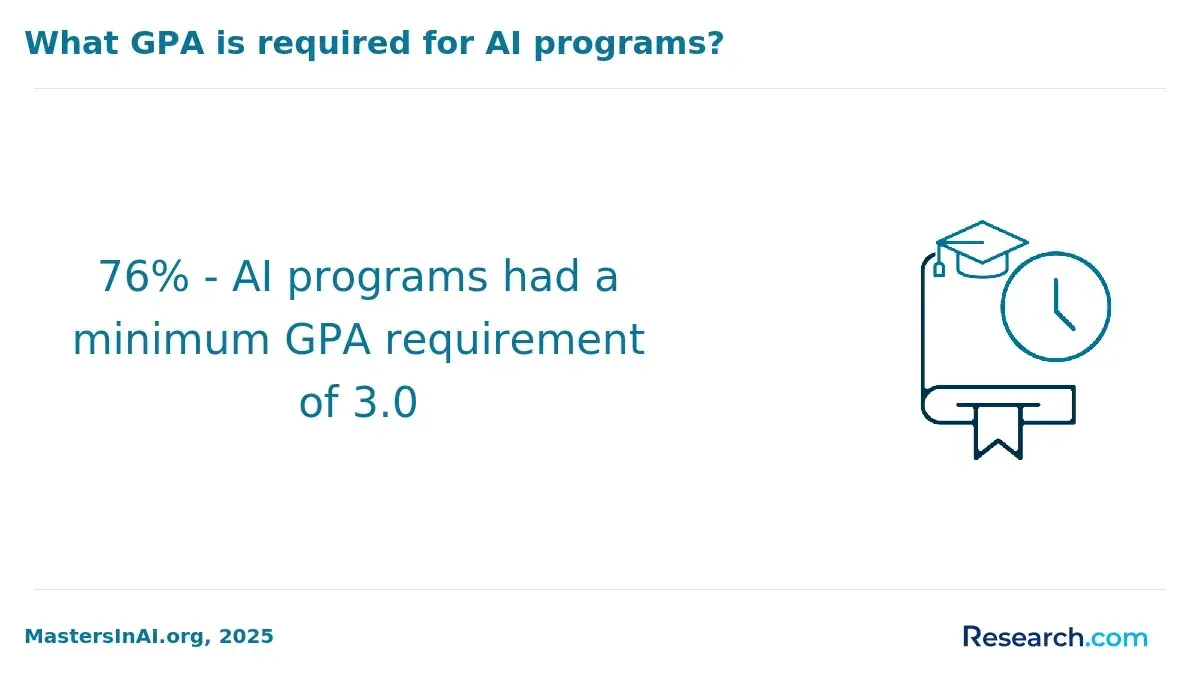
Admissions requirements for AI master’s programs using Google Cloud typically include a bachelor’s degree, evidence of quantitative ability, programming preparation, transcripts, recommendations, a statement of purpose, and sometimes standardized test scores. A computer science, engineering, mathematics, statistics, or related STEM background is common, but some programs consider applicants from other fields if they can show readiness for graduate-level technical work.
Applicants are usually expected to have preparation in several areas:
- Programming: Python is especially useful, and some programs also value Java or other languages.
- Mathematics: Linear algebra, calculus, probability, and statistics are often important for AI coursework.
- Data analysis: Experience working with datasets, databases, or analytics tools can strengthen an application.
- Computer science fundamentals: Algorithms, data structures, and systems knowledge may be required or recommended.
- Cloud familiarity: Prior experience with Google Cloud or another cloud platform can help, but it is not always required.
Typical application materials include official transcripts, letters of recommendation, a resume, and a statement of purpose explaining career goals and interest in AI. Some programs may request a portfolio, coding sample, technical interview, or prerequisite coursework. International applicants usually need to submit proof of English proficiency through TOEFL or IELTS exams.
GRE requirements vary. Some programs still accept or require standardized test scores, while others are test-optional. According to GMAC’s Application Trends Survey 2024, 42% of business master’s programs with AI or analytics tracks accept GRE scores, and some waive this requirement for candidates with strong professional backgrounds or prior graduate work.
For career changers, the most common mistake is applying before addressing prerequisite gaps. If your background is not technical, consider completing programming, statistics, and introductory machine learning coursework before applying. Google Cloud certifications such as Google Cloud Professional Data Engineer may support an application, but they usually do not replace academic prerequisites unless the program specifically says so.
How long do these AI master's programs take, and what do they cost?
AI master’s programs with Google Cloud AI training generally take 1 to 2 years for full-time students. Part-time students often take 3 years or more, depending on course load, work schedule, transfer credits, prerequisites, and whether the program includes a thesis, practicum, or capstone project.
Cost varies widely by school type, residency status, delivery format, and fee structure. At public universities, average graduate tuition and fees amount to $12,201 annually for in-state students and $28,485 for out-of-state students, according to College Board, Trends in College Pricing 2024. Private institutions frequently charge over $50,000 per year.
For a two-year full-time student at a public university, tuition alone may total about $24,400 for an in-state student, excluding fees, books, software, technology costs, and any cloud-related expenses. An out-of-state student should budget roughly $57,000 for the same period. Online programs that include Google Cloud AI certifications often charge per course, ranging from $1,000 to $3,000.
When comparing costs, do not look only at advertised tuition. Ask whether the program includes Google Cloud credits, lab fees, exam-prep materials, certification exam costs, proctoring fees, and required software. Also confirm whether online students pay different tuition than campus students and whether part-time enrollment changes financial aid eligibility.
- Typical duration: 1-2 years full-time, 3+ years part-time
- In-state tuition: approximately $12,201 per year at public universities
- Out-of-state tuition: approximately $28,485 per year at public universities
- Private institutions: can exceed $50,000 per year
- Online Google Cloud AI courses: $1,000 to $3,000 per course
Financial aid, scholarships, assistantships, employer tuition benefits, and military education benefits may reduce out-of-pocket costs. Working professionals should also ask employers whether Google Cloud certification preparation, AI coursework, or graduate tuition qualifies for reimbursement.
Which Google Cloud certifications align best with an AI master's degree?
The Google Cloud certifications that align best with an AI master’s degree are the ones that validate practical machine learning, data engineering, and cloud deployment skills. The strongest match for many students is the Professional Machine Learning Engineer certification because it focuses on designing, building, and deploying machine learning models using Google Cloud tools. According to the Skillsoft IT Skills and Salary Report 2024, this credential commands an average salary of $180,000.
The Professional Data Engineer certification is also highly relevant because AI systems depend on reliable data pipelines, scalable storage, data quality, and analytics infrastructure. Students who want to work on AI platforms, enterprise data systems, or MLOps may benefit from pairing AI coursework with data engineering validation.
The TensorFlow Developer Certificate can support students focused on model development, deep learning, computer vision, or natural language processing. TensorFlow is widely used in AI research and applied machine learning, and the certificate can help demonstrate hands-on framework proficiency.
The Associate Cloud Engineer certification is a good foundation for students who need broader cloud infrastructure knowledge before pursuing more specialized AI or data credentials. It can be especially useful for career changers who have machine learning coursework but limited cloud operations experience.
- Professional Machine Learning Engineer: Best for students targeting AI engineer, ML engineer, or MLOps-focused roles.
- Professional Data Engineer: Best for students working with large datasets, data pipelines, analytics platforms, and production AI systems.
- TensorFlow Developer Certificate: Best for students emphasizing model development and deep learning implementation.
- Associate Cloud Engineer: Best for building cloud fundamentals before advanced AI deployment work.
Students should avoid collecting certifications without a strategy. Choose credentials that match your target role, the tools used in your degree program, and the type of portfolio projects you can discuss in interviews.
What jobs can graduates get after an AI master's with Google Cloud training?
Graduates of an AI master’s program with Google Cloud training can pursue roles that require both AI knowledge and cloud implementation skills. The strongest fit is usually in jobs where models must be deployed, monitored, scaled, and connected to real business or research workflows.
Common roles include:
- AI Engineer: Builds AI applications, integrates models into software systems, and develops scalable solutions on cloud infrastructure.
- Machine Learning Engineer: Designs, trains, evaluates, deploys, and optimizes machine learning models using tools such as Vertex AI, AutoML, and TensorFlow.
- Data Scientist: Analyzes large datasets, builds predictive models, and may use Google Cloud BigQuery and AI APIs to support decision-making.
- Cloud AI Specialist: Helps organizations implement AI workflows using Google Cloud services and production-ready deployment practices.
- Cloud Architect for AI: Designs cloud environments that support AI workloads, data pipelines, security, scalability, and reliability.
- Machine Learning Researcher: Develops and tests algorithms, often using cloud infrastructure for experimentation and large-scale computation.
- AI Consultant: Advises organizations on AI strategy, use cases, implementation risks, and Google Cloud AI adoption.
- AI Product Manager: Guides AI-enabled products by connecting technical capabilities, customer needs, governance, and business goals.
Global demand for “AI and Machine Learning Specialists” is growing rapidly, according to the World Economic Forum’s projections for 2023 to 2027. Graduates with Google Cloud experience may be especially competitive in industries such as technology, finance, healthcare, and retail, where organizations need AI systems that operate reliably at scale.
U.S. AI engineers typically earn between $120,000 and $180,000 annually, with premiums for Google Cloud credentials. Actual outcomes depend on experience, location, portfolio quality, industry, and the depth of cloud and AI skills gained during the degree.
To improve job readiness, students should graduate with more than coursework. Strong candidates can explain their capstone projects, show deployed models or documented workflows, discuss trade-offs in model performance and cost, and demonstrate familiarity with Google Cloud’s AI suite.
What salary ranges and job outlook apply to AI roles using Google Cloud?
AI roles that use Google Cloud skills often have strong salary potential because they combine machine learning, data infrastructure, and cloud deployment expertise. Entry-level AI engineers and data scientists typically earn between $90,000 and $110,000 annually, while experienced professionals can make $130,000 to $180,000 depending on specialization, location, industry, and responsibility level.
The job outlook is also favorable. The U.S. Bureau of Labor Statistics projects 35% growth in employment for data scientists from 2022 to 2032, much faster than the average for all occupations. This growth reflects increased use of AI-enabled decision-making, automation, predictive analytics, and cloud-based data systems across the economy.
Common roles that benefit from Google Cloud AI skills include AI/ML Engineer, Data Scientist, Cloud Solutions Architect, and MLOps Engineer. Professionals who combine a master’s degree in AI with Google Cloud certifications, such as the Professional Machine Learning Engineer credential, may be better positioned for roles involving model deployment, monitoring, automation, and production support.
Pay can vary substantially. Tech hubs like San Francisco and New York offer 15-25% higher pay than the national average, while finance and healthcare fields often pay more than academia or government positions. Cloud specialization may also affect compensation because employers need people who can move AI projects from prototypes into secure, scalable systems.
For students evaluating return on investment, salary should be considered alongside total program cost, opportunity cost, employer tuition support, internship access, portfolio development, and certification alignment. The best financial outcome usually comes from choosing a program that builds demonstrable skills employers can verify through projects, interviews, and cloud credentials.
Other Things You Should Know About Artificial Intelligence
Capstone projects in AI master's degrees with Google Cloud training are critical for practical learning. They usually involve solving real-world AI problems using Google Cloud technologies, culminating in a final presentation and report. This hands-on experience prepares students for industry requirements.
No. Most programs list a bachelor’s degree, minimum GPA, and prior coursework in programming or statistics, but not a Google Cloud skills badge. Google Cloud training is usually built into the curriculum after enrollment, often through guided labs and 3 to 6 graduate credits.
Strong foundations in linear algebra, calculus, probability, and statistics are typically required for master's programs integrating Google Cloud AI training. These mathematical skills are essential for understanding machine learning algorithms, optimizing models, and interpreting AI results effectively within cloud environments.
AI ethics is a crucial component of Google Cloud AI master's programs, ensuring graduates understand responsible AI development. Courses often include discussions on bias, fairness, privacy, and accountability in AI systems, emphasizing ethical implications and best practices in AI deployment and use.
References
- Introduction to AI and Machine Learning on Google Cloud | Google Skills https://www.skills.google/course_templates/593
- GoogleCloud: Introduction to AI and Machine Learning on Google Cloud | edX https://www.edx.org/learn/computer-science/google-cloud-introduction-to-ai-and-machine-learning-on-google-cloud
- Best AI Masters Online & On-Campus - AIDegreePrograms.org https://aidegreeprograms.org/rankings/best-ai-masters-programs/
- 7 Jobs You Can Get with a Google Cloud Certification https://www.pluralsight.com/resources/blog/cloud/7-jobs-you-can-get-with-a-google-cloud-certification
- Google AI/ML: Step-by-Step Activity Guide (Hands-on Lab) https://k21academy.com/google-cloud/google-ai-ml-hands-on-lab-project/
- Top AI Certifications: The Best Programs to Master AI in 2026 https://www.sprintzeal.com/blog/top-ai-certifications
- AI courses and tools from Google - Grow with Google https://grow.google/ai-coursera
- AGTU | Global Degree Online https://agtu.us/en/programs/graduate-programs/computer-science/master-artificial-inteligence/free/
- Understanding AI: AI tools, training, and skills https://ai.google/learn-ai-skills/
- Master of Artificial Intelligence https://wscs.eu/master-of-artificial-intelligence/