2027 FAFSA Guide for AI Associate Degree Programs

Co-Founder and Chief Data Scientist
Many prospective students aiming for an AI associate degree face confusion navigating the FAFSA process. Uncertainty about eligibility, deadlines, and required documentation can delay or derail access to crucial financial aid. This challenge often discourages individuals switching careers or returning to education later in life.
Understanding how to effectively complete the FAFSA is vital to maximize aid opportunities and reduce out-of-pocket costs. This article explains the 2027 FAFSA application specifically for AI associate degree programs, clarifying steps and common pitfalls to help readers secure the funding necessary to pursue their education goals efficiently.
Key Things You Should Know
- FAFSA 2026 opens October 1, allowing prospective AI associate degree students to apply for federal aid, including Pell Grants, which cover up to $7,395 annually for eligible students.
- Income information from 2024 tax returns is required for FAFSA 2026, influencing aid eligibility and maximizing access to grants, loans, and work-study for AI program candidates.
- With rising demand for AI skills, over 30% of community colleges offer AI-related associate degrees, making FAFSA crucial for affordable entry into this expanding field.
What is an AI associate degree and how does it differ from bachelor's programs in artificial intelligence?
An AI associate degree focuses on foundational skills in data analysis, programming, machine learning, and automation, typically completed in two years. These programs offer hands-on training preparing students for entry-level roles such as AI technicians, data analysts, or AI support specialists. Coursework often includes Python, statistics, database management, and introductory machine learning algorithms.
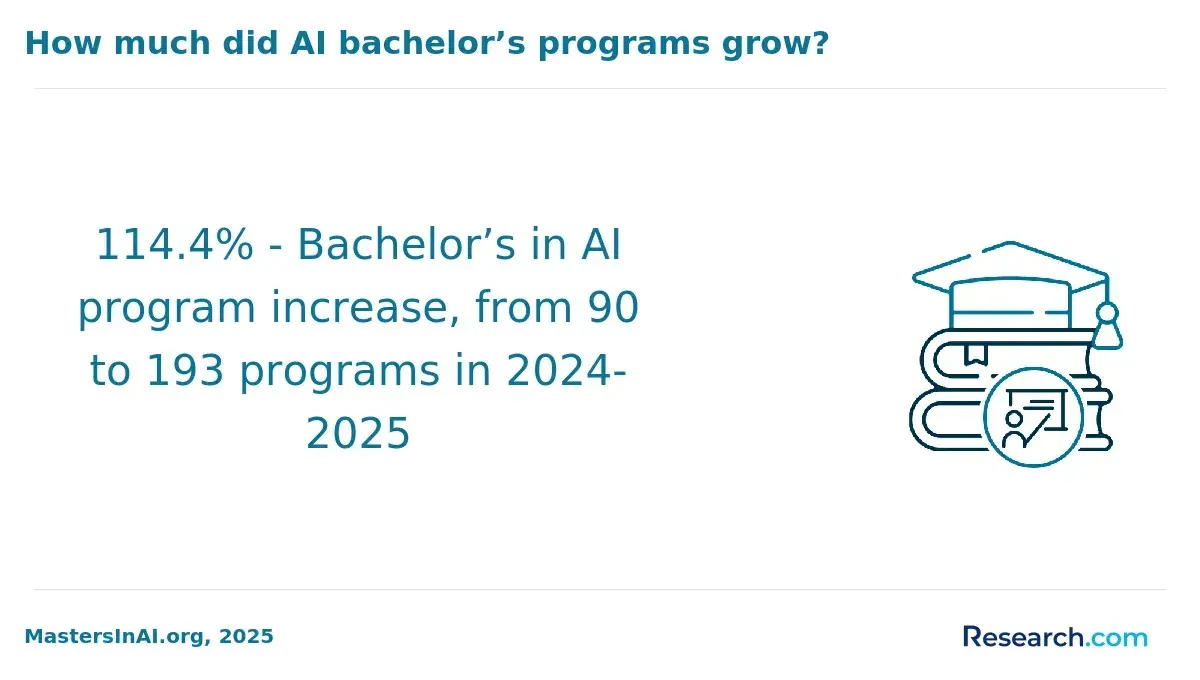
In contrast, bachelor's degree programs in artificial intelligence span four years and provide a deeper, more theoretical understanding of AI concepts, mathematics, advanced algorithms, and system design. Bachelor's degrees also cover broader computer science subjects, ethical considerations, and research methodologies, qualifying graduates for specialized roles like AI developers, researchers, or engineers.
The differences between AI associate and bachelor degrees mainly reflect the depth and scope of study. Associate degrees offer a faster, more affordable path into the AI job market, ideal for students seeking practical skills or planning later transfer to a bachelor's program. They also appeal to working professionals aiming to upgrade skills without committing to a longer degree. Bachelor's graduates typically qualify for advanced positions requiring stronger problem-solving and development expertise.
The U.S. Bureau of Labor Statistics projects 15% growth in computer and information technology jobs from 2023 to 2033, adding about 667,600 roles. This growth spans both entry-level and advanced positions, supporting the value of both associate and bachelor's degrees in AI. Students should carefully assess their career goals, time, and finances when deciding between an AI associate degree vs bachelor's degree programs.
For more insight on career possibilities, see what can you do with an applied artificial intelligence degree.
How does FAFSA work for AI associate degree programs, and what financial aid is available?
FAFSA supports financial aid for AI associate degree programs similarly to other fields, helping students apply for federal financial assistance by completing the Free Application for Federal Student Aid. This process evaluates financial need based on personal and family income to determine eligibility for grants, loans, and work-study opportunities.
Early submission is crucial since some aid is awarded on a first-come, first-served basis. According to the National Center for Education Statistics, 86% of full-time undergraduates at degree-granting postsecondary institutions received some form of financial aid during the 2023-24 period, highlighting widespread availability of support.
Primary funding options via FAFSA include Federal Pell Grants, which do not require repayment and can significantly reduce tuition costs depending on financial need. Federal Direct Loans, encompassing subsidized and unsubsidized versions, offer low-interest rates and flexible repayment plans.
Work-study programs provide part-time jobs on campus or in the community, offsetting education expenses while providing practical experience. Additionally, private grants or scholarships tailored to AI-related fields may be available through separate applications and can supplement FAFSA aid. Prospective students might also explore related programs like the mechanical engineer degree online for alternate STEM options.
Students enrolled in accredited AI associate degree programs should stay in contact with their institution's financial aid office to track deadlines and uncover additional funding opportunities. Those with unusual financial circumstances have the option to appeal FAFSA results by submitting documentation.
Dual-enrolled high school students and transfer students should also file FAFSA to confirm their aid eligibility. Understanding FAFSA eligibility and funding options for AI associate degrees in the US maximizes access to crucial cost-reduction resources, helping prevent financial shortfalls that could impede degree completion.
What are the admission requirements and prerequisites for accredited AI associate degree programs?
Admission requirements for accredited associate degree programs in artificial intelligence in the US generally include a high school diploma or equivalent, with a significant focus on math skills. Many programs expect completion of Algebra II and precalculus, as students who finish these courses are 23% more likely to complete STEM associate degrees, underlining their importance for success in AI fields.
Minimum GPA expectations, often around 2.5 on a 4.0 scale, may apply, especially in science and math subjects. Placement tests or remedial coursework might be needed for applicants without advanced math background. Basic computer literacy demonstrated through prior courses or test scores is also commonly required.
Prerequisites for enrolling in accredited AI associate degree programs often include foundational programming, statistics, and logic courses, either completed in high school or during the degree. These prepare students for advanced topics like machine learning and data analysis. Admission policies vary: technical colleges may value practical experience or certifications, while community colleges emphasize academic prerequisites. Veterans and adult learners sometimes access alternative admissions through portfolio reviews or competency assessments.
Prospective students should review specific program details since some institutions require introductory programming courses or standardized test scores such as the SAT or ACT. Considering options among the cheapest engineering colleges can help balance quality and affordability in pursuing an AI associate degree.
Which accrediting bodies recognize AI associate degree programs, and how do you verify program accreditation?
AI associate degree programs are primarily accredited by regional bodies approved by the U.S. Department of Education and specialized agencies such as the Accreditation Council for Business Schools and Programs (ACBSP). ACBSP has accredited over 1,400 business and computing programs worldwide, including those focused on AI technology, ensuring curricula meet industry-relevant educational standards.
Regional accreditors like the Higher Learning Commission (HLC), Middle States Commission on Higher Education (MSCHE), and Southern Association of Colleges and Schools Commission on Colleges (SACSCOC) oversee institutional quality, which is crucial for federal financial aid eligibility and credit transferability. Knowing the key accreditation agencies for AI associate degrees helps students choose reliable programs.
To verify accreditation of AI associate programs, students should consult the U.S. Department of Education's official database or the Council for Higher Education Accreditation (CHEA) website. Checking the program's institutional website for listed accrediting bodies and ensuring the AI track is specifically accredited is important. Contacting the registrar or admissions office to request official documentation adds an extra layer of confirmation.
Beware of programs claiming accreditation from non-recognized agencies or offering online-only certificates without proper accreditation, as this can impact FAFSA aid eligibility, graduate studies options, and employer recognition. For those exploring related fields, consider reviewing online cyber security degrees as an alternative or complementary path.
What is the typical curriculum and coursework in an AI associate degree program?
An AI associate degree program integrates foundational studies in computer science, mathematics, and statistics with specialized topics such as machine learning, neural networks, and natural language processing. Students learn essential programming languages like Python and R while developing strong computational problem-solving skills through data structures and algorithms.
Core classes often cover data science, database management, and cloud computing, equipping students to manage large datasets and deploy AI models effectively. Hands-on labs are a critical part of the curriculum, allowing students to design, train, and test machine learning models using real-world datasets. According to CompTIA's 2024 Cybersecurity Jobs Report, 73% of employers highly value such practical lab experience for entry-level technical roles.
Courses may also focus on AI ethics and the societal effects of automation, alongside interdisciplinary studies linking AI with business analytics or robotics. Many programs require a capstone project or internship to provide direct industry exposure.
Typically spanning 60 to 70 credit hours over two years, programs may include extra coursework in cybersecurity or electives in deep learning. Prospective students should seek programs balancing theory with practical labs and up-to-date tools like TensorFlow or PyTorch to remain competitive in this fast-evolving field.
How long does an AI associate degree take to complete, and what is the average total cost?
An AI associate degree generally requires about two years of full-time study, though the timeline can vary. Part-time enrollment, transfer credits, and accelerated paths may shorten or extend this period to as little as 18 months or as long as three years. Such flexibility suits students balancing work and other commitments.
Tuition costs largely depend on the type of institution and residency status. For in-state students at public two-year colleges, average tuition and fees are approximately $3,860 annually, totaling around $7,720 for the degree. This is considerably more affordable than many bachelor's degree programs, which often exceed $10,000 per year. Additional expenses may include textbooks, supplies, technology fees, and specialized software or hardware essential for AI coursework, so budgeting for these is important.
Financial aid through FAFSA and other sources can substantially reduce out-of-pocket costs, particularly at public and community colleges. Students attending private institutions or studying part-time should prepare for potentially higher or prolonged expenses. Careful planning ensures alignment with both academic goals and financial resources.
Are AI associate degree programs available online, and how do online and campus formats compare?
AI associate degree programs are widely available online, offering flexibility for students balancing work, family, or geographic constraints. According to the National Center for Education Statistics, 35% of undergraduates enrolled in distance education courses in fall 2023. Online AI associate degrees have a completion rate of 58%, compared to 62% for traditional in-person programs, highlighting that online formats increase access but require strong self-discipline and time management.
Many online AI programs feature asynchronous coursework, allowing students to learn at their own pace-ideal for working professionals. Some include live sessions or virtual labs for hands-on experience. Campus programs provide face-to-face interaction with instructors and peers, enhancing networking and immediate feedback during labs and group projects.
Prospective students should consider their learning style when choosing between formats. Beginners or those unfamiliar with programming might benefit from campus environments with personalized support. Meanwhile, digital natives or independent learners can excel in online settings. Since AI careers demand practical skills, ensuring programs integrate relevant projects and tools is essential regardless of delivery mode.
Financial aid like FAFSA is available for both online and campus AI associate degrees at accredited schools. Evaluating accreditation, tech support, and course relevance can help students select programs aligned with their career goals in AI and emerging technologies.
What professional certifications can you earn alongside or after completing an AI associate degree?
Students earning an AI associate degree can boost their career prospects by obtaining professional certifications from leading providers such as CompTIA, Microsoft, and AWS. These credentials focus on essential IT knowledge and cloud computing-core elements in AI deployment. For instance, certifications like CompTIA's A+ or Network+ enhance hardware and networking expertise, while Microsoft's Azure AI Fundamentals and AWS Certified Machine Learning - Specialty confirm skills in cloud AI services.
Certifications help graduates demonstrate practical proficiency valued by employers, bridging the gap between academic learning and real-world application. Many students integrate certification study into their coursework or pursue these qualifications after graduating as part of ongoing professional development. The U.S. Bureau of Labor Statistics reports a 28% annual increase in candidates earning CompTIA, Microsoft, and AWS certificates, highlighting growing industry demand for multifaceted, certified AI professionals.
Additional specialized certifications, such as Google's Professional Machine Learning Engineer and IBM AI Engineering, focus on advanced AI competencies. These credentials prepare individuals for roles in AI model development, data engineering, and system integration.
Maintaining certifications alongside or following an associate degree ensures graduates can adapt within a fast-changing tech environment and offer verified skills to prospective employers.
What career roles and job titles are available to AI associate degree graduates?
Graduates with an associate degree in artificial intelligence can pursue a variety of in-demand careers, including machine learning engineer, AI data analyst, and prompt engineer. Machine learning engineers develop and optimize algorithms, requiring skills in Python, neural networks, and model evaluation. AI data analysts work with large datasets to extract insights and improve models, relying on expertise in statistical software and data visualization. Prompt engineers, a rapidly emerging role, create precise input prompts to effectively guide language models and generative AI tools, acting as a crucial link between human intent and AI responses.
Other career paths include AI support technician, responsible for maintaining AI infrastructure and assisting in testing, and junior AI software developer, who writes code for AI applications under guidance. AI quality assurance specialists also play a key role, ensuring AI models deliver accurate outputs. These entry-level roles often require a mix of technical abilities and analytical thinking. Employers are increasingly valuing candidates proficient in AI frameworks, data management, and communication skills.
According to LinkedIn's 2024 Jobs Report, AI data analyst positions surged 74% year-over-year in job postings, reflecting strong demand in data-focused roles. This growth highlights the expanding opportunities for those holding artificial intelligence associate degrees.
What is the job outlook and average salary for AI associate degree graduates in 2027?
Associates degree holders in artificial intelligence (AI) typically find strong employment prospects and competitive salaries. According to the U.S. Bureau of Labor Statistics, computer support specialists-a role often filled by AI graduates-earn a median annual wage of $61,490 as of May 2024. This demand is fueled by the increasing use of AI technologies in industries like healthcare, finance, manufacturing, and customer service.
Job growth for AI-related positions is projected at 11% through 2033, outpacing the average for all occupations. Entry-level roles such as AI support technicians, junior machine learning assistants, and data specialists provide a solid foundation. Salary ranges depend on location, employer, and additional certifications in areas like machine learning or programming languages such as Python, which can enhance earning potential and career progression.
Strong analytical skills, problem-solving, and familiarity with AI tools are essential for success. Gaining practical experience and continuing education improve employability and open pathways to mid-level roles like AI analyst or AI system operator, where salaries tend to rise significantly.
Overall, holding an AI associate degree offers a stable career path with solid income potential, supported by a positive employment outlook from authoritative sources.
Other Things You Should Know About Artificial Intelligence
Students pursuing an AI associate degree should focus on programming languages commonly used in artificial intelligence development. Python is the most popular choice due to its extensive libraries for machine learning and data analysis. Other useful languages include R for statistics and data visualization, as well as Java and C++ for performance-critical applications.
Many AI associate degree programs encourage or require internships to provide hands-on experience. Internships are often available through partnerships with tech companies, startups, and research labs. These opportunities allow students to apply theoretical knowledge in real-world AI projects and build professional networks.
To be eligible for FAFSA in 2027, students enrolling in AI associate degree programs must be U.S. citizens or eligible non-citizens, have a valid Social Security number, and demonstrate financial need. They must also be enrolled in an accredited institution and maintain satisfactory academic progress.
Yes, graduates with an AI associate degree can often transfer credits to bachelor's programs in computer science, data science, or artificial intelligence. This pathway allows for deeper specialization and better career opportunities. It is advisable to confirm transfer policies with both the associate and bachelor's institutions in advance.
References
- What Is The Best Degree for Artificial Intelligence? https://campus.edu/blog/artificial-intelligence/what-is-the-best-degree-for-artificial-intelligence
- Artificial Intelligence Salary and Jobs in 2025 - Is it in High Demand? https://dumpsgate.com/artificial-intelligence-salary/
- Online Associate Degrees | American InterContinental University https://www.aiuniv.edu/degrees/associate
- Job Roles After an AI Certificate - IABAC https://iabac.org/blog/job-roles-after-an-ai-certificate
- Top Artificial Intelligence Courses: Fees and Duration https://collegevidya.com/blog/artificial-intelligence-course-fees-structure-duration/
- Artificial Intelligence Course Duration Guide for 2025 Beginners | Your Blog https://mammothclub.com/blog/artificial-intelligence-course-duration
- How Long is an Average AI Course? A Complete Guide for Learners https://emeritus.org/in/learn/how-long-is-an-average-ai-course/
- How Long Does It Take to Complete an AI Course https://www.epw.com/blog/courses/how-long-is-ai-course
- How FAFSA Works & Important Things to Know | Ascent Funding https://www.ascentfunding.com/blog/fafsa-101/
- Best Online AI Degrees: 2025 Rankings & Program Directory - MastersInAI.org https://www.mastersinai.org/degrees/online-artificial-intelligence-degrees/