2027 AI Master's Degrees With Evening Classes

Co-Founder and Chief Data Scientist
Many working professionals with unrelated undergraduate degrees face the challenge of shifting careers into artificial intelligence while maintaining full-time jobs. Evening classes offer a practical solution, allowing students to balance work and study without sacrificing income. However, finding accredited programs that combine flexibility, industry relevance, and rigorous curriculum can be difficult.
The high demand for AI expertise makes choosing the right master's degree essential for a successful transition. This article reviews current evening master's degree options in artificial intelligence, highlighting programs designed to support career changers with convenient schedules and comprehensive training.
Key Things You Should Know
- In 2027, AI master's degrees with evening classes cater to working professionals, combining flexibility with advanced technical training to meet growing industry demands.
- Programs emphasize practical skills in machine learning, data analysis, and ethical AI, reflecting a 35% projected job growth in AI-related fields through 2030.
- Many accredited U.S. universities offer hybrid or fully online evening formats, improving access for diverse students balancing careers and education.
What is an AI master's degree with evening classes, and who is it for?
An AI master's degree evening programs offer flexible advanced education designed for working professionals and career changers. These programs schedule classes outside regular daytime hours, making it easier for students to maintain full-time employment while deepening technical skills in machine learning, natural language processing, robotics, and data analytics.
In many cases, evening courses share the same curriculum as full-time programs but extend over a longer period or use half-semester modules to accommodate part-time attendance. Formats vary widely, from in-person evening classes to hybrid models that combine online and face-to-face sessions, as well as fully online courses with synchronous or asynchronous options.
Such flexibility suits students balancing jobs with study. For instance, a database engineer can keep their daytime role and attend live evening classes twice a week. The growing demand for flexible delivery in graduate education is reflected in surveys showing that over half of prospective students prefer online artificial intelligence master's courses for working professionals.
Prospective students should consider program format, instructor qualifications, industry connections, and prerequisites carefully. Evening AI degrees are ideal for those aiming to pivot careers, upgrade STEM skills, or expand interdisciplinary knowledge in fields like healthcare, finance, and manufacturing without pausing their current job or personal life.
To better understand career outcomes related to such degrees, students can research, "What jobs can you get with an AI degree?"
Which accredited U.S. schools offer AI master's programs with evening schedules?
Many accredited U.S. schools offer evening artificial intelligence master's programs designed for working professionals and nontraditional students. Institutions like Northeastern University, University of Southern California (USC), and Columbia University provide part-time master's degrees in artificial intelligence or related fields such as machine learning and data science. These programs often feature evening or late afternoon classes in hybrid or fully in-person formats.
For example, Northeastern's College of Computer and Information Science offers an MS in Artificial Intelligence with part-time evening options across several urban campuses. USC's Viterbi School of Engineering delivers an MS in Computer Science specializing in AI, including evening courses tailored for professionals in the Los Angeles area. Columbia Engineering's evening MS programs allow students to focus on AI through electives while managing work commitments.
Federal Title IV aid programs support more than 4,000 U.S. institutions, ensuring these programs come from a well-regulated and quality-assured educational ecosystem. Accreditation guarantees standards are met and provides access to financial aid. Practical considerations for prospective students include program flexibility, modality (online, hybrid, in-person), access to faculty experts, and alignment with career goals in AI domains such as natural language processing, computer vision, or robotics.
Evening programs often limit cohort size and course availability, so early application and direct contact with advisors are crucial. Those seeking an affordable data science degree may find well-structured options within these offerings to advance their careers efficiently. Learn more about affordable data science degree programs at affordable data science degree programs.
How do online, hybrid, and on-campus evening AI master's programs compare?
Online, hybrid, and on-campus evening AI master's programs serve diverse student needs with distinct advantages. Online programs maximize flexibility, allowing students to balance work and study without commuting. Asynchronous lectures and digital resources enable access to coursework anytime, an important factor considering that over half of U.S. postsecondary students take at least one distance-education course.
However, online formats may limit real-time interaction and networking critical in technical fields like AI. Hybrid programs combine remote learning with scheduled on-campus sessions, offering flexibility alongside face-to-face engagement. These formats suit those needing hands-on labs or access to campus facilities, common in applied AI fields such as robotics or natural language processing.
On-campus evening programs provide direct faculty access, peer interaction, and immediate technical support through live discussions, workshops, and research opportunities. This format fits students focused on experimental or team-based AI work, but can challenge full-time employees due to commuting and fixed schedules.
When comparing evening AI master's programs, career goals, personal commitments, and learning preferences are essential factors. Prospective students should review program accreditation, technology platforms, and support services. For those exploring affordable options, considering a game design online degree may also offer insight into flexible learning models.
What prerequisites and admission requirements do AI master's programs typically require?
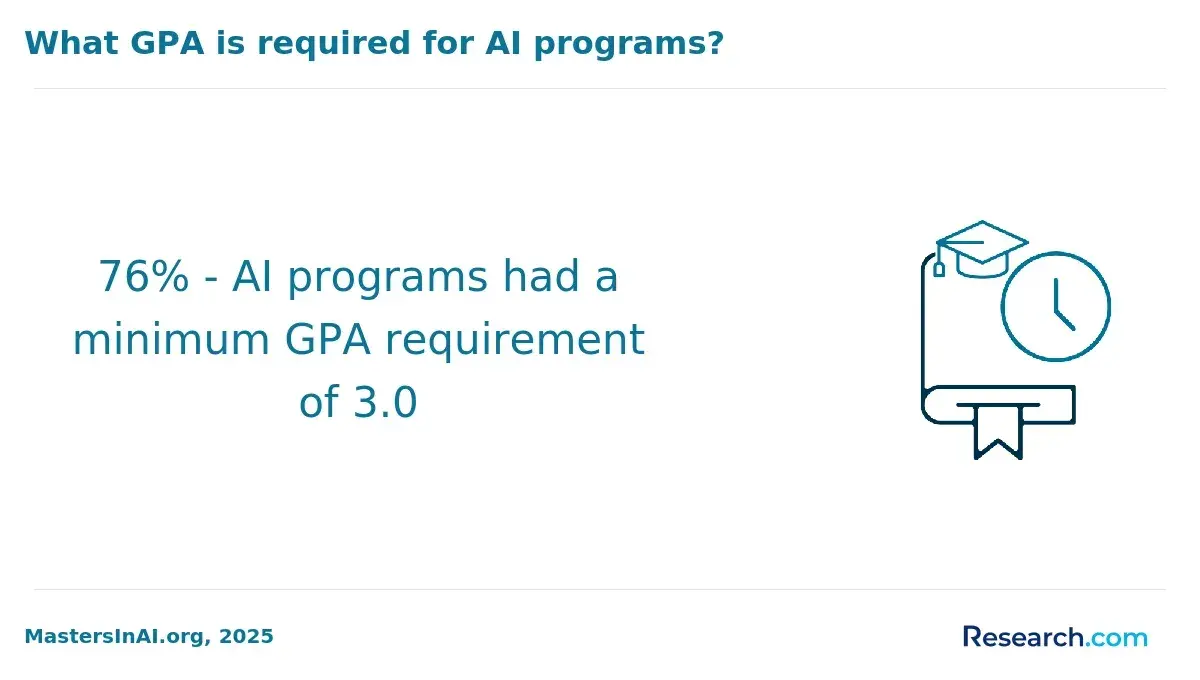
AI master's degree admission criteria in the United States generally include a bachelor's degree in computer science, engineering, mathematics, or a related STEM discipline. Applicants must show proficiency in programming languages like Python, Java, or C++, along with strong quantitative skills in calculus, linear algebra, statistics, and probability. Prior coursework or experience in core AI topics such as machine learning, algorithms, and data structures is commonly required.
Admission typically requires submission of transcripts, letters of recommendation, and a personal statement demonstrating research interests or career goals. Competitive programs may favor candidates with relevant work experience or research projects in AI or data science. Some universities ask for GRE scores, although many, including MIT since 2024, have adopted GRE-optional policies to increase accessibility.
International students often need to provide proof of English proficiency through TOEFL or IELTS. Evening class requirements for US artificial intelligence graduate programs tend to emphasize practical experience or technical certifications to accommodate working professionals. Specific prerequisites vary by institution and can include completion of discrete mathematics, advanced statistics, or portfolios of coding projects and published research.
The balance between rigorous academics and professional obligations makes evening classes a suitable option for many. Those seeking to strengthen their readiness may explore offerings such as an accelerated cybersecurity program, which can complement AI studies in related fields. Early preparation in programming, quantitative skills, and relevant experience is key to improving admission prospects for AI master's programs that offer flexible scheduling.
What courses and specializations are common in AI master's degree curricula?
Master's degree programs in artificial intelligence commonly cover essential subjects such as machine learning, natural language processing, computer vision, and robotics. These areas provide a strong foundation in algorithms, data structures, and model training. Students learn advanced deep learning techniques, including convolutional and recurrent neural networks.
Specializations allow students to focus on specific sectors or advanced methodologies, including:
- AI for healthcare, emphasizing predictive analytics and diagnostic imaging
- Reinforcement learning for autonomous agents and robotics development
- AI ethics and policy, addressing fairness, bias, and regulations
- Big data analytics for scalable AI models applied to large datasets
- AI in cybersecurity, focusing on threat detection and prevention
Proficiency in programming languages such as Python, along with frameworks like TensorFlow or PyTorch, is integral. Many curricula involve project-based learning that replicates real-world AI challenges. Evening classes often cater to working professionals by blending technical training with applied projects relevant to industries like finance, manufacturing, and smart cities.
According to the World Economic Forum's Future of Jobs Report 2024, careers like AI and machine learning specialists are among the fastest-growing globally. This trend underscores the importance of programs that merge rigorous theoretical knowledge with practical application and domain specialization. Prospective students should ensure their chosen programs offer current, interdisciplinary content reflecting the rapidly evolving AI landscape.
How long do evening AI master's programs take, and how many credits are required?
Evening master's programs in artificial intelligence usually require 30 to 36 graduate credits. Designed for working professionals, these programs extend over two to three years on average, compared to full-time day programs that often finish within 12 to 18 months. The part-time enrollment model significantly influences this longer timeline.
In 2024, 54% of U.S. graduate students attended part-time, according to the National Center for Education Statistics. Students balancing work and study often take fewer credits per semester, typically 6 to 9, by enrolling in one or two evening courses. This flexibility naturally extends the duration but makes advanced education accessible without sacrificing employment.
Some programs offer accelerated tracks with heavier course loads and intensive evening classes, enabling students to graduate in about two years. Most curricula include foundational coursework, electives, and a capstone or thesis project to meet credit requirements.
Prospective students should confirm if evening classes cover all required courses and clarify transfer credit policies to potentially reduce time-to-degree. Planning course schedules strategically is key to managing workload and ensuring timely graduation in an evening artificial intelligence master's program.
How much does an evening AI master's degree cost, and what financial aid applies?
Evening master's degrees in artificial intelligence usually cost between $20,000 and over $60,000 in total tuition, depending on the school and program length. Public universities tend to have lower tuition, especially for in-state students, often ranging from $20,000 to $35,000. Private or prestigious programs can exceed $50,000 to $70,000. Additional fees for technology access, labs, and textbooks may add $1,000 to $3,000 per year.
Financial aid options for evening students include federal loans, scholarships, employer tuition assistance, and grants. Federal Direct Unsubsidized Loans allow graduate students to borrow up to $20,500 annually without demonstrating financial need, though interest accrues from disbursement. The Federal Grad PLUS Loan can cover remaining costs but requires a credit check.
Scholarships targeted at artificial intelligence or data science are available but competitive. Many institutions also offer merit-based awards that evening students can apply for at admission. Employer tuition reimbursement programs from companies like Google, Amazon, and IBM often provide partial or full funding, typically requiring satisfactory grades or continued employment commitments.
Other funding sources may include state grants and assistantships, though availability for evening programs varies. Budgeting carefully across loan limits, scholarships, and employer aid can make pursuing an evening artificial intelligence master's degree more affordable and help reduce overall debt.
What careers can you pursue with an AI master's degree, and what do employers expect?
Graduates holding a master's degree in artificial intelligence can pursue varied roles, including AI engineer, machine learning specialist, data scientist, robotics engineer, natural language processing (NLP) expert, and AI research scientist. Employers prioritize candidates who demonstrate strong programming abilities, algorithmic and statistical expertise, and skills in designing scalable AI models. Experience with popular frameworks like TensorFlow, PyTorch, or scikit-learn is often essential.
Practical experience in data preprocessing, model training, and deployment remains critical across both industry and research. Other valued attributes include a solid grasp of ethical AI practices and the capacity to interpret AI outputs for informed, data-driven decisions. Effective collaboration with cross-functional teams to integrate AI solutions within existing business infrastructure is also sought after.
Specialized AI skills are increasingly important in sectors such as healthcare, finance, and autonomous vehicles. Healthcare AI roles frequently demand knowledge of medical data privacy regulations like HIPAA, while finance professionals benefit from expertise in risk modeling and fraud detection. Robotics engineers require strong fundamentals in control systems and robotics.
The demand for AI skills has risen sharply, with U.S. job postings requiring artificial intelligence expertise roughly doubling compared to the previous year. This trend highlights employers' growing focus on advanced AI capabilities combined with practical application knowledge for master's graduates.
What salaries can AI master's graduates earn across roles and industries?
Graduates with a master's degree in artificial intelligence in the U.S. enjoy competitive salaries that vary by role, industry, and location. According to the U.S. Bureau of Labor Statistics, the median annual wage for Computer and Information Research Scientists was around $145,000 as of May 2024, highlighting the strong earning potential in this field.
Salary ranges often depend on specific job titles and sectors:
- Machine learning engineers: They typically earn $120,000 to $160,000 annually, with top pay in tech hubs like Silicon Valley and New York.
- Data scientists: Professionals holding AI master's degrees usually make between $100,000 and $140,000, influenced by industries such as finance and healthcare.
- AI research scientists: Those in academia or tech firms can earn over $150,000, especially when leading projects or teams.
High-paying industries include technology, finance, healthcare, and automotive sectors centered on autonomous systems. Startups may offer lower base salaries but compensate with equity or bonuses, while government and nonprofit roles generally pay less but provide stability and work-life balance.
Location is crucial-urban centers and tech corridors offer higher wages, though with increased living costs. Specializing in areas like natural language processing or computer vision can further boost salaries. Continuous skill development remains essential for maximizing earning potential in this fast-evolving field.
Which certifications complement an AI master's degree for career advancement?
Certifications that complement an AI master's degree can significantly speed up career growth by validating skills that employers highly value. Cloud certifications, particularly from Amazon Web Services (AWS), are among the most influential. Over one million people have earned an AWS Certification. Credentials like AWS Certified Machine Learning - Specialty or AWS Certified Solutions Architect enhance a graduate's ability to deploy AI models on scalable cloud infrastructure.
Additional certifications worth considering include:
- Certified Data Scientist programs offered by the Data Science Council of America (DASCA) or Microsoft Certified: Azure Data Scientist Associate.
- DevOps certifications like Certified Kubernetes Administrator (CKA), which help optimize AI deployment and continuous integration/continuous delivery (CI/CD) pipelines.
- Ethical AI and Responsible AI certifications to meet the growing compliance and governance requirements in many sectors.
Industry-specific certifications can further boost effectiveness in applying AI. For example, healthcare professionals benefit from Health Informatics credentials, while finance experts may pursue Certified Financial Analyst (CFA) qualifications integrated with AI and quantitative skills.
Choosing certifications that align closely with one's career goals and emphasize practical cloud experience strengthens job prospects and prepares professionals to meet evolving industry demands.
Other Things You Should Know About Artificial Intelligence
Many AI master's programs offer students opportunities to engage in research projects focused on machine learning, natural language processing, computer vision, robotics, and data analytics. These projects often involve collaboration with faculty members or industry partners, providing hands-on experience with the latest AI technologies. Research participation can enhance learning and build a strong foundation for those considering doctoral studies or careers in R&D.
Internships are not always mandatory, but are highly encouraged in AI master's programs, including evening classes. Practical experience through internships, co-op programs, or industry collaborations helps students apply theoretical knowledge to real-world problems, build professional networks, and improve job prospects after graduation. Many programs assist students in finding relevant internships aligned with their career goals.
Evening classes in 2027 AI Master's degree programs are designed with flexibility to accommodate working professionals. Many offer part-time options and hybrid formats, including online and on-campus sessions, allowing students to balance work and study effectively. Additionally, class schedules are often structured to fit around standard work hours.
While not always mandatory, having a solid foundation in programming languages like Python, Java, or C++ is strongly recommended before starting an AI master's program. Courses often assume familiarity with coding, data structures, and algorithms. Some programs offer preparatory classes or boot camps to help students without a strong programming background develop the required skills.
References
- Application and admission - Master Artificial Intelligence https://www.uva.nl/shared-content/programmas/en/masters/artificial-intelligence/application-and-admission/international-prior-education/international-prior-education-foldout-menu.html
- AI Certification Programs: Which Ones Matter for Your Career https://www.businessplusai.com/blog/ai-certification-programs-which-ones-matter-for-your-career
- 5 Benefits of an Online AI MS Degree | University of Bridgeport https://www.bridgeport.edu/news/benefits-of-online-ms-ai-degree/
- Best AI Certifications to Boost Your Career in 2026 – Dataquest https://www.dataquest.io/blog/best-ai-certifications/
- Artificial intelligence and society https://psl.eu/en/education/master-s-degree-artificial-intelligence-and-society
- Masters Artificial Intelligence https://www.udacity.com/masters-artificial-intelligence
- Master’s in Artificial Intelligence: Curriculum, Scope, Jobs - TBS Education https://tbseducation.in/masters-in-artificial-intelligence-curriculum-scope-jobs/
- 16 Artificial Intelligence Career Paths https://www.calmu.edu/news/artificial-intelligence-career-paths
- AI Careers - Top AI Jobs with Education Requirements and Pay https://aidegreeprograms.org/ai-careers/
- What can I do with a master's in artificial intelligence? | edX https://www.edx.org/resources/what-can-you-do-with-a-masters-in-artificial-intelligence