2027 Capstone vs Thesis Requirements for AI Master's Programs

Co-Founder and Chief Data Scientist
Choosing between a capstone project and a thesis poses a significant challenge for prospective students aiming to enter the rapidly evolving AI field. Many face uncertainty about which option aligns better with their career goals, time constraints, and research interests. The decision impacts both skill development and employability after graduation. Understanding the distinctive requirements and outcomes of each path is essential for making an informed choice. This article examines the 2027 capstone versus thesis requirements for ai master's programs, providing clear guidance to help students select the option that best supports their professional transition and academic success.
Key Things You Should Know
- Capstone projects in 2027 AI master's programs emphasize applied problem-solving and industry relevance, while theses focus on original research contributing new knowledge to the field.
- Approximately 65% of U.S. AI master's students choose capstones for quicker completion and practical experience; theses remain preferred for those targeting PhD studies.
- Capstone assessments prioritize demonstration of technical skills and collaboration, whereas theses undergo rigorous peer review and require extensive literature analysis and defense.
What is the difference between a capstone project and a thesis in AI master's programs?
The primary distinction in capstone vs thesis requirements for AI graduate degrees lies in their objectives. A thesis involves a comprehensive research project where students formulate a hypothesis, conduct original research, and contribute new knowledge to the artificial intelligence field. It requires rigorous methodology, extensive literature review, formal documentation, and often a public defense. This path suits those aiming for academic or research careers.
On the other hand, a capstone project centers on practical application. Students solve real-world problems using AI techniques, frequently collaborating with industry partners. Capstones emphasize teamwork, interdisciplinary skills, and project management, producing tangible deliverables like software or data analyses. This option benefits professionals seeking immediate career advancement or applied experience.
According to the Council of Graduate Schools, 73% of master's programs now offer capstone alternatives to traditional theses, reflecting a significant shift in degree structures. This change aligns with evolving employer demands that value practical AI skills alongside theory.
When weighing the difference between capstone project and thesis in AI master's programs, students should consider their career goals. Those targeting research roles or doctoral studies typically benefit more from the thesis. Conversely, future AI engineers and data scientists may prefer capstones. Some universities incorporate a literature review into capstones to balance theory with practice, demonstrating program variation.
Time commitment and academic rigor differ as well. Theses often span over a year, while capstones typically last a single semester with less theoretical depth but greater implementation focus. Prospective students can learn more about career pathways with an artificial intelligence major, helping to align choices with their professional objectives.
Which accredited universities offer capstone or thesis options in their AI master's degrees?
Among highly regarded master's programs, 68% of accredited universities with AI master's capstone options offer students a choice between capstone projects and thesis tracks. This flexibility aligns well with diverse career goals, spanning research to industry application. For example, Carnegie Mellon University's Master of Science in Artificial Intelligence allows students to pursue either a research-oriented thesis or an industry-focused capstone. Stanford University similarly caters to different career aspirations by providing both options in its AI-related master's programs, supporting students targeting academia or tech roles.
Emerging public universities like the University of California, Berkeley and Massachusetts Institute of Technology (MIT) also provide clear pathways. Berkeley includes optional thesis and capstone tracks in its AI and computer science master's curriculum to accommodate those interested in foundational research as well as practical problem-solving projects. MIT emphasizes interdisciplinary capstone projects alongside thesis options within its AI-focused graduate studies, enhancing flexibility.
Top programs offering thesis or capstone in artificial intelligence often shape career trajectories: thesis paths prepare students for PhD programs or research careers through original research, while capstone projects focus on real-world technology applications suited for industry and startups. Evaluating program specifics is crucial since credit requirements, supervision, and project scope vary. Prospective students should consult official department guidelines and consider their professional goals, including options for more affordable degrees like those found in this affordable data science degree list.
What are the typical admission requirements for AI master's programs with capstone or thesis tracks?
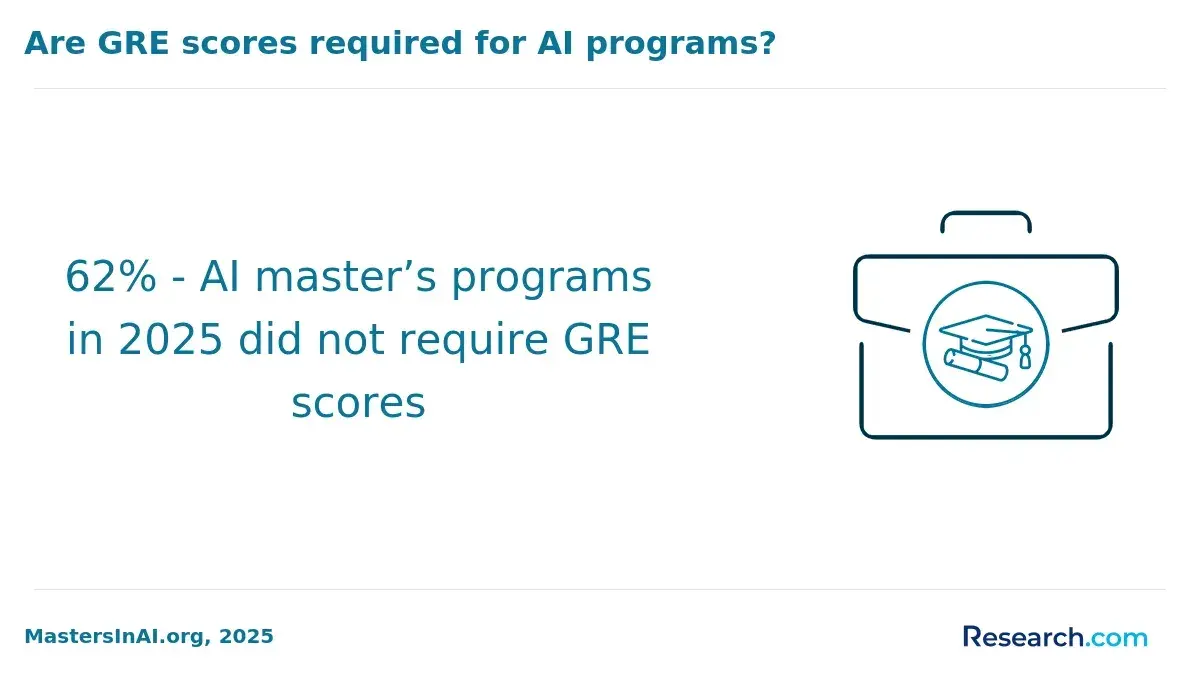
Admission criteria for AI master's capstone and thesis programs typically require a bachelor's degree in computer science, engineering, mathematics, or a related field. Most programs expect a minimum GPA of 3.0 on a 4.0 scale, though more competitive programs may demand higher. While GRE scores are increasingly optional, submitting them can strengthen applications, particularly for thesis tracks emphasizing research ability.
Graduate eligibility requirements for AI master's thesis and capstone options differ regarding experience and skills. Capstone track applicants benefit from showcasing practical experience through internships, coding projects, or relevant work, often boosting acceptance rates to about 42%, compared to 28% for thesis-only tracks. This reflects an emphasis on applied expertise over purely academic research potential.
Thesis track applicants must demonstrate strong research aptitude with a statement of purpose clarifying research interests, along with letters of recommendation from academic or industry mentors. Some programs also request research proposals or writing samples to evaluate readiness for independent study. International students usually need TOEFL or IELTS scores to confirm English proficiency.
Both tracks often require prerequisite coursework in machine learning, algorithms, or data structures, with some schools offering conditional admission to fulfill these. Prospective students should carefully review each program's specific requirements to align their applications effectively. To explore options, consider reviewing affordable engineering schools that offer AI master's programs.
How long does it take to complete a capstone versus a thesis in an AI master's program?
Completing a capstone in an AI master's program typically requires less time than completing a thesis. According to the National Association of Graduate Admissions Professionals, students pursuing capstone-based degrees graduate about 5.2 months faster, finishing in roughly 18.4 months compared to 23.6 months for thesis students. This duration comparison of capstone and thesis projects for AI master's degrees highlights key differences in focus and process.
Capstone projects prioritize practical application and integration of skills within a shorter timeframe. They often span a single semester or summer, involving clear milestones and deliverables like building machine learning prototypes or deploying chatbots. This approach emphasizes solving real-world problems without the extensive research and formal documentation required by a thesis.
Thesis work demands original research, data collection, and thorough analysis, often leading to a longer and less predictable timeline due to hypothesis testing and peer reviews. This path is better suited for those aiming for research careers or doctoral studies, whereas capstone projects appeal to professionals seeking faster program completion.
For those comparing the time to complete capstone versus thesis in an AI master's program, it's important to consider personal goals and commitments. Prospective students balancing work might prefer the capstone's expedited schedule. Resources listing affordable programs, such as online data science masters, can guide choices aligned with career objectives.
What are the key differences between online and campus-based capstone or thesis requirements for AI degrees?
Online and campus-based master's programs in Artificial Intelligence differ significantly in their final project requirements. Online programs emphasize capstone projects, with 82% requiring them, compared to only 29% of campus programs, according to the Online Learning Consortium. These capstones focus on practical application, involving team or individual work that addresses real-world industry challenges and often produce software prototypes, datasets, or technical reports. This model suits students who need flexibility while balancing work and study.
Campus-based programs, however, prioritize theses involving original research, including hypothesis development, literature reviews, and detailed data analysis. These theses typically end with a formal defense before faculty, reflecting a strong theoretical foundation supported by faculty mentoring and access to research labs. Students attending in person benefit from this richer academic interaction and theoretical rigor.
The differences affect career readiness: online capstones align with immediate industry roles emphasizing applied skills, while campus theses are ideal for those pursuing research or doctoral studies. Access to faculty-led research and resources is another key distinction, with campus students having greater exposure. Prospective students should consider their career goals and learning preferences when selecting a program structure that best matches their objectives.
What topics and research areas are commonly covered in AI master's capstones and theses?
Capstone and thesis projects in AI master's programs concentrate on focused topics such as machine learning, large language models, computer vision, robotics, natural language processing, and ethical AI. These projects showcase practical skills and original research applied to real-world problems. Notably, machine learning applications and large language models represent 47% of such projects, highlighting their prominence in graduate research (AI Index Report, 2024).
Typical machine learning subjects include supervised and unsupervised learning, reinforcement learning, and model optimization, with examples like predictive models for healthcare diagnostics and e-commerce recommendation systems. Projects on large language models often involve fine-tuning, prompt engineering, and uses in automated summarization or translation.
Theoretical work frequently covers algorithmic fairness, explainability, and robustness against adversarial threats. Practical applications span autonomous vehicles, where computer vision and sensor fusion play vital roles, as well as AI for social good, tackling climate modeling and misinformation detection. Interdisciplinary research combining AI with bioinformatics or finance is also common.
Successful capstone and thesis projects depend on clear problem definition, careful dataset selection, and rigorous evaluation methods. Prospective students should consider programs offering strong faculty expertise and computing resources tailored to these research themes. This focus helps candidates develop innovative yet feasible projects, enhancing their competitiveness in the AI job market.
How much do AI master's programs with capstone or thesis components typically cost?
AI master's programs with capstone components generally cost an average of $31,500 in total tuition, about 18% less than thesis-focused programs averaging $38,400 (Chronicle of Higher Education, 2024). This cost difference reflects the distinct educational approaches: capstone projects emphasize practical experience through industry partnerships or applied research, which often reduces the need for extended faculty supervision and costly laboratory resources required by thesis programs.
The variation in tuition plays a key role in students' decisions based on career goals and financial constraints. Those seeking direct professional application might lean toward the capstone option for its affordability and hands-on learning. In contrast, students aiming for academic research or doctoral studies may accept higher tuition for the depth and theoretical focus of a thesis.
Tuition also varies depending on institution type and residency status. Public universities typically have lower fees than private ones, and out-of-state students pay more. Additional charges can arise from materials or resources, especially in capstone courses with real-world projects. Financial aid, scholarships, and employer tuition assistance can significantly reduce the effective cost of AI master's programs.
Prospective students should weigh tuition together with factors like time investment, career alignment, and opportunity cost to choose the most suitable AI graduate track.
What career outcomes and job titles do graduates with capstone-based versus thesis-based AI master's degrees pursue?
Graduates of capstone-based AI master's programs typically enter industry roles such as machine learning engineer, data scientist, AI product manager, or AI solutions architect. These positions emphasize hands-on skills for applying AI models to real-world challenges, which capstone projects simulate by involving client-driven or company-sponsored tasks. Data from the National Center for Education Statistics indicates that capstone-track graduates land jobs 22% faster than those from thesis tracks, with 76% employed within three months compared to 62% for thesis graduates. This advantage reflects employer preference for practical experience and demonstrable project outcomes.
Thesis-based graduates are more likely to pursue research-intensive or academic careers, including AI research scientist, doctoral candidate, or AI policy analyst positions. These roles require deep theoretical understanding and original research contributions, making thesis experience vital. Many thesis graduates continue into PhD programs or research labs at universities, government agencies, or corporate R&D sectors.
Job seekers should align their education pathway with career goals: capstone programs favor rapid industry entry with a focus on implementation, while thesis paths suit those targeting foundational AI research and academic work. Interviews for capstone grads often stress teamwork, project management, and coding proficiency, whereas thesis grads face questions on research depth, publications, and analytical problem-solving. Selecting the right path helps match roles and career trajectories effectively.
What is the average salary range for AI master's graduates who completed a capstone or thesis project?
Graduates completing a capstone project in AI master's programs earn an average starting salary of $137,600, which is 8% higher than the $127,400 average for thesis-track graduates, based on the 2024 Levels.fyi salary database. This salary difference highlights industry demand for practical, project-focused experience, as employers often prefer candidates who demonstrate applied skills in solving real-world problems. Such experience can speed up career growth and salary increases.
On the other hand, thesis-track graduates, while starting with slightly lower salaries, gain deeper research expertise that suits careers in academia, R&D, and innovation-driven roles. Over time, their salaries may equal or surpass those of capstone graduates, particularly in specialized or research-intensive fields. The choice between tracks should factor in immediate earning potential and long-term career goals.
Salary outcomes also vary depending on employer type, location, and prior experience. Large tech firms and startups typically place higher value on capstone experience for its direct relevance to product development. Conversely, public sector and research institutions often prefer thesis credentials for their analytical rigor.
Engaging with alumni reports and industry insights helps students align their education path with career aspirations, ensuring decisions reflect both financial and professional priorities.
How should prospective students choose between a capstone and thesis option when selecting an AI master's program?
Choosing between a capstone and thesis option in artificial intelligence programs depends largely on career goals, time availability, and interest in research. Capstone projects emphasize practical skills and solving real-world problems, helping students graduate faster and improve job readiness. This approach is ideal for working professionals aiming to enter the industry quickly, as it often involves applied AI techniques alongside companies or tech teams. According to the Graduate Student Experience Survey, 71% of AI master's students prioritize career readiness and timely graduation over academic research contributions.
In contrast, the thesis route focuses on thorough investigation of novel problems and original contributions to the AI field. This path requires more time and commitment and suits students planning to pursue PhD studies or research-intensive careers. Thesis projects vary by program, ranging from algorithm development to theoretical or interdisciplinary studies.
Program support, faculty expertise, and resources also influence this decision. Students with access to mentorship and labs often find a thesis more feasible, while those in programs connected to industry may prefer capstone projects. Additionally, funding opportunities differ; thesis students may secure research grants, whereas capstone students often obtain internships.
Balancing immediate employment objectives with long-term academic ambitions and personal learning preferences helps students determine the best path in artificial intelligence education.
Other Things You Should Know About Artificial Intelligence
Succeeding in an AI master's program requires strong programming abilities, especially in languages like Python and frameworks such as TensorFlow or PyTorch. A solid foundation in mathematics, including linear algebra, calculus, and probability, is also essential. Critical thinking and problem-solving skills help students design and implement AI models effectively.
Thesis projects generally offer deeper research opportunities and often involve original contributions to AI knowledge, which can lead to publications or conference presentations. Capstone projects tend to be more application-focused, allowing students to address real-world industry problems and gain practical experience, but with less emphasis on novel research.
Many AI master's programs encourage or allow students to pursue internships concurrently with their capstone or thesis work. This practical exposure complements academic learning, providing valuable experience in applying AI techniques in professional environments. However, the level of flexibility varies by program, so students should verify policies with their institution.
AI master's programs in 2027 may require students with non-computer science backgrounds to undertake prerequisite courses. While capstone projects offer practical exposure useful for such students, thesis requirements may emphasize foundational theory, demanding more extensive preparation for those lacking a computer science background.
References
- M.SC. IN Artificial Intelligence https://put.poznan.pl/msc-artificial-intelligence
- Career Paths for Graduates of Master in AI and Data Analytics | Asian Institute of Management https://aim.edu/masters-data-analytics-career-progression-jobs/
- Most Affordable Online Master's in AI for 2025 https://www.mastersinai.org/degrees/affordable-online-masters-in-ai/
- 15 Top Masters Degree in AI Programs: Entry Requirements & Costs - AI Degree Center https://aidegreecenter.org/masters/
- Capstone vs Thesis – A Complete Guide for Undergraduate and Graduate Students https://www.affordable-dissertation.co.uk/blog/2025/08/05/capstone-vs-thesis/
- Best AI Masters Online & On-Campus - AIDegreePrograms.org https://aidegreeprograms.org/rankings/best-ai-masters-programs/
- 6 High-Paying Jobs With a Master’s in AI | University of Bridgeport https://www.bridgeport.edu/news/high-paying-jobs-with-a-masters-in-ai/
- Use of Artificial Intelligence (AI) in Writing Master’s and Doctoral Theses https://grad.emu.edu.tr/en/academic-issues/use-of-ai-in-thesis
- Top 25 Online Master’s In AI Programs for 2026 - Programs.com https://programs.com/programs/online-masters-in-ai/
- International study programs: Artificial Intelligence https://www.mpowerfinancing.com/blog/artificial-intelligence