2027 Best Career Paths After an AI Bachelor's Degree

Co-Founder and Chief Data Scientist
Graduates with a bachelor's degree in artificial intelligence often face uncertainty about the most promising career paths amid rapid industry changes and expanding technology applications. Many professionals from unrelated fields seek flexible, accredited programs to pivot smoothly into AI careers but struggle to identify viable options with clear growth potential. This challenge intensifies as AI reshapes traditional roles across industries, requiring informed decisions for long-term success.
This article explores the best career paths available to 2027 AI bachelor's degree holders, aiming to guide readers through emerging opportunities and strategies to advance effectively within the evolving AI landscape.
Key Things You Should Know
- Employment in AI-related careers is projected to grow by 35% through 2030, driven by demand in healthcare, finance, and autonomous systems sectors.
- AI bachelor's graduates typically earn 20-40% higher starting salaries than general computer science graduates, reflecting specialized skill scarcity.
- Key roles post-graduation include machine learning engineer, data scientist, and AI ethicist, requiring interdisciplinary knowledge integrating technical and social perspectives.
What are the most in-demand career paths for AI bachelor's degree graduates?
The most in-demand career paths for AI bachelor's degree graduates in the United States include machine learning engineer, data scientist, AI software developer, and AI research analyst. Machine learning engineer roles saw a 74% increase in job postings year-over-year in 2024, making them a top job opportunity in artificial intelligence for recent graduates. These professionals design and implement algorithms that enable systems to learn from data, often using neural networks, natural language processing, and computer vision technologies.
Data scientists remain highly sought after, analyzing extensive datasets to deliver actionable insights with AI models and statistical methods. Their expertise supports decision-making across finance, healthcare, marketing, and more, requiring strong skills in programming, machine learning, and domain knowledge.
AI software developers create AI-powered applications like recommendation engines, chatbots, and autonomous systems, combining software engineering with AI expertise. Familiarity with frameworks such as TensorFlow or PyTorch is essential in this role. AI research analysts explore novel AI methodologies, refine existing models, and interpret complex data patterns within academic, corporate, or government research environments.
Graduates should also explore specialization areas like robotics, AI ethics, and AI security, which are gaining importance. Building skills in cloud computing and big data platforms enhances employability across these fields. Practical experience is highly valued, and completing internships or projects showcasing AI model deployment and optimization can be critical. For those considering education options, a 2-year computer science degree online can be an accessible pathway into these careers.
What is the average salary for professionals with an AI bachelor's degree?
Professionals with a bachelor's degree in artificial intelligence in the United States typically earn a median salary ranging from $120,000 to $135,000 annually. This reflects strong demand for AI specialists in sectors like technology, healthcare, finance, and automotive industries. For recent graduates, the average salary for AI bachelor's degree graduates often starts between $90,000 and $110,000, influenced by factors such as company size and geographic location.
Typical earnings of AI bachelor's degree holders in the US tend to increase with specialized skills in machine learning, natural language processing, or robotics. Roles like AI research assistants and product managers may command salaries closer to or above the median due to their combined technical and managerial responsibilities. Salaries are generally higher in cities with a high cost of living, such as Silicon Valley and New York, to reflect market conditions.
Graduates can boost their career prospects and earnings by acquiring certifications in areas like cloud computing or advanced programming. Engaging with AI communities and contributing to open-source projects further strengthens skill sets and networking opportunities. Those exploring educational options may also consider an online mechanical engineering bachelor degree, which can be complementary in many AI-related fields.
What is the job outlook for AI professionals over the next decade?
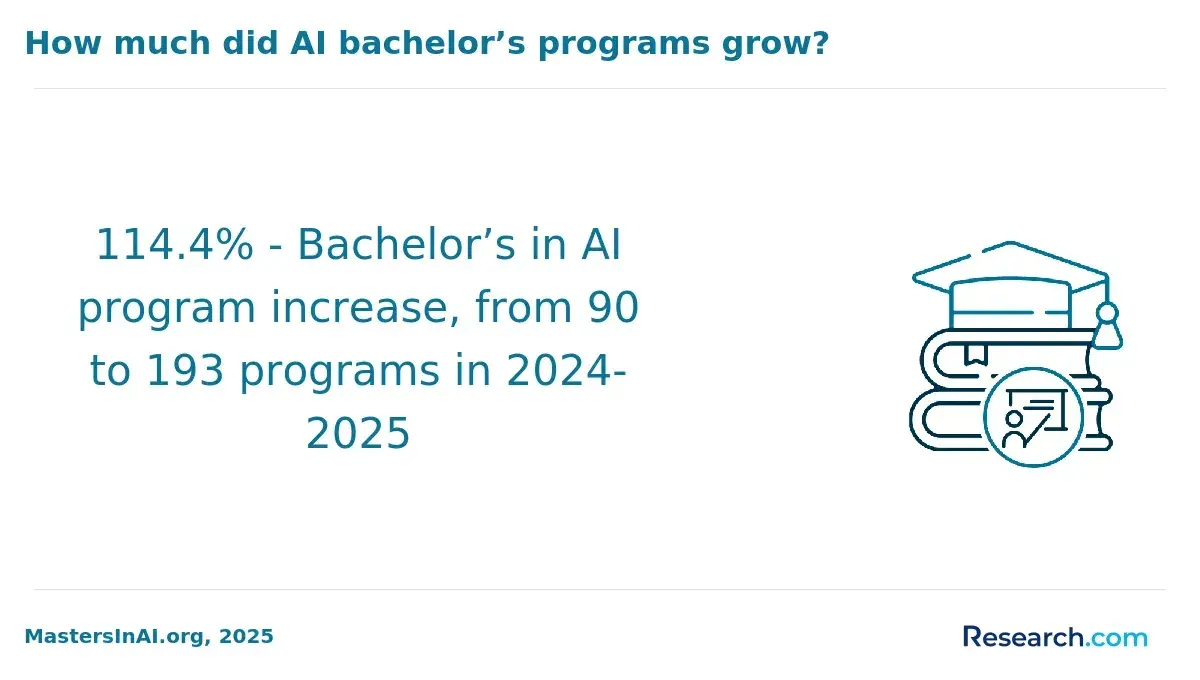
Employment in AI and machine learning roles is projected to grow 35% from 2024 to 2034, substantially faster than the average for all occupations, according to the U.S. Bureau of Labor Statistics. This strong demand spans multiple sectors including healthcare, finance, automotive, and technology, reflecting the expanding AI job market growth in North America. Opportunities will increase for core AI developers and specialists in applied AI, data analysis, ethical AI design, and AI infrastructure engineering.
Graduates with an AI bachelor's degree can expect roles such as machine learning engineers, data scientists, AI research scientists, and AI product managers. The rising demand for AI professionals in the United States requires individuals who can design algorithms, interpret complex datasets, and integrate AI solutions into business workflows. Healthcare companies, for instance, seek experts to develop diagnostic tools, while financial firms utilize AI for fraud detection and risk management.
Success in this field depends on adaptability to evolving technologies like natural language processing, computer vision, and reinforcement learning. Candidates with interdisciplinary skills in programming, statistics, and domain-specific knowledge gain a competitive edge. Emerging roles focusing on ethical AI highlight the importance of fairness, transparency, and regulatory compliance.
Experienced AI degree holders must engage in continuous learning to stay competitive amid rapid technological advances. Certifications and graduate studies can boost career prospects in leadership or research. Students looking for educational pathways can explore the best online AI degree programs to prepare for this dynamic job market.
What accreditation standards should you look for in an AI bachelor's degree program?
ABET accreditation is a key factor when evaluating AI bachelor's degree programs, as it indicates adherence to rigorous academic and professional standards. Graduates from ABET-accredited programs tend to have a 12-15% higher employment rate within six months of finishing their studies compared to those from non-accredited programs. This accreditation assures employers that the curriculum aligns with national quality benchmarks in computing, engineering, and technology education.
In addition to ABET, accreditation criteria for AI bachelor's degrees often include endorsements from bodies like the Computing Accreditation Commission (CAC) or specialized AI and data science organizations. Regional accreditation standards for AI programs further ensure institutional quality and eligibility for federal financial aid, which supports a student's academic and financial security.
Programs should offer hands-on projects, industry partnerships, and internship possibilities to provide real-world experience. Prospective students and working professionals ought to review detailed accreditation reports alongside program outcomes, faculty expertise, and graduate employment statistics. For those continuing education, credits from accredited programs can facilitate professional certification processes, such as becoming a Certified AI Engineer.
For those interested in graduate options, researching the best data science master's programs can offer valuable pathways beyond the bachelor's degree.
What core technical skills and programming languages are taught in AI bachelor's programs?
Proficiency in programming languages such as Python and Java forms the foundation of AI bachelor's degree programs. Python is essential, featured in 94% of accredited curricula, valued for its role in algorithm development, data analysis, and seamless use with machine learning libraries like TensorFlow, PyTorch, and scikit-learn. Java appears in 61% of programs, offering benefits for building scalable, object-oriented AI applications, particularly in natural language processing and robotics.
Mathematics is another core component, with courses focusing on linear algebra, calculus, probability, and statistics. These areas support understanding of neural networks, pattern recognition, and reinforcement learning. Practical coding assignments help students apply these mathematical principles effectively.
Expertise in data management through SQL and NoSQL databases is common, reflecting AI's requirement to handle large datasets. Version control skills with Git and familiarity with cloud computing platforms enhance students' readiness for AI model deployment in professional settings.
Hands-on experience with advanced AI tools is vital. Coursework frequently includes projects on convolutional and recurrent neural networks and unsupervised learning algorithms, strengthening both theoretical knowledge and industry-aligned coding skills. This comprehensive training ensures graduates are prepared for challenges in AI research and development.
What are the admission requirements for accredited AI bachelor's degree programs?
Admission requirements for accredited Artificial Intelligence bachelor's degree programs demand strong academic preparation, particularly in math and science. Many top programs require a minimum high school GPA of 3.7 or higher, reflecting increasing competitiveness. According to U.S. News & World Report's engineering rankings, the average GPA requirement rose from 3.5 to 3.7. Applicants usually submit standardized test scores like the SAT or ACT, though some programs offer test-optional policies. High scores in math sections are especially beneficial due to the technical nature of AI studies.
Relevant coursework, including advanced math such as calculus or precalculus, physics, and computer science, is typically required. Letters of recommendation from teachers who can attest to analytical and problem-solving skills are important. Personal statements highlighting interest in Artificial Intelligence, technology, or problem-solving experience strengthen applications. Participation in coding clubs, robotics teams, or tech internships can further enhance candidacy.
Diverse applicants may need to demonstrate quantitative aptitude through placement tests or introductory course performance. Some programs request portfolios or coding challenge results to evaluate programming skills. International students often must submit TOEFL or IELTS scores for English proficiency. Prospective students should verify each program's criteria early and aim to exceed the 3.7 GPA threshold while showcasing technical experience to improve admission chances.
How do online AI bachelor's programs compare to campus-based options in terms of outcomes?
Online AI bachelor's programs now offer outcomes nearly equal to traditional campus-based degrees, especially in employment rates. A 2024 National Student Clearinghouse Research Center study found an 89% job placement rate within 12 months among online AI graduates, just 3 percentage points lower than campus graduates. This closeness highlights the maturity of online programs in delivering quality education and career support.
Many online AI degree plans include synchronous classes, virtual labs, and collaborations with tech companies, such as capstone projects, that help students build practical skills and industry portfolios comparable to on-campus students. Employers increasingly value accredited online credentials that emphasize hands-on experience.
Online learners benefit from flexible schedules, allowing them to work or intern in tech roles while studying, which can accelerate their employment opportunities after graduation. Yet, success often requires active engagement with virtual career services and alumni networks, which many programs now offer through dedicated advisors and online job fairs.
These resources help bridge the gap between remote and campus experiences, ensuring online students access similar support for career development. Overall, choosing an accredited online AI bachelor's degree can be a strong path for gaining skills and entering tech careers efficiently.
What professional certifications can complement an AI bachelor's degree?
Professional certifications significantly boost the value of an AI bachelor's degree by validating practical skills and enhancing employability. Leading cloud provider certifications like AWS Certified Machine Learning Specialty and Google Professional Machine Learning Engineer reflect the strong demand for cloud-based AI expertise. According to Coursera's Skills and Salary Report 2024, professionals with AI and machine learning certifications earn 18-22% higher salaries than those without, showcasing the clear advantage of adding these credentials.
Beyond cloud platforms, certificates such as the Certified Artificial Intelligence Practitioner (CAIP) from the Global Academy of Finance and Management and Microsoft Certified: Azure AI Engineer Associate provide pathways to specialize in AI deployment, frameworks, and ethical practices. These certifications emphasize knowledge in data engineering and responsible AI development.
Professionals focused on AI's broader impacts can benefit from certifications like Certified Data Scientist or ethical AI credentials such as CertNexus' AI Ethics certification, addressing concerns around algorithmic bias and regulatory compliance. Those targeting natural language processing, computer vision, or robotics are advised to consider domain-specific certificates, including NVIDIA's Deep Learning Institute courses for practical experience with AI hardware and software.
Given AI's fast evolution, earning multiple complementary certifications greatly enhances both versatility and marketability in diverse technical and managerial roles. Pursuing certifications aligned with personal career goals and market trends offers measurable financial returns, supported by data from reputable sources like the Coursera Skills and Salary Report.
How long does it take to complete an AI bachelor's degree and what is the typical cost?
An AI bachelor's degree generally takes around four years of full-time study, totaling 120 to 140 credit hours. Many U.S. universities follow this timeline, though accelerated programs can shorten it to three years, and cooperative education or internships might extend it. Part-time students or those balancing work often require up to six years to complete their degree.
Costs vary widely depending on the institution type. Private universities average between $120,000 and $180,000 in total attendance costs, while public universities offer lower fees, typically $40,000 to $60,000 for in-state students. Out-of-state tuition and prestigious programs elevate public university expenses closer to private levels. Additional costs include textbooks, software licenses, and specialized AI hardware, along with possible technology or lab fees related to the major.
Financial aid, scholarships, and grants play a vital role in managing these expenses, especially at private institutions. Prospective students should explore funding options and scholarships targeted at AI students, often sponsored by tech companies or foundations.
Choosing the right AI program means balancing duration, cost, and career goals. Fast-track options reduce completion time but increase workload, whereas public universities offer affordability but may have fewer AI-focused specializations.
What graduate degree or specialization options are available after completing an AI bachelor's degree?
Graduate programs in artificial intelligence offer notable benefits, including increased salary potential and strong job prospects. Master's degrees in AI and related fields typically yield earnings 28-35% higher than a bachelor's degree, according to the Graduate Management Admission Council, with job placement rates near 95% within three months of graduation.
Common graduate pathways include specialized master's degrees in artificial intelligence, machine learning, data science, or robotics. These programs deepen technical skills and allow focus areas such as natural language processing, computer vision, or autonomous systems. For instance, a master's in machine learning targets algorithm development, while data science integrates AI with big data analytics and statistics.
Interdisciplinary degrees combining AI with cybersecurity, healthcare informatics, or business analytics are growing in popularity. These prepare graduates for roles addressing domain-specific challenges, like securing AI systems or applying AI to patient care data. Doctoral programs emphasize original research contributions to AI theory and applications, suitable for those pursuing academic or research careers.
Working professionals can also benefit from graduate certificates and diplomas focused on specific AI tools or frameworks to update skills quickly without a full degree commitment.
These graduate options equip candidates with advanced expertise and specialization, enhancing career growth in a competitive job market.
Other Things You Should Know About Artificial Intelligence
By 2026, AI bachelor's degree graduates have mid-career opportunities in roles such as AI consultant, machine learning engineer, and AI project manager. These positions often require experience and the ability to bridge gaps between technical teams and business objectives, highlighting leadership and innovation skills.
Yes, AI degree holders play a crucial role in designing ethical AI systems. They are trained to understand the social and ethical implications of AI technologies, ensuring fairness, transparency, and privacy in AI models. Many programs incorporate coursework on AI ethics, preparing graduates to address bias and promote responsible AI use.
Interdisciplinary knowledge is highly valuable in AI careers. Combining AI with skills from fields like psychology, linguistics, or business can enhance the development and application of AI systems. Understanding domain-specific challenges allows AI professionals to create more effective and tailored solutions.
Besides technical expertise, AI professionals need strong communication, problem-solving, and teamwork skills. The ability to explain complex concepts to non-experts and collaborate across diverse teams is essential. Critical thinking and adaptability also help AI specialists respond to rapidly evolving technologies and challenges.
References
- Career Prospects https://www.uni-bamberg.de/en/ba-ki/career-prospects/
- Predictions for AI's next 20 years by the US public and AI experts https://www.pewresearch.org/internet/2025/04/03/public-and-expert-predictions-for-ais-next-20-years/
- How to choose a bachelor's in artificial intelligence | edX https://www.edx.org/resources/how-to-choose-a-bachelors-in-artificial-intelligence
- University Degree vs AI Bootcamp: Which is Best Career Path? https://agilefever.com/university-degree-vs-ai-bootcamp-which-is-best/
- Finding Your Ideal AI Career Path: Which Field in Artificial Intelligence Suits You Best? https://dev.to/furqanahmadrao/finding-your-ideal-ai-career-path-which-field-in-artificial-intelligence-suits-you-best-an5
- AI’s Impact on Job Growth | J.P. Morgan Global Research https://www.jpmorgan.com/insights/global-research/artificial-intelligence/ai-impact-job-growth
- Industries with a High Demand for AI Graduates | ABD Careers https://allbachelordegrees.com/degrees/computers-it/artificial-intelligence/industries-with-the-highest-demand-for-ai-graduates/
- Online Bachelor’s Degree: Artificial Intelligence https://www.umgc.edu/online-degrees/bachelors/artificial-intelligence-ai
- AI Course Duration: How Long Does It Take to Become AI-Ready? https://rcm.ac.in/ai-course-duration-how-long-does-it-take-to-become-ai-ready/
- How Long Does It Take to Learn AI? - MMC Learning https://mmclearning.com/ai-course/how-long-does-it-take-to-learn-ai/