
2027 Best Accelerated Online Dental Assistant to Dental Hygienist Bridge Programs

Co-Founder and Chief Data Scientist
Dental hygiene is one of the fastest-growing careers in healthcare, with job openings projected to rise 9% through 2033. That means licensed dental hygienists will have plenty of choices and better pay. But many dental assistants miss out on those opportunities simply because they wait too long to enroll in the right program. Some are unsure what is accredited.
This guide helps you cut through the confusion and act now. It covers the top accelerated online dental assistant to dental hygienist programs for 2025, picked and reviewed by career experts to help you succeed quickly and affordably.
What are the benefits of getting an accelerated online dental assistant to dental hygienist bridge program?
- You’ll qualify for higher-level dental hygiene roles that offer greater responsibility, independence, and opportunities for patient interaction.
- Accelerated online dental assistant to dental hygienist programs often give you credit for past training, so you skip unnecessary coursework and focus on new clinical skills.
- Dental hygienists can earn nearly twice as much as dental assistants, with top earners making over $120,000 a year.
What can I expect from the best accelerated online dental assistant to dental hygienist bridge programs?
You can expect the best accelerated online dental assistant to dental hygienist programs to build on your current experience and offer a streamlined path toward licensure. These bridge programs are designed for working dental assistants and focus on the science, clinical, and communication skills you’ll need to become a licensed dental hygienist.
Most programs lead to an Associate of Applied Science (A.A.S.) or Associate of Science (A.S.) degree in Dental Hygiene. They typically require between 60 and 84 total credits to graduate. However, many will transfer some of your prior dental assisting coursework, which helps shorten the path.
The curriculum often includes oral anatomy, periodontics, pharmacology, radiography, and community dental health. You’ll also take general education classes like English, psychology, or biology if you haven’t already completed them. Expect a mix of online lectures, assignments, and in-person clinical training hours arranged near your location.
While full tuition varies, the average cost per credit at a public college ranges from $100 to $400, with private schools costing more. Some programs offer financial aid, scholarships, or flexible payment plans.
Where can I work with an accelerated online dental assistant to dental hygienist bridge program?
After completing one of the best accelerated online dental assistant to dental hygienist programs, you’ll be qualified to work as a licensed dental hygienist in a variety of healthcare settings. Most graduates go straight into patient-facing roles, where they clean teeth, take X-rays, apply sealants, and educate patients on how to maintain their oral health.
According to 2025 data from the BLS, here’s where dental hygienists are most commonly employed:
- Dentist offices (94%): This is by far the most common workplace. You’ll likely work alongside a dentist, providing direct patient care.
- Physician offices (1%): A small number of hygienists are employed in medical practices, particularly those specializing in care for older adults or integrated care.
- Government agencies (1%): You may work in public health clinics, correctional facilities, or programs serving underserved communities.
In addition to clinical care, some hygienists also move into roles in education, dental sales, or public health outreach after gaining experience.
How much can I make with an accelerated online dental assistant to dental hygienist bridge program?
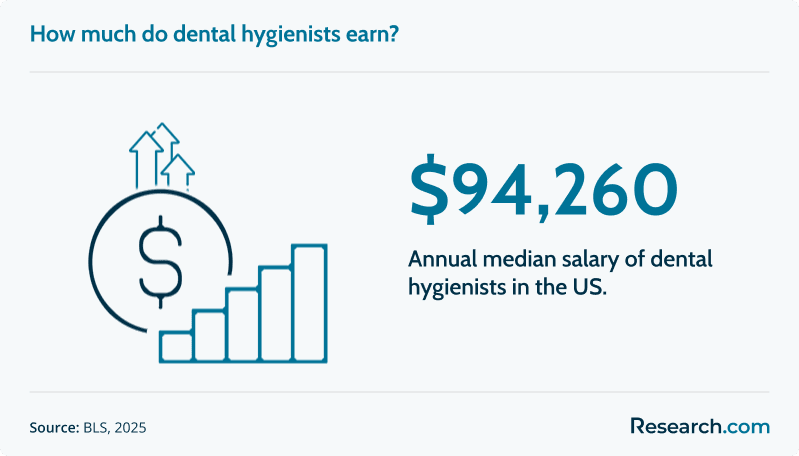
In 2025, the median annual salary for dental hygienists was approximately $94,000, with some earning over $120,000, depending on experience and location. Those just starting typically earn more than $66,000, which is still higher than many mid-level dental assistant roles.
By comparison, dental assistants earned a median annual salary of approximately $47,000 in the same year. Entry-level assistants made closer to $36,000, while the top earners reached just above $61,000.
That means moving into dental hygiene through a bridge program doesn’t just open doors—it puts you on track for higher-paying, more independent work. You’ll also be eligible for better benefits and have more control over your daily responsibilities.
For working professionals, such a pay boost can mean greater security, more choices, and a faster return on investment. That’s why many dental assistants are choosing to level up through online dental assistant to dental hygienist programs that fit their schedules and goals.
- List of the Best Accelerated Online Dental Assistant to Dental Hygienist Bridge Programs for 2027 List of Programs
- How long does it take to complete an accelerated online dental assistant to dental hygienist bridge program? Program Length
- How does an accelerated online dental assistant to dental hygienist bridge program compare to an on-campus program? How does an accelerated online dental assistant to dental hygienist bridge program compare to an on-campus program?
- What is the average cost of an accelerated online dental assistant to dental hygienist bridge program? Program Cost
- What are the financial aid options for students enrolling in an accelerated online dental assistant to dental hygienist bridge program? Financial Aid
- What are the prerequisites for enrolling in an accelerated online dental assistant to dental hygienist bridge program? What are the prerequisites for enrolling in an accelerated online dental assistant to dental hygienist bridge program?
- What courses are typically in an accelerated online dental assistant to dental hygienist bridge program? What courses are typically in an accelerated online dental assistant to dental hygienist bridge program?
- What types of specializations are available in an accelerated online dental assistant to dental hygienist bridge program? What types of specializations are available in an accelerated online dental assistant to dental hygienist bridge program?
- How to choose the best accelerated online dental assistant to dental hygienist bridge program? How to choose the best accelerated online dental assistant to dental hygienist bridge program?
- What career paths are available for graduates of an accelerated online dental assistant to dental hygienist bridge program? Career Paths
- What is the job market for graduates of the best accelerated online dental assistant to dental hygienist bridge programs? Job Market
- What challenges may impact success in an accelerated online dental assistant to dental hygienist bridge programs? What challenges may impact success in an accelerated online dental assistant to dental hygienist bridge programs?
- What future innovations are shaping dental hygienist bridge programs? What future innovations are shaping dental hygienist bridge programs?
- How do post-graduation career support services enhance long-term career success? How do post-graduation career support services enhance long-term career success?
Accelerated Online Dental Assistant to Dental Hygienist Bridge Programs: What Students Should Know
If you are working in dentistry and want to move into dental hygiene, the biggest question is not just which online program is fastest. It is whether the program actually leads to the credential you need. Many programs marketed as “bridge” or “completion” options are designed for licensed registered dental hygienists who already completed clinical training, not for dental assistants seeking initial dental hygiene licensure.
This guide explains how accelerated online dental assistant to dental hygienist bridge programs work, what the listed programs are best suited for, how long they take, what they cost, and how to compare accreditation, transfer credit, licensure alignment, and career outcomes. It is intended for dental assistants, registered dental hygienists, and working dental professionals who want a practical way to evaluate their next academic step without wasting time or money on the wrong program type.
Quick Answer: Can You Become a Dental Hygienist Through an Online Bridge Program?
In most cases, you cannot become a licensed dental hygienist through a fully online program alone. Dental hygienist licensure typically requires completing an accredited dental hygiene program with clinical and laboratory training. Many accelerated online options are degree-completion programs for current registered dental hygienists, such as RDH-to-BSDH or AS-to-MS pathways.
If you are already a licensed RDH, an online completion or bridge program can help you earn a bachelor’s or master’s degree faster, qualify for education or public health roles, and prepare for graduate study. If you are currently a dental assistant, you should confirm whether the program provides initial dental hygiene clinical preparation or whether you must first complete a CODA-accredited dental hygiene program.
How do we rank schools?
Choosing a dental hygiene bridge or completion program is a financial and professional decision, so our ranking process emphasizes transparent data and student-relevant factors. Research.com reviewed information from trusted education sources, including IPEDS, College Scorecard, Peterson’s, and the National Center for Education Statistics.
These sources help us compare accelerated online dental hygiene bridge and completion programs using consistent information rather than marketing claims. For more details about our ranking process, review Research.com’s methodology page.
List of the Best Accelerated Online Dental Assistant to Dental Hygienist Bridge Programs for 2027
The programs below are strongest for working dental professionals who already have dental hygiene training or licensure and want to complete a higher credential online. Before applying, verify whether the program is intended for dental assistants, licensed RDHs, associate-degree graduates, or students pursuing a combined bachelor’s and master’s pathway.
| School | Best Fit | Required Credits to Graduate | Program Length | Cost | Accreditation |
| Texas Woman’s University | Licensed RDHs with significant transfer credit | 120 | As little as 1 year (with 90 transfer credits) | $7,140 per 15-credit semester (in-state); +$12,600 for out-of-state | Southern Association of Colleges and Schools Commission on Colleges (SACSCOC) |
| Georgia State University | Working hygienists seeking leadership and education skills | 30 | 1 year (full-time) | $4,590 per semester (in-state); $14,700 (non-residents) | Southern Association of Colleges and Schools Commission on Colleges (SACSCOC) |
| Wichita State University | Licensed hygienists who want flexible pacing | 32 | As little as 15 months | $250.97 per credit hour | Higher Learning Commission (HLC) |
| Georgia Highlands College | Students choosing a focus area in leadership, education, or public health | 120 | 3 semesters (full-time); 4+ semesters (part-time) | $133 per credit (in-state); $445 per credit (out-of-state) | Southern Association of Colleges and Schools Commission on Colleges (SACSCOC) |
| East Tennessee State University | RDHs interested in public health, geriatric care, or dental education | 120 | ~1–2 years, depending on transfer credits | $5,497 per semester (in-state); up to $7,597 per semester (out-of-state) | Southern Association of Colleges and Schools Commission on Colleges (SACSCOC) |
| Ohio State University | Dental hygienists planning for policy, administration, or teaching roles | 55 | 1 to 5 years | ~$507.50 per credit (plus fees) | Higher Learning Commission (HLC) |
| Oregon Institute of Technology | Practicing hygienists seeking a self-paced completion route | 45 (from Oregon Tech, plus transferred credits) | Varies (self-paced) | $335 per credit | Northwest Commission on Colleges and Universities (NWCCU) |
| Massachusetts College of Pharmacy and Health Sciences | Associate-prepared hygienists considering a graduate bridge | 36 | Varies (graduate-level pacing) | $1,215 per credit hour | New England Commission of Higher Education (NECHE) |
| University of Michigan School of Dentistry | Hygienists seeking an associate-to-master’s progression | 54 | 3 years | $5,191 per term (in-state); $16,513 per term (out-of-state) | Commission on Dental Accreditation (CODA) |
| Idaho State University | Students pursuing linked BS and MS coursework | 145 (BS + MS combined) | Varies (includes BS and MS progression) | $230 per credit (didactic); $315 per credit (thesis) | Commission on Dental Accreditation (CODA) |
1. Texas Woman’s University
Texas Woman’s University offers a fully online, non-clinical RDH-to-BSDH pathway for dental hygienists who already earned an associate degree from a CODA-accredited program. The program is built for career advancement rather than initial licensure, with small classes and faculty support designed for working professionals.
- Required Credits to Graduate: 120
- Program Length: As little as 1 year (with 90 transfer credits)
- Cost: $7,140 per 15-credit semester (in-state); +$12,600 for out-of-state
- Accreditation: Southern Association of Colleges and Schools Commission on Colleges (SACSCOC)
2. Georgia State University
Georgia State’s online bachelor’s completion program is intended for practicing hygienists who want to strengthen skills in leadership, education, advocacy, and research. It is a practical option for students who want to move beyond direct clinical care while continuing to work.
- Required Credits to Graduate: 30
- Program Length: 1 year (full-time)
- Cost: $4,590 per semester (in-state); $14,700 (non-residents)
- Accreditation: Southern Association of Colleges and Schools Commission on Colleges (SACSCOC)
3. Wichita State University
Wichita State’s online RDH-to-BSDH program supports licensed hygienists preparing for graduate school, teaching, or broader professional responsibilities. Students may receive up to 28 credits of retroactive credit, which can reduce the time and coursework needed to finish.
- Required Credits to Graduate: 32
- Program Length: As little as 15 months
- Cost: $250.97 per credit hour
- Accreditation: Higher Learning Commission (HLC)
4. Georgia Highlands College
Georgia Highlands College's online RDH-to-BSDH completion program includes four focus areas, allowing students to align their coursework with leadership, teaching, or public health goals. The program supports both part-time and full-time enrollment, which can help students balance school with employment.
- Required Credits to Graduate: 120
- Program Length: 3 semesters (full-time); 4+ semesters (part-time)
- Cost: $133 per credit (in-state); $445 per credit (out-of-state)
- Accreditation: Southern Association of Colleges and Schools Commission on Colleges (SACSCOC)
5. East Tennessee State University
ETSU’s online completion program emphasizes public health, geriatric care, and dental education. Students complete upper-division and general education coursework while applying transfer credits from previous associate-level study.
- Required Credits to Graduate: 120
- Program Length: ~1–2 years, depending on transfer credits
- Cost: $5,497 per semester (in-state); up to $7,597 per semester (out-of-state)
- Accreditation: Southern Association of Colleges and Schools Commission on Colleges (SACSCOC)
6. Ohio State University
Ohio State’s online RDH-to-BSDH completion program is designed for dental hygienists who want to build advanced knowledge in administration, education, public health, evidence-based care, and healthcare policy.
- Required Credits to Graduate: 55
- Program Length: 1 to 5 years
- Cost: ~$507.50 per credit (plus fees)
- Accreditation: Higher Learning Commission (HLC)
7. Oregon Institute of Technology
Oregon Tech’s online RDH-to-BSDH degree gives practicing hygienists a route toward graduate study and roles in education, management, or research. The school awards credit for licensure and board exams, which can reduce the number of courses students need to complete.
- Required Credits to Graduate: 45 (from Oregon Tech, plus transferred credits)
- Program Length: Varies (self-paced)
- Cost: $335 per credit
- Accreditation: Northwest Commission on Colleges and Universities (NWCCU)
8. Massachusetts College of Pharmacy and Health Sciences
MCPHS provides an AS-to-MS online bridge that allows eligible dental hygienists to move into graduate-level study without completing a separate bachelor’s degree first. The program is aimed at advanced work in education, research, public health, and specialized concentration areas.
- Required Credits to Graduate: 36
- Program Length: Varies (graduate-level pacing)
- Cost: $1,215 per credit hour
- Accreditation: New England Commission of Higher Education (NECHE)
9. University of Michigan School of Dentistry
University of Michigan School of Dentistry's associate-to-master’s accelerated program enables hygienists to earn both a bachelor’s and a master’s degree in just three years. Coursework emphasizes leadership, public health, education, and policy.
- Required Credits to Graduate: 54
- Program Length: 3 years
- Cost: $5,191 per term (in-state); $16,513 per term (out-of-state)
- Accreditation: Commission on Dental Accreditation (CODA)
10. Idaho State University
Idaho State’s online accelerated pathway allows students to earn dual credit toward BS and MS requirements. It is designed for students who want a structured move into graduate study while developing knowledge in education, leadership, and advanced practice.
- Required Credits to Graduate: 145 (BS + MS combined)
- Program Length: Varies (includes BS and MS progression)
- Cost: $230 per credit (didactic); $315 per credit (thesis)
- Accreditation: Commission on Dental Accreditation (CODA)
How long does it take to complete an accelerated online dental assistant to dental hygienist bridge program?
The fastest online dental hygiene bridge and completion programs can be completed in as little as 12 to 15 months. However, many students finish in 18 months to 3 years, depending on enrollment pace, transfer credit, degree level, and whether the program is a bachelor’s completion route or an AS-to-MS bridge.
Programs built for working professionals often resemble other accelerated online pathways, such as the shortest master's programs in teacher leadership online, because they compress coursework while allowing students to remain employed.
| Student Situation | Likely Timeline | What Affects Speed |
| Licensed RDH with maximum transfer credit | As little as 1 year or As little as 15 months | Number of accepted credits, full-time study, and required upper-division courses |
| Part-time working student | 2 to 3 years | Work schedule, family responsibilities, course availability, and advising plan |
| Student in a flexible completion program | 1 to 5 years | Self-paced structure, course load, and degree-completion limits |
| Student pursuing AS-to-MS or BS + MS progression | 2.5 to 3 years or Varies | Graduate pacing, thesis or didactic credits, and combined degree requirements |
Transfer credit is usually the biggest timeline factor. Some programs allow students to bring in many associate-degree credits, and Texas Woman’s University notes a completion timeline of as little as 1 year with 90 transfer credits. Without substantial transfer credit, students should expect a longer path.
Part-time students usually need more time, but that is not necessarily a drawback. A slower pace can make sense if you are working chairside, managing family obligations, or trying to avoid heavy borrowing. Some programs also provide extended completion windows, which can reduce pressure during busy clinical work periods.
Graduate bridge options require more planning. AS-to-MS pathways may save time compared with completing a bachelor’s and master’s separately, but they also involve graduate-level expectations and may not be ideal for students who only need a bachelor’s degree for near-term career advancement.
How does an accelerated online dental assistant to dental hygienist bridge program compare to an on-campus program?
Online and on-campus dental hygiene pathways can lead to similar academic advancement, but they serve different students. Online bridge and completion programs are usually best for licensed professionals who already have clinical training. On-campus or hybrid programs are more common for students who still need initial hands-on dental hygiene preparation.
This distinction matters. If you are a dental assistant without dental hygiene licensure, do not assume a fully online program will satisfy clinical requirements. If you are already an RDH, online study can be a strong fit because the program may focus on theory, leadership, public health, research, and administration rather than basic clinical skill development.
| Factor | Online Bridge or Completion Program | On-Campus Program |
| Best for | Licensed RDHs and working dental professionals completing an advanced credential | Students who need structured labs, direct supervision, and clinical preparation |
| Course delivery | Often focused on didactic, upper-division, or graduate coursework | Typically includes in-person lectures, labs, clinics, and faculty supervision |
| Schedule | More flexible and often easier to combine with employment | More fixed and may require daytime campus attendance |
| Clinical experience | Usually assumes prior clinical training or licensure | Provides required hands-on learning for students entering the profession |
| Student support | May include online advising, virtual office hours, discussion boards, and mentorship | Provides in-person faculty access, peer interaction, labs, and campus services |
Some accelerated formats are comparable to the shortest ESL graduate certificate programs online because both are designed for students who already have foundational preparation and need focused, flexible coursework.
Online healthcare bridge models are also similar to the best value online EMT to RN bridge programs in one important way: they are most useful when the student’s prior experience and credentials match the program’s assumptions. The key is confirming that the degree matches your current license status and future goal.
What is the average cost of an accelerated online dental assistant to dental hygienist bridge program?
The average cost of online dental assistant to dental hygienist programs ranges from $7,500 to $20,000, depending on residency, tuition model, transfer credits, school type, and program length. Public universities often charge between $230 and $600 per credit hour, while private colleges may charge higher rates, with some programs costing up to $1,200 per credit hour.
Programs typically require 30 to 60 credit hours to complete, depending on the credits accepted from prior associate-degree coursework. Some schools charge per credit, while others use a flat semester rate. Flat-rate tuition can be cost-effective for full-time students, but less helpful if you enroll part time.
| Cost Factor | Why It Matters | Question to Ask |
| Transfer credits | Accepted credits can shorten the program and reduce tuition | How many of my previous credits will apply to the degree? |
| Residency rate | In-state and out-of-state tuition can differ substantially | Do online students pay in-state, out-of-state, or a separate online rate? |
| Per-credit vs. semester pricing | Full-time students may benefit from flat pricing, while part-time students may prefer per-credit billing | Which tuition model will cost less for my planned course load? |
| Fees and materials | Technology, graduation, textbooks, and other charges can add another $300 to $1,000 per year | What mandatory fees are not included in published tuition? |
| Graduate-level coursework | AS-to-MS and master’s bridge programs often cost more per credit | Will the higher cost support the career roles I actually want? |
Students comparing accelerated online programs may also look at related healthcare and education pathways, such as the shortest online special education graduate programs, to understand how shorter formats can reduce opportunity cost while increasing weekly workload.
If you are just entering dentistry, the most affordable online dental assistant associate degree programs can cost under $5,000. That may be a sensible first step for new students, but it is not the same as completing dental hygiene clinical education or earning an RDH-to-BSDH degree.
The chart below lists the states with the highest level of employment for dental hygienists, as reported by the BLS in 2025.
What are the financial aid options for students enrolling in an accelerated online dental assistant to dental hygienist bridge program?
Students in eligible online dental hygiene bridge and completion programs can use several forms of financial aid to manage tuition, fees, and required materials. The usual first step is completing the Free Application for Federal Student Aid (FAFSA), which determines access to federal grants, work-study, and federal student loans.
- Federal Pell Grants: Need-based aid for eligible undergraduate students that does not have to be repaid.
- Federal Direct Loans: Federal loans available to many students, with repayment terms that differ from private loans.
- State Grants: State-funded tuition support may be available for residents attending public colleges online or on campus.
- School Scholarships: Colleges may offer awards for dental hygiene students based on financial need, academic achievement, professional goals, or program fit.
- American Dental Hygienists’ Association (ADHA) Institute for Oral Health: Offers national scholarship opportunities for licensed dental hygienists pursuing bachelor’s or master’s education.
- National Dental Association Foundation: Provides scholarship opportunities for underrepresented minority students preparing for dental careers.
- Employer Tuition Assistance: Larger dental practices, public health departments, and corporate dental groups may help employees pay for approved coursework.
Before borrowing, compare your expected out-of-pocket cost against your realistic career goal. A bachelor’s completion program may be worthwhile if it opens access to teaching, public health, or administrative roles you want. A graduate bridge may be harder to justify if you do not plan to use the master’s credential.
What are the prerequisites for enrolling in an accelerated online dental assistant to dental hygienist bridge program?
Admission requirements vary widely because “bridge program” can refer to different academic pathways. Some are for licensed RDHs completing a bachelor’s degree. Others are accelerated graduate bridges for associate-prepared hygienists. Programs designed for initial dental hygiene licensure may require in-person clinical components and different admissions standards.
Most online dental hygiene bridge or completion programs expect applicants to have a strong dental background before enrolling. Students considering other accelerated pathways, such as the shortest online special education master's programs, face a similar issue: the faster format only works if you already meet the entry requirements.
- Graduation from a CODA-accredited dental assisting or dental hygiene program.
- A current license or certification as a dental assistant or registered dental hygienist (RDH).
- Completed general education courses, often including English, anatomy and physiology, microbiology, and psychology.
- Minimum GPA, usually between 2.5 and 3.0, depending on the school.
- Official transcripts from previous colleges or dental hygiene programs.
- Possible completion of the National Board Dental Hygiene Examination (NBDHE), depending on the program.
If you are coming from another healthcare support role, some general education coursework may transfer, but it may not replace dental hygiene-specific training. For example, the cheapest online patient care technician certification programs can help students enter healthcare, but additional accredited dental education is still needed before most dental hygiene bridge or completion pathways will apply.
What courses are typically in an accelerated online dental assistant to dental hygienist bridge program?
Accelerated online dental hygiene bridge and completion programs usually focus on upper-level professional topics rather than introductory chairside skills. The curriculum is designed to help experienced dental professionals expand into evidence-based practice, public health, education, leadership, and patient advocacy.
- Advanced Periodontics: Examines current approaches to preventing, identifying, and managing gum disease.
- Oral Pathology: Trains students to recognize, document, and communicate abnormal oral conditions.
- Healthcare Law and Dental Ethics: Covers patient rights, informed consent, scope of practice, professional responsibility, and ethical decision-making.
- Cultural Competency in Healthcare: Builds skills for serving patients with different cultural, linguistic, economic, and health backgrounds.
- Pain and Anxiety Management: Reviews approaches to improving patient comfort, including behavioral and pharmacological strategies.
- Interprofessional Collaboration: Teaches students how oral health professionals work with broader healthcare teams.
- Community Dental Health Program Planning: Focuses on designing, managing, and evaluating oral health outreach programs for underserved communities.
These courses are most valuable when they connect directly to your career plan. If you want to teach, look for curriculum design and instructional methods. If you want public health work, prioritize epidemiology, program planning, and community oral health. If you want management, look for leadership, budgeting, compliance, and healthcare administration content.
What types of specializations are available in an accelerated online dental assistant to dental hygienist bridge program?
Specializations help students connect their degree to a specific career outcome. They are especially useful for RDHs who do not want to stay only in clinical practice and are considering education, public health, administration, research, or graduate study.
| Specialization | What It Emphasizes | Best For |
| Education | Teaching methods, curriculum development, classroom management, and student assessment | Hygienists who want to teach at community colleges, technical schools, or universities |
| Public Health | Community oral health, outreach design, health policy, prevention, and underserved populations | Students interested in schools, nonprofits, health departments, or community programs |
| Healthcare Administration or Management | Leadership, operations, budgeting, compliance, and clinic systems | Professionals aiming for supervisory, program management, or practice leadership roles |
| Pediatrics or Geriatrics | Oral health needs of children or older adults | Students who want to work with age-specific patient populations |
| Behavioral Health or Patient Advocacy | Communication, motivation, patient education, and support for anxious or underserved patients | Hygienists who want to improve access, adherence, and patient experience |
Choosing a specialization can make your resume more coherent because it signals the type of work you are preparing to do. This is similar to how students in the best online nutrition programs often choose tracks connected to clinical care, teaching, wellness, or public outreach.
The chart below lists the industries with the highest employment levels for dental hygienists, as published by the BLS in 2025.
How to choose the best accelerated online dental assistant to dental hygienist bridge program?
The best program is not automatically the fastest or cheapest option. It is the program that matches your current credential, meets accreditation expectations, accepts the right transfer credits, fits your schedule, and supports the career role you want after graduation.
- Confirm the program’s purpose. Ask whether it leads to initial dental hygiene licensure, RDH-to-BSDH completion, AS-to-MS advancement, or another credential.
- Verify accreditation. Use the Commission on Dental Accreditation (CODA) search tool when CODA accreditation is relevant to your licensure or dental hygiene pathway.
- Review transfer credit before applying. Request an unofficial credit evaluation so you know your actual remaining coursework and cost.
- Check clinical requirements. If you are not already licensed as an RDH, ask exactly where labs, clinics, and supervised practice take place.
- Compare total cost, not only tuition. Include fees, books, technology, travel, lost work time, and whether you qualify for in-state pricing.
- Look at faculty and advising. Strong programs should provide access to instructors with dental hygiene, public health, education, or leadership experience.
- Match specializations to your goal. Do not choose a public health track if your real goal is teaching, administration, or graduate research.
- Ask about career support. Programs with advising, alumni networks, resume support, and employer relationships may be more useful after graduation.
| Question to Ask the School | Why It Matters |
| Is this program for dental assistants, licensed RDHs, or associate-prepared hygienists? | Prevents enrolling in a program that does not match your current credential. |
| Will this program meet licensure requirements in my state? | Licensure rules can affect whether the credential supports your intended role. |
| How many credits will transfer? | Determines your real timeline and cost. |
| Are there any in-person, clinical, internship, or campus requirements? | Helps you plan around work, travel, and family responsibilities. |
| What student outcomes can the program document? | Graduation, licensure, and placement information can help you judge program quality. |
What career paths are available for graduates of an accelerated online dental assistant to dental hygienist bridge program?
Graduates of online dental hygiene bridge and completion programs may qualify for broader roles than chairside clinical care, especially if they already hold RDH licensure. Career options depend on state rules, degree level, prior experience, and whether the program includes bachelor’s or graduate-level preparation.
- Clinical Dental Hygienist: Provides preventive oral care, screenings, cleanings, patient education, and periodontal support in dental settings.
- Dental Hygiene Educator: Teaches future hygienists in community colleges, technical schools, or universities; many roles prefer or require a bachelor’s degree or higher.
- Public Health Dental Hygienist: Works in schools, public agencies, community clinics, or nonprofit programs to expand oral health access. Students comparing service-oriented healthcare careers may also review public health salary information when considering long-term options.
- Community Program Coordinator: Plans and manages oral health initiatives for rural, low-income, school-based, or medically underserved populations.
- Research Assistant or Oral Health Analyst: Supports studies, quality improvement projects, policy work, or product evaluation related to oral healthcare.
- Corporate Sales or Consulting: Uses dental field experience to work with dental products, insurance organizations, technology platforms, or practice-management companies.
What is the job market for graduates of the best accelerated online dental assistant to dental hygienist bridge programs?
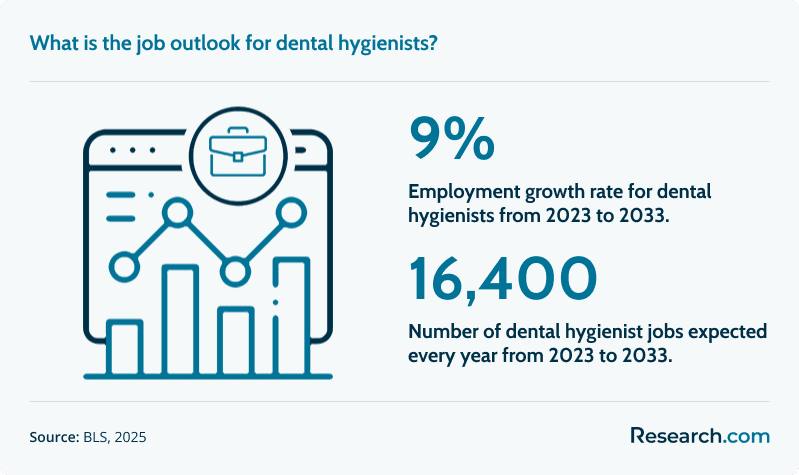
According to the U.S. Bureau of Labor Statistics, employment of dental hygienists is expected to grow 9% from 2023 to 2033, which is significantly faster than the average growth rate for all occupations. The BLS reports approximately 16,400 new job openings each year, with demand supported by preventive care needs, an aging population, and attention to oral health.
Dental assistant employment is also projected to grow, but at a slightly lower rate of 8% over the same period. For dental assistants who want more clinical responsibility and long-term advancement, this difference helps explain why moving toward dental hygiene or advanced dental hygiene education can be attractive.
The strongest job-market value often comes from matching the credential to a specific role. A bachelor’s completion degree may support teaching, supervision, public health, or administrative work. A master’s bridge may make more sense for students targeting higher-level education, research, program leadership, or policy-focused positions.
What challenges may impact success in accelerated online dental assistant to dental hygienist bridge programs?
Accelerated online study can be convenient, but it is not easy. Condensed courses require consistent time management, strong reading and writing skills, and the ability to learn independently. Students who are working full time should be realistic about weekly study hours before choosing the fastest available pathway.
- Misunderstanding licensure requirements: A completion program may not prepare a dental assistant for initial dental hygiene licensure.
- Underestimating workload: Shorter programs often require heavier weekly assignments and fewer breaks.
- Missing hidden costs: Technology, materials, graduation, travel, or clinical-related expenses can change affordability.
- Weak online support: Limited advising, tutoring, or faculty availability can make accelerated learning harder.
- Poor clinical planning: Students who need hands-on requirements must confirm where and how those experiences are completed.
If your goal is to enter healthcare quickly with lower upfront cost, compare the bridge route with alternatives such as the cheapest medical billing and coding program. The right choice depends on whether you want direct patient care, administrative healthcare work, public health, or a longer dental career pathway.
Common Mistakes to Avoid Before Enrolling
| Mistake | Why It Can Hurt You | Better Approach |
| Assuming “online bridge” means no clinical requirements | Initial dental hygiene licensure usually requires supervised hands-on training | Ask whether the program is for new hygienists or already licensed RDHs |
| Choosing only by speed | The fastest program may not fit your work schedule or academic readiness | Compare weekly workload, course sequencing, and support services |
| Looking only at tuition | Fees, transfer-credit limits, and residency charges may raise total cost | Request a full cost estimate based on your transcript |
| Ignoring accreditation | Accreditation can affect licensure, transferability, graduate admission, and employer confidence | Verify institutional accreditation and CODA status when applicable |
| Assuming salaries are guaranteed | Pay varies by state, employer, experience, credential, and role | Use labor-market data as a guide, not a promise |
| Relying only on rankings | A highly ranked school may not be the best match for your state, schedule, or career goal | Use rankings as a shortlist, then verify fit with admissions and advising staff |
Here’s What Graduates Have to Say About Their Accelerated Online Dental Assistant to Dental Hygienist Bridge Programs
-
: "Completing the program while working in a clinic took planning, but the online format made it possible. I could study after work and move toward a role with more responsibility without stepping away from dentistry.
Taneisha"
-
: "The accelerated courses were demanding, but they were connected to real practice. Evidence-based care, ethics, and public health topics gave me tools I could use with patients right away.
Matt"
-
: "After several years in dental assisting, I wanted a clearer route forward. The bridge pathway helped me understand what credentials I needed and how to build toward the kind of work I wanted long term.
Ines"
Key Insights
- Many “online dental assistant to dental hygienist bridge” programs are actually RDH-to-BSDH or AS-to-MS completion pathways for licensed dental hygienists, not fully online routes to initial dental hygiene licensure.
- The fastest programs can be completed in as little as 12 to 15 months, but many working students need 18 months to 3 years depending on transfer credits and course load.
- Costs commonly range from $7,500 to $20,000, but your real price depends on residency, transfer credit, fees, and whether the program uses per-credit or semester tuition.
- Accreditation and licensure alignment are non-negotiable. Verify CODA accreditation when it applies to your dental hygiene pathway and confirm state requirements before enrolling.
- Online completion programs are best for experienced dental professionals who already have clinical training and want career mobility in education, public health, leadership, research, or administration.
- Do not choose a program based only on speed or ranking. The best choice is the one that fits your current credential, accepts your credits, supports your target role, and offers a sustainable cost.
How can you assess the quality and accreditation of an accelerated online dental assistant to dental hygienist bridge program?
Program quality starts with accreditation, but it does not end there. Accreditation shows that a school or program has met recognized educational standards, while outcomes and support services show whether students are likely to complete the program and benefit from it.
Prospective students should verify institutional accreditation, confirm CODA status when relevant, and ask for available information on graduation rates, licensure success, job placement, faculty qualifications, and advising support. It is also important to review how clinical components are handled, especially if you are not already a licensed RDH.
Students comparing healthcare programs can use similar quality checks across fields. For example, when reviewing an affordable online health care administration degree, students should still examine accreditation, curriculum relevance, faculty experience, and career support rather than relying on tuition alone.
What future innovations are shaping dental hygienist bridge programs?
Dental hygiene education is increasingly affected by digital tools, tele-dentistry, simulation, and integrated patient-record systems. Online programs may use virtual collaboration, case-based assignments, digital radiography concepts, and data-informed care planning to help students connect academic work with modern practice.
Programs are also placing more attention on healthcare data, documentation, and technology-supported communication. These skills overlap with competencies found in an affordable health information management degree online, especially around patient records, compliance, and efficient information use in healthcare settings.
Technology will not replace required clinical competence, but it can improve how students prepare for public health work, patient education, practice management, and interprofessional collaboration. Students should look for programs that teach current tools without exaggerating what online simulation can replace.
How do post-graduation career support services enhance long-term career success?
Career support can make a meaningful difference, especially for students using a bridge or completion degree to move into a new type of role. Useful services include career advising, alumni networking, resume reviews, interview preparation, faculty mentorship, and connections with dental practices, public health agencies, schools, or professional associations.
Students should ask whether career services understand dental hygiene career paths or only provide general job-search help. A strong program should be able to support students exploring education, public health, administration, graduate study, or nonclinical dental industry roles.
Some students also broaden their healthcare skills by comparing adjacent online pathways, including accredited medical billing and coding schools online with financial aid. This can be useful for professionals interested in dental office operations, insurance processes, compliance, or administrative healthcare work.
References:
- American Dental Association (ADA). (2025). S5 E06: Dental Industry Predictions for 2025. ADA.
- American Dental Education Association (ADEA) Go Dental. (2025). Trends in Dental Hygiene. ADEA.
- Bureau of Labor Statistics (BLS). (2025a). 29-1292 Dental Hygienists. Occupational Employment and Wage Statistics (OEWS) Profiles. BLS.
- Bureau of Labor Statistics (BLS). (2025b). Dental Assistants. Occupational Outlook Handbook. BLS.
- Bureau of Labor Statistics (BLS). (2025c). Dental Hygienists. Occupational Outlook Handbook. BLS.
- Zippia. (2025). Dental Hygienist education requirements. Zippia.
Other Things You Should Know About Accelerated Online Dental Assistant to Dental Hygienist Bridge Programs
Yes, clinical practice hours are typically required. Most programs mandate a certain number of supervised clinical hours to ensure students gain practical experience. These hours are often completed at a local dental facility, even for online courses, to meet licensure requirements.
Yes. Most programs require proof of active dental assistant certification or licensure, such as DANB CDA credentials or a state dental assisting license, before admission. Some also require recent chairside work experience, a minimum GPA, and a completed background check before clinical enrollment.
Yes, many accelerated online bridge programs allow transfer of credits from previous dental assistant training. Specific transfer policies vary, so it's essential to check each program's guidelines. Generally, these credits help reduce the time and courses required to complete the program.


