2027 Best Online MBA Programs for International Students in the U.S.

Co-Founder and Chief Data Scientist
Choosing an online MBA from a U.S. university is often a mobility decision: you want a credential recognized outside your home market, but you may not want to pause your career, relocate, or take on the full cost of an on-campus program. For international students and early-career professionals, the right online MBA can strengthen business knowledge, expand professional networks, and support a move into management, consulting, analytics, finance, marketing, or entrepreneurship.
The opportunity is real, but the decision requires careful comparison. Around 25% of U.S. employers plan to hire more MBA graduates in 2024, yet outcomes still depend on school quality, accreditation, specialization, work experience, location, and employer recognition of online degrees. This guide explains how U.S. online MBA programs work for international students, what they cost, how admissions and funding differ, and how to evaluate programs before applying.
Key Benefits of an Online MBA Program for International Students in the U.S.
- With an online MBA you can move into roles such as operations manager, business development director or strategy consultant—often in sectors focused on social good like healthcare services or sustainable business.
- U.S. data show MBA-holders earn around $165,372 per year on average.
- An online format lets you continue working, avoid relocating, access the same curriculum as on-campus programs and study at your own pace—making it ideal for international graduates balancing career and study.
Why should international students consider an online MBA in the U.S.?
International students consider U.S. online MBA programs because they can earn a globally recognized business credential without leaving their current job or country. The strongest programs combine flexible delivery with rigorous coursework in leadership, finance, strategy, operations, marketing, analytics, and global management.
The main advantages are practical rather than abstract:
- Employer recognition: 99 % of global recruiters in 2025 reported that a business master’s degree prepares graduates for success. A U.S. MBA can help signal graduate-level business training to employers in multiple markets.
- Hiring demand: Around 90 % of employers plan to hire MBA talent in 2025, which keeps the degree relevant for candidates targeting management-track roles.
- Global portability: The U.S. MBA brand is widely understood by multinational companies, consulting firms, financial institutions, technology companies, startups, and NGOs.
- Work-study flexibility: Online programs allow students to keep earning income while studying. If budget is a priority, comparing options such as the cheapest online MBA programs can help you balance cost, accreditation, and career value.
- Lower relocation burden: Online study can reduce costs tied to housing, relocation, commuting, and time away from work, although tuition and fees still vary widely.
For early-career professionals with 1–4 years of experience, an online MBA may be especially useful when it builds on existing work experience rather than replacing it. The degree is most valuable when your target jobs clearly require stronger business, leadership, financial, analytical, or strategic decision-making skills.
How long does it take to complete an online MBA program?
Most online MBA programs take 18 to 36 months to complete. The exact timeline depends on course load, program format, transfer credit policies, academic calendar, and whether the student takes breaks for work or personal obligations.
| Program pace | Typical completion time | Best fit | Trade-off |
| Full-time online MBA | About 18 to 24 months | Students who can devote significant weekly time to coursework | Faster completion but a heavier academic workload |
| Part-time online MBA | Two to three years | Working professionals balancing job, study, and family commitments | More manageable pace but a longer time to graduation |
| Accelerated online MBA | Often faster than standard formats | Highly organized students with strong academic preparation and stable schedules | Less flexibility and less time for networking, internships, or career exploration |
For many international students with 1–4 years of work experience, a part-time format is the safest option. It lets you keep building professional experience while completing a U.S. MBA credential. Students already moving toward senior leadership may also compare formats such as an online executive MBA, especially if they need coursework designed around management experience and leadership responsibilities.
Before enrolling, ask each school about maximum completion time, required live sessions, group project expectations, exam schedules, and whether courses are offered asynchronously. These details matter more for international students because time zones can affect participation and performance.
What is the average cost of an online MBA program?
The cost of a U.S. online MBA varies widely by institution, accreditation, reputation, program length, and fee structure. Many affordable programs in 2025 charge between US $257 and US $385 per credit, while top-ranked programs can exceed US $100,000 in total tuition. That range is large enough that students should compare total program cost, not just per-credit tuition.
When estimating your budget, include these common expenses:
- Tuition: Usually the largest cost and often charged per credit or per term.
- Mandatory fees: Technology, online learning, orientation, graduation, student services, and course-specific fees can raise the final price.
- Books and materials: Some programs use digital materials, simulations, case studies, or paid platforms.
- Admissions costs: International students may need exam fees, English proficiency tests, transcript translation, or credential evaluations.
- Travel costs: Some online MBAs include optional or required residencies, immersions, or campus visits.
- Visa-related expenses: These may apply if a program includes in-person components or if the student later pursues U.S.-based study or work options.
Online study can be less expensive than relocating for an on-campus MBA because students may avoid housing, commuting, and lost income. However, a lower-cost program is not automatically a better investment. International students should verify accreditation, faculty quality, student support, career services, alumni access, and employer reputation. For students prioritizing both price and accreditation, researching options such as the cheapest AACSB online MBA programs is a useful starting point.
Online MBA admissions usually evaluate whether an applicant has the academic foundation, professional maturity, communication skills, and leadership potential to succeed in graduate business study. Requirements vary by school, but most applications include the same core elements.
- Bachelor’s degree: Applicants generally need a completed undergraduate degree from an accredited institution or its recognized equivalent.
- Professional experience: Most programs expect 2–5 years of professional experience. Schools often look for evidence of career progression, responsibility, teamwork, initiative, or leadership rather than job title alone.
- Resume or CV: A strong resume should show measurable achievements, scope of work, promotions, management experience, international exposure, technical skills, and business impact.
- Letters of recommendation: Programs usually request two or three recommendations from supervisors, managers, professors, or professional mentors who can comment on your judgment, performance, and growth potential.
- Essays or statement of purpose: These should explain why you want an MBA, why now, why that school, and how the program connects to your career plan.
- GMAT or GRE: Many programs now waive or make standardized tests optional. In a 2025 study of 54 schools, 12 did not require a test, and 8 offered waivers. Applicants who prefer not to test can compare online MBA programs no GMAT options.
- International applicant documents: English proficiency scores, credential evaluations, translated transcripts, and proof of funding may be required depending on the school.
A common mistake is applying only to the most recognized school without checking fit. A better approach is to compare admissions selectivity, tuition, time zone requirements, career support, and specialization strength. Applicants with limited work experience should show clear professional direction and evidence that they can contribute to team-based MBA coursework.
International applicants must usually complete additional steps so U.S. schools can evaluate academic equivalency, English-language readiness, and financial capacity. These requirements do not mean the program is harder to access, but they do require more preparation time.
- English proficiency: Most programs require proof of English proficiency through tests such as TOEFL or IELTS, although minimum scores vary by school. Some applicants may qualify for waivers based on prior education or professional experience in English.
- Credential evaluation: Schools may require confirmation that your bachelor’s degree is equivalent to a U.S. undergraduate degree. Organizations such as WES are commonly used for this process.
- Official transcripts: You may need transcripts sent directly by your university, translated into English, or evaluated course by course depending on the program.
- Financial documentation: Some schools request proof that you can cover tuition, fees, and living expenses if applicable.
- Academic grading review: Admissions teams may interpret international grading systems, degree lengths, and institutional standards using U.S. criteria.
- Professional background review: Work experience outside the U.S. is valuable, but applicants should clearly explain employer context, role scope, promotions, and measurable results.
GMAC 2025 surveys show that 90 % of global employers plan to hire MBA graduates, encouraging schools to recruit students worldwide. Still, international students should contact admissions offices early to confirm document rules, deadlines, time-zone expectations, and whether any in-person attendance is required.
Funding an online MBA requires a full-cost plan. International students may not qualify for every aid program available to U.S. citizens, but they can still explore scholarships, employer support, payment plans, institutional aid, and private or school-based loans.
Scholarships
Many business schools offer merit-based, leadership-based, diversity-focused, or need-based scholarships. Awards may be competitive, so apply early and submit a strong resume, focused essays, and clear career goals. Some online programs provide per-credit tuition as low as $257 in 2025, which can reduce the amount students need to finance even before scholarships are applied.
Employer Tuition Reimbursement
Employer tuition reimbursement can be one of the most practical funding sources for working professionals. Ask your HR department whether the company covers graduate business education, whether the program must be accredited, whether grades affect reimbursement, and whether you must stay with the employer for a set period after receiving support.
Loans
Private or institutional loans may be available to international students, but eligibility rules vary. Some lenders require a U.S. co-signer, while some schools have loan partnerships for non-U.S. citizens. Before borrowing, compare interest rates, repayment start dates, currency risk, fees, and whether your expected post-MBA income can reasonably support repayment.
Other cost-control strategies
- Choose a program with transparent tuition and limited hidden fees.
- Ask whether scholarships are renewable or one-time awards.
- Confirm whether online students receive the same career services as campus students.
- Look for flexible pacing so you can continue working while studying.
- Compare total tuition against likely career outcomes, not just school prestige.
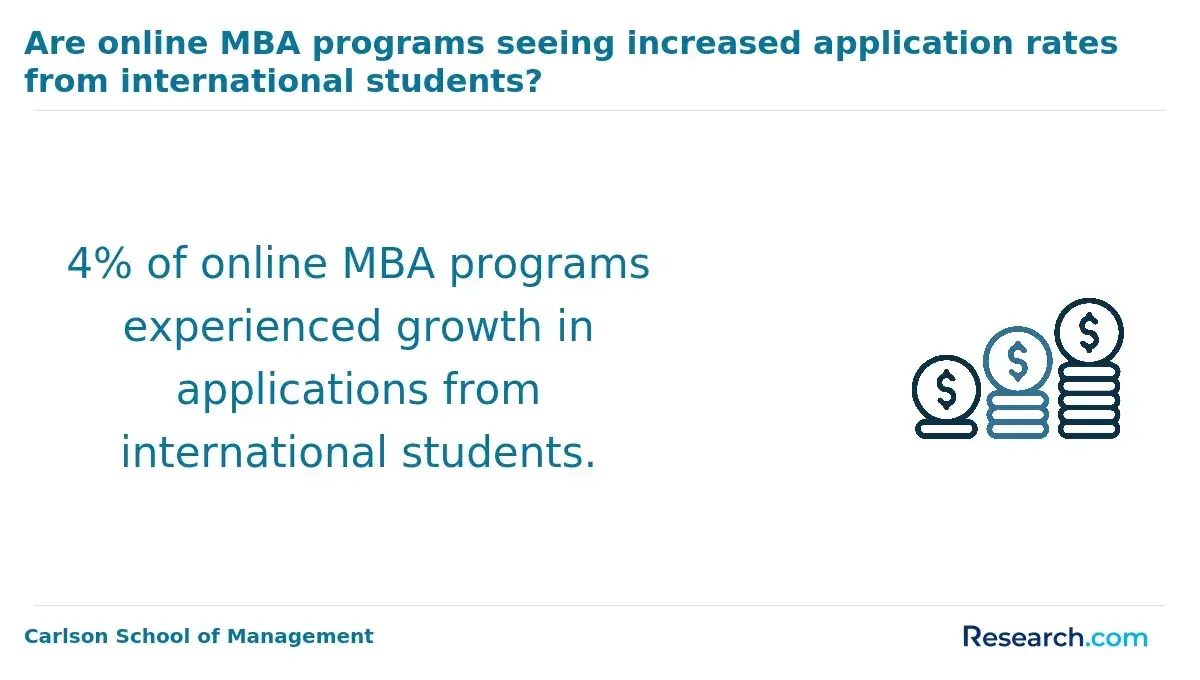
Rising application volumes suggest that more programs are offering financial aid, giving international students additional support to fund their education. Even so, students should request a written cost estimate from each school before committing.
Online MBA specializations allow students to align general management training with a target industry or function. The best choice depends on your current experience, career goal, employer demand, and the program’s strength in that area.
Analytics and STEM Tracks
Specializations in data analytics, business intelligence, and STEM-designated fields are popular for students who want to combine management training with quantitative decision-making. These tracks may include coursework in data interpretation, forecasting, operations analytics, information systems, and technology strategy.
Marketing and Digital Strategy
Marketing-focused MBAs cover brand management, digital marketing, customer analytics, market research, product strategy, and growth planning. This path can fit students targeting roles in consumer goods, technology, e-commerce, startups, agencies, or global corporations.
Healthcare and Sustainability
Healthcare management and sustainability tracks can be useful for students interested in hospitals, health systems, public health organizations, NGOs, responsible business, climate-related initiatives, or social-good sectors. These concentrations often connect business fundamentals with regulation, operations, ethics, stakeholder management, and impact measurement.
Finance, consulting, operations, and entrepreneurship
Many online MBA programs also offer electives or concentrations in finance, consulting, supply chain management, operations, entrepreneurship, project management, and international business. These options can help students move from technical or functional roles into broader management positions.
Career Alignment
Choose a specialization by working backward from your target job. Review job postings, required skills, preferred credentials, and industries that recruit from the program. Also confirm that the specialization is available online, taught by qualified faculty, and supported by relevant career services, alumni connections, and applied projects.
After graduating from a U.S. online MBA program, international students can expect stronger business credentials, broader management knowledge, and access to new professional networks. Outcomes vary significantly by school reputation, specialization, prior work experience, location, industry, and work authorization rules.
- Employer demand: Over a third of global recruiters in 2024 reported plans to hire more MBA graduates than the previous year.
- Earning potential: MBA graduates can expect approximately 1.75× the median starting salary of bachelor’s degree holders, although individual salaries vary by market and role.
- Management roles: Graduates may pursue roles such as business development manager, operations director, strategy consultant, product manager, finance manager, or general management trainee.
- Global career mobility: A U.S. MBA can help position graduates for multinational employers, regional leadership roles, and cross-border business functions.
- Social impact pathways: Some graduates move into non-profit organizations, sustainability initiatives, healthcare leadership, education ventures, or mission-driven enterprises.
- Network value: Online programs can still provide peer learning, alumni access, faculty connections, and group projects, but students must be proactive because networking is less automatic than in residential programs.
- Visa and employment planning: International graduates should review visa regulations and work authorization rules early, especially if they hope to work in the U.S. after completing an online program.
The degree alone does not guarantee a job change or salary increase. The strongest results usually come from pairing the MBA with relevant experience, a clear target role, strong networking, and demonstrated business impact.
MBA salaries vary by industry, geography, school reputation, role, employer, and prior work experience. International students should use salary data as a benchmark, not a guarantee. Consulting, finance, technology, and strategy roles often report higher compensation, while nonprofit, public sector, and social impact roles may offer different rewards and career trajectories.
- Median starting salary for U.S. MBA grads: Employers estimate U.S. MBA graduates earn a median starting salary roughly 1.75 × that of bachelor’s‑only hires.
- Top business schools, Class of 2024: Yale School of Management MBA graduates entering consulting reported a median base salary of $190,000.
- Industry-specific salaries at high tier schools: At NYU Stern School of Business, the average starting salary for consulting roles was $177,561, and for finance roles $164,382.
- Early-career ROI for international students: If you combine 1‑4 years of work experience and earn an online U.S. MBA, targeting management/strategy roles could realistically bring salaries in the $150,000‑ $200,000+ range depending on school and specialization.
To evaluate salary potential responsibly, compare outcomes by function rather than only overall MBA averages. A student pursuing consulting should review consulting placement; a student pursuing healthcare leadership should review healthcare outcomes; a student staying in their home country should research local employer pay and recognition of online U.S. degrees.
Also consider total return on investment. A lower-cost accredited program may produce a better financial outcome than a high-priced program if your target employer values experience, skills, and accreditation more than brand prestige.
How do you choose the best online MBA program as an international student?
The best online MBA is not simply the highest-ranked or most expensive program. It is the program that matches your career goal, budget, time zone, academic background, work schedule, and need for international student support.
- Check accreditation first: Look for recognized business accreditation, such as AACSB. As of 2025, over 1,047 institutions globally hold AACSB accreditation, signaling high-quality business education.
- Compare total cost: Review tuition, fees, books, technology charges, residency expenses, payment plans, scholarships, and loan options.
- Confirm online delivery details: Ask whether classes are asynchronous, live, recorded, or hybrid. Time-zone fit is especially important for students studying from outside the U.S.
- Evaluate international student support: Strong programs offer clear admissions guidance, credential evaluation help, responsive advising, career coaching, and access to global alumni networks.
- Review curriculum relevance: Choose programs with courses in global business, cross-cultural leadership, analytics, sustainability, healthcare, finance, marketing, or other areas aligned with your goals.
- Study career outcomes: Look for employment reports, alumni profiles, employer partnerships, career services access for online students, and evidence that graduates enter roles you want.
- Assess faculty and peer quality: Online MBA value depends partly on who teaches the courses and who studies with you. Cohort experience, group projects, and class diversity can affect learning quality.
- Ask about networking access: Confirm whether online students can join alumni events, industry sessions, mentoring programs, career fairs, and student organizations.
Before applying, shortlist programs in three categories: affordable accredited options, best-fit specialization options, and higher-prestige reach options. Then compare them using the same criteria. A strong choice should be academically credible, financially realistic, logistically manageable, and clearly connected to the roles you want after graduation.
Other Things You Should Know About Online MBA Programs for International Students in the U.S.
Yes. Most U.S. online MBA programs ask international applicants to submit a credential evaluation from a recognized service such as WES, ECE, or SpanTran. Schools use it to verify degree equivalency, convert grades, and confirm that the bachelor’s degree meets admission standards.
Most U.S. online MBA programs require international students to demonstrate English proficiency through tests like TOEFL or IELTS. The minimum scores are typically around 80-100 for TOEFL or 6.5 for IELTS, specific to 2027 admissions.
- BusinessBecause. (2025). Employer confidence in MBA talent remains strong. Retrieved November 11, 2025, from https://www.businessbecause.com/news/in-the-news/9823/employer-confidence-in-mba-talent-remains-strong
- EFMD Global. (2025, July 21). Five favourable findings with regional differences about graduate business education from GMAC’s 2025 survey of corporate recruiters. Retrieved November 11, 2025, from https://blog.efmdglobal.org/2025/07/21/five-favourable-findings-with-regional-differences-about-graduate-business-education-from-gmacs-2025-survey-of-corporate-recruiters/
- Financial Times. (n.d.). Online MBA method. Retrieved November 11, 2025, from https://www.ft.com/online-mba-method
- GMAC. (2024). 2024 corporate recruiters survey report. Retrieved November 11, 2025, from https://www.gmac.com/-/media/files/gmac/research/employment-outlook/2024-corporate-recruiters-survey/2024_gmac_crs_report.pdf
- GMAC. (2024). 2024 corporate recruiters survey regional profile: United States. Retrieved November 11, 2025, from https://www.gmac.com/-/media/files/gmac/research/employment-outlook/2024-corporate-recruiters-survey/2024_gmac_crs_regional_profile-united-states.pdf
- Harvard Business Review/HCAMag Asia. (2024). More than 1 in 4 employers to recruit more GME grads in 2024: Global survey. Retrieved November 11, 2025, from https://www.hcamag.com/asia/specialisation/recruitment/more-than-1-in-4-employers-to-recruit-more-gme-grads-in-2024-global-survey/503283
- Yale School of Management. (2025). Career paths: Employment report 2024–25. Retrieved November 11, 2025, from https://som.yale.edu/programs/mba/career-paths/employment-report-2024-25
- AACSB. (2025). AACSB data guide 2025. Retrieved November 11, 2025, from https://www.aacsb.edu/-/media/publications/data-reports/aacsb-data-guide-2025.pdf
- ZipRecruiter. (n.d.). MBA salary. Retrieved November 11, 2025, from https://www.ziprecruiter.com/Salaries/Mba-Salary