
2027 Most Affordable Online Electrical Lineworker Trade School Programs

Co-Founder and Chief Data Scientist
Choosing an electrical lineworker trade school is not just a tuition decision. You need a program that teaches safety, climbing, electrical systems, and field readiness while also fitting your schedule and budget. For many students, the most confusing part is separating truly career-focused online or hybrid lineworker programs from programs that are only loosely related to utility work.
This guide is for high school graduates, career changers, veterans, and working adults who want an affordable path into linework. Electrical power-line installer jobs are expected to grow by 8% from 2023 to 2033, so the field offers a practical route into infrastructure, utility, and power distribution careers. Below, you will find affordable online electrical lineworker trade school programs for 2027, what they cost, how long they take, what employers look for, and how to choose a program that can actually prepare you for field work.
Quick answer: What is the best path into electrical linework?
The best path is usually an accredited or industry-recognized lineworker certificate, technical diploma, associate degree, or apprenticeship that combines online coursework with required in-person field training. Fully online study can teach electrical theory, safety rules, power distribution concepts, and equipment basics, but lineworker preparation still requires hands-on practice in pole climbing, rigging, transformer work, CDL-related skills, and jobsite safety.
Most students should compare programs by accreditation, cost, field training access, CDL preparation, employer partnerships, job placement support, and whether the curriculum aligns with utility or apprenticeship expectations. A low tuition price is useful only if the program leads to recognized skills and employability.
What are the benefits of getting an online electrical lineworker trade school program?
- Builds job-focused skills for entry-level utility, power distribution, electrical construction, and apprenticeship roles.
- Can lead to a career field where electrical power-line installers and repairers earned $44.50 per hour and $92,560 per year, according to the wage figures cited in this guide.
- Offers more scheduling flexibility than traditional campus-only training while still requiring hands-on labs, field assessments, or employer-based training for safety-critical skills.
- May help students enter the workforce faster than many four-year college routes, especially when the program includes CDL preparation, OSHA training, or apprenticeship connections.
What can I expect from an online electrical lineworker trade school program?
An online electrical lineworker program usually combines remote classroom instruction with required field training. The online portion covers electrical theory, power systems, safety standards, equipment identification, utility terminology, and troubleshooting concepts. The in-person portion is where students practice climbing, rigging, pole-top rescue, transformer installation, tool use, and safe work procedures around energized or de-energized systems.
Common delivery formats include video lessons, digital assignments, instructor-led virtual sessions, simulations, and scheduled campus or training-yard labs. Some programs are better described as hybrid programs because they require students to report to a training site for practical skills checks. This is not a weakness; in linework, hands-on validation is essential.
Tuition commonly ranges from $3,000 to $19,000, depending on program length, location, included gear, CDL preparation, and whether the credential is a short certificate, technical diploma, apprenticeship, or associate degree. Many options are designed to prepare students for employment or apprenticeship entry in less than a year, though some associate degree and apprenticeship pathways take longer.
| Program feature | What it means for students | Why it matters |
| Online coursework | Electrical theory, safety rules, power distribution, and equipment basics are completed remotely. | Gives students flexibility before or between hands-on training sessions. |
| Hands-on training | Students practice climbing, rigging, rescue procedures, transformer work, and tool use. | Employers need proof that graduates can work safely in real field conditions. |
| Industry credentials | Programs may include OSHA-10, NCCER, CDL-related preparation, or other recognized training. | Credentials can strengthen apprenticeship and entry-level job applications. |
| Career support | Schools may offer resume help, hiring events, interview preparation, or employer referrals. | Strong employer connections can make the transition from training to work easier. |
Where can I work with an online electrical lineworker trade degree?
Graduates can work in power generation, utility construction, electric distribution, local government, contractor services, and related infrastructure roles. The credential alone does not guarantee employment, but a program with strong field training can prepare students for entry-level hiring requirements and apprenticeship competition.
According to the U.S. Bureau of Labor Statistics, as of May 2023, the industries with the highest employment levels for electrical power-line installers and repairers include:
- Electric Power Generation, Transmission, and Distribution: Employs around 57,100 workers, making up over 50% of the field.
- Local Government: Employs about 13,120 lineworkers, representing roughly 11% of the occupation.
- Utility System Construction: Employs close to 36,320 lineworkers, or about 30% of the total workforce.
- Building Equipment Contractors: Employs approximately 5,340 workers, accounting for 5% of the field.
- Natural Gas Distribution: Employs around 2,700 lineworkers, or 2% of the total industry.
How much can I make with an electrical lineworker trade degree?
Electrical linework can pay well compared with many other jobs that do not require a bachelor's degree. The 2023 median wage for all U.S. occupations was $23.11 per hour. By comparison, the wage figures below show substantially higher earnings for electrical lineworker-related roles and industries (US BLS, 2024):
- Electrical Power-Line Installers and Repairers: $44.50 per hour; $92,560 per year
- Utility System Construction: $35.78 per hour; $74,410 per year
- Local Government: $39.45 per hour; $82,050 per year
- Electric Power Transmission and Distribution: $45.22 per hour; $94,050 per year
Entry-level workers typically start around $50,000 to $60,000. With 5+ years of experience or certifications like CDL or OSHA-30, wages can exceed $100,000 annually, especially in high-demand states like California or Alaska. Actual pay depends on the employer, union status, overtime, storm response work, geographic region, and the worker's level of experience.
- List of the Best Online Electrical Lineworker Trade School Programs for 2027
- How long does it take to complete an online electrical lineworker trade degree program?
- How does an online electrical lineworker trade degree program compare to an on-campus program?
- What is the average cost of an online electrical lineworker trade degree program?
- What are the financial aid options for students enrolling in an online electrical lineworker trade degree program?
- What are the prerequisites for enrolling in an online electrical lineworker trade degree program?
- Are these programs accredited and industry-recognized?
- Can an online electrical lineworker trade degree program fast-track you into a bachelor's degree?
- What courses are typically in an online electrical lineworker trade degree program?
- How can advanced education further boost my electrical lineworker career?
- What types of specializations are available in an online electrical lineworker trade degree program?
- What additional certifications can boost my career advancement?
- How to Choose the Best Online Electrical Lineworker Trade Degree Program
- What career paths are available for graduates of an online electrical lineworker trade degree program?
- What is the job market for graduates with an online electrical lineworker trade degree program?
List of the Best Online Electrical Lineworker Trade School Programs for 2027
How do we rank schools?
Affordability matters, but a lineworker program also has to prepare students for physically demanding, safety-sensitive work. Research.com reviews available education and workforce data from the IPEDS database, Peterson's database, the College Scorecard database, and The National Center for Education Statistics.
These sources help evaluate schools on factors such as cost, institutional quality, student outcomes, and program availability. For more detail on how Research.com evaluates programs, visit the Research.com methodology page.
| School | Program | Length | Cost | Accreditation |
| Texas State Technical College | A.A.S. in Electrical Lineworker Technology | 20 months | $18,420 | Southern Association of Colleges and Schools Commission on Colleges (SACSCOC) |
| Connecticut State Community College | Eversource Lineworker Program | 13 weeks | $2,999 | New England Commission of Higher Education (NECHE) |
| Blue Ridge Community and Technical College | A.A.S. in Electric Distribution Engineering Technology | 2 years | $50 per credit hour (In-state) / $367 per credit hour (Out-of-state) | Higher Learning Commission (HLC) |
| Lansing Community College | A.A.S. in Electrical Utility/Lineworker | 13 months | $12,000 for in-district / $19,000 for out-of-district | Higher Learning Commission (HLC) |
| College of Southern Idaho | Electrical Apprenticeship | 4 years | $995 per year | Northwest Commission on Colleges and Universities (NWCCU) |
| St. Petersburg College | Electrical Lineworker with CDL Certification | 4 months | $7,500 class price | Southern Association of Colleges and Schools Commission on Colleges (SACSCOC) |
| Ogden-Weber Technical College | Electrical Trades Preparation | 5 months | $805.00 tuition cost | Council on Occupational Education (COE) |
| Blackhawk Technical College | Electric Power Distribution Technical Diploma | Required Classes to Graduate: 31 | $5,593 tuition fee | Higher Learning Commission (HLC) |
| Midlands Technical College | Maintenance Electrical Technician Certificate | Contact the school for details | $8,938 full program | Southern Association of Colleges and Schools Commission on Colleges (SACSCOC) |
| Los Angeles Trade-Technical College | A.S. in Electrical Line-Worker / Lineman | Required Units to Graduate: 21 | $46 per unit (In-state) / $377 per unit + enrollment fee of $46 per unit (Out-of-state) | Accrediting Commission for Community and Junior Colleges, Western Association of Schools and Colleges (ACCJC-WASC) |
1. Texas State Technical College (A.A.S. in Electrical Lineworker & Management)
The Texas State Technical College Associate of Applied Science in Electrical Lineworker Technology is designed for students who want structured preparation for entry-level utility work. The program emphasizes climbing, electrical safety, line installation, and equipment used in the electric utility industry. Students train on utility poles and can benefit from TSTC’s employer connections.
- Program Length: 20 months
- Cost: $18,420
- Accreditation: Southern Association of Colleges and Schools Commission on Colleges (SACSCOC)
2. Connecticut State Community College (Eversource Lineworker Program)
The Connecticut State Community College Lineworker Certificate program blends classroom preparation with field-based instruction in pole climbing, electrical systems, and safe work practices. Its utility-focused structure makes it a practical choice for students seeking concentrated training for power distribution careers.
- Program Length: 13 weeks
- Cost: $2,999
- Accreditation: New England Commission of Higher Education (NECHE)
3. Blue Ridge Community and Technical College (A.A.S. in Electric Distribution Engineering Technology)
The Blue Ridge Community and Technical College Electric Distribution Engineering Technology program is built for students interested in utility service, distribution systems, and technical field operations. Coursework and hands-on training cover power system installation, maintenance, repair, safety, climbing, and electrical theory.
- Program Length: 2 years
- Required Credits to Graduate: 60
- Cost: $50 per credit hour (In-state) / $367 per credit hour (Out-of-state)
- Accreditation: Higher Learning Commission (HLC)
4. Lansing Community College (A.A.S. in Electrical Utility/Lineworker)
The Lansing Community College Utility Lineworker program prepares students to construct, maintain, and repair electrical distribution systems. The curriculum combines technical classroom instruction with practical work in climbing, electrical safety, utility equipment, and live-power work procedures.
- Program Length: 13 months
- Cost: $12,000 for in-district / $19,000 for out-of-district
- Accreditation: Higher Learning Commission (HLC)
5. College of Southern Idaho (Electrical Apprenticeship)
The College of Southern Idaho Electrical Apprenticeship is a longer workforce pathway that combines online instruction with paid on-the-job training under licensed professionals. It can support students preparing for state licensure and long-term work in electrical and utility services.
- Program Length: 4 years
- Cost: $995 per year
- Accreditation: Northwest Commission on Colleges and Universities (NWCCU)
6. St. Petersburg College (Electrical Lineworker with CDL Certification)
The St. Petersburg College Lineworker Training program prepares students for entry-level power delivery work through classroom learning and hands-on practice. Students train in pole climbing, electrical systems, safety procedures, and utility equipment use in a controlled training environment.
- Program Length: 4 months
- Cost: $7,500 class price
- Accreditation: Southern Association of Colleges and Schools Commission on Colleges (SACSCOC)
7. Ogden-Weber Technical College (Electrical Trades Preparation)
The Ogden-Weber Technical College Electrical Trades Preparation program focuses on foundational electrical knowledge and workplace readiness. Students study electrical theory, safety, wiring skills, tool use, blueprint reading, and industry codes to prepare for apprenticeships or entry-level electrical and utility-related jobs.
- Program Length: 5 months
- Required Credits to Graduate: 8
- Cost: $805.00 tuition cost
- Accreditation: Council on Occupational Education (COE)
8. Blackhawk Technical College (Electric Power Distribution Technical Diploma)
The Blackhawk Technical College Electric Power Distribution program centers on field practice, safety, pole climbing, electrical systems, and equipment operation. It is a strong fit for students who want technical diploma training aimed at utility and electric linework roles.
- Required Classes to Graduate: 31
- Cost: $5,593 tuition fee
- Accreditation: Higher Learning Commission (HLC)
9. Midlands Technical College (Maintenance Electrical Technician Certificate)
The Midlands Technical College Maintenance Electrical Technician program is a related electrical pathway focused on installing, maintaining, and troubleshooting industrial electrical systems. Students study electrical theory, safety, motor controls, programmable logic controllers, and lab-based technical skills for manufacturing and maintenance roles.
- Program Length: Contact the school for details
- Cost: $8,938 full program
- Accreditation: Southern Association of Colleges and Schools Commission on Colleges (SACSCOC)
10. Los Angeles Trade-Technical College (A.S. in Electrical Line-Worker / Lineman)
The Los Angeles Trade-Technical College Electrical Line Worker program gives students job-focused training in climbing, safety, equipment use, and electrical theory. The curriculum is aligned with practical utility expectations and prepares graduates for entry-level roles in the electric utility field.
- Required Units to Graduate: 21
- Cost: $46 per unit (In-state) / $377 per unit + enrollment fee of $46 per unit (Out-of-state)
- Accreditation: Accrediting Commission for Community and Junior Colleges, Western Association of Schools and Colleges (ACCJC-WASC)
How long does it take to complete an online electrical lineworker trade degree program?
Many electrical lineworker trade programs take less than a year, especially certificate and pre-apprenticeship options. Associate degree pathways often take longer because they include additional technical and general education coursework. Apprenticeships may take several years because students are combining classroom instruction with paid work experience.
Programs such as those at Cape Fear Community College and Tulsa Welding School offer options as short as 10 to 15 weeks, particularly when the program is structured around intensive labs or externship-style training. Even when coursework is online, students should expect in-person requirements for climbing, pole-top rescue, equipment handling, safety drills, and field assessments.
Admission usually requires a high school diploma or GED, a valid driver’s license, and the physical ability to work in outdoor field conditions. Compared with unrelated advanced healthcare credentials such as the cheapest post master's PMHNP certificate online, lineworker trade programs are typically more direct and do not require prior graduate education. Students comparing other fast career options, including low cost real estate degree programs online, should pay attention to the difference between classroom-only credentials and programs that verify jobsite skills.
| Training route | Typical timeline from this guide | Best for | Trade-off |
| Short certificate or academy | 10 to 15 weeks or 13 weeks | Students who want a fast pre-apprenticeship route | May offer fewer credits toward a degree |
| Hybrid lineworker certificate | 4 months or 5 months | Students who need structured skills training with some flexibility | Still requires in-person field practice |
| Associate degree | 13 months, 20 months, or 2 years | Students who want broader technical education and possible transfer value | Usually costs more and takes longer |
| Apprenticeship | 4 years | Students seeking paid on-the-job training and licensure preparation | Requires a longer commitment |
How does an online electrical lineworker trade degree program compare to an on-campus program?
Online and campus-based lineworker programs can lead to similar career preparation when they include the same field competencies. The major difference is delivery. Online programs shift theory, safety modules, assignments, and some simulations to remote learning, while campus programs deliver more instruction face to face. In both formats, students still need hands-on training to demonstrate safe performance.
Hybrid learning is common in many practice-based fields. For example, even accredited online SLP master's programs may blend online coursework with required clinical or in-person components. Lineworker training follows the same general logic: remote study can support knowledge, but field competence must be practiced and verified.
| Factor | Online or hybrid lineworker program | On-campus lineworker program |
| Schedule flexibility | Stronger for students balancing work, family, or travel limits. | Less flexible because students report to campus more often. |
| Hands-on training | Required through labs, training yards, internships, or partner sites. | Usually built into the regular campus schedule. |
| Employer perception | Can be positive if the program includes recognized credentials and field training. Nearly 70% of skilled-trades employers consider micro-credentials and online certifications just as valuable as traditional ones. | Often familiar to local employers, especially when the school has utility partnerships. |
| Cost | May reduce commuting or housing costs, though travel to labs may still be required. | May include more campus fees, commuting, or relocation expenses. |
| Best fit | Self-directed students who can complete online work and attend required skills sessions. | Students who learn best through daily in-person instruction and structured lab access. |
Certification and licensing expectations do not disappear in an online format. Students still need to meet trade-specific, apprenticeship, employer, and safety requirements. Job placement outcomes depend less on whether the lecture content was online and more on whether the program provides credible hands-on training, employer access, and recognized credentials.
What is the average cost of an online electrical lineworker trade degree program?
Online and hybrid electrical lineworker programs are generally less expensive than many longer college programs, but prices vary widely. Most programs discussed in this guide fall between $3,000 and $19,000, while the median for pre-apprenticeship lineman programs that include classroom and hands-on modules sits at around $8,400.
Average trade school tuition is between $3,800–$16,000, which is typically below the cost of a four-year college route. However, students should avoid comparing tuition alone. A program that includes equipment, CDL preparation, safety certifications, and employer hiring support may offer better value than a cheaper program that requires many extra out-of-pocket purchases.
Lineworker training can also compare favorably with other vocational options. Students researching the cheapest baking and pastry arts programs online or the cheapest online digital photography degree should compare not just sticker price, but also required equipment, local job demand, wage potential, and how quickly graduates can begin paid work.
| Cost item | What to ask before enrolling |
| Tuition | Is the published price the full program cost or only the instructional fee? |
| Tools and gear | Are climbing gear, PPE, uniforms, and tools included, rented, or purchased separately? |
| CDL preparation | Does the program include CDL training, or will students pay for it elsewhere? |
| Travel and housing | Will you need to travel to campus, a training yard, or employer site for labs? |
| Certification and exam fees | Are OSHA, NCCER, or other credential fees included in tuition? |
| Financing costs | If using loans, what will repayment look like after graduation? |
Financial support is often available. Over 46% of trade school students benefit from federal or state aid, grants, and scholarships. Eligible online programs may qualify for federal loans and GI Bill benefits. Return on investment can be strong when a student completes a recognized program, secures employment, and keeps borrowing modest. Vocational programs boast employment rates over 85% after graduation, with wages typically covering tuition in less than a year. National three-year federal loan default rates are low (around 2.3%), suggesting good outcomes for graduates.
What are the financial aid options for students enrolling in an online electrical lineworker trade degree program?
Students should check aid eligibility before assuming they must pay the full cost out of pocket. Aid options depend on the school, program length, accreditation status, enrollment status, state residency, and whether the program qualifies for federal student aid.
Federal financial aid
Pell Grants and federal student loans may be available through the FAFSA for eligible accredited programs. In 2023, about 36% of students at North American Trade Schools received federal grants or loans. State-funded aid, such as the Cal Grant, may also apply depending on residency and program eligibility.
Scholarships
The OTEC Lineman School Scholarship offers up to $5,000. Trade unions, electric cooperatives, community foundations, and workforce organizations may also fund scholarships for aspiring lineworkers. Scholarships are especially valuable because they reduce dependence on loans.
Employer assistance
Some skilled-trades employers provide tuition reimbursement, sponsorships, or paid training pathways. Availability varies by region and employer, but this can be one of the lowest-debt routes into linework when the student is able to meet hiring requirements.
Institutional and workforce support
Schools may offer payment plans, institutional grants, or workforce funding options. Programs such as Southeast Lineman Training Center accept Sallie Mae loans and WIOA funding for unemployed or underemployed students.
Online lineworker program graduates typically carry about $10,000 in student loans, far lower than average debt from four-year institutions. Students should still borrow carefully and compare expected monthly payments with realistic entry-level wages.
What are the prerequisites for enrolling in an online electrical lineworker trade degree program?
Lineworker programs are usually accessible to students without previous college experience, but they are not casual online courses. Schools set prerequisites because the work is physically demanding and safety-critical.
Most programs require a high school diploma or GED and basic physical readiness. This makes admission more direct than healthcare programs such as the cheapest graduate certificate in nursing leadership online, which require previous nursing education and professional credentials.
- Minimum age and education: Students usually must be at least 18 years old and hold a high school diploma or GED.
- Driver’s license: A valid driver’s license is commonly required. Some programs expect Class A CDL eligibility before or during training.
- Academic preparation: Algebra, basic science, mechanical reasoning, and introductory electrical concepts can help students succeed.
- Physical fitness: Students must be able to climb utility poles, lift heavy equipment, pass a Department of Transportation (DOT) physical, and stay within typical weight limits, often around 275 lbs, for climbing gear.
- Safety readiness: Students should be prepared for outdoor work, heights, weather exposure, protective equipment, and strict safety procedures.
Students who are comparing linework with technology-based careers may also look at most affordable online CompTIA Network training bootcamps. That route may suit people who want technical work but prefer a less physically demanding environment.
Are these programs accredited and industry-recognized?
Accreditation and industry recognition should be among your first checks. Accreditation shows that the institution meets external quality standards, while industry recognition helps confirm that the program teaches skills employers actually understand. For lineworker training, both matter.
Look for regional accreditation, national career or technical accreditation, workforce board approval, utility partnerships, apprenticeship alignment, or recognized curriculum standards such as NCCER. Accreditation can also affect access to federal aid, transfer credit, and employer confidence. Industry partnerships may improve access to field training, hiring events, and realistic jobsite expectations.
Do not assume that speed equals quality. Some accelerated credentials, including a degree in 6 months, may be useful in certain fields, but lineworker preparation must still include safety, field performance, and recognized skills validation.
Can an online electrical lineworker trade degree program fast-track you into a bachelor's degree?
Some lineworker associate degree and technical programs may provide transfer credit toward a bachelor's degree, especially if the school has articulation agreements with four-year institutions. This can be useful for students who eventually want to move into utility management, construction management, safety leadership, engineering technology, or energy operations.
Certificate-only programs may have less transfer value, even if they are strong for employment. Before enrolling, ask whether credits are transcripted, whether they apply to general education or technical electives, and which colleges accept them. Students who want a faster academic ladder can compare options through accelerated programs for bachelor's degree.
What courses are typically in an online electrical lineworker trade degree program?
Lineworker curricula usually begin with electrical fundamentals and safety before moving into distribution systems, equipment use, climbing, and applied field skills. Online coursework supports knowledge development, while labs and field training confirm whether students can perform safely.
Electrical theory and fundamentals
Students typically study DC and AC circuits, Ohm’s Law, and Three-phase systems. These topics help students understand how electricity moves through power networks and why safe work practices matter.
Safety and compliance training
Safety training often includes OSHA regulations, Personal Protective Equipment (PPE), live-line hazard management, substation safety, lockout/tagout concepts, and emergency procedures. Because linework carries serious risk, safety is not a side topic; it is central to the curriculum.
Power systems and distribution
Programs commonly introduce the structure and operation of power delivery systems. Students may study:
- Overhead vs. underground systems
- Pole framing and setup
- Transformer installation
- Troubleshooting faults in the grid
Specialized tools and equipment
Training may cover bucket trucks and digger derricks, hot sticks and grounding systems, rigging equipment, test meters, cable splicing, load calculations, and system grounding techniques. Students should confirm which equipment they will actually use during in-person training.
Virtual simulation components
Many programs now use VR/AR simulations for repeatable practice in pole climbing, repair scenarios, fault response, and hazard recognition. Simulations can be helpful, but they should supplement—not replace—supervised field practice.
Certifications and program length
Depending on the school, students may earn credentials such as:
- NCCER Power Line Worker Level 1
- OSHA-10 certification
- Additional industry-recognized credentials
These credentials are valued by 99% of employers in the skilled trades. Typical program length ranges between 200–350 hours, depending on the institution and learning pace.
How can advanced education further boost my electrical lineworker career?
Advanced education is most useful after a worker has field experience and wants to move toward supervision, safety management, training, operations, project coordination, or energy technology roles. A lineworker who understands both field realities and business operations may be better prepared for leadership positions.
Graduate education is not required for most lineworker jobs, but it can support longer-term advancement into management or specialized energy-sector roles. Students considering future leadership pathways can explore flexible options such as 12 month master's programs, especially if they plan to combine technical experience with management, technology, or grid operations knowledge.
What types of specializations are available in an online electrical lineworker trade degree program?
Specializations help students align training with the type of utility work they want to pursue. Not every school offers every track, so students should verify the curriculum before enrolling.
- Transmission linework: Focuses on high-voltage structures, rigging, live-line maintenance, and transmission systems. Some programs use the NCCER Power Line Worker: Transmission curriculum.
- Distribution systems: Covers residential and commercial power delivery, pole framing, transformer setup, troubleshooting, and overhead or underground systems.
- Substation linework: Introduces relay systems, control panels, concrete foundation installation, high-voltage switchgear, and NCCER Substation Level 2-style coursework.
- Cable splicing: Trains students in medium-voltage cable splicing through practical exercises and knowledge checks, a skill used by utilities and municipalities.
- Renewable energy and smart grid systems: Covers solar, wind, hybrid energy infrastructure, and smart grid integration. Demand has been increasing in related areas, including a 4.9% annual rise for smart grid roles and 5.4% growth in solar-related jobs (as of 2021).
Graduates from specialized tracks may pursue credentials such as NCCER Level 2, OSHA-10, cable splicing credentials, and smart grid technician badges. Transmission and substation specialists can earn average wages above $46 per hour, surpassing general lineworker salaries.
What additional certifications can boost my career advancement?
Additional certifications can improve a lineworker's profile when they match employer needs. Useful credentials may relate to CDL, OSHA safety, first aid, CPR, pole-top rescue, NCCER levels, cable splicing, substation work, or smart grid systems. The best choice depends on whether you want to work in distribution, transmission, substation operations, utility construction, or renewable energy infrastructure.
Before paying for extra credentials, ask employers or apprenticeship sponsors which ones they value. Students exploring certificates across multiple career fields can also compare certification training for high paying jobs to understand how short credentials may affect hiring prospects.
How to Choose the Best Online Electrical Lineworker Trade Degree Program
The best program is not always the cheapest or fastest. Choose the option that offers credible training, safe hands-on practice, recognized credentials, and a realistic path to employment.
| Selection factor | What to verify | Warning sign |
| Accreditation | Check regional, national, technical, workforce, or industry recognition. | The school cannot clearly explain its accreditation or approval status. |
| Hands-on training | Ask where climbing, rescue, rigging, and equipment practice happen. | The program suggests simulations are enough for field readiness. |
| Employer connections | Look for utility partnerships, hiring events, apprenticeship referrals, or local contractor relationships. | Career support is limited to generic resume advice. |
| Credential alignment | Confirm whether the program includes OSHA, NCCER, CDL preparation, or other employer-recognized credentials. | The curriculum uses vague language without naming skills or credentials. |
| Total cost | Add tuition, fees, gear, tools, travel, certification exams, and financing costs. | The advertised price excludes major required expenses. |
| Student outcomes | Ask for placement data, retention information, and recent graduate feedback. | The school promises a job or refuses to share outcome information. |
Accredited programs are preferred by 75–80% of employers and can support access to federal aid and recognized certifications. Northwest Lineman College reports a 73% job placement rate and 84% retention for its online and hybrid cohorts. Strong programs also make instructor qualifications easy to verify and provide clear course outlines covering theory, safety, equipment, and labs.
Students comparing linework with digital or emerging-technology pathways may also review best value online AI degree programs. AI programs and lineworker programs serve very different career goals, so the better choice depends on whether you want physical infrastructure work or computer-based technical work.
Common mistakes to avoid
- Choosing only by tuition: A low price can become expensive if tools, travel, CDL preparation, and certification fees are excluded.
- Ignoring accreditation: Accreditation can affect aid eligibility, transfer options, and employer confidence.
- Assuming “online” means no field training: Safe linework requires hands-on assessment.
- Overlooking physical requirements: Students should understand climbing, lifting, height, weather, and DOT physical expectations before enrolling.
- Trusting guaranteed salary claims: Wages vary by region, employer, overtime, union status, experience, and credentials.
- Skipping employer research: Contact local utilities, contractors, unions, and apprenticeship sponsors to learn which credentials they prefer.
What career paths are available for graduates of an online electrical lineworker trade degree program?
Graduates can pursue utility, contractor, government, and renewable energy roles. Many begin as apprentices or trainees, then advance as they gain supervised field experience, certifications, and employer trust.
Apprentice lineworker
This is the common entry point. Apprentices combine paid on-the-job training with continued coursework and earn about $52,350 annually while building core field skills.
Journeyman lineworker
After around four years of apprenticeship, workers may become journeymen. Journeymen handle more independent work in transmission and distribution line maintenance and repair, with average earnings of $90,000 or more.
Crew foreman or supervisor
Experienced lineworkers can move into leadership roles that coordinate crews, enforce safety procedures, manage storm restoration work, and oversee jobsite execution.
Renewable energy technician
Lineworkers can transition into solar, energy storage, EV infrastructure, and smart grid-related work. Solar and storage sectors continue to face workforce needs, including a 5.9% increase in solar jobs in 2023.
Substation or transmission specialist
Workers with advanced credentials can specialize in high-voltage systems, protective relays, switching, and substation operations. These roles can pay $115,000 or more annually.
Utility or contractor employee
About 50% of graduates work in public utilities, while others are hired by private electrical contractors or renewable energy firms. Students weighing other associate-level career questions, such as can you teach with an associate degree, should compare licensing requirements, job availability, and advancement paths across fields.
What is the job market for graduates with an online electrical lineworker trade degree program?
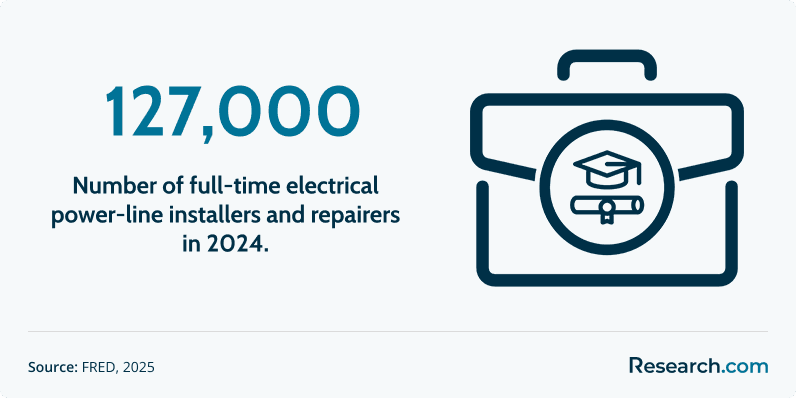
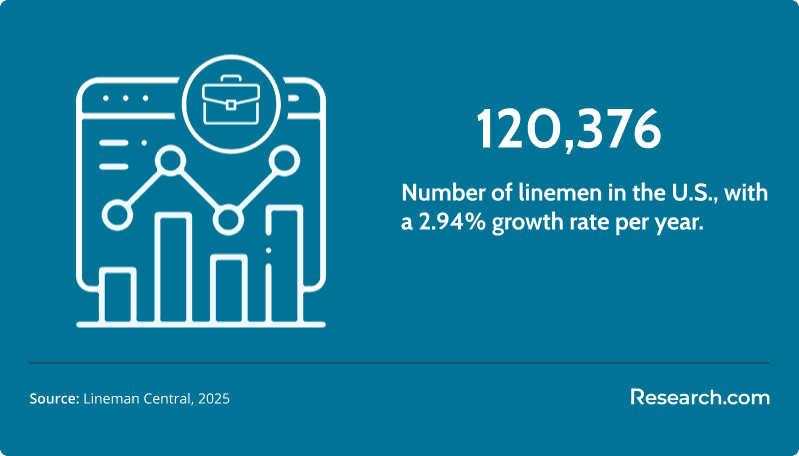
The job market is favorable for students who complete credible training and meet employer requirements. The BLS projects 8% growth in electrical power-line installer jobs from 2023 to 2033, with about 9,400 openings annually. Employment is expected to move from around 123,400 workers in 2023 to 132,800 by 2033.
Demand is shaped by infrastructure maintenance, storm recovery, grid upgrades, retirements, and replacement needs. Graduates of online or hybrid programs can be competitive if they complete meaningful field training and earn recognized credentials. Employers generally care most about safety, reliability, physical readiness, technical fundamentals, and the ability to work as part of a crew.
Most lineworker jobs are concentrated in utilities, utility construction, and local government. Utilities account for about 50%, utility construction for 30%, and local government for 11%. Electricians and electronics installers may also hire lineworker-trained workers for construction and infrastructure-related tasks.
Starting salaries are strong compared with many entry-level roles. The median wage was $92,560 in May 2024, or about $44.50 per hour. Entry-level positions typically start at $50,000–$60,000, with pay rising as workers gain experience, credentials, overtime opportunities, and specialized skills.
Questions to ask before enrolling
- Is the school accredited, and by which organization?
- Does the program include required hands-on training, or must I arrange it separately?
- Will I receive OSHA, NCCER, CDL-related, or other recognized credentials?
- What is included in tuition, and what will I pay separately for tools, gear, exams, travel, and housing?
- Which utilities, contractors, unions, or apprenticeship sponsors hire graduates from this program?
- Does the school publish job placement, retention, or graduate outcome data?
- Are instructors experienced lineworkers, utility professionals, or electrical trades experts?
- Will credits transfer if I later want an associate or bachelor's degree?
- What physical standards, driving requirements, and safety expectations must I meet?
References:
- Electrical Lineworker - job training. (2025, March 5). Job Training. https://cfcc.edu/job-training/construction-careers/electrical-lineworker
- Electrical Power-Line installers and repairers. (2025, April 18). Bureau of Labor Statistics. https://www.bls.gov/ooh/installation-maintenance-and-repair/line-installers-and-repairers.htm
- Electricians. (2025, April 18). Bureau of Labor Statistics. https://www.bls.gov/ooh/construction-and-extraction/electricians.htm
- Lineman Apprentice Salary (June 2025) - Zippia. (2025, January 8). https://www.zippia.com/salaries/lineman-apprentice
- Gamelin, L. (2025, March 27). Micro-Credentials that matter - Lee Gamelin - medium. Medium. https://medium.com/%40leegamelin/micro-credentials-that-matter-c05f42c4062a
- Kortnoy, B. (2025, February 3). How much does lineman school cost in 2025? Lineman Central. https://www.linemancentral.com/post/how-much-does-lineman-school-cost
- Tosic, T. (2025, February 24). How much does trade school cost? Affordable career training. Genesis Career College. https://www.genesiscareer.edu/trade-school-cost-breakdown-2/
- North American Trade Schools (162371) | Data USA. (n.d.). Data USA. https://datausa.io/profile/university/north-american-trade-schools
- Nces. (n.d.). DFR Report HTML. https://nces.ed.gov/ipeds/dfr/2023/ReportHTML.aspx?unitId=162371
- How to pay for Lineman School: 6+ financial aid options. (n.d.). Southeast Lineman Training Center. https://www.lineworker.com/how-to-pay-for-lineman-school-with-financial-aid
- Trade School vs College: What Finance Experts Have to Say - CET. (n.d.). https://cetweb.edu/blog/trade-school-vs-college-what-finance-experts-have-to-say
- Northwest Lineman College. (2025, June 2). Lineworker School Admissions | Northwest Lineman College | NLC. Northwest Lineman College - NLC. https://lineman.edu/admissions
- TEEX.ORG. (2025, June 11). Lineworker Academy | TEEX.ORG. TEEX.ORG | Texas a&M Engineering Extension Service. https://teex.org/class/epp700/
- Vector Solutions. (2024, November 6). Transmission and distribution of electrical power training courses. https://www.vectorsolutions.com/course-search/libraries/transmission-and-distribution-training
- electrical training ALLIANCE for the IBEW and NECA. (n.d.). https://www.electricaltrainingalliance.org/training/CableSplicingCertification
- Northwest Lineman College. (2025a, January 29). Career Opportunities - Northwest Lineman College - NLC. Northwest Lineman College - NLC. https://lineman.edu/electrical-lineworker-program-overview/career-opportunities
- 2025 State of Power Line Jobs | Lineman Central. (n.d.). Lineman Central. https://www.linemancentral.com/2025-state-of-power-line-jobs
- Northwest Lineman College. (2025b, March 3). Statistics & Sources - Northwest Lineman College - NLC. Northwest Lineman College - NLC. https://lineman.edu/about-nlc/statistics-sources%23sources
- What do lineman get paid? | Lineman Central. (n.d.). Lineman Central. https://www.linemancentral.com/lineman-pay
- Electrical Power-Line installers and repairers. (2023, April 25). Bureau of Labor Statistics. https://www.bls.gov/oes/2023/may/oes499051.htm
- Utilities: NAICS 22 : U.S. Bureau of Labor Statistics. (n.d.). Bureau of Labor Statistics. https://www.bls.gov/iag/tgs/iag22.htm
Key Insights
- Online electrical lineworker programs are usually hybrid in practice: theory can be learned online, but climbing, rescue, rigging, and equipment skills must be trained in person.
- The most affordable program is not automatically the best value. Compare tuition with tools, PPE, travel, CDL preparation, certification fees, and job placement support.
- Accreditation, NCCER alignment, OSHA training, CDL preparation, and utility partnerships can make a program more useful for employment than a generic electrical course.
- Many programs can be completed in less than a year, while associate degrees and apprenticeships take longer but may offer broader training or paid work experience.
- Electrical linework offers strong wage potential, with electrical power-line installers and repairers listed at $44.50 per hour and $92,560 per year in the wage figures cited above.
- Before enrolling, ask where hands-on training happens, which employers hire graduates, what credentials are included, and whether the program meets the requirements for your target state, utility, or apprenticeship sponsor.
Other Things You Should Know About Online Electrical Lineworker Trade Degree Programs
Most programs require OSHA 10 or OSHA 30, CPR and first aid, and a climbing or pole-top rescue credential before field labs. Employers and utilities may also require a DOT drug screen, a physical exam, and proof of NFPA 70E electrical safety training before apprentices enter live-line work.
Students need a reliable internet connection, a computer with updated software, and specific tools like virtual lab simulators to participate fully in online electrical lineworker programs in 2027. Technical specifications for these tools can vary by program.


