
2027 Most Affordable Online CompTIA Network+ Training Bootcamps

Co-Founder and Chief Data Scientist
Choosing an online CompTIA Network+ training bootcamp is really a cost-versus-support decision. Some learners only need free videos and practice questions; others need live instruction, labs, an exam voucher, accountability, and career help. The right choice depends on your current IT experience, your exam timeline, your budget, and whether you learn best through self-paced study or instructor-led practice.
This guide explains the most affordable online CompTIA Network+ training options in the USA, what each program includes, how much you should expect to pay, and how to decide whether a bootcamp is worth it. It also covers certification benefits, skills learned, salary expectations, career paths, job market realities, online versus in-person training, and common mistakes to avoid before enrolling.
Quick Answer: What is the best affordable online CompTIA Network+ bootcamp?
The best affordable option depends on how much structure you need. Free resources such as Professor Messer and PowerCert Animated Videos are strongest for disciplined self-study. CBT Nuggets is a low-cost subscription option at $59/month with hands-on labs and practice tools. Coursera’s Packt CompTIA Network+ Specialization is free to audit and costs $49/month for graded work and a certificate. Learners who want live instruction, labs, exam preparation, and an included voucher should compare providers such as Cyberkraft Training, Koenig Solutions, and New Horizons, where listed bootcamp prices range from $2,170 to $2,495, with some exam fees listed separately.
| Best fit | Recommended option type | Why it may work | Main trade-off |
| Lowest possible cost | Free video-based study | PowerCert Animated Videos and Professor Messer provide full Network+ coverage without tuition. | No live instructor, limited accountability, and exam voucher is not included. |
| Affordable guided self-study | Subscription or audit-based platform | CBT Nuggets and Coursera offer structured lessons at monthly prices. | Costs can rise if you stay subscribed for several months. |
| Fast exam preparation | Live online bootcamp | Cyberkraft Training, Koenig Solutions, and New Horizons provide intensive schedules and instructor support. | Higher upfront price and a compressed learning pace. |
| College credit and longer-term pathway | Online undergraduate certificate | American Public University and University of Maryland Global Campus offer credit-bearing networking certificates. | Longer timeline than a short bootcamp and may not include the certification exam. |
What is CompTIA Network+ and who should consider it?
CompTIA Network+ is a vendor-neutral IT certification focused on networking fundamentals, network implementation, operations, security, and troubleshooting. Unlike vendor-specific credentials that center on one company’s technology, Network+ is designed to validate skills that apply across different network devices, platforms, and environments.
This certification is often used by people pursuing entry-level or early-career IT infrastructure roles. It can be useful for help desk technicians who want to move into networking, career changers building their first IT credential stack, military or public-sector candidates seeking recognized technical credentials, and working professionals preparing for more advanced certifications such as cybersecurity or cloud credentials.
It is not automatically a substitute for experience. A bootcamp can help you prepare for the exam, but employers may still look for troubleshooting practice, customer support ability, lab projects, internships, or prior IT work.
What are the benefits of getting an online CompTIA Network+ training bootcamp qualification?
- Clearer path into networking roles: Network+ can support applications for roles such as Network Administrator, Network Support Specialist, Network Engineer (Entry-Level), and IT Consultant.
- Higher earning potential: Professionals with CompTIA Network+ certification often report median salary figures in the range of $70,000 to $85,000 annually in the United States, though pay depends heavily on location, experience, role, and employer.
- Vendor-neutral knowledge: The credential covers concepts that apply across multiple technologies and vendors, which can be helpful if you are not yet committed to a Cisco, Microsoft, AWS, or security-specific track.
- Stronger base for later specialization: Network+ is commonly used as a stepping stone toward more advanced areas, including cybersecurity credentials such as CompTIA Security+ and cloud-related training.
- Flexible training options: Online bootcamps and self-paced courses allow learners to study around work, family, military service, or other commitments.
What can I expect from an online CompTIA Network+ training bootcamp?
An online CompTIA Network+ bootcamp is usually a focused exam-preparation program. It should map lessons to the current CompTIA Network+ exam objectives and help you practice networking concepts through labs, quizzes, simulations, and practice tests. Some programs are live and intensive, while others are self-paced and subscription-based.
- Exam-focused instruction: Expect coverage of networking concepts, implementation, operations, security, and troubleshooting in a format designed around the CompTIA Network+ exam.
- Structured learning materials: Programs commonly include live classes, recorded videos, reading materials, quizzes, labs, and practice exams.
- Hands-on practice: Better programs include virtual labs or simulations so you can practice subnetting, device configuration, network documentation, wireless setup, and troubleshooting.
- Condensed schedule: A bootcamp may prepare students in several days or a few weeks, while self-paced options can stretch over months depending on study time.
- Exam support: Some providers include an exam voucher, retake support, study groups, or coaching; others sell training only.
Where can I work with an online CompTIA Network+ training bootcamp qualification?
Network+ preparation can support job searches across many IT environments because nearly every organization depends on reliable connectivity, secure access, and network troubleshooting. The credential is most useful when combined with practical labs, customer support experience, and a portfolio of hands-on projects.
- Corporate IT departments: Businesses of all sizes need staff who can support users, maintain connectivity, document network issues, and escalate infrastructure problems.
- Managed service providers: MSPs support multiple client networks, giving entry-level networking professionals exposure to different systems and troubleshooting situations.
- Public-sector organizations: Government agencies, schools, colleges, and public institutions often maintain internal networks and IT support teams.
- Telecommunications employers: Service providers hire technical workers to help maintain, monitor, and troubleshoot large-scale networking infrastructure.
- Data centers: Network+ knowledge can help candidates understand connectivity, switching, cabling, documentation, and uptime expectations in data center environments.
- Remote support roles: Some networking and infrastructure support tasks can be handled remotely, especially at the help desk, NOC, and monitoring levels.
How much can I make with an online CompTIA Network+ training bootcamp qualification?
Completing a bootcamp does not guarantee a salary. Earnings depend on the role you land, your prior experience, location, industry, shift requirements, clearance status, and whether you also hold other credentials. Still, Network+ can help signal that you understand core networking concepts.
- Entry-level roles: Network support Specialist or help desk technician salaries typically range from $40,000 to $60,000 annually.
- Mid-level roles: Network administrator or network analyst earnings can increase to $60,000 to $85,000, depending on experience and location.
- Specialized roles: With more experience and specialization, such as network engineer or cybersecurity analyst work, salaries can exceed $85,000, with some roles reaching over $100,000 annually in high-demand areas.
- Most Affordable Online CompTIA Network+ Training Bootcamps in the USA
- Benefits of online CompTIA Network+ training bootcamps
- How to choose the right Network+ bootcamp
- Prerequisites and enrollment process
- Skills taught in Network+ training
- Career options after Network+ training
- Costs and financing options
- Salary expectations after Network+ certification
- Online versus in-person bootcamps
- Further education options for IT careers
- How academic credentials can complement Network+
- Bootcamp quality indicators
- Whether to pursue more academic credentials Quality checklist Academic fit Further education Training format
- Networking subspecialties and advancement paths
- Job market for Network+ bootcamp graduates
- Current industry trends and future outlook
Most Affordable Online CompTIA Network+ Training Bootcamps in the USA
The programs below are not identical. Some are true bootcamps with live instruction. Others are self-paced subscriptions, free video libraries, or college certificates that can prepare students for Network+ but are not the same as an exam bootcamp. Use the list as a comparison starting point, then verify current exam version, voucher inclusion, refund policy, lab access, and schedule directly with the provider before enrolling.
| Provider | Format | Listed cost | Best for |
| American Public University | Online undergraduate certificate | $315 per credit | Learners who want college credit and networking fundamentals. |
| CBT Nuggets | Self-paced subscription | $59/month | Learners who want labs, videos, quizzes, and flexible study. |
| Coursera and Packt | Self-paced specialization | Free to audit; $49/month for certificate and graded assignments | Learners who want low-cost structured study without live bootcamp pricing. |
| Cyberkraft Training | Live instructor-led bootcamp | $2,170, including $369 exam voucher | Learners who want live instruction, exam support, and included voucher. |
| Koenig Solutions | Online course | $2,200 course fee; $369 exam fee | Learners seeking flexible scheduling and guided training. |
| New Horizons | 5-day intensive bootcamp | $2,495 | Learners who want rapid, instructor-led exam preparation. |
| PowerCert Animated Videos | Free self-paced video course | Free | Visual learners who can study independently. |
| Professor Messer | Free videos, study groups, optional paid materials | Free, with optional paid resources available | Self-motivated learners who want full exam objective coverage. |
| University of Maryland Global Campus | Online undergraduate certificate | $330 per credit in-state, $499 per credit out-of-state, $250 per credit military | Students who want an accredited credit-bearing credential that can transfer toward a degree. |
1. American Public University (APU)
American Public University offers an online Undergraduate Certificate in Computer Systems and Networks for students who want a credit-bearing introduction to computer systems, operating systems, hardware, and network infrastructure. This is better viewed as a college certificate than a short exam bootcamp. Courses are taught by experienced IT professionals and emphasize practical tasks such as troubleshooting PCs, peripherals, and networks. Some coursework aligns with CompTIA Network+ and A+ certification requirements, which can help students prepare for those exams, although the certificate itself does not award professional certification. The curriculum also addresses how computer systems affect global commerce, including legal and economic considerations. Students study CPU architectures, local area networks, Windows client systems, and storage protocols, with multiple start dates for working adults.
- Program Length: 8-week sessions; total duration depends on course load
- Tracks/Concentrations: Computer systems, network infrastructure, operating systems, hardware, and troubleshooting
- Tuition Cost: $315 per credit (in-state and out-of-state)
- Requirements: High school diploma or equivalent
- Accreditation: Accredited by the Higher Learning Commission
2. CBT Nuggets
CBT Nuggets provides CompTIA Network+ (N10-009) online training for beginners and IT workers who want a flexible exam-prep route. The course uses video instruction, hands-on virtual labs, quizzes, CyberVista® IT practice exams, and community support. Learners practice concepts such as TCP/IP, subnetting, device configuration, troubleshooting, the OSI model, network security, and zero-trust architecture. The subscription model makes it appealing for students who can commit to a focused study plan and finish efficiently. Instruction from industry trainers such as Keith Barker is designed to make complex networking topics easier to understand.
- Program Length: Approximately 38 hours (self-paced)
- Tracks/Concentrations: Networking fundamentals, configuration, troubleshooting, security
- Tuition Cost: $59/month (subscription)
- Requirements: No formal prerequisites; recommended for those with some IT experience
- Accreditation: CompTIA authorized content
3. Coursera (Packt CompTIA Network+ Specialization)
Coursera, through Packt, offers the CompTIA Network+ (N10-008) Specialization for learners who want a structured, self-paced path through networking concepts. The specialization covers the OSI and TCP/IP models, IP addressing, wired and wireless setup, troubleshooting, network monitoring, VPNs, and security techniques. It also introduces CompTIA’s troubleshooting model so students can connect exam objectives with practical problem-solving. This option can work for aspiring IT professionals and network administrators who want affordability and flexibility, especially if they are comfortable learning without live classroom pressure.
- Program Length: Self-paced; typically 3-6 months depending on individual progress
- Tracks/Concentrations: Network administration, cybersecurity, network monitoring, VPNs, OSI models
- Tuition Cost: Free to audit; $49/month for certificate and graded assignments
- Requirements: Basic IT knowledge recommended
- Accreditation: Certificate of completion from Coursera and Packt
4. Cyberkraft Training
Cyberkraft Training offers an instructor-led CompTIA Network+ bootcamp built around exam preparation and live support. The program includes 40 hours of live training, interactive labs, study sessions, practice exams, lifetime access to recorded sessions, a paid exam voucher, and an exam-prep masterclass. As a CompTIA Authorized Partner, Cyberkraft aligns training with certification objectives. Its First Time Pass Guarantee offers a free second exam attempt if needed, and the Cyberkraft Alumni Program provides job placement assistance. This is a stronger fit for students who want accountability and a bundled exam-prep package rather than a low-cost self-study route.
- Program Length: 40 hours (weekday, weekend, or evening formats)
- Tracks/Concentrations: Networking concepts, implementation, operations, security, troubleshooting
- Tuition Cost: $2,170 (includes $369 exam voucher)
- Requirements: No specific prerequisites
- Accreditation: CompTIA Authorized Partner
5. Koenig Solutions
Koenig Solutions offers a CompTIA Network+ (N10-009) course focused on practical network infrastructure skills. Students study wired and wireless device deployment, network documentation, cloud networking, virtual networking, and maintenance of network services. The online delivery and flexible scheduling may help learners who need training outside a standard academic calendar. Koenig Solutions is positioned around personalized instruction and experienced trainers, making it more suitable for students who want guided preparation than for those seeking the absolute lowest-cost study option.
- Program Length: Not explicitly stated; typically ranges from 5 days to several weeks
- Tracks/Concentrations: Network infrastructure management, deployment, documentation, cloud networking
- Tuition Cost: $2,200 (course fee), $369 (exam fee)
- Requirements: Not specified
- Accreditation: Not specified
6. New Horizons
New Horizons provides an intensive CompTIA Network+ bootcamp aimed at students who want fast, structured preparation for the N10-009 exam. The curriculum covers networking fundamentals, infrastructure, security, operations, design concepts, management, and troubleshooting for wired and wireless networks. Its 5-day format may work for learners who can dedicate uninterrupted time to exam preparation and already have basic IT familiarity. Because the schedule is compressed, students should plan additional review and practice exams after class before sitting for the certification test.
- Program Length: 5 days (intensive format)
- Tracks/Concentrations: Networking fundamentals, infrastructure, security, operations
- Tuition Cost: $2,495 (uniform pricing)
- Requirements: Basic knowledge of hardware, software, and operating systems
- Accreditation: Not explicitly mentioned
7. PowerCert Animated Videos (YouTube)
PowerCert Animated Videos offers a free CompTIA Network+ course on YouTube with more than 23 hours of visual instruction. The animated format is useful for concepts that are easier to understand visually, including the OSI model, IP addressing, subnetting, and network security. This option is best for self-directed learners who can build their own study schedule and supplement free videos with practice exams and labs. It is not a live bootcamp and does not provide instructor feedback, an exam voucher, or formal accreditation.
- Program Length: 23+ hours (self-paced)
- Tracks/Concentrations: All core Network+ exam domains
- Tuition Cost: Free
- Requirements: None
- Accreditation: Independent educational resource
8. Professor Messer (YouTube and Website)
Professor Messer is one of the most widely used free CompTIA Network+ study resources. His website and YouTube training include a full video course, live study groups, practice questions, and optional paid course notes or Success Bundle materials. The course is organized around the current Network+ objectives and is regularly updated as exam content changes. This is an excellent option for learners who can study independently but still want a clear sequence of lessons and community study opportunities.
- Program Length: Over 20 hours of video content; ongoing live study groups
- Tracks/Concentrations: All Network+ exam domains, troubleshooting, live Q&A
- Tuition Cost: Free (optional paid resources available)
- Requirements: None
- Accreditation: Not accredited; independent educational resource
9. University of Maryland Global Campus (UMGC)
The University of Maryland Global Campus offers an online undergraduate certificate in computer networking for students who want academic credit and a longer-term education pathway. The 18-credit program prepares students for network administration-related work and can help them study for industry credentials such as CompTIA Network+. Credits may transfer toward a bachelor’s degree, which can matter for roles where employers prefer or require a degree. UMGC’s online format, no-cost digital materials, multiple start dates, and military tuition option make it especially relevant for working adults and military-affiliated learners.
- Program Length: 18 credits (completable in a year or less)
- Tracks/Concentrations: Computer networking
- Tuition Cost: $330 per credit (in-state), $499 per credit (out-of-state), $250 per credit (military)
- Requirements: High school diploma or equivalent
- Accreditation: Regional accreditation (Middle States Commission on Higher Education)
What are the benefits of attending online CompTIA Network+ training bootcamps?
Online CompTIA Network+ bootcamps are built for speed and focus. Instead of taking several separate networking courses, students follow a condensed path aligned with the certification exam. The value is highest when the program includes practical labs, realistic practice exams, and enough support to keep students from getting stuck on difficult topics such as subnetting, routing, wireless configuration, and troubleshooting methodology.
- Accelerated preparation: A bootcamp compresses Network+ topics into a shorter schedule, which can help learners preparing for a job search, promotion, or employer requirement.
- Flexible access: Online delivery allows students to train from home, during evenings, or around work schedules, depending on whether the program is live or self-paced.
- Exam-objective coverage: Strong providers organize lessons around the official Network+ domains so students do not waste time on unrelated material.
- Applied practice: Virtual labs and simulations help students move beyond memorization and practice configuration, monitoring, and troubleshooting tasks.
- Career support in some programs: Higher-priced bootcamps may include resume help, coaching, study groups, mentorship, or job placement assistance.
Network+ training is most useful when it is part of a broader career plan. Some learners use it as their first infrastructure credential, while others pair it with cloud, security, or degree programs. For example, students planning a more advanced academic route may compare affordable graduate options such as cheap and best universities for MS in Computer Science after building foundational IT experience.
Students who are comparing short, career-focused online IT pathways may also review cheapest cloud engineering online training options. Cloud programs are not the same as Network+ bootcamps, but both can appeal to learners who want flexible, skills-based preparation without immediately committing to a traditional campus degree.
A pilot study conducted by the Virginia Community College System’s (VCCS) Northern Virginia Fast Forward Program found that several industry certifications were associated with notable wage gains six months after certification. In that study, CompTIA Network+ produced an average wage increase of $21,519. AWS Certified Solutions Architect (Associate) showed a $20,939 gain, CompTIA Security+ showed an $18,541 increase, Pharmacy Technician (NHA) showed a $16,117 rise, CompTIA A+ showed a $13,180 boost, and Certified Billing and Coding Specialist (CBCS) showed a $12,706 increase. These increases were measured on top of prior base earnings. The results suggest that recognized technical credentials can offer strong short-term value, although individual outcomes vary by employer, region, experience, and job search execution.
How do I choose the best online CompTIA Network+ training bootcamps for my specific needs and career goals?
Start by deciding what problem you need the bootcamp to solve. If you already understand basic IT support and need exam review, a low-cost subscription or free course may be enough. If you are new to networking and need structure, instructor access, labs, and accountability, paying for a live bootcamp may be more reasonable. If you want academic credit, a university certificate may be a better long-term fit than a short exam-prep course.
| Selection factor | What to verify | Why it matters |
| Exam version | Confirm whether the curriculum covers N10-008 or N10-009. | Studying outdated objectives can waste time and leave exam gaps. |
| Total price | Ask whether tuition includes the $369 voucher, labs, practice tests, books, retakes, and recordings. | A cheaper advertised price may become more expensive once required materials are added. |
| Instruction format | Compare live online, recorded, self-paced, hybrid, weekday, evening, and weekend formats. | The best format is the one you can actually complete consistently. |
| Hands-on labs | Look for virtual labs, simulations, troubleshooting exercises, and device configuration practice. | Networking is difficult to learn through lectures alone. |
| Instructor quality | Review instructor experience, certifications, teaching history, and student feedback. | A knowledgeable instructor can shorten the time it takes to understand hard topics. |
| Provider credibility | Check CompTIA partnership status, university accreditation where relevant, reviews, and transparent outcomes. | Bootcamps are not all regulated like colleges, so verification is important. |
| Support after class | Ask about office hours, tutoring, community access, recordings, practice exams, and career services. | Many students need review time after the bootcamp ends before taking the exam. |
- Do not assume accreditation applies to every provider: Many bootcamps are private training companies, not colleges. If you want academic accreditation, compare institutions carefully and understand the difference between bootcamp provider recognition and college accreditation. Research.com’s guide to nationally accredited online universities can help you understand accreditation language.
- Match the program to your experience level: Beginners may need more instructor access and labs, while experienced help desk workers may only need targeted review.
- Check the refund and retake policy: A pass guarantee or retake support is only useful if you understand the conditions.
- Ask for a sample lesson: The teaching style matters, especially for topics such as subnetting and troubleshooting workflows.
- Compare opportunity cost: A 5-day intensive bootcamp may be efficient, but only if you can clear your schedule and review immediately afterward.
What are the prerequisites and application process for online CompTIA Network+ training bootcamps?
Most Network+ bootcamps are designed to be accessible, but “no prerequisites” does not mean the exam is easy. Students who already understand basic computer hardware, operating systems, command-line tools, and help desk troubleshooting usually have an easier time. Beginners can still succeed, but they may need more study time before and after the bootcamp.
- Basic computer literacy: Familiarity with hardware, software, operating systems, and common troubleshooting steps is often recommended.
- High school diploma or equivalent: Many programs ask for a high school diploma or GED, especially college-based certificates.
- Online application: Bootcamps usually require a short form with contact information, education history, and training goals.
- Assessment or admissions conversation: Some providers use a skills check or interview to determine whether the pace is appropriate.
- Technology requirements: Students need a reliable computer, stable internet connection, webcam or microphone for live classes when required, and any software specified by the provider.
- Identity verification: Some programs may request proof of identity, such as a driver’s license or passport.
CompTIA itself recommends that Network+ candidates have CompTIA A+ certification and 9 to 12 months of networking experience. Many learners still take a Network+ bootcamp without meeting that recommendation, but they should budget extra time for foundational review. A future degree is not required to sit for Network+, though some professionals later explore flexible academic routes, including easiest online master's degree options, once they have clearer career goals.
Learners with strong quantitative or analytical backgrounds may find parts of networking more approachable. For example, students coming from an affordable online bachelor's in math may be comfortable with binary logic, subnetting patterns, and structured problem-solving, although they still need hands-on IT practice.
What essential skills will I learn in a top online CompTIA Network+ training bootcamp?
A strong Network+ bootcamp should teach both concepts and troubleshooting habits. Passing the exam requires vocabulary and theory, but working in networking requires methodical investigation, documentation, and the ability to explain technical issues clearly to users, managers, and other IT teams.
- Networking fundamentals: Students learn network topologies, architectures, the OSI model, common protocols, IPv4, IPv6, addressing, and how data moves across networks.
- Network implementation: Training may include routers, switches, firewalls, cabling, wireless networks, VLAN concepts, and basic device configuration.
- Network operations: Learners study monitoring, documentation, policies, availability, performance, and maintenance of network infrastructure.
- Network security: Programs introduce firewalls, authentication, access control, threat detection, secure configuration, and security best practices.
- Troubleshooting: Students practice diagnosing connectivity issues, hardware problems, configuration errors, DNS issues, wireless failures, and performance problems.
- Cloud and virtualization basics: Network+ also introduces how cloud services and virtualized environments affect modern networking.
| Skill area | What you should be able to do after training | How to practice |
| Subnetting and addressing | Read IP addresses, understand masks, and troubleshoot addressing conflicts. | Use subnetting drills and configure small lab networks. |
| Device configuration | Understand basic switch, router, firewall, and wireless concepts. | Use virtual labs or simulations that require configuration decisions. |
| Troubleshooting workflow | Follow a structured process instead of guessing. | Work through scenario-based practice questions and lab failures. |
| Security fundamentals | Recognize common risks and apply basic safeguards. | Practice firewall rules, secure wireless settings, and access control scenarios. |
| Documentation | Record network layouts, changes, incidents, and troubleshooting notes. | Create diagrams and incident summaries for lab projects. |
According to CompTIA's 2025 analysis of Lightcast job posting data, software developers led remote tech job postings in December with 9,496 new positions. IT project management and cybersecurity engineers collectively accounted for 7,360 remote openings, while data scientists had 3,504 remote postings. Database architects had 2,002 remote postings, tech support specialists had 1,815, database administrators had 1,460, and systems analysts had 1,386.
Networking roles also appeared in the remote posting data: network architects accounted for 1,380 remote positions, while network and systems administrators had 1,026. These figures show that remote tech demand is broad, with software development and cybersecurity at the top, while infrastructure and support roles remain part of the remote labor market. If your long-term goal shifts from networking into software development, comparing cheapest software engineering degree options may help you evaluate a more code-focused path.
What are some career prospects after completing an online CompTIA Network+ training bootcamp?
Network+ can help with entry-level and early-career roles, especially when paired with practical troubleshooting experience. Employers may use the certification as evidence that you understand networking fundamentals, but they will still evaluate your communication skills, work history, lab experience, and ability to solve real problems under pressure.
| Role | Typical responsibilities | How Network+ helps |
| Network Support Specialist | Help users resolve connectivity, device, and access issues. | Builds the troubleshooting foundation needed for support work. |
| Junior Network Administrator | Assist with network monitoring, documentation, maintenance, and escalation. | Shows familiarity with infrastructure concepts and terminology. |
| Help Desk Technician | Handle tickets, triage issues, and support hardware, software, and basic network problems. | Strengthens credibility for network-related support tickets. |
| Network Analyst | Monitor traffic, review performance, identify issues, and document trends. | Supports understanding of protocols, performance, and troubleshooting tools. |
| Entry-Level Network Engineer | Assist with implementation, configuration, documentation, and infrastructure projects. | Provides baseline networking knowledge, though more experience is usually needed. |
| Systems Administrator | Support servers, access, infrastructure, and network-connected systems. | Helps connect server administration with network behavior and access issues. |
- Network Administrator: Maintain and support an organization’s network infrastructure so users and systems remain connected.
- Network Support Specialist: Diagnose and resolve network access, connectivity, performance, and configuration problems.
- Network Engineer (Entry-Level): Assist with network implementation, design support, documentation, and infrastructure projects.
- IT Consultant: Help organizations evaluate network solutions, implementation decisions, and security considerations.
- Network Analyst: Review performance, traffic, and operational data to identify problems and improvement opportunities.
- System Administrator: Manage IT systems that depend on stable network access, including servers, permissions, and related infrastructure.
Many graduates begin in help desk, desktop support, or IT technician roles before moving deeper into networking. The pattern is similar to other short training pathways: for example, students comparing cheapest cna programs online are also looking at fast, affordable entry routes into an essential service field, although healthcare training and IT certification lead to very different work environments and requirements.
How much do online CompTIA Network+ training bootcamps cost and what financing options are available?
Network+ training costs vary because “bootcamp” can mean anything from a free video course to a live, instructor-led program with labs and an exam voucher. Always compare total cost, not just tuition. A program that looks inexpensive may require separate spending on the exam voucher, practice tests, labs, books, or retake fees.
- Tuition range: Online CompTIA Network+ bootcamps can range from a few hundred to several thousand dollars.
- Included resources: Some programs bundle the exam voucher, labs, study materials, and practice exams; others sell only instructional access.
- Payment plans: Many bootcamps allow students to spread payments over time.
- Scholarships and grants: Some organizations fund IT training for eligible learners.
- Employer reimbursement: Employers may pay for Network+ if it supports the employee’s current role or promotion path.
- Public workforce funding: Eligible students may explore programs such as WIOA (Workforce Innovation and Opportunity Act) for training support.
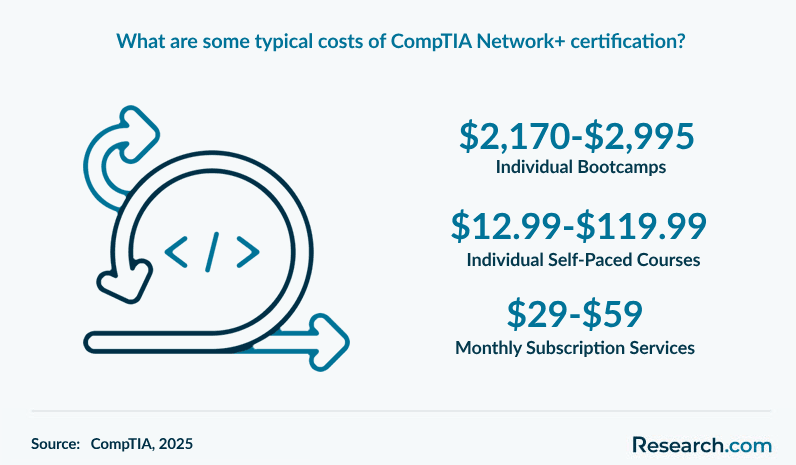
Bootcamp-style Network+ programs that include live instruction, labs, and an exam voucher typically range from around $2,170 to $2,995. Cyberkraft Training lists a similar package at $2,170, while Certification Camps charges $2,995 for a five-day live online bootcamp. New Horizons and UMBC Training Centers are described as falling within this general range, often with live instruction and an exam voucher. Ed2Go and Infosec Institute do not publicly list prices in the cited material, but they offer comparable five-day bootcamps with similar inclusions.
Lower-cost self-paced routes can reduce upfront spending. Udemy courses range from $12.99 to $119.99, but they generally do not include exam vouchers or live support. Subscription services such as Pluralsight, LinkedIn Learning, and CBT Nuggets offer broader IT content with monthly fees between $29 and $59. The CompTIA Network+ exam voucher itself costs approximately $369 if purchased separately. Free resources such as Saylor Academy can help with foundational study, but they usually lack interactive labs and formal exam-prep support.
| Cost category | Typical inclusion | Who should consider it |
| Free resources | Videos or foundational lessons | Self-motivated learners with a limited budget. |
| Low-cost individual courses | Recorded lessons, sometimes quizzes | Learners who can add their own labs and practice tests. |
| Subscription platforms | Video libraries, labs, quizzes, and broader IT content | Students who want flexible study and multiple IT topics. |
| Live bootcamps | Instructor-led training, labs, practice exams, and sometimes voucher support | Learners who need structure, urgency, and interaction. |
| College certificates | Academic credit, structured courses, and possible transfer pathways | Students who want a longer-term education credential in addition to exam preparation. |
Before paying, ask for a written breakdown of tuition, exam fees, retake rules, lab duration, recording access, cancellation policy, and any required materials. The best value is not always the lowest price; it is the option that gives you enough support to finish, pass the exam, and apply the skill at work.
How much can you earn after obtaining online CompTIA Network+ training bootcamp qualifications?
Salary outcomes vary widely. A bootcamp certificate of completion is not the same as the CompTIA Network+ certification, and neither guarantees employment. Your salary will depend on role, experience, location, employer size, industry, clearance requirements, shift work, and whether you have complementary skills in cloud, cybersecurity, scripting, or systems administration.
- Average salary: The average annual salary for professionals with CompTIA Network+ certification in the United States typically ranges from $70,000 to $85,000.
- Entry-level roles: Network support specialist or junior network administrator positions may start in the $40,000 to $60,000 range.
- Experienced professionals: With experience, network administrators and network engineers can earn $80,000 or more.
- Specialized roles: Professionals who move into network security, cloud networking, or engineering specializations may earn more.
- Location effects: Metropolitan areas and regions with higher IT demand may offer higher pay, but cost of living also matters.
According to Payscale data from 2025, the median salary for a CompTIA Network+ Certified professional is $79,000, with a U.S. base salary averaging $78,000. The general average salary for CompTIA Network+ Certified individuals in the U.S. is listed as $73,938. Skillsoft data shows a higher average of $90,793 for CompTIA Network+ Certified professionals.
Location can materially affect compensation. Among the listed states, New York reports the highest average salary at $80,835, followed by Washington at $79,385 and Tennessee at $74,630. Florida shows the lowest listed state average at $58,899, while Texas is listed at $65,024. Among the cited cities, Green River, Wyoming, appears at $88,619, ahead of San Mateo at $85,221 and San Jose at $82,523. These figures show why candidates should compare both salary and local cost of living before judging an offer.
The 2025 Payscale figures suggest a solid earning outlook for Network+ certified professionals, but the credential is only one part of compensation. Candidates can improve their marketability by building troubleshooting experience, documenting lab projects, learning ticketing workflows, practicing communication, and adding specialized credentials once they know which IT path they want to pursue.
What are the key benefits and drawbacks of online versus in-person CompTIA Network+ training bootcamps?
Online and in-person training can both work. The better format depends on how you learn, how quickly you need to prepare, whether you need a fixed schedule, and whether you have access to local training centers. Online training is usually more flexible; in-person training may provide stronger classroom immersion.
| Format | Advantages | Drawbacks | Best for |
| Online self-paced | Lowest-cost options, flexible schedule, ability to replay lessons. | Requires discipline and may offer limited feedback. | Independent learners with predictable study habits. |
| Live online | Instructor access, structured schedule, no travel, often includes labs. | Can still be expensive and may move quickly. | Learners who want accountability without commuting. |
| In-person | Face-to-face interaction, classroom focus, peer networking, possible physical lab access. | Less flexible, may require travel, and can cost more. | Students who learn best in a dedicated classroom environment. |
Online Bootcamps
- Benefits: Online programs offer flexibility, convenience, possible self-paced study, lower travel costs, and access from almost anywhere.
- Drawbacks: Students may receive less direct instructor interaction, feel isolated, need more self-discipline, or miss the intensity of a physical classroom.
In-Person Bootcamps
- Benefits: Classroom programs provide direct instructor and peer interaction, a structured environment, hands-on equipment exposure, and local networking opportunities.
- Drawbacks: In-person bootcamps usually offer less scheduling flexibility, may cost more, require travel, and are harder to access for remote learners.
Online Network+ bootcamps share some decision factors with other online creative and technical programs: flexibility and affordability are major advantages, while reduced face-to-face interaction can be a drawback. Learners comparing different online education models may find similar trade-offs in an affordable cinematography degree online, although the career outcomes and skill requirements are different.
What further education options can boost my IT career?
After Network+, the best next step depends on your target role. If you enjoy security, consider a cybersecurity path. If you like infrastructure and automation, cloud networking or systems administration may be a better fit. If you want leadership, analytics, or research-oriented roles, a degree may become more valuable over time.
- Cybersecurity: Add security-focused training if you want roles involving monitoring, incident response, access control, and risk reduction.
- Cloud computing: Study cloud networking, identity, storage, and virtual infrastructure if your target employers use cloud platforms.
- Systems administration: Build skills in servers, identity management, scripting, backups, and monitoring.
- Data and analytics: Consider analytics if you want to connect infrastructure knowledge with operational insight or performance reporting.
- Formal degree programs: A degree may help for employers that prefer bachelor’s or graduate credentials, especially for management or specialized technical roles.
For professionals who want to combine IT infrastructure knowledge with analytics, a data science master's online program may be worth exploring later. It is not a direct replacement for networking experience, but data training can support roles involving monitoring, automation, performance analysis, and technical decision-making.
How Can Further Academic Credentials Complement My CompTIA Network+ Certification?
Academic credentials can add theory, writing, research, project management, and broader technical context to the practical knowledge gained through Network+. This matters most for professionals who want to move into leadership, architecture, consulting, cybersecurity management, analytics, or roles where employers screen for degrees.
A focused online technology degree can help learners formalize skills across systems, networking, security, databases, and software concepts. If speed and flexibility are important, comparing the fastest online technology degree options can help you decide whether a degree pathway fits your career timeline.
What indicators demonstrate a bootcamp’s credibility and quality?
A credible Network+ bootcamp should be transparent about cost, curriculum, exam version, instructor credentials, lab access, support, and outcomes. Be cautious with providers that promise guaranteed jobs, hide fees, or advertise pass rates without explaining how the rates are measured.
- CompTIA alignment: The course should clearly state which Network+ exam version it prepares students for.
- Qualified instructors: Instructors should have relevant networking experience and current technical credentials.
- Hands-on learning: Labs, troubleshooting scenarios, and simulations are more valuable than lecture-only preparation.
- Transparent pricing: Providers should clearly state whether tuition includes the voucher, retake, books, labs, and practice tests.
- Student support: Look for office hours, study groups, tutoring, recordings, and active instructor communication.
- Realistic career services: Resume help and job search coaching can be useful, but no provider can guarantee employment.
- Independent feedback: Read reviews carefully and look for detailed student experiences rather than vague testimonials.
In degree-granting programs, accreditation is a formal quality signal. In private bootcamps, credibility must be judged differently through transparency, curriculum alignment, instructor quality, and verified support. This distinction matters across fields; for example, students evaluating cheap online bioinformatics masters programs should prioritize accredited institutions, while Network+ bootcamp shoppers should focus more on exam alignment and hands-on preparation.
Should I Pursue Additional Academic Credentials After My Bootcamp?
You should pursue additional credentials only if they support a clear next step. A second credential can help if it fills a skill gap, meets an employer requirement, or moves you toward a defined role. It is less useful if you are collecting certificates without gaining experience or applying for jobs.
- Choose another certification if: You need a practical, role-specific skill such as security, cloud, Linux, or vendor-specific networking.
- Choose a degree if: Your target employers prefer formal education, you want broader career mobility, or you plan to move into management or specialized technical roles.
- Choose work experience if: You already have Network+ but lack hands-on troubleshooting, ticketing, documentation, and customer support experience.
- Choose projects if: You need evidence of skill for interviews, such as home labs, diagrams, incident write-ups, and network configuration exercises.
Some learners also compare non-IT academic fields when deciding how online programs differ in structure, accreditation, and career outcomes. For example, geoscience degree programs involve different subject matter, but they illustrate how online programs should still be evaluated for curriculum quality, transferability, and fit with long-term goals.
What subspecialties and career paths are available for online CompTIA Network+ training bootcamp graduates?
Network+ gives you a broad foundation rather than a narrow specialization. After completing the certification, many professionals choose a direction based on the tasks they enjoy most: securing networks, supporting wireless environments, managing cloud connectivity, administering infrastructure, or designing larger systems.
- Network security: Focuses on protecting network infrastructure, access, and traffic from threats. Learners moving in this direction may later compare cheapest cyber security degree online programs.
- Wireless networking: Involves planning, configuring, supporting, and troubleshooting Wi-Fi environments.
- Cloud networking: Centers on networking concepts inside cloud platforms such as AWS, Azure, or Google Cloud.
- Network administration: Emphasizes day-to-day monitoring, maintenance, user support, and network reliability.
- Network engineering: Moves toward design, implementation, optimization, and more complex infrastructure projects.
- Voice over IP (VoIP): Specializes in voice systems, call routing, unified communications, and related network performance needs.
Additional credentials such as CompTIA Security+, Cisco CCNA, or cloud-specific certifications may be useful for these tracks. The best next credential depends on the job descriptions you are targeting, not on a generic certification ladder.
What is the job market like for online CompTIA Network+ training bootcamp graduates?
The job market for Network+ graduates is mixed: networking knowledge remains useful, but some traditional administrator roles are affected by automation, cloud platforms, outsourcing, and changing employer expectations. Candidates with only a bootcamp completion certificate may struggle; candidates who combine Network+ certification with hands-on practice, support experience, security awareness, and cloud familiarity are better positioned.
- Broad employer base: Corporations, schools, public agencies, healthcare organizations, MSPs, telecom companies, and data centers all depend on networked systems.
- Entry-level competition: Many beginners target help desk and support roles, so practical troubleshooting examples can help you stand out.
- Specialized demand: Security, cloud, automation, monitoring, and hybrid infrastructure skills can improve career options.
- Credential stacking: Network+ may work best when paired with experience and later certifications aligned to a specific path.
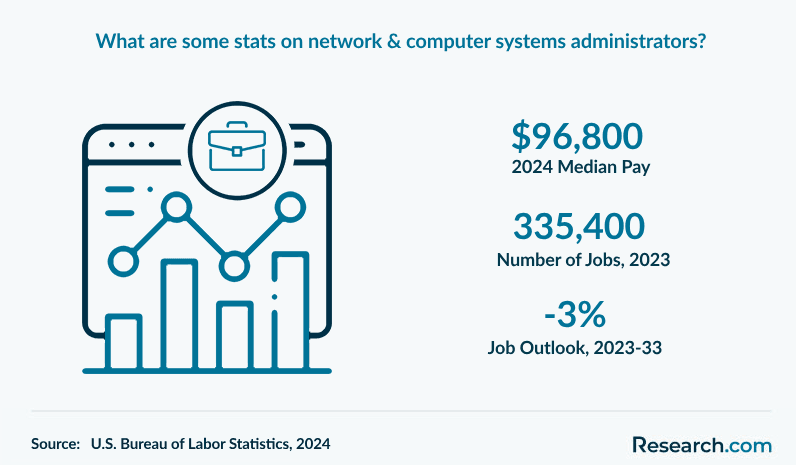
In 2024, the median annual pay for network and computer systems administrators is $96,800, or $46.54 per hour. A bachelor’s degree is typically required for entry-level positions, with no prior work experience or on-the-job training necessary. In 2023, there were approximately 335,400 jobs in this field, but employment is projected to decline by 3% from 2023 to 2033, resulting in a loss of 8,800 jobs. This projected decline suggests that automation and technology shifts may reduce demand for some traditional administrator roles, although opportunities can still exist for candidates with specialized, current skills.
For 2026 planning, the practical takeaway is clear: do not rely on Network+ alone. Use the certification to build a base, then add experience and targeted skills in areas where employers are investing, such as security, cloud infrastructure, remote support, monitoring, and automation.
What are the current industry trends and future outlook for online CompTIA Network+ careers?
Network+ remains relevant because networking is still the foundation of IT operations, but the work is changing. Employers increasingly expect networking professionals to understand security, cloud services, remote access, identity, monitoring tools, and automation. The most competitive candidates are not only able to define protocols; they can troubleshoot across hybrid environments and communicate clearly with users and technical teams.
- Cybersecurity is becoming inseparable from networking: Network roles increasingly require awareness of firewalls, access control, segmentation, monitoring, and incident response. Learners comparing security training may review online cybersecurity courses.
- Cloud networking is now a core skill area: Organizations moving workloads to the cloud need professionals who understand connectivity, virtual networks, identity, and secure access.
- Remote and hybrid work require stronger support skills: IT teams must troubleshoot VPNs, wireless connections, endpoint access, and cloud applications for users outside traditional offices.
- Automation and AI are changing routine tasks: Repetitive monitoring and configuration work may be automated, increasing the value of professionals who can interpret alerts, write scripts, and solve complex problems.
- Soft skills matter more than many beginners expect: Communication, documentation, patience, and customer service are essential in support-heavy networking roles.
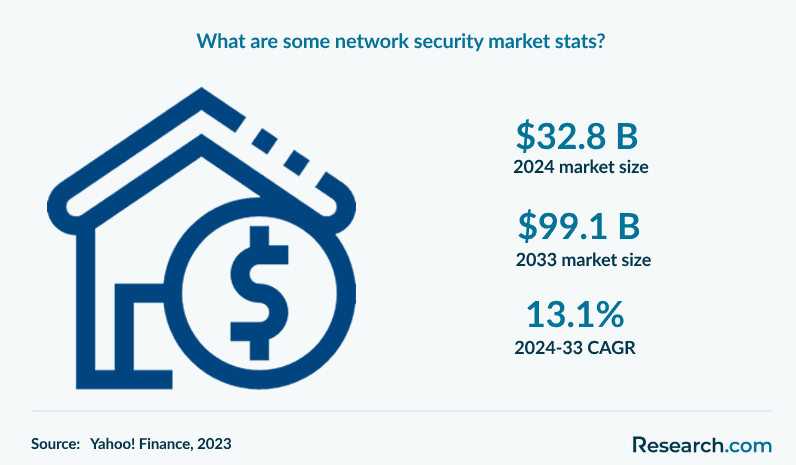
The network security market is expected to grow significantly, reaching USD 99.1 billion by 2033 with a 13.1% CAGR., as shown in the graphic below. This market focuses on protecting computer networks from cyber threats, unauthorized access, and data misuse. Its tools and services support confidentiality, integrity, and availability while monitoring authentication and authorization processes for suspicious activity.
Common mistakes to avoid when choosing a Network+ bootcamp
- Choosing only by the lowest advertised price: A free or cheap course can be excellent, but you may still need to pay for labs, practice tests, and the exam voucher.
- Ignoring the exam version: Make sure the course covers the exam you intend to take, such as N10-008 or N10-009.
- Assuming bootcamp completion equals certification: You only earn CompTIA Network+ after passing the official exam.
- Skipping hands-on practice: Watching videos is not enough for many learners. Networking concepts become clearer through labs and troubleshooting scenarios.
- Overestimating pass guarantees: Read the fine print. Guarantees may require attendance, practice test scores, or completion of assignments.
- Not asking whether the voucher is included: The exam voucher costs approximately $369 when purchased separately.
- Relying only on salary averages: Salary data can help with planning, but your actual offer will depend on role, location, experience, and interview performance.
- Collecting credentials without job search action: Apply for roles, build labs, document projects, and practice interview explanations while studying.
Questions to ask before enrolling
- Which Network+ exam version does the course prepare for?
- Is the exam voucher included in tuition?
- How long do I keep access to videos, labs, and practice exams?
- Are classes live, recorded, self-paced, or hybrid?
- What happens if I miss a live session?
- Who teaches the course, and what networking experience do they have?
- Are labs included, and are they scenario-based?
- Does the provider publish verified student outcomes or only testimonials?
- What career services are included, if any?
- What is the refund policy if the course is not a good fit?
References
- Comparably. (2024, December 7). CompTIA Salaries. Comparably.
- CompTIA. (2023, October). Tech jobs report. CompTIA.
- CompTIA. (2025, Q1). Assessing outcomes, efficacy and value: CompTIA training and certification review. CompTIA.
- Infosec. (2025, April 29). CompTIA Network+ salary prospects for 2025: What to expect. Infosec.
- Payscale. (2025, April 23). Salary for Certification: CompTIA Network+ - Payscale. Payscale.
- Prepsaret. (2025, April 24). CompTIA Network+ Salary Expectations - Prepsaret. Prepsaret.
- Skillsoft. (2025). Top 11 CompTIA Certifications and What They Pay in 2025. Skillsoft.
- StationX. (2024, December 12). CompTIA Network+ Certification Salary 2025 - StationX. StationX.
- U.S. Bureau of Labor Statistics. (2024, April 17). Network and computer systems administrators. U.S. Department of Labor.
- Yahoo Finance. (2023, July 12). Network security market is expected to reach a revenue of USD 99.1 billion by 2033. Yahoo Finance.
Key Insights
- The cheapest Network+ route is not always a bootcamp: Free resources such as Professor Messer and PowerCert Animated Videos can work well for disciplined learners, while paid live bootcamps are better for students who need structure and accountability.
- Compare total cost, not tuition alone: The exam voucher costs approximately $369 if purchased separately, so check whether the provider includes it along with labs, practice exams, retake support, and recordings.
- Live bootcamps cost more because they bundle support: Cyberkraft Training lists $2,170 including a $369 exam voucher, Koenig Solutions lists a $2,200 course fee plus a $369 exam fee, and New Horizons lists $2,495 for a 5-day intensive format.
- College certificates serve a different purpose: American Public University and University of Maryland Global Campus offer credit-bearing online certificates that may help with longer-term degree plans, but they are not the same as short exam bootcamps.
- Network+ can support entry-level IT movement, but experience still matters: Use the certification alongside labs, help desk practice, documentation samples, and job applications.
- Salary data is encouraging but not guaranteed: Payscale data from 2025 lists a median salary of $79,000 for CompTIA Network+ Certified professionals, but actual earnings depend on role, location, experience, and specialization.
- The job market rewards specialization: Traditional network and systems administrator employment is projected to decline by 3% from 2023 to 2033, so candidates should build skills in security, cloud, automation, and remote support.
- The best next step after Network+ should be role-driven: Choose Security+, CCNA, cloud training, systems administration, or a degree based on the jobs you want, not because a provider says one path fits everyone.
Other Things You Should Know About Online CompTIA A+ Training Bootcamps
In 2027, platforms like Udemy, Coursera, and LinkedIn Learning are top choices for affordable CompTIA Network+ bootcamps. They offer comprehensive training materials, interactive modules, and practice exams at competitive prices for budget-conscious learners.
To enroll in a 2027 affordable CompTIA Network+ online bootcamp, you typically need a basic understanding of networking concepts and computer hardware. Some programs may require prior experience in IT support or an equivalent certification, like the CompTIA A+.
Many low-cost online CompTIA Network+ bootcamps in 2027 include a voucher for the CompTIA Network+ exam, N10-009. Some programs sell it separately, so confirm whether the course fee covers one exam attempt or only training access before enrolling.


