
2027 Most Affordable Online Web Development Degree Programs

Co-Founder and Chief Data Scientist
Choosing an online web development degree is a practical decision for students who want a structured path into coding, website design, application development, UX/UI, or full-stack roles without relocating or pausing work. The need is clear: around 73% of small businesses in the United States run a website, and organizations in nearly every sector need people who can build, maintain, secure, and improve digital experiences.
This guide explains how online web development degrees work, what they cost, how long they take, which affordable programs stand out, and what career outcomes graduates can reasonably expect. It is designed for first-time college students, transfer students, working adults, career changers, and self-taught coders deciding whether a degree is worth the investment.
Quick answer: Is an online web development degree worth considering?
An online web development degree can be worth considering if you want a recognized credential, a portfolio of projects, broader training than a short bootcamp, and access to financial aid, career services, and transfer-friendly degree pathways. It is especially useful for learners who want to qualify for front-end, back-end, full-stack, UX/UI, database, or web application roles while studying remotely.
What are the main benefits of earning an online web development degree?
- An online web development degree can prepare students for roles such as front-end developer, back-end developer, UX developer, full-stack developer, web designer, and web project specialist.
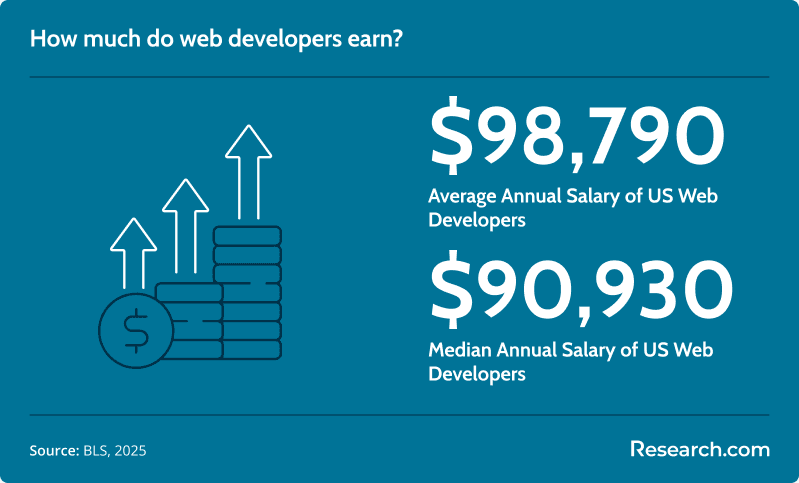
- Web developers have an average annual salary of $98,790 and a median annual salary of $90,930, according to BLS data cited in this guide.
- Online programs often provide more scheduling flexibility than campus programs and may reduce costs related to commuting, housing, and campus-based fees.
What can I expect from an online web development degree?
An online web development degree is a career-focused technology program that teaches students how websites and web applications are planned, coded, tested, deployed, secured, and maintained. Depending on the credential level, students usually complete between 60 to 120 credit hours for an associate or bachelor’s degree.
Most programs combine programming, design, databases, responsive development, UX/UI principles, cloud tools, and project-based learning. Students commonly work with HTML, CSS, JavaScript, Python, databases, content management systems, APIs, and modern development workflows. A strong program should help students graduate with a portfolio, not just completed exams.
| What to evaluate | Why it matters | What to look for |
| Curriculum | Web development jobs require practical coding ability, not only theory. | Courses in front-end, back-end, databases, responsive design, UX/UI, security, and capstone projects. |
| Portfolio support | Employers often want evidence of what you can build. | Real projects, Git-based assignments, client-style work, or a final web application. |
| Schedule format | Online students often balance school with work or family. | Asynchronous courses, multiple start dates, part-time options, or self-paced tracks. |
| Accreditation | Accreditation affects credit transfer, financial aid, and employer trust. | Institutional accreditation and, when available, programmatic recognition such as ABET-related accreditation. |
| Career services | Technical skills need to translate into interviews and job applications. | Resume help, portfolio reviews, internships, employer connections, and mock interviews. |
Where can I work with an online web development degree?
Graduates of online web development programs can work anywhere organizations need websites, applications, internal tools, e-commerce systems, customer portals, or digital content platforms. Because web development work is often digital by nature, graduates may find opportunities in remote, hybrid, freelance, and office-based roles.
- Technology companies: Developers may build software products, web platforms, dashboards, APIs, and customer-facing applications as part of engineering teams.
- Digital agencies: Agencies hire developers to create websites, landing pages, e-commerce experiences, and campaign tools for clients across multiple industries.
- Startups: Smaller companies often value developers who can handle several responsibilities, such as front-end updates, back-end logic, testing, and deployment.
- Large corporations: Enterprise employers use web developers to maintain company websites, employee platforms, customer portals, marketing systems, and internal tools.
- Freelance and contract work: Independent developers may build websites, troubleshoot existing systems, improve performance, or manage ongoing updates for clients.
- E-commerce companies: Developers in online retail may focus on shopping flows, checkout performance, secure transactions, product pages, integrations, and platforms supported by tools such as Magento eCommerce hosting.
- Media and marketing firms: These employers need developers who can combine technical skill with visual design, analytics, content systems, and campaign execution.
- Government and education: Public agencies, colleges, and schools need accessible, secure, and reliable digital platforms for students, staff, residents, and public users.
How much can I make with an online web development degree?
Web development can lead to above-average earnings, but salaries vary by role, experience, location, industry, portfolio quality, and technical specialization. According to the United States Bureau of Labor Statistics (BLS), web developers have an average annual salary of $98,790 and a median annual salary of $90,930. That median is higher than the median annual wage of all professionals in the country ($49,500).
BLS data shows that web developers can earn from $48,560 to $162,870 annually. New graduates and junior developers are more likely to start near the lower end of the range, while senior developers, specialized engineers, and technical leads may earn above the median.
The highest-paying industries by average annual salary for web developers are building materials and supplies dealers ($148,160); securities, commodity contracts, and related activities ($140,970); and motor vehicle manufacturing ($133,360). The top-paying US states are the District of Columbia ($123,640), California ($121,490), and Washington ($120,910).
- Most Affordable Online Web Development Degree Programs for 2027
- How long does it take to complete an online web development degree?
- How does an online web development degree compare to an on-campus program?
- What is the average cost of an online web development degree?
- What are the financial aid options for students enrolling in an online web development degree?
- What are the prerequisites for enrolling in an online web development degree?
- What courses are typically in an online web development degree?
- What types of specializations are available in online web development degrees?
- Can supplemental advanced studies boost my web development career?
- Are online web development programs accredited by recognized organizations?
- How to choose the best online web development degree
- What career paths are available for graduates of online web development degrees?
- What is the job market for graduates with an online web development degree?
- Is an online web development degree a worthwhile investment?
- What emerging trends should online web development students be aware of?
Most Affordable Online Web Development Degree Programs for 2027
How do we rank programs?
Because an online web development degree requires a major investment of time, tuition, and effort, rankings should be based on transparent data rather than marketing claims. For this list, program information was reviewed using reliable education data sources, including the IPEDS database, Peterson’s database, the College Scorecard, and the National Center for Education Statistics. Programs were assessed using measurable criteria and publicly available information to help students compare affordability, credibility, and program fit.
Readers who want a deeper explanation of the ranking process can review our methodology.
1. Middle Georgia State University Bachelor of Science in Information Technology (Web Applications Development)
Middle Georgia State University offers an online Bachelor of Science in Information Technology with a Web Applications Development concentration. The program costs $174 per credit, with an estimated annual cost of about $5,220. Students study both client-side and server-side technologies, making the degree relevant for future web developer, software developer, and database programmer roles. The smaller class setting can support stronger faculty interaction, and the program reports a 61% retention rate and a 71% recommendation rate among students.
- Program Length: 4 years
- Required Credits to Graduate: 120
- Annual Cost: $5,220
- Accreditation: Computing Accreditation Commission of ABET
2. Champlain College Bachelor of Science in Web Design and Development
Champlain College provides an online Bachelor of Science in Web Design and Development built for working adults. The program includes 40 courses, charges $335 per credit, and is typically completed in about three years and four months. Students combine design thinking with back-end programming and work with more than 32 platforms and programming languages, including HTML5, JavaScript, PHP, and MySQL. The degree also allows students to add certificates in Web Design or Web Programming while developing skills in web interfaces, dynamic websites, multimedia, usability, and collaboration tools.
- Program Length: 3 years and 4 months
- Required Credits to Graduate: 120
- Annual Cost: $10,050
- Accreditation: New England Commission of Higher Education
3. American Public University Online Bachelor of Science in Computer Technology
American Public University offers an Online Bachelor of Science in Computer Technology that emphasizes applied IT skills and preparation for industry certifications. Students complete 120 credits and may transfer up to 90 credits. Concentration options include Web Development, Cloud Computing, and Networking, while coursework covers web development, networking, databases, and information security. The curriculum aligns with certifications such as CompTIA A+, Security+, CIW, AWS, and Microsoft Office Specialist. Courses are fully online, begin monthly, and cost $350 per credit, with reduced tuition available for military students and veterans. Estimated annual tuition is $10,500.
- Program Length: 4 years
- Required Credits to Graduate: 120
- Annual Cost: $10,500
- Accreditation: Higher Learning Commission
4. Purdue Global Bachelor of Science in Information Technology
Purdue Global offers an online Bachelor of Science in Information Technology focused on workplace-ready IT, communication, and problem-solving skills. The 180-quarter-credit program includes system design, secure computing, ethical technology practices, and team-based collaboration. Students may choose the flexible ExcelTrack™ option for self-paced study, and the curriculum aligns with certifications such as CompTIA Security+, Network+, CIW, and AWS Cloud Practitioner. The program can support IT career preparation and may also serve as a foundation for graduate study. Tuition is $371 per credit, with an estimated annual cost of approximately $11,130.
- Program Length: 4 years
- Required Credits to Graduate: 180
- Annual Cost: $11,130
- Accreditation: Higher Learning Commission
5. Northwestern State University of Louisiana Bachelor of Science in Computer Information Systems
Northwestern State University of Louisiana offers a Bachelor of Science in Computer Information Systems for students seeking technology roles in business, public-sector, nonprofit, and technical environments. Available online and in person, the program blends programming, networking, databases, systems development, business concepts, and web development. Students complete 120 semester hours and choose from Application Development, Information Systems Management, or Networking & Cybersecurity. The curriculum emphasizes internships, industry partnerships, and applied learning. Tuition is $375 per credit, or about $11,250 annually.
- Program Length: 4 years
- Required Credits to Graduate: 120
- Annual Cost: $11,250
- Accreditation: Southern Association of Colleges and Schools Commission on Colleges
6. University of Maine at Augusta Bachelor of Science in Computer Information Systems
The University of Maine at Augusta offers a Bachelor of Science in Computer Information Systems with flexible distance-learning options. Students study networking, database design, systems analysis, web development, technical communication, and organizational problem-solving. A required internship gives students practical experience, and the program’s connection with Project>Login supports internship and employment pathways in Maine’s technology sector. Tuition is $390 per credit, with an estimated annual cost of approximately $11,700.
- Program Length: 4 years
- Required Credits to Graduate: 121
- Annual Cost: $11,700
- Accreditation: New England Commission of Higher Education
7. Liberty University BS in Information Technology Web & Mobile Programming
Liberty University offers an online Bachelor of Science in Information Technology – Web and Mobile Programming that combines technical training with a faith-based academic environment. Students study database management, information security, human-computer interaction, and mobile programming languages. The program allows students to transfer in up to 75% of credits and is delivered in 8-week terms with multiple start dates. Accredited by SACSCOC, the program costs $390 per credit and emphasizes applied development skills, business context, and Christian leadership.
- Program Length: 4 years
- Required Credits to Graduate: 120
- Annual Cost: $11,700
- Accreditation: Southern Association of Colleges and Schools Commission on Colleges
8. Franklin University Bachelor of Science in User Experience & Graphic Design
Franklin University offers a Bachelor of Science in User Experience & Graphic Design for students who want to focus on user-centered digital design. The 120-credit program combines UX, interactive design, and graphic design while incorporating tools such as Adobe Master Suite and Figma. Students build portfolio work throughout the degree and may transfer up to 75% of degree credits. The fully online format and flexible scheduling make it a practical option for adults preparing for UX/UI design roles. Tuition is $398 per credit.
- Program Length: 4 years
- Required Credits to Graduate: 120
- Annual Cost: $11,940
- Accreditation: Higher Learning Commission
9. Austin Peay State University Bachelor of Science in Computer Information Technology (Web and Database)
Austin Peay State University offers a Bachelor of Science in Computer Information Technology with a Web and Database concentration. The program trains students in web application development as well as database design, implementation, and administration. Graduates may pursue roles such as web developer, UX designer, database administrator, or software engineer. Offered online and on campus, the program features small classes, hands-on learning, smart classrooms, and faculty with computing experience. Students gain exposure to both front-end and back-end systems.
- Program Length: 4 years
- Required Credits to Graduate: 120
- Annual Cost: $13,410
- Accreditation: Southern Association of Colleges and Schools Commission
10. Bellevue University Bachelor of Science in Web Development
Bellevue University offers an online Bachelor of Science in Web Development for students interested in full-stack development, software engineering, and web application design. The accelerated cohort model covers front-end and back-end technologies, including JavaScript, API development, Agile methods, DevOps, and containerization. A Web Development Boot Camp functions as a capstone-style experience where students complete individual and team projects. The program offers online flexibility, no SAT/ACT requirement, and a transfer-friendly structure. Estimated annual tuition is approximately $13,470.
- Program Length: 4 years
- Required Credits to Graduate: 127
- Annual Cost: $13,470
- Accreditation: Higher Learning Commission
How long does it take to complete an online web development degree?
Completion time depends on the degree level, transfer credits, course load, and whether the school uses standard semesters, accelerated terms, or self-paced formats. In general, students can expect a range of 2 to 6 years.
| Path | Typical time | Best for |
| Associate degree | About two years of full-time study | Students seeking entry-level technical roles or a lower-cost transfer path into a bachelor’s program. |
| Bachelor’s degree | Typically four years of full-time study | Learners who want broader preparation, stronger credential value, and more career flexibility. |
| Accelerated program | As little as two and a half to three years | Motivated students who can study year-round or transfer prior credits. |
| Part-time program | Five to six years | Working adults, parents, and students who need a lighter course load. |
Students who want a faster, skills-first supplement may also consider the best full stack web developer bootcamp options available to them. A bootcamp can add concentrated portfolio practice, but it does not replace the broader academic credential of a degree.
According to Zippia, as shown in the visual below, 71% of web developers in the United States have a bachelor's degree, 14% hold a master's degree, 11% completed an associate degree, and 2% have a high school diploma.
How does an online web development degree compare to an on-campus program?
Online and campus-based web development degrees often cover similar technical topics, including HTML, CSS, JavaScript, frameworks, databases, responsive design, and software project workflows. The real differences usually involve schedule, learning environment, cost structure, support access, and networking style.
| Factor | Online web development degree | On-campus web development degree |
| Flexibility | Often better for students who need to study around work or family responsibilities. | Better for students who prefer a fixed weekly schedule and in-person routine. |
| Interaction | Uses discussion boards, video meetings, messaging, collaborative documents, and virtual labs. | Provides face-to-face conversations, campus events, labs, and immediate classroom interaction. |
| Accountability | Requires strong time management and self-direction. | Offers more built-in structure through scheduled meetings and campus expectations. |
| Cost | May reduce transportation, relocation, housing, and some campus-related expenses. | May include added costs for housing, commuting, parking, and campus services. |
| Resources | Relies on cloud platforms, virtual labs, online libraries, and remote tutoring. | May provide easier access to physical labs, campus equipment, clubs, and in-person academic services. |
| Networking | Works best when students actively join online communities, virtual events, and collaborative projects. | Offers more informal networking through classmates, faculty, clubs, and local employer events. |
What is the average cost of an online web development degree?
Affordable online bachelor’s degrees in web development or closely related fields commonly cost about $5,000–$17,000 per year, while online master’s degrees in web development or design may cost $13,000–$27,000 total. Depending on the school, transfer credits, fees, and time to completion, total program costs can range from under $15,000 to over $70,000.
Students should compare more than tuition. A lower-cost program may be a strong value if it is accredited, has relevant coursework, supports portfolio development, and provides career services. A higher-cost program may be reasonable if it offers accelerated completion, strong transfer credit, employer recognition, or intensive project work.
- Bachelor’s degrees: Affordable online bachelor’s programs in web development or related fields generally cost about $5,000 to $17,000 per year in tuition. Middle Georgia State University, for example, costs around $5,220 annually, while Arizona State University Online charges about $17,220 per year. Total bachelor’s degree costs can range roughly from $20,000 to $70,000, depending on tuition and program length.
- Master’s degrees: Online master’s programs in web design or development usually cost between $13,500 and $27,000 in total tuition. Lynn University offers an online master’s in web design for about $13,500 annually, while other programs may cost more but remain under $27,000 total.
Students comparing affordability across fields can also review the cheapest online TESOL master's degree programs to see how tuition, flexibility, and career alignment differ across online degree categories.
What are the financial aid options for students enrolling in an online web development degree?
Online web development students may qualify for the same major types of financial aid as campus students, provided they attend an eligible accredited institution. Aid can help cover tuition and, in some cases, related educational costs such as textbooks, software, technology fees, and required learning materials.
- Federal financial aid: Eligible students can apply for federal grants, loans, and work-study by completing the Free Application for Federal Student Aid (FAFSA). Federal aid is typically available only through eligible accredited institutions.
- State aid programs: Some states provide grants, scholarships, or tuition support for residents enrolled in approved online programs.
- Private scholarships: Technology organizations, community foundations, employers, and private sponsors may offer awards for students pursuing web development, computer science, IT, or design-related programs.
- Employer tuition assistance: Working adults should ask whether their employer reimburses tuition or covers courses related to current or future job responsibilities.
- Student loans: Federal student loans, including Direct Subsidized or Unsubsidized Loans, may be available to eligible students. Private loans can also exist, but students should compare repayment terms carefully.
- Work-study programs: Students who qualify may use work-study to earn income while gaining professional or campus-related work experience.
What are the prerequisites for enrolling in an online web development degree?
Admission requirements vary by school and degree level, but many online web development programs are accessible to beginners. Applicants usually need proof of prior education, transcripts, and a completed application. More selective or upper-division programs may require previous college credits, a minimum GPA, or additional documents.
- Educational credentials: Associate programs usually require a high school diploma or GED. Bachelor’s programs generally require the same, while some applied science degrees may require an accredited associate degree with a minimum GPA such as 2.0-2.5 or at least 24 transferable college-level credits with satisfactory performance.
- Transcripts: Schools typically ask for official high school and college transcripts. Some may review unofficial transcripts first but require official sealed documents later.
- Application and fees: Applicants normally complete an online application and may pay a non-refundable fee, typically around $50. Fee waivers may be available for military applicants or students with financial need.
- Standardized tests: Some institutions request SAT or ACT scores, but many online programs waive them, especially for adult learners and transfer students.
- English proficiency: International applicants are often required to submit TOEFL or IELTS scores or an approved alternative.
- Additional materials: Some schools request recommendation letters, a personal statement, an essay about career goals, or a resume.
- GPA expectations: Minimum cumulative GPA requirements often fall between 2.0 and 2.75, depending on the program and institution.
- Conditional admission: Some schools allow provisional admission while official documents are pending or while students complete a high school self-certification process.
Unlike graduate pathways where students may ask what is the average age to get an MBA, online web development degrees commonly serve learners at many life stages, including recent high school graduates, transfer students, career changers, and working adults.
What courses are typically in an online web development degree?
Online web development and online information technology degree programs usually combine coding, design, systems thinking, and applied projects. The best curricula teach students how to build real web products, not simply memorize terminology.
- Introduction to Web Development: Students learn how websites are structured, styled, and made interactive using HTML, CSS, and JavaScript.
- Front-End Development: Coursework focuses on the visible and interactive parts of websites and applications, including layouts, browser behavior, responsive interfaces, and frameworks such as React or Angular. Students who want added hands-on training may compare the top coding bootcamps for front end development.
- Back-End Development: Students study server-side logic, APIs, databases, authentication, and tools such as Node.js, PHP, or Python.
- Database Management: This course covers how to design, query, organize, and maintain relational and non-relational databases using tools such as MySQL, MongoDB, or PostgreSQL.
- Web Programming Languages: Students practice programming fundamentals such as functions, loops, objects, data structures, and reusable code in languages used for web projects.
- Responsive Web Design: Learners build websites that work across desktops, tablets, and smartphones using flexible layouts, media queries, and mobile-first design practices.
- Full-Stack Development: This course connects front-end and back-end development so students can build complete data-driven applications, often using a stack such as MongoDB, Express.js, React, and Node.js.
- Web Security: Students study common web vulnerabilities, including SQL injection, cross-site scripting, data exposure, authentication weaknesses, and secure coding practices.
- User Experience (UX) and User Interface (UI) Design: Coursework focuses on usability, accessibility, wireframes, prototypes, visual hierarchy, and user-centered design.
- Project Management or Agile Development: Students learn Agile, Scrum, Kanban, version control, Git workflows, team collaboration, and project planning.
- Capstone Project: A final project usually requires students to design, build, test, and present a complete website or web application suitable for a professional portfolio.
The chart below shows the industries that offer the highest salaries to web developers in the country.
What types of specializations are available in online web development degrees?
Specializations help students connect coursework to specific job goals. A front-end path is different from a database-heavy or UX-focused path, so students should choose based on the work they want to do after graduation.
| Specialization | Primary focus | Best fit for students who |
| Front-End Development | User-facing websites, layouts, interactivity, accessibility, and responsive design. | Enjoy visual problem-solving, interface behavior, and direct user experience. |
| Back-End Development | Server logic, APIs, databases, authentication, performance, and application architecture. | Prefer systems, data, infrastructure, and behind-the-scenes functionality. |
| Full-Stack Development | Both front-end and back-end application development. | Want broad versatility and the ability to build complete applications. |
| UX/UI Development | Research, usability, prototypes, accessibility, and interface design. | Want to combine design decisions with technical implementation. |
| Web Design | Visual design, branding, layout, typography, and design tools. | Are interested in aesthetics, creative direction, and user-friendly page design. |
| Webmaster or Web Administration | Website maintenance, content updates, security monitoring, performance, and SEO basics. | Want ongoing site management responsibilities rather than only new builds. |
| Cloud and DevOps for Web Development | Deployment, CI/CD, cloud infrastructure, containerization, and scalable hosting. | Want to support modern application delivery and reliability. |
Choosing among web development specializations can resemble the decision between sports management vs sports administration: related paths may overlap, but each one points toward different responsibilities and career outcomes.
Can supplemental advanced studies boost my web development career?
Additional study can help web developers move beyond entry-level implementation into more specialized or strategic roles. Certifications, graduate coursework, bootcamps, and short technical programs may strengthen skills in areas such as cybersecurity, cloud platforms, data analytics, accessibility, or software architecture.
For example, a developer interested in analytics-heavy products may consider an online masters degree in data science to combine coding ability with data-driven decision-making. This type of advanced study is most useful when it aligns with a clear career goal, such as analytics engineering, product development, technical leadership, or data-focused application design.
Are online web development programs accredited by recognized organizations?
Many online web development programs are offered by accredited colleges and universities, but students should verify accreditation before enrolling. Accreditation helps confirm that an institution meets recognized academic standards. It can also affect eligibility for federal financial aid, credit transfer, graduate school admission, and employer confidence.
Students should check both institutional accreditation and any program-specific accreditation when available. Some learners also compare accelerated technology pathways, such as online technology fast track programs, but speed should never come at the expense of accreditation, academic quality, or career relevance.
How to choose the best online web development degree
The best online web development degree is not simply the cheapest or the fastest. It is the program that matches your career goal, budget, schedule, technical starting point, and need for support. Use the factors below before applying.
- Degree type and specialization: Decide whether you need a web development, web design, computer science, information technology, interactive media, UX/UI, mobile development, cybersecurity, or database-focused degree. Students comparing web development with security-focused careers can review cyber security and computer science programs comparison resources.
- Curriculum quality: Look for HTML, CSS, JavaScript, responsive design, back-end programming, databases, APIs, UX/UI, web security, version control, and portfolio projects.
- Credit requirements and completion time: Many bachelor’s programs require around 120-127 credits and take about four years, though transfer credits and accelerated formats can shorten the timeline.
- Admissions requirements: Review GPA expectations, transcript rules, SAT/ACT policies, recommendation letters, essays, resumes, and transfer-credit requirements.
- Accreditation and reputation: Choose a regionally accredited institution and examine retention, graduation, faculty background, student services, and employer-facing support.
- Total cost and financial aid: Compare tuition, fees, software, textbooks, transfer credits, financial aid, scholarships, and employer reimbursement.
- Student support: Strong programs provide tutoring, technical support, advising, career coaching, portfolio review, and access to an online learning community.
- Learning format: Consider whether you need asynchronous courses, live meetings, multiple start dates, self-paced options, or a cohort model.
Students who are choosing between a data science and computer science degree should compare not only salary potential but also the type of work they want to do each day. Web development is more product- and application-oriented, while other computing paths may emphasize algorithms, analytics, research, systems, or infrastructure.
| Common mistake | Why it can hurt you | Better approach |
| Choosing based only on tuition | A cheap program may still be a poor value if it lacks projects, support, or relevant coursework. | Compare total cost with accreditation, curriculum, portfolio support, and career services. |
| Ignoring accreditation | Credits may not transfer, and financial aid eligibility may be limited. | Verify institutional accreditation before applying. |
| Assuming all online programs are self-paced | Some online courses still require live attendance or strict weekly deadlines. | Ask whether classes are asynchronous, synchronous, cohort-based, or self-paced. |
| Skipping portfolio development | Employers need proof of practical skill. | Choose courses with real projects, capstones, and Git-based work. |
| Relying only on rankings | A highly ranked school may not fit your budget, schedule, or specialization. | Use rankings as one input, then compare personal fit. |
| Assuming salary outcomes are guaranteed | Pay depends on experience, location, role, industry, and demonstrated skill. | Use salary data as a benchmark, not a promise. |
What career paths are available for graduates of online web development degrees?
Graduates of online web development degree programs can pursue technical, design, product, and project-focused roles. Because 29.9% of business is conducted online in this day and age, web skills are relevant across industries rather than limited to technology companies.
- Front-End Developer: Builds the browser-based side of websites and applications using HTML, CSS, JavaScript, frameworks, and responsive design techniques.
- Back-End Developer: Creates server-side logic, database connections, APIs, authentication systems, and application infrastructure.
- Full-Stack Developer: Works across both front-end and back-end layers, often helping teams build complete web applications.
- Web Designer: Plans the look, layout, structure, and usability of websites, often combining design tools with basic coding knowledge.
- UI/UX Designer: Uses research, testing, prototypes, and interface design principles to improve how users interact with digital products.
- DevOps Engineer: Supports deployment pipelines, automation, infrastructure, monitoring, and collaboration between development and operations teams.
- Mobile Web Developer: Optimizes websites and web applications for smartphones and tablets, focusing on speed, usability, and responsive behavior.
- Freelance Developer: Works independently with clients on websites, web applications, updates, maintenance, or digital projects. Freelancers interested in interactive products may later explore an online game development degree.
- Content Management System (CMS) Developer: Builds, customizes, and maintains websites using platforms such as WordPress or Drupal.
- Web Project Manager: Coordinates developers, designers, stakeholders, timelines, budgets, and deliverables for web-based projects.
- Digital Marketing Technologist: Uses development skills to support landing pages, campaign tracking, analytics tools, website optimization, and marketing technology systems.
Just as students may research what can a military science degree do for you before choosing a program, web development students should look closely at actual career outcomes. The degree can lead to multiple paths, but each path rewards different strengths.
What is the job market for graduates with an online web development degree?
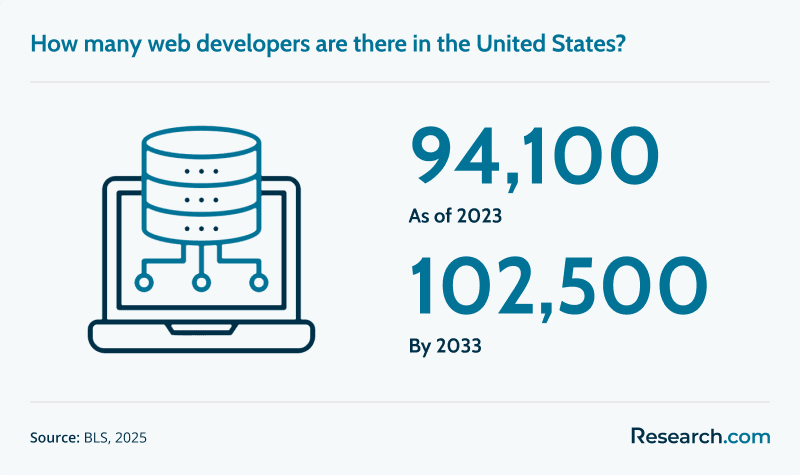
The job market for web developers is projected to grow faster than the national average. According to the BLS, employment of web developers in the United States from 2023 to 2033 is projected to increase by 9%, compared with the national average of 4%. This would move the occupation from 94,100 workers in 2023 to 102,500 by 2033.
During that period, graduates can expect 16,500 openings each year. At present, there are over 11,000 job postings on Indeed for web developer roles.
Hiring is not evenly distributed across all industries or locations. The industries employing the most developers are computer systems design and related services (22,250); management, scientific, and technical consulting services (6,440); and advertising, PR, and related services (4,970).
As shown in the chart below, the US states employing the most web developers are California (10,590), Texas (6,130), and New York (5,950).
Is an online web development degree a worthwhile investment?
An online web development degree can be a worthwhile investment when the program is accredited, affordable, project-based, and aligned with the student’s target role. The strongest return usually comes from combining the degree with a strong portfolio, internships or freelance work, networking, and continuous skill development.
The degree may be less worthwhile if a student already has strong professional experience, a proven portfolio, and a clear path to employment without needing a credential. In that case, a shorter bootcamp, certification, or targeted course may be more efficient. Students should compare total cost, expected time to completion, career services, and job-market fit before enrolling. For broader ROI perspective, some learners also compare technology programs with unrelated graduate options such as the cheapest online bioinformatics masters.
What emerging trends should online web development students be aware of?
Web development continues to change as employers adopt new tools, platforms, and workflows. Students should not choose a program that teaches only static website basics; they should look for curricula that help them adapt as the field evolves.
- AI-assisted coding: Developers increasingly use AI tools to draft code, troubleshoot errors, generate tests, and speed up repetitive tasks. Students still need strong fundamentals so they can evaluate and correct AI-generated output.
- Progressive Web Applications (PWAs): PWAs continue to influence how developers build fast, app-like experiences that work across devices.
- Cloud-native development: Many web applications now rely on cloud hosting, APIs, serverless tools, and scalable infrastructure.
- Cybersecurity expectations: Web developers need to understand secure coding, authentication, data protection, and common vulnerabilities.
- Mobile-first design: Because users access digital services from many devices, responsive and accessible design remain core web development skills.
- Cross-disciplinary problem-solving: Technical professionals benefit from analytical thinking across fields. Even resources such as an online geology degree can illustrate how domain knowledge and technical tools combine to solve specialized problems.
What graduates say about earning an online web development degree
-
: "
"The online format let me manage my schedule while still working through demanding coding projects. I could spend extra time on the topics that mattered most to me, and group assignments helped me collaborate with classmates from different backgrounds. The experience was challenging, but it gave me the confidence to start a career in tech." – Joel
"
-
: "
"Studying online made it possible to balance school, work, and family. The projects felt practical, and instructor feedback helped me improve quickly. By the end of the program, I had enough confidence to begin freelance work." – Nina
"
-
: "
"Changing careers was intimidating, but the online program made the process manageable. The assignments were hands-on and connected directly to real web development tasks. The flexibility fit my life, and the skills I gained helped me move forward." – Gene
"
Key Insights
- An online web development degree is best for students who want structured technical training, a recognized credential, portfolio projects, and the flexibility to study remotely.
- Affordability varies widely: students can expect about $5,000–$17,000 per year for affordable online bachelor’s degrees and $13,000–$27,000 total for master’s degrees in web development or design.
- Education levels among web developers vary, but Zippia reports that 71% of web developers in the United States have a bachelor's degree, 14% hold a master's degree, 11% completed an associate degree, and 2% have a high school diploma.
- Web developer compensation is strong but not guaranteed. BLS data cited here shows an average annual salary of $98,790, a median annual salary of $90,930, and an annual range from $48,560 to $162,870.
- The labor market outlook is favorable: employment of web developers in the United States from 2023 to 2033 is projected to increase by 9%, with 16,500 openings each year.
- Career outcomes depend heavily on practical skill. Students should prioritize programs with front-end, back-end, database, UX/UI, security, Agile, and capstone coursework.
- Accreditation matters. It can affect federal financial aid, transfer credit, graduate study, and employer confidence.
- Do not choose a program based only on rankings or tuition. Compare total cost, accreditation, curriculum depth, portfolio support, student services, transfer policies, and schedule format.
- Current web development students should prepare for AI-assisted coding, cloud-native development, cybersecurity, mobile-first design, and continuous learning.
- The US states that employ the most web developers are California (10,590), Texas (6,130), and New York (5,950), while current Indeed listings show over 11,000 job postings for web developer roles.
References:
- BLS (2024, April 3). 15-1254 Web Developers. BLS
- BLS (2025, May 19). Industry: Cross-industry, Private, Federal, State, and Local Government Period: May 2024. BLS
- BLS (2025, April 18). Web Developers and Digital Designers. BLS
- Flynn, J. (2023, March 28). 20+ Essential Small Business Website Statistics [2023]: How Many Businesses Have A Website. Zippia
- IBISWorld (2024, August 22). Percentage of Business Conducted Online. IBISWorld
- Zippia (2025, January 8). Web Developer Education Requirements. Zippia
Other Things You Should Know About Online Web Development Degree Programs
Yes, most affordable online web development degree programs in 2027 are eligible for federal financial aid. Eligibility requires enrollment in an accredited institution, maintaining satisfactory academic progress, and completing the Free Application for Federal Student Aid (FAFSA) for the 2027-2028 academic year.
Many online web development degree programs include a capstone in the final term. Students usually build a portfolio-ready website or application and document the project with source code, testing, and deployment steps. Some schools require 3 to 6 credit hours for this culminating course.


