
2027 Fastest Online Bioinformatics Master’s Degree Programs

Co-Founder and Chief Data Scientist
The global demand for bioinformatics expertise is accelerating, driven by a market expected to nearly triple from $10.1 billion in 2022 to $28.5 billion by 2030. With such rapid growth, there’s an urgent need for trained professionals who can bridge biology and data science.
For those looking to meet that demand quickly, this article explores the fastest online master’s in bioinformatics programs—ideal for students aiming to earn an advanced degree on an accelerated timeline without putting their careers on hold.
What are the benefits of getting a fast online master’s degree in bioinformatics?
- This degree prepares students for roles such as bioinformatics scientist, computational biologist, or data analyst in sectors like pharmaceuticals, genomics, and biomedical research.
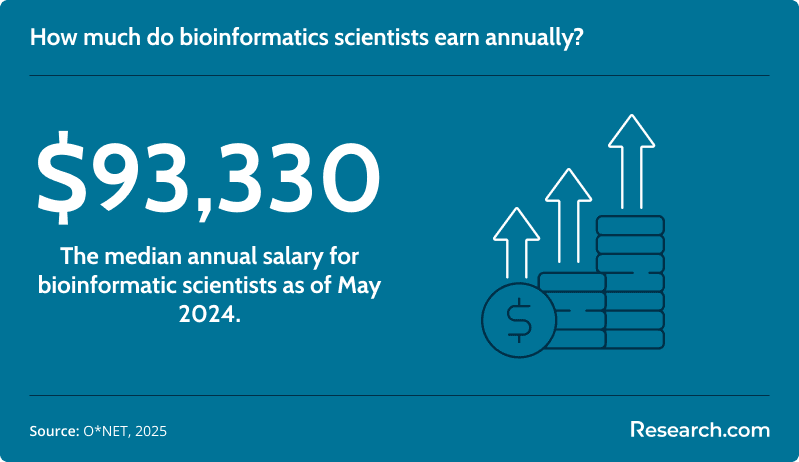
- Professionals with a master’s in bioinformatics earn a median annual wage of around $93,000 as of 2024, with experienced professionals often earning six figures in research and biotech roles.
- An online format lets students study from anywhere while completing their degree faster than traditional options—making it easier to balance work, life, and academic advancement.
What can I expect from a fast online master’s degree in bioinformatics?
A fast online master’s in bioinformatics is designed to deliver a rigorous curriculum within a shortened timeframe—typically 12 to 18 months. These programs combine core biological sciences with advanced data science, covering topics like genomics, proteomics, machine learning, and computational modeling. Students often work with real-world datasets and software platforms used in professional bioinformatics settings.
Many programs include a capstone or research project instead of a thesis, allowing students to demonstrate applied skills. Despite the accelerated pace, most online programs maintain the same academic standards and faculty quality as their on-campus counterparts, making them a strong option for working professionals or recent graduates eager to launch or advance their careers.
Where can I work with a master’s degree in bioinformatics?
Graduates with a master’s in bioinformatics find opportunities across multiple industries, especially in health care, pharmaceuticals, and biotechnology. Major employers include research institutions, pharmaceutical companies, public health agencies, and academic medical centers. As the use of big data in biology expands, demand is also rising in emerging areas like precision medicine, agricultural genomics, and clinical informatics.
In the private sector, companies like Illumina, Genentech, and Thermo Fisher Scientific regularly hire bioinformatics professionals to help develop new drugs, analyze genomic sequences, and support personalized medicine initiatives. In the public and academic sectors, roles are common at organizations such as the NIH, CDC, and leading universities, where bioinformatics supports critical research in genetics, cancer, infectious diseases, and more.
How much can I make with a master’s degree in bioinformatics?
The median annual salary for bioinformatics scientists was $93,330 in 2024, according to national wage data. Entry-level professionals may start at around $70,000, but those with specialized experience or additional training in machine learning and data analytics can earn upwards of $110,000, particularly in the pharmaceutical and biotech sectors.
Location, employer type, and job function significantly affect earnings. For example, bioinformatics professionals working in major research hubs like Boston, San Diego, or the San Francisco Bay Area often command salaries 10% to 30% above the national average.
Additionally, senior-level roles such as bioinformatics managers or directors can reach salaries well over $140,000 annually, especially in competitive industries like biopharma and genomics.
- List of the Fastest Online Bioinformatics Master’s Degree Programs for 2027 List of Programs
- How long does it take to complete a fast online master’s degree in bioinformatics? Completion Time
- How does a fast online master’s degree in bioinformatics compare to an on-campus program? Online vs. Traditional
- What is the average cost of a fast online master’s degree in bioinformatics? Cost
- What are the financial aid options for students enrolling in a fast online master’s degree in bioinformatics? Financial Aid
- What are the prerequisites for enrolling in a fast online master’s degree in bioinformatics? Prerequisites
- What courses are typically in a fast online master’s degree in bioinformatics? What courses are typically in a fast online master’s degree in bioinformatics?
- What types of specializations are available in a fast online master’s degree in bioinformatics? What types of specializations are available in a fast online master’s degree in bioinformatics?
- How do you choose the fastest online master’s degree in bioinformatics? How do you choose the fastest online master’s degree in bioinformatics?
- What career paths are available for graduates of fast online master’s degree programs in bioinformatics? Career Paths
- What is the job market for graduates of a fast online master’s degree in bioinformatics? What is the job market for graduates of a fast online master’s degree in bioinformatics?
- How does accreditation and industry partnership influence program quality? How does accreditation and industry partnership influence program quality?
- What challenges might students face in fast online master’s in bioinformatics programs? What challenges might students face in fast online master’s in bioinformatics programs?
- How does bioinformatics connect with health informatics in modern healthcare? How does bioinformatics connect with health informatics in modern healthcare?
- How do fast online master’s programs compare to accelerated online health informatics degrees? How do fast online master’s programs compare to accelerated online health informatics degrees?
- How is the curriculum updated to meet emerging industry trends in bioinformatics? How is the curriculum updated to meet emerging industry trends in bioinformatics?
Fastest Online Bioinformatics Master’s Degree Programs for 2027
An online master’s in bioinformatics can help biology, healthcare, biotechnology, and computing professionals move into data-centered roles without stepping away from work for a traditional campus program. The key decision is not simply which program is shortest. You need to know whether the curriculum builds the right mix of genomics, statistics, programming, machine learning, and applied research skills for the role you want.
This guide reviews fast online bioinformatics master’s programs that can be completed on accelerated timelines, including options that may take 12 to 18 months. It also explains how to compare cost, accreditation, prerequisites, course content, career outcomes, and online learning demands. If you are also comparing adjacent science pathways, the pace of these programs is similar to what students may see in the fastest online biochemistry degree programs.
Quick Answer: What Is the Fastest Online Master’s in Bioinformatics?
The fastest online bioinformatics master’s programs generally allow full-time students to finish in 12 to 18 months. Programs vary in structure: some are dedicated bioinformatics degrees, while others are biotechnology, biomedical informatics, or biomedical diagnostics programs with bioinformatics-focused coursework. The best choice depends on your background, target job, budget, and whether you want a research-heavy, clinical, computational, or industry-applied curriculum.
How to Use This Ranking
Use this list as a starting point, not as the only factor in your decision. A shorter program is only worthwhile if it is accredited, academically rigorous, financially realistic, and aligned with the type of bioinformatics work you plan to pursue. Before applying, confirm the current curriculum, tuition, admissions requirements, online format, transfer credit policy, and whether the program supports your preferred career path.
How Research.com Ranked These Programs
Research.com built this ranking to help prospective graduate students compare fast online bioinformatics-related master’s programs using practical decision points: completion time, online availability, credit requirements, tuition information, institutional accreditation, and curriculum focus.
The ranking draws from established education data sources, including the IPEDS database, Peterson’s Distance Learning Licensed Data Set, the College Scorecard database, and the National Center for Education Statistics. Readers can review the broader evaluation approach on the Research.com methodology page.
Fast Online Bioinformatics Master’s Programs at a Glance
| School | Program Focus | Fastest Listed Timeline | Credits | Accreditation |
| Johns Hopkins University | MS in Bioinformatics | As few as 12 months | 36 | Middle States Commission on Higher Education (MSCHE) |
| Northeastern University | MS in Bioinformatics | 12 to 18 months | 32 | New England Commission of Higher Education (NECHE) |
| University of Maryland Global Campus | MS in Biotechnology with Bioinformatics Specialization | 18 months | 36 | MSCHE |
| University of Illinois Urbana-Champaign | MS in Bioinformatics | 12 to 16 months | 32 | Higher Learning Commission (HLC) |
| University of Nebraska Medical Center | MS in Biomedical Informatics with Bioinformatics Concentration | 12 to 18 months | 36 | HLC |
| Arizona State University | MS in Biomedical Diagnostics with Bioinformatics-Relevant Coursework | 12 to 15 months | 30 | HLC |
| University of Maine | MS in Bioinformatics and Computational Biology | 12 to 18 months | 30 | NECHE |
| University of Texas Health Science Center at Houston | MS in Biomedical Informatics | 15 to 18 months | 36 | Southern Association of Colleges and Schools Commission on Colleges (SACSCOC) |
| Boston University | MS in Bioinformatics | 12 to 16 months | 32 | NECHE |
| George Mason University | MS in Bioinformatics and Computational Biology | 16 to 18 months | 31 to 36 | SACSCOC |
1. Johns Hopkins University
Johns Hopkins University offers an online MS in Bioinformatics through Advanced Academic Programs for students and professionals who want graduate-level training in computational biology, genomics, biotechnology, and biological data analysis. The program has been available online since 2001 and is built for learners with backgrounds in life sciences, computing, health, or related STEM fields. Its online format combines asynchronous learning with optional live engagement, allowing working students to complete rigorous coursework while maintaining professional responsibilities.
- Program Length: As few as 12 months (full-time)
- Tracks/concentrations: General Bioinformatics
- Cost per Credit: $5,060 (total estimated tuition)
- Required Credits to Graduate: 36
- Accreditation: Middle States Commission on Higher Education (MSCHE)
2. Northeastern University
Northeastern University provides a fully online MS in Bioinformatics that blends biotechnology, data analytics, and computational science. The program is designed for both STEM professionals and career changers who need structured preparation for bioinformatics roles. Students can follow course sequences shaped by their academic background and may benefit from Northeastern’s project-based approach, industry connections, and co-op-oriented professional network.
- Program Length: 12 to 18 months
- Tracks/concentrations: Bioinformatics Enterprise, Data Analytics, Regulatory Science
- Cost per Credit: $1,698
- Required Credits to Graduate: 32
- Accreditation: New England Commission of Higher Education (NECHE)
3. University of Maryland Global Campus (UMGC)
UMGC offers an online MS in Biotechnology with a Bioinformatics Specialization for students who want to combine biotechnology knowledge with applied data analysis. The program is structured for online learners, including mid-career professionals who are preparing for scientific, clinical, research, or data-focused advancement. Its asynchronous format and multiple annual start dates can make it easier for working adults to plan an accelerated path.
- Program Length: 18 months (accelerated pace)
- Tracks/concentrations: Bioinformatics (within Biotechnology MS)
- Cost per Credit: $524 (in-state), $659 (out-of-state)
- Required Credits to Graduate: 36
- Accreditation: MSCHE
4. University of Illinois Urbana-Champaign
The University of Illinois Urbana-Champaign offers an online MS in Bioinformatics through its Department of Bioengineering. The program emphasizes computational biology, machine learning, data science, and genomic analysis. It is best suited for students who already have preparation in biology, statistics, computer science, or a related technical field and want a fast but academically demanding route into bioinformatics practice.
- Program Length: 12 to 16 months
- Tracks/concentrations: Computational Genomics, Data Science
- Cost per Credit: $670
- Required Credits to Graduate: 32
- Accreditation: Higher Learning Commission (HLC)
5. University of Nebraska Medical Center
The University of Nebraska Medical Center offers a fully online MS in Biomedical Informatics with a bioinformatics concentration. The program serves students from healthcare, life sciences, computing, and related fields who want to apply informatics tools to genomic data, biomedical research, and personalized medicine. Its flexible structure can support both full-time students seeking a faster finish and part-time learners balancing work or family commitments.
- Program Length: 12 to 18 months
- Tracks/concentrations: Bioinformatics, Health Informatics
- Cost per Credit: $626
- Required Credits to Graduate: 36
- Accreditation: HLC
6. Arizona State University
Arizona State University offers an online MS in Biomedical Diagnostics that includes bioinformatics-relevant training in clinical applications, diagnostics, and data analysis. It is not a standalone bioinformatics degree, so students should review the curriculum carefully before enrolling. However, its data-centered coursework and 7.5-week accelerated course blocks may appeal to learners interested in bioinformatics applications within diagnostic and clinical environments.
- Program Length: 12 to 15 months
- Tracks/concentrations: Biomedical Informatics
- Cost per Credit: $850
- Required Credits to Graduate: 30
- Accreditation: HLC
7. University of Maine
The University of Maine offers an online MS in Bioinformatics and Computational Biology for students who want to apply computational methods to biological datasets. The program is especially relevant for learners interested in research roles, doctoral preparation, molecular biology, statistics, algorithms, or computer science applications in biology. Its curriculum can be customized, which may help students align coursework with their technical strengths and career goals.
- Program Length: 12 to 18 months
- Tracks/concentrations: Customizable; includes molecular biology, statistics, and computer science
- Cost per Credit: $560 (resident), $1,495 (non-resident)
- Required Credits to Graduate: 30
- Accreditation: NECHE
8. University of Texas Health Science Center at Houston
The MS in Biomedical Informatics at UTHealth School of Biomedical Informatics prepares students to use informatics in clinical, genomic, population health, and biomedical research settings. The program has been online since the mid-2010s and combines self-paced modules with optional synchronous discussions. Students considering this option should compare the bioinformatics and clinical informatics components to make sure the degree supports their intended role.
- Program Length: 15 to 18 months
- Tracks/concentrations: Bioinformatics, Clinical Informatics
- Cost per Credit: $295 (resident), $695 (non-resident)
- Required Credits to Graduate: 36
- Accreditation: Southern Association of Colleges and Schools Commission on Colleges (SACSCOC)
9. Boston University
Boston University offers an online professional track in its MS in Bioinformatics for students who already have relevant experience and want advanced applied training. The curriculum includes personalized genomics, data management, and algorithm development. Instead of a thesis, students complete a final project, which may suit professionals seeking portfolio-ready applied work rather than a traditional research thesis.
- Program Length: 12 to 16 months
- Tracks/concentrations: Computational Biology, Genomic Data Science
- Cost per Credit: $995
- Required Credits to Graduate: 32
- Accreditation: NECHE
10. George Mason University
George Mason University offers an online MS in Bioinformatics and Computational Biology for students with undergraduate preparation in biology, computer science, or related areas. The program emphasizes interdisciplinary training in software, databases, algorithms, and computational biology. It may also appeal to students who want optional research exposure before pursuing doctoral study or advanced technical roles.
- Program Length: 16 to 18 months
- Tracks/concentrations: General Bioinformatics, Computational Biology
- Cost per Credit: $850 (in-state), $1,370 (out-of-state)
- Required Credits to Graduate: 31 to 36
- Accreditation: SACSCOC
How Long Does a Fast Online Master’s in Bioinformatics Take?
Most accelerated online bioinformatics master’s programs can be completed in 12 to 18 months. The actual timeline depends on the number of required credits, course length, start-date flexibility, whether courses are offered year-round, and whether the student studies full time or part time.
Students with relevant preparation in programming, statistics, molecular biology, or computational science may move through the curriculum more efficiently. Students who need prerequisite coursework may need additional time before or during the program.
A faster timeline can be valuable if your goal is to qualify sooner for roles in bioinformatics, biotechnology, biomedical data science, or health data analysis. If you are comparing this field with health informatics, Research.com’s guide to MS healthcare informatics salary can help you evaluate related earnings and career pathways.
Online vs. On-Campus Bioinformatics Master’s Programs: Which Format Fits You?
Online and on-campus bioinformatics programs may cover similar material, but the learning experience can be very different. The right format depends on your schedule, learning style, need for lab access, networking preferences, and ability to manage independent study.
| Factor | Fast Online Program | On-Campus Program | Best Fit |
| Schedule | Often asynchronous or designed for working adults | Usually follows set class times and campus calendars | Online works better for students balancing employment, caregiving, or location constraints. |
| Completion speed | Accelerated options commonly run 12 to 18 months | Many traditional programs take two years or more | Online may be better if speed is a top priority. |
| Networking | Requires intentional participation in virtual discussions, projects, and office hours | Offers easier access to informal conversations, campus events, labs, and research groups | Campus may be better for students who want frequent in-person mentorship. |
| Research access | May rely on virtual labs, public datasets, simulations, capstones, or employer-based projects | May provide more direct access to wet labs and research assistantships | Campus may be stronger for students targeting lab-intensive research careers. |
| Cost and relocation | May avoid relocation and commuting costs | May require moving, commuting, or reducing work hours | Online may be more practical for students who need geographic flexibility. |
If your main goal is rapid technical upskilling rather than a graduate degree, compare master’s programs with shorter training options such as the fastest online data science bootcamps. Bootcamps can build coding and analytics skills quickly, but they do not replace a graduate credential in bioinformatics.
How Much Does a Fast Online Master’s in Bioinformatics Cost?
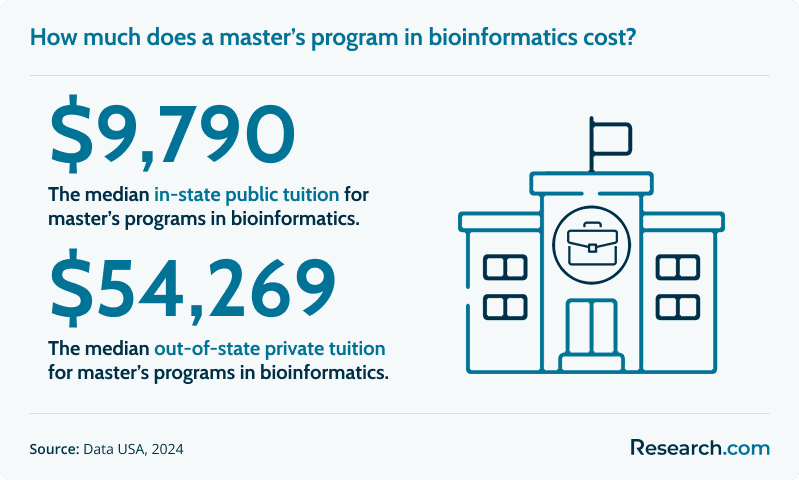
Costs vary widely by institution, residency status, number of credits, program format, and whether the school is public or private. According to Data USA, median in-state tuition for public institutions is around $9,790, while private out-of-state programs average $54,269. That range shows why students should calculate total program cost, not just compare advertised tuition rates.
When estimating cost, include tuition, university fees, technology fees, textbooks or software, transcript costs, graduation fees, and any travel required for optional residencies or campus experiences. Also compare whether the program’s accelerated structure allows you to keep working while enrolled.
Return on investment depends on your current experience, target role, local labor market, and how well the program helps you build job-ready skills. Bioinformatics can overlap with health informatics, clinical analytics, biotech research, and biomedical data science. For a broader view of related compensation pathways, see Research.com’s health informatics salary and career guide.
Financial Aid Options for Fast Online Bioinformatics Master’s Students
Many online graduate students use more than one funding source. Before enrolling, ask each school for a full cost breakdown and confirm whether online students qualify for the same aid, scholarships, or employer partnership benefits as campus students.
- Federal student aid: Students in eligible accredited programs may be able to apply for federal loans through FAFSA.
- Institutional scholarships and grants: Some universities offer awards for graduate students, STEM students, online learners, or professionals in biotechnology-related fields. Students comparing shorter credentials can also review funding possibilities for options such as the fastest online biotechnology graduate certificate programs.
- Employer tuition assistance: Healthcare systems, pharmaceutical companies, research organizations, and technology employers may help pay for job-related graduate study.
- Assistantships or fellowships: These are more common in campus programs, but some online students may find research, teaching, or project-based funding opportunities.
- Military and veteran education benefits: Eligible students should ask whether the program is approved for VA funding or Yellow Ribbon participation.
Admission Requirements and Prerequisites
Fast online bioinformatics master’s programs usually expect applicants to have a bachelor’s degree and a foundation in life sciences, computing, statistics, or a related technical discipline. Because accelerated programs move quickly, weak preparation in programming or biology can make the workload much harder.
- Bachelor’s degree in biology, computer science, bioengineering, biotechnology, statistics, health sciences, or a related field
- Prior coursework in molecular biology, statistics, calculus, programming, or a comparable quantitative subject
- Minimum GPA, often 3.0 or higher
- Letters of recommendation
- Statement of purpose explaining academic preparation and career goals
- Possible resume, transcripts, prerequisite review, or interview depending on the school
According to Zippia, 43% of bioinformatics scientists hold a bachelor’s degree, while 31% have a master’s degree and 24% hold a doctorate. That distribution suggests that a master’s degree is common in the field, but students can enter related roles through several academic routes depending on technical experience and employer expectations.
If you are not ready for graduate study and want to build a stronger computing foundation first, compare undergraduate options such as the fastest online bachelor’s in computer science programs.
Common Courses in an Online Master’s in Bioinformatics
A bioinformatics master’s curriculum combines biology, computing, statistics, and applied data interpretation. The strongest programs do not treat programming as an add-on; they require students to use code, databases, algorithms, and statistical methods to solve biological problems.
Core Course Areas
- Molecular Biology and Genomics
- Programming in Python or R for Bioinformatics
- Biostatistics and Data Analysis
- Algorithms in Computational Biology
Advanced or Elective Topics
- Machine Learning in Genomics
- Structural Bioinformatics
- Biomedical Data Mining
- Clinical Informatics
Capstone, Thesis, or Applied Project
Many programs end with a capstone or research project where students analyze biological, genomic, biomedical, or clinical datasets. A strong final project can help demonstrate practical ability to employers, especially for students changing careers from laboratory science, healthcare, or software development. If you are still deciding between bioinformatics and biotechnology more broadly, Research.com’s guide on whether a biotechnology degree is worth it can help clarify the overlap.
Bioinformatics Specializations and When They Make Sense
Specializations matter because bioinformatics is not one single job market. Some roles focus on genomic data analysis, while others emphasize clinical systems, drug discovery, statistical modeling, or software tools. Choose electives based on the work you want to do after graduation.
| Specialization | What It Emphasizes | Best For Students Who Want To |
| Biostatistics | Statistical modeling, study design, biological data interpretation, and quantitative analysis | Work in clinical research, genomics, epidemiology-adjacent analytics, or research data analysis |
| Molecular Biology and Biophysics | Biological mechanisms, molecular systems, protein structure, and biological function | Support drug discovery, structural analysis, or research-heavy roles |
| Computational Genomics | Large genomic datasets, algorithm development, pattern detection, and machine learning applications | Analyze genomic variation, build computational workflows, or work in precision medicine research |
| Biomedical or Clinical Informatics | Connections between biological data, clinical data, patient information, and healthcare systems | Bridge bioinformatics with healthcare analytics, clinical decision support, or digital health |
| Computer Science Applications | Programming, databases, visualization, software pipelines, and scalable computation | Build tools, manage data infrastructure, or move into technical bioinformatics engineering roles |
Biostatistics is a common related academic background; 17% of professionals in the field hold a degree in this area. Students interested in healthcare-facing informatics roles can also compare adjacent positions, including the training and earnings profile discussed in Research.com’s clinical informatics specialist salary and career paths guide.
How to Choose the Best Fast Online Bioinformatics Master’s Program
The best accelerated program is the one you can complete successfully while building skills employers or doctoral programs actually value. Do not choose only by speed. A 12-month program can be a poor fit if it lacks the courses, support, or project experience you need.
Questions to Ask Before Applying
- Is the institution accredited? Confirm the school’s status through the U.S. Department of Education’s regional accreditation database.
- Does the curriculum match your target role? Genomics roles may require different preparation than clinical informatics, regulatory science, or computational biology roles.
- How much programming is required? Ask whether Python, R, databases, machine learning, and command-line tools are taught at a practical level.
- What kind of final project is required? A capstone using real datasets can be valuable for building a portfolio.
- Are online students eligible for career services? Confirm access to advising, resume support, employer events, alumni networks, and internship or project opportunities.
- What is the total cost? Compare tuition, fees, residency pricing, course materials, and the opportunity cost of reducing work hours.
- Can you handle the pace? Accelerated programs require consistent weekly time for coding, reading, analysis, and group work.
Students who want a broader information systems path rather than a science-heavy curriculum may also compare programs in areas such as online management information systems degrees.
Career Paths After a Fast Online Master’s in Bioinformatics
Graduates of online bioinformatics master’s programs can pursue roles that require biological knowledge, quantitative reasoning, and data analysis. Job titles vary by employer, and some research-intensive positions may prefer or require doctoral training. Still, a master’s degree can be useful for applied roles in biotechnology, pharmaceuticals, clinical research, health data, academic research support, and biomedical analytics.
| Career Path | Typical Work | Skills That Matter |
| Bioinformatics Scientist | Analyzes biological and genomic data, develops computational methods, and supports research findings | Programming, statistics, genomics, data interpretation, reproducible workflows |
| Computational Biologist | Uses models, algorithms, and biological datasets to study complex biological systems | Algorithms, molecular biology, computational modeling, machine learning |
| Genomics Data Analyst | Processes and interprets sequencing, genetic, or molecular datasets | Genomic pipelines, Python or R, quality control, visualization |
| Clinical Informatics Specialist | Connects biomedical or clinical data with healthcare systems and decision-making | Clinical data, interoperability concepts, analytics, communication with healthcare teams |
| Biotech or Pharmaceutical Researcher | Supports discovery, diagnostics, therapeutic development, or translational research | Bioinformatics tools, experimental context, data management, regulatory awareness |
Because bioinformatics involves interpreting complex data for decisions, some graduates may also find transferable value in adjacent analytic fields. Students interested in broader intelligence and data interpretation roles can compare the skill overlap with online master’s degrees in intelligence.
Job Market Outlook for Bioinformatics Graduates
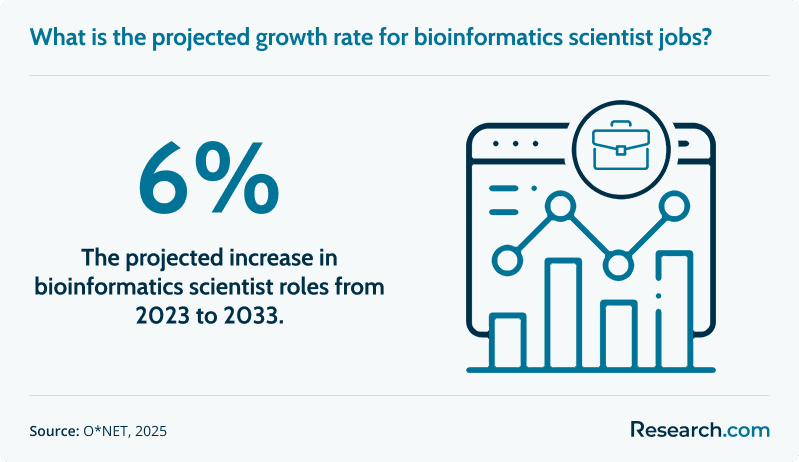
Bioinformatics demand is tied to the expansion of genomic research, biotechnology, personalized medicine, public health analytics, agricultural research, pharmaceutical development, and AI-supported data workflows. According to projections, employment for bioinformatics scientists is expected to grow by 6% between 2023 and 2033, adding about 5,400 job openings annually.
Employers often look for candidates who can do more than run tools. Strong applicants can explain biological meaning, document reproducible workflows, clean and manage datasets, collaborate with scientists or clinicians, and communicate findings to nontechnical stakeholders. A master’s program is more valuable when it helps students build those applied capabilities through projects, coding practice, and domain-specific analysis.
Why Accreditation and Industry Connections Matter
Accreditation helps verify that a university meets recognized academic quality standards. It can affect financial aid eligibility, credit transfer, employer recognition, and the credibility of the degree. Before enrolling, confirm institutional accreditation directly rather than relying only on marketing language.
Industry partnerships can also strengthen a program when they lead to applied projects, current datasets, guest speakers, employer-informed curriculum, or networking opportunities. This is especially important in a field where tools and employer expectations change quickly. Students making technology-focused comparisons may find a similar decision process when evaluating a computer science accelerated program.
Challenges of Fast Online Bioinformatics Master’s Programs
Accelerated online study can be efficient, but it is not easy. Bioinformatics requires students to combine biology, statistics, programming, and interpretation under tight timelines. Learners who fall behind in one technical area may struggle to keep pace with weekly assignments and projects.
| Common Challenge | Why It Matters | How to Prepare |
| Condensed workload | Short terms leave little time to recover from missed assignments or weak prerequisite knowledge. | Review programming, statistics, and molecular biology before the first course begins. |
| Limited in-person networking | Online students may have fewer spontaneous connections with faculty, peers, and researchers. | Attend virtual office hours, participate in discussion boards, and join professional groups. |
| Technical learning curve | Students may need to learn coding, command-line tools, databases, and statistical methods quickly. | Choose programs with clear support resources, tutoring, bootcamps, or bridge modules. |
| Balancing work and study | Many online students continue working while enrolled, which can create scheduling pressure. | Map weekly study hours before committing to a full-time accelerated plan. |
If your main goal is a lower-cost computing foundation before graduate study, you may want to compare options such as the most affordable bachelor’s in software engineering online programs.
How Bioinformatics Connects With Health Informatics
Bioinformatics and health informatics both use data to improve science and healthcare, but they focus on different types of information. Bioinformatics usually centers on molecular, genomic, and biological datasets. Health informatics focuses more on clinical data, health records, systems integration, patient information, and healthcare operations.
The fields increasingly overlap in precision medicine, diagnostics, population health, and clinical research. A bioinformatics graduate who understands clinical data systems may be well positioned for roles connecting genomic insights with patient care. Students who want deeper training in healthcare data systems can compare bioinformatics programs with the fastest master’s in health informatics online programs.
Bioinformatics vs. Accelerated Health Informatics Master’s Programs
Fast online bioinformatics programs and accelerated health informatics degrees both prepare students for data-focused work, but they lead to different skill sets and career directions.
| Comparison Point | Bioinformatics Master’s | Health Informatics Master’s |
| Main data focus | Genomic, molecular, biological, and biomedical research data | Clinical, administrative, patient, and healthcare systems data |
| Typical coursework | Genomics, computational biology, biostatistics, programming, algorithms, machine learning | Health information systems, data governance, interoperability, healthcare analytics, privacy, operations |
| Best for | Students targeting biotech, genomics, computational biology, biomedical research, or pharmaceutical analytics | Students targeting hospitals, health IT, clinical analytics, digital health, or healthcare administration analytics |
| Key technical expectation | Ability to analyze biological data and understand scientific context | Ability to manage, interpret, and apply healthcare data in operational or clinical settings |
If your career goal is more clinical systems-oriented than genomics-oriented, compare your options with the fastest master’s in health informatics online.
How Bioinformatics Curricula Respond to Industry Trends
Bioinformatics programs must evolve as biological datasets grow larger and computational methods become more advanced. Strong programs regularly review course content, update software tools, incorporate current research practices, and use applied projects that reflect how students will work with data after graduation.
Important curriculum areas include machine learning applications, genomic data analysis, biomedical data mining, reproducible coding workflows, data visualization, and ethical handling of sensitive biological or clinical information. Similar curriculum-review pressures affect other healthcare-related online programs, including an online healthcare administration degree, where programs must keep pace with changes in technology, policy, and employer expectations.
Common Mistakes to Avoid When Choosing a Fast Online Bioinformatics Master’s
| Mistake | Why It Can Hurt You | Better Approach |
| Choosing the shortest program automatically | A fast timeline does not guarantee strong training, career support, or the right specialization. | Compare speed with curriculum depth, faculty expertise, projects, and outcomes. |
| Ignoring accreditation | Accreditation can affect aid eligibility, credit transfer, and employer confidence. | Verify institutional accreditation before applying. |
| Looking only at tuition per credit | Fees, credit totals, residency pricing, software, and lost work time can change the real cost. | Calculate total cost to completion. |
| Underestimating prerequisites | Accelerated courses can be difficult without programming, statistics, or biology preparation. | Ask whether bridge courses or prerequisite refreshers are available. |
| Assuming every program is a pure bioinformatics degree | Some programs are biomedical informatics, biotechnology, or diagnostics degrees with bioinformatics-related coursework. | Read course descriptions and confirm alignment with your target job. |
| Relying only on rankings | A highly ranked school may not be the best fit for your schedule, budget, or career goals. | Use rankings as one input alongside practical program comparison. |
Graduate Perspectives on Fast Online Bioinformatics Master’s Programs
- Lena: "The online format made it possible for me to move from a laboratory support role into data-focused work without leaving my job. The workload was intense, especially when programming assignments and genomics projects overlapped, but the applied case studies helped me connect theory to real scientific problems. The biggest benefit was building confidence with datasets I had only seen from the bench before."
- Carlos: "As a working parent, I needed a program that did not require relocation or daytime classes. Completing the degree in 15 months required careful planning, but the structure helped me build practical skills in Python, statistics, and genomics. Virtual office hours were more useful than I expected because I could get targeted help without commuting to campus."
- Meera: "I was already working in pharmaceutical research, so the most valuable part of the program was applying coursework directly to my job. Group projects and discussion forums also gave me a professional network outside my company. The accelerated pace was demanding, but it shortened the time between enrolling and qualifying for more advanced responsibilities."
References
- Data USA. (2024). Bioinformatics. datausa.io.
- Grand View Research. (n.d.). Bioinformatics Market Size, Share & Growth Report, 2030. grandviewresearch.com.
- O*NET. (2025). 19-1029.01 - Bioinformatics Scientists. onetonline.org.
- O*NET. (2025). National Employment Trends: 19-1029.01 - Bioinformatics Scientists. onetonline.org.
- Zippia. (2025, January 8). Best Colleges and Degrees for Bioinformatics Scientists. zippia.com.
Key Insights
- Fast online bioinformatics master’s programs typically take 12 to 18 months, but the best program is not always the shortest one.
- Dedicated bioinformatics degrees are usually better for genomics, computational biology, and research-focused roles, while biomedical or health informatics programs may fit students interested in clinical data and healthcare systems.
- Before enrolling, verify accreditation, total cost, prerequisites, course content, online student support, and capstone or research opportunities.
- Strong preparation in programming, statistics, and molecular biology is especially important in accelerated formats.
- Bioinformatics career outcomes depend heavily on applied skills: coding, reproducible analysis, biological interpretation, communication, and experience with real datasets.
- Do not rely only on rankings or advertised completion time. Compare each program against your target role, budget, schedule, and technical readiness.
Other Things You Should Know About the Fastest Online Bioinformatics Master’s Degree Programs
Yes, some programs accept up to 12 transfer credits from a graduate certificate, but only courses with a grade of B or higher usually count. The school’s registrar and program director must approve the transfer before enrollment is finalized.
In 2027, several renowned institutions offer accelerated online bioinformatics master’s programs, including Johns Hopkins University, Stanford University, and the University of California, Santa Cruz. These programs often range from 10 to 16 months, depending on the course structure and credit requirements.


