
2027 Master's in Health Informatics Salary

Co-Founder and Chief Data Scientist
A master’s in health informatics can lead to roles that sit at the intersection of healthcare, data, technology, compliance, and operations. The salary question is not simple, however. Pay can vary widely depending on whether you work in a hospital, health tech company, insurer, pharmaceutical organization, public agency, or consulting firm.
This guide is for current healthcare workers, IT professionals, analysts, nurses, pharmacists, and prospective graduate students trying to decide whether a Master’s in Health Informatics is worth the cost in 2027. You will learn what salary ranges look like, which jobs tend to pay the most, how experience changes earning potential, what industries and states offer stronger compensation, and how to evaluate a program before enrolling.
The goal is practical: help you connect graduate study to realistic career outcomes, not just average salary figures.
Quick Answer: Master's in Health Informatics Salary in 2027
According to the latest Payscale data cited in this guide, the average salary for professionals with a master’s in health informatics is approximately $72,000 per year. Actual compensation may range from $46,000 to over $118,000, and senior leadership roles can pay substantially more.
| Salary question | Short answer |
| What is the average master’s in health informatics salary? | Approximately $72,000 per year, based on Payscale data. |
| What salary range should students expect? | In 2025, salaries can range from $46,000 to over $118,000 depending on role, employer, location, and experience. |
| Can leadership roles pay more? | Yes. Informatics managers can earn over $160,000 annually, and directors of informatics may exceed $200,000. |
| Does a master’s degree help? | It can improve access to leadership, specialized analytics, clinical informatics, and health IT management roles. |
| Are remote jobs available? | Yes. As of May 2025, LinkedIn listed over 450 remote health informatics positions in the United States. |
Key Things You Should Know About Master's in Health Informatics Salary
- Health informatics salaries vary widely. A master’s degree can support higher-paying roles, but job title, experience, industry, and technical skills matter just as much as the credential itself.
- Senior positions in pharma, health technology, consulting, and large private healthcare organizations often offer stronger compensation than smaller clinics, nonprofit employers, or some public-sector roles.
- Remote and hybrid work have expanded the market for informatics talent, allowing some professionals to compete for roles beyond their immediate location.
- What is the average master's in health informatics salary for 2027?
- What factors influence salary in health informatics careers?
- How does salary increase with years of experience in health informatics?
- What are the highest-paying jobs with a master's in health informatics?
- Which industries pay the most for health informatics professionals?
- Do private sector jobs in health informatics pay more than public ones?
- Which states pay the most for health informatics careers?
- What should I consider when selecting a Master's in Health Informatics program?
- Is pursuing a Master's in Health Informatics a cost-effective investment?
- What complementary certifications can further enhance my career growth in health informatics?
- What are the emerging trends in health informatics?
- What additional online specializations can complement a Master's in Health Informatics?
- Does having a master's degree increase salary in health informatics?
- What are common career paths after a master’s in health informatics?
- Can you work remotely with a master’s in health informatics?
What is the average master's in health informatics salary for 2027?
Based on the Payscale data referenced in this article, the average salary for a master’s in health informatics is about $72,000 per year. That number is useful as a benchmark, but it should not be treated as a guaranteed outcome. Health informatics is a broad field, and salaries differ sharply between analyst, specialist, manager, consultant, and executive roles.
At the lower and middle ranges, professionals may work with reporting systems, electronic health records, data quality, workflow improvement, or operational analytics. At the higher end, informatics managers can earn over $160,000 annually, while directors of informatics may earn more than $200,000. These roles usually require more than a degree; employers often look for proven leadership, enterprise system experience, regulatory knowledge, and the ability to connect data strategy with clinical and business goals. Zippia data also shows that 23% of health informatics specialists hold a master’s degree, which reflects the value many employers place on graduate-level preparation.
What factors influence salary in health informatics careers?
Your degree can help you qualify for stronger roles, but it is only one part of the salary equation. Health informatics compensation is shaped by the type of work you do, the systems you know, the industry you enter, and the level of responsibility you carry.
| Salary factor | Why it matters | How to use it in career planning |
| Job title and scope | Managers, directors, and executive-level informatics leaders are paid more because they make strategic decisions, supervise teams, and oversee complex health IT systems. | Look beyond entry-level analyst titles and identify the responsibilities required for advancement. |
| Certifications | Credentials such as RHIA, PMP, and CHDA can show employers that you have validated skills in health information management, project leadership, or data analysis. | Choose certifications that match your target role instead of collecting credentials without a career plan. |
| Technical skills | Knowledge of SQL, Python, Epic Systems, databases, dashboards, data governance, and reporting tools can make a candidate more competitive. | Use graduate projects and work experience to build a portfolio that demonstrates applied technical ability. |
| Industry | Pharmaceutical companies, insurers, health technology firms, and consulting organizations may pay more than some traditional healthcare settings. | Compare employers by both salary and career growth, not just job title. |
| Location | High-cost and high-demand markets such as California, New York, and Massachusetts often offer higher pay, especially where healthcare and technology employers cluster. | Adjust salary expectations for cost of living, remote options, and local employer demand. |
- Responsibility level: A health informatics coordinator and a director of informatics may both work with healthcare data, but the director is accountable for larger systems, budgets, teams, and organizational outcomes.
- Project management ability: Informatics work often involves EHR implementations, workflow redesign, reporting rollouts, and vendor coordination. If you are comparing related roles, Research.com’s guide to what a project management specialist does can help explain why project leadership skills are valuable in this field.
- Comparison to other graduate paths: Health informatics can offer stronger earning potential than some public-service-oriented fields. For context, you can compare it with the average salary for teachers with a master’s degree, though the work, licensing expectations, and labor markets are very different.
How does salary increase with years of experience in health informatics?
Salary growth in health informatics usually comes from moving from task-based work into ownership of systems, projects, teams, or strategy. Early-career professionals often begin in roles such as data analyst, health informatics analyst, clinical informatics specialist, or EHR support analyst. These positions commonly start around $62,000 to $65,000 per year.
With additional experience, professionals may move into mid-level positions where compensation rises to approximately $70,000 to $82,000. At this stage, they may lead workflow improvement projects, support implementation teams, manage reporting requirements, or serve as the link between clinicians, administrators, and IT departments. Students who want to enter healthcare operations more quickly may also compare adjacent pathways such as accelerated healthcare programs, though those programs are not the same as a health informatics master’s degree.
Professionals with more than 10 to 15 years of experience may see much stronger pay growth, particularly if they move into informatics management, consulting, health data science, or director-level positions. Senior-level salaries can range from $93,000 to over $200,000, depending on employer type, leadership scope, and technical specialization.
| Career stage | Common role examples | Typical compensation pattern described in current sources | Main advancement driver |
| Entry level | Data analyst, clinical informatics specialist, informatics coordinator | Often around $62,000 to $65,000 per year | Building EHR, reporting, workflow, and healthcare data experience |
| Mid-career | Senior analyst, project lead, informatics specialist, implementation analyst | Approximately $70,000 to $82,000 | Leading projects, improving systems, and coordinating across departments |
| Senior level | Informatics manager, director, consultant, health data leader | Can range from $93,000 to over $200,000 | Managing strategy, teams, budgets, vendors, compliance, and enterprise systems |
Here's a general breakdown of how compensation progresses over time based on the most recent data from Glassdoor:
What are the highest-paying jobs with a master's in health informatics?
The highest-paying health informatics jobs usually combine advanced healthcare knowledge, enterprise technology experience, analytics fluency, and leadership responsibility. A master’s degree may help you qualify, but most of these roles also require substantial professional experience.
1. Director of Informatics
- Median Total Pay: $232,000/year
- What the role does: A director of informatics leads the organization’s informatics strategy and ensures that clinical, operational, and technology systems support patient care and business goals. This role often supervises analysts, informatics specialists, and IT professionals; oversees major data initiatives; works with executives; and helps guide digital transformation across a healthcare organization.
2. Informatics Manager
- Median Total Pay: $162,000/year
- What the role does: Informatics managers coordinate the planning, implementation, and improvement of health information systems. They may supervise analysts and specialists, manage EHR optimization projects, monitor data integrity, work with vendors, and help clinical teams use information systems more effectively.
3. Pharmacist Informatics
- Median Total Pay: $149,000/year
- What the role does: Pharmacist informatics professionals apply pharmacy expertise to medication systems, EHR pharmacy modules, safety alerts, medication-use data, formulary compliance, and workflow improvement. This pathway is most relevant for licensed pharmacists or pharmacy professionals who want to specialize in technology-enabled medication management. Students comparing pharmacy-related options can review Research.com’s resource on online pharmacy school, though pharmacy licensure and informatics leadership require careful program and credential planning.
4. Clinical Informatics Specialist
- Median Total Pay: $146,000/year
- What the role does: Clinical informatics specialists connect frontline clinical teams with IT and analytics departments. They evaluate workflows, support EHR improvements, train users, document system requirements, and help organizations use technology to improve care coordination and decision-making.
5. Nursing Informatics Specialist
- Median Total Pay: $125,000/year
- What the role does: Nursing informatics specialists bring nursing practice, data, and information systems together. They improve documentation processes, support clinical decision tools, help redesign nursing workflows, and contribute to quality improvement initiatives that affect care delivery.
Which industries pay the most for health informatics professionals?
Industry can have as much impact on salary as the degree itself. According to the U.S. Bureau of Labor Statistics, health information technologists with an associate’s degree earn an average of $80,990 per year in the “management of companies and enterprises” sector. This category can include corporate offices, consulting firms, and large healthcare organizations with complex administrative and technology operations.
By comparison, professionals working in physicians’ offices earn average annual wages around $52,760. Smaller clinical settings may have narrower responsibilities, smaller technology budgets, and fewer enterprise-level data projects. Higher-paying opportunities are often found where organizations use health data for large-scale strategy, compliance, product development, risk management, revenue optimization, or clinical performance improvement.
| Industry or employer type | Why pay may be higher or lower | Best fit for |
| Pharmaceutical companies | These employers often rely on data for research, safety, regulatory, and commercial decision-making. | Professionals interested in analytics, compliance, population data, and product-related healthcare work |
| Health technology firms | Health tech companies need people who understand both clinical workflows and software-driven products. | Candidates with strong technical, product, EHR, or implementation experience |
| Insurance companies | Insurers use healthcare data for claims, utilization, risk adjustment, care management, and quality programs. | Analysts and informatics professionals comfortable with large datasets and business operations |
| Hospitals and health systems | Pay varies widely, but large systems may offer strong opportunities in EHR optimization, analytics, and leadership. | Clinical professionals, workflow specialists, and health IT project leaders |
| Physicians’ offices | These roles may involve smaller systems and more limited informatics responsibilities. | Professionals seeking local clinical operations experience or entry-level health data work |
If you are comparing healthcare roles more broadly, Research.com also covers salaries for positions such as patient care technician and PCT salary, which can help you understand how informatics differs from direct patient care occupations.
Do private sector jobs in health informatics pay more than public ones?
Private-sector health informatics roles often pay more than public-sector roles, especially in leadership, consulting, pharma, insurance, and health technology. The difference is usually tied to budget flexibility, competitive hiring markets, product or revenue impact, and demand for specialized technical skills.
- Private sector: Informatics managers can earn over $160,000 annually, and directors of informatics may earn more than $200,000. These roles are often found in private healthcare organizations, health tech firms, pharmaceutical companies, insurers, and consulting environments. Some also overlap with business-focused leadership paths; for comparison, Research.com explains MBA jobs in healthcare for readers interested in management-heavy roles.
- Public sector: Government agencies, public health departments, and public-sector healthcare programs may offer lower salaries but can provide mission-driven work, stability, benefits, and opportunities to influence population health. ZipRecruiter reports that the average salary for public health informatics professionals in the U.S. is approximately $98,409 per year.
| Option | Potential advantages | Possible trade-offs |
| Private sector | Higher salary ceiling, exposure to innovation, faster promotion potential, more performance-driven roles | May involve heavier workloads, changing business priorities, or stronger pressure to deliver measurable returns |
| Public sector | Mission-focused work, population health impact, benefits, stability, policy exposure | May have lower salary bands, slower advancement, and more standardized pay structures |
To compare a nearby analytics-oriented field, you can also review Research.com’s guide to business analytics salary.
Which states pay the most for health informatics careers?
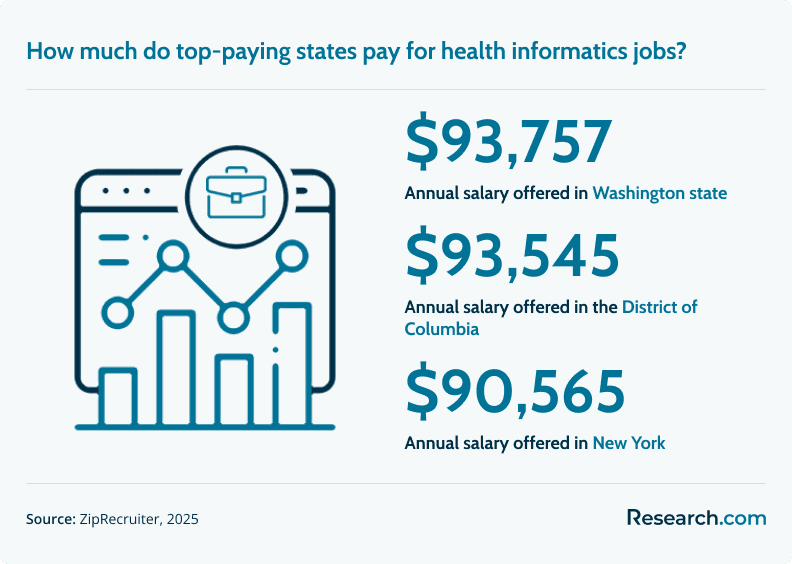
The highest-paying states for health informatics careers tend to have dense healthcare systems, major research hospitals, established technology employers, and higher costs of living. California, Massachusetts, and Washington are examples of states where healthcare, research, and technology employers can create stronger demand for informatics expertise.
State-level salary differences are shaped by employer concentration, regional healthcare investment, cost of living, competition for technical talent, and the presence of insurers, academic medical centers, consulting firms, or health tech companies. A higher salary in a coastal or urban market may not always mean higher purchasing power, so students should compare compensation against housing, commuting, taxes, and remote-work flexibility.
If you are still deciding among healthcare occupations, this healthcare careers list can help you compare clinical, administrative, and technology-focused options.
Based on ZipRecruiter data, the following are among the top-paying states for health informatics professionals:
What should I consider when selecting a Master's in Health Informatics program?
Choosing the right program matters because not every health informatics master’s degree prepares students for the same roles. Some programs are designed for clinicians moving into informatics. Others focus more heavily on analytics, health IT management, public health data, cybersecurity, or healthcare administration.
| Program factor | What to check | Why it affects career outcomes |
| Accreditation and institutional quality | Confirm that the school is properly accredited and that the program’s curriculum aligns with recognized health informatics competencies. | Accreditation can affect financial aid, transferability, employer recognition, and long-term academic options. |
| Curriculum focus | Review courses in EHR systems, data analytics, privacy, interoperability, healthcare operations, project management, and clinical workflow. | Your course mix should match your target role, whether that is analytics, management, clinical informatics, or consulting. |
| Hands-on learning | Look for capstones, applied projects, internships, simulations, data labs, or partnerships with healthcare organizations. | Employers often want evidence that you can solve real health data and workflow problems. |
| Technology exposure | Ask what tools, platforms, databases, and EHR environments students use. | Practical tool experience can make your resume stronger than coursework alone. |
| Flexibility | Compare online, hybrid, evening, part-time, and accelerated formats. | Working professionals need a format that does not force unnecessary career disruption. |
| Total cost | Calculate tuition, fees, books, software, travel, lost work time, and financing costs. | The cheapest program is not always the best value, but overpaying without strong career support can reduce ROI. |
| Career support | Ask about employer partnerships, alumni outcomes, career coaching, practicum placement, and informatics-specific networking. | Strong career services can help translate the degree into interviews, promotions, and career changes. |
Students comparing healthcare education formats may also look at lower-cost or shorter healthcare training options, such as medical assistant school online programs. These are not substitutes for a master’s in health informatics, but they can help clarify the difference between entry-level healthcare training and graduate-level health data leadership preparation.
Is pursuing a Master's in Health Informatics a cost-effective investment?
A master’s in health informatics can be a cost-effective investment if it helps you move into a higher-paying role, enter a stronger industry, qualify for leadership, or transition from clinical work into analytics or health IT. It may be less cost-effective if you enroll without a target role, borrow heavily, choose a weak program, or fail to build marketable technical skills while studying.
| ROI question | What to evaluate before enrolling |
| Will the degree qualify me for roles I cannot currently access? | Review job postings for your target titles and identify whether employers require or prefer a graduate degree. |
| How much will the full program cost? | Include tuition, fees, materials, software, interest, and any reduction in work hours. |
| What salary increase is realistic? | Compare current salary with target jobs in your industry and region rather than relying only on national averages. |
| Does the curriculum build employer-valued skills? | Look for analytics, SQL, Python, EHR optimization, data governance, privacy, interoperability, and project management. |
| Can I reduce cost? | Ask about employer tuition assistance, scholarships, transfer credits, part-time study, and in-state or online tuition policies. |
Students focused on affordability can also compare adjacent graduate options such as the cheapest online healthcare administration degree. Healthcare administration and health informatics overlap in some leadership settings, but informatics places more emphasis on data, systems, analytics, and technology-enabled care improvement.
What complementary certifications can further enhance my career growth in health informatics?
Certifications can strengthen a health informatics resume when they match the role you want. They are most useful when paired with applied experience, measurable projects, and a clear specialization. A certification alone is unlikely to replace a graduate degree or professional experience, but it can help signal targeted expertise.
| Credential or skill area | Best for | Career value |
| RHIA | Health information management, compliance, records, and data governance roles | Shows advanced knowledge of health information administration and regulated data environments |
| CHDA | Healthcare data analysis and reporting roles | Supports credibility in analytics-focused informatics work |
| PMP | Health IT implementation, EHR optimization, and project leadership roles | Demonstrates formal project management knowledge for complex cross-functional initiatives |
| Vendor-specific EHR training | Roles involving platforms such as Epic Systems | Can be highly relevant when employers need system-specific implementation or optimization experience |
| Analytics and programming skills | Data analyst, health data scientist, reporting, and population health roles | SQL, Python, dashboarding, and database skills can directly improve employability in data-heavy positions |
Short healthcare training programs, including options described in Research.com’s guide to an online medical assisting degree 6 weeks, serve a different purpose. They may help some learners build practical healthcare exposure, but they do not replace graduate informatics education or advanced health IT experience.
What are the emerging trends in health informatics?
Health informatics is changing as healthcare organizations manage larger datasets, expand digital care, and face growing pressure to protect sensitive information. Professionals who understand both healthcare operations and modern technology will be better positioned for advancement.
- Artificial intelligence and machine learning: Healthcare organizations are exploring predictive analytics, clinical decision support, risk modeling, and automation, but these tools require careful governance and human oversight.
- Cybersecurity and privacy: As more patient data moves through connected systems, organizations need informatics professionals who understand data protection, access controls, compliance, and risk management.
- Interoperability: Employers need people who can help systems exchange data accurately and securely across providers, payers, vendors, and public health entities.
- Telehealth and remote patient monitoring: Digital care delivery creates new data streams and workflow challenges that informatics professionals can help manage.
- Data governance: As analytics becomes more central to healthcare decisions, organizations need clear rules for data quality, ownership, definitions, and ethical use.
Students seeking faster online pathways in related health information fields can compare resources such as the quickest online health information management degree programs, while keeping in mind that program level, accreditation, and career goals should guide the final decision.
What additional online specializations can complement a Master's in Health Informatics?
A specialization can help you stand out if it deepens your expertise in a specific part of the informatics market. The best choice depends on whether you want to work closer to clinical care, analytics, technology implementation, research, or management.
| Specialization | Best match | Possible career direction |
| Health data analytics | Students who enjoy statistics, reporting, dashboards, and decision support | Health informatics analyst, senior analyst, population health analyst |
| Clinical informatics | Nurses, pharmacists, physicians, and allied health professionals moving into health IT | Clinical informatics specialist, nursing informatics specialist, pharmacist informatics |
| Health IT management | Professionals interested in systems, vendors, teams, and implementation leadership | Informatics manager, EHR project manager, director of informatics |
| Cybersecurity and privacy | Students interested in protecting patient data and managing compliance risk | Health data privacy analyst, security-focused informatics role |
| Bioinformatics | Learners interested in biological data, genomics, research, and computational methods | Research informatics, biomedical data analysis, bioinformatics-related roles |
If you are drawn to computational biology or research-heavy data work, Research.com’s guide to the top bioinformatics masters programs can help you compare that path with health informatics.
Does having a master's degree increase salary in health informatics?
A master’s degree can increase salary potential in health informatics, especially when it helps a professional move from support or analyst work into specialized, managerial, or strategic roles. Employers often value graduate training because informatics work requires more than basic data handling; it demands knowledge of healthcare operations, clinical workflows, privacy rules, system implementation, and organizational change.
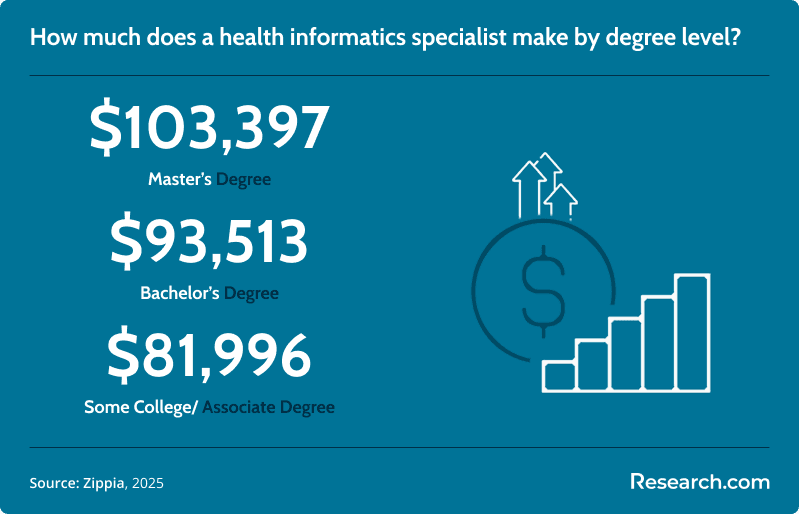
For example, a health informatics specialist with a bachelor’s degree may earn an average salary of about $93,500 per year. In the same role, someone with a master’s degree can earn nearly $137,400 annually. That difference suggests meaningful salary upside, but the degree works best when paired with experience, technical skills, and a clear target role. Students exploring faster graduate formats can compare online master's degree programs you can complete in 6 months, while carefully checking accreditation, workload, and whether the curriculum fits informatics career goals.
Some health informatics professionals eventually move into teaching, training, or academic roles. If that interests you, Research.com’s guide to what the requirements are for a master's degree in education can help you understand how education-focused graduate study differs from informatics training.
What are common career paths after a master’s in health informatics?
Graduates do not all follow the same route. The strongest path depends on your prior background, whether clinical or technical, and the type of work you want to do long term.
| Career path | Typical starting point | Possible advancement | Best for |
| Technical track | Health data analyst, informatics analyst, reporting analyst | Data engineer, health data scientist, analytics leader | Professionals who enjoy databases, modeling, dashboards, programming, and advanced analytics |
| Clinical track | Clinical informaticist, nursing informatics specialist, pharmacist informatics | Clinical informatics lead, CMIO-related leadership, informatics director | Clinicians who want to improve care delivery through technology and workflow redesign |
| Managerial track | Project manager, EHR implementation lead, informatics supervisor | Informatics manager, director, vice president of health IT | Professionals who want to lead teams, projects, vendors, budgets, and organizational strategy |
| Consulting track | Healthcare IT analyst, implementation consultant, informatics consultant | Senior consultant, strategy lead, digital transformation advisor | Professionals who like client-facing work, problem-solving, travel or remote consulting, and system improvement |
Clinicians can be especially strong candidates for informatics because they understand patient care realities. Nurses considering advanced practice or informatics-related graduate routes may compare options such as the easiest direct entry MSN programs to get into, while confirming whether those programs support informatics goals.
These tracks often overlap. A nurse may become a data-driven clinical informatics leader. A health IT analyst may move into consulting. A project manager may become an informatics director. The most successful professionals usually combine domain knowledge, technical competence, communication skills, and measurable project outcomes.
Can you work remotely with a degree in health informatics?
Yes, many health informatics roles can be performed remotely or in hybrid formats because the work often involves data analysis, EHR configuration, reporting, system documentation, stakeholder meetings, and virtual project coordination. As of May 2025, there are over 450 remote health informatics positions available in the United States, according to LinkedIn.
- Clinical Informaticist Analyst: This role reviews clinical workflows, supports system changes, and helps ensure that technology aligns with patient care needs. Much of the work can be done through data review, virtual meetings, and remote system access.
- Health Informatics Analyst: Analysts gather, clean, interpret, and report healthcare data. Because many tasks involve dashboards, datasets, documentation, and analytics tools, remote work can be feasible.
- EHR Clinical Operations Analyst: These professionals improve EHR workflows, troubleshoot system issues, support users, and help configure clinical tools. Some tasks may be remote, although go-live support or training may require onsite work.
- Clinical Informatics Consultant: Consultants advise healthcare organizations on system selection, implementation, optimization, and workflow redesign. Virtual assessments, documentation, and stakeholder meetings can support remote or hybrid consulting models.
- Healthcare Informatics Program Manager: Program managers coordinate budgets, timelines, teams, vendors, and project deliverables. Digital project management tools and virtual communication make remote coordination possible for many projects.
| Remote-work factor | Why it matters |
| Data security | Remote roles must comply with privacy, access, and security requirements for protected health information. |
| EHR access | Some employers restrict remote access or require secure networks, approved devices, or specific authentication tools. |
| Stakeholder collaboration | Informatics professionals often work with clinicians, IT, compliance, vendors, and administrators, so communication skills are essential. |
| Implementation schedule | EHR launches, training, and workflow observation may require onsite presence even if the role is usually remote. |
What do graduates say about their Master's in Health Informatics salary?
Individual graduate experiences can be helpful, but they should be treated as anecdotal rather than predictive. Salary outcomes depend on prior experience, location, employer type, skills, and the quality of the program. The following examples reflect personal outcomes and should not be read as guaranteed results.
- After earning my Master’s in Health Informatics, I moved into a data analyst position at a large hospital system and saw my salary rise by 40%. The increase mattered, but so did the chance to use data in ways that support better patient care. Quinn
- My return on the degree came quickly because I accepted a six-figure healthcare IT role within six months of finishing the program. The job uses both my technical training and my understanding of clinical environments. Gianna
- I was unsure about returning to school, but the degree helped me move from nursing into consulting, where my income became three times higher than before. I also found a career that combines healthcare and technology in a way that fits me well. Priscila
Common Mistakes to Avoid Before Choosing This Path
| Mistake | Why it can hurt your ROI | Better approach |
| Choosing a program based only on tuition | A low-cost program may still be a poor investment if it lacks relevant courses, career support, or employer recognition. | Compare total cost, accreditation, curriculum, hands-on learning, and career outcomes together. |
| Assuming the master’s degree alone guarantees a high salary | Employers usually want experience, technical skills, and evidence of project impact. | Build a portfolio of analytics, EHR, workflow, or data governance projects while enrolled. |
| Ignoring industry differences | The same degree may produce different salary outcomes in hospitals, public health, pharma, insurance, or consulting. | Research target employers before selecting electives or internships. |
| Skipping technical skill development | Many higher-paying roles require comfort with data tools, databases, systems, or analytics platforms. | Prioritize SQL, Python, dashboards, EHR systems, interoperability, and data governance where relevant. |
| Overlooking remote-work requirements | Remote informatics jobs may still require strict security, communication, and system-access standards. | Ask employers about onsite expectations, equipment, privacy rules, and travel before accepting a role. |
| Relying only on rankings or promotional claims | Rankings rarely show whether a program fits your specific career goal. | Talk with admissions advisors, faculty, alumni, and employers who hire informatics graduates. |
Questions to Ask Before Enrolling in a Master's in Health Informatics Program
- Is the institution properly accredited?
- Does the curriculum emphasize analytics, EHR systems, privacy, interoperability, healthcare operations, and project management?
- Are there applied projects, practicums, internships, or capstones using real healthcare data problems?
- What technical tools will I learn, and how will I demonstrate those skills to employers?
- Do graduates work in hospitals, health tech, insurance, pharma, consulting, public health, or government?
- What career services are available specifically for informatics students?
- Can I complete the program while working full time?
- What is the total cost after tuition, fees, books, software, and financing?
- Will the program help me move toward my target role, or is a certificate, healthcare administration degree, analytics degree, or employer-sponsored training a better fit?
Key Insights
- The average master’s in health informatics salary is about $72,000 per year, but leadership and specialized roles can pay far more.
- Salary varies most by job title, experience, industry, technical skill set, and location. The degree matters, but it is not the only factor.
- Director of Informatics is one of the strongest-paying roles cited in this guide, with median total pay of $232,000/year.
- Private-sector roles in pharma, health technology, insurance, consulting, and large healthcare organizations often offer higher salary ceilings than many public-sector positions.
- Washington state, the District of Columbia, and New York are among the highest-paying locations identified in the cited state salary data.
- A master’s degree can improve earning potential; the salary difference cited for health informatics specialists is about $44,000 compared with a bachelor’s-level counterpart.
- The best ROI comes from choosing an accredited, career-aligned program and building marketable skills in analytics, EHR systems, privacy, data governance, interoperability, and project leadership.
- Remote work is realistic in health informatics, but secure data access, compliance expectations, and occasional onsite implementation needs may still apply.
References:
- Payscale. (2024, August 1). Master of science (MS), health informatics salary. Payscale.com. Retrieved May 6, 2025.
- U.S. BLS. (2025, April 18). Occupational outlook handbook: Health information technologists and medical registrars. U.S. Bureau of Labor Statistics. Retrieved May 6, 2025.
- Zippia. (2025, July 21). Health informatics specialist demographics and statistics [2024]: Number of health informatics specialists in the US. Zippia.com. Retrieved May 6, 2025.
- ZipRecruiter. (2025, April 29). Public health informatics salary. ZipRecruiter.com. Retrieved May 6, 2025.
- ZipRecruiter. (2025). What is the average health informatics salary by state. ZipRecruiter.com. Retrieved May 6, 2025.
Other Things You Should Know About Master's in Health Informatics Salary
Key factors include industry demand, geographic location, technology advancements, and level of experience. In 2027, graduates working in metropolitan healthcare systems or tech-heavy environments may earn higher salaries due to greater demand for health informatics expertise.
The U.S. Department of Health and Human Services, through the Office for Civil Rights, enforces HIPAA privacy and security rules. Employers often pay more for informatics roles that require HIPAA compliance, audit support, and protected health information handling, especially in hospitals and health systems.





