2027 Dental Assistant Salary by State

Co-Founder and Chief Data Scientist
Did you know that dental assistants in some states earn nearly twice as much as those in others? Where you live can have a major impact on your paycheck, and with demand for dental assistants rising, understanding salary differences is more important than ever.
This article breaks down dental assistant salaries by state for 2027 using the latest BLS data, highlights where pay is growing the fastest, and shows how certification and experience can boost earnings. By the end, you’ll know exactly where opportunities are strongest.
Key Things You Should Know About Dental Assistants
- Salaries for dental assistants vary significantly by state. For example, Minnesota dental assistants earn a median of more than $64,000, while those in Mississippi earn closer to $37,000. Knowing where pay is highest helps prospective assistants plan their careers strategically.
- While many positions require only a postsecondary certificate or on-the-job training, earning certification can significantly boost pay. Certified Dental Assistants earn around 15% more, making formal training a worthwhile investment for long-term career growth.
- Job outlook for dental assistants is strong. According to the Bureau of Labor Statistics, employment is projected to grow 6% faster than average for all occupations, driven by demand for preventive dental services and expanding patient access.
- Dental Assistant Salary by State for 2027 Salary by State
- What factors influence dental assistant pay in different states? Pay Factors
- How much more do certified dental assistants (like CDAs) make? Certified vs Non-Certified
- How does experience level affect dental assistant earnings? Experience vs Earnings
- Which states saw salary increases in the past year? Salary Increases
- What’s the national average dental assistant salary in 2027? National Salary
- Which states currently pay dental assistants the most? Top Paying States
- How much can you expect when comparing dental assistants vs hygienists? Assistant vs Hygienist
- Are urban areas paying dental assistants more than rural areas? Are urban areas paying dental assistants more than rural areas?
- Could pursuing complementary administrative certifications enhance your career growth? Could pursuing complementary administrative certifications enhance your career growth?
- What other ways—like specialized roles or setting—affect pay? What other ways—like specialized roles or setting—affect pay?
Dental Assistant Salary by State for 2027: What You Can Earn and Where Pay Is Highest
Dental assistant salaries vary widely across the United States, so location matters when you are comparing job offers, choosing a training program, or deciding whether relocation is worth it. A state with a higher wage may also have higher rent, transportation costs, and licensing expectations, while a lower-paying state may still offer strong entry-level access and faster hiring.
This guide breaks down dental assistant pay by state, explains why salaries differ, compares certified and non-certified earnings, and shows how experience, work setting, specialization, and career advancement can affect income. It is designed for students, new dental assistants, working assistants considering certification, and career changers comparing dental assisting with other practical healthcare or education pathways.
Quick answer: How much do dental assistants make?
In 2027, the national median salary for dental assistants is $47,300 per year, or about $22.74 per hour, according to the Bureau of Labor Statistics. State medians range from $23,690 in Puerto Rico to $64,630 in Minnesota. Certified dental assistants earn about 15% more than non-certified assistants, based on Dental Assisting National Board salary information.
Dental assistant salary by state
The list below shows annual median wages for dental assistants in 2025, organized alphabetically. Use these figures as a starting point, not a guaranteed offer. Actual pay depends on your city, experience, credentials, employer, and whether the role includes expanded functions or specialty duties.
| State or territory | Annual median dental assistant salary |
| Alabama | $37,280 |
| Alaska | $55,950 |
| Arizona | $49,000 |
| Arkansas | $37,680 |
| California | $48,910 |
| Colorado | $47,770 |
| Connecticut | $50,820 |
| Delaware | $46,090 |
| District of Columbia | $56,500 |
| Florida | $47,060 |
| Georgia | $45,600 |
| Guam | $35,640 |
| Hawaii | $44,870 |
| Idaho | $39,460 |
| Illinois | $47,430 |
| Indiana | $47,980 |
| Iowa | $47,820 |
| Kansas | $39,840 |
| Kentucky | $46,520 |
| Louisiana | $38,150 |
| Maine | $51,340 |
| Maryland | $48,280 |
| Massachusetts | $57,960 |
| Michigan | $47,030 |
| Minnesota | $64,630 |
| Mississippi | $37,130 |
| Missouri | $45,220 |
| Montana | $45,820 |
| Nebraska | $46,660 |
| Nevada | $46,970 |
| New Hampshire | $50,260 |
| New Jersey | $48,070 |
| New Mexico | $38,840 |
| New York | $47,020 |
| North Carolina | $48,710 |
| North Dakota | $51,310 |
| Ohio | $47,330 |
| Oklahoma | $44,450 |
| Oregon | $57,720 |
| Pennsylvania | $48,290 |
| Puerto Rico | $23,690 |
| Rhode Island | $48,060 |
| South Carolina | $45,930 |
| South Dakota | $47,680 |
| Tennessee | $46,090 |
| Texas | $42,270 |
| Utah | $37,320 |
| Vermont | $51,020 |
| Virgin Islands | $36,350 |
| Virginia | $46,910 |
| Washington | $57,040 |
| West Virginia | $37,330 |
| Wisconsin | $48,000 |
| Wyoming | $42,770 |
If you are still deciding between career tracks, compare dental assisting with other structured entry-level pathways. For example, reviewing typical early childhood education bachelor’s coursework can help you weigh healthcare support work against education-focused degree routes.
Why Dental Assistant Pay Differs by State
Dental assistant pay is shaped by more than a state name on a job posting. Two assistants with similar duties can earn different wages because their local labor market, certification status, employer type, and responsibilities are not the same. Before choosing a program or accepting a job, look at the full compensation picture.
| Factor | How it affects pay | What to check before deciding |
| Cost of living | States with expensive housing, transportation, and healthcare costs often post higher wages, as seen in places such as Massachusetts and Washington. | Compare take-home pay after rent, commuting, taxes, and insurance rather than looking only at the salary number. |
| Demand for dental services | Areas with growing populations or more patient volume may need more assistants, which can support stronger wages. | Review local job postings, number of dental practices, and whether offices are advertising hiring bonuses or expanded duties. |
| Certification and education | Credentials such as Certified Dental Assistant status can increase earning potential, with certified assistants making about 15% more than non-certified peers. | Confirm whether your state or employer requires specific credentials for radiography, infection control, or expanded functions. |
| Work setting | Specialty practices, high-volume clinics, hospital-based dental departments, and oral surgery or orthodontic offices may pay more than some general practices. | Ask whether the role includes specialty procedures, administrative work, patient coordination, or supervisory responsibilities. |
| Experience level | Experienced assistants often qualify for higher hourly rates, especially when they can train new staff or work independently with complex procedures. | Keep records of procedures, software systems, radiography experience, and certifications you can document during salary negotiations. |
Regional demand patterns are not unique to dentistry. Students who compare labor markets across fields may also find it useful to review states where teacher demand is high, since population growth can affect hiring needs in both education and healthcare support roles.
How Much More Do Certified Dental Assistants Make?
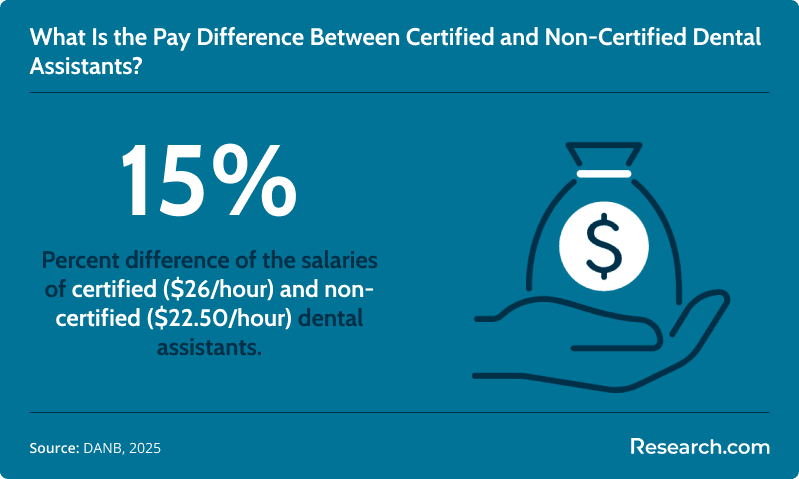
Certified dental assistants earn about 15% more than non-certified dental assistants. In hourly terms, DANB reports an average of $26 per hour for certified assistants compared with $22.50 per hour for assistants without certification. Across a full year of work, that difference can become meaningful income.
Certification can also change how employers view your readiness. A credential may support assignments involving more complex chairside procedures, infection control responsibilities, radiography-related tasks where permitted, or staff training. It does not guarantee a raise, but it gives you a stronger case when applying, negotiating, or asking for expanded responsibilities.
| Path | Reported average hourly pay | Best fit |
| Non-certified dental assistant | $22.50 | Someone entering the field quickly, gaining experience, or working in a state or office where certification is not required for basic duties. |
| Certified dental assistant | $26 | An assistant who wants stronger pay potential, broader responsibilities, better mobility, or a more competitive resume. |
If you are comparing the value of professional credentials across healthcare careers, the decision logic is similar to evaluating steps for CPNP-PC certification: the credential should be judged by cost, eligibility requirements, employer recognition, and the responsibilities it unlocks.
The visual below summarizes the 15% wage difference between certified and non-certified dental assistants and shows why many workers treat certification as a career investment rather than a one-time requirement.
How Experience Changes Dental Assistant Earnings
Experience affects pay because dental practices value speed, reliability, patient communication, procedural familiarity, and the ability to anticipate what the dentist or hygienist needs next. New assistants often start with basic chairside support, sterilization, patient preparation, and administrative tasks. With time, they may take on radiography, lab work, scheduling coordination, inventory management, training, or specialty assisting.
Entry-level dental assistants commonly begin around $17 to $19 per hour, depending on the state and employer. After several years, wages often rise as assistants become more efficient and require less supervision. Assistants with a decade or more of experience can earn above the national median of $47,300, especially when they combine tenure with certification, expanded functions, or specialty practice experience.
| Career stage | Typical responsibilities | Pay strategy |
| Entry level | Instrument sterilization, patient room setup, basic chairside support, scheduling help, and learning office systems. | Focus on building clinical confidence, documenting competencies, and completing any required state-specific training. |
| Developing assistant | More independent chairside work, stronger patient communication, radiography-related duties where allowed, and procedure preparation. | Ask about certification, expanded functions, and specialty exposure that can justify higher pay. |
| Experienced assistant | Complex procedures, new staff training, inventory oversight, treatment coordination, or specialty practice support. | Negotiate based on measurable value: procedures supported, credentials held, software skills, leadership duties, and patient volume. |
Dental assisting is often compared with medical assisting because both are healthcare support roles with relatively direct entry points. A closer look at medical assistant versus dental assistant careers can help you decide which role better matches your preferred work setting, duties, and long-term income goals.
Which States Had the Largest Dental Assistant Salary Increases?
Salary movement from one year to the next can reveal where employers may be raising wages to attract or keep dental assistants. According to Becker’s Dental Review, Michigan had the largest increase from 2024 to 2025, with median annual pay rising from $45,210 in 2024 to $56,790 in 2025, a 25.61% increase.
Kentucky also posted a notable gain, increasing from $41,090 to $45,720, or 11.27%. Illinois rose from $42,420 to $47,170, while Maine increased from $48,760 to $54,190; both were slightly above 11%. Louisiana moved from $38,290 in 2024 to $41,450 in 2025, an 8.25% increase.
Other states with sizable year-over-year gains included Wisconsin at 7.75%, New Jersey at 7.71%, Mississippi at 6.78%, Arizona at 6.40%, and Tennessee at 6.31%. These changes do not guarantee future increases, but they can help job seekers identify markets where compensation recently improved.
| State | 2024 median salary | 2025 median salary | Increase |
| Michigan | $45,210 | $56,790 | 25.61% |
| Kentucky | $41,090 | $45,720 | 11.27% |
| Illinois | $42,420 | $47,170 | Just over 11% |
| Maine | $48,760 | $54,190 | Just over 11% |
| Louisiana | $38,290 | $41,450 | 8.25% |
| Wisconsin | Not stated | Not stated | 7.75% |
| New Jersey | Not stated | Not stated | 7.71% |
| Mississippi | Not stated | Not stated | 6.78% |
| Arizona | Not stated | Not stated | 6.40% |
| Tennessee | Not stated | Not stated | 6.31% |
Regional wage differences appear in many healthcare roles. For a broader comparison, see how location affects the family nurse practitioner salary by state, where cost of living, employer demand, and scope of practice can also influence earnings.
The chart below highlights the states with the strongest reported salary increases, giving job seekers a quick way to spot markets where dental assistant pay recently gained momentum.
What Is the National Average Dental Assistant Salary in 2027?
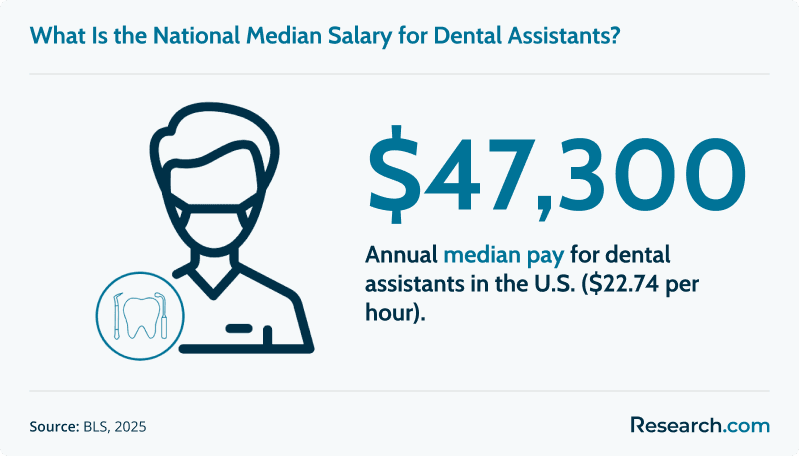
The national median salary for dental assistants in 2027 is $47,300 per year, equal to about $22.74 per hour, according to the Bureau of Labor Statistics. This national figure is useful as a benchmark when comparing your current pay, evaluating a job offer, or estimating whether a training program could lead to a reasonable return.
However, the national median should not be the only number you use. Minnesota reports $64,630, while Massachusetts and Oregon are also above $57,000. By contrast, Mississippi and West Virginia are near $37,000, and Puerto Rico is listed at $23,690. These gaps show why state, city, certification, and employer type matter so much.
Dental assisting can be a practical healthcare entry point because it combines patient care, procedural support, and office operations. But the value of the career depends on your local job market, training cost, whether you plan to certify, and whether you want to advance into dental hygiene, office management, specialty assisting, or another healthcare role.
The infographic below presents the national median in annual and hourly terms so you can compare state and local job postings against the broader U.S. benchmark.
Which States Pay Dental Assistants the Most?
The highest-paying state listed is Minnesota, with an annual median dental assistant wage of $64,630. Massachusetts follows at $57,960, Oregon at $57,720, Washington at $57,040, the District of Columbia at $56,500, and Alaska at $55,950.
Maine, North Dakota, Vermont, Connecticut, and New Hampshire also exceed $50,000. These locations may look attractive, but a higher salary does not always mean a better financial outcome. Housing costs, commuting expenses, taxes, childcare, and benefit quality can reduce the advantage of a higher wage.
| High-paying location | Annual median wage | Decision note |
| Minnesota | $64,630 | Highest listed median; compare local job openings and living costs before relocating. |
| Massachusetts | $57,960 | Strong wage level, but major metro areas may carry high housing expenses. |
| Oregon | $57,720 | High median pay; evaluate licensing expectations and city-level demand. |
| Washington | $57,040 | Above national median; consider commute and regional cost differences. |
| District of Columbia | $56,500 | High wages may reflect an expensive urban labor market. |
| Alaska | $55,950 | Higher pay may be offset by location-specific living and travel costs. |
If your long-term goal is higher clinical earning potential, dental assisting can also serve as a stepping stone toward dental hygiene. Research bridge options carefully, including accelerated online dental assistant to dental hygienist bridge programs, and verify that any program meets licensing and clinical requirements in your state.
The chart below shows the top-paying states and regions, making it easier to compare the strongest salary markets for dental assistants in 2025.
Dental Assistant vs. Dental Hygienist Salary: Which Path Pays More?
Dental hygienists generally earn more than dental assistants, but they also need more education and carry a different scope of responsibility. In 2025, dental assistants have a national median wage of about $47,300 per year, or $22.74 per hour. Dental hygienist median annual wages often exceed $80,000 depending on location.
The pay gap exists because the roles are not the same. Dental assistants support dentists during procedures, prepare rooms, sterilize instruments, take on administrative work, and help patients move through appointments. Dental hygienists provide direct preventive care such as cleanings, oral health education, and other services permitted by state scope-of-practice rules.
| Role | Main work | Training and career trade-off |
| Dental assistant | Chairside support, sterilization, patient preparation, scheduling support, procedure assistance, and office workflow tasks. | Usually offers faster workforce entry and lower training time, but the national median wage is lower than hygienist pay. |
| Dental hygienist | Preventive patient care, cleanings, oral health instruction, screenings, and services allowed by state rules. | Typically requires more formal education, but can provide substantially higher long-term earnings. |
Before choosing, compare the full career path, not just the salary. A detailed guide to dental assistant versus dental hygienist roles can help you weigh time in school, clinical responsibilities, licensure, cost, and advancement options.
Do Dental Assistants Earn More in Urban Areas Than Rural Areas?
In many cases, yes. Urban dental assistants often see higher wages because large cities tend to have more dental practices, higher patient volume, stronger competition for experienced staff, and higher living costs. Cities such as New York, Los Angeles, and Washington, D.C., commonly have higher expenses, which can influence wage levels.
Rural areas may offer lower wages because there are fewer practices, smaller patient populations, and less employer competition. However, rural jobs can still be attractive when the cost of living is lower, commutes are shorter, or employers provide stable schedules and broad hands-on experience.
| Work location | Potential advantages | Possible drawbacks |
| Urban or metropolitan area | Higher wage potential, more specialty practices, more job openings, and more advancement options. | Higher rent, parking or transit costs, heavier competition, and faster-paced offices. |
| Rural or small-town area | Lower living costs, closer patient relationships, broader duties, and potentially less competition for roles. | Lower salary ranges, fewer employers, and fewer specialty or advancement openings. |
If speed matters, short training options may help you enter either market sooner. Compare fast online dental assistant certificate programs, but confirm that online coursework includes the clinical preparation, externship expectations, and state-specific requirements you need.
Can Administrative Certifications Improve a Dental Assistant’s Career Growth?
Administrative skills can make a dental assistant more valuable, especially in smaller offices where one person may support both clinical and front-desk operations. Billing knowledge, coding awareness, insurance coordination, scheduling, treatment plan communication, and electronic records skills can create opportunities beyond chairside duties.
An option such as an affordable online medical billing and coding course may be useful if you want to move toward insurance coordination, dental office administration, revenue cycle support, or practice management. Before enrolling, ask whether the course content applies to dental billing workflows or is primarily designed for medical settings.
Other Factors That Can Raise or Lower Dental Assistant Pay
Geography is important, but it is not the only salary driver. The type of practice, specialty, benefits package, schedule, and scope of duties can all change total compensation. A slightly lower hourly wage with health insurance, paid time off, predictable hours, and tuition support may be better than a higher rate with limited benefits.
| Pay factor | Why it matters | Question to ask the employer |
| Specialty practice | Orthodontics, oral surgery, pediatric dentistry, and other specialties may require more technical skills and procedure-specific knowledge. | “Will this role include specialty procedures or training that affects compensation?” |
| Expanded functions | Some states and employers allow trained assistants to perform additional duties, which may support higher pay. | “Which expanded functions are allowed here, and what credentials are required?” |
| Practice size | Larger or high-volume clinics may have more structured pay scales, benefits, and advancement roles. | “Is there a formal path from assistant to lead assistant, treatment coordinator, or office manager?” |
| Benefits | Health insurance, retirement contributions, paid leave, uniforms, continuing education, and certification reimbursement affect total value. | “What is included beyond hourly pay?” |
| Education level | Formal programs may support stronger preparation, but only if the credential is recognized and reasonably priced. | “Do graduates meet state requirements and qualify for the duties local employers need?” |
For assistants who want a more structured credential, an online dental assistant associate degree option may be worth comparing with shorter certificate programs. The best choice depends on cost, time, transferability, clinical requirements, and whether the added credential improves your local job prospects.
How to Use Dental Assistant Salary Data Before Choosing a Program or Job
Salary lists are helpful, but they should not be the only factor in your decision. A smart comparison looks at earnings, training cost, licensing or certification requirements, time to employment, and advancement options.
- Check your state’s rules first. Dental assisting duties vary by state, especially for radiography, infection control, and expanded functions.
- Compare local job postings. Look at hourly rates, required credentials, benefits, schedule expectations, and whether employers prefer certified assistants.
- Calculate total cost of training. Include tuition, fees, books, exams, uniforms, background checks, transportation, and lost work time.
- Ask about clinical experience. Online coursework can be convenient, but dental assisting is hands-on. Confirm how labs, externships, and skills practice are handled.
- Evaluate certification value in your market. Certification may increase pay potential, but the return depends on employer recognition and state requirements.
- Plan your next step early. Decide whether you want to remain a dental assistant, specialize, move into office management, or eventually pursue dental hygiene.
Common Mistakes to Avoid
| Mistake | Why it can hurt you | Better approach |
| Choosing a program only because it is fast | A short program may not provide enough clinical preparation or meet employer expectations. | Balance speed with hands-on training, state requirements, externship access, and graduate outcomes. |
| Looking only at tuition | Exam fees, supplies, transportation, and unpaid clinical time can change the real cost. | Ask for a full cost breakdown before enrolling. |
| Assuming online training automatically qualifies you for every role | Some duties may require in-person training, state approval, or specific exams. | Verify requirements with your state dental board or licensing authority. |
| Ignoring certification | Without certification, you may miss higher-paying roles or expanded responsibilities in some markets. | Compare certified and non-certified job postings in your area. |
| Accepting the highest hourly rate without checking benefits | A higher hourly wage may be less valuable if benefits are weak or hours are inconsistent. | Compare total compensation, including insurance, paid time off, retirement, and continuing education support. |
| Assuming state medians predict your exact pay | Median wages do not reflect every city, employer, specialty, or experience level. | Use state data as a benchmark, then validate with local job offers. |
Questions to Ask Before Accepting a Dental Assistant Job
- What is the hourly rate, and how often are performance or salary reviews conducted?
- Are benefits included, such as health insurance, retirement contributions, paid time off, or continuing education support?
- Does the practice pay for certification exams, renewals, uniforms, or required training?
- What duties are expected during a normal shift?
- Will I be trained for radiography, expanded functions, specialty procedures, or front-office systems?
- Is there a path to lead dental assistant, treatment coordinator, office manager, or specialty assistant roles?
- How many patients does the practice typically see each day?
- What software, imaging systems, and infection control protocols does the office use?
Here's What Graduates Have to Say About Their Dental Assistant Program
- Selene: "Online study let me keep a part-time job while completing my certification. The virtual lab activities were more engaging than I expected, and my instructors made sure I understood the clinical fundamentals before moving forward."
- Maricel: "The program worked well with my schedule as a parent because I could study at night and follow a clear weekly plan. Finishing the program gave me more confidence and helped me move into a job I genuinely enjoy."
- Darian: "I worried that technical skills would be hard to learn online, but the video demonstrations and live feedback helped everything make sense. Within months, I had the knowledge base and hands-on practice opportunities I needed to start my new career."
Key Insights
- The national median dental assistant salary in 2027 is $47,300 per year, or about $22.74 per hour.
- Minnesota has the highest listed annual median wage at $64,630, while Puerto Rico has the lowest listed figure at $23,690.
- Certification matters: certified dental assistants earn about 15% more than non-certified assistants, with reported averages of $26 per hour versus $22.50 per hour.
- High-paying states are not automatically the best choice. Compare salary with cost of living, benefits, commute, licensing rules, and advancement opportunities.
- Experience, specialty practice work, expanded functions, and administrative skills can all improve earning potential.
- Dental assisting can be a fast entry point into healthcare, but students should verify state requirements, clinical training, and certification value before enrolling in a program.
- Dental hygienists generally earn more than dental assistants, but the path requires more education and a different scope of practice.
References:
- Becker’s Dental Review. Dental Assistant Pay in 2025 vs. 2024 by State.
- Dental Assisting National Board (DANB). Dental assistant salary information.
- U.S. Bureau of Labor Statistics. Occupational Outlook Handbook: Dental Assistants.
- U.S. Bureau of Labor Statistics. May 2019 National Occupational Employment and Wage Estimates: Dental Assistants.
- U.S. Bureau of Labor Statistics. Occupational Employment and Wage Statistics Data Explorer.
Other Things You Should Know About Dental Assistants
Yes. State rules affect pay because requirements for duties, certifications, and expanded functions differ by board and employer. Some states allow more advanced tasks with the right credential, and those roles often pay more. Check your state dental board and the U.S. Bureau of Labor Statistics for current wage data.
In 2027, licensing requirements for dental assistants vary by state, often requiring completion of an accredited dental assisting program and passing the Dental Assisting National Board (DANB) exams. Some states also necessitate certification in radiography or infection control before practicing.
In 2027, the highest paying state for dental assistants is California, where salaries can exceed $50,000 annually. The high demand for dental services and the state's higher cost of living contribute to these elevated wages.