
2027 What Can You Do with a Bachelor's Degree in Health Sciences?

Co-Founder and Chief Data Scientist
A bachelor’s degree in health sciences opens the door to a wide range of careers in both clinical and non-clinical fields, from direct patient care to healthcare administration, public health, and research. With overall employment in healthcare occupations reaching about 1.9 million job openings expected each year, the opportunities for graduates in this field are both abundant and diverse.
This guide will walk you through potential career paths, salaries, further education options, and skills you’ll gain, giving you the insights needed to make informed decisions about your professional future in the health sciences.
Key things you should know about getting a bachelor’s degree in health sciences:
- Many graduates use a health sciences degree as a foundation for advanced study in fields such as medicine, physical therapy, or public health.
- This degree offers diverse career options, including roles in patient care, healthcare administration, public health, and laboratory science.
- The average salary for someone with a bachelor’s in health sciences is $80,389 per year, though earnings can vary by job title, location, and experience.
- What is a bachelor’s degree in health sciences, and what does it prepare you for? What is a bachelor’s degree in health sciences, and what does it prepare you for?
- How long does it take to complete a bachelor’s degree in health sciences? Completion Time
- What bridge or accelerated programs exist for health sciences graduates? Accelerated Programs
- What jobs can you get with a bachelor's degree in health sciences? Job Types
- Do health sciences majors need internships or clinical hours to get jobs? Do health sciences majors need internships or clinical hours to get jobs?
- What skills do you gain from a bachelor's degree in health sciences? Skills
- What is the average salary with a bachelor’s degree in health sciences? Average Salary
- Can health sciences graduates work outside of healthcare? Can health sciences graduates work outside of healthcare?
- Can a complementary biochemistry qualification strengthen my health sciences career? Can a complementary biochemistry qualification strengthen my health sciences career?
- What certifications should you get if you have a bachelor's degree in health sciences? Certifications
- What is the job outlook for graduates with a bachelor's degree in health sciences? Job Outlook
- Is a career in medical billing and coding a viable option for health science graduates? Is a career in medical billing and coding a viable option for health science graduates?
Bachelor’s Degree in Health Sciences: What It Is, What You Can Do With It, and How to Decide If It Fits
A bachelor’s degree in health sciences is a broad undergraduate path for students who want to work in healthcare but are not yet committed to one narrow clinical profession. It can prepare you for entry-level roles in patient support, laboratory work, public health, healthcare administration, wellness education, and health data-related fields. It can also serve as a pre-professional foundation for graduate programs in areas such as medicine, physician assistant studies, physical therapy, occupational therapy, public health, and healthcare management.
This degree matters in 2026 because healthcare employers increasingly need workers who understand both science and systems: how the human body works, how care is delivered, how health data is used, and how communities access services. Students comparing healthcare majors often look at related options such as careers with a health information management degree, because both fields connect clinical knowledge with healthcare operations, records, technology, and compliance.
This guide explains what a health sciences bachelor’s degree covers, how long it takes, which jobs it can lead to, what salaries may look like, when certifications or graduate school make sense, and how to choose a program without overlooking accreditation, experience requirements, or long-term return on investment.
Quick Answer: Is a Bachelor’s in Health Sciences Worth It?
A bachelor’s in health sciences can be worth it if you want a flexible healthcare degree that keeps several career and graduate school options open. It is strongest for students who want a science-based education but are still deciding between clinical care, public health, healthcare administration, laboratory work, health education, or advanced professional training.
It may not be the best choice if your goal is a licensed profession with a fixed degree requirement, such as registered nursing, physical therapy, physician assistant practice, or medical laboratory licensure in certain settings. In those cases, you should confirm whether a health sciences degree includes the required prerequisites, clinical hours, and program accreditation before enrolling.
| Best fit | Use caution if | What to check before enrolling |
| You want a flexible healthcare major with clinical and non-clinical options. | You need a direct licensure pathway for a specific profession. | Confirm prerequisites, clinical requirements, accreditation, and transfer policies. |
| You plan to apply to graduate or professional school later. | You expect the bachelor’s degree alone to qualify you for every healthcare role. | Compare required science courses with admission requirements for your target programs. |
| You are interested in public health, wellness, health education, administration, or lab-related work. | You want a highly specialized technical credential immediately after graduation. | Ask whether internships, practicums, certifications, or concentrations are available. |
What Is a Bachelor’s Degree in Health Sciences?
A bachelor’s degree in health sciences is an undergraduate program that blends life sciences, healthcare delivery, public health, health behavior, research methods, and healthcare systems. Most programs combine general education courses with core study in anatomy, physiology, biology, disease processes, statistics, ethics, health policy, population health, and healthcare management.
The major is intentionally interdisciplinary. Instead of training students for one single occupation, it builds a foundation that can be applied across hospitals, clinics, laboratories, public health agencies, nonprofits, insurance organizations, wellness programs, and health technology environments.
Students usually use the degree in one of three ways: entering the workforce after graduation, pairing the degree with a certification for a more defined role, or using the curriculum as preparation for graduate or professional school. Some students also add short-term credentials, such as an online home health aide certification, when they want additional exposure to direct patient care while completing or after finishing the degree.
What the Degree Can Prepare You For
- Entry-level healthcare employment: Graduates may qualify for roles in health education, patient services, clinical support, laboratory settings, healthcare administration, or community health, depending on coursework and experience.
- Graduate or professional programs: The degree can help students complete prerequisites for medicine, physical therapy, occupational therapy, physician assistant studies, public health, healthcare administration, and related fields.
- Public health and wellness work: Students learn how to support prevention programs, health campaigns, community outreach, and population health initiatives.
- Research and health data support: Coursework in statistics, research methods, and healthcare systems can prepare graduates to assist with studies, interpret health trends, and support evidence-based decisions.
How Long Does a Bachelor’s Degree in Health Sciences Take?
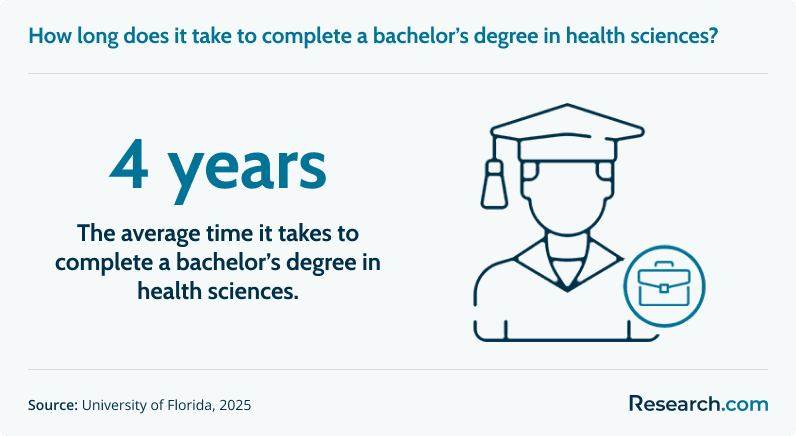
A bachelor’s degree in health sciences typically takes about four years for full-time students. Most programs require around 120 semester credits, including general education, health sciences core courses, electives, and sometimes a concentration, internship, practicum, or capstone project.
The timeline depends on how you enter the program and how many credits you can apply toward graduation. A first-time full-time student who follows the standard course sequence generally needs four academic years. A transfer student with an associate degree or substantial prior college credit may finish sooner. A part-time student may need additional semesters, especially when balancing work, caregiving, or military responsibilities.
Online and hybrid programs may make scheduling easier, but they do not usually reduce the total credit requirement. Students who want to move into leadership later sometimes compare the bachelor’s degree with graduate options such as the shortest online MBA in healthcare management, but an MBA is normally a later step rather than a substitute for completing required undergraduate credits.
| Student situation | Typical timeline | What affects completion speed |
| First-time full-time student | About four years | Course sequencing, science lab availability, general education requirements, and advising quality |
| Transfer student | May finish in less than four years | Accepted transfer credits, associate degree alignment, and upper-division course availability |
| Part-time student | Often longer than four years | Work schedule, course load, family responsibilities, and whether required courses are offered every term |
| Accelerated or bridge pathway student | Varies by program | Prior credits, admissions requirements, GPA standards, and whether graduate coursework is shared |
Bridge and Accelerated Programs for Health Science Graduates
Bridge and accelerated programs can help students move from a health sciences background into a more specialized credential. These pathways may combine undergraduate and graduate coursework, recognize prior education, or create a faster route into professional preparation. They are useful only when they match your target career, so students should compare prerequisites, admissions standards, clinical requirements, and licensure outcomes before committing.
Students looking for faster undergraduate completion may also compare dedicated accelerated online bachelor’s in health sciences programs, especially if they already have transfer credits or healthcare experience.
| Pathway | Who it is for | Typical purpose |
| RN-to-BSN programs | Registered nurses with an associate degree or diploma | These programs often take 12–18 months and expand preparation in leadership, research, population health, and evidence-based nursing practice. |
| BS-to-MPH programs | Students interested in public health practice, epidemiology, health policy, or community health leadership | Accelerated bachelor’s-to-Master of Public Health tracks may allow students to complete both degrees in about five years instead of the usual six. |
| BS-to-MHA programs | Students aiming for healthcare administration, operations, or management roles | These combined programs often pair a Bachelor of Science in Health Science with a Master of Health Administration and may be completed in five years. |
| BS-to-DPT programs | Students committed to physical therapy | Qualified students may move from undergraduate study into Doctor of Physical Therapy coursework, reducing the total time needed before seeking licensure. |
| BS-to-PA programs | Students targeting physician assistant practice | Some universities offer combined Bachelor of Science and Master of Physician Assistant Studies pathways that can take about five to six years. |
What Jobs Can You Get With a Bachelor’s Degree in Health Sciences?
A bachelor’s degree in health sciences can lead to both clinical-adjacent and non-clinical jobs. The exact options depend on your concentration, internship experience, certifications, state rules, and employer requirements. Some jobs are available with the bachelor’s degree alone, while others may require certification, licensure, supervised experience, or graduate education.
Below are common job paths connected to health sciences training, along with the average U.S. salaries and responsibilities provided in the source article.
| Role | Average U.S. salary | What the job involves | Best for students who like |
| Medical Assistant | $44,200 | Supports patient visits by taking histories, measuring vital signs, scheduling appointments, preparing rooms, and assisting clinicians during exams. | Patient interaction, organized routines, front-office and basic clinical tasks |
| Clinical Laboratory Technologist | $61,890 | Performs laboratory testing, analyzes bodily fluids, helps identify disease indicators, and supports clinical decision-making through accurate test results. | Biology, lab methods, detail-oriented technical work |
| Health Educator | $63,000 | Plans, delivers, and evaluates wellness and prevention programs for schools, public health departments, nonprofits, and community organizations. | Teaching, public health, behavior change, community programs |
| Community Health Worker | $51,030 | Connects people with healthcare services, explains care options, supports underserved communities, and advocates for patient needs. | Outreach, advocacy, communication, service navigation |
Students interested in combining health education with records, analytics, and information systems may also consider accelerated online health information management programs, especially if they want a more data-centered healthcare career.
The best job target is usually the one that matches both your coursework and your hands-on experience. For example, a student who completes lab-intensive science courses may be better positioned for laboratory roles, while a student who completes a public health internship may be more competitive for health education or community outreach work.
Do Health Science Majors Need Internships or Clinical Hours?
Internships and clinical hours are not required in every health sciences bachelor’s program, but they can make a major difference in employability. Healthcare employers often prefer candidates who have already worked in a clinic, hospital, public health office, laboratory, nonprofit, insurance setting, or administrative environment.
Hands-on experience helps students turn classroom learning into workplace skills. It also gives them examples to discuss in interviews, supervisors who can serve as references, and a clearer understanding of which career paths they actually enjoy.
Experience is valuable even for students pursuing non-clinical roles. A healthcare administration internship can show that you understand scheduling, compliance, patient flow, billing coordination, or quality improvement. A public health practicum can demonstrate experience with outreach, education, data collection, and program evaluation.
Students who discover an interest in management may later compare graduate programs such as the fastest online master’s degree in healthcare management programs, but practical experience during the bachelor’s degree can help clarify whether leadership, operations, or policy is the right next step.
Where to Look for Experience
- Hospital volunteer offices, patient experience departments, and outpatient clinics
- County or city public health departments
- Community clinics and nonprofit health organizations
- University research labs or clinical research offices
- Healthcare administration departments, including scheduling, quality improvement, compliance, or operations
- Wellness centers, rehabilitation facilities, long-term care organizations, and health education programs
Skills You Gain in a Bachelor’s Degree in Health Sciences
A health sciences degree is valuable because it develops both scientific understanding and workplace-ready healthcare skills. Research on important healthcare professional skills emphasizes the need for communication, teamwork, ethics, problem-solving, and adaptable practice across healthcare settings.
| Skill area | What it means in practice | Where it is used |
| Scientific literacy | Understanding anatomy, physiology, disease processes, and evidence-based health concepts | Clinical support, lab roles, graduate prerequisites, patient education |
| Data analysis | Interpreting health statistics, research findings, program outcomes, and healthcare trends | Public health, informatics support, quality improvement, research assistance |
| Communication | Explaining health information clearly to patients, families, colleagues, and community partners | Health education, care coordination, administration, outreach |
| Critical thinking | Using evidence, context, and professional judgment to solve healthcare problems | Clinical support, operations, research, policy, patient services |
| Ethics and cultural competence | Respecting privacy, professional standards, and the needs of diverse populations | Patient-facing roles, public health, administration, compliance |
| Leadership and teamwork | Working across disciplines, coordinating with others, and contributing to team-based care; over 60% of health sciences graduates work in team-based environments. | Hospitals, clinics, public health programs, nonprofit health services, healthcare management |
Average Salary With a Bachelor’s Degree in Health Science
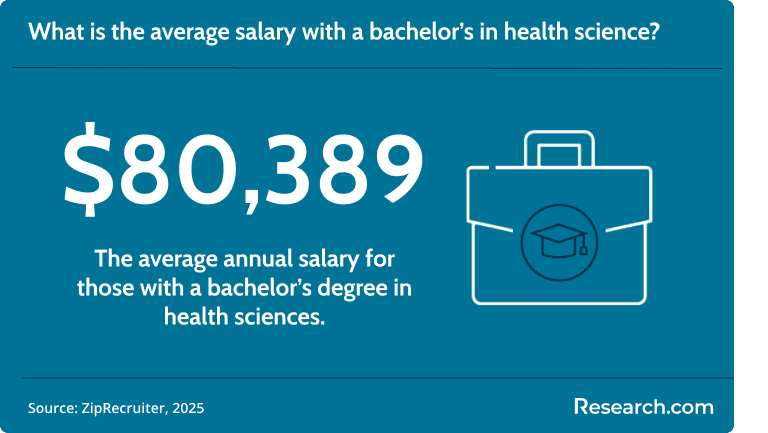
The average salary for someone with a bachelor’s degree in health science is about $80,389 per year in the United States, or roughly $38.65 per hour, according to recent data cited in the source article. This number should be treated as a broad benchmark rather than a guaranteed outcome, because actual earnings vary by job title, employer, location, experience, certifications, and whether the role is clinical, administrative, technical, or management-focused.
Entry-level support and administrative positions may pay below the overall average, while specialized roles in healthcare administration, health informatics, clinical support, or leadership may pay more after additional training or experience. Students considering graduate education should compare this pathway with options such as Master of Health Administration career and salary outcomes, since management-focused graduate credentials can lead to different responsibilities and compensation ranges.
| Salary factor | Why it matters |
| Job title | A health educator, medical assistant, lab technologist, analyst, and administrator can have very different pay ranges even with a similar undergraduate background. |
| Location | Healthcare salaries often reflect local labor markets, cost of living, and employer competition. |
| Experience | Internships, clinical exposure, lab work, and administrative experience can improve competitiveness for stronger entry-level roles. |
| Certification or licensure | Credentials such as CHES, CPC, EMT, or role-specific certifications may open more specialized job options. |
| Graduate education | Advanced degrees may be required for roles in physical therapy, physician assistant practice, public health leadership, healthcare administration, or other professional tracks. |
Can Health Sciences Graduates Work Outside Traditional Healthcare?
Yes. Health sciences graduates are not limited to bedside or clinic-based jobs. Because the degree develops communication, research, data interpretation, public health, and systems thinking, graduates can also pursue roles in policy, insurance, wellness, health technology, pharmaceuticals, nonprofit programs, and government agencies.
This flexibility is similar to the way students compare role-specific credentials, such as asking what jobs a patient care technician certificate can lead to. The difference is that a bachelor’s in health sciences is broader, so it can support several career directions rather than preparing for only one technical role.
| Non-clinical path | Salary information provided | How health sciences training helps |
| Health Policy Specialist | Approximately $83,600 annually | Applies knowledge of health systems, population health, regulation, and program impact. |
| Public Health Policy Analyst | Median total pay around $131,000 | Uses data, policy research, and public health knowledge to evaluate healthcare issues. |
| Health Informatics Specialist | Average salary of $91,300, with top earners reaching up to $126,000 | Connects clinical knowledge with data, records, systems, and healthcare technology. |
| Pharmaceutical Sales Representative | Average salary about $80,700, with high earners reaching $100,000+ depending on location | Uses scientific literacy and communication skills to explain products to healthcare professionals. |
| Public Health Specialists | Between $131,000 and $152,000 annually | Supports prevention, education, outreach, program planning, and public health operations. |
Can a Biochemistry Qualification Strengthen a Health Sciences Career?
A complementary biochemistry credential can be useful for health sciences graduates who want stronger preparation for laboratory, research, diagnostic, biotechnology, or graduate science pathways. Health sciences gives students a broad view of health and healthcare delivery, while biochemistry deepens understanding of chemical processes, molecular biology, metabolism, and lab-based analysis.
This combination can be especially valuable for students considering clinical laboratory work, biomedical research support, pharmaceutical roles, or advanced study in medicine and related health professions. Students who need flexibility may compare options such as an affordable online biochemistry degree, but they should verify lab requirements, transferability, and whether the coursework meets graduate or professional school prerequisites.
Certifications to Consider After a Bachelor’s Degree in Health Sciences
Certifications can help health sciences graduates turn a broad degree into a clearer employment path. The right credential depends on the role you want. A public health student may benefit from a health education credential, while a student interested in healthcare administration may choose coding, billing, or administrative certification.
| Certification | Best for | What it signals to employers |
| Certified Health Education Specialist (CHES) | Public health, school health, community wellness, prevention programs | The CHES credential shows preparation in planning, delivering, and evaluating health education programs. |
| Certified Medical Administrative Assistant (CMAA) | Medical office administration, scheduling, patient records, front-office operations | Demonstrates readiness for administrative responsibilities in healthcare settings. |
| Personal Trainer Certification, such as NASM or ACE | Fitness, wellness coaching, preventive health, community wellness programs | Shows preparation to design and lead exercise or wellness programs for clients. |
| Certified Professional Coder (CPC) | Medical coding, billing, insurance, revenue cycle support | Indicates knowledge of coding systems used for billing and reimbursement. |
| Emergency Medical Technician (EMT) | Emergency response, prehospital care, paramedicine preparation | Provides training for urgent care situations and can support entry into emergency medical services. |
Students interested in disaster response, public health preparedness, or organizational resilience may also explore careers with a master’s degree in emergency management, especially if they want to combine healthcare knowledge with crisis planning and leadership.
Job Outlook for Health Sciences Graduates
The job outlook for health sciences graduates is supported by the broader healthcare labor market. Overall employment in healthcare occupations is projected to grow much faster than the average for all occupations until 2033, with about 1.9 million openings projected each year, on average.
This growth is tied to long-term healthcare needs, including an aging population, continued demand for preventive care, and the increasing complexity of healthcare delivery. For health sciences graduates, the opportunity is not limited to one job title. The degree can support roles in direct patient support, public health, administration, laboratory services, health education, and healthcare data-related work.
Graduates who want to move into leadership may later consider options such as accelerated online MBA programs in healthcare administration. However, management roles usually require a combination of education, experience, and demonstrated leadership, not just a degree title.
Trends Affecting Health Sciences Careers in 2026
- Healthcare teams are becoming more interdisciplinary: Employers value graduates who can communicate across clinical, administrative, public health, and technical roles.
- Data and technology skills matter more: Health records, analytics, quality metrics, and informatics are increasingly part of healthcare operations, even in non-technical jobs.
- Experience is a competitive advantage: Internships, practicums, volunteering, and certifications help graduates show that they can apply classroom knowledge in real settings.
- Graduate pathways remain important: Many high-responsibility clinical and leadership careers require advanced degrees, licensure, or professional certification.
- Program selection has long-term consequences: Accreditation, prerequisites, clinical placements, transfer credit policies, and advisor support can affect both job options and graduate school eligibility.
Is Medical Billing and Coding a Good Option for Health Science Graduates?
Medical billing and coding can be a practical route for health sciences graduates who prefer administrative, technical, and detail-focused work over direct patient care. This field uses knowledge of healthcare terminology, documentation, insurance processes, coding standards, and revenue cycle management.
It may be a good fit if you are organized, accurate, comfortable with regulations, and interested in the business side of healthcare. It may be less appealing if you want frequent patient interaction, clinical procedures, or hands-on care.
Students who want a structured credential pathway can compare accredited online medical billing and coding schools with financial aid. Before enrolling, confirm whether the program prepares students for recognized certification exams, whether financial aid applies, and whether employers in your target area prefer a specific credential.
How to Choose a Bachelor’s in Health Sciences Program
Choosing a program should involve more than comparing tuition or picking the fastest option. The right program should match your career goal, graduate school plans, schedule, budget, and preferred learning format.
- Define your target outcome first. Decide whether you want immediate employment, a certification-based role, or graduate school after the bachelor’s degree.
- Check accreditation. Confirm institutional accreditation and, when relevant, program-level accreditation or alignment with graduate and professional school requirements.
- Compare prerequisites. If you plan to apply to PA, PT, medical, public health, or other graduate programs, compare the degree plan with required science and lab courses.
- Ask about internships or practicums. Programs with supervised experience can improve your resume and help you choose a career direction earlier.
- Review concentration options. Common tracks may include public health, pre-professional health, healthcare administration, health promotion, or health informatics.
- Understand transfer credit rules. Transfer students should ask which credits apply to the major, not just which credits count as electives.
- Calculate total cost. Include tuition, fees, textbooks, lab costs, technology requirements, commuting, and time away from work.
- Ask about career support. Look for advising, employer partnerships, internship placement help, graduate school guidance, and alumni outcomes.
Common Mistakes to Avoid
| Mistake | Why it can hurt you | Better approach |
| Choosing a program without checking accreditation | It may limit transfer options, graduate school eligibility, or employer recognition. | Verify institutional accreditation and any relevant program-specific requirements before applying. |
| Assuming the degree automatically leads to a licensed healthcare job | Many licensed professions require a specific professional degree, exam, or clinical training. | Start with the licensing requirements for your intended role and work backward. |
| Focusing only on tuition | The cheapest program is not always the best value if it lacks advising, internships, lab access, or prerequisite alignment. | Compare total cost, completion time, support services, and career fit. |
| Skipping internships or volunteer experience | A broad degree without experience can make it harder to stand out for entry-level jobs. | Build practical experience every year through volunteer work, practicums, research, or part-time healthcare roles. |
| Ignoring graduate school prerequisites | You may graduate still missing required courses for PA, PT, medical, or other professional programs. | Use official admissions checklists from target programs when planning electives. |
| Relying only on rankings | A highly ranked school may still be a poor fit for your budget, schedule, location, or career plan. | Use rankings as one data point, then evaluate curriculum, outcomes, cost, format, and student support. |
Questions to Ask Before You Enroll
- Does the program include the science prerequisites required for my intended graduate or professional program?
- Are internships, practicums, clinical placements, research projects, or capstones built into the curriculum?
- Can I choose a concentration in public health, healthcare administration, pre-professional health, health promotion, or informatics?
- How many of my transfer credits will apply directly to the major?
- What certifications do graduates commonly pursue after finishing the program?
- What career services are available for health sciences students?
- Does the online or hybrid format include any in-person lab, clinical, or campus requirements?
- What are the most common jobs graduates enter immediately after completion?
- If I plan to attend graduate school, what advising support is available for applications, prerequisites, and entrance exams?
Graduate Perspectives on Health Sciences Degrees
- : "After completing my bachelor’s in health science, I moved into healthcare administration and found that the degree helped me understand both patient needs and operational decisions. The work is meaningful because strong systems can improve care for many people at once. — Shane"
- : "My health science background gave me the academic base I needed to pursue the Certified Health Education Specialist path. I now build wellness programs for communities, and the most rewarding part is seeing prevention work translate into healthier choices. — Derek"
- : "I began working as a clinical laboratory technologist after graduation, and the lab environment still keeps me engaged. The science is technical, but the impact is personal because accurate results help guide real treatment decisions. — Arnold"
Key Insights
- A bachelor’s in health sciences is a flexible healthcare degree, not a single-career credential. It works best when you pair it with a clear goal, relevant experience, and the right electives or certifications.
- The standard completion time is about four years for full-time students, with most programs requiring around 120 semester credits. Transfer credits, part-time study, and accelerated formats can change the timeline.
- Common career paths include health education, community health, medical assisting, laboratory work, healthcare administration, public health, and health data-related roles.
- The average salary cited for a bachelor’s degree in health science is about $80,389 per year, or roughly $38.65 per hour, but actual pay depends heavily on role, location, experience, and credentials.
- Healthcare employment is projected to grow much faster than the average for all occupations until 2033, with about 1.9 million openings projected each year, on average.
- Internships, practicums, volunteer work, and certifications can be decisive because they turn a broad academic background into evidence of job readiness.
- Students planning for licensed careers such as PA, PT, nursing, or medicine should confirm prerequisites and clinical requirements early. A health sciences degree can support these goals, but it does not automatically satisfy every professional requirement.
- Before enrolling, compare accreditation, curriculum, transfer policies, internship access, online requirements, total cost, and graduate school alignment—not just program length or tuition.
References:
- Anderson, A., Gayfield, A., et. al. (2021). 22 Million Employed in Health Care Fight Against COVID-19. U.S. Census
- Indeed. (2205). Public health analyst salary in the United States. Indeed
- U.S. Bureau of Labor Statistics. (2025). Occupational Outlook Handbook: Healthcare Occupations. U.S. BLS
- University of Florida. (2025). Health Science Major. UF Catalog
- ZipRecruiter. (2025). Bachelor of Health Science Salary. ZipRecruiter
Other things you should know about getting a bachelor’s degree in health science
In 2027, with a bachelor's degree in health sciences, you can pursue entry-level roles such as Health Services Manager, Community Health Worker, Health Educator, and Occupational Health and Safety Technician. These positions often serve as a gateway to more advanced roles within the healthcare sector.
Yes. Many graduates use a health sciences bachelor’s degree to apply to master’s programs in public health, healthcare administration, or physician assistant studies. Most programs require a 3.0 GPA, prerequisite science courses, and official transcripts; PA programs also require direct patient-care hours.


